


 Скачать презентацию Research Methodology HOW TO FIND RESEARCH GAP AND
c0ec4856fbd4473971440c59cbb47f35.ppt
- Количество слайдов: 95
 Research Methodology HOW TO FIND RESEARCH GAP AND RESEARCH OBJECTIVES Lecturer: AP Dr Nor Zairah Ab Rahim Office: MJIIT 7. 18. 1 HP : 019 -3142975 e. Mail: nzairah@utm. my 24 Sept 2017
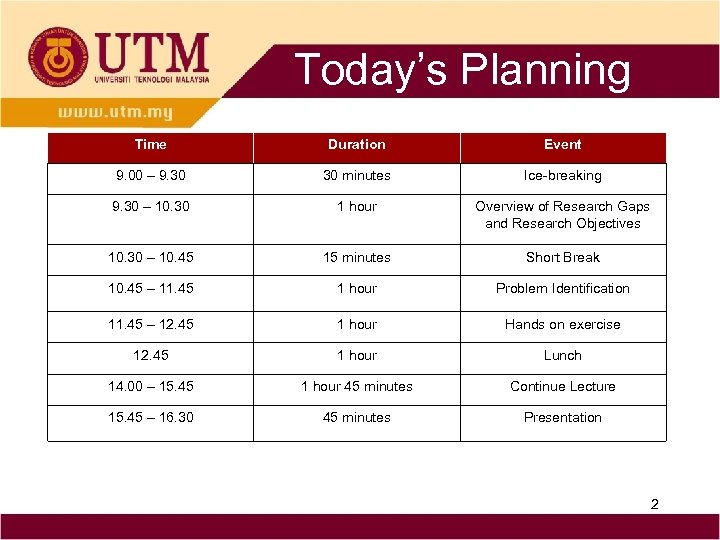 Today’s Planning Time Duration Event 9. 00 – 9. 30 30 minutes Ice-breaking 9. 30 – 10. 30 1 hour Overview of Research Gaps and Research Objectives 10. 30 – 10. 45 15 minutes Short Break 10. 45 – 11. 45 1 hour Problem Identification 11. 45 – 12. 45 1 hour Hands on exercise 12. 45 1 hour Lunch 14. 00 – 15. 45 1 hour 45 minutes Continue Lecture 15. 45 – 16. 30 45 minutes Presentation 2
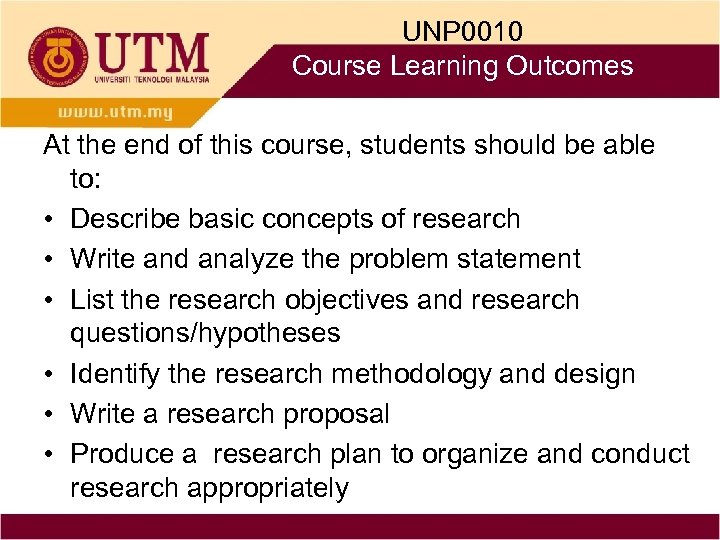 UNP 0010 Course Learning Outcomes At the end of this course, students should be able to: • Describe basic concepts of research • Write and analyze the problem statement • List the research objectives and research questions/hypotheses • Identify the research methodology and design • Write a research proposal • Produce a research plan to organize and conduct research appropriately 3
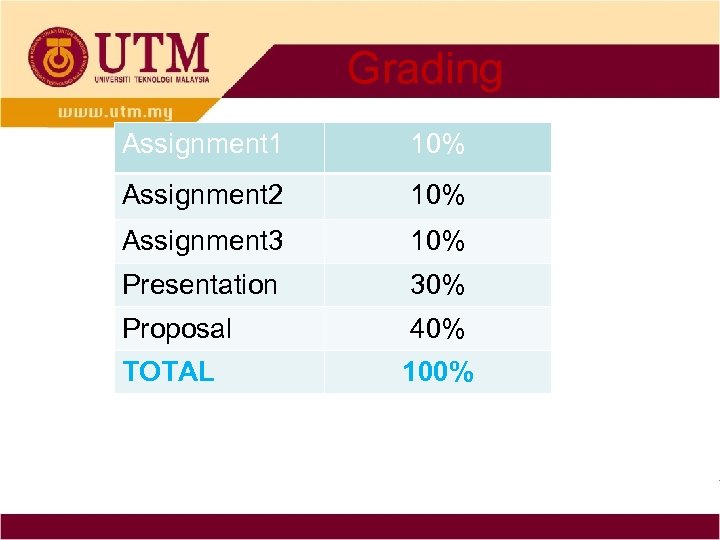 Grading Assignment 1 10% Assignment 2 10% Assignment 3 10% Presentation 30% Proposal 40% TOTAL 100% 4
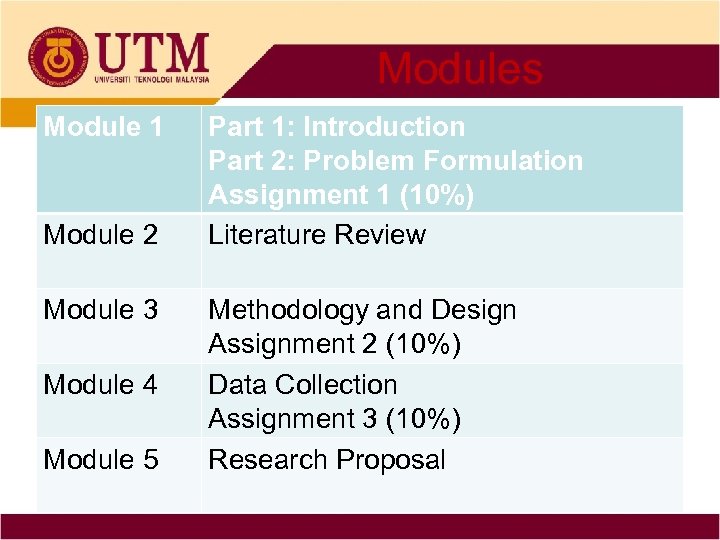 Modules Module 1 Module 2 Module 3 Module 4 Module 5 Part 1: Introduction Part 2: Problem Formulation Assignment 1 (10%) Literature Review Methodology and Design Assignment 2 (10%) Data Collection Assignment 3 (10%) Research Proposal 5
 FINDING…. RESEARCH GAP? ? ? RESEARCH OBJECTIVES? ? ? H O W!!!!!!
 Research 7
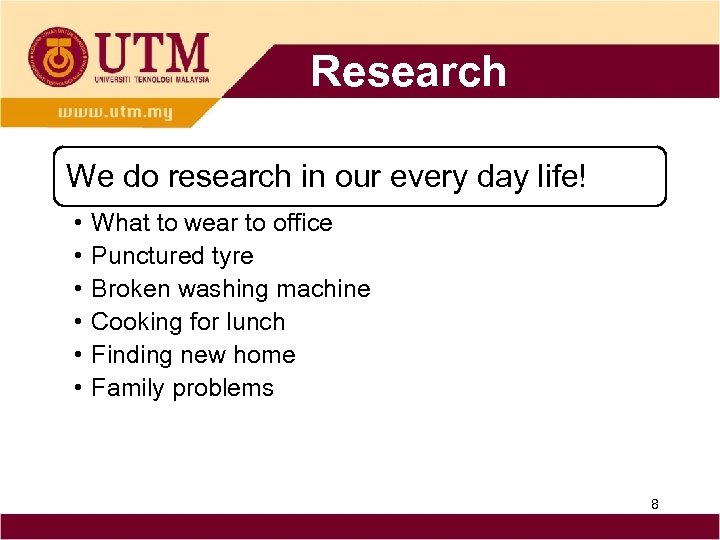 Research We do research in our every day life! • • • What to wear to office Punctured tyre Broken washing machine Cooking for lunch Finding new home Family problems 8
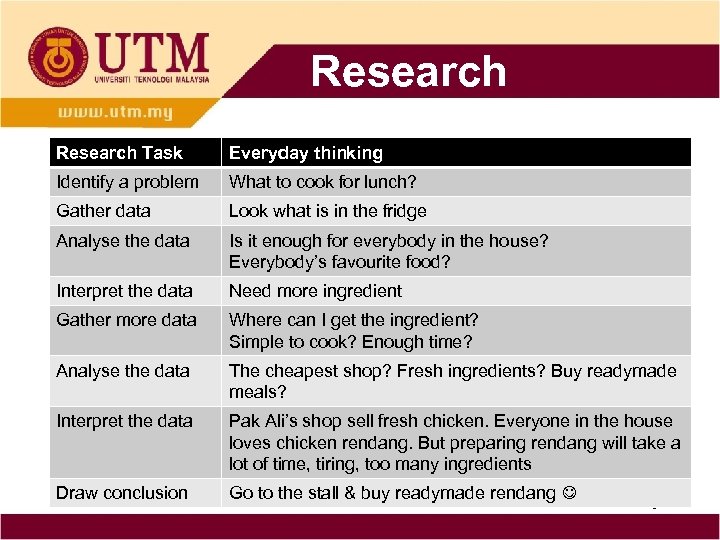 Research Task Everyday thinking Identify a problem What to cook for lunch? Gather data Look what is in the fridge Analyse the data Is it enough for everybody in the house? Everybody’s favourite food? Interpret the data Need more ingredient Gather more data Where can I get the ingredient? Simple to cook? Enough time? Analyse the data The cheapest shop? Fresh ingredients? Buy readymade meals? Interpret the data Pak Ali’s shop sell fresh chicken. Everyone in the house loves chicken rendang. But preparing rendang will take a lot of time, tiring, too many ingredients Draw conclusion Go to the stall & buy readymade rendang 9
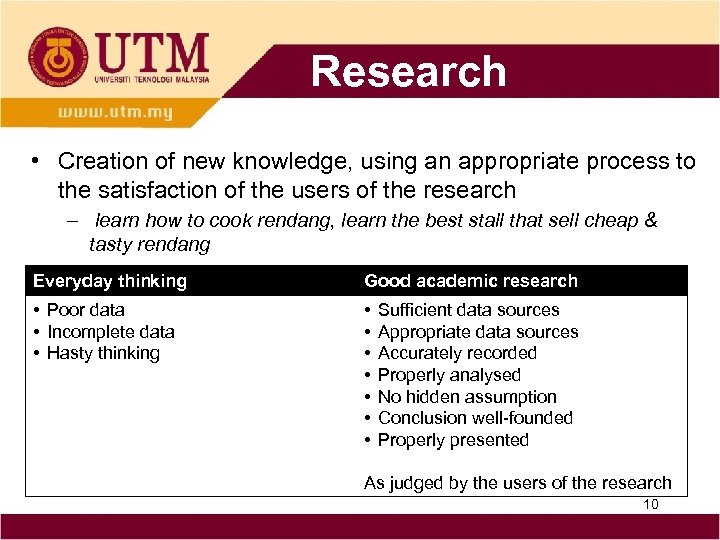 Research • Creation of new knowledge, using an appropriate process to the satisfaction of the users of the research – learn how to cook rendang, learn the best stall that sell cheap & tasty rendang Everyday thinking Good academic research • Poor data • Incomplete data • Hasty thinking • • Sufficient data sources Appropriate data sources Accurately recorded Properly analysed No hidden assumption Conclusion well-founded Properly presented As judged by the users of the research 10
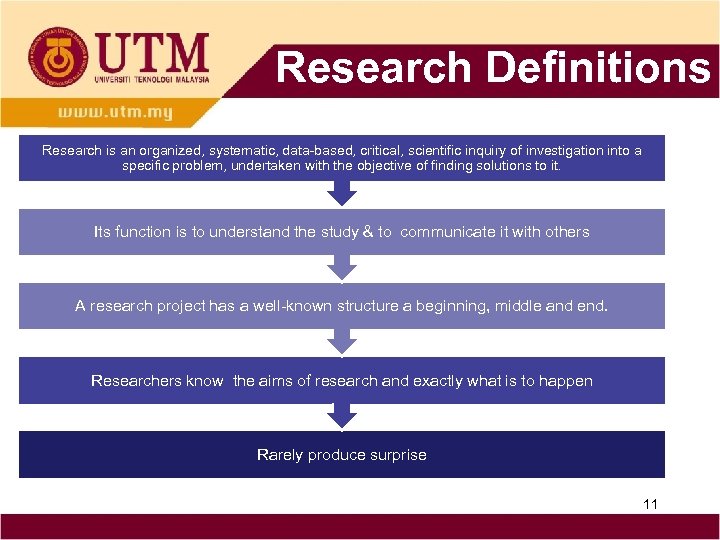 Research Definitions Research is an organized, systematic, data-based, critical, scientific inquiry of investigation into a specific problem, undertaken with the objective of finding solutions to it. Its function is to understand the study & to communicate it with others A research project has a well-known structure a beginning, middle and end. Researchers know the aims of research and exactly what is to happen Rarely produce surprise 11
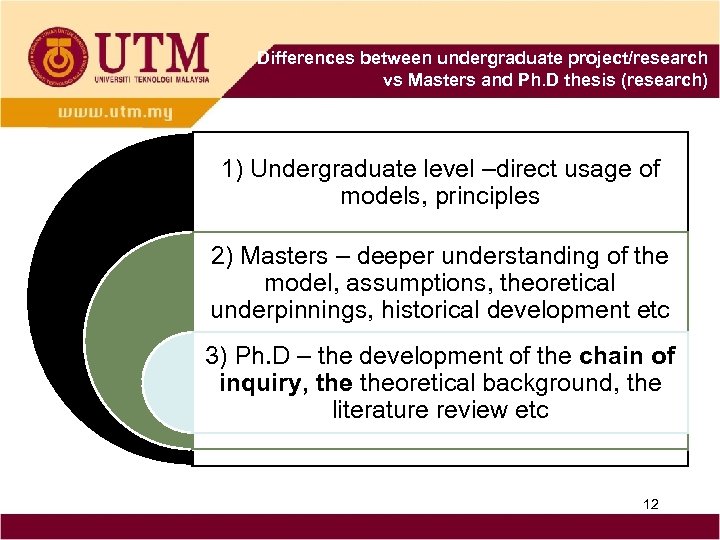 Differences between undergraduate project/research vs Masters and Ph. D thesis (research) 1) Undergraduate level –direct usage of models, principles 2) Masters – deeper understanding of the model, assumptions, theoretical underpinnings, historical development etc 3) Ph. D – the development of the chain of inquiry, theoretical background, the literature review etc 12
 Reasons for doing research • • • To add to the body of knowledge To solve a problem To find out what happen To find evidence to inform practice To develop a greater understanding of people or their world To predict, plan and control To contribute to other people’s well-being To contribute to personal needs To test or disprove a theory To come out with a better way To understand another person’s point of view To create more interest in the researcher 13
 The outcome of the research • • • A new or improved product A new theory A re-interpretation of an existing theory New or improved research tool or technique A new or improved model or perspective An in-depth study of a particular situation An exploration of a topic, area or field A critical analysis Unanticipated outcomes 14
 Sources of research ideas • Suggestions from people • Past research students’ work • Recent conference & journal paper (www. scholar. google. com) • Call for papers • Current issues • Clients needs • To support or refute certain statements e. g: - Green computing is the future - Social networking is the future communication - Baby dumping is the result of new year events 15
 What is your BIG Y? • Personal • Academic/Professional • Write it down & visualize it 16
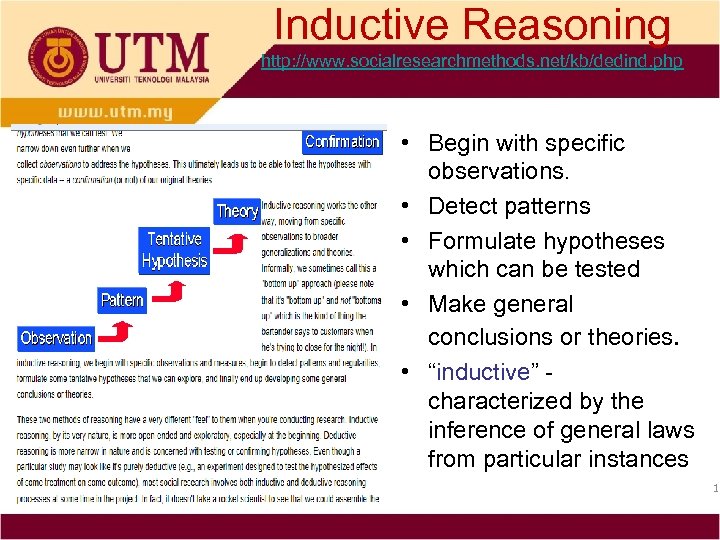 Inductive Reasoning http: //www. socialresearchmethods. net/kb/dedind. php • Begin with specific observations. • Detect patterns • Formulate hypotheses which can be tested • Make general conclusions or theories. • “inductive” - characterized by the inference of general laws from particular instances 17
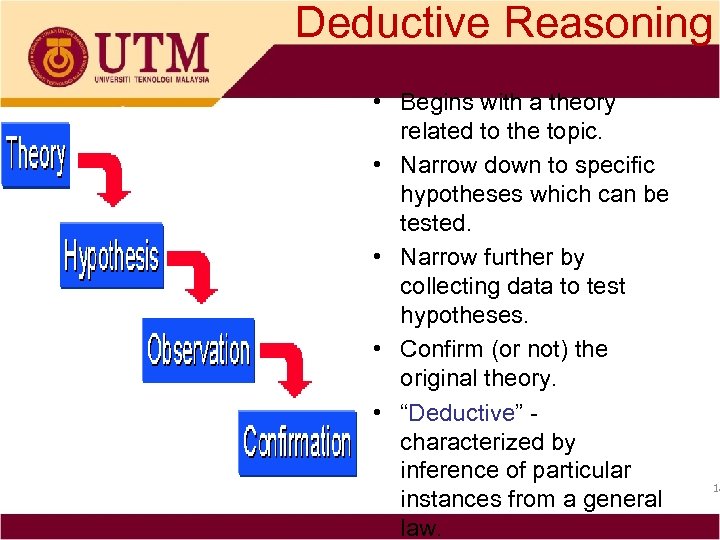 Deductive Reasoning • Begins with a theory related to the topic. • Narrow down to specific hypotheses which can be tested. • Narrow further by collecting data to test hypotheses. • Confirm (or not) the original theory. • “Deductive” - characterized by inference of particular instances from a general law. 18
 Research can be • Replicated using the detailed procedures • Could be generalize to other setting • Based o the work of others. • Continued where others had left off. • Tied to a theory. Must have a theoretical / conceptual framework
 Never stop writing… • Keep notes of: – Possible research questions – Anything that came across your mind in relation to the research; thoughts problems, insights, plans, emerging analysis, interpretation • Helps to clarify your ideas – esp when you meet your SV • Exercise for your proposal/thesis writing 20
 Some Difficulties • Scientific method described above is rules which guide researcher in trying to figure out answers to the problems. • Problem - the way of observations are determined by theoretical positions and cultural biases of the observer. (e. g. health research in Western World and Chinese Medicine) • Should be aware of the potential sources of bias in the research. 21
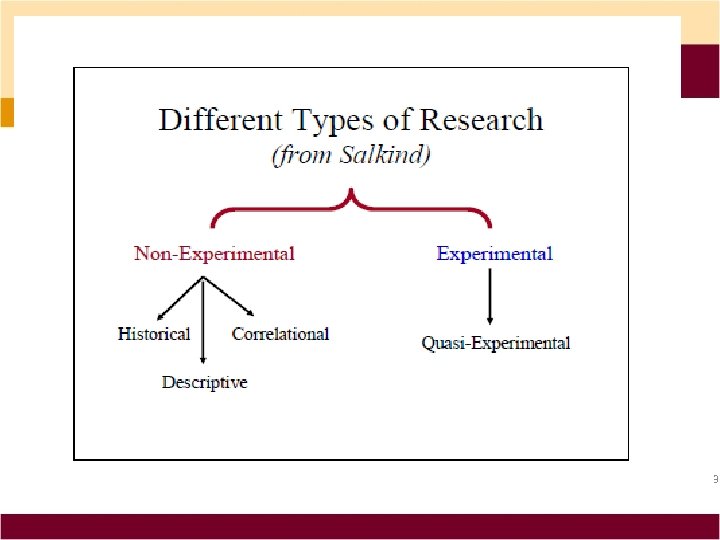
 Types of Research • Useful to categorize a research study because each type of research uses a specific set of procedures. • Types of research can be based on: – Purpose ( How far can be applied/generalized) – Method (The method employed in research) 22
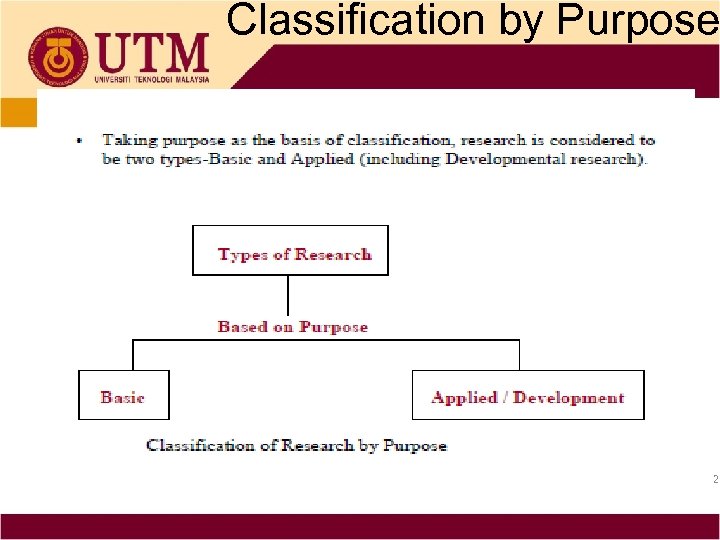 Classification by Purpose 23
 24
24
 An Example of Basic Research • Decision Support Systems for Logistic Networks and Supply Chain Optimization OBJECTIVE: • To develop methods and algorithms for problems that can be modeled as problems on networks using tools and techniques in particular from operations research, integer and linear programming, graph theory, evolutionary computing, and agent-based computational economics. 25
 An Example of Basic Research • Redesigning electronic health record systems to support public health. Kukafka R, Ancker JS, Chan C, Chelico J, Khan S, Mortoti S, Natarajan K, Presley K, Stephens K. J Biomed Inform. 40(4): 398 -409. Epub 2007 26
 OBJECTIVES: • To adapt EHR systems to serve public health. • To identify and discuss important design, implementation, and methodological issues with current systems. • To determine the optimal way of collecting environmental, psychosocial, and other non-medical data. 27
 EXPECTED OUTCOME: • Redesigning EHR systems to support public health offers benefits not only to the public health system but also to consumers, health-care institutions, and individual providers. 28
 Examples of problems for applied research: • Design of telecommunication networks, design of wireless networks, scheduling of aircraft crew, assigning airport gates, workflow scheduling, timetabling, and management of supply chains. 29
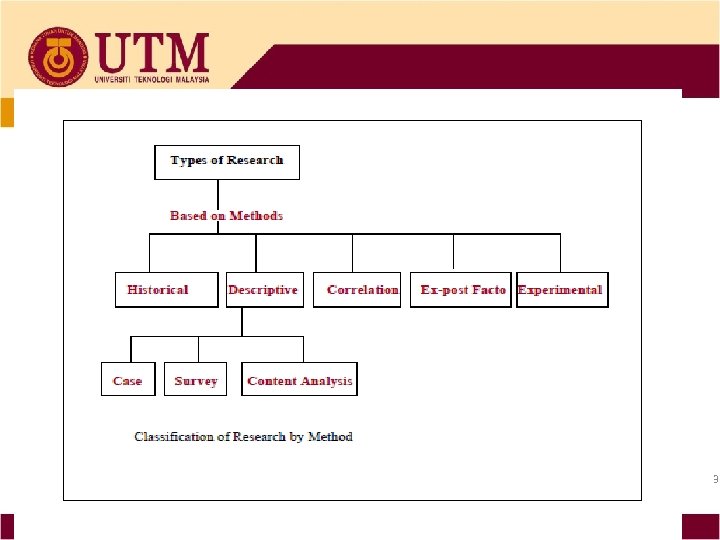
 Classification by Method • Research method is characterized by the techniques of data collection and analysis employed. • Five types of research based on method: – Historical – Descriptive – Correlational – Ex-post facto – Experimental 30
 31
31
 32
32
 WHAT IS…. RESEARCH GAP? ? ?
 Research Gap is…. . A research gap is the missing element in the existing research literature, and you have to fill with your research approach to make your manuscript publishable. In another words, it indicates a finding from a research in which a key question has not been answered.
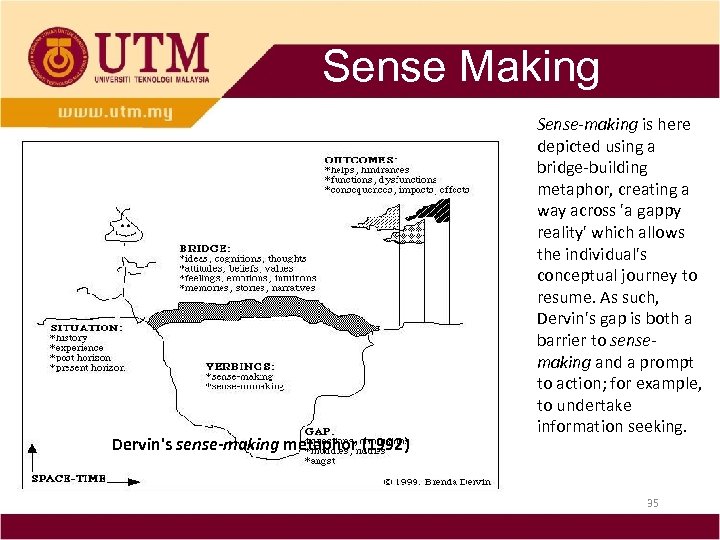 Sense Making Dervin's sense-making metaphor (1992) Sense-making is here depicted using a bridge-building metaphor, creating a way across 'a gappy reality' which allows the individual's conceptual journey to resume. As such, Dervin's gap is both a barrier to sensemaking and a prompt to action; for example, to undertake information seeking. 35
 Research follows steps in logical order ü Understand the nature of problem to be studied & identify related areas of knowledge and theories (Conceptual Framework). ü Review the literature to understand what have been done so far & how others approach the problem (Identify the GAP)
 Systematic Character of a Research 1. Problem Identification 2. Literature Review 3. METHODOLOGY § Data Collection § Data Analysis 4. Draw Conclusions
 Systematic Character of a Research 1. Problem Identification What is a research problem? § The topic that we would like to address, investigate or study. § The focus or reason in doing the study.
 What is a Research Problem? • A research problem is basically a “gap” between “what is “ and “what ought to be”. • Tips : i. Find out why the information is being sought ii. Determine whether the information already exist iii. Determine whether the question really can/should be answered iv. Use exploratory research to define background of the problem v. Determine relevant variables.
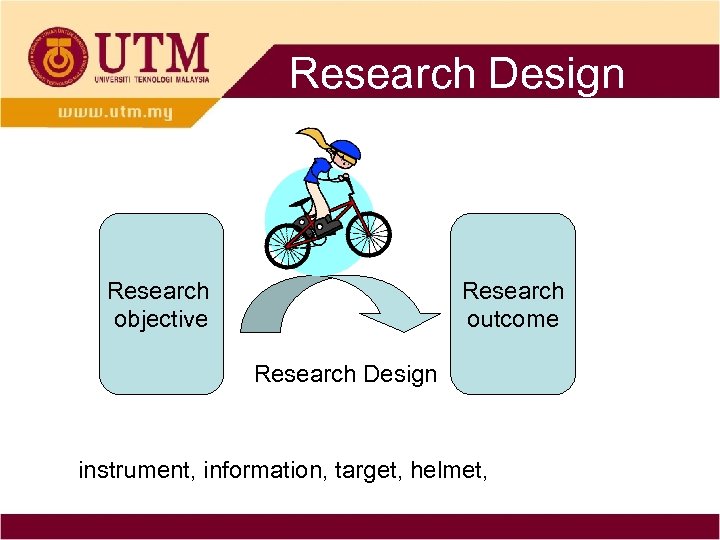 Research Design Research objective Research outcome Research Design instrument, information, target, helmet,
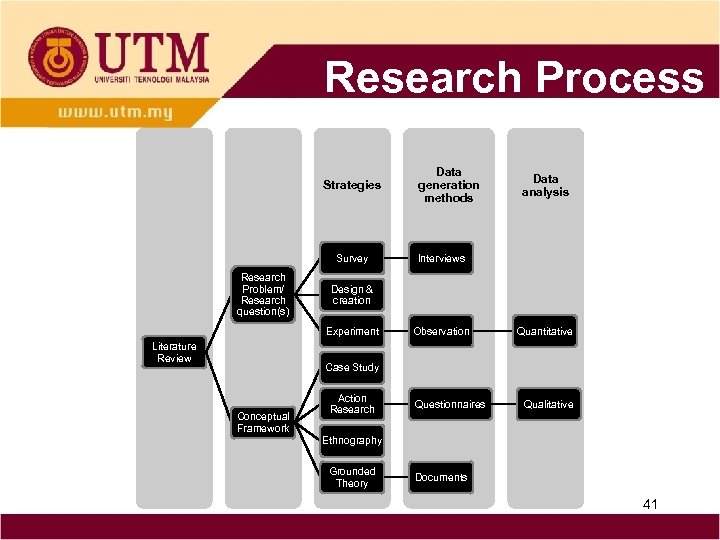 Research Process Strategies Survey Research Problem/ Research question(s) Data analysis Interviews Design & creation Experiment Literature Review Data generation methods Observation Quantitative Case Study Conceptual Framework Action Research Questionnaires Qualitative Ethnography Grounded Theory Documents 41
 Selecting Research Area • Will the subject/area sustain your interest in the research? • Is the research within your area of competence? • Is the area researchable, i. e. Can the area be researched or investigated? • How practical and feasible is the intended area of research? • Will the research lead to clearly identifiable deliverables? • Establish Questions relating to the significance of the research? • Is the research manageable? • Will the output of the research meet the requirements of the Master/Ph. D degree in terms of relevancy and level?
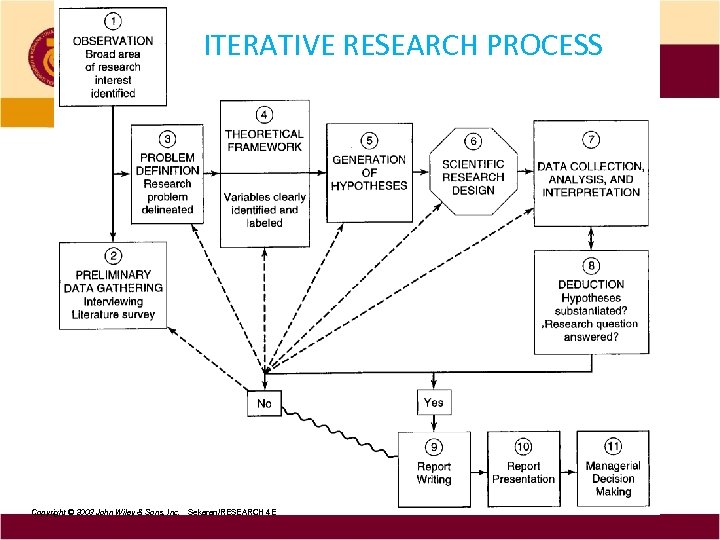 ITERATIVE RESEARCH PROCESS Copyright © 2003 John Wiley & Sons, Inc. Sekaran/RESEARCH 4 E
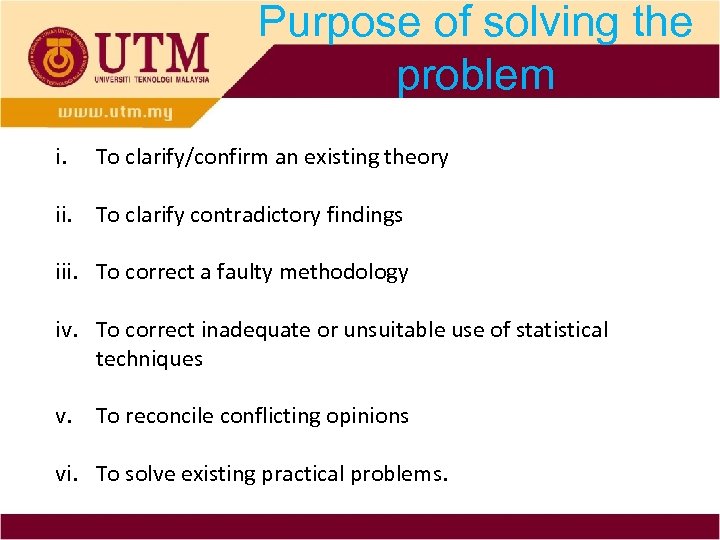 Purpose of solving the problem i. To clarify/confirm an existing theory ii. To clarify contradictory findings iii. To correct a faulty methodology iv. To correct inadequate or unsuitable use of statistical techniques v. To reconcile conflicting opinions vi. To solve existing practical problems.
 Problem Formulation § Definition of the problem is the first step in any research § Provides te foundation that guides the research: study design, sampling strategy, research instrument & type of data analysis.
 FEASIBILITY OF RESEARCH PROBLEM 1. Interest, motivation, strength & weaknesses: - If you are going to be commit yourself to a research, then its is important that you should be interested to the topic that you are researching, you know your motivation & capability of conducting it 2. Duration, Size: - Exercise some professional wisdom! Manageable research problem. 3. Economy, Resources: - Researchers are often confronted with practical constraints - time and money. 4. Researcher’s Capabilities and Limitations: - Must recognize his/her own capabilities and limitations. Inexperienced in research, seek guidance - close to your supervisor, advise from others who are interested or specialized in your field of study. 47
 FEASIBILITY OF RESEARCH PROBLEM 5. Start with theories/set of ideas : - easier to start. The outcome might be a critique to theory, suggestions how it can be modified or extended 6. Uniqueness: - Do not spend a lot of time and energy researching a problem if the answer to the problem already existed. Offer new knowledge. 7. Potential & sufficient outcomes: - valuable results. Even if you plan to develop something in the end which might not be achievable the knowledge developed in the process still has contribution within the indicated period (3++ years? ) 8. Not bias, safe & ethical: - be objective as much as possible, not causing discomfort & harm to anyone/anything (social, emotional, physical). 48
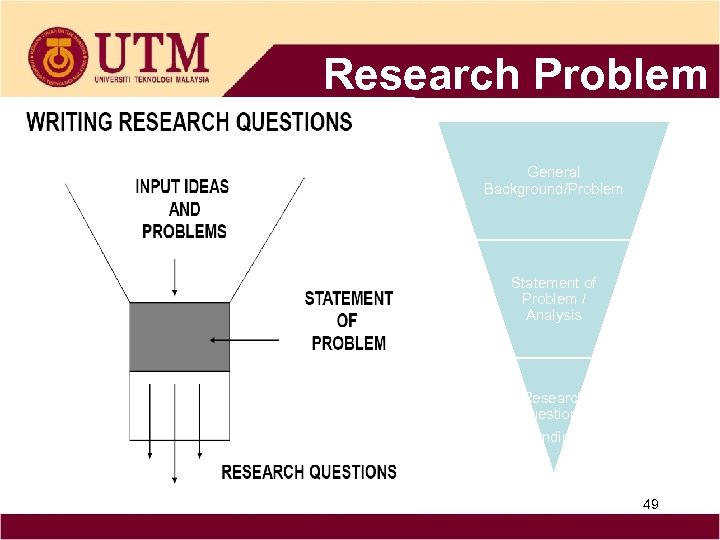 Research Problem General Background/Problem Statement of Problem / Analysis Research Questions/ Finding 49
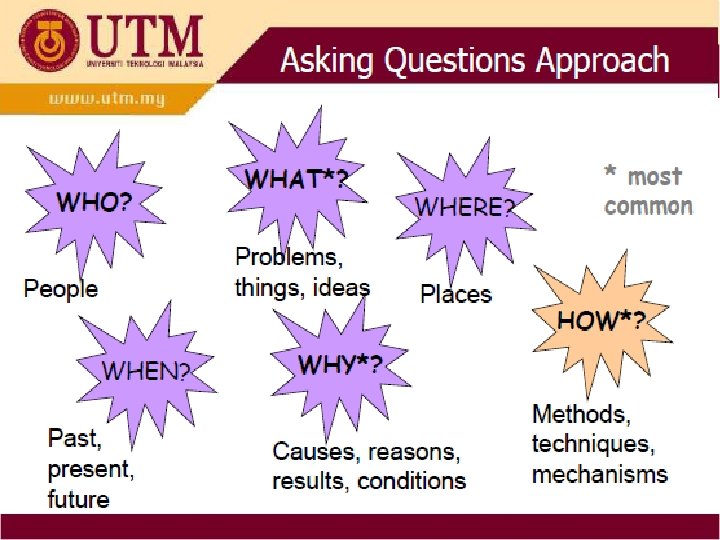
 Problem Identification Initial Idea: • Stems from critical thinking & observation – Gaps in framework – Repetitive behavior that’s slightly different (and can be generalized) – Inelegant, inefficient solutions • Ask questions – “Is something missing here? ” – “Can this be done in a better way? ” – “Is there a need for a new approach? ” • Should be an area you’re interested in, as: – You’ll be spending a lot of time with it – It won’t always be easy/fun to continue… 50
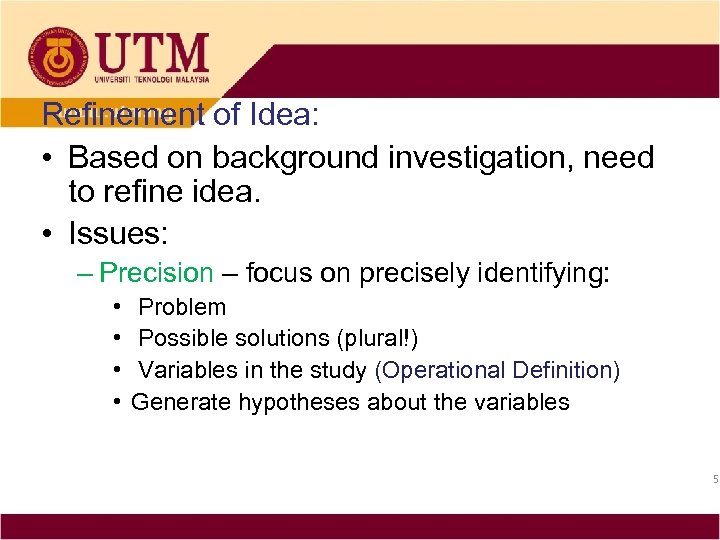 Refinement of Idea: • Based on background investigation, need to refine idea. • Issues: – Precision – focus on precisely identifying: • • Problem Possible solutions (plural!) Variables in the study (Operational Definition) Generate hypotheses about the variables 51
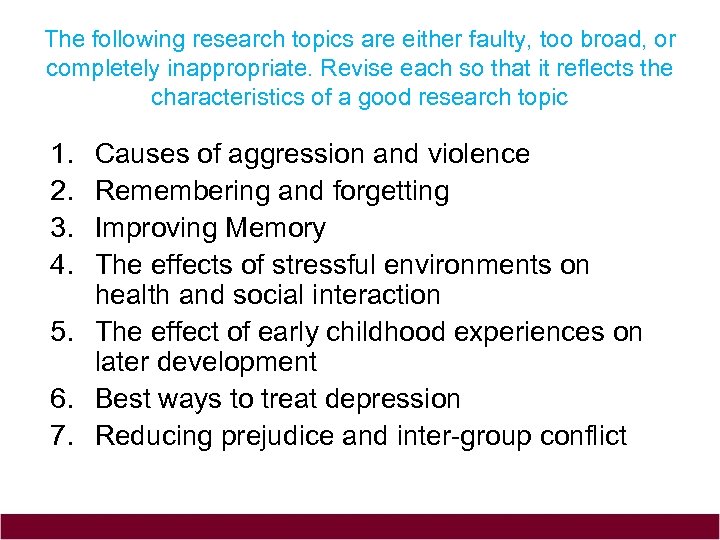 The following research topics are either faulty, too broad, or completely inappropriate. Revise each so that it reflects the characteristics of a good research topic 1. 2. 3. 4. Causes of aggression and violence Remembering and forgetting Improving Memory The effects of stressful environments on health and social interaction 5. The effect of early childhood experiences on later development 6. Best ways to treat depression 7. Reducing prejudice and inter-group conflict
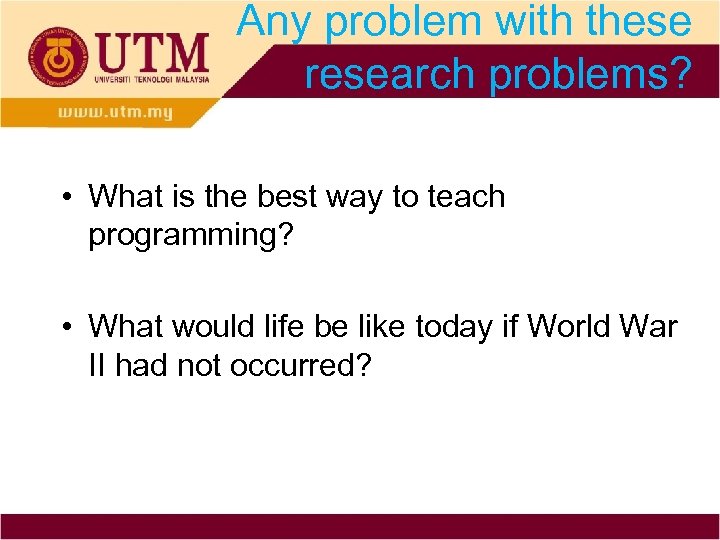 Any problem with these research problems? • What is the best way to teach programming? • What would life be like today if World War II had not occurred?
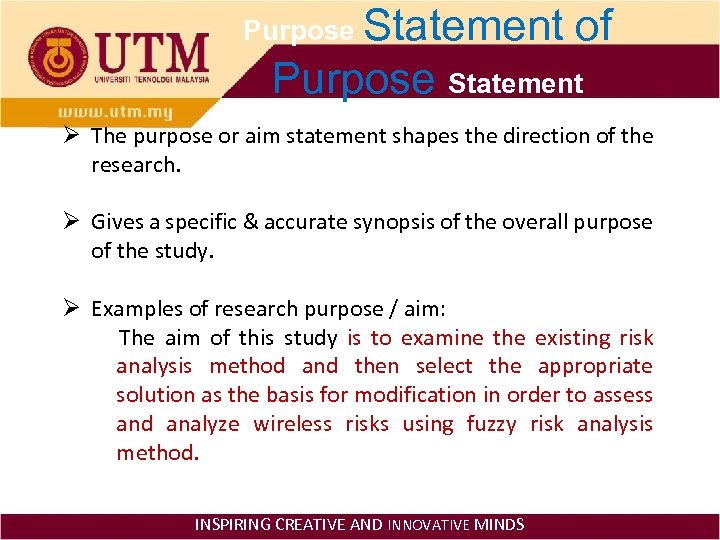 Purpose Statement of Purpose Statement Ø The purpose or aim statement shapes the direction of the research. Ø Gives a specific & accurate synopsis of the overall purpose of the study. Ø Examples of research purpose / aim: The aim of this study is to examine the existing risk analysis method and then select the appropriate solution as the basis for modification in order to assess and analyze wireless risks using fuzzy risk analysis method. INSPIRING CREATIVE AND INNOVATIVE MINDS
 • Example of Statement of Purpose The purpose of this study is to investigate the impact of the introduction of an individualized program on the skill acquisition of a technician students in information security course. 55
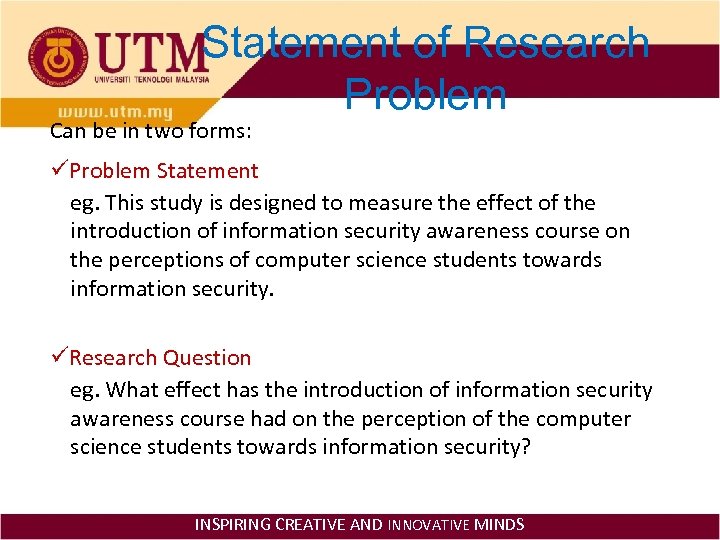 Statement of Research Problem Can be in two forms: üProblem Statement eg. This study is designed to measure the effect of the introduction of information security awareness course on the perceptions of computer science students towards information security. üResearch Question eg. What effect has the introduction of information security awareness course had on the perception of the computer science students towards information security? INSPIRING CREATIVE AND INNOVATIVE MINDS
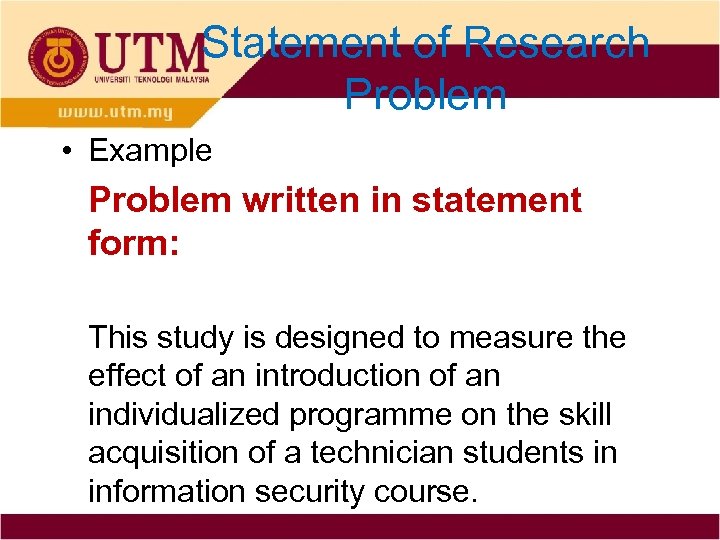 Statement of Research Problem • Example Problem written in statement form: This study is designed to measure the effect of an introduction of an individualized programme on the skill acquisition of a technician students in information security course.
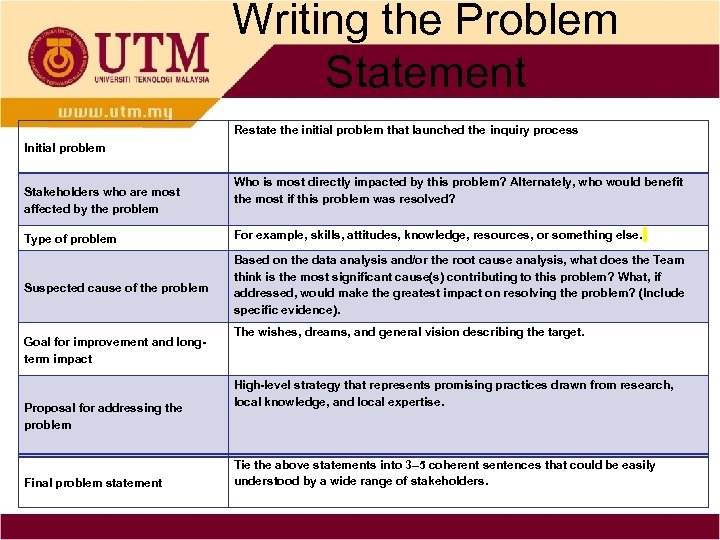 Writing the Problem Statement Restate the initial problem that launched the inquiry process Initial problem Stakeholders who are most affected by the problem Who is most directly impacted by this problem? Alternately, who would benefit the most if this problem was resolved? Type of problem For example, skills, attitudes, knowledge, resources, or something else. Suspected cause of the problem Based on the data analysis and/or the root cause analysis, what does the Team think is the most significant cause(s) contributing to this problem? What, if addressed, would make the greatest impact on resolving the problem? (Include specific evidence). Goal for improvement and longterm impact Proposal for addressing the problem Final problem statement The wishes, dreams, and general vision describing the target. High-level strategy that represents promising practices drawn from research, local knowledge, and local expertise. Tie the above statements into 3– 5 coherent sentences that could be easily understood by a wide range of stakeholders.
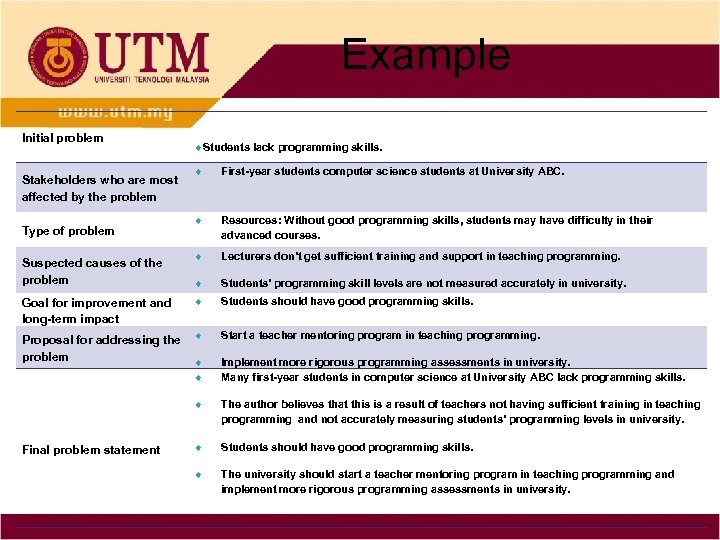 Example Initial problem Stakeholders who are most affected by the problem Type of problem Suspected causes of the problem Goal for improvement and long-term impact Students lack programming skills. First-year students computer science students at University ABC. Resources: Without good programming skills, students may have difficulty in their advanced courses. Lecturers don’t get sufficient training and support in teaching programming. Students’ programming skill levels are not measured accurately in university. Students should have good programming skills. Proposal for addressing the problem Start a teacher mentoring program in teaching programming. Implement more rigorous programming assessments in university. Many first-year students in computer science at University ABC lack programming skills. Final problem statement The author believes that this is a result of teachers not having sufficient training in teaching programming and not accurately measuring students’ programming levels in university. Students should have good programming skills. The university should start a teacher mentoring program in teaching programming and implement more rigorous programming assessments in university.
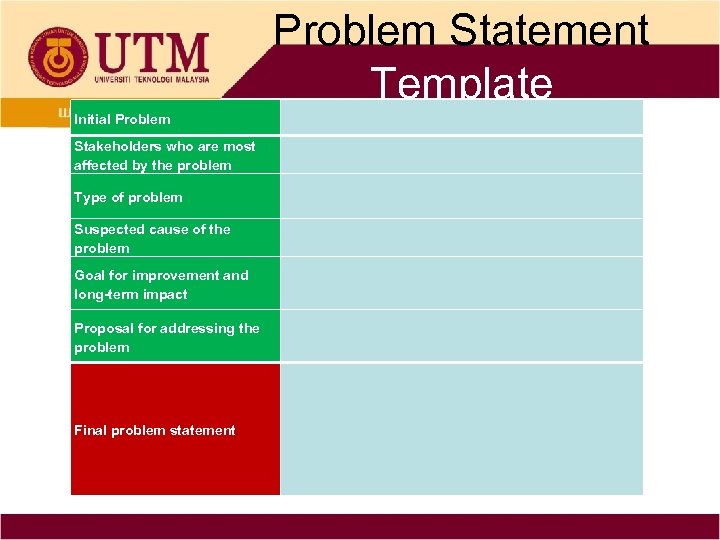 Problem Statement Template Initial Problem Stakeholders who are most affected by the problem Type of problem Suspected cause of the problem Goal for improvement and long-term impact Proposal for addressing the problem Final problem statement
 Scope – need to “build fences/boundaries” • What’s an essential part of this work? (fence in) • What’s tangential, additional, or for any other reason best left for later/someone else? (fence out) 61
 Research Objectives General Objectives The General/Global Objective should state the expected contribution of the research to the general body of knowledge in the subject area. For example, you could have a statement like: “The general objective of the proposed research is to contribute to the general body of knowledge and research work in the area of the application of artificial intelligence to support medical diagnosis”
 Example General Objective: The general objective of the study is to know the differences and similarities of two programming language Visual Basic 6. 0 and JAVA (Netbeans) in terms of the Object Oriented Programming.
 Specific Objectives • State how specifically the general objectives will be achieved. • Use action verbs that can have tangible/observable outcomes. • Avoid the use of vague non-active verbs eg to appreciate, to understand , to study. • Should pass the “SMART” test - Specific, Measurable, Achievable, Relevant and Time-oriented
 S. M. A. R. T. Objectives • The establishment of objectives should be created using the S. M. A. R. T. philosophy. • S. M. A. R. T. is an acronym that is used to guide the development of measurable goals. Each objective should be: Specific Measurable w/Measurement Achievable Relevant Time-Oriented
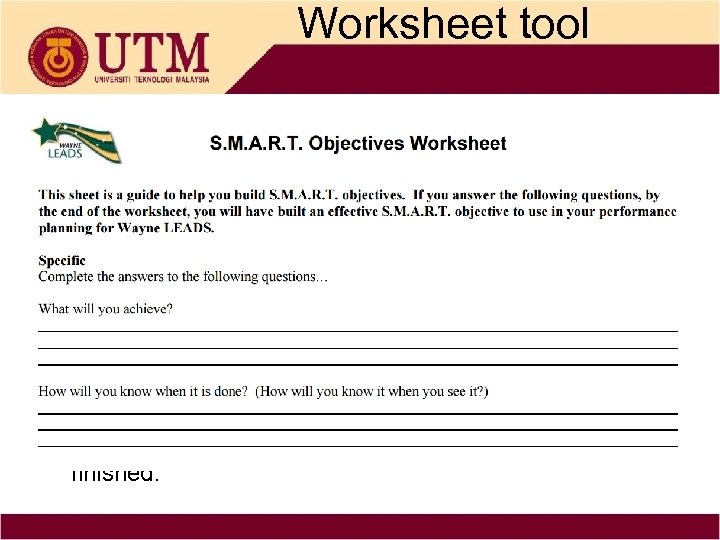
 Specific • Specific answers the questions "what is to be done? " "how will you know it is done? " and describes the results (end product) of the work to be done. • The description is written in such a way that anyone reading the objective will most likely interpret it the same way. • To ensure that an objective is specific is to make sure that the way it is described is observable. • Observable means that somebody can see or hear (physically observe) someone doing something.
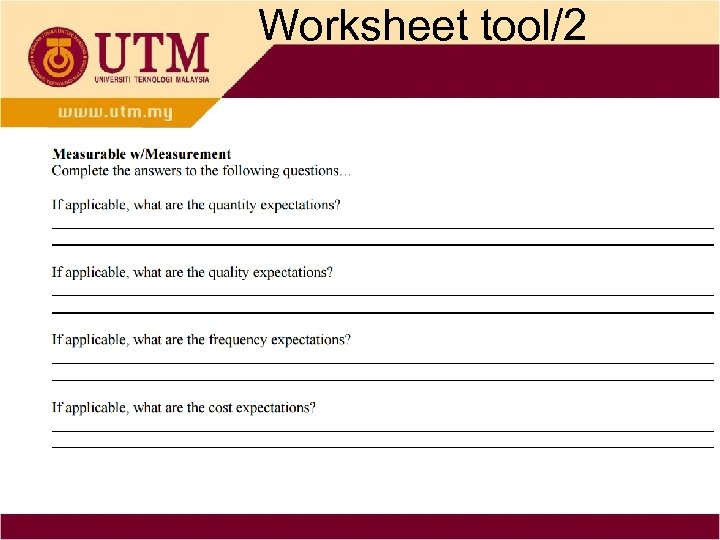
 Measurable w/Measurement • Measurable w/Measurement answers the question "how will you know it meets expectations? " and defines the objective using assessable terms (quantity, quality, frequency, costs, deadlines, etc. ). • It refers to the extent to which something can be evaluated against some standard. • An objective with a quantity measurements uses terms of amount, percentages, etc. . Eg. A frequency measurement could be daily, weekly, 1 in 3. • An objective with a quality measurement would describe a requirement in terms of accuracy, format, within university guidelines.
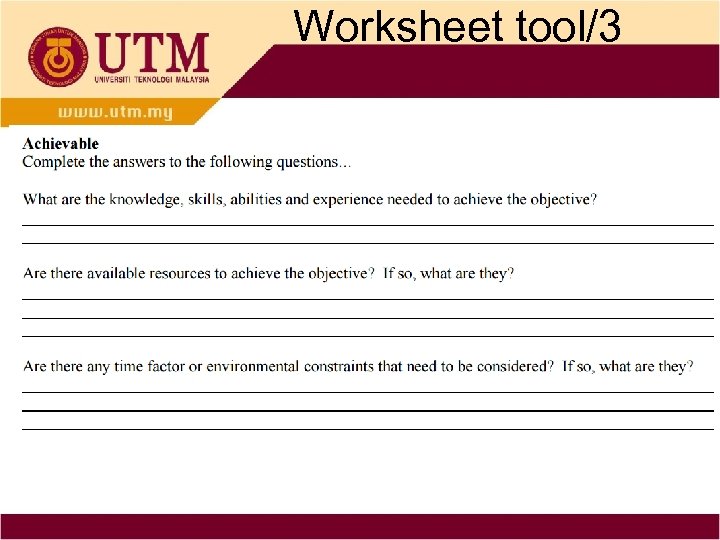
 Achievable • Achievable answers the questions "can the person do it? " "Can the measurable objective be achieved by the person? " "Does he/she have the experience, knowledge or capability of fulfilling the expectation? " • It also answers the question "Can it be done giving the time frame, opportunity and resources? " • These items should be included in the SMART objective if they will be a factor in the achievement.
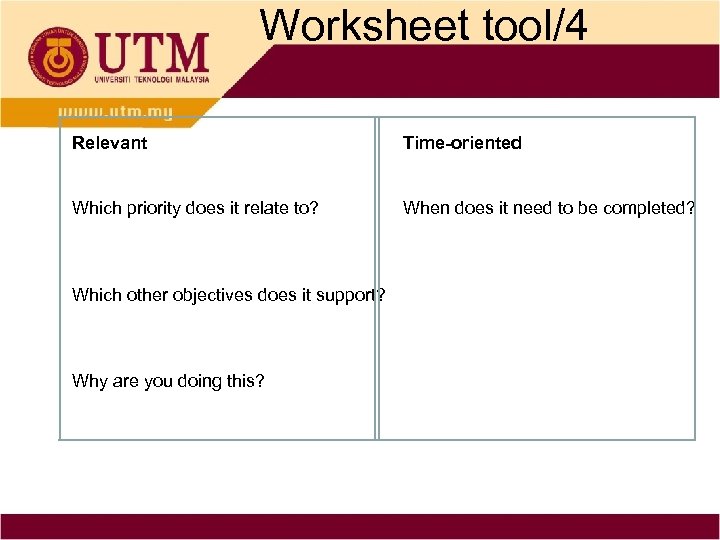
 Relevant • Relevant answers the questions, – "should it be done? ", – "why? " and – "what will be the impact? " • Is the objective aligned with the overall research plan?
 Time-oriented • Time-oriented answers the question, "when will it be done? " It refers to the fact that an objective has end points and check points built into it. • Sometimes a task may only have an end point or due date. • Sometimes a task may have several milestones or check points to help you or others assess how well something is going before it is finished so that corrections or modifications can be made as needed to make sure the end result meets expectations. • The due dates or milestones are there to create a sense of urgency that helps them to get something finished.
 Worksheet tool • Time-oriented answers the question, "when will it be done? " It refers to the fact that an objective has end points and check points built into it. • Sometimes a task may only have an end point or due date. • Sometimes a task may have several milestones or check points to help you or others assess how well something is going before it is finished so that corrections or modifications can be made as needed to make sure the end result meets expectations. • The due dates or milestones are there to create a sense of urgency that helps them to get something finished.
 Worksheet tool/2
 Worksheet tool/3
 Worksheet tool/4 Relevant Time-oriented Which priority does it relate to? When does it need to be completed? Which other objectives does it support? Why are you doing this?
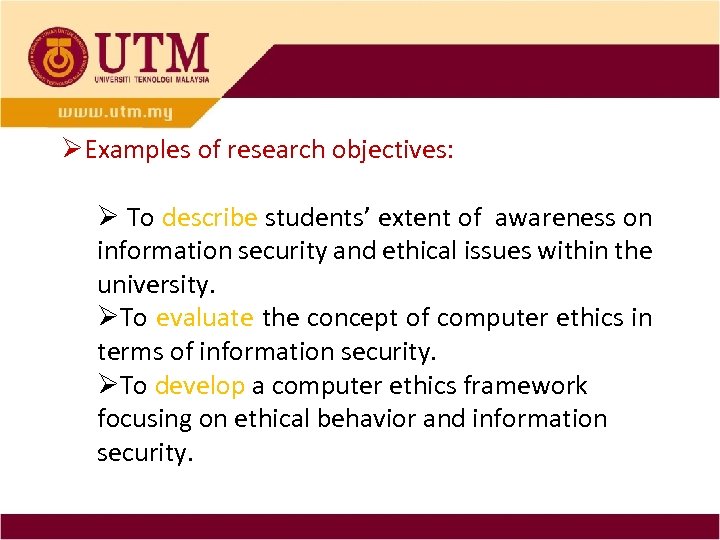 ØExamples of research objectives: Ø To describe students’ extent of awareness on information security and ethical issues within the university. ØTo evaluate the concept of computer ethics in terms of information security. ØTo develop a computer ethics framework focusing on ethical behavior and information security.
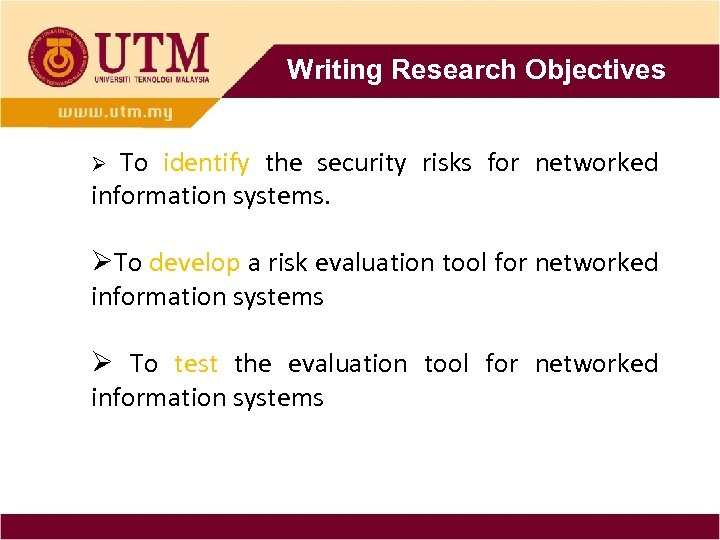 Writing Research Objectives To identify the security risks for networked information systems. Ø ØTo develop a risk evaluation tool for networked information systems Ø To test the evaluation tool for networked information systems
 Ø To compare and contrast the two programming languages. Ø To identify the weaknesses of the two programming languages. Ø To select which specific programming language to use in a particular application or system.
 Example: From Research Objective to Research Question Research Objective: To measure the effect of an introduction of an individualized program on the skill acquisition of technician students in information security course. Research Question: What effect has an introduction of an individualized program on the skill acquisition of technician students in information security course?
 From Research Question to Hypothesis A hypothesis • is stated in declarative form • posits a relationship between variables • is brief and to the point • is testable
 Example: Research Question: What effect has an introduction of an individualized programme had on the skill acquisition of technician students in information security course? Research Hypothesis: An individualized programme increases the skill level of technician students in information security course.
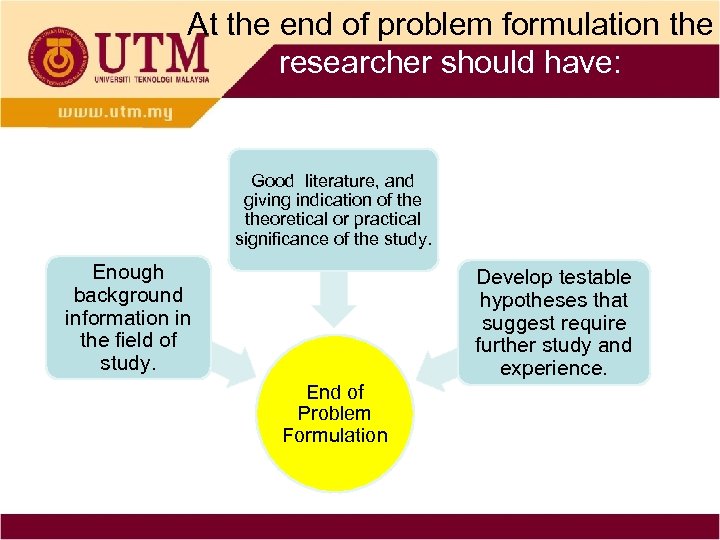 At the end of problem formulation the researcher should have: Good literature, and giving indication of theoretical or practical significance of the study. Enough background information in the field of study. Develop testable hypotheses that suggest require further study and experience. End of Problem Formulation
 Problem Statement • Common Mistakes : - – the problem to investigate is not stated clearly enough – the scope is too big • For example: - – Finding risk assessment methodology for cloud computing, but there are smaller steps (small research) to achieve the goal. • Before can proceed to the research question, the researcher should conduct literature review to extend the knowledge.
 Theoretical/Conceptual Framework • Research MUST be grounded on theory or relevant concepts. • There is a wide range of theories and concepts available. • Theories and concepts are means to explain the research. • We can also conduct research that challenges existing theories or to develop new theories.
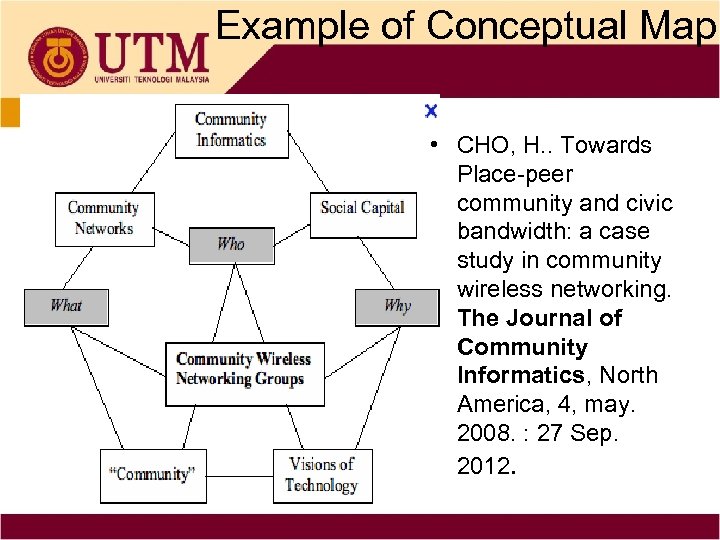 Example of Conceptual Map • CHO, H. . Towards Place-peer community and civic bandwidth: a case study in community wireless networking. The Journal of Community Informatics, North America, 4, may. 2008. : 27 Sep. 2012.
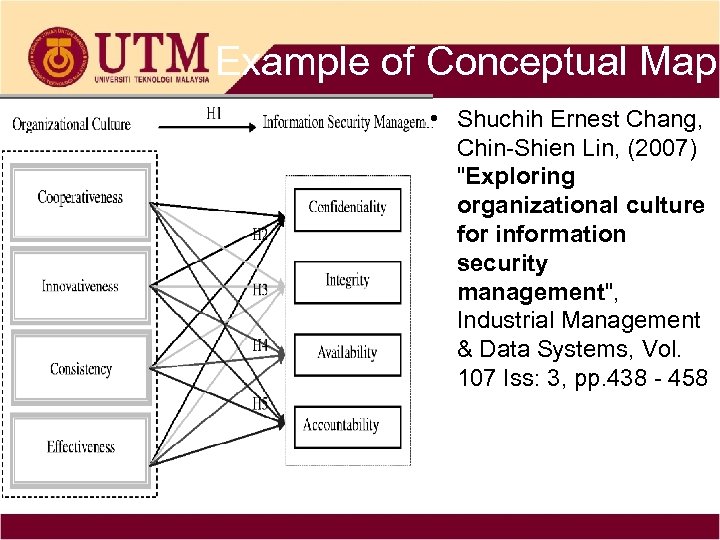 Example of Conceptual Map • Shuchih Ernest Chang, Chin-Shien Lin, (2007) "Exploring organizational culture for information security management", Industrial Management & Data Systems, Vol. 107 Iss: 3, pp. 438 - 458
 Summary of Module 1 We have covered the topics: • Definition of a research problem • How to identify a research problem • Steps in formulating a research problem • Research questions, hypotheses. objectives
 Steps in Formulating a Research Problem: 1. Identify a broad field of interest 2. Dissect the broad area into subareas 3. Select what is of most interest to you, and something manageable 4. Write the problem statement 5. Formulate research objectives - Main objectives Sub-objectives
 Use action-oriented words to describe objectives. eg. To determine, to ascertain, to examine to validate 6. Apply the SMART test. 7. State research questions (Need LR) 8. Assess the feasiblility of your objectives - time, financial resources, technical expertise
 Establishing Operational Definitions • Give clear meaning of concepts/variables/study population used in your study – Eg. “Effectiveness” , “Young people”, “academic achievement” • Define in practical, observable and measureable terms • Can be different from legal definitions or those used by others.
 Examples of Operational Definition Observable behavior, Measureable concept • Academic achievement = CPA • Thirst = Number of glasses of water to quench thirst • Success = ? ? ? Motivation = ? ? ? – May need many items in a survey to measure just one concept
 Brainstorming • Form group of 2 • Each of you write down your proposed research topic on 2 pieces of paper • Exchange the paper with your group member • In 5 minutes, write down anything that you can think of related to your friend’s topic • Then exchange it again with another group member & brainstorm for another 5 minutes • Finally you brainstorm your own topic • Then, you analyse the 3 papers & cluster/group any similar ideas & identify any ideas/words that excite you & omit irrelevant ideas. • Present your findings to the class 91
 Workshop • Form into groups • Each group decide on an area they know something about and are interested in. • Each group formulate a main research question. • Each group formulate three supporting questions. 92
 Workshop • Return to your groups • Review your main research question and especially your three supporting questions. • Operationalize your questions. • Where are you going to get the data to answer them? PCM 1524 6 July 2009 Bob Colomb, Noorminshah 93
 References • Oates, B. J (2006) Researching Information Systems and Computing. Sage Publication. London • SPS Research Methodology Slides (Prof Dr. Muhd Rashid Rajuddin, Prof Dr. Noor Azlan Ahmad Zanzali, etc. ) • Slides from previous semester (Prof. Dr. Bob Colomb, Dr. Noorminshah I. Ahad) 94
 • https: //www. youtube. com/watch? v=LWL YCYe. CFak • https: //www. youtube. com/watch? v=r 9 fk Szd. Lf 7 M • https: //www. youtube. com/watch? v=jj. F 6 YVtsx. I 95