


 Скачать презентацию Research in Psychology Unit 1 Modules 2
d02584c77b9e66938467b8b92f3f479d.ppt
- Количество слайдов: 38
 Research in Psychology Unit 1: Modules 2 & 3 AP Psychology Jessica Mulder
 The Limits of Common Sense • We cannot always rely on our intuition and common sense to tell us what is true about the world. The earth is flat! The sun revolves around the earth! How can we think that “opposites attract” & “birds of a feather flock together”?
 Try This If you drop a bullet off a table three feet high, and fire another one straight across an empty football field, which hits the ground first?
 How do we come up with the truth? 1. Ask Questions! 2. Think Critically- Have a Scientific Attitude 3. Use a systematic method to find out the answers to your questions. - The Scientific Method!
 The Scientific Method • The scientific method is a process for experimentation that is used to explore observations and answer questions. • Scientists use the scientific method to search for cause and effect relationships in nature.
 The scientific method starts when you ask a question about something that you observe: How, What, When, Who, Which, Why, or Where? Rather than starting from scratch, you want to be a savvy psychologist using library and Internet research to help you find the best way to do things and insure that you don't repeat mistakes from the past. A hypothesis is an educated guess about how things work: "If _____[I do this] _____, then _____[this]_____ will happen. " You must state your hypothesis in a way that you can easily measure. Your experiment tests whether your hypothesis is true or false. There are many ways to test a hypothesis! Experimentation is just ONE way Once your experiment is complete, you collect your data and analyze them to see if your hypothesis is true or false. Once your experiment is complete, you collect your measurements and analyze them to see if your hypothesis is true or false.
 The Scientific Method is great but… • Experimenter / Research Bias – Report Research allow for replication – Use Operational Definitions – Be transparent in research! • ALWAYS QUESTION! • ALWAYS remain both critical AND open minded.
 Ethics • The rules of conduct recognized in respect to a particular group. • APA (American Psychological Association) • Ethical considerations are a major component in research design. • Any type of academic research must first propose the study to the ethics board or institutional review board (IRB) at the institution
 Ethics for Research: Animal Studies 1. They must have a clear scientific purpose. The research must answer a specific, important scientific question. Animals chosen must be best-suited to answer the question at hand.
 Ethics for Research: Animal Studies 2. They must care for and house animals in a humane way. 3. They must acquire animal subjects legally. Animals must be purchased from accredited companies. If wild animals must be used, they need to be trapped in a humane manner.
 Ethics for Research: Animal Studies 4. They must design experimental procedures that employ the least amount of suffering feasible.
 Ethics for Research: Human Studies 1. Participation must be voluntary. 2. Informed consent- Participants must know that they are involved in research and give their consent. 3. Deception- Deception cannot be used unless it is absolutely necessary!
 Ethics for Research: Human Studies 4. Anonymity/Confidentiality. Participants’ privacy must be protected. Their identities and actions must not be revealed by the researcher. 5. Risk- Participants cannot be placed at significant mental or physical risk.
 Ethics for Research: Human Studies 6. Participants must be debriefed (told the purpose of the study) and provided with ways to contact the researchers about study results. When research involves deception, it is particularly important to conduct a thorough debriefing.
 Research Methods • • • Case Studies Surveys Naturalistic Observation Longitudinal & Cross-sectional Studies Correlation Experimentation
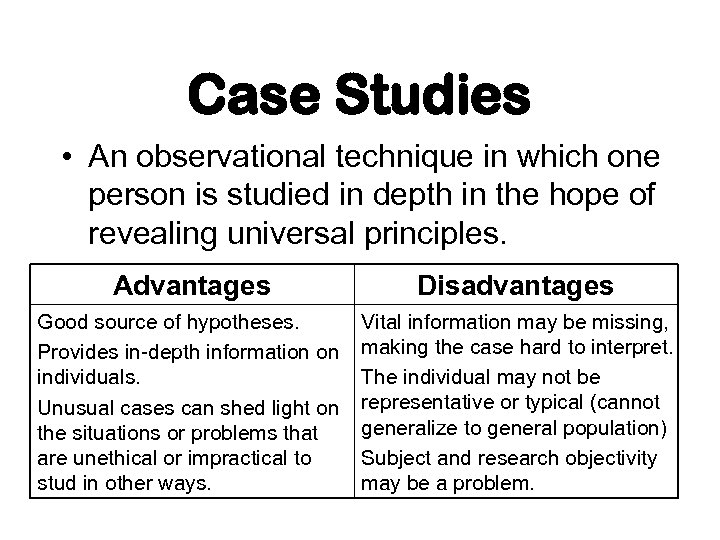 Case Studies • An observational technique in which one person is studied in depth in the hope of revealing universal principles. Advantages Disadvantages Good source of hypotheses. Provides in-depth information on individuals. Unusual cases can shed light on the situations or problems that are unethical or impractical to stud in other ways. Vital information may be missing, making the case hard to interpret. The individual may not be representative or typical (cannot generalize to general population) Subject and research objectivity may be a problem.
 Surveys • A technique for ascertaining the selfreported attitudes or behaviors of people, usually by questioning a representative, random sample of people. Advantages Provides a large amount of information on large numbers of people. Inexpensive. Disadvantages If sample is non-representative or biased, it may be impossible to generalize from the results. Responses may be inaccurate or untrue.
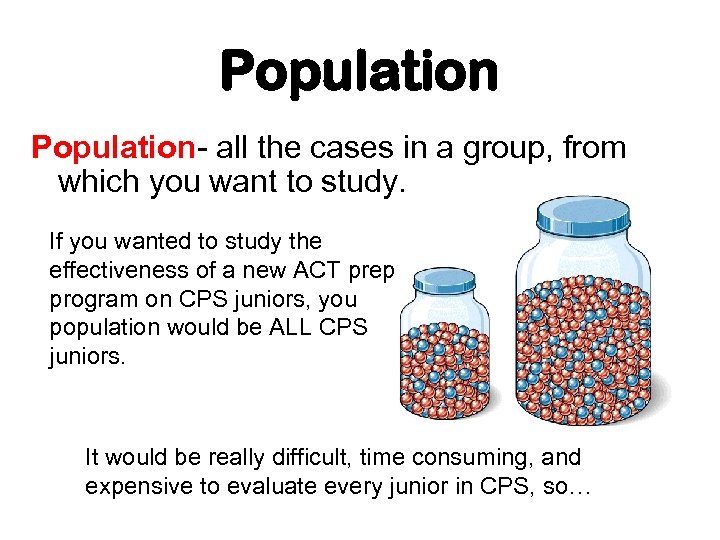 Population- all the cases in a group, from which you want to study. If you wanted to study the effectiveness of a new ACT prep program on CPS juniors, you population would be ALL CPS juniors. It would be really difficult, time consuming, and expensive to evaluate every junior in CPS, so…
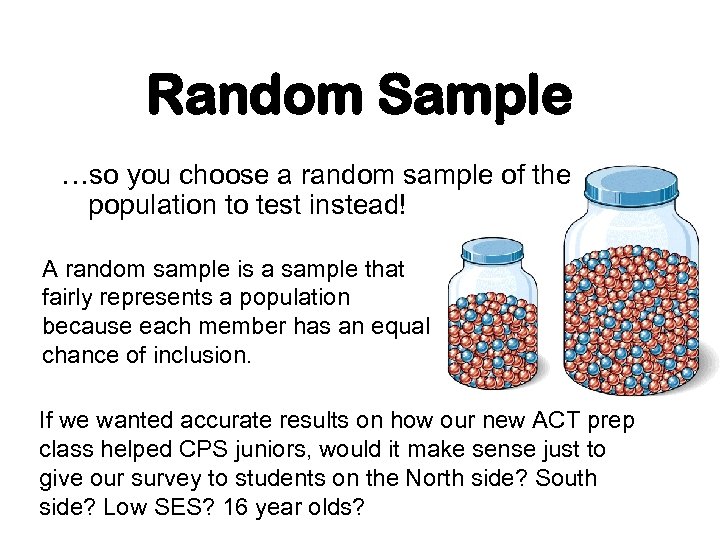 Random Sample …so you choose a random sample of the population to test instead! A random sample is a sample that fairly represents a population because each member has an equal chance of inclusion. If we wanted accurate results on how our new ACT prep class helped CPS juniors, would it make sense just to give our survey to students on the North side? South side? Low SES? 16 year olds?
 Naturalistic Observation Observing and recording behavior in naturally occurring situations without trying to manipulate and control the situation. Advantages Allows description of behavior as it occurs in the natural environment. Often useful in first stages of a research program. Disadvantages Allows researcher little or no control of the situation. Observations may be biased. Does not allow firm conclusions about cause and effect.
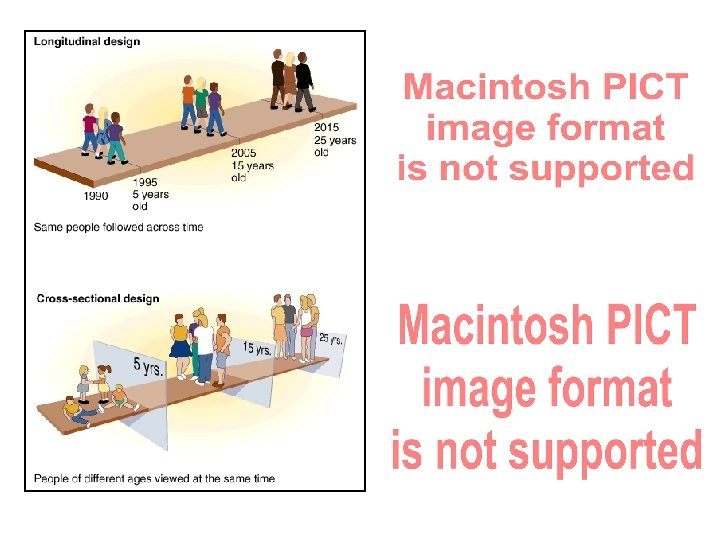
 Longitudinal and Cross-Sectional Studies Longitudinal Study – A research technique that studies the same group of individuals over a long period of time. – Tend to be rare. – Advantages: provide a rich source of data. – Disadvantages: expensive, timeconsuming, difficult to conduct, cohort effect. Cross-Sectional Study – A research technique that compares individuals from different age groups at one time. – More common. – Advantages: much more efficient than longitudinal studies. – Disadvantages: difficult to determine cause and effect, hard to control for differences between groups, cannot measure change. Both methods are used mostly by developmental psychologists!
 Correlation A measure of the extent to which two factors vary together. How well does one thing predict the other? Let’s look at test scores and time spent studying.
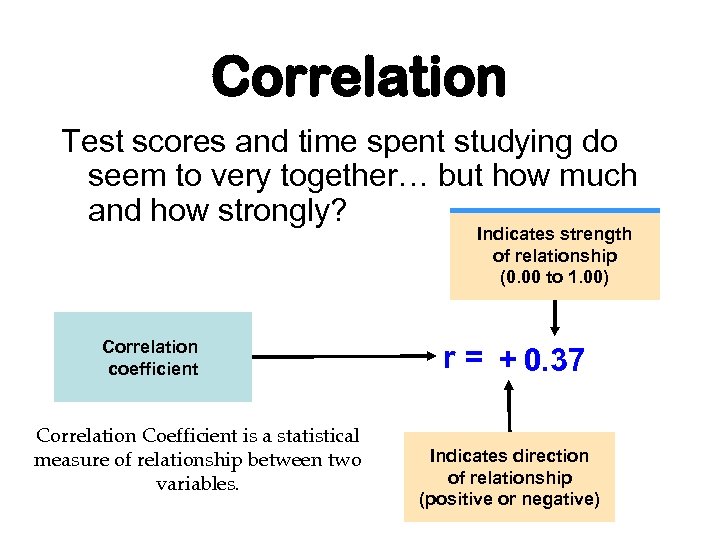 Correlation Test scores and time spent studying do seem to very together… but how much and how strongly? Indicates strength of relationship (0. 00 to 1. 00) Correlation coefficient Correlation Coefficient is a statistical measure of relationship between two variables. r = + 0. 37 Indicates direction of relationship (positive or negative)
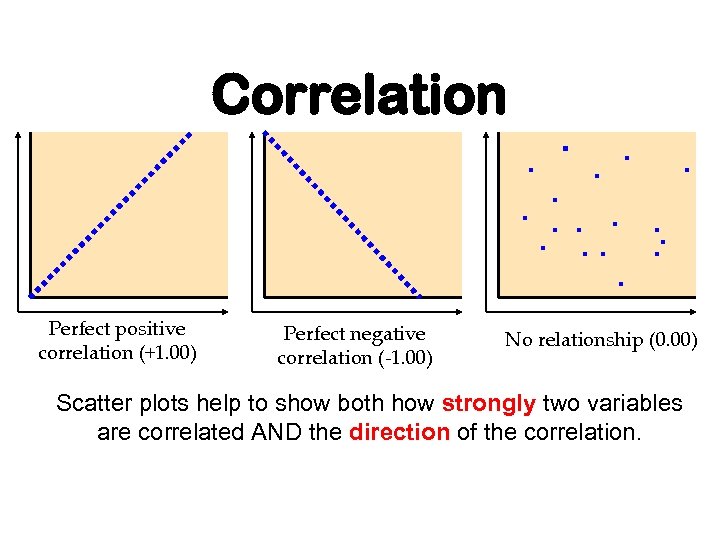 Correlation Perfect positive correlation (+1. 00) Perfect negative correlation (-1. 00) No relationship (0. 00) Scatter plots help to show both how strongly two variables are correlated AND the direction of the correlation.
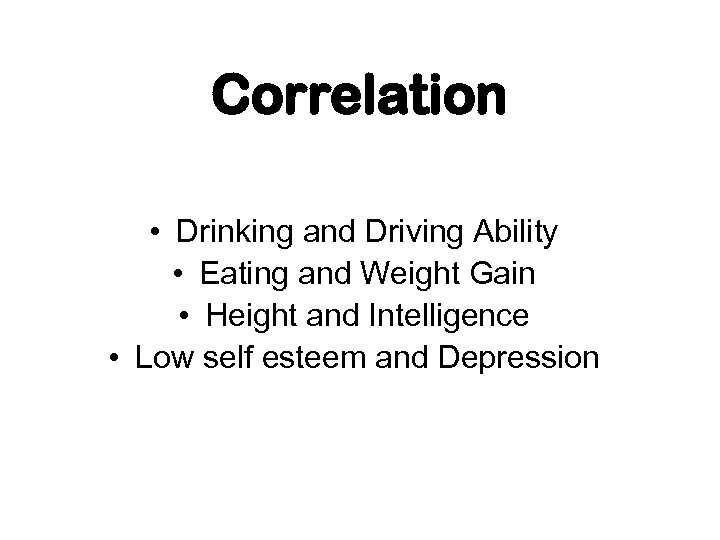 Correlation • Drinking and Driving Ability • Eating and Weight Gain • Height and Intelligence • Low self esteem and Depression
 CORRELATION does not equal CAUSATION!!
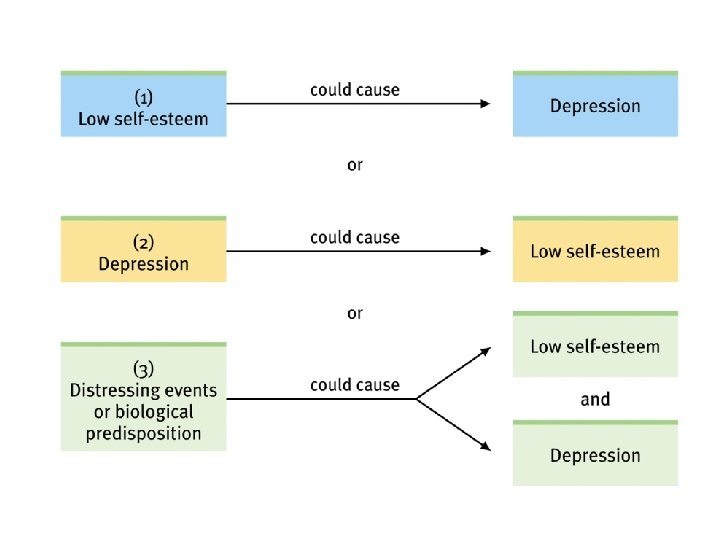
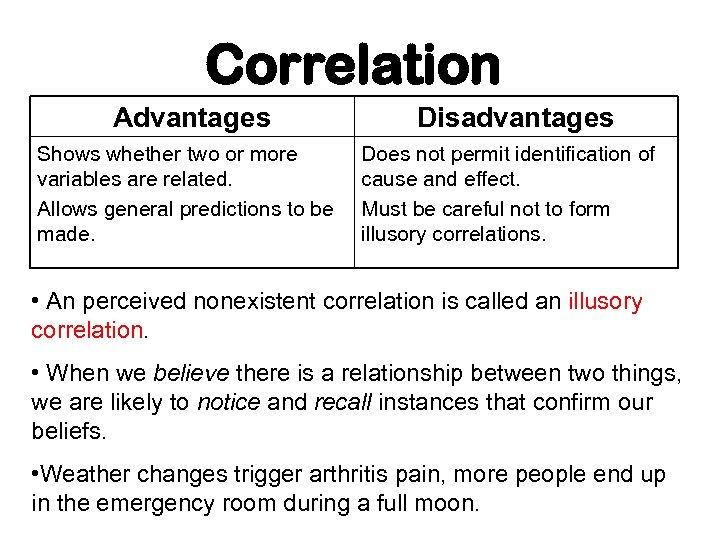 Correlation Advantages Shows whether two or more variables are related. Allows general predictions to be made. Disadvantages Does not permit identification of cause and effect. Must be careful not to form illusory correlations. • An perceived nonexistent correlation is called an illusory correlation. • When we believe there is a relationship between two things, we are likely to notice and recall instances that confirm our beliefs. • Weather changes trigger arthritis pain, more people end up in the emergency room during a full moon.
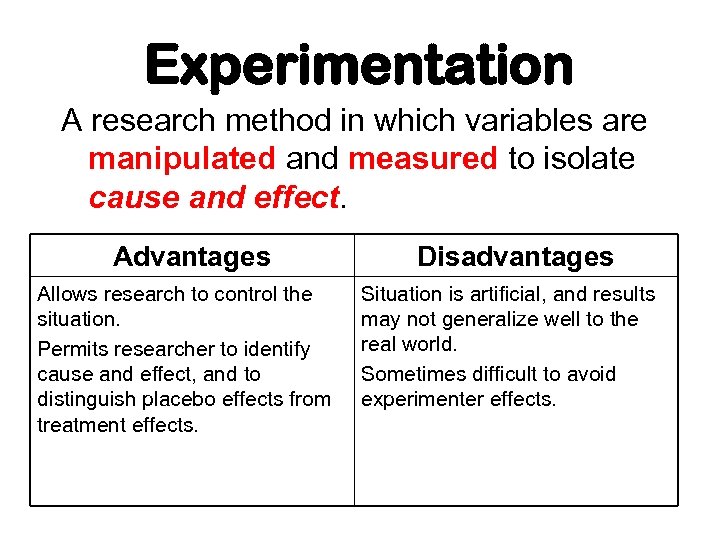 Experimentation A research method in which variables are manipulated and measured to isolate cause and effect. Advantages Allows research to control the situation. Permits researcher to identify cause and effect, and to distinguish placebo effects from treatment effects. Disadvantages Situation is artificial, and results may not generalize well to the real world. Sometimes difficult to avoid experimenter effects.
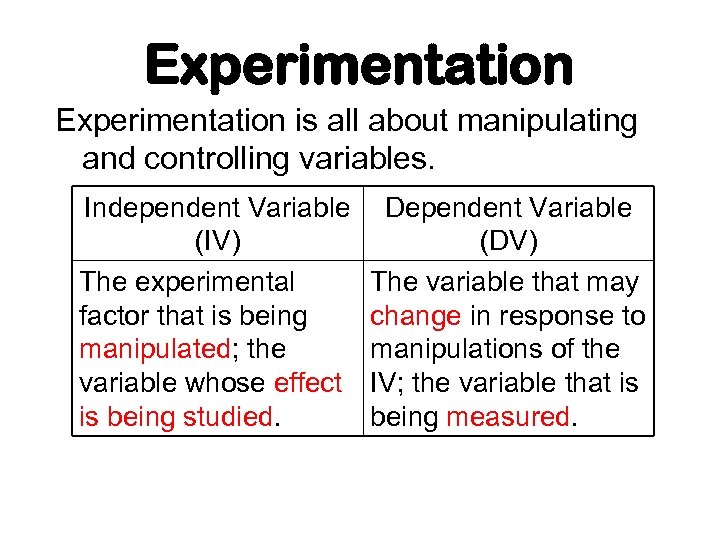 Experimentation is all about manipulating and controlling variables. Independent Variable (IV) The experimental factor that is being manipulated; the variable whose effect is being studied. Dependent Variable (DV) The variable that may change in response to manipulations of the IV; the variable that is being measured.
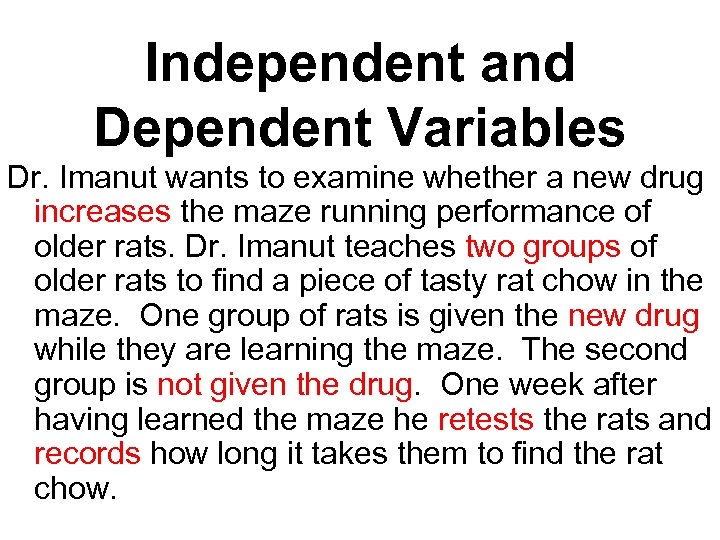 Independent and Dependent Variables Dr. Imanut wants to examine whether a new drug increases the maze running performance of older rats. Dr. Imanut teaches two groups of older rats to find a piece of tasty rat chow in the maze. One group of rats is given the new drug while they are learning the maze. The second group is not given the drug. One week after having learned the maze he retests the rats and records how long it takes them to find the rat chow.
 Independent and Dependent Variables 1. Children’s reading skill is measured after taking either a special reading class or a standard reading class. 2. College students’ memory for German vocabulary words is tested after a normal nights sleep or a night of no sleep. 3. Experiment title: “The effect of a daily walking program on elderly people’s lung capacity. ” 4. People’s ability to avoid “accidents” in a driving simulator is tested before, during, and after talking on a cell phone.
 Experimentation Research ? : Does Prozac reduce depression? Running an experiment: 1. Identify a question and form a hypothesis. 2. Define variables and make operational definitions. 3. Recruit participants and randomly assign participants into the experimental or control group. 4. Conduct the experiment / collect data 5. Analyze Data 6. Reject or Accept the Hypothesis / Formulate Conclusions
 Placebo Effect Experimental results caused by expectations alone.
 Double-Blind Procedure An experimental procedure in which both the research participants and the research staff are ignorant (blind) about whether the research participants have received the treatment or a placebo. A method of control!
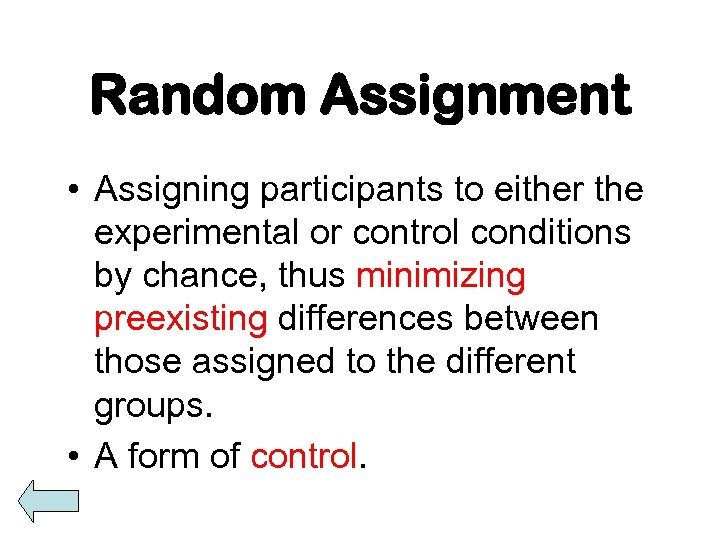 Random Assignment • Assigning participants to either the experimental or control conditions by chance, thus minimizing preexisting differences between those assigned to the different groups. • A form of control.
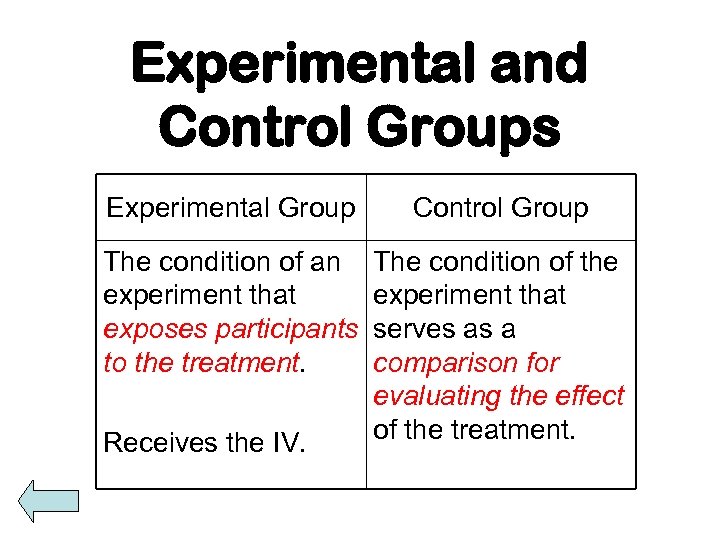 Experimental and Control Groups Experimental Group Control Group The condition of an experiment that exposes participants to the treatment. The condition of the experiment that serves as a comparison for evaluating the effect of the treatment. Receives the IV.