


 Скачать презентацию Research in Context The Federal and Political Landscape
980337ee00923d6e3c7e30ef79116088.ppt
- Количество слайдов: 11
 Research in Context The Federal and Political Landscape, What it Means for Universities Travis Reed Lewis-Burke Associates LLC October 1, 2012
 Setting the Context • Polarized political environment is paralyzing progress • Legislative gridlock • Instability and low morale in federal agencies • The GOOD news?
 The Budgetary Environment: A Perfect Storm • Before the end of the year: – November elections – Extension of the Bush era tax cuts – Raising the debt ceiling – Sequestration
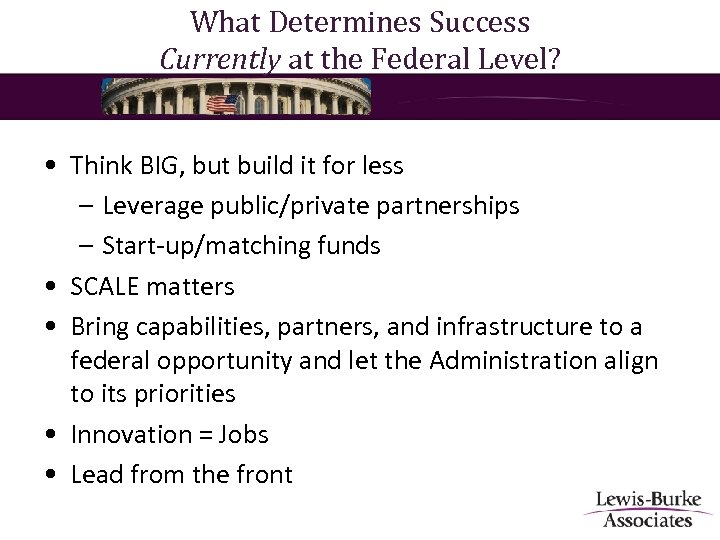 What Determines Success Currently at the Federal Level? • Think BIG, but build it for less – Leverage public/private partnerships – Start-up/matching funds • SCALE matters • Bring capabilities, partners, and infrastructure to a federal opportunity and let the Administration align to its priorities • Innovation = Jobs • Lead from the front
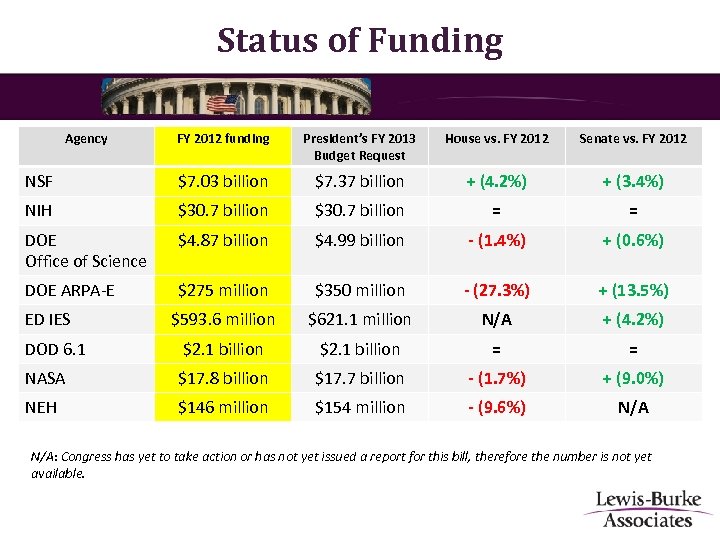 Status of Funding Agency FY 2012 funding President’s FY 2013 Budget Request House vs. FY 2012 Senate vs. FY 2012 NSF $7. 03 billion $7. 37 billion + (4. 2%) + (3. 4%) NIH $30. 7 billion = = DOE Office of Science $4. 87 billion $4. 99 billion - (1. 4%) + (0. 6%) DOE ARPA-E $275 million $350 million - (27. 3%) + (13. 5%) $593. 6 million $621. 1 million N/A + (4. 2%) DOD 6. 1 $2. 1 billion = = NASA $17. 8 billion $17. 7 billion - (1. 7%) + (9. 0%) NEH $146 million $154 million - (9. 6%) N/A ED IES N/A: Congress has yet to take action or has not yet issued a report for this bill, therefore the number is not yet available.
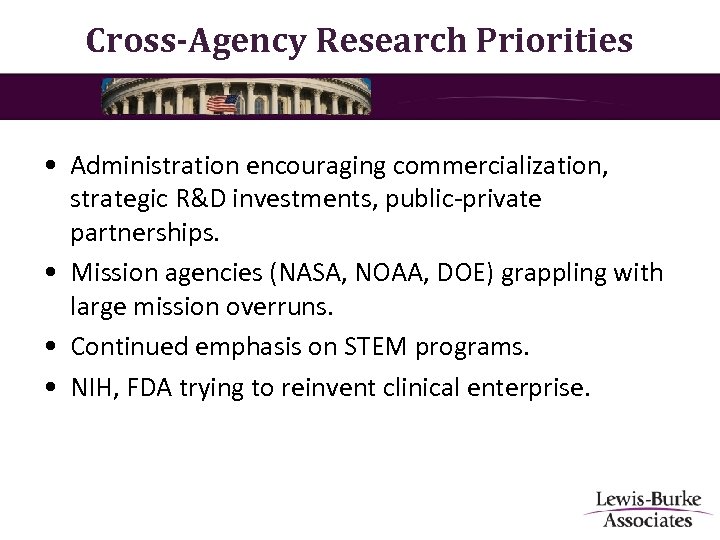 Cross-Agency Research Priorities • Administration encouraging commercialization, strategic R&D investments, public-private partnerships. • Mission agencies (NASA, NOAA, DOE) grappling with large mission overruns. • Continued emphasis on STEM programs. • NIH, FDA trying to reinvent clinical enterprise.
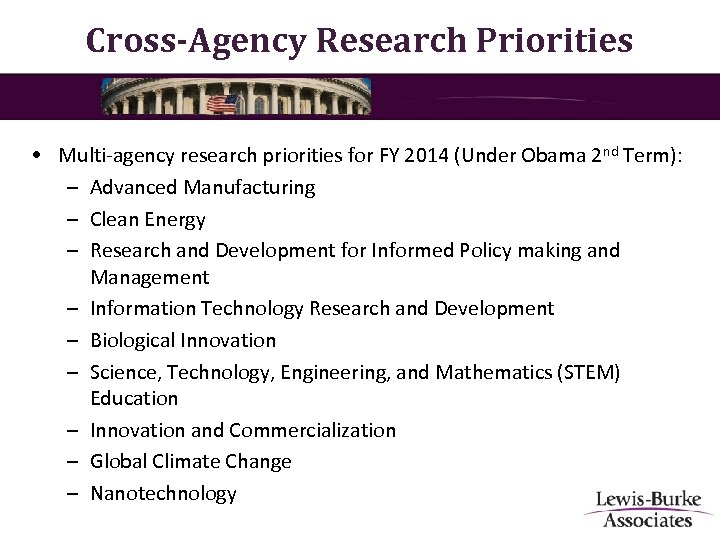 Cross-Agency Research Priorities • Multi-agency research priorities for FY 2014 (Under Obama 2 nd Term): – Advanced Manufacturing – Clean Energy – Research and Development for Informed Policy making and Management – Information Technology Research and Development – Biological Innovation – Science, Technology, Engineering, and Mathematics (STEM) Education – Innovation and Commercialization – Global Climate Change – Nanotechnology
 Status of Federal Agencies National Science Foundation (NSF) • NSF is a favored agency by both the Administration and Capitol Hill; House would increase NSF by $300 million, with the Senate proposing a $240 million increase for FY 2013 • All-in on Obama Administration priorities – manufacturing, innovation, sustainability, STEM, data-intensive science Department of Energy (DOE) • Office of Science research programs expected to be flat or slightly decreased • Basic energy, environmental, and computing research remain Administration priorities at the expense of other Office of Science programs National Institutes of Health (NIH) • NIH bracing for tight budgets • Largest institutes reviewing and revising portfolios: National Cancer Institute; National Institute of Allergy and Infectious Diseases; National Heart, Lung, and Blood Institute
 Status of Federal Agencies National Aeronautics and Space Administration (NASA) • Bipartisan support for Science and Human Space Flight, but Congress and President disagree on prioritization within each • James Webb Space Telescope continues to put pressure on rest of Science Mission Directorate funding Department of Defense (DOD) • Bipartisan and bicameral support remains for DOD RDT&E; particularly strong support for defense science and technology (6. 1 -6. 3) programs; most cuts to test and evaluation accounts • DOD’s seven S&T priorities will continue to guide BAAs and large funding opportunities: autonomy, counter weapons of mass destruction, cyber, data-to-decisions, electronic warfare and protection, human systems, and engineering resilient systems
 The End Lewis-Burke Associates LLC is a leading full service government relations firm specializing in institutions of higher education and other research and education organizations. Website: http: //www. lewis-burke. com/