Скачать презентацию Research findings that have falsified the view of
e4ad367f8de9d1db7925696f65922701.ppt
- Количество слайдов: 52





 Research findings that have falsified the view of fluent reading that depends on heavy use of context to identify words during text reading
 Another study found higher predictability for function words (40%) than content words (10%). Unfortunately, content words are the words most likely to be unfamiliar.
 Research findings that have falsified the view of fluent reading that depends on heavy use of context to identify words during text reading

 Research findings that have falsified the view of fluent reading that depends on heavy use of context to identify words during text reading


 Research findings that have falsified the view of fluent reading that depends on heavy use of context to identify words during text reading





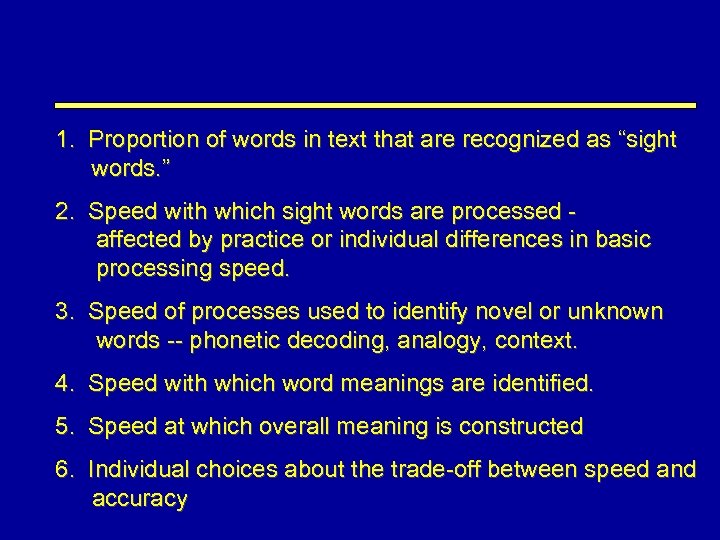 1. Proportion of words in text that are recognized as “sight words. ” 2. Speed with which sight words are processed affected by practice or individual differences in basic processing speed. 3. Speed of processes used to identify novel or unknown words -- phonetic decoding, analogy, context. 4. Speed with which word meanings are identified. 5. Speed at which overall meaning is constructed 6. Individual choices about the trade-off between speed and accuracy
 1. Proportion of words in text that are recognized as “sight words. ” 2. Speed with which sight words are processed affected by practice or individual differences in basic processing speed. 3. Speed of processes used to identify novel or unknown words -- phonetic decoding, analogy, context. 4. Speed with which word meanings are identified. 5. Speed at which overall meaning is constructed 6. Individual choices about the trade-off between speed and accuracy









 something decide money then said

 1. The number and breadth of the words they have multiple opportunities to read—reading practice 2. The accuracy of the child’s “first guesses” at the identity and pronunciation of unknown words 3. The size of their oral language vocabulary-its easier to accurately guess a “known” word than an unknown word 4. Perhaps a biologically based ability to process symbolic information fluently (RAN tasks) 5. The level and fluency of phonemic awareness 6. Motivation and interest in adding new words to sight vocabulary

 Associations between the visual features of words and their meanings. Shape -- on ate tent But what about -- stick, sting, sling, string, sink, stick Sight word reading must involve remembering the letters in the words; these are the distinctive features that make one word different from another.
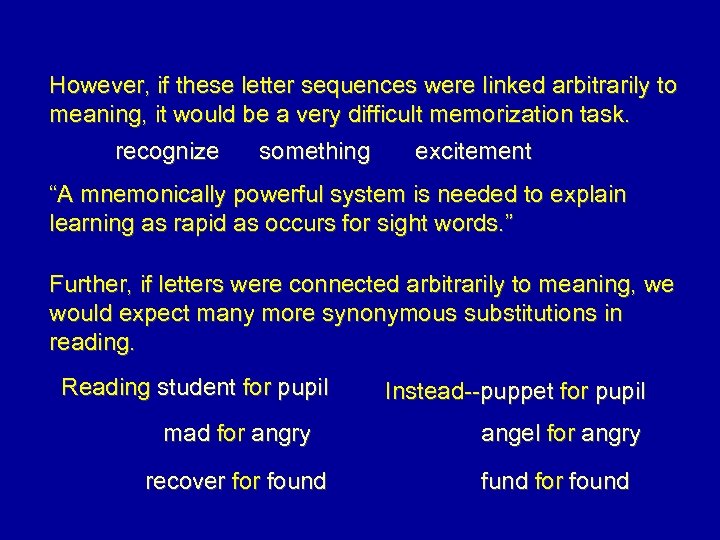 However, if these letter sequences were linked arbitrarily to meaning, it would be a very difficult memorization task. recognize something excitement “A mnemonically powerful system is needed to explain learning as rapid as occurs for sight words. ” Further, if letters were connected arbitrarily to meaning, we would expect many more synonymous substitutions in reading. Reading student for pupil Instead--puppet for pupil mad for angry angel for angry recover found for found
 “. . that pronunciations of words are the anchors for written words in memory. Readers learn sight words by forming connections between letters seen in spellings of words and sounds detected in their pronounciations alreading present in memory. “When readers learn sight words, they look at the spelling, pronounce the word, and analyse how the graphemes match up to phonemes in that word. Reading the word a few times secures its connections in memory. ” For a reader with well developed phonemic awareness, the phonological structure of a word, which is already known, serves as a mnemonic for remembering the letters in its spelling.


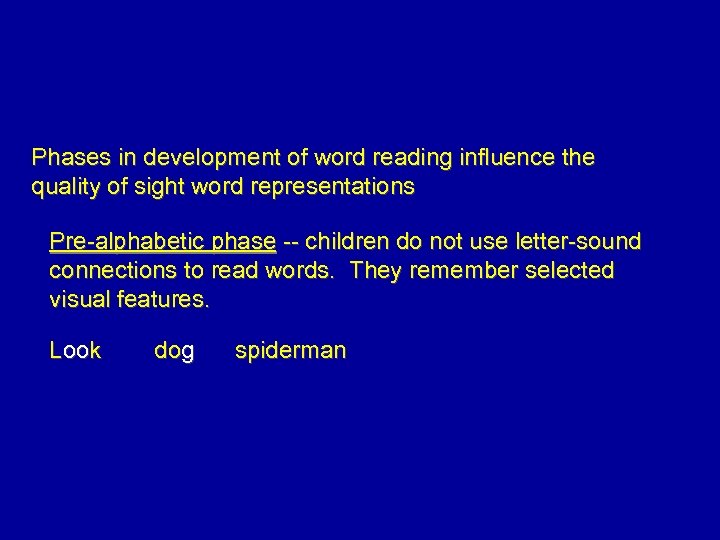 Phases in development of word reading influence the quality of sight word representations Pre-alphabetic phase -- children do not use letter-sound connections to read words. They remember selected visual features. Look dog spiderman
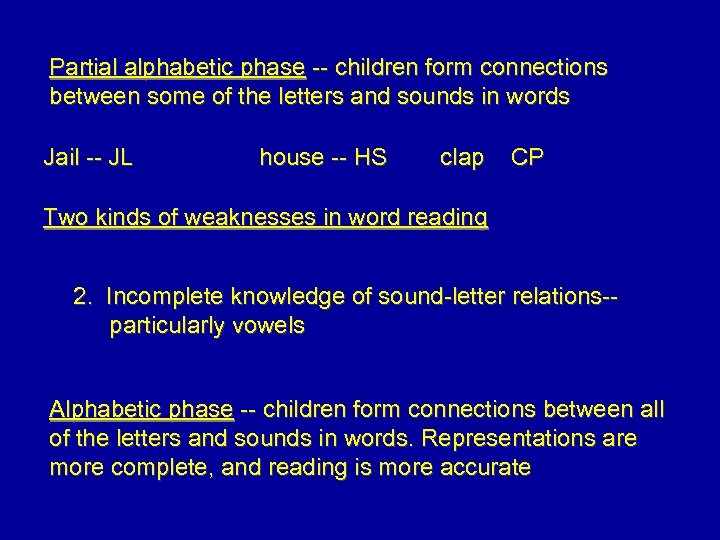 Partial alphabetic phase -- children form connections between some of the letters and sounds in words Jail -- JL house -- HS clap CP Two kinds of weaknesses in word reading 2. Incomplete knowledge of sound-letter relations-particularly vowels Alphabetic phase -- children form connections between all of the letters and sounds in words. Representations are more complete, and reading is more accurate

 A. It helps children to make more accurate “first guesses” when they encounter a word for the first time. B. It allows children to become independent readers early in development.
 1. Delays in the development of accurate phonemic decoding skills and possibly incomplete development of phonemic awareness 2. Lack of reading practice 3. Problems with the texts children are asked to read-too many singletons and difficult words 4. Perhaps a biologically based weaknesses in ability to process symbolic information fluently (RAN tasks)
 2. Young children should be encouraged and supported to do lots of reading at the right level-- there should be lots of opportunities for guided oral reading (reading with feedback). 3. Classrooms and assignments should be structured do that students have opportunities and motivation to repeatedly read the same material with an emphasis on fluency
 4. Text that is specifically written to provide extra practice opportunities for high-utility “core vocabulary” words may be particularly efficient for building fluency through early acquisition of high frequency words in sight vocabularies
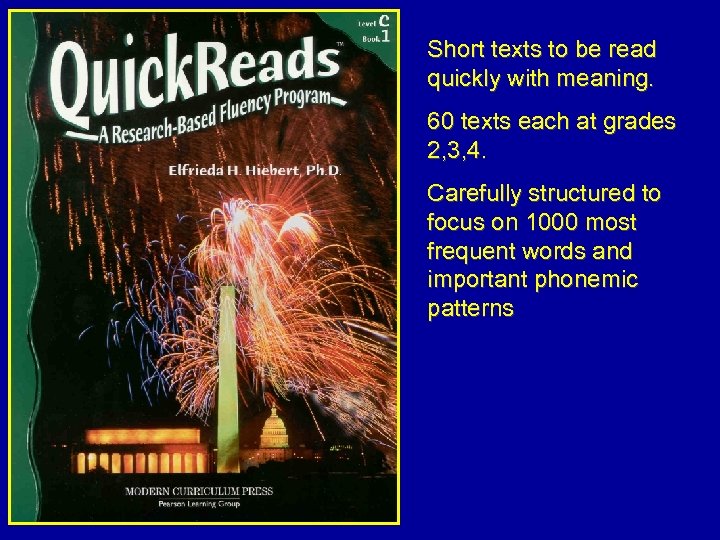 Short texts to be read quickly with meaning. 60 texts each at grades 2, 3, 4. Carefully structured to focus on 1000 most frequent words and important phonemic patterns