 Скачать презентацию Research Evaluation Collaborative Capacity Building A Positive
1491fd309a9045a25c9b7f46dec965db.ppt
- Количество слайдов: 18



Research & Evaluation Collaborative Capacity Building: A Positive Psychology Perspective for Evaluation Lisa Raphael Laura Costello Jack Lumbley Melissa Dodson SEDL
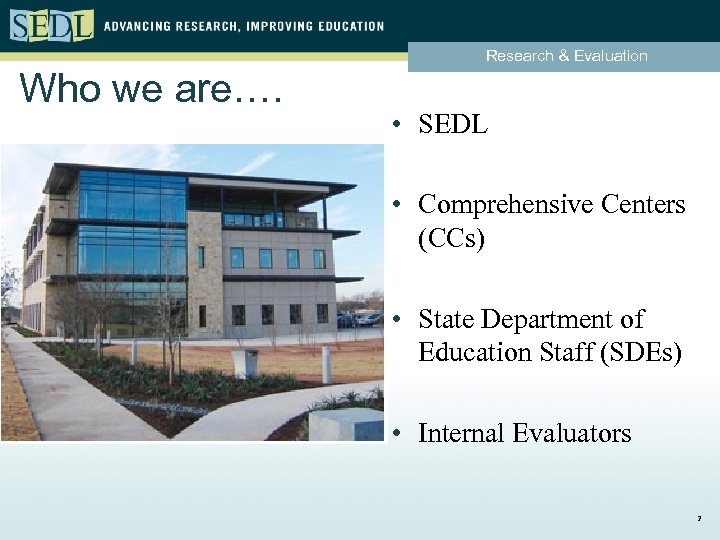
Research & Evaluation Who we are…. • SEDL • Comprehensive Centers (CCs) • State Department of Education Staff (SDEs) • Internal Evaluators 2
Research & Evaluation What brings us here today? 1. Share our Journey – How we developed our capacity building model – What we’ve learned in the process – Changes we have created 1. Gain Feedback – Tools and resources 3
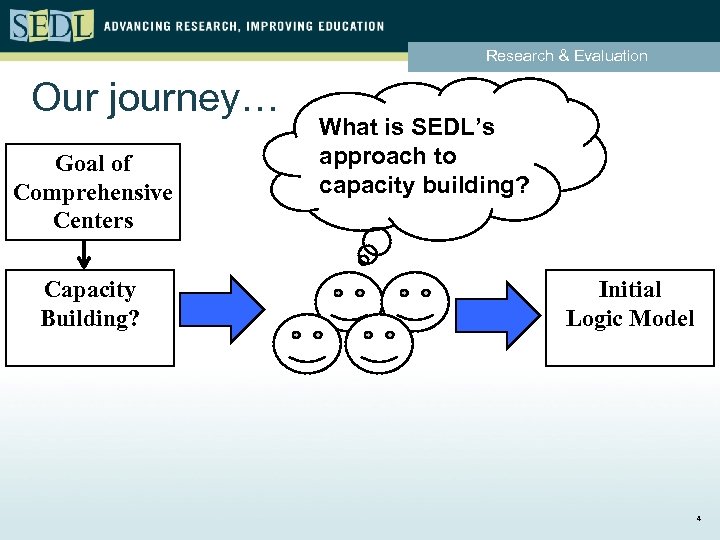
Research & Evaluation Our journey… Goal of Comprehensive Centers Capacity Building? What is SEDL’s approach to capacity building? Initial Logic Model 4
Research & Evaluation Our journey continued… Does our initial model truly capture SEDL’s approach to capacity building? q Re-examine initial model 5
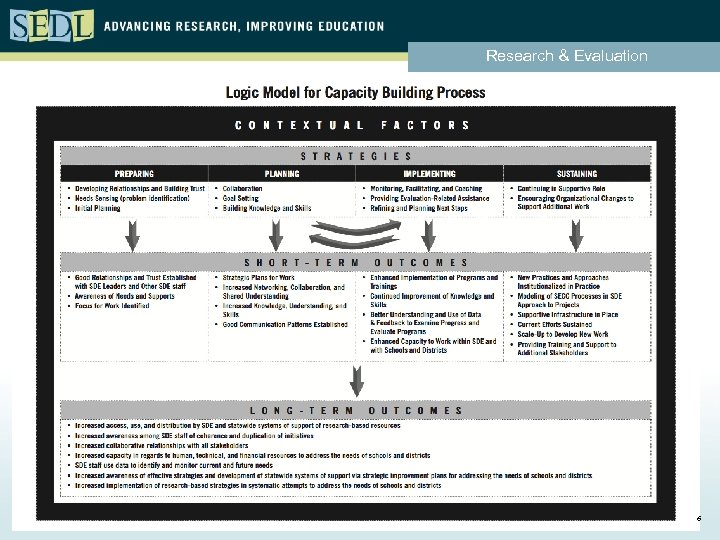
Research & Evaluation 6
Research & Evaluation Our journey continued… How can we best represent SEDL’s approach to capacity building? ü Re-examine initial model q Data collection from CC staff and SDE clients 7
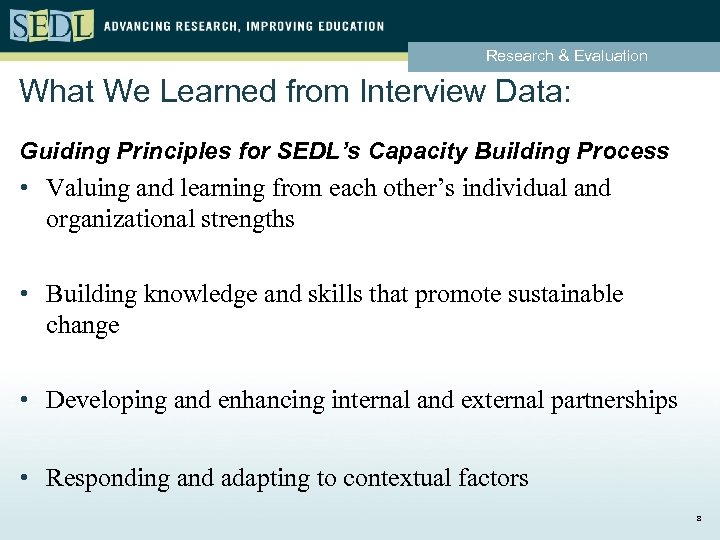
Research & Evaluation What We Learned from Interview Data: Guiding Principles for SEDL’s Capacity Building Process • Valuing and learning from each other’s individual and organizational strengths • Building knowledge and skills that promote sustainable change • Developing and enhancing internal and external partnerships • Responding and adapting to contextual factors 8
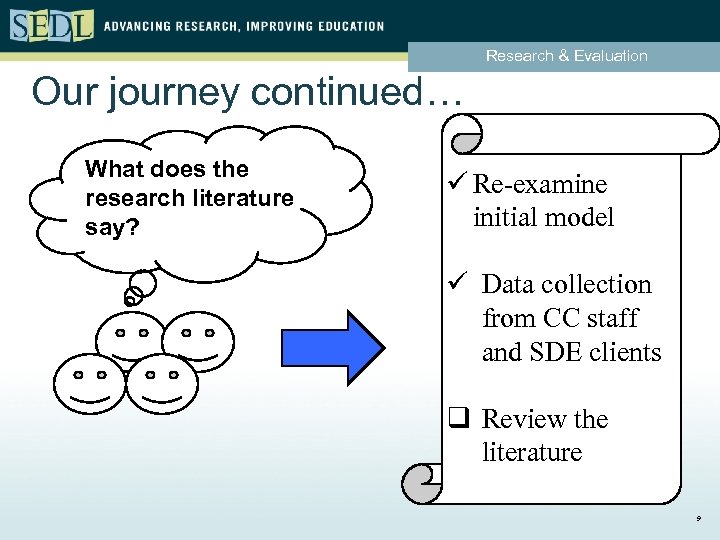
Research & Evaluation Our journey continued… What does the research literature say? ü Re-examine initial model ü Data collection from CC staff and SDE clients q Review the literature 9
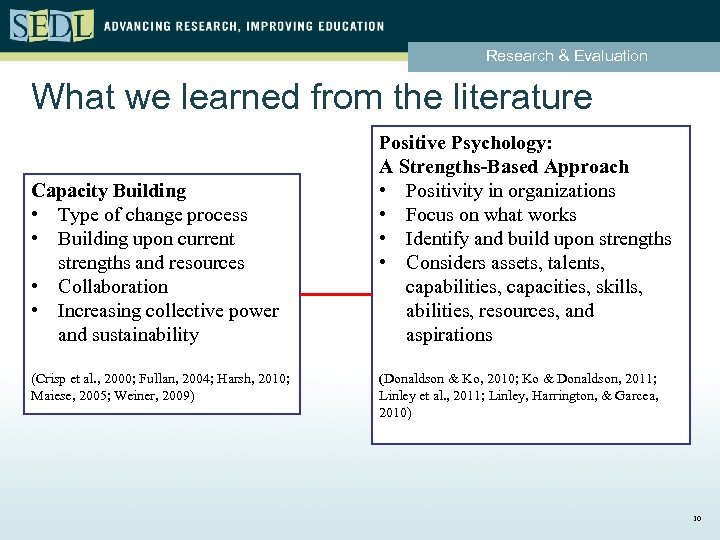
Research & Evaluation What we learned from the literature Capacity Building • Type of change process • Building upon current strengths and resources • Collaboration • Increasing collective power and sustainability (Crisp et al. , 2000; Fullan, 2004; Harsh, 2010; Maiese, 2005; Weiner, 2009) Positive Psychology: A Strengths-Based Approach • Positivity in organizations • Focus on what works • Identify and build upon strengths • Considers assets, talents, capabilities, capacities, skills, abilities, resources, and aspirations (Donaldson & Ko, 2010; Ko & Donaldson, 2011; Linley et al. , 2011; Linley, Harrington, & Garcea, 2010) 10
Research & Evaluation ü Re-examine initial model ü Data collection from CC staff and SDE clients ü Review the literature q Create a new model 11
Research & Evaluation “The whole idea of capacity is turning great ideas that we’ve learned and SEDL learned from across the country into action…” –SDE client 12
Research & Evaluation Strengths-Based Approach in CCB Model Processes • Identifying problems, needs, goals, priorities, and strengths • Facilitating partnerships • Documenting and compiling tools and resources 13
Research & Evaluation Strengths-Based Approach in CCB Model Short-Term Outcomes • Consensus of problems, goals, needs, priorities, and strengths Long-Term Outcomes • Efficient organizational structures that promote coordinated and effective organizational change • Increased awareness of relevant expertise, processes, and structures • Strengthened and sustained to support project work partnerships that impact multiple programs and policies • Partnerships established with relevant partners and organizations • Increased awareness of expertise and resources available internally and with external partners 14
Research & Evaluation Change takes time… • Current model incorporates a strengthsbased approach to capacity building • Institutional buy-in essential As internal evaluators, we are uniquely positioned to facilitate change in our organization 15
Research & Evaluation The change we have created… • Shaping how SEDL as an institution defines and depicts capacity building • Using the model as a programmatic and evaluation tool • Institutionalizing the approach 16
Research & Evaluation Next steps —open to feedback • Getting more staff and clients on board/Creating more awareness within and outside SEDL • Tools evaluation and program staff can actually use— developed collaboratively • Continue to redefine our roles as internal evaluators How evaluation contributes to organizational learning and change 17
Research & Evaluation Thank you! 18
Скачать презентацию Research Evaluation Collaborative Capacity Building A Positive
1491fd309a9045a25c9b7f46dec965db.ppt