


 Скачать презентацию Research Education Needs in Energy Market Risk
c2cdc763018fb95e541c5ffa043b1a9c.ppt
- Количество слайдов: 15
 Research & Education Needs in Energy Market Risk Ralph Masiello
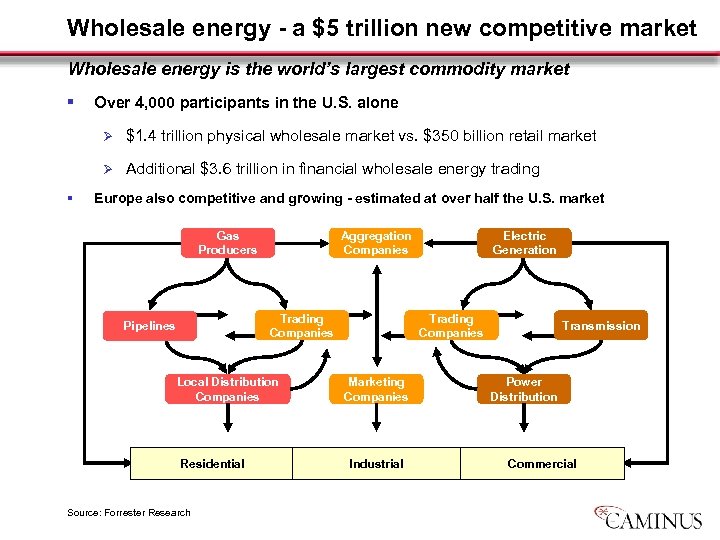 Wholesale energy - a $5 trillion new competitive market Wholesale energy is the world’s largest commodity market § Over 4, 000 participants in the U. S. alone Ø Ø § $1. 4 trillion physical wholesale market vs. $350 billion retail market Additional $3. 6 trillion in financial wholesale energy trading Europe also competitive and growing - estimated at over half the U. S. market Gas Producers Aggregation Companies Trading Companies Pipelines Local Distribution Companies Residential Source: Forrester Research Electric Generation Trading Companies Marketing Companies Industrial Transmission Power Distribution Commercial
 Wholesale energy - the most volatile commodity market Anyone taking a position in energy must manage risk § Extreme price volatility Ø Ø Weather and grid unreliability produce shortages and supply imbalances Ø § Electrical power is naturally the most volatile commodity Enron, California, Regulatory Risk, etc all exacerbate volatility Market complexity is growing Ø Convergence of gas and power require operation in multiple markets Ø Need to compete across multiple geographic/regional markets Ø Introduction of complex energy derivatives Ø Fuel Procurement, Watershed inflows, Emissions Limits and Trading, Wind, Transportation, ……… Creating the need for energy specific application software • New solutions are needed to manage trading and risk unique to energy • No viable heritage systems exist
 Who is The leading provider of trading, transaction processing and risk management software and strategic consulting services to the global wholesale energy market Over 300 Energy Companies Use Caminus Software and Services We enable companies to compete effectively in wholesale energy markets § Trade all major energy-related commodities, and instruments § Manage the physical and financial process across the entire energy value chain § Manage the full spectrum of energy related risks 500 Energy Trading/Risk Specialists >100 Professionals Engaged in R&D >60% of North American Energy Traded on Caminus software (more in UK)
 “déja vu all over again” § “What on Earth is Happening” – Eric T B Gross American Power Conference – 69 § Context: Huge R&D response to the great ’ 67 Blackout § § Academic Feeding Frenzy – Inter. Disciplinary Funding Fest Any IEEE PES over 50 in this room Raise Your Hand His concern - too many new programs and “unqualified” entrants – we should have had grad school re-regulation and an Independent School Organizer allocating capacity and research Net Result was all Positive – lots of new technology for planning and reliability § § § State Estimation, Security Analysis, Optimal Power Flow, the marriage of Operations Research and Network Analysis, ----Took half a decade to sort out the real contributions from the drivel Back Then we Didn’t have Venture Capitalists throwing money at the next big thing, however !
 Risk Assessment and Optimization – Trading and Production § Already lots of work going on in areas to help producers and traders § They’re unregulated and highly incented to innovate § Probably 10 -20 specialized software firms and consulting companies focused on energy real option modeling, risk assessment, and optimization aimed at these companies § They all have in-house quants developing models and methods, and they don’t share information § § Completely unlike the regulated sector! They demand proprietary solutions as part of competitive advantage
 R&D Hot Topics § How can a poor LDC or RTO keep up with all those quants? (the CERS / CDWR experience) § “Derivatives” is a dirty word – but LDCs and Munis need to hedge retail volumetric risk § Volumetric Risk is an Energy-specific problem; the “volume” of a retail sale; is unknown and correlated with price; all correlated with weather and supply/transportation outages § They also need to analyze and hedge “potential credit” risk – the cost of replacing supply when a supplier defaults. (Enron again !) § Regulators needs Education about these issues !! § Need for LDC Best Practices
 More LDC Points – Why Best Practices are Needed § To “enable” intelligent hedging politically § To disseminate methods and elevate business practice § To justify hedging costs to the PUC and correctly allocate it in either regulated energy tariffs or distribution services tariffs (big point of contention) § To maintain bond ratings (S&P has figured out that this is a credit rating issue) § A Plea: We don’t need Software – there are plenty of tools out there already. We need education and air cover for the LDC
 Long Term Asset Valuation and Planning § Given a forward curve we can “value” a generating unit, a PPA contract, a retail deal, etc. § But who has a 10 yr valid forward curve? (Enron did) § Path Contingent Real Option Valuation is a Challenge – when to invest/divest over a multi year horizon § Solving these problems critical to producers and to obtaining financing; ultimately linked to ensuring sufficient supply. § How to avoid the “boom and bust” cycle in energy supply
 Transportation § Energy is the only commodity with Transportation Risk § Curtailment, congestion, LBMP § LBMP makes risk assessment very hard – to value a TCC you have to look at 300 correlated locational prices in NE, for instance. If the risk can’t be valued there will not be a liquid market for hedges § LBMP can impose congestion costs when “small” paths are congested in the grid – sometimes just opening the line works better § How will predominantly bilateral markets co-exist with day ahead multi-part bid auctions and LBMP?
 Markets § Better Solution than gate closing clearing price market § Argument of economic efficiency not pragmatically valid absent continuous bidding and price discovery § “as bid” not politically correct § More work down CA ISO path of Rational Buyer approach – time sequential ancillaries markets § Ways for RTO/ISO to contract ancillaries outside day ahead markets – forward contracts, hedges, etc § Static market designs are made to be exploited § Should Ancillaries be allocated other than on a “peanut butter” approach (spread it out on average)
 Regulation § Expensive ancillary § Tie Line Bias Control is an old paradigm – and the 2 or 4 second cycle is rooted in analog control § Do we need a replacement for the NERC control area criteria (A 1, A 2, etc) in the RTO era ? § How does ACE relate to reliability today § What is economic value of frequency/time today in the digital age? § Can regulation cost be allocated to “users” differently- eg a cost applied to intermittent generation; to large variable loads, etc § Maybe wind generators should internalize storage costs ? § Or – be subject to “permissive control” mechanism
 Demand Elasticity § Risk Perspective – how to build models, forward curves, etc § Lots of new derivatives to be designed ! § Focus on two “Enablers” § Market structure to allow competition in aggregating demand response – not a bureaucratic RTO function § Low Cost ways to calculate/verify demand response w/o expensive real time metering § Collect Commercial Demand allow customer decision making
 Demand Elasticity - example § Alternative approach to Real Time Demand Metering § Avoid “revenue accuracy” and meter changeout § Avoid communications § Assume voltage is nominal and measure current cheaply at panel § Build it into the circuit breakers § Use X-10 or Firewire and PC software in building to communicate out to Internet and to the office purchasing manager’s PC § Final Value settled after balancing market/day ahead markets clear and the entrepreneur absorbs the inaccuracies/variabilities § Think of it’s value as fast reserve ! § Break the Mold of Utility Think re command control, revenue measurement
 Broad Conclusions § Don’t worry about the for profit market players – they will take care of themselves § Do elevate market sophistication of market operators and regulated buyers § Look for market structural solutions to reliability problems § Distributed and localized control will deploy faster, cost less, and be more reliable § Keep the market math transparent and simple; let the complexity accrue to the players.