


 Скачать презентацию Research and Research Training 1 Research
32583a53c62bdf0e2067d48f61b3c8f4.ppt
- Количество слайдов: 20
 Research and Research Training 1
 Research • Goals – from the MQ & Faculty research plans – – – Increasing research activity (p. 47) Increasing research income (p. 68) Concentrations of research strength (p. 59) International collaborations (p. 66) Community & end-user engagement (p. 63) Page numbers are from the MQ Performance Portfolio 2
 1. Increasing research activity • Doubled % staff research active 2004 -08 – Now 67% of levels A-E – We linked research activity to OSP, conference travel, salary loading, workloads • In 2009 introduced Research Incentive Scheme (RIS) – Rewards quality as well as quantity of publication • Supplemented by Research Development Scheme (RDS) – Safety net and transition to RIS 3
 2. Research income • Application numbers quadrupled since 2004 – We have become more strategic • 2009 established ACG seed grants of $4 k based on contract with applicants • Established peer review panel among leading researchers • Grant writing workshops – support from Academic Writing Specialists – 9 x DP 10; 5 via other inst; 5 promised LP 10 s • Goal: 50% categories 2 & 3 by 2011 – Appoint Business Development Manager (elsewhere known as Research Partnership Manager) – Transform teaching/alumni links into research links • • Interactive website Minister’s SME research grants Invite potential partners to research seminars/presentations Recent partners include APRA, WHO, WADC 4
 3. Support for Research Strengths • CORE in Financial Risk est. 2008 – 2 appointments at Levels E, D – Future appointments at more junior levels? – 6/9 DP 10 applications, 1 proposed LP 10 • Build on potential strengths in – – Knowledge Economy Asian Business & Economics Business Relationships Workforce Planning • Budgeted resources focused on these areas in 2009 – 2 competitive post-docs (2 years renewable if ACG successful) – 7 international visiting scholars – Infrastructure support 5
 4. Internationalisation • 4/9 DP 10 applications included international PIs • Support travel to high quality international conferences (through RIS/RDS) • International collaborative research projects – e. g. , with UNDP, World Bank, WHO, UNESCO • Visiting scholar program • Need to improve data collection • Leverage existing MQ partner relationships 6
 5. Community & end-user engagement • Existing links: – Voice Project – an outstanding commercial consulting success • Data collected in commercial context to be used for research purposes – Labour Management Studies Foundation • Annual ‘Women in Leadership’ Conference • Research links to EOWA – Large number of ad hoc arrangements with: • UNDP, UNIFEM, World Bank, Institute of Actuaries, CPA, ATO, etc • Data for planning purposes – We look forward to the results of last year’s audit – Develop better communication with Access MQ 7
 Issues • Data for planning purposes • External research partnerships – from ad hoc to systematic 8
 HDR component • • Commencements (p. 55) HDR support (p. 56) HDR experience (p. 57) Completions (p. 62) 9
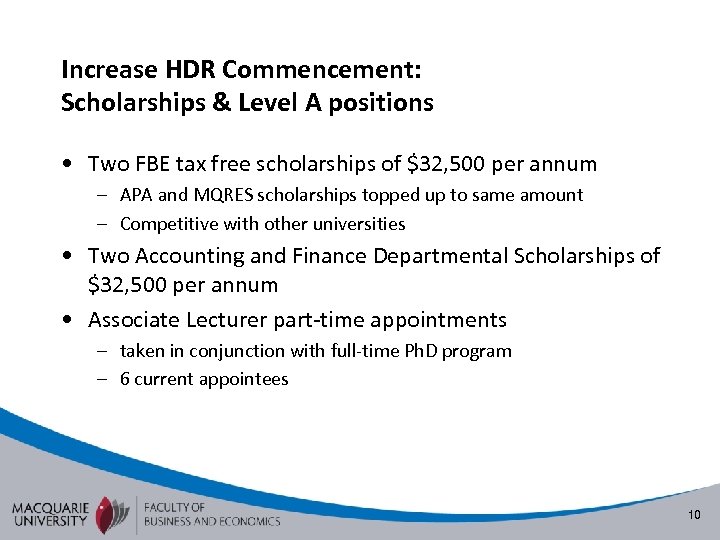 Increase HDR Commencement: Scholarships & Level A positions • Two FBE tax free scholarships of $32, 500 per annum – APA and MQRES scholarships topped up to same amount – Competitive with other universities • Two Accounting and Finance Departmental Scholarships of $32, 500 per annum • Associate Lecturer part-time appointments – taken in conjunction with full-time Ph. D program – 6 current appointees 10
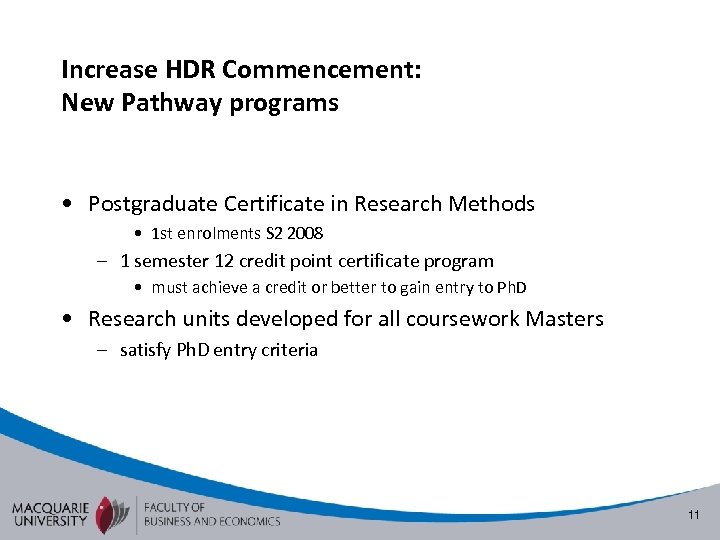 Increase HDR Commencement: New Pathway programs • Postgraduate Certificate in Research Methods • 1 st enrolments S 2 2008 – 1 semester 12 credit point certificate program • must achieve a credit or better to gain entry to Ph. D • Research units developed for all coursework Masters – satisfy Ph. D entry criteria 11
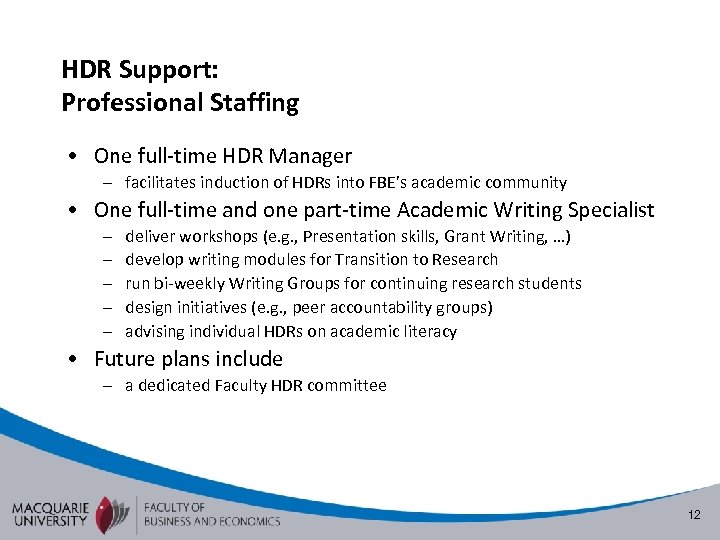 HDR Support: Professional Staffing • One full-time HDR Manager – facilitates induction of HDRs into FBE’s academic community • One full-time and one part-time Academic Writing Specialist – – – deliver workshops (e. g. , Presentation skills, Grant Writing, …) develop writing modules for Transition to Research run bi-weekly Writing Groups for continuing research students design initiatives (e. g. , peer accountability groups) advising individual HDRs on academic literacy • Future plans include – a dedicated Faculty HDR committee 12
 HDR Support: Quality Supervision • Supervisors required to – – complete Colloquia in Research Supervision comply with Code of Supervisory Practice be registered on Supervisor Register, held by Research Office FBE aiming to be 100% compliant with policy by 2010 • FBE recognises importance of quality supervision – Moving to treat supervision as part of academic teaching load – proposal to limit number of FTE HDRs per supervisor • audit of supervisor workloads is underway • currently 50% of supervisors are on the register 13
 HDR Support: Resources • $10 000 funding over candidature • Computers – provided to all on-campus full-time candidates • Workspace – most on-campus full-time candidates are provided with a permanent workspace near the Faculty • HDR guide and FBE Guidelines – provide information on HDR support and processes • Lack of space is a major concern for future HDR growth 14
 HDR Support: Commencement Program • FBE HDR Commencement Week – Welcome Evening – Introductory seminars on candidature management, policies, resources • Transition to Research – 12 week research intensive seminar series • Protocol – leading to confirmation of candidature – Written & oral presentation after 6 months’ candidature 15
 HDR Support: Training • Candidates’ needs identified through Annual Report, Protocol. • Such training includes, but is not limited to – FBE sponsored training workshops – New workshops to be introduced in 2009 – Doctoral Symposium being developed for 2010 • Intensive 3 day training bringing together Ph. D candidates from universities throughout Australia 16
 HDR Experience • Candidates participate in – departmental seminars, workshops, reading groups and other academic events • FBE holds monthly feedback meetings with HDR candidates • Annual HDR Research EXPO – research intensive day to showcase HDR projects – opportunities to receive feedback in a supportive environment – industry partners are invited to attend and participate • In 2008 five partners from Deloitte held a seminar on areas of possible research collaboration 17
 International collaborations HDRs supported to present at international conferences to utilise links with international universities to conduct international fieldwork currently in Sri Lanka, Germany, Bangladesh, China, Indonesia Outreach opportunity Contact academics within the Asia-Pacific region intending to pursue Ph. Ds to come to Macquarie currently have one United Board scholarship holder Co-tutelle doctorates currently being investigated 18
 On-time completions • Commencement program – to achieve flying start • Thesis by Publication – FBE promotes as preferred format • Formal Completion Review Process – introduced in 2009 • meeting with supervisors and candidates 3 to 6 months prior to submission 19
 Issues • Space • Supervisor Training • International Collaborations 20