


 Скачать презентацию Research and Ph D programmes at the York
549af187689f5bcefeb383edb8d70152.ppt
- Количество слайдов: 30
 Research and Ph. D programmes at the York Plasma Institute Professor Kieran Gibson York Plasma Institute Department of Physics, University of York kieran. gibson@york. ac. uk
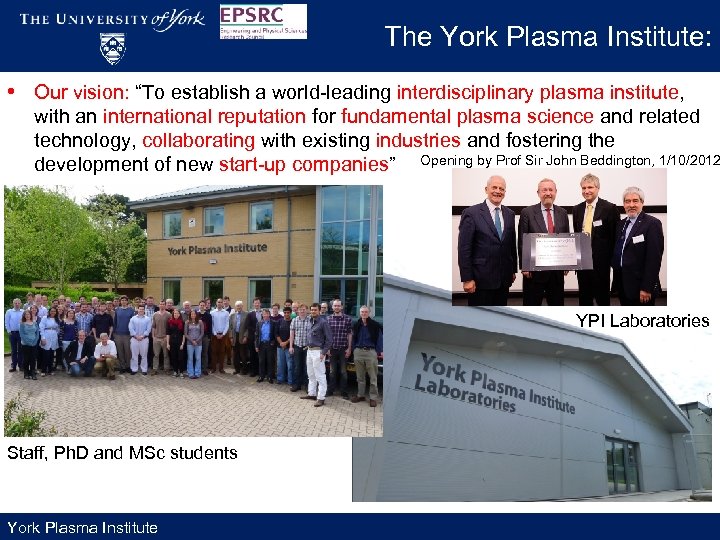 The York Plasma Institute: • Our vision: “To establish a world-leading interdisciplinary plasma institute, with an international reputation for fundamental plasma science and related technology, collaborating with existing industries and fostering the development of new start-up companies” Opening by Prof Sir John Beddington, 1/10/2012 YPI Laboratories Staff, Ph. D and MSc students York Plasma Institute
 York Plasma Institute: The three research strands • Academic staff span three strands, supported by Industry Officer (Dr Kate Lancaster) • Magnetic confinement fusion – – – Prof Howard Wilson (lead) Prof Kieran Gibson Dr Roddy Vann Dr Ben Dudson Prof Bruce Lipschultz Dr Matt Reinke – Laser-plasma interaction – – – Prof Greg Tallents (lead) Dr Nigel Woolsey Dr John Pasley Dr Chris Ridgers Prof Geoff Pert, FRS (emeritus) • Low temperature plasmas • • – Prof Timo Gans (lead) – Dr Deborah O’Connell – Dr Erik Wagenaars 7 PDRA staff and Research Officer 30 Ph. D students York Plasma Institute
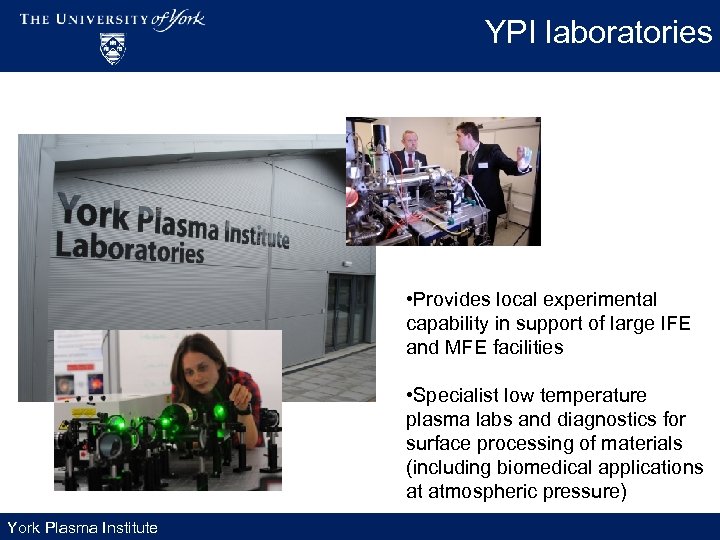 YPI laboratories • Provides local experimental capability in support of large IFE and MFE facilities • Specialist low temperature plasma labs and diagnostics for surface processing of materials (including biomedical applications at atmospheric pressure) York Plasma Institute
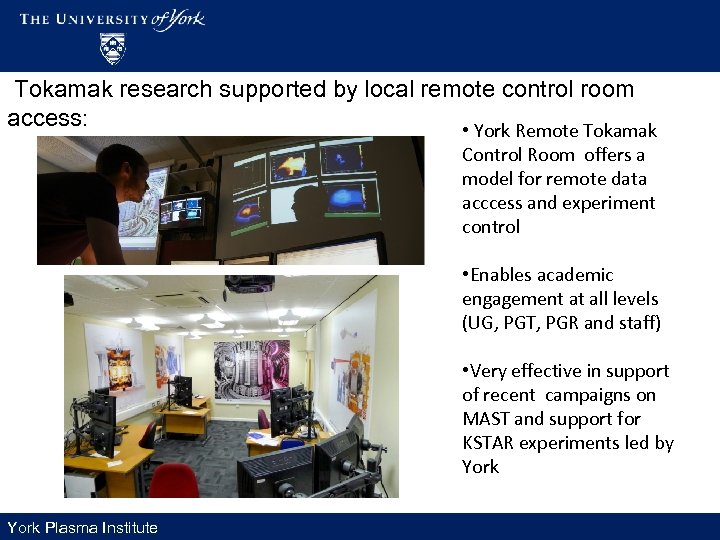 Tokamak research supported by local remote control room access: • York Remote Tokamak Control Room offers a model for remote data acccess and experiment control • Enables academic engagement at all levels (UG, PGT, PGR and staff) • Very effective in support of recent campaigns on MAST and support for KSTAR experiments led by York Plasma Institute
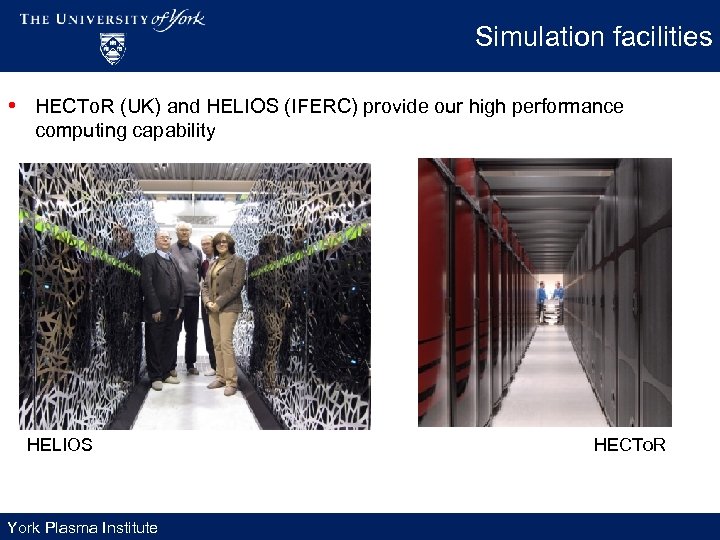 Simulation facilities • HECTo. R (UK) and HELIOS (IFERC) provide our high performance computing capability HELIOS York Plasma Institute HECTo. R
 Magnetic Confinement Fusion York Plasma Institute
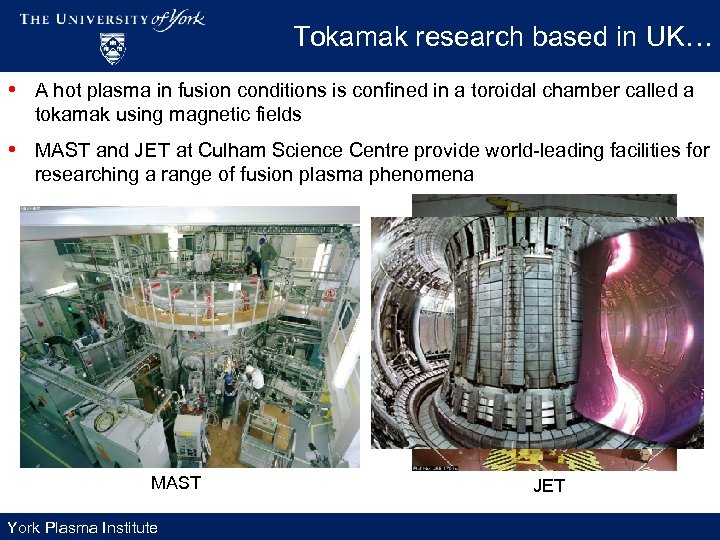 Tokamak research based in UK… • A hot plasma in fusion conditions is confined in a toroidal chamber called a tokamak using magnetic fields • MAST and JET at Culham Science Centre provide world-leading facilities for researching a range of fusion plasma phenomena MAST York Plasma Institute JET
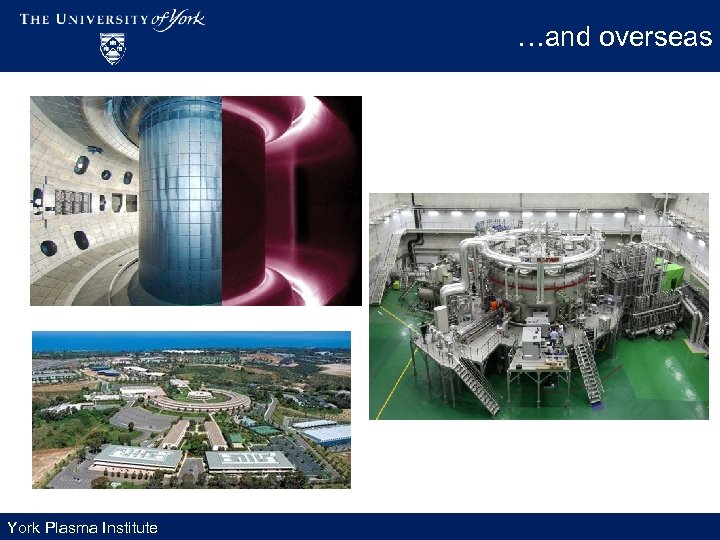 …and overseas York Plasma Institute
 …and overseas York Plasma Institute
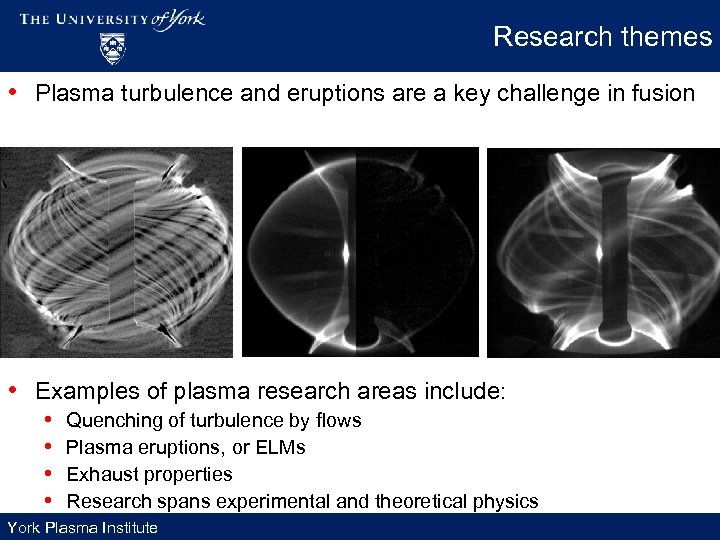 Research themes • Plasma turbulence and eruptions are a key challenge in fusion • Examples of plasma research areas include: • • Quenching of turbulence by flows Plasma eruptions, or ELMs Exhaust properties Research spans experimental and theoretical physics York Plasma Institute
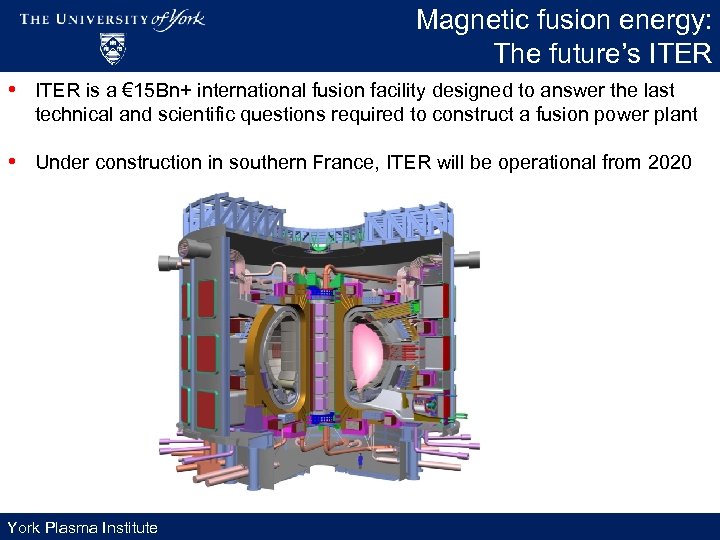 Magnetic fusion energy: The future’s ITER • ITER is a € 15 Bn+ international fusion facility designed to answer the last technical and scientific questions required to construct a fusion power plant • Under construction in southern France, ITER will be operational from 2020 York Plasma Institute
 Laser-Plasma Interaction York Plasma Institute
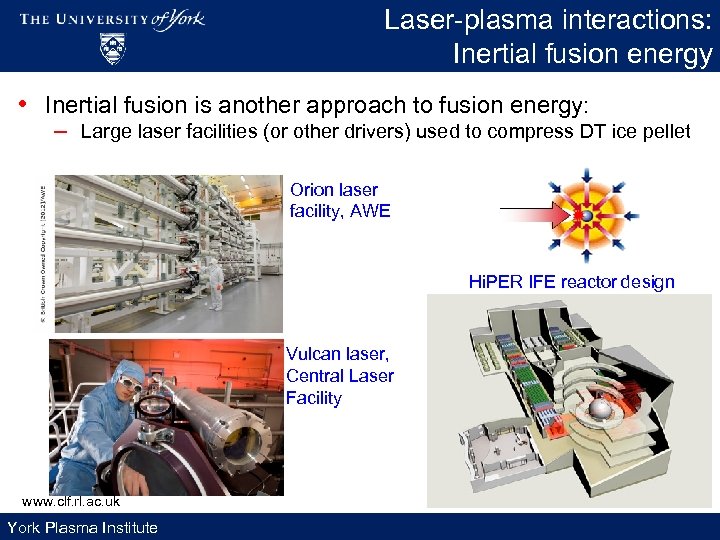 Laser-plasma interactions: Inertial fusion energy • Inertial fusion is another approach to fusion energy: – Large laser facilities (or other drivers) used to compress DT ice pellet Orion laser facility, AWE Hi. PER IFE reactor design Vulcan laser, Central Laser Facility www. clf. rl. ac. uk York Plasma Institute
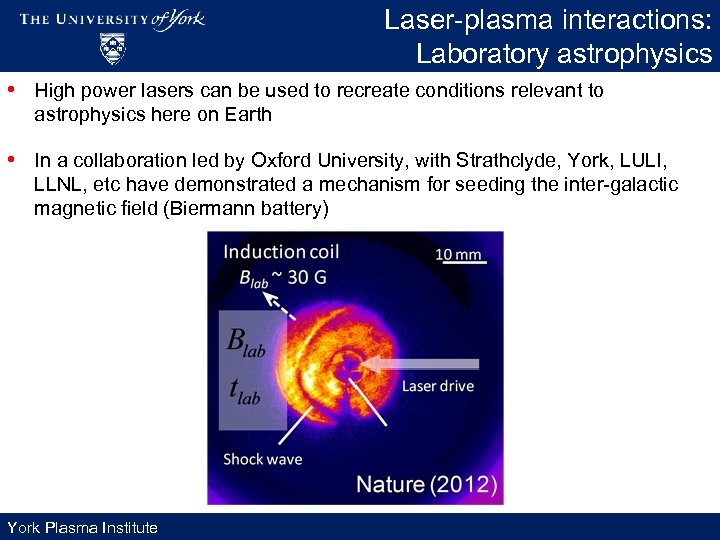 Laser-plasma interactions: Laboratory astrophysics • High power lasers can be used to recreate conditions relevant to astrophysics here on Earth • In a collaboration led by Oxford University, with Strathclyde, York, LULI, LLNL, etc have demonstrated a mechanism for seeding the inter-galactic magnetic field (Biermann battery) York Plasma Institute
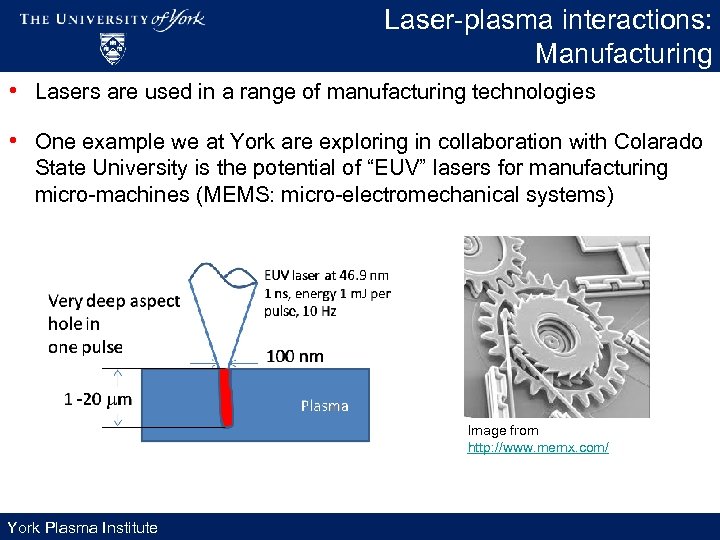 Laser-plasma interactions: Manufacturing • Lasers are used in a range of manufacturing technologies • One example we at York are exploring in collaboration with Colarado State University is the potential of “EUV” lasers for manufacturing micro-machines (MEMS: micro-electromechanical systems) Image from http: //www. memx. com/ York Plasma Institute
 Low Temperature Plasmas York Plasma Institute
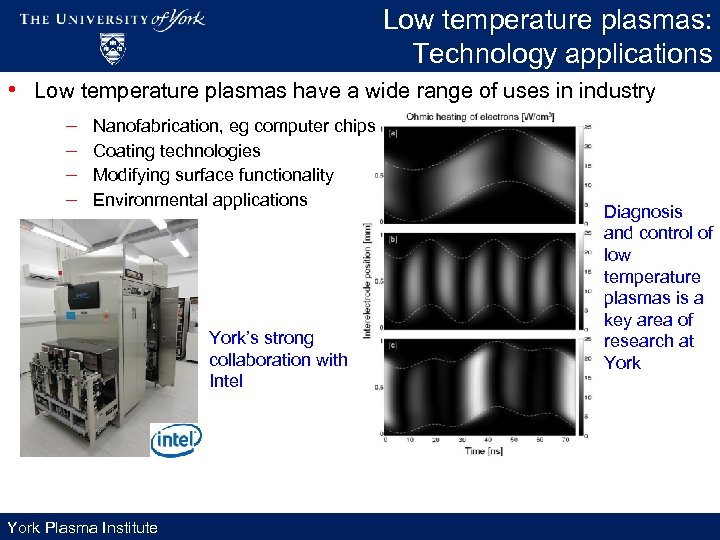 Low temperature plasmas: Technology applications • Low temperature plasmas have a wide range of uses in industry - Nanofabrication, eg computer chips Coating technologies Modifying surface functionality Environmental applications York’s strong collaboration with Intel York Plasma Institute Diagnosis and control of low temperature plasmas is a key area of research at York
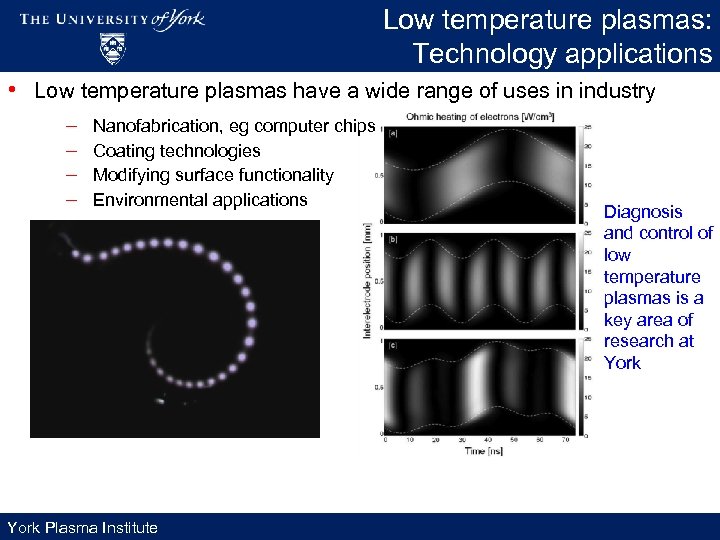 Low temperature plasmas: Technology applications • Low temperature plasmas have a wide range of uses in industry - Nanofabrication, eg computer chips Coating technologies Modifying surface functionality Environmental applications York Plasma Institute Diagnosis and control of low temperature plasmas is a key area of research at York
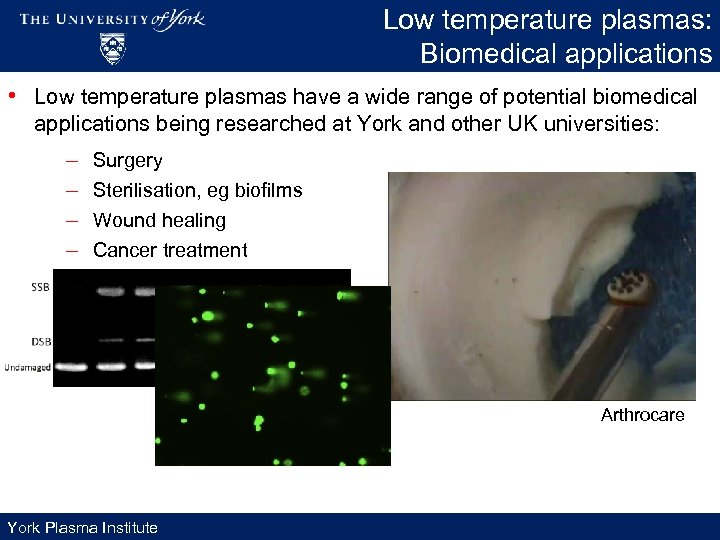 Low temperature plasmas: Biomedical applications • Low temperature plasmas have a wide range of potential biomedical applications being researched at York and other UK universities: - Surgery Sterilisation, eg biofilms Wound healing Cancer treatment Arthrocare York Plasma Institute
 EPSRC Centre for Doctoral Training in The Science and Technology of Fusion Energy
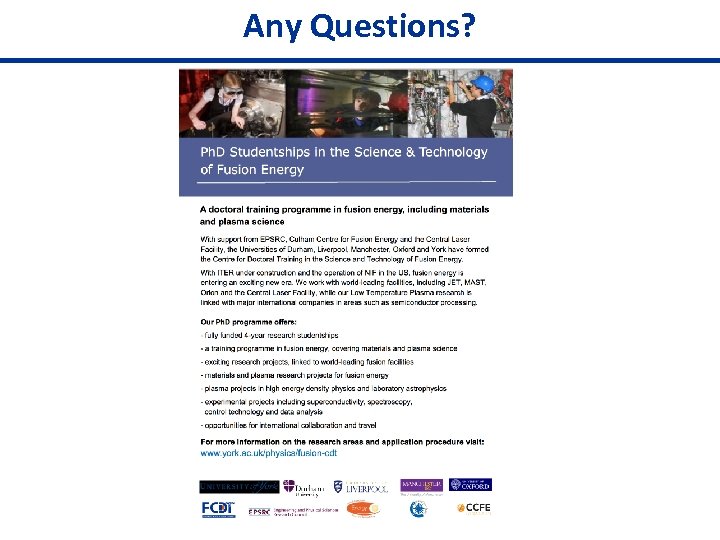
 The FCDT Scheme: key features • A training programme with total value over £ 12 M part of ~£ 350 M EPSRC initiative across all areas of physical sciences and engineering • York Plasma Institute leads network of 5 Universities (Durham, Liverpool, Manchester, Oxford, York) • Key features - 4 -year doctoral programme - Typical intakes of 10 -14 students per year for up to 5 intakes - formal assessable coursework (innovative delivery, broadening skills. . . ) - Original research project -Cohort approach (eg peer-peer learning) - Transferable skills and outreach
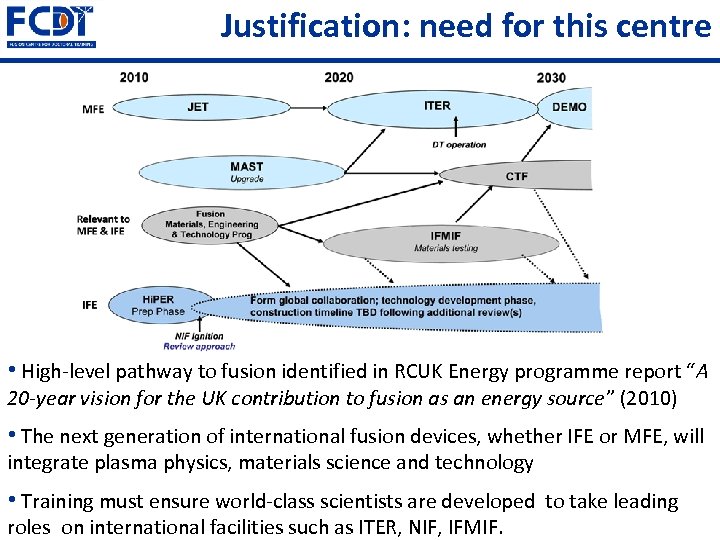 Justification: need for this centre • High-level pathway to fusion identified in RCUK Energy programme report “A 20 -year vision for the UK contribution to fusion as an energy source” (2010) • The next generation of international fusion devices, whether IFE or MFE, will integrate plasma physics, materials science and technology • Training must ensure world-class scientists are developed to take leading roles on international facilities such as ITER, NIF, IFMIF.
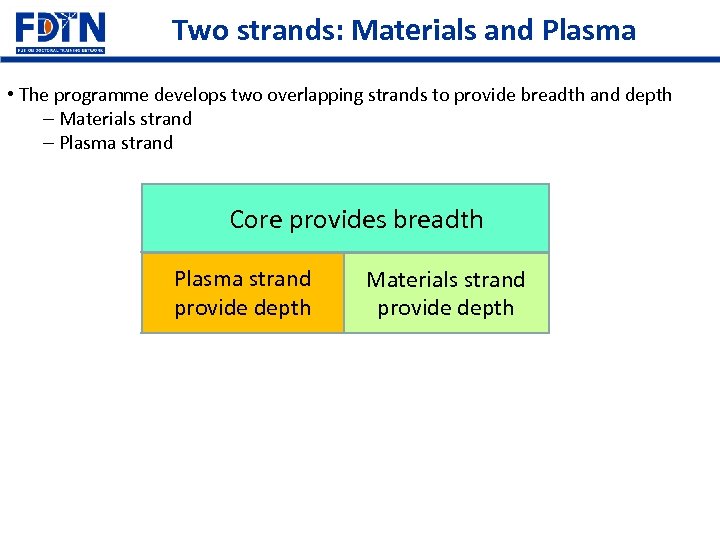 Two strands: Materials and Plasma • The programme develops two overlapping strands to provide breadth and depth - Materials strand - Plasma strand Core provides breadth Plasma strand provide depth Materials strand provide depth
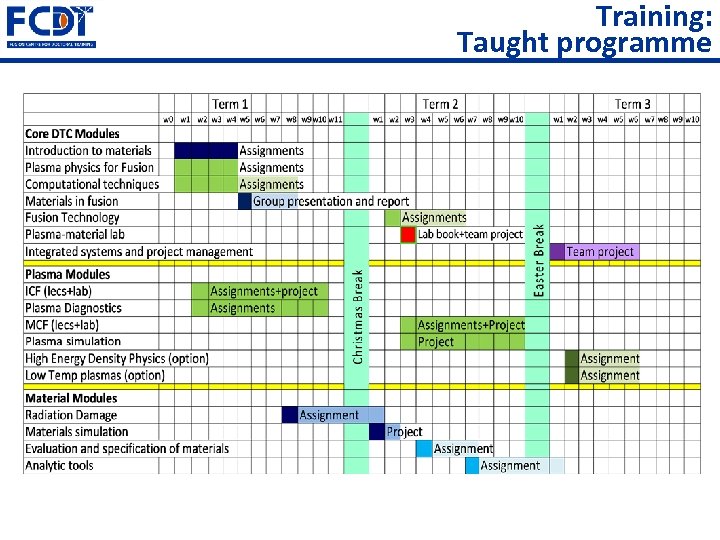 Training: Taught programme
 Training: Professional development • Skills are integrated into the taught programme – – – Group presentations in “materials applications” and “Project management” Remote collaboration in “Project management” Teamwork skills in the Plasma-Material interaction lab Proposal writing, paper writing and presentation skills in Collaboratory (year 2) Nuclear safety integrated into “Fusion Experience” course (year 3 -4) • In addition, there are some dedicated professional development activities: - Continuation of successful sundome outreach programme Two high profile outreach days at CCFE and RAL, involving media, industry and children Teambuilding courses Programme management and QA “Fusion experience” at CCFE, RAL and AWE (a week-long course led by national labs) Summer schools and international conferences Extended research placement at an international laboratory or industry (at least 3 -4 weeks) • York’s postgraduate professional development courses are available to all: – CV-writing; interview technique; presentation skills; Latex; IP and patents; enterprise…
 Full programme meets Fuse. Net accreditation • Skills are integrated into the taught programme – – – Group presentations in “materials applications” and “Project management” Remote collaboration in “Project management” Teamwork skills in the Plasma-Material interaction lab Proposal writing, paper writing and presentation skills in Collaboratory (year 2) Nuclear safety integrated into “Fusion Experience” course (year 3 -4) • In addition, there are some dedicated professional development activities: - Continuation of successful sundome outreach programme Two high profile outreach days at CCFE and RAL, involving media, industry and children Teambuilding courses Programme management and QA “Fusion experience” at CCFE, RAL and AWE (a week-long course led by national labs) Summer schools and international conferences Extended research placement at an international laboratory or industry (at least 3 -4 weeks) • York’s postgraduate professional development courses are available to all: – CV-writing; interview technique; presentation skills; Latex; IP and patents; enterprise…
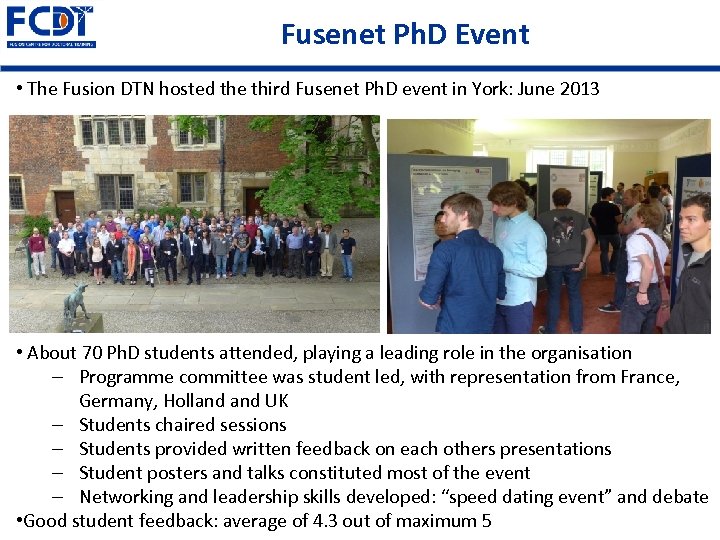 Fusenet Ph. D Event • The Fusion DTN hosted the third Fusenet Ph. D event in York: June 2013 • About 70 Ph. D students attended, playing a leading role in the organisation – Programme committee was student led, with representation from France, Germany, Holland UK – Students chaired sessions – Students provided written feedback on each others presentations – Student posters and talks constituted most of the event – Networking and leadership skills developed: “speed dating event” and debate • Good student feedback: average of 4. 3 out of maximum 5
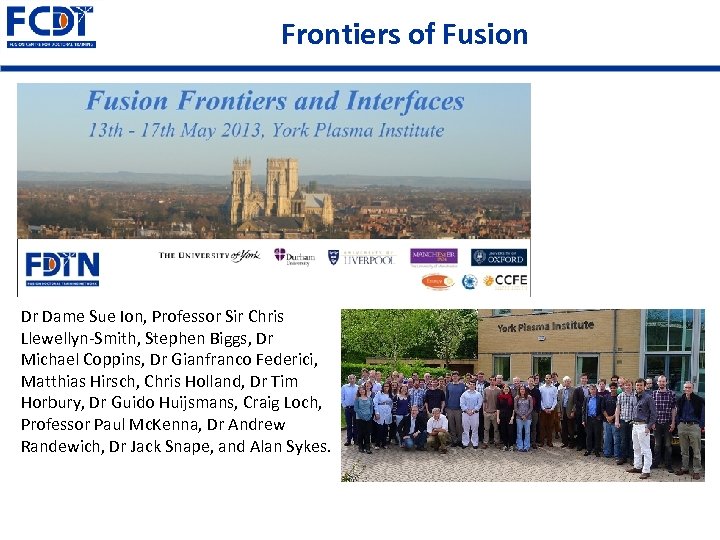 Frontiers of Fusion Dr Dame Sue Ion, Professor Sir Chris Llewellyn-Smith, Stephen Biggs, Dr Michael Coppins, Dr Gianfranco Federici, Matthias Hirsch, Chris Holland, Dr Tim Horbury, Dr Guido Huijsmans, Craig Loch, Professor Paul Mc. Kenna, Dr Andrew Randewich, Dr Jack Snape, and Alan Sykes.
 Any Questions?