


 Скачать презентацию Requirements of Financial Institutions for the financing of
6f9373fd9ebba9767dac15f39ae20624.ppt
- Количество слайдов: 27
 Requirements of Financial Institutions for the financing of gas infrastructure projects ABN AMRO Presentation to the Council of European Energy Regulators Workshop Brussels, 9 th November 2006
 Disclaimer This presentation was prepared by ABN AMRO exclusively for the benefit and use in the CEER Workshop. This presentation is incomplete without reference to, and should be viewed solely in conjunction with, the oral briefing provided by ABN AMRO. The presentation is proprietary to ABN AMRO and may not be disclosed to any third party or used for any other purpose without the prior written consent of ABN AMRO. The information in this presentation reflects prevailing conditions and our views as of this date, which are accordingly subject to change. In preparing this presentation, we have relied upon and assumed, without independent verification, the accuracy and completeness of all information available from public sources or which was otherwise reviewed by us. In addition, our analyses are not and do not purport to be appraisals of the assets, stock or business of the Company. Even when this presentation contains a kind of appraisal, it should be considered preliminary, suitable only for the purpose described herein and not be disclosed or otherwise used without the prior written consent of ABN AMRO. The information in this presentation does not take into account the effects of a possible transaction or transactions involving an actual or potential change of control, which may have significant valuation and other effects. 2
 Contact Information Rob Shepherd Executive Director Structured Loans and Advisory ABN AMRO Bank N. V. 250 Bishopsgate London EC 2 M 4 AA +44 20 7678 6629 rob. shepherd@uk. abnamro. com 3
 Table of contents 1 The Gas Infrastructure Market in Perspective 2 Lender Requirements for New Gas Infrastructure 4
 Food for Thought…. . It is primarily due to the fact that our upstream gas colleagues continue to fail to find gas “close to markets” that keeps those of us involved in the gas infrastructure industry in jobs and more importantly enables us to be here today discussing the relevant issues……. . 5
 1 The Gas Infrastructure Market in Perspective
 Common Types of Gas Infrastructure Projects 1. LNG Regasification Terminals 2. Pipeline Projects 3. Storage Facilities 4. Vessel Finance 7
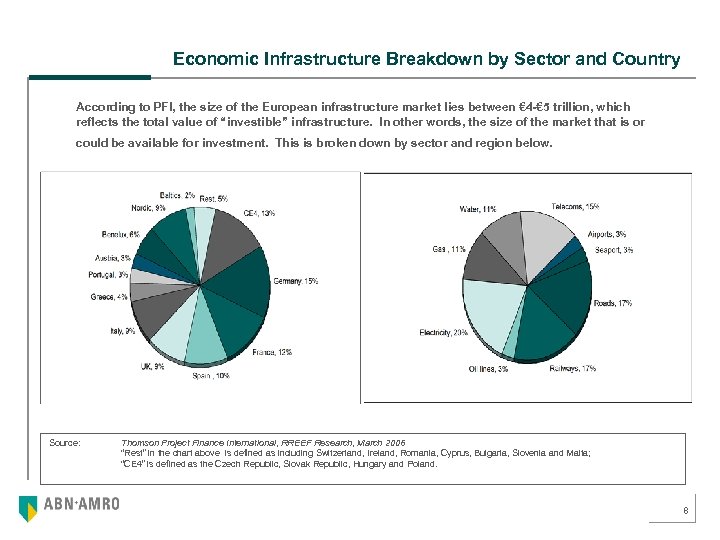 Economic Infrastructure Breakdown by Sector and Country According to PFI, the size of the European infrastructure market lies between € 4 -€ 5 trillion, which reflects the total value of “investible” infrastructure. In other words, the size of the market that is or could be available for investment. This is broken down by sector and region below. Source: Thomson Project Finance International, RREEF Research, March 2006 “Rest” in the chart above is defined as including Switzerland, Ireland, Romania, Cyprus, Bulgaria, Slovenia and Malta; “CE 4” is defined as the Czech Republic, Slovak Republic, Hungary and Poland. 8
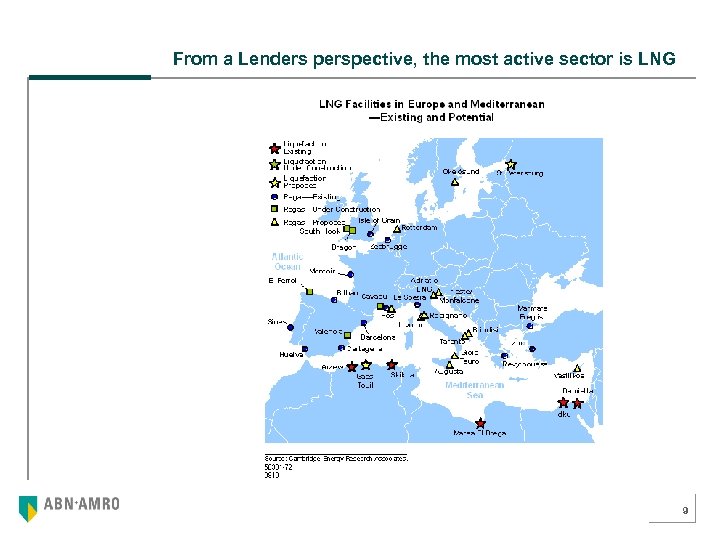 From a Lenders perspective, the most active sector is LNG 9
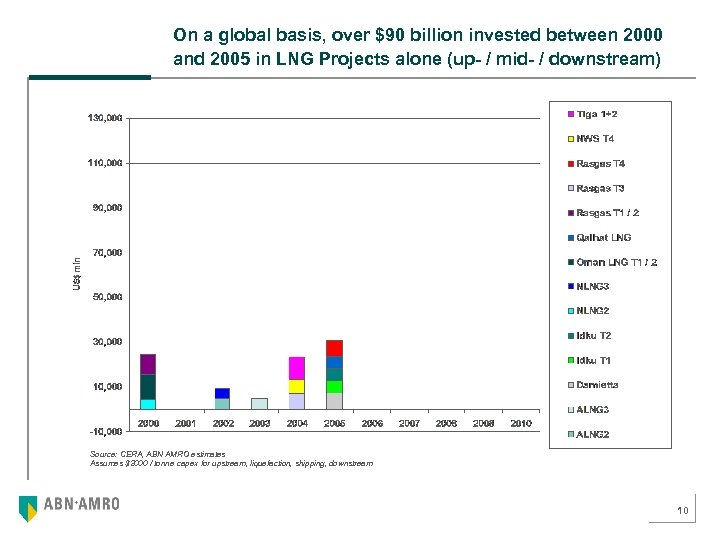 On a global basis, over $90 billion invested between 2000 and 2005 in LNG Projects alone (up- / mid- / downstream) Source: CERA, ABN AMRO estimates Assumes $2000 / tonne capex for upstream, liquefaction, shipping, downstream 10
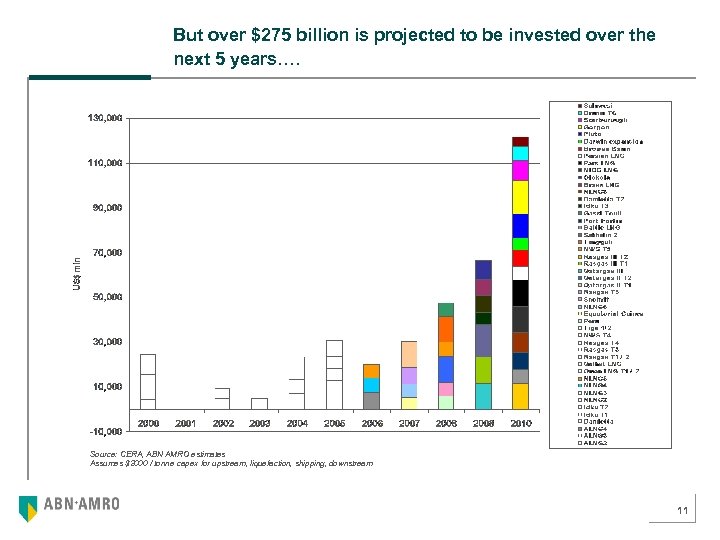 But over $275 billion is projected to be invested over the next 5 years…. Source: CERA, ABN AMRO estimates Assumes $2000 / tonne capex for upstream, liquefaction, shipping, downstream 11
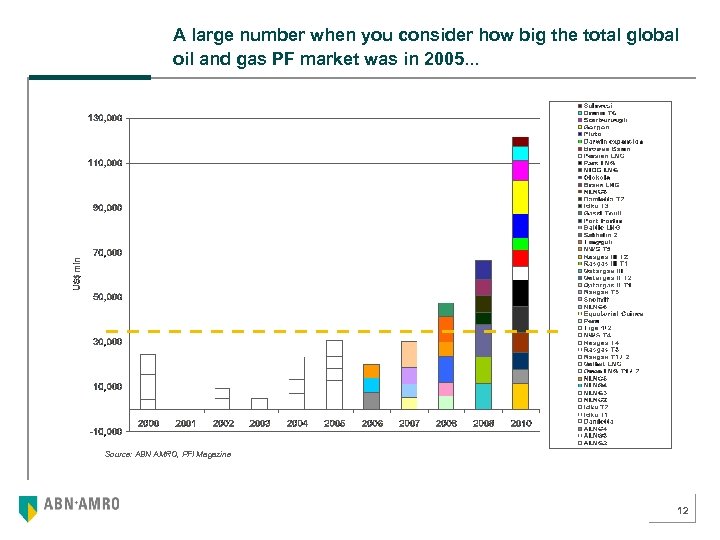 A large number when you consider how big the total global oil and gas PF market was in 2005. . . Source: ABN AMRO, PFI Magazine 12
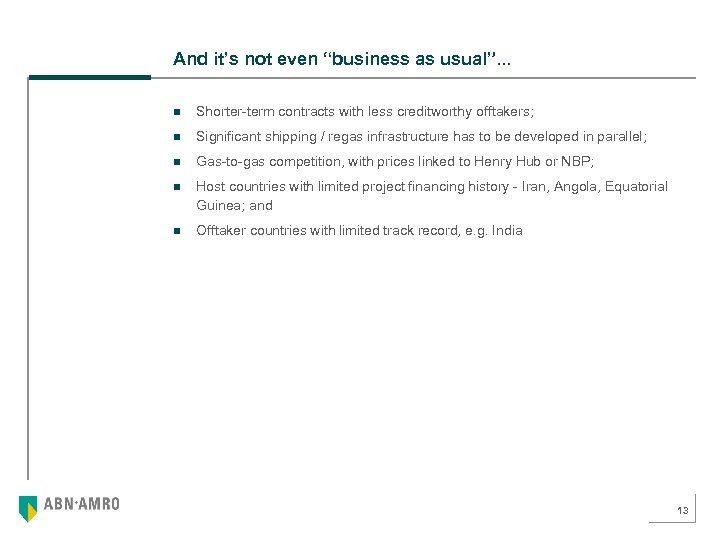 And it’s not even “business as usual”. . . n Shorter-term contracts with less creditworthy offtakers; n Significant shipping / regas infrastructure has to be developed in parallel; n Gas-to-gas competition, with prices linked to Henry Hub or NBP; n Host countries with limited project financing history - Iran, Angola, Equatorial Guinea; and n Offtaker countries with limited track record, e. g. India 13
 2 Lender Requirements for Gas Infrastructure Projects
 So what are the issues that concern Lenders…. n Political Risks n Technical Risks n Commercial Risks Remember, the best we lenders can do is get all of our money back, we don’t share in the upside as do the Governments and sponsors 15
 Political Risks “Traditional” political risks include: n Expropriation n Political Violence n Transfer and Convertibility n Contract stability 16
 Political Risks (continued) n Whilst in reality there may be no sound basis for these concerns (for example, the UK remains one of the most “unstable” investment environments), projects in “newer” countries may require support from Export Credit Agencies and / or Multi-Lateral Agencies; n This will lead to significant complications in the financing process - and lengthen the time to complete; n As lenders become increasingly comfortable with the stability in particular countries, political risks become less of a concern - e. g. Qatar, Oman The key remains a stable, supportive host Government 17
 Political Risks (continued) n In the European context, the key issue is the Gas Directive; n From a lenders perspective, the specific provisions contained within clauses 18 (“Third Party Access”) and 25 (“Regulatory Authorities”) would give potential concerns as to the predictability and stability of applicable tariffs and shipped volumes going forward. n Based on our understanding of the Gas Directive, the only way that sufficient comfort could be provided to lenders in relation to tariffs and volume usage would be for the Project to benefit from an exemption in relation to the relevant clauses, as envisaged under the terms of clause 22 (“New Infrastructure”). 18
 Technical Risks n Lenders remain generally unwilling to accept “technical” risks in major greenfield developments and so will continue to seek “pre-completion” support; n This will be a challenge for some less creditworthy sponsors, as they seek to develop multiple projects almost simultaneously; n The key is to focus lenders not on “will it complete? ”, more on “what are the risks of (a) cost overruns and / or (b) start-up delays? ” n These can be “back-stopped in different ways, e. g. insurance, risk-sharing with contractor(s), “conservative” budgets, cost overrun facilities Lenders want to see strong sponsorship with an established track record of (a) delivering and (b) operating major projects. 19
 “Technical” Risks (continued) n The overwhelming majority of project finance banks have signed up to the Equator Principles, which create minimum standards for the Environmental and Social Compliance of projects which they finance; n In practice, we would not expect the standards of host governments involved in Western European jurisdictions to be materially divergent from the Equator Principles (which essentially refer back to World Bank principles), however, this may not be the case in the emerging markets. In any case, financial institutions are increasingly concerned with the environmental impacts and issues around the projects they finance. 20
 Commercial Risks n Whilst lenders can accept “commercial risks” in gas production projects, they are generally absorbed in infrastructure projects by the shippers through long-term “ship or pay” contracts; n Key issues for infrastructure lenders are therefore: – Long-term creditworthiness of the shipper(s); – Accepting flexibility in relation to “traditional clauses”, such as Destination-, Force Majeure; – Progressing major financings on the back of LOIs / Ho. As, as opposed to “termed” contracts; and – Giving “value” to un-contracted capacity 21
 Commercial Risks (continued) n Modifying key contractual terms should be doable, as long as the overall risk profile remains “balanced” - sponsors shouldn’t seek to transfer risks to lenders that they aren’t comfortable with themselves; n Lenders are being flexible in progressing financings in parallel with the commercial / technical process; and n In terms of giving “value” to un-contracted capacity, the key will be to demonstrate (a) a strong case to demonstrate how this capacity will be utilised and (b) under what terms 22
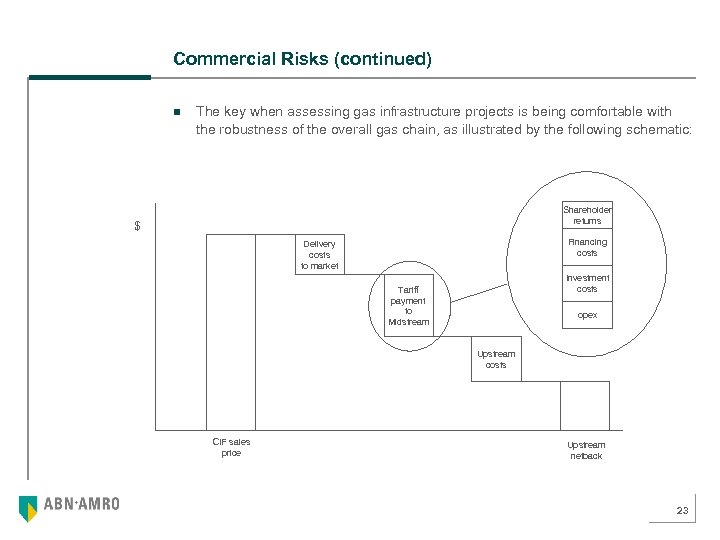 Commercial Risks (continued) n The key when assessing gas infrastructure projects is being comfortable with the robustness of the overall gas chain, as illustrated by the following schematic: Shareholder returns $ Financing costs Delivery costs to market Investment costs Tariff payment to Midstream opex Upstream costs CIF sales price Upstream netback 23
 Typical Project Finance Security Package n Whilst there have been few examples of gas infrastructure projects defaulting in recent years, prudent risk management by lenders requires them to create security rights that can be enforced in case of default; n The will typically require the following types of security by way of assignment or pledge: – Shareholders’ agreement; – pledge of project company shares; – mortgages over the project company physical assets; – assignment of the major project commercial agreements – Construction contracts, offtake contracts, operation and maintenance agreements, etc; – assignment of project insurances – pledge of project accounts (including the debt service reserve account); – direct agreements with the counterparties to the major project commercial agreements; and – hedging arrangements if required. 24
 In conclusion, lenders look forward to the next wave of gas infrastructure projects…. n A balanced risk profile is the key to ensure success: n Supportive host/offtaker Government(s) n Strong support for mitigating technical risks n Robust underlying commercial structure (contracts) and economic viability Early involvement of financial advisor can be critical in ensuring efficient financing process subsequently 25
 Annex 1 Loan Markets Performance - 2006
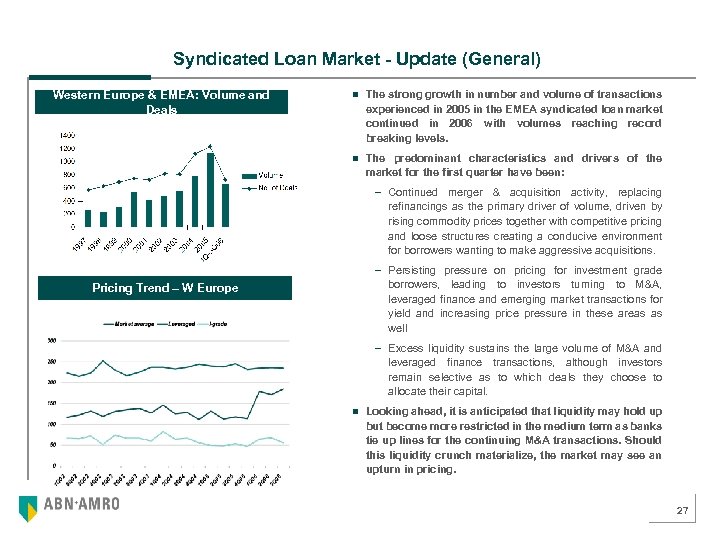 Syndicated Loan Market - Update (General) n The strong growth in number and volume of transactions experienced in 2005 in the EMEA syndicated loan market continued in 2006 with volumes reaching record breaking levels. n Western Europe & EMEA: Volume and Deals The predominant characteristics and drivers of the market for the first quarter have been: – Continued merger & acquisition activity, replacing refinancings as the primary driver of volume, driven by rising commodity prices together with competitive pricing and loose structures creating a conducive environment for borrowers wanting to make aggressive acquisitions. – Persisting pressure on pricing for investment grade borrowers, leading to investors turning to M&A, leveraged finance and emerging market transactions for yield and increasing price pressure in these areas as well Pricing Trend – W Europe – Excess liquidity sustains the large volume of M&A and leveraged finance transactions, although investors remain selective as to which deals they choose to allocate their capital. n Looking ahead, it is anticipated that liquidity may hold up but become more restricted in the medium term as banks tie up lines for the continuing M&A transactions. Should this liquidity crunch materialize, the market may see an upturn in pricing. 27