


 Скачать презентацию Requirements Analysis and the Unified Process Last Update
9cf5d123297c734a6668c18252d0c623.ppt
- Количество слайдов: 75
 Requirements Analysis and the Unified Process Last Update: Thursday, September 6, 2001 9/3/01 CS 406 Fall 2001 Requirements Analysis 1
 Contents n n n Requirements Analysis: What and what? Unified Process OO Analysis and Design n 9/3/01 Basics UML Actors, Use cases CS 406 Fall 2001 Requirements Analysis 2
![Requirements Analysis [1] n What is it? n n The process by which customer](https://present5.com/presentation/9cf5d123297c734a6668c18252d0c623/image-3.jpg "Requirements Analysis [1] n What is it? n n The process by which customer") Requirements Analysis [1] n What is it? n n The process by which customer needs are understood and documented. Expresses “what” is to be built and NOT “how” it is to be built. Example 1: n The system shall allow users to withdraw cash. [ What? ] Example 2: n A sale item’s name and other attributes will be stored in a hash table and updated each time any attribute changes. [How? ] 9/3/01 CS 406 Fall 2001 Requirements Analysis 3
Requirements Analysis [1] n What is it? n n The process by which customer needs are understood and documented. Expresses “what” is to be built and NOT “how” it is to be built. Example 1: n The system shall allow users to withdraw cash. [ What? ] Example 2: n A sale item’s name and other attributes will be stored in a hash table and updated each time any attribute changes. [How? ] 9/3/01 CS 406 Fall 2001 Requirements Analysis 3
![Requirements Analysis [2] n C- and D-Requirements n n 9/3/01 C-: Customer wants and](https://present5.com/presentation/9cf5d123297c734a6668c18252d0c623/image-4.jpg "Requirements Analysis [2] n C- and D-Requirements n n 9/3/01 C-: Customer wants and") Requirements Analysis [2] n C- and D-Requirements n n 9/3/01 C-: Customer wants and needs; expressed in language understood by the customer. D-: For the developers; may be more formal. CS 406 Fall 2001 Requirements Analysis 4
Requirements Analysis [2] n C- and D-Requirements n n 9/3/01 C-: Customer wants and needs; expressed in language understood by the customer. D-: For the developers; may be more formal. CS 406 Fall 2001 Requirements Analysis 4
![Requirements Analysis [2] Why document requirements? Serves as a contract between the customer and](https://present5.com/presentation/9cf5d123297c734a6668c18252d0c623/image-5.jpg "Requirements Analysis [2] Why document requirements? Serves as a contract between the customer and") Requirements Analysis [2] Why document requirements? Serves as a contract between the customer and the developer. Serves as a source of test plans. Serves to specify project goals and plan development cycles and increments. 9/3/01 CS 406 Fall 2001 Requirements Analysis 5
Requirements Analysis [2] Why document requirements? Serves as a contract between the customer and the developer. Serves as a source of test plans. Serves to specify project goals and plan development cycles and increments. 9/3/01 CS 406 Fall 2001 Requirements Analysis 5
![Requirements Analysis [3] n Roadmap: n n 9/3/01 Identify the customer. Interview customer representatives.](https://present5.com/presentation/9cf5d123297c734a6668c18252d0c623/image-6.jpg "Requirements Analysis [3] n Roadmap: n n 9/3/01 Identify the customer. Interview customer representatives.") Requirements Analysis [3] n Roadmap: n n 9/3/01 Identify the customer. Interview customer representatives. Write C-requirements, review with customer, and update when necessary. Write D-requirements; check to make sure that there is no inconsistency between the C- and the D-requirements. CS 406 Fall 2001 Requirements Analysis 6
Requirements Analysis [3] n Roadmap: n n 9/3/01 Identify the customer. Interview customer representatives. Write C-requirements, review with customer, and update when necessary. Write D-requirements; check to make sure that there is no inconsistency between the C- and the D-requirements. CS 406 Fall 2001 Requirements Analysis 6
![Requirements Analysis [4] n C-requirements: n n Use cases expressed individually and with a](https://present5.com/presentation/9cf5d123297c734a6668c18252d0c623/image-7.jpg "Requirements Analysis [4] n C-requirements: n n Use cases expressed individually and with a") Requirements Analysis [4] n C-requirements: n n Use cases expressed individually and with a use case diagram. A use case specifies a collection of scenarios. n Sample use case: Process sale. Data flow diagram: n n State transition diagram: n n Explains the flow of data items across various functions. Useful for explaining system functions. [Example on the next slide. ] Explains the change of system state in response to one or more operations. [Example two slides later. ] User interface: Generally not a part of requirements analysis though may be included. [Read section 3. 5 from Braude. ] 9/3/01 CS 406 Fall 2001 Requirements Analysis 7
Requirements Analysis [4] n C-requirements: n n Use cases expressed individually and with a use case diagram. A use case specifies a collection of scenarios. n Sample use case: Process sale. Data flow diagram: n n State transition diagram: n n Explains the flow of data items across various functions. Useful for explaining system functions. [Example on the next slide. ] Explains the change of system state in response to one or more operations. [Example two slides later. ] User interface: Generally not a part of requirements analysis though may be included. [Read section 3. 5 from Braude. ] 9/3/01 CS 406 Fall 2001 Requirements Analysis 7
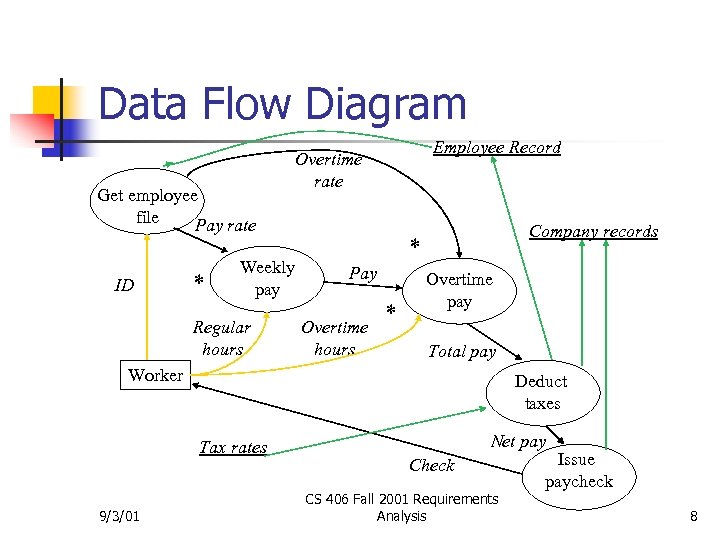 Data Flow Diagram Get employee file Pay rate ID * Weekly pay Regular hours Employee Record Overtime rate Company records * Pay Overtime hours * Overtime pay Total pay Worker Deduct taxes Tax rates 9/3/01 Net pay Check CS 406 Fall 2001 Requirements Analysis Issue paycheck 8
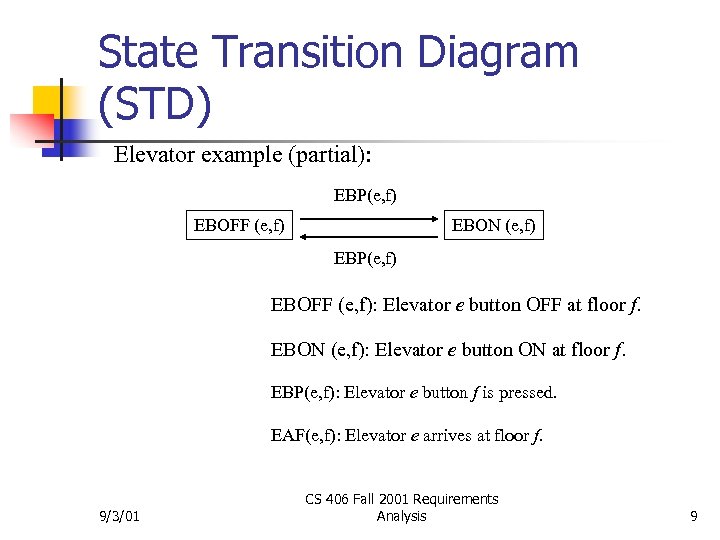 State Transition Diagram (STD) Elevator example (partial): EBP(e, f) EBOFF (e, f) EBON (e, f) EBP(e, f) EBOFF (e, f): Elevator e button OFF at floor f. EBON (e, f): Elevator e button ON at floor f. EBP(e, f): Elevator e button f is pressed. EAF(e, f): Elevator e arrives at floor f. 9/3/01 CS 406 Fall 2001 Requirements Analysis 9
![Requirements Analysis [5] n D-requirements: 1. 2. Organize the D-requirements. Create sequence diagrams for](https://present5.com/presentation/9cf5d123297c734a6668c18252d0c623/image-10.jpg "Requirements Analysis [5] n D-requirements: 1. 2. Organize the D-requirements. Create sequence diagrams for") Requirements Analysis [5] n D-requirements: 1. 2. Organize the D-requirements. Create sequence diagrams for use cases: n n n 3. 4. 9/3/01 Obtain D-requirements from C-requirements and customer. Outline test plans Inspect Validate with customer. Release: CS 406 Fall 2001 Requirements Analysis 10
Requirements Analysis [5] n D-requirements: 1. 2. Organize the D-requirements. Create sequence diagrams for use cases: n n n 3. 4. 9/3/01 Obtain D-requirements from C-requirements and customer. Outline test plans Inspect Validate with customer. Release: CS 406 Fall 2001 Requirements Analysis 10
![Requirements Analysis [6] 1. Organize the D-requirements. (a) (b) Functional requirements The blood pressure](https://present5.com/presentation/9cf5d123297c734a6668c18252d0c623/image-11.jpg "Requirements Analysis [6] 1. Organize the D-requirements. (a) (b) Functional requirements The blood pressure") Requirements Analysis [6] 1. Organize the D-requirements. (a) (b) Functional requirements The blood pressure monitor will measure the blood pressure and display it on the in-built screen Non-functional requirements (i) Performance The blood pressure monitor will complete a reading within 10 seconds. (i) Reliability The blood pressure monitor must have a failure probability of less than 0. 01 during the first 500 readings. 9/3/01 CS 406 Fall 2001 Requirements Analysis 11
Requirements Analysis [6] 1. Organize the D-requirements. (a) (b) Functional requirements The blood pressure monitor will measure the blood pressure and display it on the in-built screen Non-functional requirements (i) Performance The blood pressure monitor will complete a reading within 10 seconds. (i) Reliability The blood pressure monitor must have a failure probability of less than 0. 01 during the first 500 readings. 9/3/01 CS 406 Fall 2001 Requirements Analysis 11
![Requirements Analysis [7] (c) Interface requirements: interaction with the users and other applications The](https://present5.com/presentation/9cf5d123297c734a6668c18252d0c623/image-12.jpg "Requirements Analysis [7] (c) Interface requirements: interaction with the users and other applications The") Requirements Analysis [7] (c) Interface requirements: interaction with the users and other applications The blood pressure monitor will have a display screen and push buttons. The display screen will…. (d) Constraints: timing, accuracy The blood pressure monitor will take readings with an error less than 2%. 9/3/01 CS 406 Fall 2001 Requirements Analysis 12
Requirements Analysis [7] (c) Interface requirements: interaction with the users and other applications The blood pressure monitor will have a display screen and push buttons. The display screen will…. (d) Constraints: timing, accuracy The blood pressure monitor will take readings with an error less than 2%. 9/3/01 CS 406 Fall 2001 Requirements Analysis 12
![Requirements Analysis [7] Properties of D-requirements: 1. Traceability: Functional requirements D-requirement inspection report design](https://present5.com/presentation/9cf5d123297c734a6668c18252d0c623/image-13.jpg "Requirements Analysis [7] Properties of D-requirements: 1. Traceability: Functional requirements D-requirement inspection report design") Requirements Analysis [7] Properties of D-requirements: 1. Traceability: Functional requirements D-requirement inspection report design segment code inspection report test plan test report 2. Traceability: Non-Functional requirements (a) (b) 9/3/01 Isolate each non-functional requirement. Document each class/function with the related non-functional requirement. CS 406 Fall 2001 Requirements Analysis 13
Requirements Analysis [7] Properties of D-requirements: 1. Traceability: Functional requirements D-requirement inspection report design segment code inspection report test plan test report 2. Traceability: Non-Functional requirements (a) (b) 9/3/01 Isolate each non-functional requirement. Document each class/function with the related non-functional requirement. CS 406 Fall 2001 Requirements Analysis 13
![Requirements Analysis [8] Properties of D-requirements: 3. Testability It must be possible to test](https://present5.com/presentation/9cf5d123297c734a6668c18252d0c623/image-14.jpg "Requirements Analysis [8] Properties of D-requirements: 3. Testability It must be possible to test") Requirements Analysis [8] Properties of D-requirements: 3. Testability It must be possible to test each requirement. Example ? 4. Categorization and prioritization 9/3/01 CS 406 Fall 2001 Requirements Analysis 14
Requirements Analysis [8] Properties of D-requirements: 3. Testability It must be possible to test each requirement. Example ? 4. Categorization and prioritization 9/3/01 CS 406 Fall 2001 Requirements Analysis 14
 Categorizing Requirements n How to categorize system functions? 9/3/01 CS 406 Fall 2001 Requirements Analysis 15
 Prioritizing (Ranking) Use Cases n Strategy : n n n 9/3/01 pick the use cases that significantly influence the core architecture pick the use cases that are critical to the success of the business a useful rule of thumb - pick the use cases that are the highest risk!!! CS 406 Fall 2001 Requirements Analysis 16
![Requirements Analysis [9] Properties of D-requirements: 5. Completeness Self contained, no omissions. 6. Error](https://present5.com/presentation/9cf5d123297c734a6668c18252d0c623/image-17.jpg "Requirements Analysis [9] Properties of D-requirements: 5. Completeness Self contained, no omissions. 6. Error") Requirements Analysis [9] Properties of D-requirements: 5. Completeness Self contained, no omissions. 6. Error conditions State what happens in case of an error. How should the implementation react in case of an error condition? 9/3/01 CS 406 Fall 2001 Requirements Analysis 17
Requirements Analysis [9] Properties of D-requirements: 5. Completeness Self contained, no omissions. 6. Error conditions State what happens in case of an error. How should the implementation react in case of an error condition? 9/3/01 CS 406 Fall 2001 Requirements Analysis 17
![Requirements Analysis [10] Properties of D-requirements: 7. Consistency Different requirements must be consistent. Example:](https://present5.com/presentation/9cf5d123297c734a6668c18252d0c623/image-18.jpg "Requirements Analysis [10] Properties of D-requirements: 7. Consistency Different requirements must be consistent. Example:") Requirements Analysis [10] Properties of D-requirements: 7. Consistency Different requirements must be consistent. Example: R 1. 2: The speed of the vehicle will never exceed 250 mph. R 5. 4: When the vehicle is cruising at a speed greater than 300 mph, a special “watchdog” safety mechanism will be automatically activated. 9/3/01 CS 406 Fall 2001 Requirements Analysis 18
Requirements Analysis [10] Properties of D-requirements: 7. Consistency Different requirements must be consistent. Example: R 1. 2: The speed of the vehicle will never exceed 250 mph. R 5. 4: When the vehicle is cruising at a speed greater than 300 mph, a special “watchdog” safety mechanism will be automatically activated. 9/3/01 CS 406 Fall 2001 Requirements Analysis 18
 The Unified Process n Why a Process? n n Software projects are large, complex, sophisticated time to market is key many facets involved in getting to the end Common process should integrate the many facets n provide guidance to the order of activities n specify what artifacts need to be developed n offer criteria for monitoring and measuring a CS 406 Fall 2001 Requirements 9/3/01 project Analysis n 19
 The Unified Process n n n Component based - meaning the software system is built as a set of software components interconnected via interfaces Uses the Unified Modeling Language (UML) makes This is what the Unified process Use case driven Unique Architecture-centric Iterative and incremental Component: A physical and replaceable part of a system that conforms to and provides realization of a set of interfaces. Interface: A collection of operations that are used to specify a service of a class or a component 9/3/01 CS 406 Fall 2001 Requirements Analysis 20
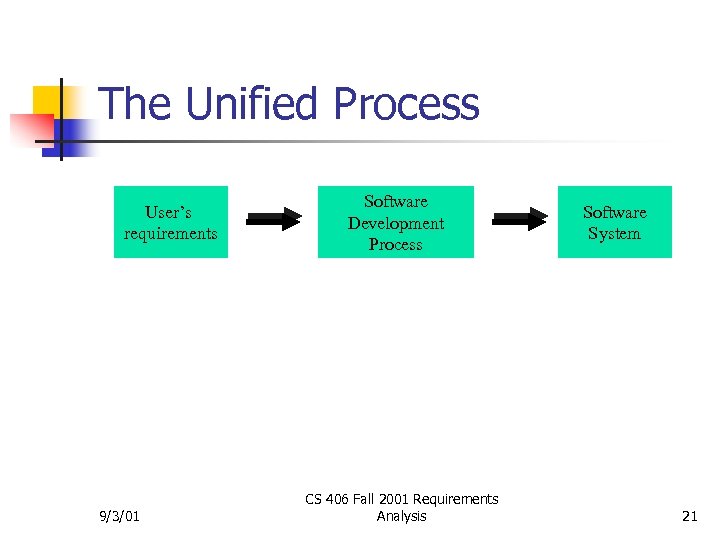 The Unified Process User’s requirements 9/3/01 Software Development Process CS 406 Fall 2001 Requirements Analysis Software System 21
 The Unified Process n Use Case driven n A use case is a piece of functionality in the system that gives a user a result of value Use cases capture functional requirements Use case answers the question: What is the system supposed to do for the user? 9/3/01 CS 406 Fall 2001 Requirements Analysis 22
 The Unified Process n Architecture centric n n similar to architecture for building a house Embodies the most significant static and dynamic aspects of the system Influenced by platform, OS, DBMS etc. Primarily serves the realization of use cases 9/3/01 CS 406 Fall 2001 Requirements Analysis 23
 The Unified Process n Iterative and Incremental n n commercial projects continue many months and years to be most effective - break the project into iterations n n Every iteration - identify use cases, create a design, implement the design Every iteration is a complete development process 9/3/01 CS 406 Fall 2001 Requirements Analysis 24
 The Unified Process n Look at the whole process n n n 9/3/01 Life cycle Artifacts Workflows Phases Iterations CS 406 Fall 2001 Requirements Analysis 25
 The Life of the Unified Process n n n Unified process repeats over a series of cycles Each cycle concludes with a product release Each cycle consists of four phases: n n 9/3/01 inception elaboration construction transition CS 406 Fall 2001 Requirements Analysis 26
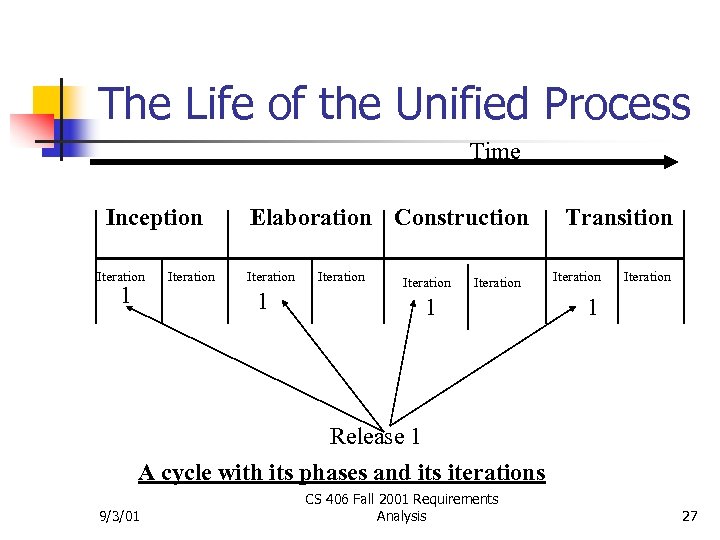 The Life of the Unified Process Time Inception Iteration 1 Iteration Elaboration Construction Iteration 1 Iteration 1 Transition Iteration 1 Release 1 A cycle with its phases and its iterations 9/3/01 CS 406 Fall 2001 Requirements Analysis 27
 OO Analysis and Design n Compare and Contrast analysis and design Define object-oriented analysis and design Relate, by analogy, OO analysis and design to business organization. 9/3/01 CS 406 Fall 2001 Requirements Analysis 28
 What is Analysis and Design? n n Analysis - investigation of the problem (what) Design - logical solution to fulfill the requirements (how) 9/3/01 CS 406 Fall 2001 Requirements Analysis 29
 What is OO analysis and design? n n Essence of OO analysis - consider a problem domain from the perspective of objects (real world things, concepts) Essence of OO design - define the solution as a collection of software objects (allocating responsibilities to objects) 9/3/01 CS 406 Fall 2001 Requirements Analysis 30
 Examples n OO Analysis - in the case of the library information systems, one would find concepts like book, library, patron n OO Design - emphasis on defining the software objects; ultimately these objects are implemented in some programming language; Book may have a method named print. 9/3/01 CS 406 Fall 2001 Requirements Analysis 31
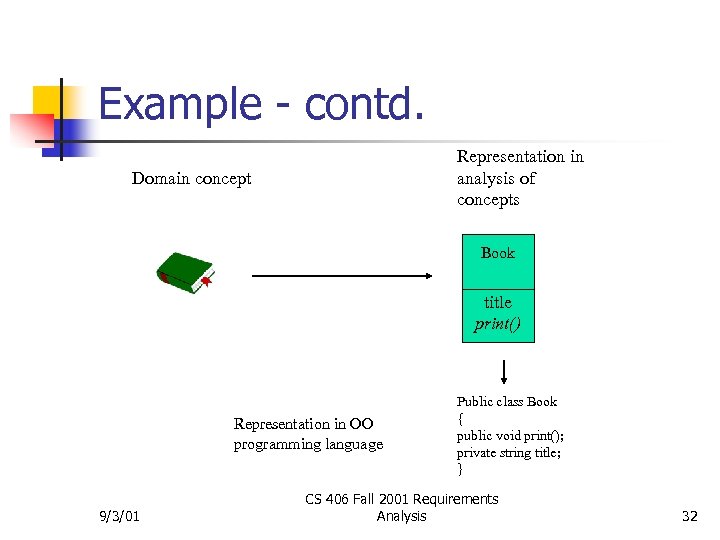 Example - contd. Representation in analysis of concepts Domain concept Book ______ title print() Representation in OO programming language 9/3/01 Public class Book { public void print(); private string title; } CS 406 Fall 2001 Requirements Analysis 32
 What are the business processes? n n First step - consider what the business must do; in the case of a library - lending books, keeping track of due dates, buying new books. In OO terms - requirements analysis; represent the business processes in textual narration (Use Cases). 9/3/01 CS 406 Fall 2001 Requirements Analysis 33
 Business processes - contd. n Identifying and recording the business processes as use cases is not actually an object oriented activity; though a necessary first step. 9/3/01 CS 406 Fall 2001 Requirements Analysis 34
 Roles in the organization n Identify the roles of people who will be involved in the business processes In OO terms - domain analysis Examples - customer, library assistant, programmer, navigator, sensor, etc. 9/3/01 CS 406 Fall 2001 Requirements Analysis 35
 Who does what? Collaboration n Business processes and people identified; time to determine how to fulfill the processes and who does these processes in OO terms - object oriented design; assigning responsibilities to the various software objects often expressed in class diagrams 9/3/01 CS 406 Fall 2001 Requirements Analysis 36
 In Summary. . . 9/3/01 CS 406 Fall 2001 Requirements Analysis 37
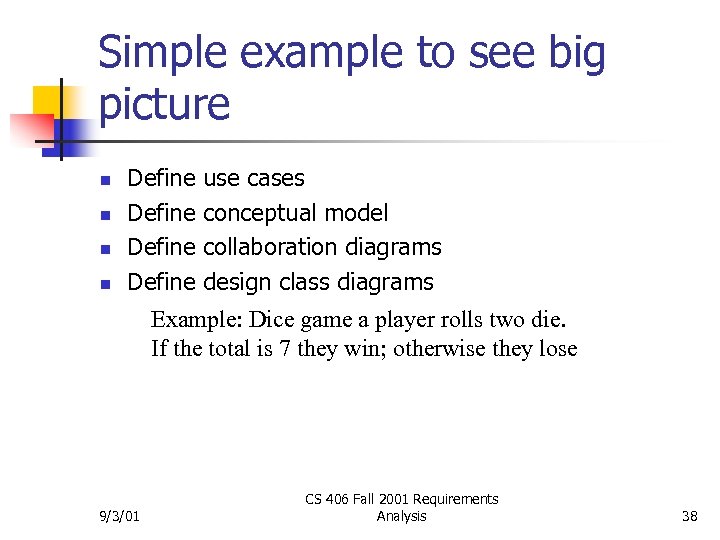 Simple example to see big picture n n Define use cases conceptual model collaboration diagrams design class diagrams Example: Dice game a player rolls two die. If the total is 7 they win; otherwise they lose 9/3/01 CS 406 Fall 2001 Requirements Analysis 38
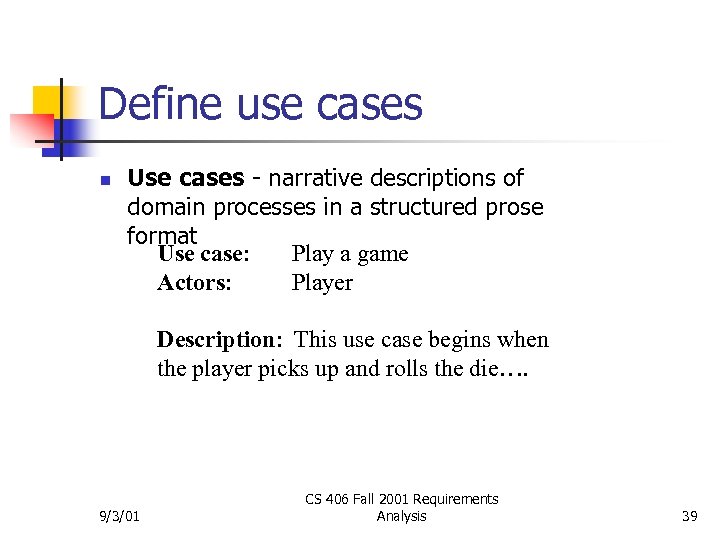 Define use cases n Use cases - narrative descriptions of domain processes in a structured prose format Use case: Play a game Actors: Player Description: This use case begins when the player picks up and rolls the die…. 9/3/01 CS 406 Fall 2001 Requirements Analysis 39
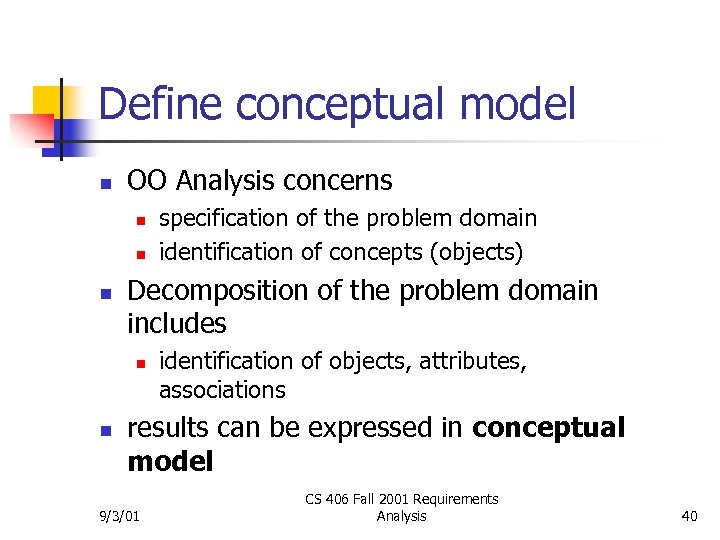 Define conceptual model n OO Analysis concerns n n n Decomposition of the problem domain includes n n specification of the problem domain identification of concepts (objects) identification of objects, attributes, associations results can be expressed in conceptual model 9/3/01 CS 406 Fall 2001 Requirements Analysis 40
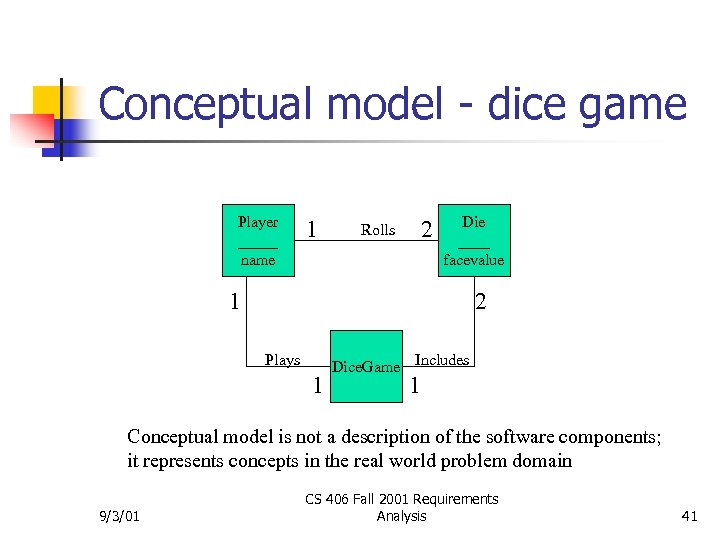 Conceptual model - dice game Player _____ name 1 2 Rolls Die ____ facevalue 1 2 Plays 1 Dice. Game Includes 1 Conceptual model is not a description of the software components; it represents concepts in the real world problem domain 9/3/01 CS 406 Fall 2001 Requirements Analysis 41
 Defining collaboration diagram n OO Design is concerned with n n n defining logical software specification that fulfills the requirements Essential step - allocating responsibility to objects and illustrating how they interact with other objects Expressed as Collaboration diagrams express the flow of messages between Objects. 9/3/01 CS 406 Fall 2001 Requirements Analysis 42
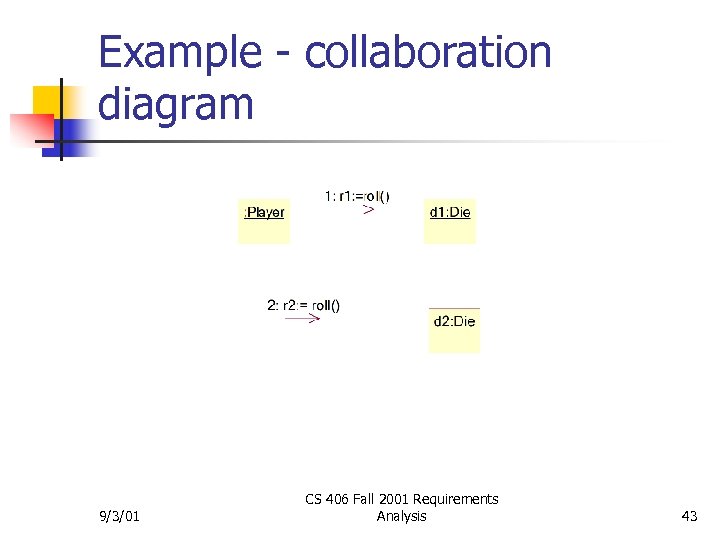 Example - collaboration diagram 9/3/01 CS 406 Fall 2001 Requirements Analysis 43
 Defining class diagrams n Key questions to ask n n How do objects connect to other objects? What are the behaviors (methods) of these objects? Collaboration diagrams suggests connections; to support these connections methods are needed Expressed as class diagrams 9/3/01 CS 406 Fall 2001 Requirements Analysis 44
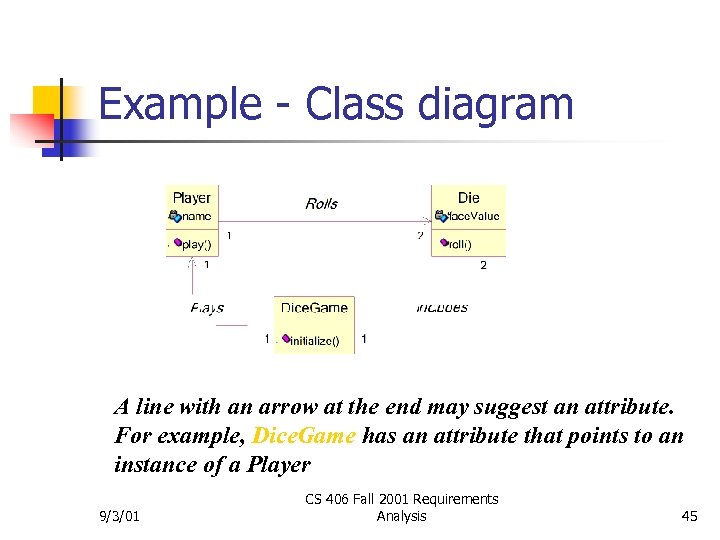 Example - Class diagram A line with an arrow at the end may suggest an attribute. For example, Dice. Game has an attribute that points to an instance of a Player 9/3/01 CS 406 Fall 2001 Requirements Analysis 45
 Defining Models and Artifacts n Objectives n n analysis and design models familiarize UML notations and diagrams real world software systems are inherently complex Models provide a mechanism for decomposition and expressing specifications 9/3/01 CS 406 Fall 2001 Requirements Analysis 46
 Analysis and Design models n n Analysis model - models related to an investigation of the domain and problem space (Use case model qualifies as an example) Design model - models related to the solution (class diagrams qualifies as an example) 9/3/01 CS 406 Fall 2001 Requirements Analysis 47
![Introduction to UML[1] n n UML UML 9/3/01 is is NOT a methodology NOT](https://present5.com/presentation/9cf5d123297c734a6668c18252d0c623/image-48.jpg "Introduction to UML[1] n n UML UML 9/3/01 is is NOT a methodology NOT") Introduction to UML[1] n n UML UML 9/3/01 is is NOT a methodology NOT a process NOT proprietary (Now under the OMG) strictly Notations CS 406 Fall 2001 Requirements Analysis 48
Introduction to UML[1] n n UML UML 9/3/01 is is NOT a methodology NOT a process NOT proprietary (Now under the OMG) strictly Notations CS 406 Fall 2001 Requirements Analysis 48
![Introduction to UML[2] n Goals of UML notation n n 9/3/01 Simple : requires](https://present5.com/presentation/9cf5d123297c734a6668c18252d0c623/image-49.jpg "Introduction to UML[2] n Goals of UML notation n n 9/3/01 Simple : requires") Introduction to UML[2] n Goals of UML notation n n 9/3/01 Simple : requires only a few concepts and symbols Expressive : applicable to a wide spectrum of systems and life cycle methods Useful : focuses only upon those necessary elements to software engineering Consistent : the same concept and symbol should be applied in the same fashion throughout CS 406 Fall 2001 Requirements Analysis 49
Introduction to UML[2] n Goals of UML notation n n 9/3/01 Simple : requires only a few concepts and symbols Expressive : applicable to a wide spectrum of systems and life cycle methods Useful : focuses only upon those necessary elements to software engineering Consistent : the same concept and symbol should be applied in the same fashion throughout CS 406 Fall 2001 Requirements Analysis 49
![Introduction to UML[3] n Goals of UML notation: n n n Printable Extensible :](https://present5.com/presentation/9cf5d123297c734a6668c18252d0c623/image-50.jpg "Introduction to UML[3] n Goals of UML notation: n n n Printable Extensible :") Introduction to UML[3] n Goals of UML notation: n n n Printable Extensible : users and tool builders should have some freedom to extend the notation UML has different parts n n n 9/3/01 Views - shows different aspects of the system that are modeled, links the modeling language to the method/process chosen for development Diagrams - graphs that describe the contents in a view Model elements - concepts used in a diagram CS 406 Fall 2001 Requirements Analysis 50
Introduction to UML[3] n Goals of UML notation: n n n Printable Extensible : users and tool builders should have some freedom to extend the notation UML has different parts n n n 9/3/01 Views - shows different aspects of the system that are modeled, links the modeling language to the method/process chosen for development Diagrams - graphs that describe the contents in a view Model elements - concepts used in a diagram CS 406 Fall 2001 Requirements Analysis 50
![Introduction to UML[4] Component View Logical View Use Case View Deployment View 9/3/01 Concurrenc](https://present5.com/presentation/9cf5d123297c734a6668c18252d0c623/image-51.jpg "Introduction to UML[4] Component View Logical View Use Case View Deployment View 9/3/01 Concurrenc") Introduction to UML[4] Component View Logical View Use Case View Deployment View 9/3/01 Concurrenc y View CS 406 Fall 2001 Requirements Analysis 51
Introduction to UML[4] Component View Logical View Use Case View Deployment View 9/3/01 Concurrenc y View CS 406 Fall 2001 Requirements Analysis 51
![Introduction to UML[5] n n n Use-case view : A view showing the functionality](https://present5.com/presentation/9cf5d123297c734a6668c18252d0c623/image-52.jpg "Introduction to UML[5] n n n Use-case view : A view showing the functionality") Introduction to UML[5] n n n Use-case view : A view showing the functionality of the system as perceived by the external actors Logical view: A view showing how the functionality is designed inside the system, in terms of the static structure and dynamic behavior Component view: A view showing the organization of the code components 9/3/01 CS 406 Fall 2001 Requirements Analysis 52
Introduction to UML[5] n n n Use-case view : A view showing the functionality of the system as perceived by the external actors Logical view: A view showing how the functionality is designed inside the system, in terms of the static structure and dynamic behavior Component view: A view showing the organization of the code components 9/3/01 CS 406 Fall 2001 Requirements Analysis 52
![Introduction to UML[6] n Concurrency view: A view showing the concurrency of the system](https://present5.com/presentation/9cf5d123297c734a6668c18252d0c623/image-53.jpg "Introduction to UML[6] n Concurrency view: A view showing the concurrency of the system") Introduction to UML[6] n Concurrency view: A view showing the concurrency of the system n Deployment view: A view showing the deployment of the system in terms of the physical architecture 9/3/01 CS 406 Fall 2001 Requirements Analysis 53
Introduction to UML[6] n Concurrency view: A view showing the concurrency of the system n Deployment view: A view showing the deployment of the system in terms of the physical architecture 9/3/01 CS 406 Fall 2001 Requirements Analysis 53
![Introduction to UML[9] n Model elements n Class Object State Use case Interface Association](https://present5.com/presentation/9cf5d123297c734a6668c18252d0c623/image-54.jpg "Introduction to UML[9] n Model elements n Class Object State Use case Interface Association") Introduction to UML[9] n Model elements n Class Object State Use case Interface Association Link n Package n n n 9/3/01 …. CS 406 Fall 2001 Requirements Analysis 54
Introduction to UML[9] n Model elements n Class Object State Use case Interface Association Link n Package n n n 9/3/01 …. CS 406 Fall 2001 Requirements Analysis 54
![Introduction to UML[10] n n n Use Case diagram: External interaction with actors Class/Object](https://present5.com/presentation/9cf5d123297c734a6668c18252d0c623/image-55.jpg "Introduction to UML[10] n n n Use Case diagram: External interaction with actors Class/Object") Introduction to UML[10] n n n Use Case diagram: External interaction with actors Class/Object Diagram : captures static structural aspects, objects and relationships State Diagram: Dynamic state behavior Sequence diagram: models object interaction over time Collaboration diagram: models component interaction and structural dependencies 9/3/01 CS 406 Fall 2001 Requirements Analysis 55
Introduction to UML[10] n n n Use Case diagram: External interaction with actors Class/Object Diagram : captures static structural aspects, objects and relationships State Diagram: Dynamic state behavior Sequence diagram: models object interaction over time Collaboration diagram: models component interaction and structural dependencies 9/3/01 CS 406 Fall 2001 Requirements Analysis 55
![Introduction to UML[11] n n n Activity diagram : models object activities Deployment diagram](https://present5.com/presentation/9cf5d123297c734a6668c18252d0c623/image-56.jpg "Introduction to UML[11] n n n Activity diagram : models object activities Deployment diagram") Introduction to UML[11] n n n Activity diagram : models object activities Deployment diagram : models physical architecture Component diagram : models software architecture 9/3/01 CS 406 Fall 2001 Requirements Analysis 56
Introduction to UML[11] n n n Activity diagram : models object activities Deployment diagram : models physical architecture Component diagram : models software architecture 9/3/01 CS 406 Fall 2001 Requirements Analysis 56
 Case study - Point of Sale n POS terminal should support the following n n n many architectural layers n n record sales handle payments presentation application logic (problem domain, service support) persistence Emphasis - problem domain application objects 9/3/01 CS 406 Fall 2001 Requirements Analysis 57
 Understanding requirements 9/3/01 CS 406 Fall 2001 Requirements Analysis 58
 Analysis n Objectives n n 9/3/01 Identification of Use cases Draw use case diagrams Ranking Use cases Contrast essential and real use cases CS 406 Fall 2001 Requirements Analysis 59
![Use cases [1] n n n Excellent technique for improving the understanding of requirements](https://present5.com/presentation/9cf5d123297c734a6668c18252d0c623/image-60.jpg "Use cases [1] n n n Excellent technique for improving the understanding of requirements") Use cases [1] n n n Excellent technique for improving the understanding of requirements Narrative in nature Use cases are dependent on having some understanding of the requirements (expressed in functional specifications document). 9/3/01 CS 406 Fall 2001 Requirements Analysis 60
Use cases [1] n n n Excellent technique for improving the understanding of requirements Narrative in nature Use cases are dependent on having some understanding of the requirements (expressed in functional specifications document). 9/3/01 CS 406 Fall 2001 Requirements Analysis 60
![Use Cases [2] n n Use case - narration of the sequence of events](https://present5.com/presentation/9cf5d123297c734a6668c18252d0c623/image-61.jpg "Use Cases [2] n n Use case - narration of the sequence of events") Use Cases [2] n n Use case - narration of the sequence of events of an actor using a system UML icon for use case 9/3/01 CS 406 Fall 2001 Requirements Analysis 61
Use Cases [2] n n Use case - narration of the sequence of events of an actor using a system UML icon for use case 9/3/01 CS 406 Fall 2001 Requirements Analysis 61
![Actors [1] n n n Actor - an entity external to the system that](https://present5.com/presentation/9cf5d123297c734a6668c18252d0c623/image-62.jpg "Actors [1] n n n Actor - an entity external to the system that") Actors [1] n n n Actor - an entity external to the system that in some way participates in the use case An actor typically stimulates the system with input events or receives outputs from the system or does both. UML notation for actor: 9/3/01 CS 406 Fall 2001 Requirements Analysis 62
Actors [1] n n n Actor - an entity external to the system that in some way participates in the use case An actor typically stimulates the system with input events or receives outputs from the system or does both. UML notation for actor: 9/3/01 CS 406 Fall 2001 Requirements Analysis 62
![Actors [2] n n n Primary Actor - an entity external to the system](https://present5.com/presentation/9cf5d123297c734a6668c18252d0c623/image-63.jpg "Actors [2] n n n Primary Actor - an entity external to the system") Actors [2] n n n Primary Actor - an entity external to the system that uses system services in a direct manner. Supporting Actor- an actor that provides services to the system being built. Hardware, software applications, individual processes, can all be actors. 9/3/01 CS 406 Fall 2001 Requirements Analysis 63
Actors [2] n n n Primary Actor - an entity external to the system that uses system services in a direct manner. Supporting Actor- an actor that provides services to the system being built. Hardware, software applications, individual processes, can all be actors. 9/3/01 CS 406 Fall 2001 Requirements Analysis 63
 Identification of Use Cases n Method 1 - Actor based n n n Method 2 - Event based n n n Identify the actors related to the system Identify the processes these actors initiate or participate in Identify the external events that a system must respond to Relate the events to actors and use cases Method 3 – Goal based n n n 9/3/01 [Actors have goals. ] Find user goals. [Prepare actor-goal list. ] Define a use case for each goal. CS 406 Fall 2001 Requirements Analysis 64
![Identification of Use Cases[2] n To identify use cases, focus on elementary business processes](https://present5.com/presentation/9cf5d123297c734a6668c18252d0c623/image-65.jpg "Identification of Use Cases[2] n To identify use cases, focus on elementary business processes") Identification of Use Cases[2] n To identify use cases, focus on elementary business processes (EBP). n An EBP is a task performed by one person in one place at one time, in response to a business event. This task adds measurable business value and leaves data in a consistent state. . 9/3/01 CS 406 Fall 2001 Requirements Analysis 65
Identification of Use Cases[2] n To identify use cases, focus on elementary business processes (EBP). n An EBP is a task performed by one person in one place at one time, in response to a business event. This task adds measurable business value and leaves data in a consistent state. . 9/3/01 CS 406 Fall 2001 Requirements Analysis 65
 Point of Sale - Actors n Actors: n n Cashier Customer Supervisor Choosing actors: n n n 9/3/01 Identify system boundary Identify entities, human or otherwise, that will interact with the system, from outside the boundary. Example: A temperature sensing device is an actor for a temperature monitoring application. CS 406 Fall 2001 Requirements Analysis 66
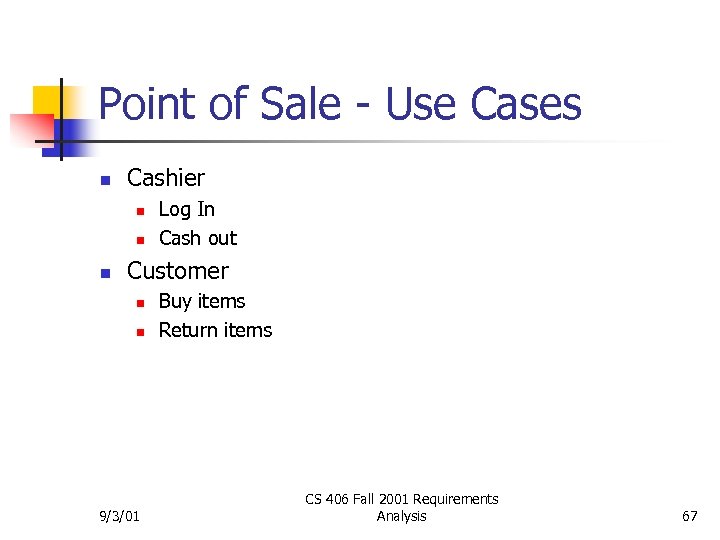 Point of Sale - Use Cases n Cashier n n n Log In Cash out Customer n n 9/3/01 Buy items Return items CS 406 Fall 2001 Requirements Analysis 67
 Common mistake n Common error representing individual steps as use cases n 9/3/01 Example: printing a receipt (Why? ) CS 406 Fall 2001 Requirements Analysis 68
![High level vs. Low Level Use cases[1] n Consider the following use cases: n](https://present5.com/presentation/9cf5d123297c734a6668c18252d0c623/image-69.jpg "High level vs. Low Level Use cases[1] n Consider the following use cases: n") High level vs. Low Level Use cases[1] n Consider the following use cases: n n n Log out Handle payment Negotiate contract with a supplier These use cases are at different levels. Are they all valid? To check, use the EBP definition. Log out: a secondary goal; it is necessary to do something but not useful in itself. Handle payment: A necessary EBP. Hence a primary goal. 9/3/01 CS 406 Fall 2001 Requirements Analysis 69
High level vs. Low Level Use cases[1] n Consider the following use cases: n n n Log out Handle payment Negotiate contract with a supplier These use cases are at different levels. Are they all valid? To check, use the EBP definition. Log out: a secondary goal; it is necessary to do something but not useful in itself. Handle payment: A necessary EBP. Hence a primary goal. 9/3/01 CS 406 Fall 2001 Requirements Analysis 69
![High level vs. Low Level Use cases [2] n n n Log out: a](https://present5.com/presentation/9cf5d123297c734a6668c18252d0c623/image-70.jpg "High level vs. Low Level Use cases [2] n n n Log out: a") High level vs. Low Level Use cases [2] n n n Log out: a secondary goal; it is necessary to do something but not useful in itself. Handle payment: A necessary EBP. Hence a primary goal. Negotiate contract: Most likely this is too high a level. It is composed of several EBPs and hence must be broken down. 9/3/01 CS 406 Fall 2001 Requirements Analysis 70
High level vs. Low Level Use cases [2] n n n Log out: a secondary goal; it is necessary to do something but not useful in itself. Handle payment: A necessary EBP. Hence a primary goal. Negotiate contract: Most likely this is too high a level. It is composed of several EBPs and hence must be broken down. 9/3/01 CS 406 Fall 2001 Requirements Analysis 70
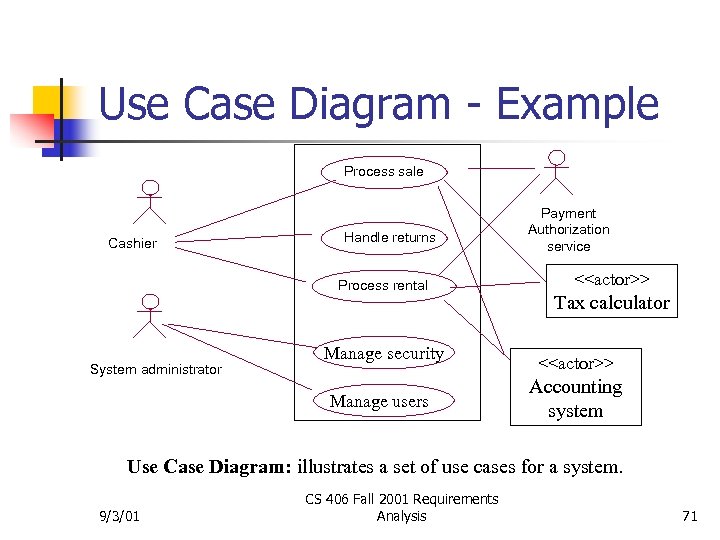 Use Case Diagram - Example Process sale Cashier Handle returns Process rental System administrator Manage security Manage users Payment Authorization service <
 More on Use Cases n n n Try to describe use cases independent of implementation Be as narrative as possible State success scenarios (how do you measure the success of an use case) A use can have many scenarios (threads of execution) Agree on a “format style” for use case description Name a use case starting with a verb in order to emphasize that it is a process (Buy Items, Enter an order, Reduce inventory) Requirements CS 406 Fall 2001 9/3/01 Analysis 72
 More on Use Cases n Document exception handling or branching n n 9/3/01 when a “Buy Item” fails, what is expected of the system when a “credit card” approval fails, what is expected of the system CS 406 Fall 2001 Requirements Analysis 73
 A sample Use Case Use case: Actors: Type: Description: 9/3/01 Buy Items Customer, Cashier Primary, Essential A customer arrives at a checkout with items to purchase. The cashier records the purchase items and collects payment. CS 406 Fall 2001 Requirements Analysis 74
 Ranking Use Cases n Use some ordering that is customary to your environment n n Example: High, Medium, Low Example: Must have, Essential, Nice to have n Useful while deciding what goes into an increment n Point of sale example: n n n 9/3/01 Buy Items - High Refund Items - Medium (Why? ) Shut Down POS terminal - Low CS 406 Fall 2001 Requirements Analysis 75