 Скачать презентацию República del Paraguay Tetã Paraguái Республіка Парагвай
стегура.ppt
- Количество слайдов: 10



República del Paraguay Tetã Paraguái Республіка Парагвай
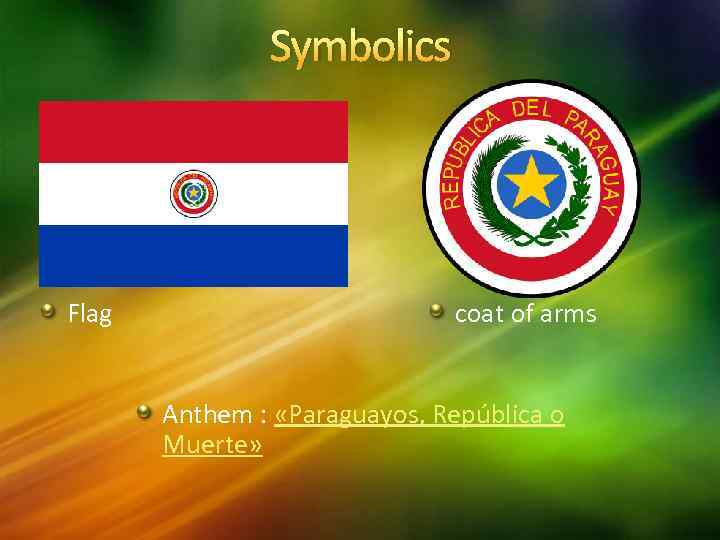
Symbolics Flag coat of arms Anthem : «Paraguayos, República o Muerte»
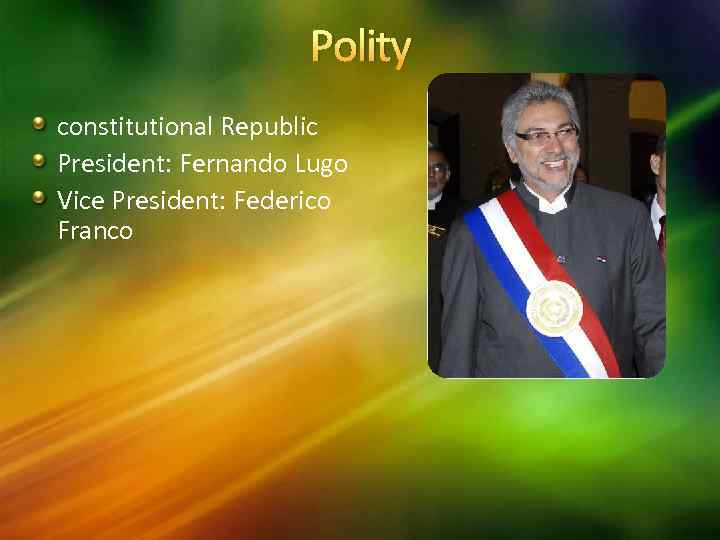
Polity constitutional Republic President: Fernando Lugo Vice President: Federico Franco
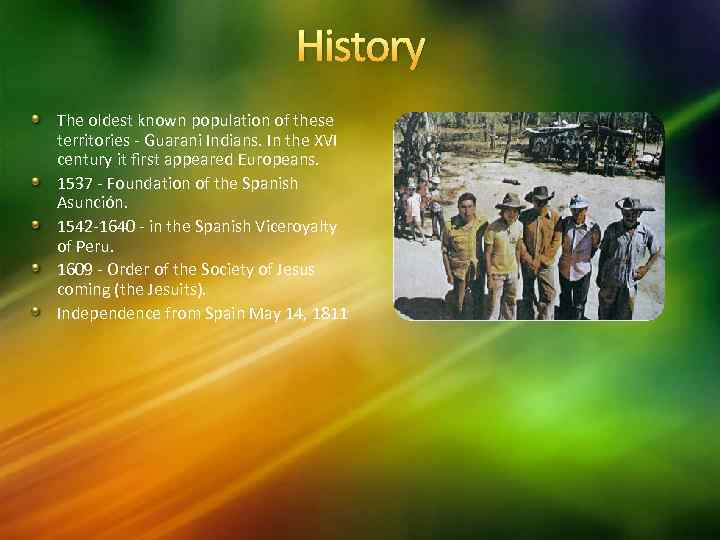
History The oldest known population of these territories - Guarani Indians. In the XVI century it first appeared Europeans. 1537 - Foundation of the Spanish Asunción. 1542 -1640 - in the Spanish Viceroyalty of Peru. 1609 - Order of the Society of Jesus coming (the Jesuits). Independence from Spain May 14, 1811
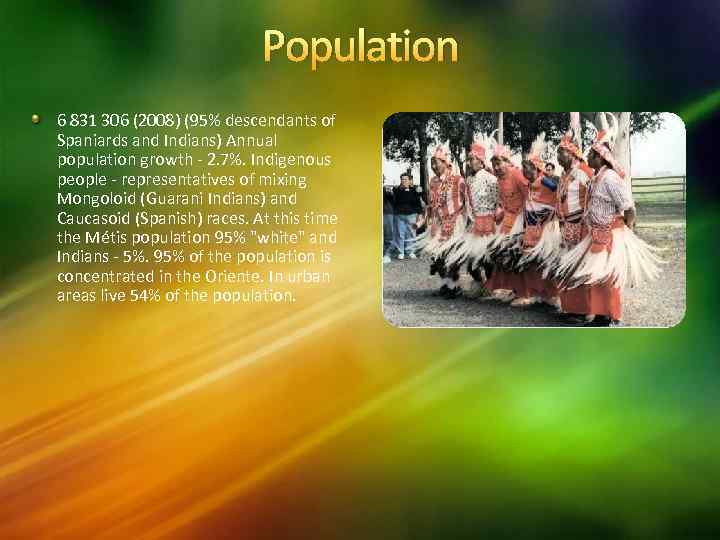
Population 6 831 306 (2008) (95% descendants of Spaniards and Indians) Annual population growth - 2. 7%. Indigenous people - representatives of mixing Mongoloid (Guarani Indians) and Caucasoid (Spanish) races. At this time the Métis population 95% "white" and Indians - 5%. 95% of the population is concentrated in the Oriente. In urban areas live 54% of the population.
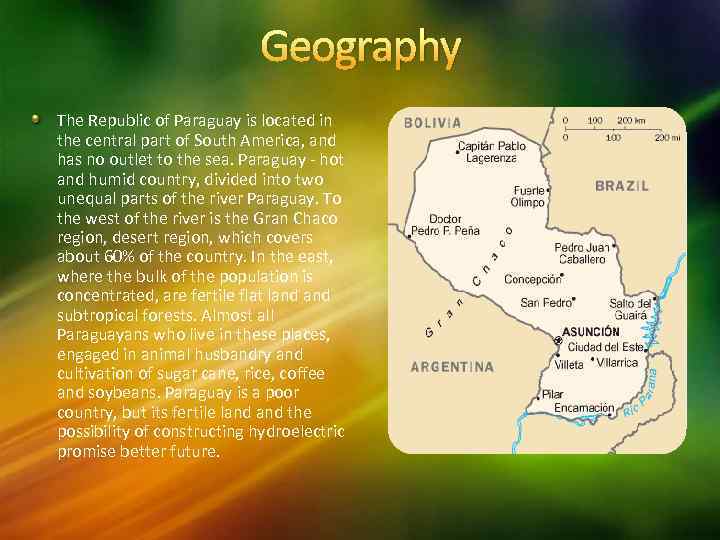
Geography The Republic of Paraguay is located in the central part of South America, and has no outlet to the sea. Paraguay - hot and humid country, divided into two unequal parts of the river Paraguay. To the west of the river is the Gran Chaco region, desert region, which covers about 60% of the country. In the east, where the bulk of the population is concentrated, are fertile flat land subtropical forests. Almost all Paraguayans who live in these places, engaged in animal husbandry and cultivation of sugar cane, rice, coffee and soybeans. Paraguay is a poor country, but its fertile land the possibility of constructing hydroelectric promise better future.
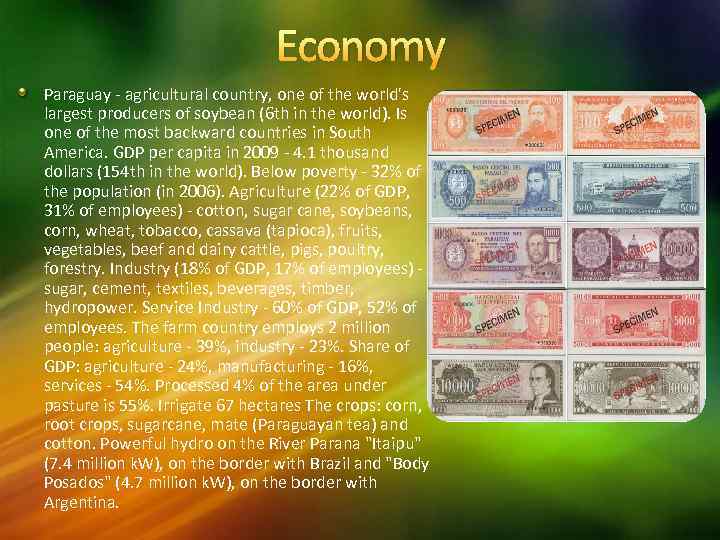
Economy Paraguay - agricultural country, one of the world's largest producers of soybean (6 th in the world). Is one of the most backward countries in South America. GDP per capita in 2009 - 4. 1 thousand dollars (154 th in the world). Below poverty - 32% of the population (in 2006). Agriculture (22% of GDP, 31% of employees) - cotton, sugar cane, soybeans, corn, wheat, tobacco, cassava (tapioca), fruits, vegetables, beef and dairy cattle, pigs, poultry, forestry. Industry (18% of GDP, 17% of employees) - sugar, cement, textiles, beverages, timber, hydropower. Service Industry - 60% of GDP, 52% of employees. The farm country employs 2 million people: agriculture - 39%, industry - 23%. Share of GDP: agriculture - 24%, manufacturing - 16%, services - 54%. Processed 4% of the area under pasture is 55%. Irrigate 67 hectares The crops: corn, root crops, sugarcane, mate (Paraguayan tea) and cotton. Powerful hydro on the River Parana "Itaipu" (7. 4 million k. W), on the border with Brazil and "Body Posados" (4. 7 million k. W), on the border with Argentina.
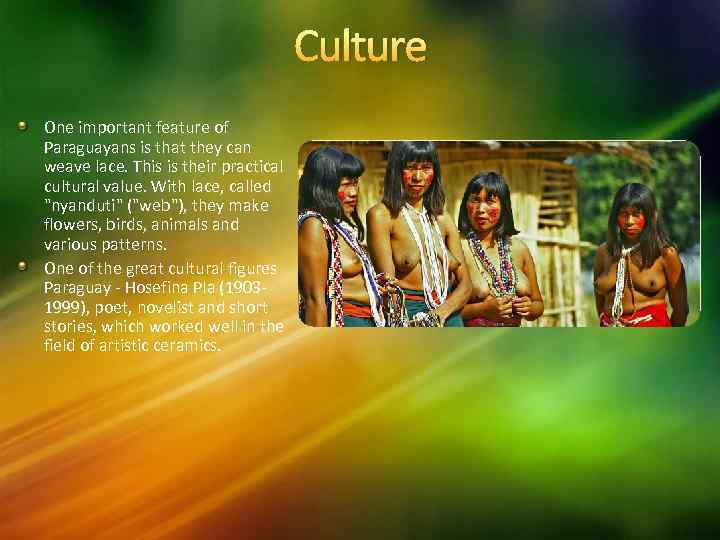
Culture One important feature of Paraguayans is that they can weave lace. This is their practical cultural value. With lace, called "nyanduti" ("web"), they make flowers, birds, animals and various patterns. One of the great cultural figures Paraguay - Hosefina Pla (19031999), poet, novelist and short stories, which worked well in the field of artistic ceramics.
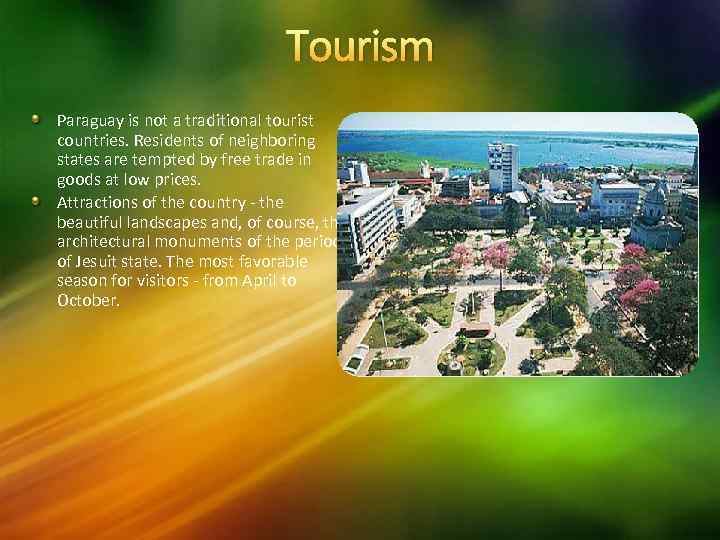
Tourism Paraguay is not a traditional tourist countries. Residents of neighboring states are tempted by free trade in goods at low prices. Attractions of the country - the beautiful landscapes and, of course, the architectural monuments of the period of Jesuit state. The most favorable season for visitors - from April to October.
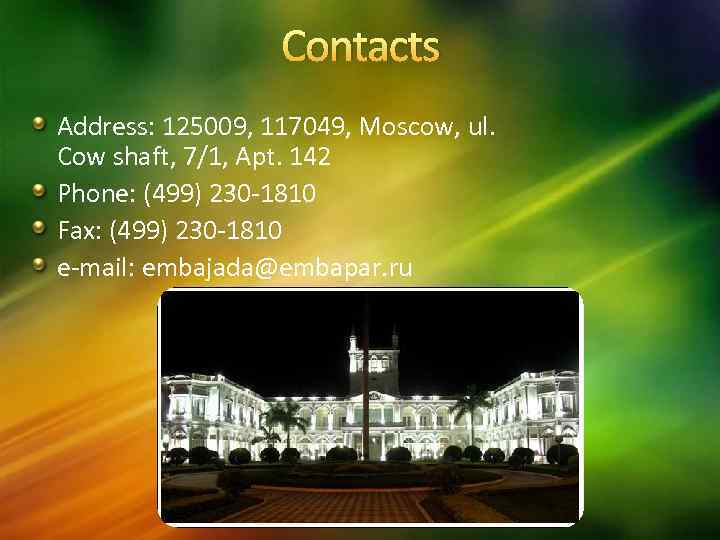
Contacts Address: 125009, 117049, Moscow, ul. Cow shaft, 7/1, Apt. 142 Phone: (499) 230 -1810 Fax: (499) 230 -1810 e-mail: embajada@embapar. ru
Скачать презентацию República del Paraguay Tetã Paraguái Республіка Парагвай
стегура.ppt