


 Скачать презентацию REPP TERM PAPER Learning Group — 4 Gender
f7cfb9345303cec901658d68d7847654.ppt
- Количество слайдов: 46
 REPP TERM PAPER Learning Group - 4 Gender Issue, PRIs, PPPs, Innovative Finance and Microfinance in Agriculture in the 11 th Five Year Approach Plan
 Introduction • The Eleventh Five Year Plan visualizes “faster and more inclusive growth”. • This implies that we need to/ for – – Shift the plan priorities towards the social sectors – Put appropriate institutions and linkages in place to bring good to the common man – The States to play a facilitating role in encouraging individual-institutional linkages
 Objective of the Report • To undertake a critical review of the existing approach, strategies, priorities, institutional arrangements, on-going policies, access to resources, gender concerns and empowerment of women in agriculture. • To review the progress of schemes/measures for empowerment of women in agriculture and suggest continuance/ discontinuance/ improvement in design/ convergence of the ongoing programmes and effective inter-sectoral integration during the XI Five Year Plan.
 Why women in agriculture? • • • Eradicating poverty Ensuring food security Promoting their own well being Their increasing stake in agriculture Decreasing economic contribution Ownership in livestock, land , etc. is limited Statistics: • While only 53% of the male population is involved in agriculture, the corresponding numbers for the female population was a 85% of all rural female workers. Source: Report submitted to the Working Group Gender Issue, PRIs, PPPs, Innovative Finance and Microfinance in Agriculture in the 11 th Five Year Approach Plan
 Context for the agrarian crisis • • Low size of landholding Faulty policies and structures Lack of technology Sale of spurious seeds and pesticides Debt at very high interest rates No health insurance and crop insurance NCF agrees that there is no agricultural policy that supports institutional arrangements
 Solutions • Firstly, the focus has to be on sustainability • Find ways to encourage farmers towards food production over commercial crops • Strengthen capital related investment in agriculture and rural infrastructure • Specific recommendations listed in report
 Invisibility of Women’s Work • Conceptual Biases in Measurement – Non recognition of Women’s role in decision making – Historical and Complex Causes reinforced by social, cultural, political and religious practices and beliefs • Serious inaccuracies and measurement failure in the recording of the work that women do due to conceptual and operational (enumerators' and respondents') biases at the time of data collection. • Engendering Agriculture reduced to women’s participation in training programs for technology dissemination or micro credit. • Non involvement of women in institutional work
 Recommendation • Correct the statistical invisibility of women’s work through preparation of an account that should include in detail the work that women undertake. • Policies and funds allocation need to take cognizance of this, and address women’s needs. • Adequate attention is given to the educational process through which women engage with the institutions in an informed and empowered way. • Agricultural education be made gender sensitive and research, development, extension and services be engendered to give due recognition to the multiple role played by women agriculturists.
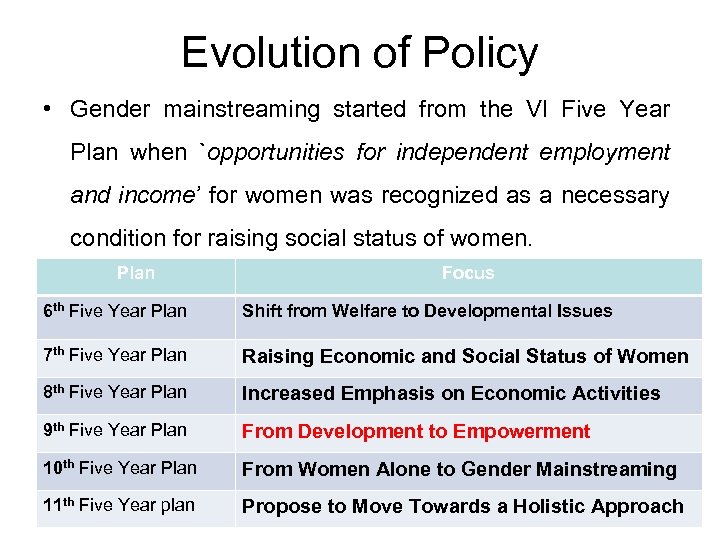 Evolution of Policy • Gender mainstreaming started from the VI Five Year Plan when `opportunities for independent employment and income’ for women was recognized as a necessary condition for raising social status of women. Plan Focus 6 th Five Year Plan Shift from Welfare to Developmental Issues 7 th Five Year Plan Raising Economic and Social Status of Women 8 th Five Year Plan Increased Emphasis on Economic Activities 9 th Five Year Plan From Development to Empowerment 10 th Five Year Plan From Women Alone to Gender Mainstreaming 11 th Five Year plan Propose to Move Towards a Holistic Approach
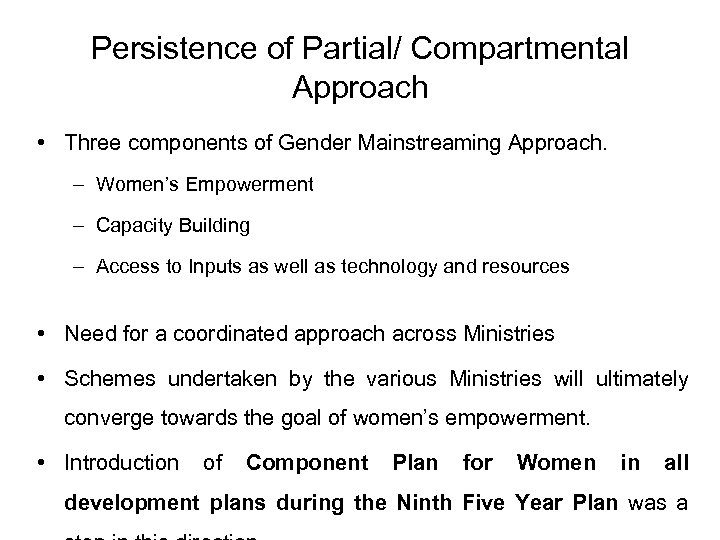 Persistence of Partial/ Compartmental Approach • Three components of Gender Mainstreaming Approach. – Women’s Empowerment – Capacity Building – Access to Inputs as well as technology and resources • Need for a coordinated approach across Ministries • Schemes undertaken by the various Ministries will ultimately converge towards the goal of women’s empowerment. • Introduction of Component Plan for Women in all development plans during the Ninth Five Year Plan was a
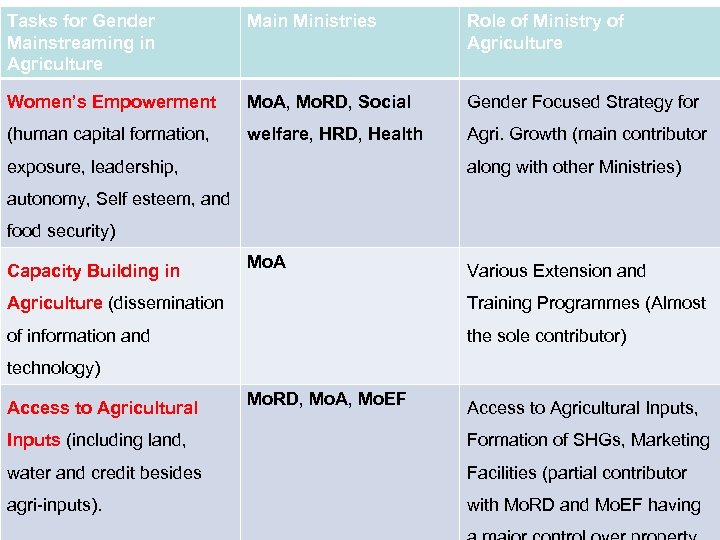 Tasks for Gender Mainstreaming in Agriculture Main Ministries Role of Ministry of Agriculture Women’s Empowerment Mo. A, Mo. RD, Social Gender Focused Strategy for (human capital formation, welfare, HRD, Health Agri. Growth (main contributor exposure, leadership, along with other Ministries) autonomy, Self esteem, and food security) Capacity Building in Mo. A Various Extension and Agriculture (dissemination Training Programmes (Almost of information and the sole contributor) technology) Access to Agricultural Mo. RD, Mo. A, Mo. EF Access to Agricultural Inputs, Inputs (including land, Formation of SHGs, Marketing water and credit besides Facilities (partial contributor agri-inputs). with Mo. RD and Mo. EF having
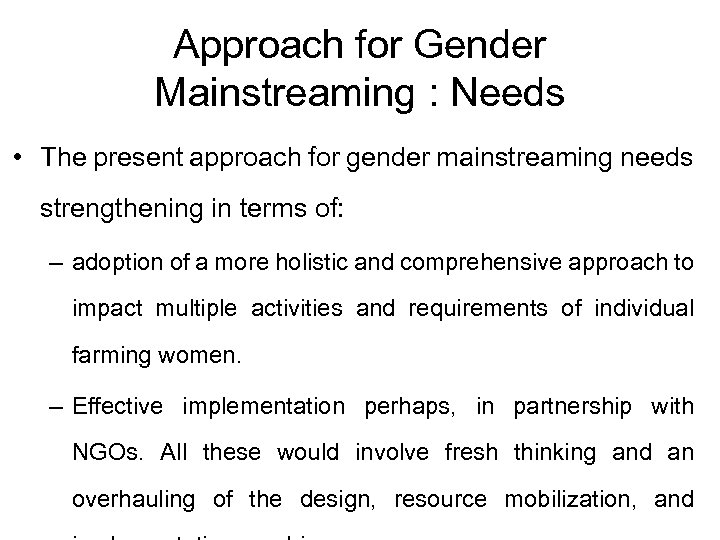 Approach for Gender Mainstreaming : Needs • The present approach for gender mainstreaming needs strengthening in terms of: – adoption of a more holistic and comprehensive approach to impact multiple activities and requirements of individual farming women. – Effective implementation perhaps, in partnership with NGOs. All these would involve fresh thinking and an overhauling of the design, resource mobilization, and
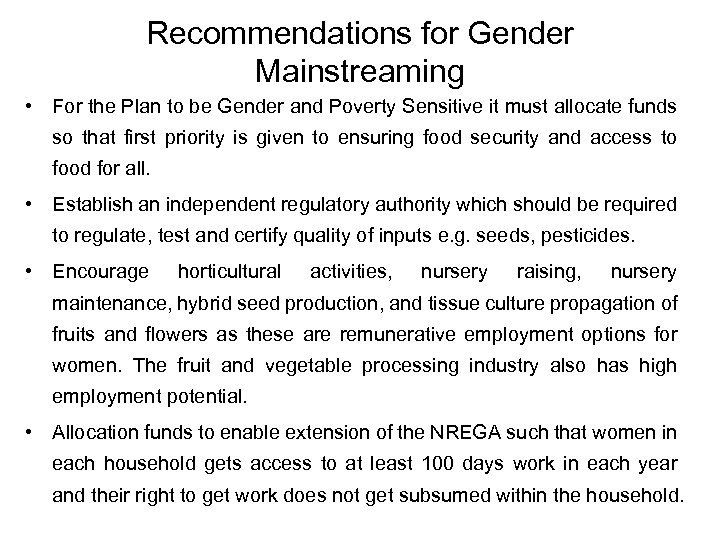 Recommendations for Gender Mainstreaming • For the Plan to be Gender and Poverty Sensitive it must allocate funds so that first priority is given to ensuring food security and access to food for all. • Establish an independent regulatory authority which should be required to regulate, test and certify quality of inputs e. g. seeds, pesticides. • Encourage horticultural activities, nursery raising, nursery maintenance, hybrid seed production, and tissue culture propagation of fruits and flowers as these are remunerative employment options for women. The fruit and vegetable processing industry also has high employment potential. • Allocation funds to enable extension of the NREGA such that women in each household gets access to at least 100 days work in each year and their right to get work does not get subsumed within the household.
 Some attempts and initiatives taken by NGOs
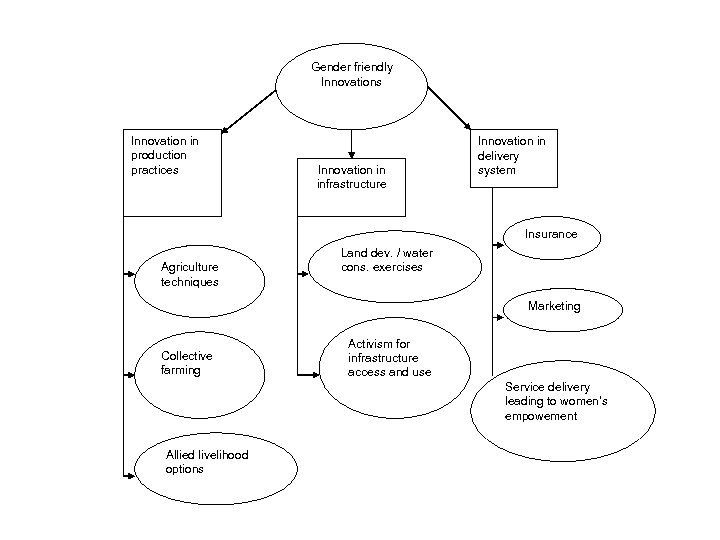 Gender friendly Innovations Innovation in production practices Innovation in infrastructure Innovation in delivery system Insurance Agriculture techniques Land dev. / water cons. exercises Marketing Collective farming Activism for infrastructure access and use Service delivery leading to women’s empowement Allied livelihood options
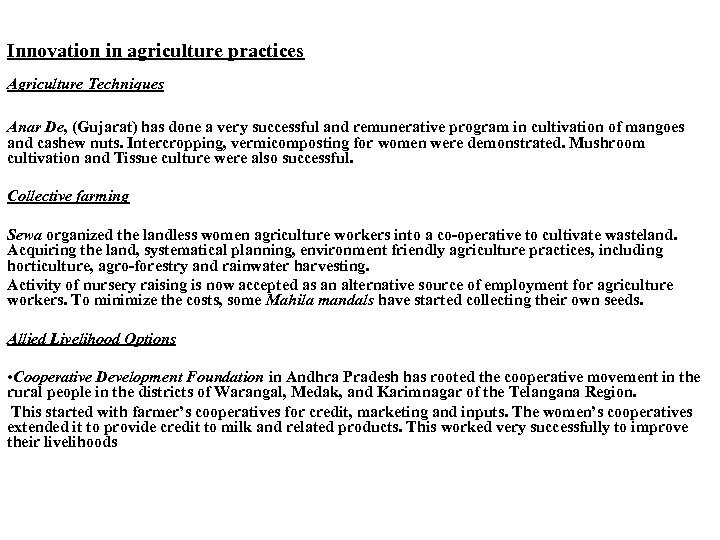 Innovation in agriculture practices Agriculture Techniques Anar De, (Gujarat) has done a very successful and remunerative program in cultivation of mangoes and cashew nuts. Intercropping, vermicomposting for women were demonstrated. Mushroom cultivation and Tissue culture were also successful. Collective farming Sewa organized the landless women agriculture workers into a co-operative to cultivate wasteland. Acquiring the land, systematical planning, environment friendly agriculture practices, including horticulture, agro-forestry and rainwater harvesting. Activity of nursery raising is now accepted as an alternative source of employment for agriculture workers. To minimize the costs, some Mahila mandals have started collecting their own seeds. Allied Livelihood Options • Cooperative Development Foundation in Andhra Pradesh has rooted the cooperative movement in the rural people in the districts of Warangal, Medak, and Karimnagar of the Telangana Region. This started with farmer’s cooperatives for credit, marketing and inputs. The women’s cooperatives extended it to provide credit to milk and related products. This worked very successfully to improve their livelihoods
 • UNDP, under its women in agriculture projects, undertook 21 districts spread across Andhra Pradesh, Uttar Pradesh and Orissa. • Provided resources and opportunities to women’s groups to increase and improve their private agricultural land, experiment with a range of farm and off-farm based economic activities, and improve their access to sustainable farm practices, quality seed and inputs. • Support was also provided for building rain water harvesting structures, de-silting tanks/ponds and reviving irrigation systems to improve the productivity of the land. • Core issues for women in agriculture projects are access to land working on farms collectively. Hence access to productive assets including land, credit, technologies, inputs and subsidies were made available to women’s groups.
 Innovations in infrastructure Land development / water conservation exercises • SEWA organized the women agriculture workers/farmers into Sabarkantha Women Farmer's Association which initiated watershed development to check soil erosion. The cooperative also works to organize the women into their own SHGs and provides the necessary training for leadership development, awareness generation, and capacity building. Activism for infrastructure access and use Dharangrast Parishad working with dam project affected people in South Maharashtra came up with some innovative demands which shows the concern for women: women would have an equal access to the water lands be given in joint names of the man and the woman of the household. MASUM from Pune district has launched a successful campaign to ensure joint pattas for women and land-rights of female headed households.
 Innovations in Delivery System Insurance sector: Swayam Shiksha Prayog has started a community based health insurance plan, Sakhi. Program benefits include reimbursements for hospital expenses of Rs. 5, 000, community-level outpatient delivery (OPD) services, discounted rates and various health education workshops and programs. Marketing: Economic associations promoted by SEWA in different districts have come together and formed their own women’s marketing network—Sewa Gram Mahila Haat (SGMH). The essence is to strengthen the rural economy through rural procurement and rural distribution. The focused areas are agriculture, salt, gum and handloom and handicraft.
 External and Internal Environment Reviewing and accessing the availability and utility of gender-disaggregated data on women in agriculture and measures for effective generation of needed data, needed for policy making in accordance with the prevailing scenario is very important: Issues: the data system capturing women’s work, simultaneously reflects on issues like: • what comes out of the work carried out by women and men; • who decides the division of work; • what are the conditions within which the work takes place; how are the benefits shared and controlled; • what is the perceived notion of autonomy; • to what extent does poverty (or economic well being) impinges on women’s work burden;
 Another picture {source: The Hindu Business line, 30 December, 2005} • Advisor to the Chennai-based M. S. Swaminathan Research Foundation (MSSRF), on education, communication and gender, Mrs Mina Swaminathan feels that"people in various areas of agriculture — the extension departments, the Ministry, the agricultural universities, the ICAR or the research system, the Krishi Vigyan Kendras (KVK). . . the entire agricultural bureaucracy. . . is gender insensitive. • They're supposed to be serving the farming community but they see only one half of this community — the men. The entire agricultural establishment does little for women because they're not aware of women and their problems. • historically the academic, research and other streams of agriculture have been headed by men "and the traditional perception of the kisan is male. • Another drawback on the gender front in agriculture is whenever a poor women is considered for betterment we immediately talk about starting SHGs • In horticulture or dairy, where labour is provided usually by women, they do not get the profits women take care of the cattle, milk the cows, etc, but in the milk co-operatives, the members are mostly men. Right from the early days the women do all the work in the milk co-operatives, but the profits come in the name of men.
 Public Private Partnership in Agriculture (PPP) Partnerships between public research institutions, private firms, and civil society organizations offer a means of tapping the strengths of diverse actors, while channeling knowledge and resources into areas where they can impact poverty reduction, food security, and agriculture-led development and growth. Partnerships in research and innovation enhance our capacity to solve complex development problems and to provide options to smallholder farmers, food-insecure households, rural women, and other vulnerable groups.
 MDG and women in agriculture • About 70 percent of the MDGs' target group live in rural areas, particularly in Asia and Africa, • Agriculture is a critical component in the successful attainment of the MDGs. • Immediate gains in poor households' welfare can be achieved through agriculture, involving women, which can help the poor overcome some of the critical constraints they now face in meeting their basic needs. • Thus, a necessary component in meeting the MDGs by 2015 in many parts of the world is a more productive and profitable agricultural sector.
 Strengths • Linking of agriculture and allied sectors with national and international markets to achieve the goal of faster and more inclusive growth. • Providing critical inputs by linking with mobile, computer companies who want to access rural markets. • New crops with good markets (American corn) • Organic outlets in malls (Big Bazar). • Making competition work for farmers; greater information access.
 Weakness • PRI, differences in the devolution of power and authority as distinct from delegation of functions. • Joint Forest Management Committees (JFMC) autonomy undermined by no cost sharing by JFMC in JFM, Forester as secretary. Secretary appoints JFMC members. • Non existence of agri-extension at village-level; it has less staff and focuses on subsidy schemes. Oligopolies of private traders supply seeds, and inputs on credit. This often results in, exploitation (esp. tribals), vested information. The PRI’s play almost no role currently.
 Opportunity • Partnership of the private/ public corporate sector with farmers’ federations or community groups have emerged within the framework of profit driven initiatives governed on business lines with CEO/partners accountable to a Board on which the Farmers federation, CBOs and PRIs have representation.
 Threats • The performance of NGO implemented watersheds has been found to be better in general but a good implementing agency is a necessary but not sufficient condition. • Social and human capital at the village level is another critical need. • Partnerships between unequal partners as farmers comprise an unorganized group, this might led to asymmetry in bargaining capabilities.
 Key Stake holders Government • PRI • Agriculture department • Planning commission Private • Companies involved in Agri business • Private traders
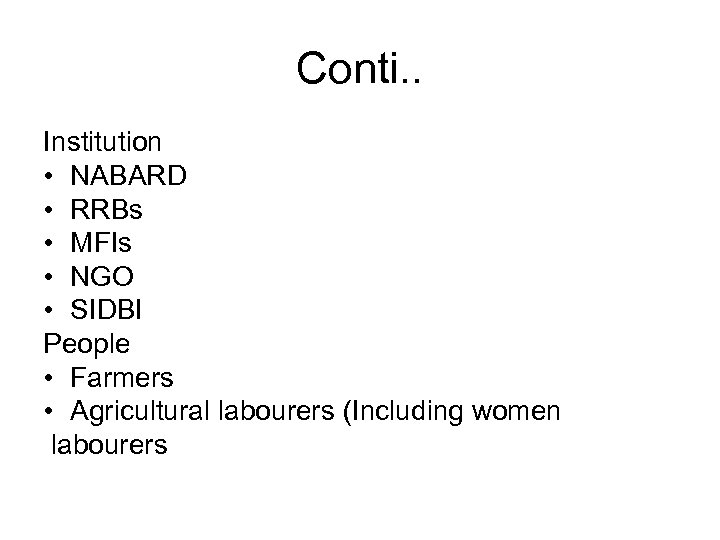 Conti. . Institution • NABARD • RRBs • MFIs • NGO • SIDBI People • Farmers • Agricultural labourers (Including women labourers
 Micro Finance and Poverty Alleviation
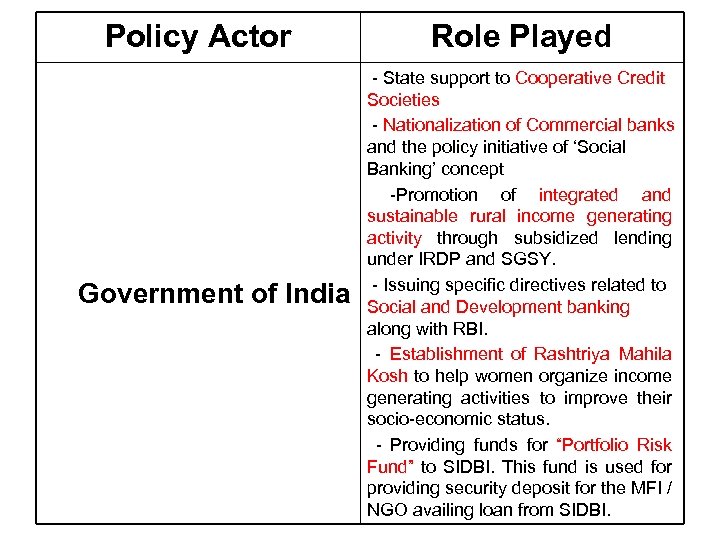 Policy Actor Government of India Role Played - State support to Cooperative Credit Societies - Nationalization of Commercial banks and the policy initiative of ‘Social Banking’ concept -Promotion of integrated and sustainable rural income generating activity through subsidized lending under IRDP and SGSY. - Issuing specific directives related to Social and Development banking along with RBI. - Establishment of Rashtriya Mahila Kosh to help women organize income generating activities to improve their socio-economic status. - Providing funds for “Portfolio Risk Fund” to SIDBI. This fund is used for providing security deposit for the MFI / NGO availing loan from SIDBI.
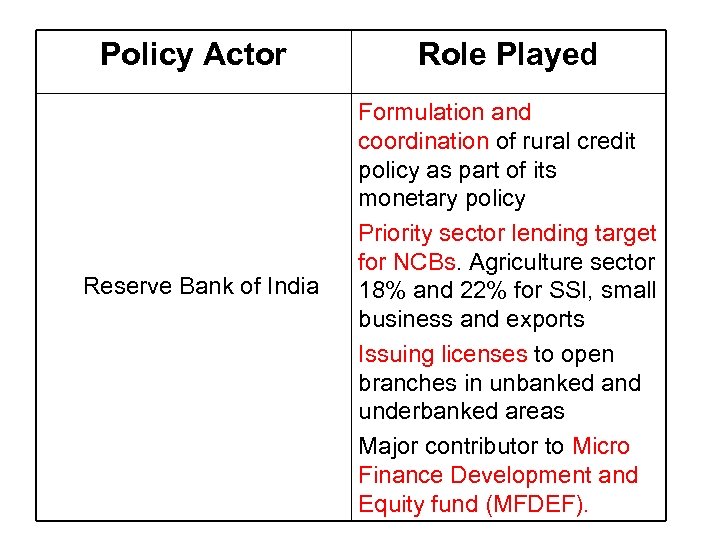 Policy Actor Reserve Bank of India Role Played Formulation and coordination of rural credit policy as part of its monetary policy Priority sector lending target for NCBs. Agriculture sector 18% and 22% for SSI, small business and exports Issuing licenses to open branches in unbanked and underbanked areas Major contributor to Micro Finance Development and Equity fund (MFDEF).
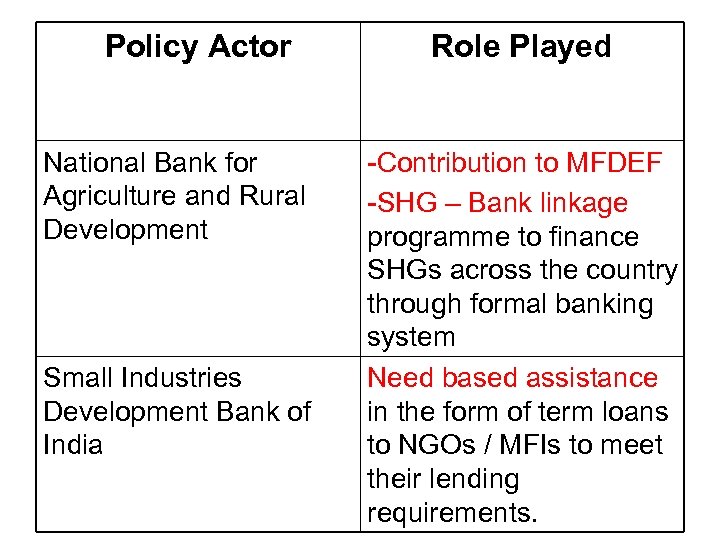 Policy Actor National Bank for Agriculture and Rural Development Small Industries Development Bank of India Role Played -Contribution to MFDEF -SHG – Bank linkage programme to finance SHGs across the country through formal banking system Need based assistance in the form of term loans to NGOs / MFIs to meet their lending requirements.
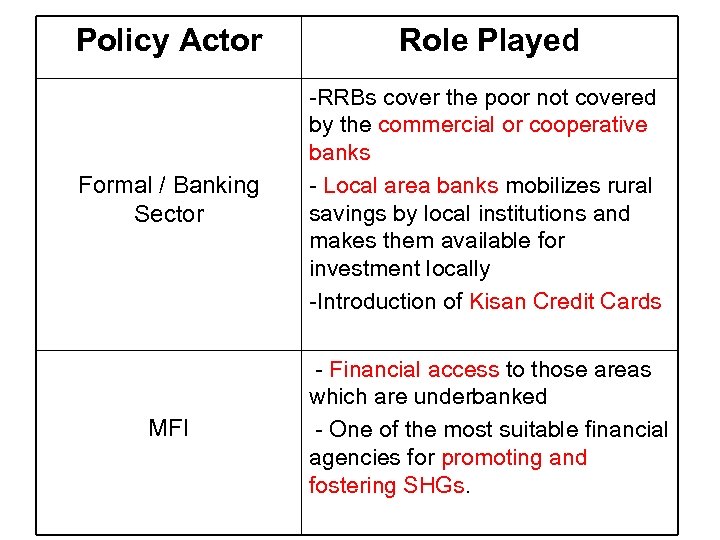 Policy Actor Role Played Formal / Banking Sector -RRBs cover the poor not covered by the commercial or cooperative banks - Local area banks mobilizes rural savings by local institutions and makes them available for investment locally -Introduction of Kisan Credit Cards MFI - Financial access to those areas which are underbanked - One of the most suitable financial agencies for promoting and fostering SHGs.
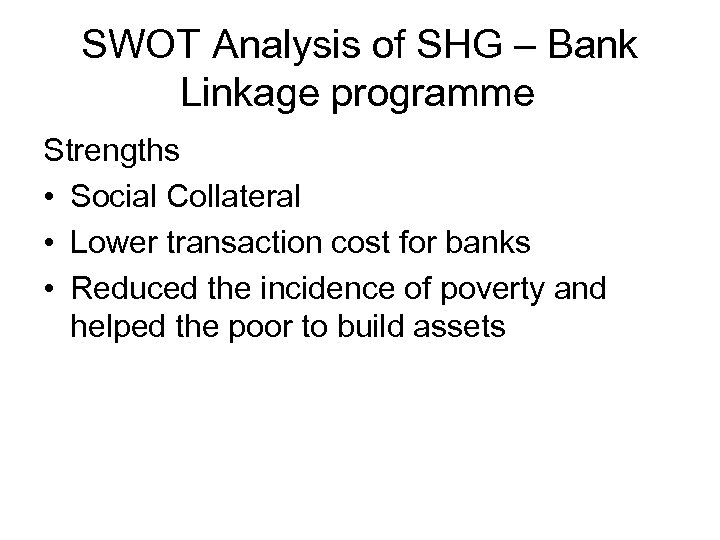 SWOT Analysis of SHG – Bank Linkage programme Strengths • Social Collateral • Lower transaction cost for banks • Reduced the incidence of poverty and helped the poor to build assets
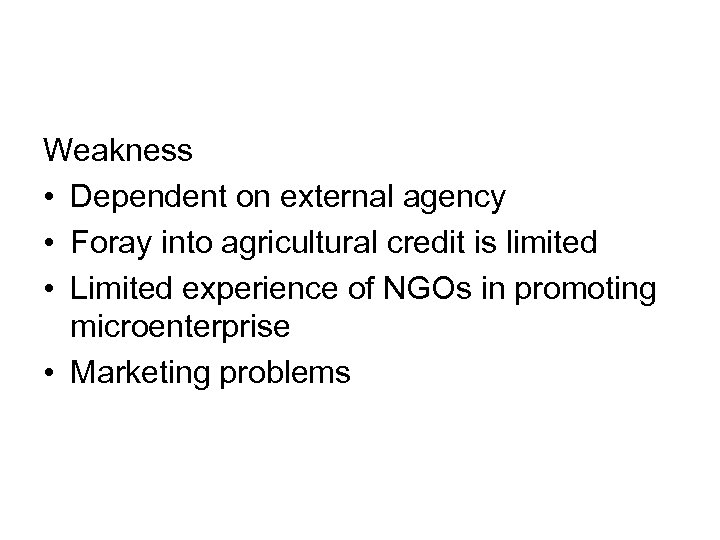 Weakness • Dependent on external agency • Foray into agricultural credit is limited • Limited experience of NGOs in promoting microenterprise • Marketing problems
 Opportunity • Bridging the demand – supply gap • Support from NABARD • Support from commercial banks • Inclusion of Service Area Approach
 Threats • Quality of SHGs • Govt. implementing this design in various poverty alleviation programmes
 Some other models of Micro Finance in India • Micro Finance Institutions models – Agency Model – MFI Bulk lending model • Primary Agriculture Credit Societies • Post office network and banking services
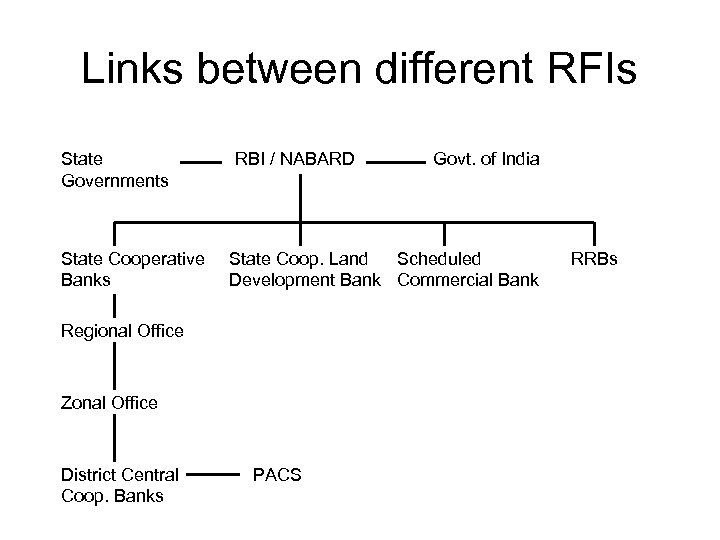 Links between different RFIs State Governments State Cooperative Banks RBI / NABARD State Coop. Land Scheduled Development Bank Commercial Bank Regional Office Zonal Office District Central Coop. Banks Govt. of India PACS RRBs
 Issues of Micro Finance in India • Legal Issues - Seventh schedule declares money lending as State subject - Doesn’t mention private money lending - No model money lending act prepared by center. • Gender Issues • Rate of Interest • Choice of productive assets.
 • Absence of policy The ‘Micro. Financial Sector (Developments and Regulations)’ Bill which is presently under consideration is expected to address the issue and the ‘regulator’ which has been proposed in the Bill is expected to put in place the required policy and regulatory framework • Absence of Information / Statistics
 Recommendations • Access to credit – Post office network to be used to deliver effective banking servives. – NABARD should evolve an efeective strategy to implement the business facilitator and correspondence model. § Formation of consortium by banks § Uniform legal framework § National Policy on Micro Finance.
 • MFIS should be allowed to mobilize savings at least from their members under a regulatory framework monitored by NABARD. • Credit linked subsidy • Information and Communication Technology (ICT) may be utilized for improving the reach and spread of various Micro-Finance and Poverty Alleviation Schemes in rural areas in the country
 References • info. worldbank. org/etools/docs/library/154927/financeforum 2002/pdf /sirtaine. ppt • www. indianngos. com/issue/microcredit/operationalissues. htm • info. worldbank. org/etools/docs/library/ • Organisation and Management of Rural Financial Sector – Bhupat M Desai & N. V. Namboodiri • Feminisation of Agriculture and Marginalization of their economic stake. - Swarna S Vepa (EPW, June 18, 2005) • Food Security: How and for Whom? – Maithrevi Krishnaraj (EPW, June 18, 2005) • Women Professionals in Agriculture; Some employment issues – N Sandhya Shenoy, D Rama Rao (EPW, April 24, 2004)
 Presented by (LG 4): Anand Saha - 09 Gautam Rajagopalan - 16 Rajat Kumar - 33 Sandeep Saxena - 42 Santanu Chakraborty - 44