 Скачать презентацию REPOSITIONING LIVESTOCK ON THE GLOBAL DEVELOPMENT AGENDA LIVESTOCK
6f17212740e096703cfb0321c9d1c806.ppt
- Количество слайдов: 28



REPOSITIONING LIVESTOCK ON THE GLOBAL DEVELOPMENT AGENDA LIVESTOCK AND THE PUBLIC GOOD NEXUS Jimmy W. Smith World Bank IADG Annual Meeting IFAD, Rome, Italy May 4 -5, 2010
OUTLINE Ways to think about the Public Good nexus The status quo Increasing the Public Good contributions

Ways to think about the Public Good Nexus
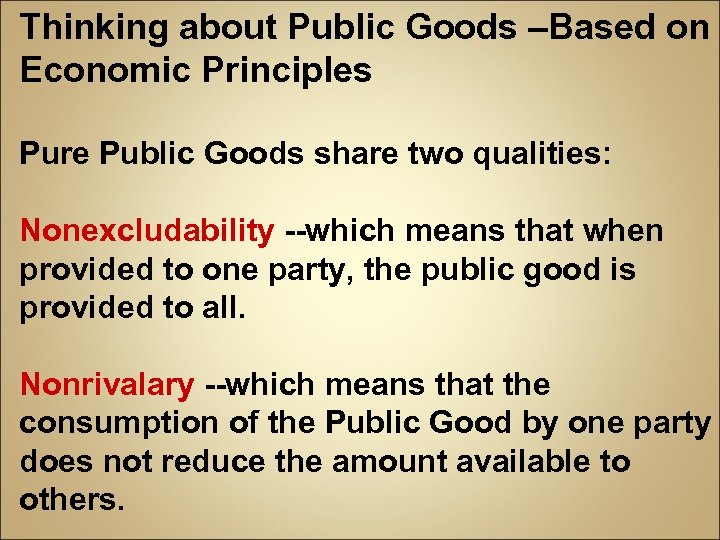
Thinking about Public Goods –Based on Economic Principles Pure Public Goods share two qualities: Nonexcludability --which means that when provided to one party, the public good is provided to all. Nonrivalary --which means that the consumption of the Public Good by one party does not reduce the amount available to others.
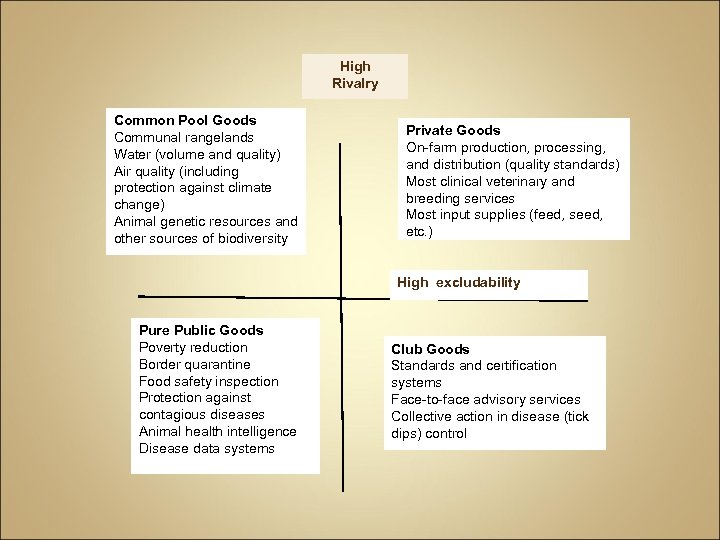
High Rivalry Common Pool Goods Communal rangelands Water (volume and quality) Air quality (including protection against climate change) Animal genetic resources and other sources of biodiversity Private Goods On-farm production, processing, and distribution (quality standards) Most clinical veterinary and breeding services Most input supplies (feed, seed, etc. ) High excludability Pure Public Goods Poverty reduction Border quarantine Food safety inspection Protection against contagious diseases Animal health intelligence Disease data systems Club Goods Standards and certification systems Face-to-face advisory services Collective action in disease (tick dips) control
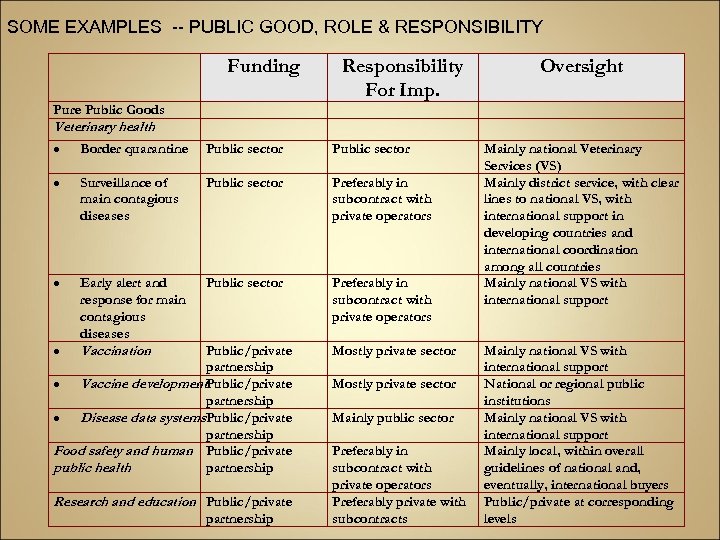
SOME EXAMPLES -- PUBLIC GOOD, ROLE & RESPONSIBILITY Funding Responsibility For Imp. Oversight Pure Public Goods Veterinary health Border quarantine Public sector Surveillance of main contagious diseases Public sector Preferably in subcontract with private operators Early alert and response for main contagious diseases Public sector Preferably in subcontract with private operators Vaccination Public/private partnership Vaccine development. Public/private partnership Disease data systems. Public/private partnership Food safety and human Public/private public health partnership Research and education Public/private partnership Mostly private sector Mainly public sector Preferably in subcontract with private operators Preferably private with subcontracts Mainly national Veterinary Services (VS) Mainly district service, with clear lines to national VS, with international support in developing countries and international coordination among all countries Mainly national VS with international support National or regional public institutions Mainly national VS with international support Mainly local, within overall guidelines of national and, eventually, international buyers Public/private at corresponding levels
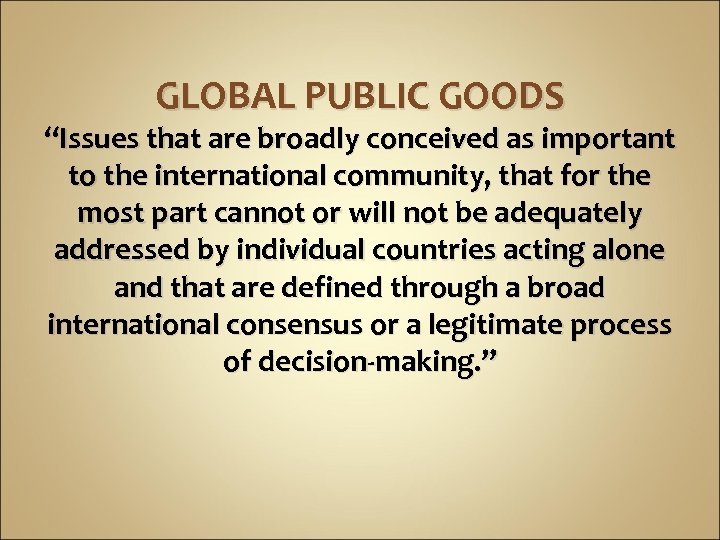
GLOBAL PUBLIC GOODS “Issues that are broadly conceived as important to the international community, that for the most part cannot or will not be adequately addressed by individual countries acting alone and that are defined through a broad international consensus or a legitimate process of decision-making. ”
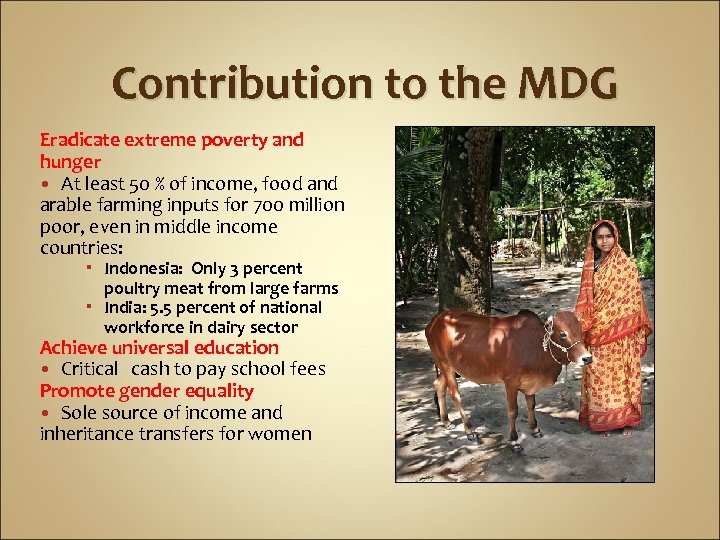
Contribution to the MDG Eradicate extreme poverty and hunger At least 50 % of income, food and arable farming inputs for 700 million poor, even in middle income countries: Indonesia: Only 3 percent poultry meat from large farms India: 5. 5 percent of national workforce in dairy sector Achieve universal education Critical cash to pay school fees Promote gender equality Sole source of income and inheritance transfers for women
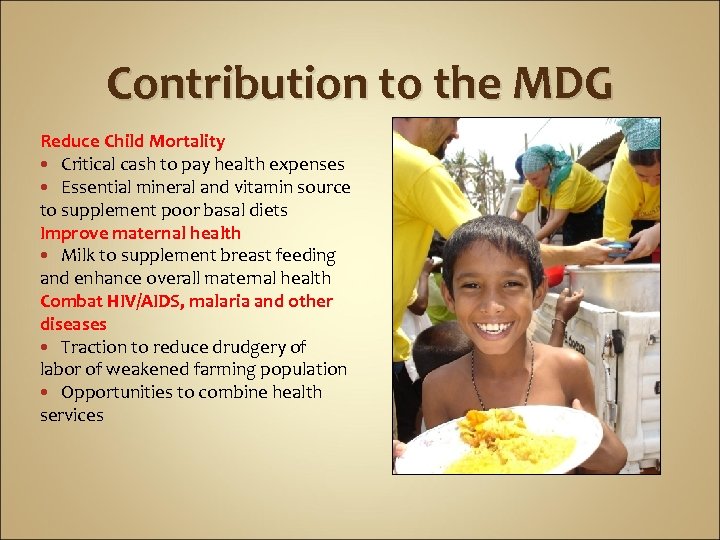
Contribution to the MDG Reduce Child Mortality Critical cash to pay health expenses Essential mineral and vitamin source to supplement poor basal diets Improve maternal health Milk to supplement breast feeding and enhance overall maternal health Combat HIV/AIDS, malaria and other diseases Traction to reduce drudgery of labor of weakened farming population Opportunities to combine health services
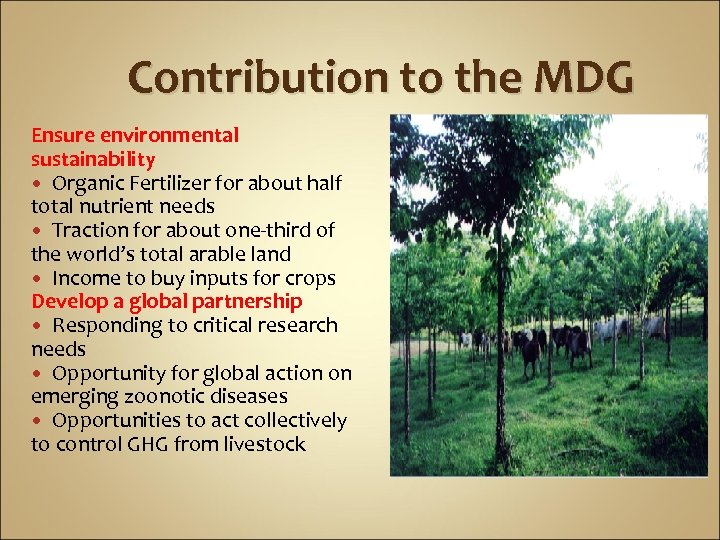
Contribution to the MDG Ensure environmental sustainability Organic Fertilizer for about half total nutrient needs Traction for about one-third of the world’s total arable land Income to buy inputs for crops Develop a global partnership Responding to critical research needs Opportunity for global action on emerging zoonotic diseases Opportunities to act collectively to control GHG from livestock
The status quo
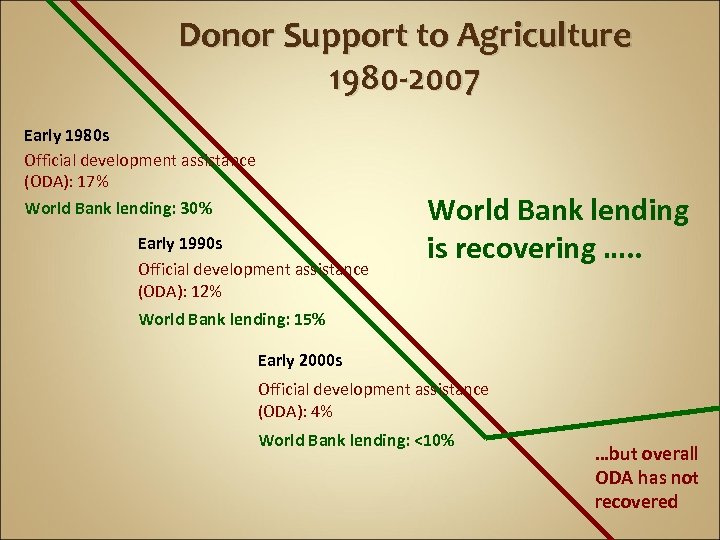
Donor Support to Agriculture 1980 -2007 Early 1980 s Official development assistance (ODA): 17% World Bank lending: 30% Early 1990 s Official development assistance (ODA): 12% World Bank lending is recovering …. . World Bank lending: 15% Early 2000 s Official development assistance (ODA): 4% World Bank lending: <10% …but overall ODA has not recovered
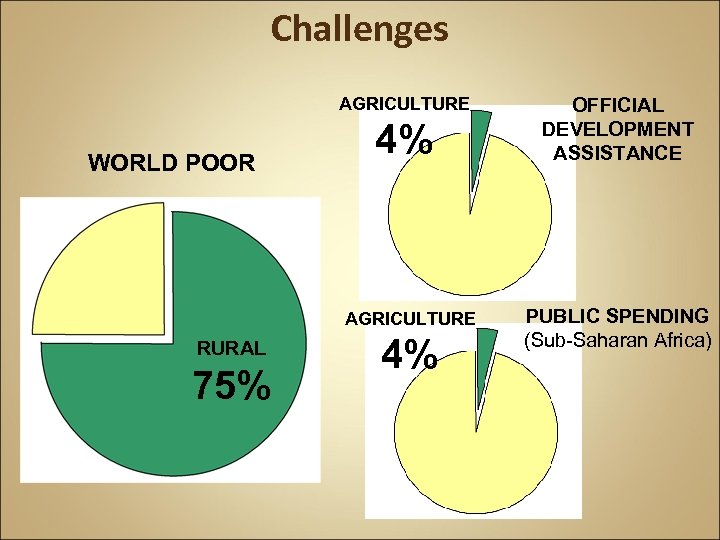
Challenges AGRICULTURE WORLD POOR 4% AGRICULTURE RURAL 75% 4% OFFICIAL DEVELOPMENT ASSISTANCE PUBLIC SPENDING (Sub-Saharan Africa)
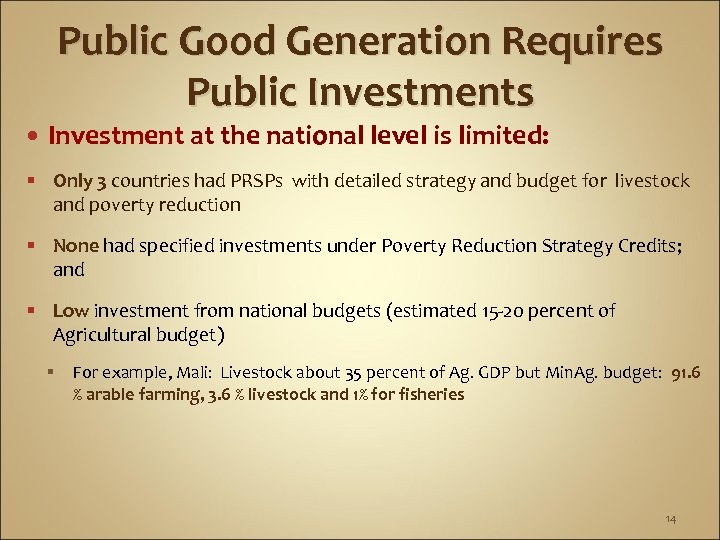
Public Good Generation Requires Public Investments Investment at the national level is limited: § Only 3 countries had PRSPs with detailed strategy and budget for livestock and poverty reduction § None had specified investments under Poverty Reduction Strategy Credits; and § Low investment from national budgets (estimated 15 -20 percent of Agricultural budget) § For example, Mali: Livestock about 35 percent of Ag. GDP but Min. Ag. budget: 91. 6 % arable farming, 3. 6 % livestock and 1% for fisheries 14
Increasing the Public Good Contributions
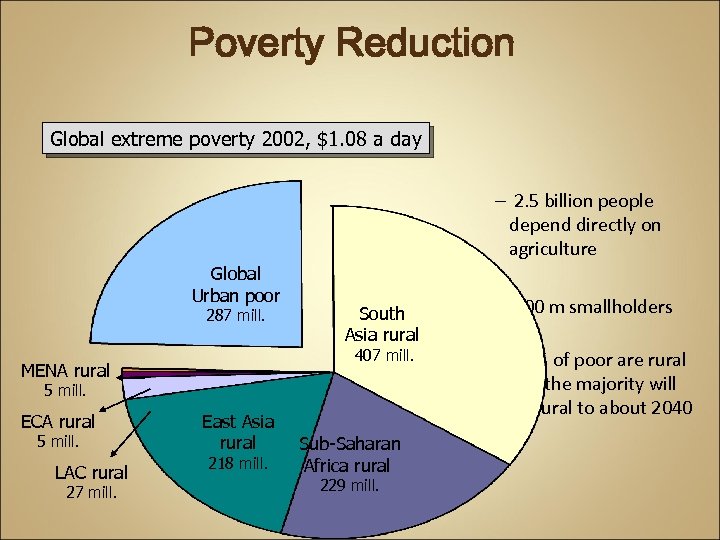
Poverty Reduction Global extreme poverty 2002, $1. 08 a day – 2. 5 billion people depend directly on agriculture Global Urban poor 287 mill. South Asia rural 407 mill. MENA rural 5 mill. ECA rural 5 mill. LAC rural 27 mill. East Asia rural 218 mill. Sub-Saharan Africa rural 229 mill. – 800 m smallholders – 75% of poor are rural and the majority will be rural to about 2040
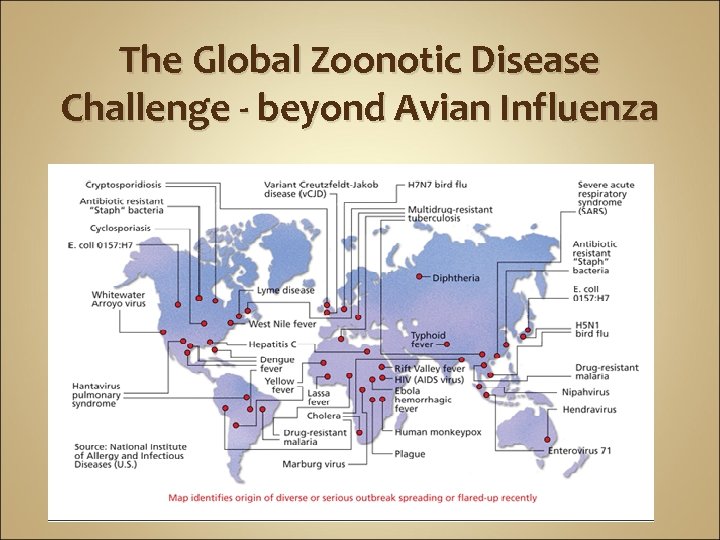
The Global Zoonotic Disease Challenge - beyond Avian Influenza
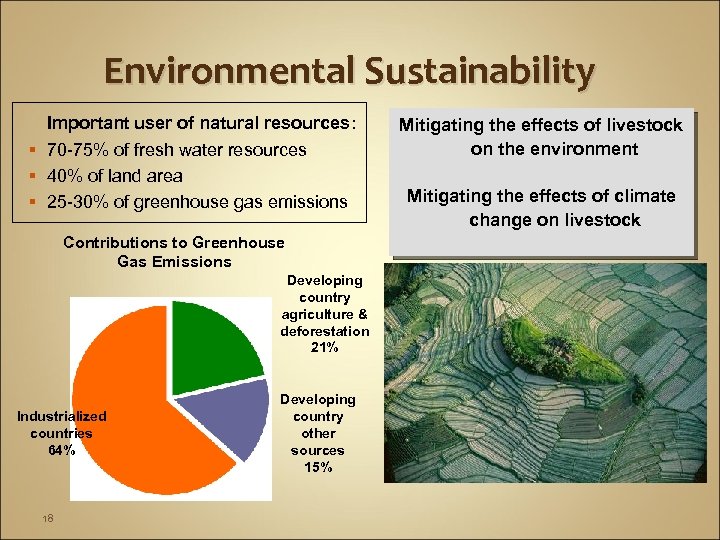
Environmental Sustainability Important user of natural resources: § 70 -75% of fresh water resources § 40% of land area § 25 -30% of greenhouse gas emissions Contributions to Greenhouse Gas Emissions Developing country agriculture & deforestation 21% Industrialized countries 64% 18 Developing country other sources 15% Mitigating the effects of livestock on the environment Mitigating the effects of climate change on livestock
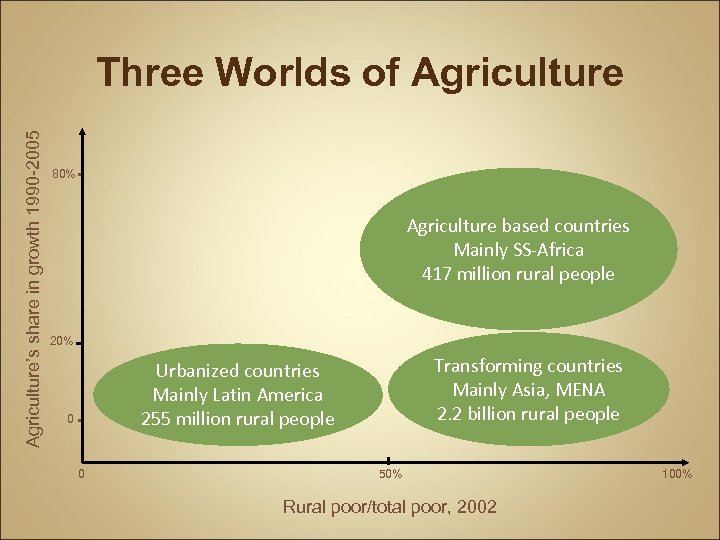
Agriculture’s share in growth 1990 -2005 Three Worlds of Agriculture 80% Agriculture based countries Mainly SS-Africa 417 million rural people 20% Transforming countries Mainly Asia, MENA 2. 2 billion rural people Urbanized countries Mainly Latin America 255 million rural people 0 0 50% Rural poor/total poor, 2002 100%
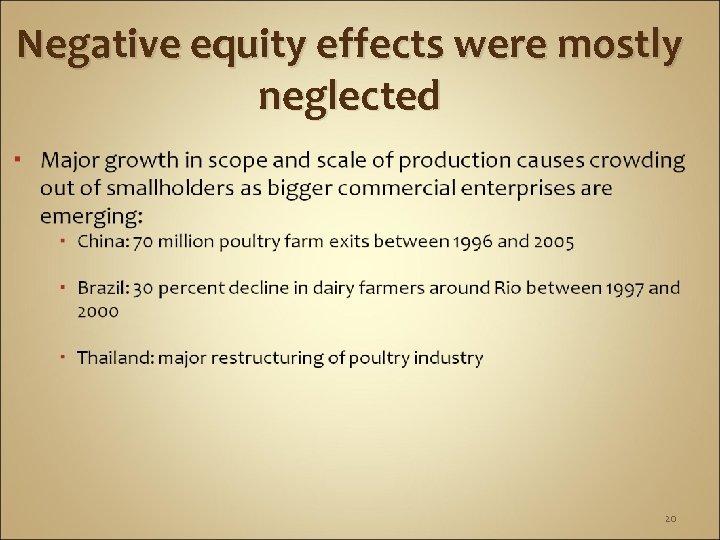
Negative equity effects were mostly neglected 20
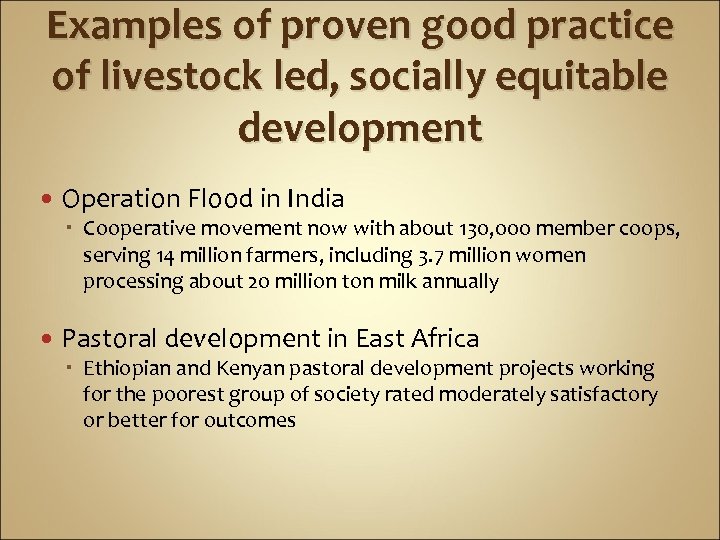
Examples of proven good practice of livestock led, socially equitable development Operation Flood in India Cooperative movement now with about 130, 000 member coops, serving 14 million farmers, including 3. 7 million women processing about 20 million ton milk annually Pastoral development in East Africa Ethiopian and Kenyan pastoral development projects working for the poorest group of society rated moderately satisfactory or better for outcomes
Poverty --proposed actions Support research for “technologies for the poor” Develop remedies to “livestock diseases of the poor” Develop alternative feeds resources Support better integration of smallholders in the value chain Promote, where needed, exits from the sector
Neglect of emerging health issues (until recently) Public health: Six major zoonotic disease scares over last decade with economic losses over US $ 200 billion (direct and indirect) over the last decade Of 1415 known pathogens, 62 percent of animal origin 1. 6 million annual TB fatalities of which 2 -15 percent of bovine origin Food borne pathogens important contributor to diarrheal diseases Contribution to obesity and other food related health risks 23
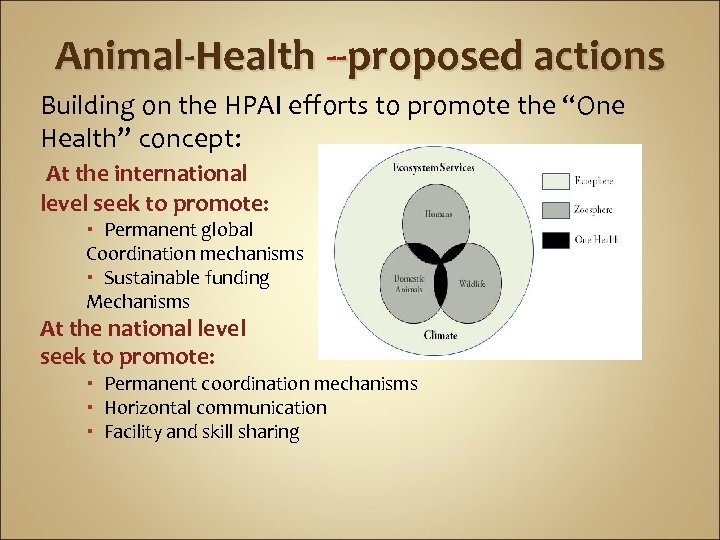
Animal-Health --proposed actions Building on the HPAI efforts to promote the “One Health” concept: At the international level seek to promote: Permanent global Coordination mechanisms Sustainable funding Mechanisms At the national level seek to promote: Permanent coordination mechanisms Horizontal communication Facility and skill sharing
Animal-Health --proposed actions Prevent and control the ‘lingering’ zoonotic diseases whih mostly affect the poor Further strengthen veterinary public health services/mechanisms.
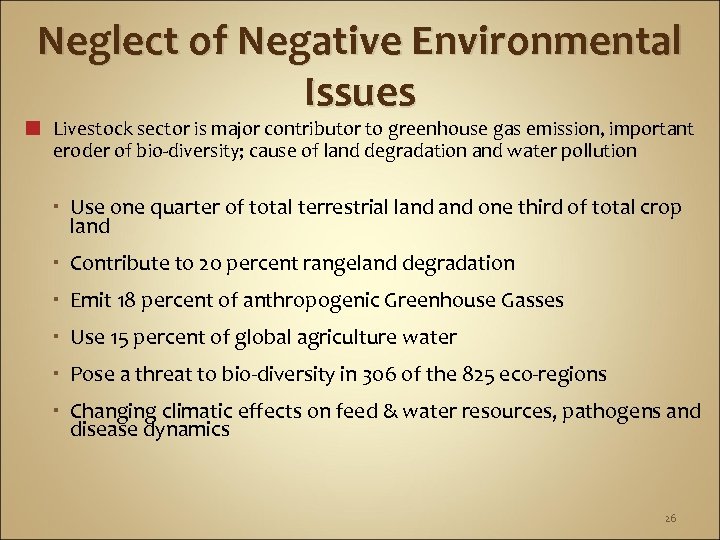
Neglect of Negative Environmental Issues Livestock sector is major contributor to greenhouse gas emission, important eroder of bio-diversity; cause of land degradation and water pollution Use one quarter of total terrestrial land one third of total crop land Contribute to 20 percent rangeland degradation Emit 18 percent of anthropogenic Greenhouse Gasses Use 15 percent of global agriculture water Pose a threat to bio-diversity in 306 of the 825 eco-regions Changing climatic effects on feed & water resources, pathogens and disease dynamics 26
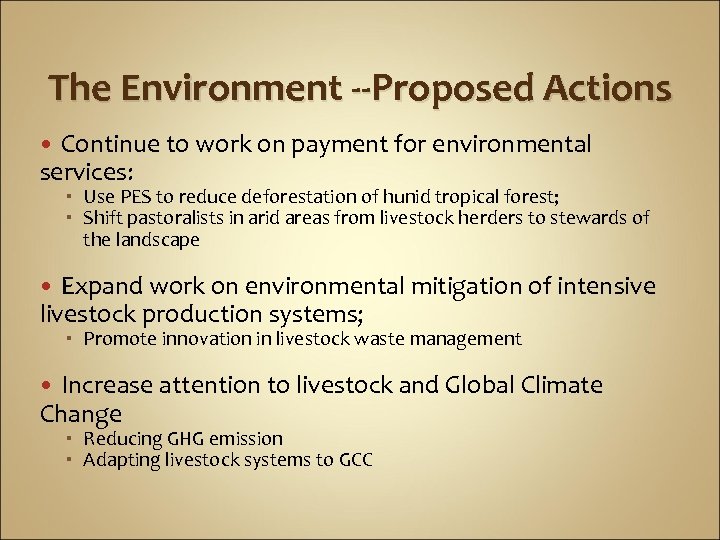
The Environment --Proposed Actions Continue to work on payment for environmental services: Use PES to reduce deforestation of hunid tropical forest; Shift pastoralists in arid areas from livestock herders to stewards of the landscape Expand work on environmental mitigation of intensive livestock production systems; Promote innovation in livestock waste management Increase attention to livestock and Global Climate Change Reducing GHG emission Adapting livestock systems to GCC

THANK YOU
Скачать презентацию REPOSITIONING LIVESTOCK ON THE GLOBAL DEVELOPMENT AGENDA LIVESTOCK
6f17212740e096703cfb0321c9d1c806.ppt