


 Скачать презентацию Reports Proposals and Instructions for the Workplace 1
af3f90efad4283f7720821925330d777.ppt
- Количество слайдов: 24
 Reports, Proposals, and Instructions for the Workplace 1 Effective Communication for Colleges, 11 th ed. , Brantley & Miller 2008©
 Learning Objectives Identify sources of primary and secondary information. Identify the parts and characteristics of formal reports and informal reports. Discuss variations of informal reports. Explain the characteristics of instructions. Prepare reports, proposals, and instructions by following the timely guidelines, implementing the CBO approach, and incorporating the six Cs. 2 Effective Communication for Colleges, 11 th ed. , Brantley & Miller 2008©
 Section 1: Report Overview A report is a planned, organized, factual presentation of information prepared for a specific purpose and for a specific audience. Updates receivers Makes recommendations Gives results Provides operational data 3 Effective Communication for Colleges, 11 th ed. , Brantley & Miller 2008©
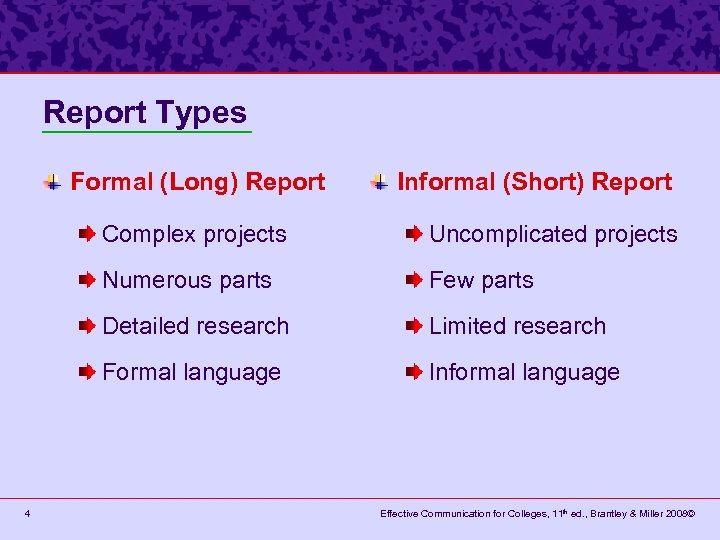 Report Types Formal (Long) Report Informal (Short) Report Complex projects Numerous parts Few parts Detailed research Limited research Formal language 4 Uncomplicated projects Informal language Effective Communication for Colleges, 11 th ed. , Brantley & Miller 2008©
 Report Functions An informational report presents the facts but does not analyze the information, draw conclusions, or make recommendations. Annual report—summarizes a company’s accomplishments, finances, and significant events Progress report—updates status of a project Travel or trip report—summarizes travel agenda Minutes—record of proceedings of a meeting 5 Effective Communication for Colleges, 11 th ed. , Brantley & Miller 2008©
 Report Functions (continued) An analytical report presents information, analyzes the information, draws conclusions, and sometimes includes recommendations. Feasibility report—examines a proposed course of action Justification report—explains or recommends an action 6 Effective Communication for Colleges, 11 th ed. , Brantley & Miller 2008©
 Compose a Draft Style and vocabulary Formal versus informal Technical versus nontechnical vocabulary Visuals and headings Charts and tables Headings and subheadings 7 Effective Communication for Colleges, 11 th ed. , Brantley & Miller 2008©
 Complete a Report Ensure objective was met, content is correct and unbiased, and format guidelines were followed. Confirm incorporation of six Cs of effective messages. Verify readability. Evaluate overall effectiveness. Leave a positive impression. 8 Effective Communication for Colleges, 11 th ed. , Brantley & Miller 2008©
 Section 2: Formal Reports A formal report is prepared for a decision-making audience and typically requires in-depth investigation and team collaboration. A formal report includes three parts: Preliminary parts precede report body. Report body contains information and visuals to support the report objective. Supplementary parts follow the report body. 9 Effective Communication for Colleges, 11 th ed. , Brantley & Miller 2008©
 Preliminary Parts Title page—title, author, affiliation, date, receiver Transmittal message—official submission of report Table of contents—page numbers of report parts List of illustrations—titles and page numbers of visuals Executive summary—summary of key points 10 Effective Communication for Colleges, 11 th ed. , Brantley & Miller 2008©
 Report Body Introduction—statement of authorization, purpose, background, scope, limitations, research sources, order of presentation Text—details to support objective Terminal section or conclusion—summary of key points, conclusions, and recommendations 11 Effective Communication for Colleges, 11 th ed. , Brantley & Miller 2008©
 Supplementary Parts References (APA) or works cited (MLA) – alphabetical list of sources cited Appendix—supplemental information not necessary to understand the report or too lengthy to include in the body 12 Effective Communication for Colleges, 11 th ed. , Brantley & Miller 2008©
 Report-Writing Mechanics Margins 2 -inch top margin on first page of report body, each preliminary part, and each supplementary part 1 -inch top margin on all subsequent pages 1 -inch bottom margin on all pages 1 -inch side margins or 1. 5 -inch side margin for leftbound reports 13 Effective Communication for Colleges, 11 th ed. , Brantley & Miller 2008©
 Report-Writing Mechanics (continued) Spacing Double space and indent paragraphs or single space and double space between paragraphs. Center title page vertically and horizontally; provide equal white space between elements. Double space table of contents. Align first line of each reference at left margin and indent subsequent lines of each reference. 14 Effective Communication for Colleges, 11 th ed. , Brantley & Miller 2008©
 Report-Writing Mechanics (continued) Reference and Parenthetical Citations Enclose direct quotes in quotation marks. Indent lengthy quotes from the body. Credit quotes and paraphrases both in the document and in the References or Works Cited. Enclose parenthetical citations in parentheses. 15 Effective Communication for Colleges, 11 th ed. , Brantley & Miller 2008©
 Report-Writing Mechanics (continued) Pagination Preliminary parts numbered with lowercase roman numerals (ii, iv, etc. ) Report body and supplementary parts numbered with arabic numerals (2, 3, 4, etc. ) Transmittal message neither numbered nor counted 16 Effective Communication for Colleges, 11 th ed. , Brantley & Miller 2008©
 Section 3: Informal Reports An informal report relays information about routine, short-term, or uncomplicated situations. Types of informal reports: Memos Letters Fill-in report forms Agendas and minutes of meetings 17 Effective Communication for Colleges, 11 th ed. , Brantley & Miller 2008©
 Memo and Letter Reports Memo Report Distributed internally Letter Report Prepared using a memo template Distributed externally Written in personal language Prepared on company letterhead Arranged in direct business letter Formatted as a pattern Written in direct or indirect pattern 18 Effective Communication for Colleges, 11 th ed. , Brantley & Miller 2008©
 Fill-in Report Forms Online or paper fill-in report forms and templates are used for routine reporting. Increase likelihood that essential information is provided Allow limited space for explanations 19 Effective Communication for Colleges, 11 th ed. , Brantley & Miller 2008©
 Agendas and Minutes Agendas Structure Minutes of the meeting Items for discussion and date, location Group, meeting time, action People Presenterspresent and absent Status time devoted to each Length of of previous minutes item Old and new business, reports, announcements Motions, initiator, outcome of vote Adjournment remarks Name and signature of person taking minutes 20 Effective Communication for Colleges, 11 th ed. , Brantley & Miller 2008©
 Section 4: Proposals A proposal identifies a need or problem and offers a plan to meet the need or solve the problem. Prepared for internal receivers Request a change or improvement inside a firm Work within the chain of command Prepared for external receivers Sell a product or service Solicited or unsolicited 21 Effective Communication for Colleges, 11 th ed. , Brantley & Miller 2008©
 Proposal Format and Content Format Lengthy formal report for complex, large-scale problems Short informal reports for simple problems Content Introduction—problem, solution, benefits Text—background, details, qualifications Terminal section—summary of solution, results, benefits 22 Effective Communication for Colleges, 11 th ed. , Brantley & Miller 2008©
 Section 5: Instructions Well-prepared instructions save time and money, promote safety, and increase productivity. Introduction—reason for instruction, warnings, completion time List of supplies—exact sizes, names, and quantities of tools and supplies in order used 23 Effective Communication for Colleges, 11 th ed. , Brantley & Miller 2008©
 Instructions (continued) Instructional steps—number required steps in chronological order; use imperative sentences with action verbs and concise familiar words; use exact measures, distances, and times; include warnings; add visuals; and give helpful tips. 24 Effective Communication for Colleges, 11 th ed. , Brantley & Miller 2008©