


 Скачать презентацию Reporting against the National Indigenous Reform Agreement Kate
84b4a5aae9d4056e581d05c28998dd33.ppt
- Количество слайдов: 19
 Reporting against the National Indigenous Reform Agreement Kate Connors Senior Adviser Australasian Evaluation Society 2011 International Conference 31 August 2011
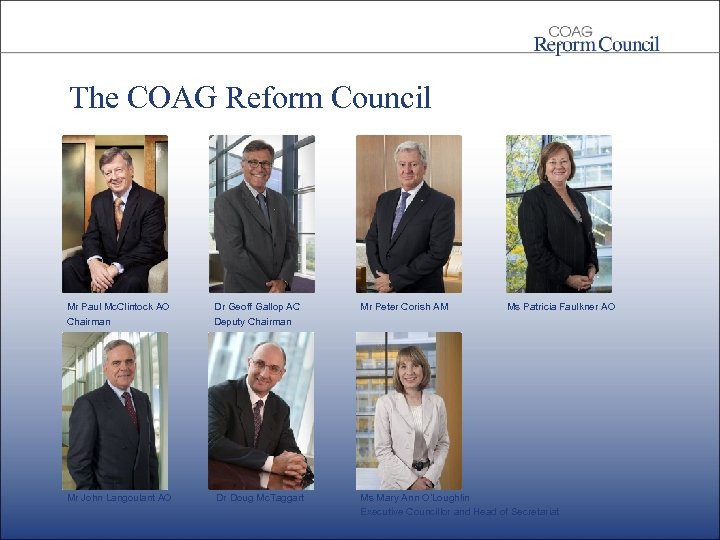 The COAG Reform Council Mr Paul Mc. Clintock AO Chairman Dr Geoff Gallop AC Deputy Chairman Mr Peter Corish AM Ms Patricia Faulkner AO Mr John Langoulant AO Dr Doug Mc. Taggart Ms Mary Ann O’Loughlin Executive Councillor and Head of Secretariat
 Intergovernmental Agreement on Federal Financial Relations • ‘represents the most significant reform of Australia’s federal financial relations in decades’ – governs all policy and financial relations between the Commonwealth and the States.
 National Agreements • In specific areas of service delivery: – Healthcare, Disability Services, Education, Skills and Workforce Development, Affordable Housing, Indigenous Reform • Define objectives, outcomes, performance indicators • Clarify the roles and responsibilities of the Commonwealth and States • Ongoing financial contributions from the Commonwealth – States have full budget flexibility to allocate funds as they see fit to achieve the agreed objectives for the sector. 4
 New accountability arrangements • COAG Reform Council – reports annually to COAG on a comparative analysis of governments’ performance under National Agreements and related National Partnerships – assesses States achievement of performance benchmarks under National Partnerships before the Commonwealth makes reward payments
 Improving performance through accountability • Performance is improved through accountability arrangements that are: – preventive – remedial – educative
 Setting standards • National Agreements identify objectives, outcomes, performance indicators and targets
 Encouraging responsibility for performance • Comparative analysis of governments’ performance – across jurisdictions – within a jurisdiction over time
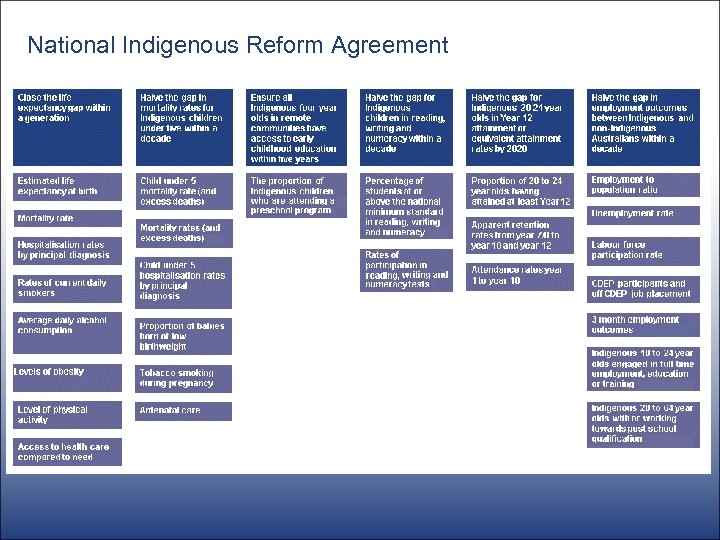 National Indigenous Reform Agreement
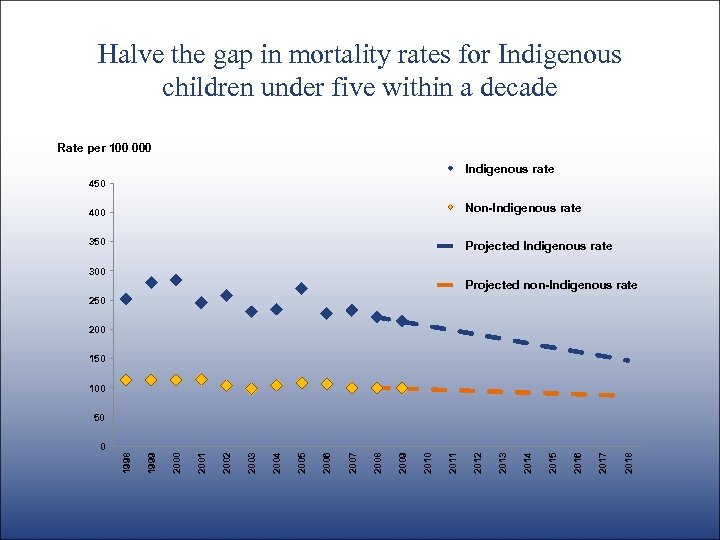 Halve the gap in mortality rates for Indigenous children under five within a decade Rate per 100 000 Indigenous rate 450 Non-Indigenous rate 400 350 Projected Indigenous rate 300 Projected non-Indigenous rate 250 200 150 100 2018 2017 2016 2015 2014 2013 2012 2011 2010 2009 2008 2007 2006 2005 2004 2003 2002 2001 2000 1999 0 1998 50
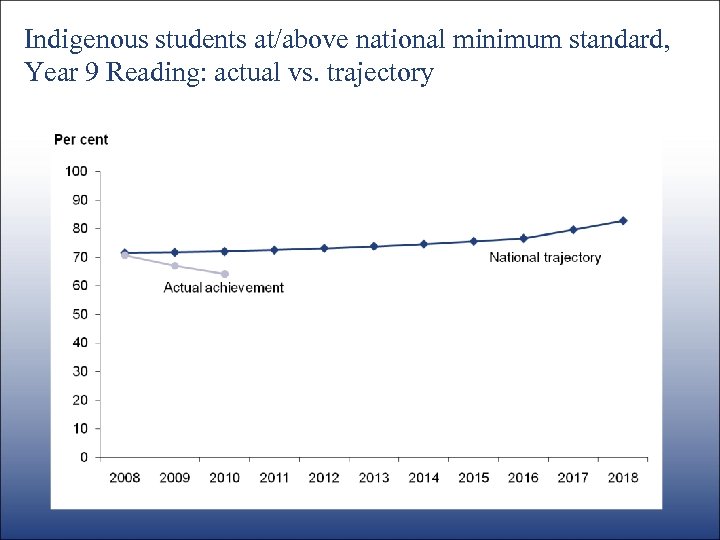 Indigenous students at/above national minimum standard, Year 9 Reading: actual vs. trajectory
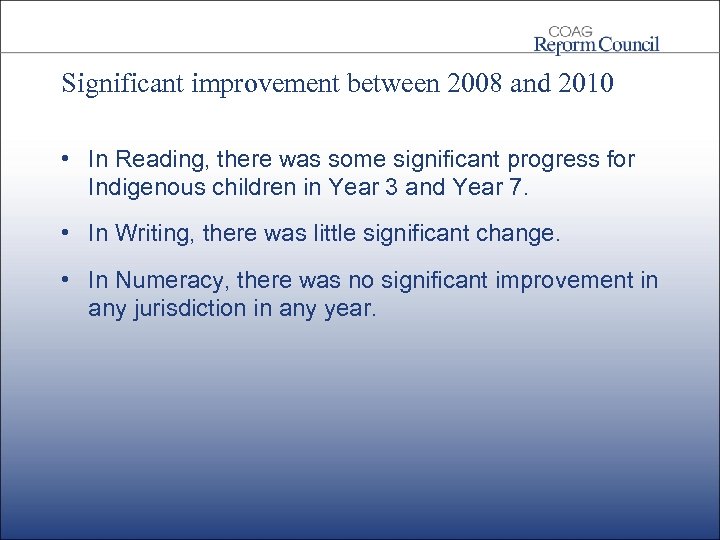 Significant improvement between 2008 and 2010 • In Reading, there was some significant progress for Indigenous children in Year 3 and Year 7. • In Writing, there was little significant change. • In Numeracy, there was no significant improvement in any jurisdiction in any year.
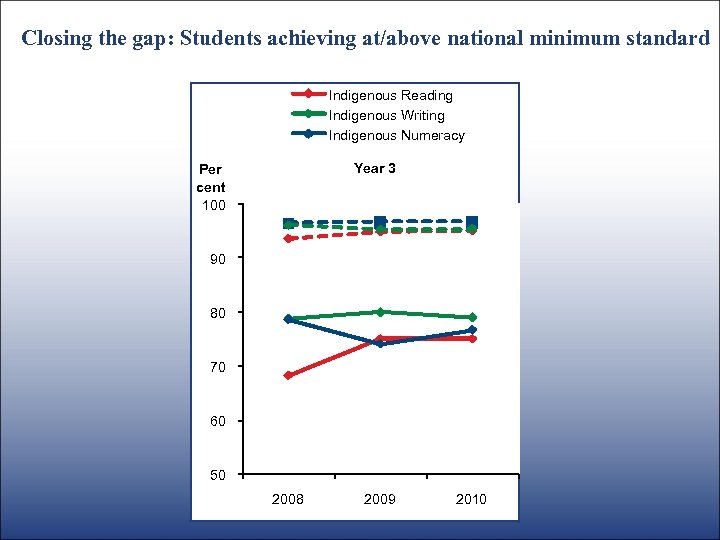 Closing the gap: Students achieving at/above national minimum standard Indigenous Reading Indigenous Writing Indigenous Numeracy Year 3 Per cent 100 90 80 70 60 50 2008 2009 2010
 Challenges • Clearly defined roles and responsibilities • Performance reporting framework • Public accountability as an incentive for reform
 Clearly defined roles and responsibilities • To strengthen the accountability of governments to the community.
 Performance reporting framework • Data – – timely meaningful for purpose comparable robust for change over time
 Public accountability as an incentive for reform • Will it help close the gap?
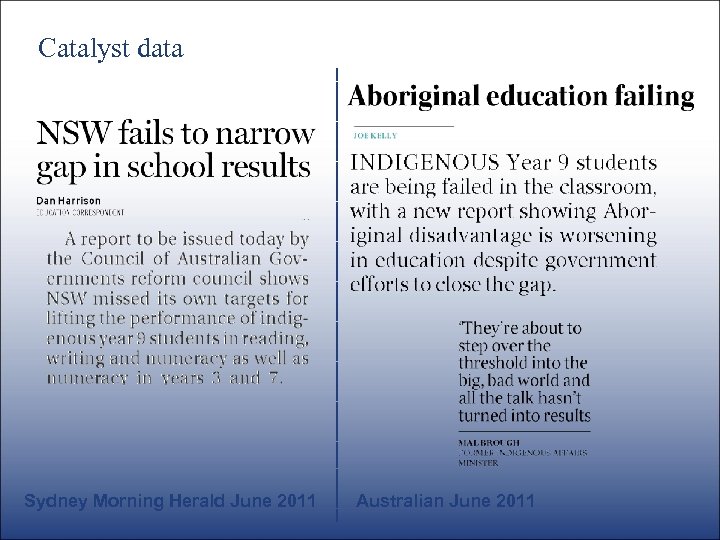 _________________ Catalyst data Sydney Morning Herald June 2011 Australian June 2011
 www. coagreformcouncil. gov. au