


 Скачать презентацию REPORTED SPEECH DIRECT SPEECH exact words and
6f600a7277dfdab4c71b7b354642dbe5.ppt
- Количество слайдов: 14
 REPORTED SPEECH
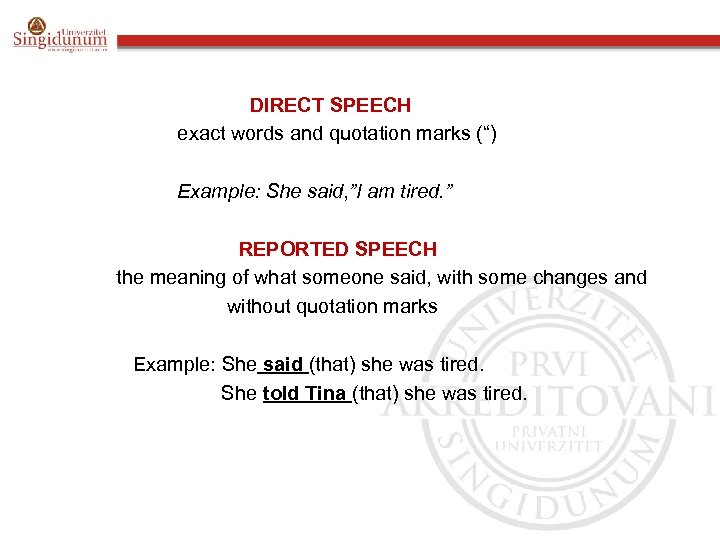 DIRECT SPEECH exact words and quotation marks (“) Example: She said, ”I am tired. ” REPORTED SPEECH the meaning of what someone said, with some changes and without quotation marks Example: She said (that) she was tired. She told Tina (that) she was tired.
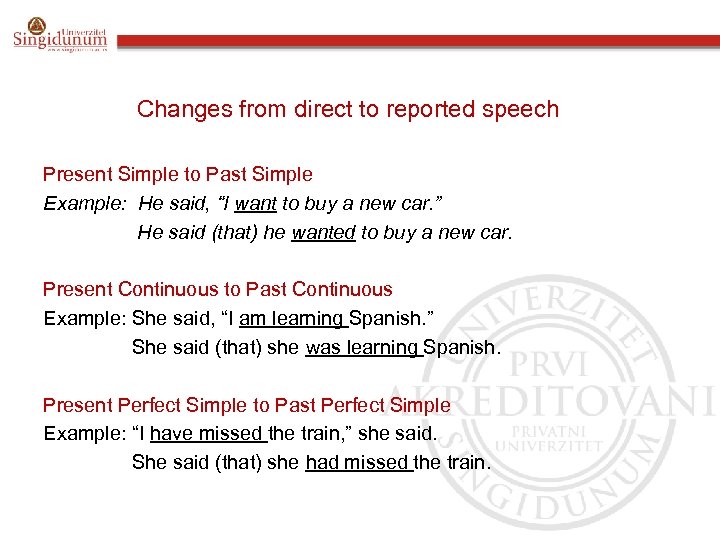 Changes from direct to reported speech Present Simple to Past Simple Example: He said, “I want to buy a new car. ” He said (that) he wanted to buy a new car. Present Continuous to Past Continuous Example: She said, “I am learning Spanish. ” She said (that) she was learning Spanish. Present Perfect Simple to Past Perfect Simple Example: “I have missed the train, ” she said. She said (that) she had missed the train.
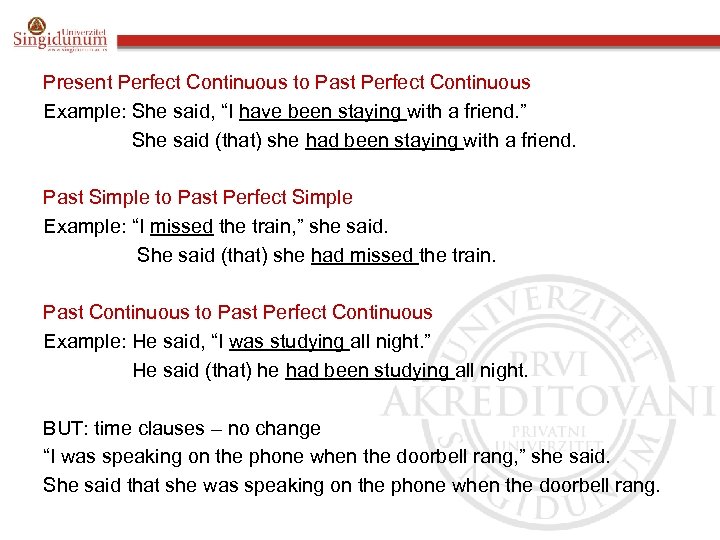 Present Perfect Continuous to Past Perfect Continuous Example: She said, “I have been staying with a friend. ” She said (that) she had been staying with a friend. Past Simple to Past Perfect Simple Example: “I missed the train, ” she said. She said (that) she had missed the train. Past Continuous to Past Perfect Continuous Example: He said, “I was studying all night. ” He said (that) he had been studying all night. BUT: time clauses – no change “I was speaking on the phone when the doorbell rang, ” she said. She said that she was speaking on the phone when the doorbell rang.
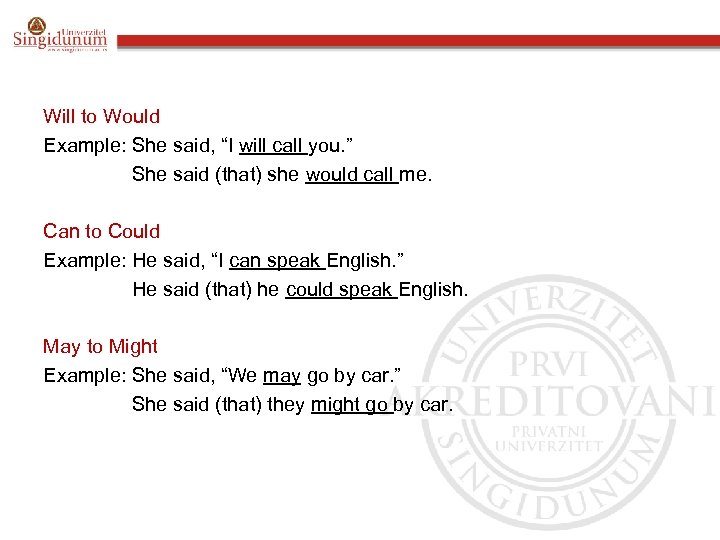 Will to Would Example: She said, “I will call you. ” She said (that) she would call me. Can to Could Example: He said, “I can speak English. ” He said (that) he could speak English. May to Might Example: She said, “We may go by car. ” She said (that) they might go by car.
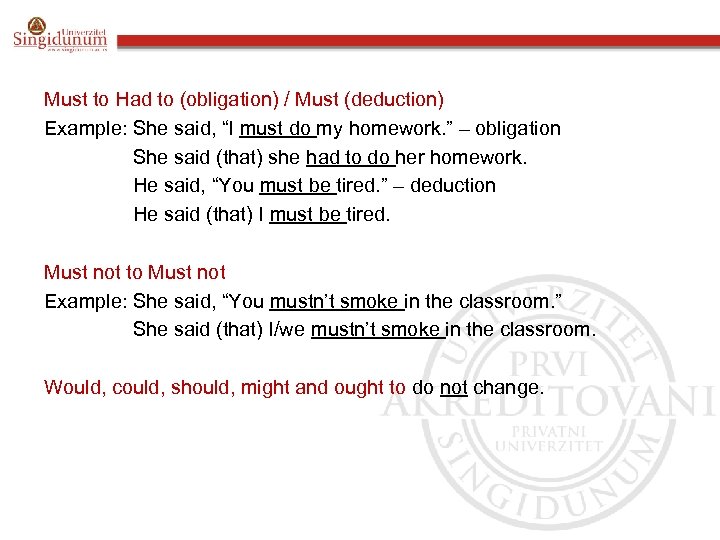 Must to Had to (obligation) / Must (deduction) Example: She said, “I must do my homework. ” – obligation She said (that) she had to do her homework. He said, “You must be tired. ” – deduction He said (that) I must be tired. Must not to Must not Example: She said, “You mustn’t smoke in the classroom. ” She said (that) I/we mustn’t smoke in the classroom. Would, could, should, might and ought to do not change.
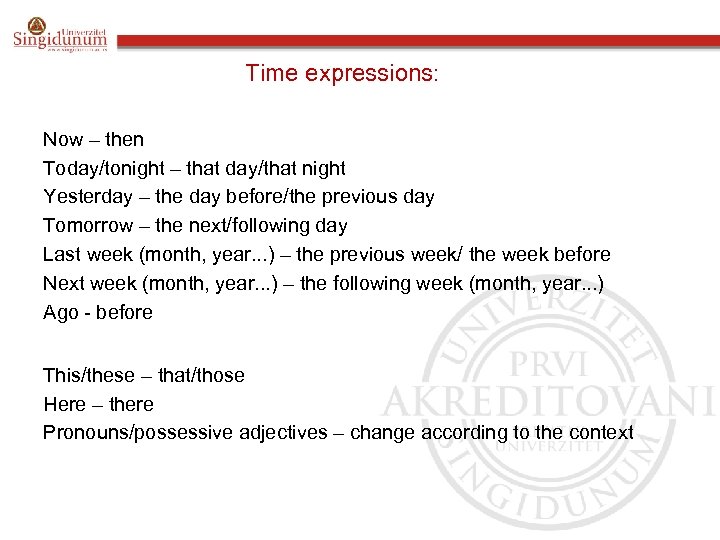 Time expressions: Now – then Today/tonight – that day/that night Yesterday – the day before/the previous day Tomorrow – the next/following day Last week (month, year. . . ) – the previous week/ the week before Next week (month, year. . . ) – the following week (month, year. . . ) Ago - before This/these – that/those Here – there Pronouns/possessive adjectives – change according to the context
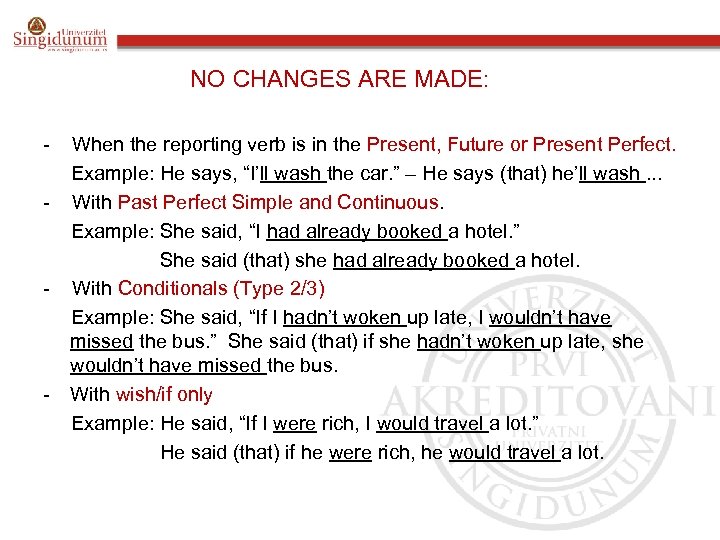 NO CHANGES ARE MADE: - - - When the reporting verb is in the Present, Future or Present Perfect. Example: He says, “I’ll wash the car. ” – He says (that) he’ll wash. . . With Past Perfect Simple and Continuous. Example: She said, “I had already booked a hotel. ” She said (that) she had already booked a hotel. With Conditionals (Type 2/3) Example: She said, “If I hadn’t woken up late, I wouldn’t have missed the bus. ” She said (that) if she hadn’t woken up late, she wouldn’t have missed the bus. With wish/if only Example: He said, “If I were rich, I would travel a lot. ” He said (that) if he were rich, he would travel a lot.
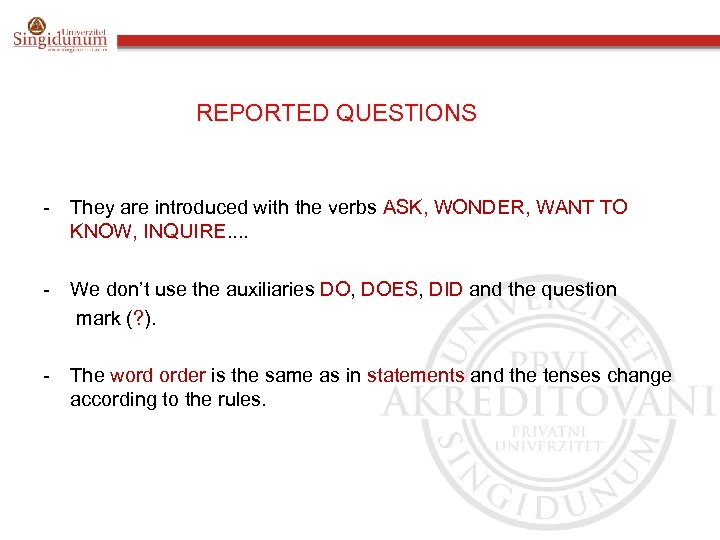 REPORTED QUESTIONS - They are introduced with the verbs ASK, WONDER, WANT TO KNOW, INQUIRE. . - We don’t use the auxiliaries DO, DOES, DID and the question mark (? ). - The word order is the same as in statements and the tenses change according to the rules.
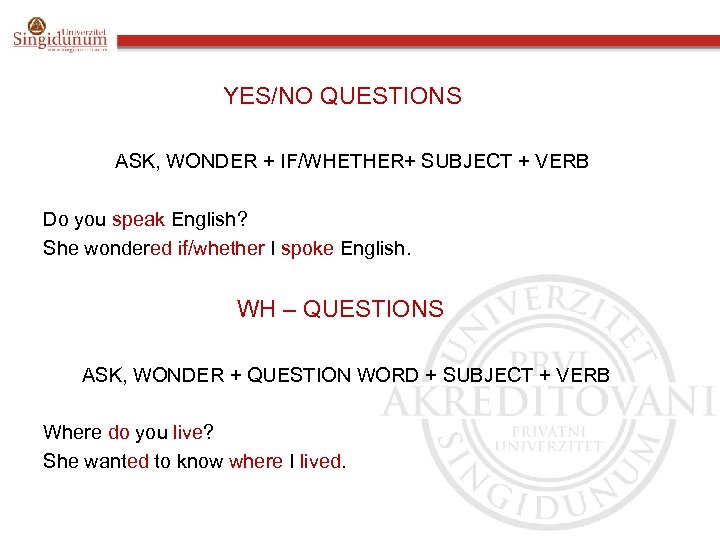 YES/NO QUESTIONS ASK, WONDER + IF/WHETHER+ SUBJECT + VERB Do you speak English? She wondered if/whether I spoke English. WH – QUESTIONS ASK, WONDER + QUESTION WORD + SUBJECT + VERB Where do you live? She wanted to know where I lived.
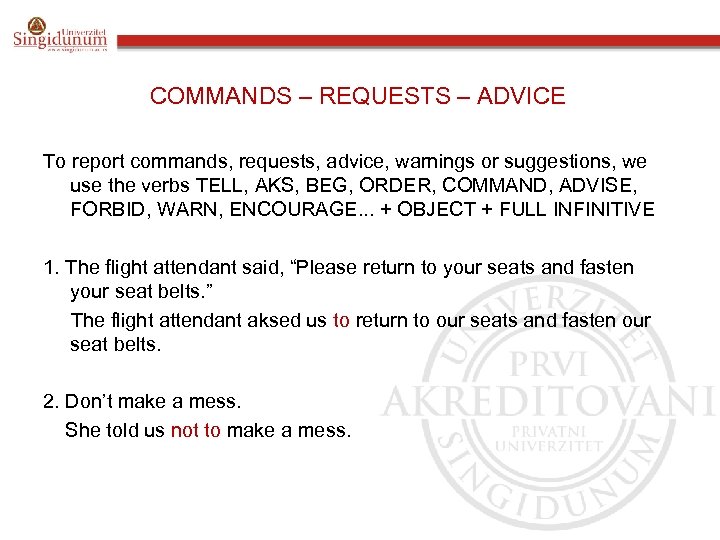 COMMANDS – REQUESTS – ADVICE To report commands, requests, advice, warnings or suggestions, we use the verbs TELL, AKS, BEG, ORDER, COMMAND, ADVISE, FORBID, WARN, ENCOURAGE. . . + OBJECT + FULL INFINITIVE 1. The flight attendant said, “Please return to your seats and fasten your seat belts. ” The flight attendant aksed us to return to our seats and fasten our seat belts. 2. Don’t make a mess. She told us not to make a mess.
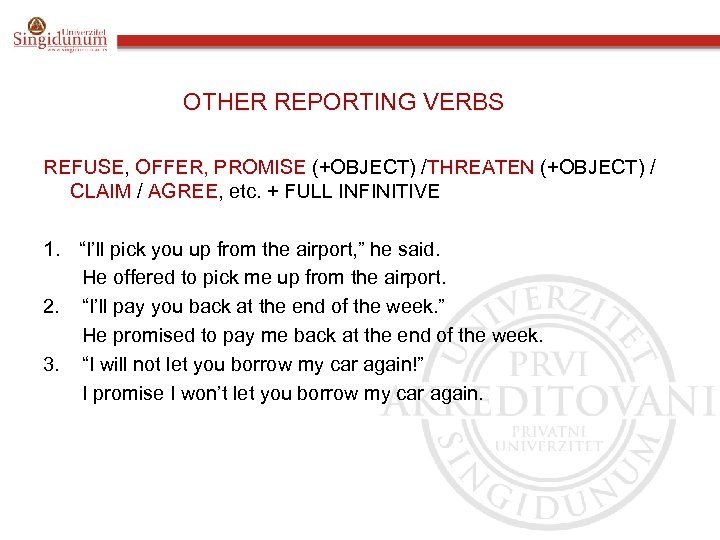 OTHER REPORTING VERBS REFUSE, OFFER, PROMISE (+OBJECT) /THREATEN (+OBJECT) / CLAIM / AGREE, etc. + FULL INFINITIVE 1. “I’ll pick you up from the airport, ” he said. He offered to pick me up from the airport. 2. “I’ll pay you back at the end of the week. ” He promised to pay me back at the end of the week. 3. “I will not let you borrow my car again!” I promise I won’t let you borrow my car again.
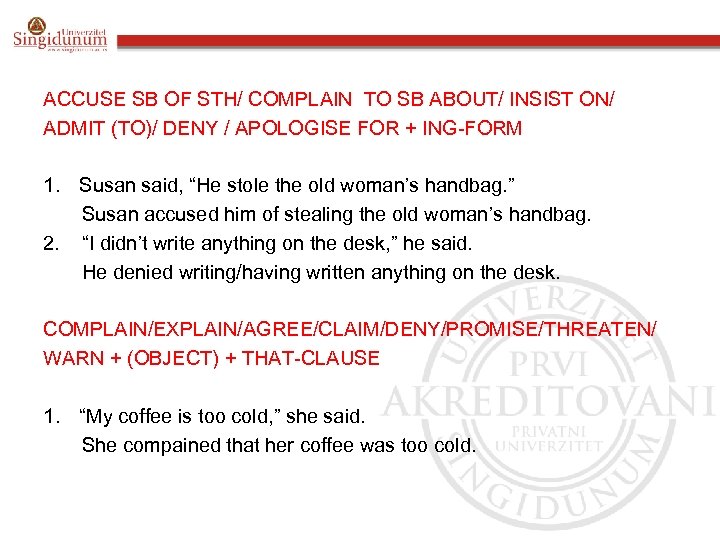 ACCUSE SB OF STH/ COMPLAIN TO SB ABOUT/ INSIST ON/ ADMIT (TO)/ DENY / APOLOGISE FOR + ING-FORM 1. Susan said, “He stole the old woman’s handbag. ” Susan accused him of stealing the old woman’s handbag. 2. “I didn’t write anything on the desk, ” he said. He denied writing/having written anything on the desk. COMPLAIN/EXPLAIN/AGREE/CLAIM/DENY/PROMISE/THREATEN/ WARN + (OBJECT) + THAT-CLAUSE 1. “My coffee is too cold, ” she said. She compained that her coffee was too cold.
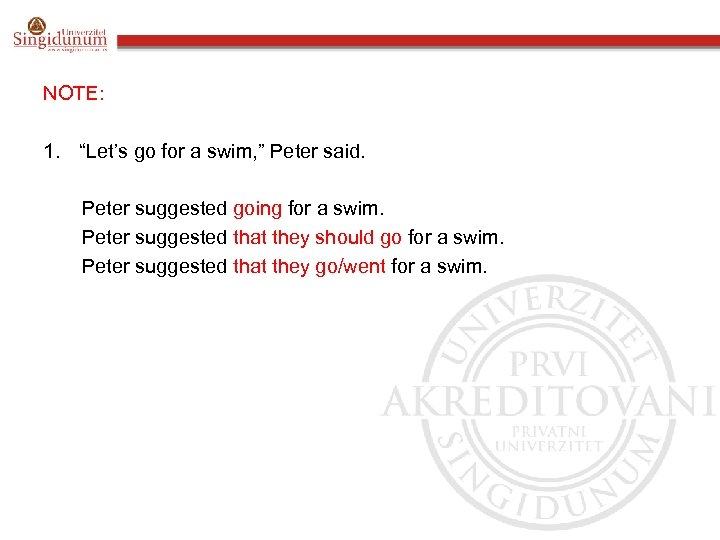 NOTE: 1. “Let’s go for a swim, ” Peter said. Peter suggested going for a swim. Peter suggested that they should go for a swim. Peter suggested that they go/went for a swim.