


 Скачать презентацию Report to WGOMD on GFDL Ocean Modelling Activities
843df5490bbae9683126dffebbce7f4a.ppt
- Количество слайдов: 18
 Report to WGOMD on GFDL Ocean Modelling Activities 2004 -2005 Stephen Griffies NOAA/GFDL (and CSIRO) • IPCC AR 4 activities • Model developments
 IPCC activities • Completed development of AR 4 coupled climate model in 2004, and submitted simulations to PCMDI 2004/2005. • ~1 degree ocean (mom 4) with 50 levels and 1/3 degree at equator. Described at previous meetings. • Numerous studies now being conducted to document the model’s design and simulation characteristics. Will take years to fully evaluate.
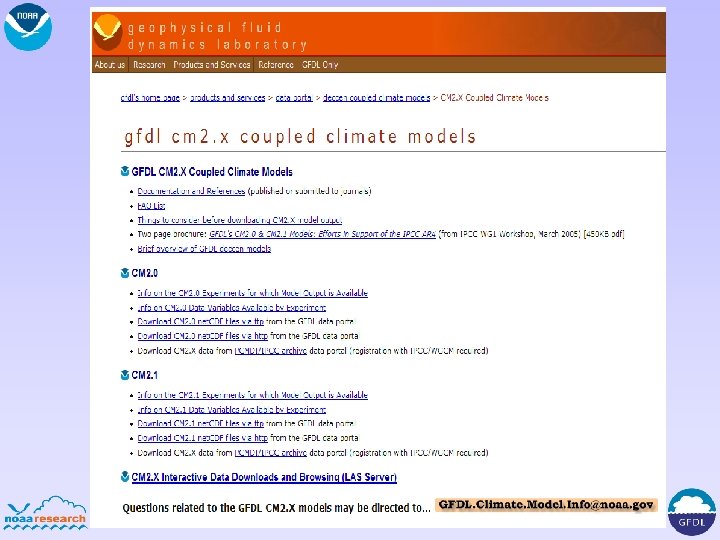 GFDL Coupled Model results
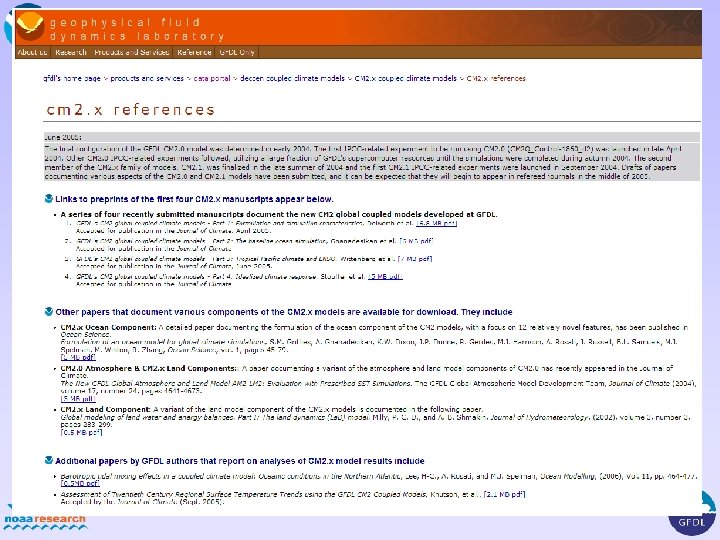 References
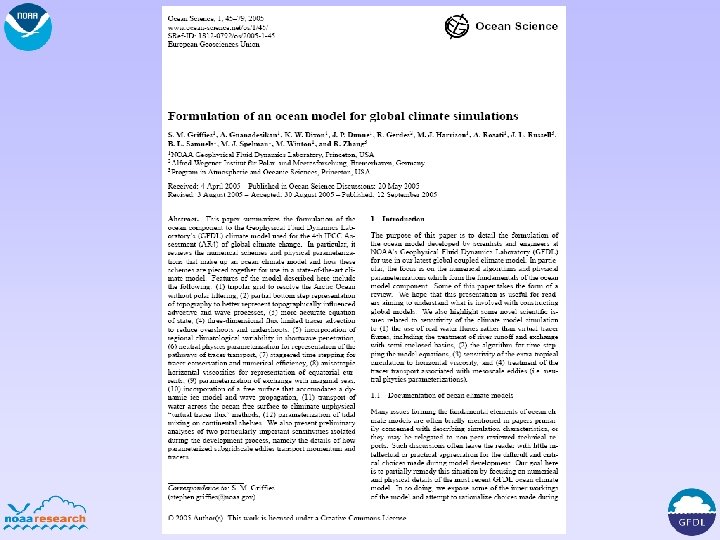 Ocean Model
 Plans for GFDL ocean model development A briefing to WGOMD • Inform WGOMD of plans for MOM 4 over next 6 months • Speculate on 3 -5 years research/development goals and applications involving ocean models.
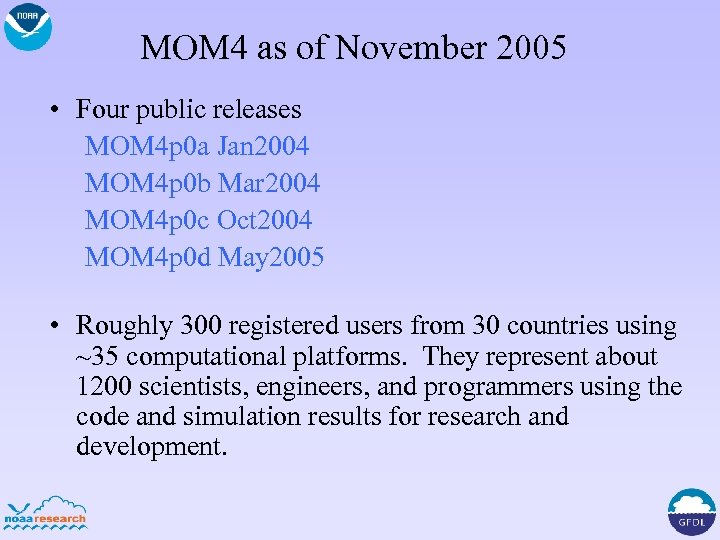 MOM 4 as of November 2005 • Four public releases MOM 4 p 0 a Jan 2004 MOM 4 p 0 b Mar 2004 MOM 4 p 0 c Oct 2004 MOM 4 p 0 d May 2005 • Roughly 300 registered users from 30 countries using ~35 computational platforms. They represent about 1200 scientists, engineers, and programmers using the code and simulation results for research and development.
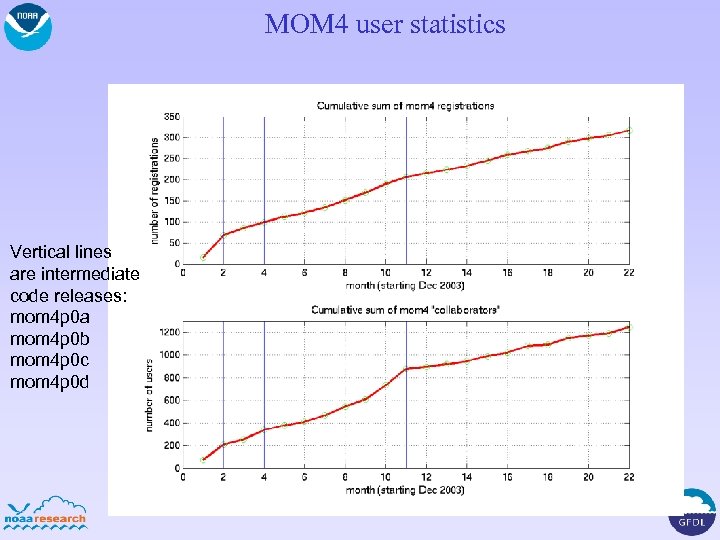 MOM 4 user statistics Vertical lines are intermediate code releases: mom 4 p 0 a mom 4 p 0 b mom 4 p 0 c mom 4 p 0 d
 GFDL Applications of MOM 4 • IPCC Global climate change modelling: – Ocean component to the GFDL AR 4 climate change models. – Developed largely for global climate modeling applications. – ~50 GFDL scientists directly involved with this research and development. • Earth system modelling: – interactive land, atmosphere, ocean biogeochemistry and ecosystems – ~30 scientists at GFDL and Princeton University • Global and regional process studies: – – – paleo-oceanography idealized climate change simulations thermohaline shutdown physical process studies ~20 scientists, visiting researchers, post-docs, graduate students
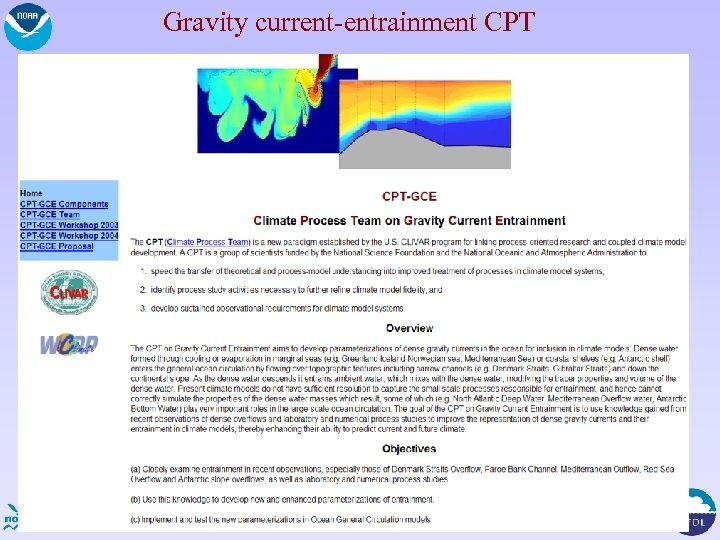 Gravity current-entrainment CPT
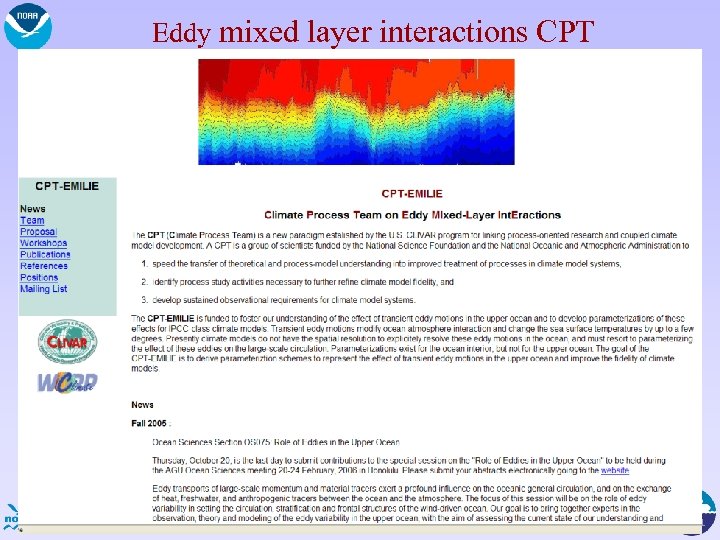 Eddy mixed layer interactions CPT
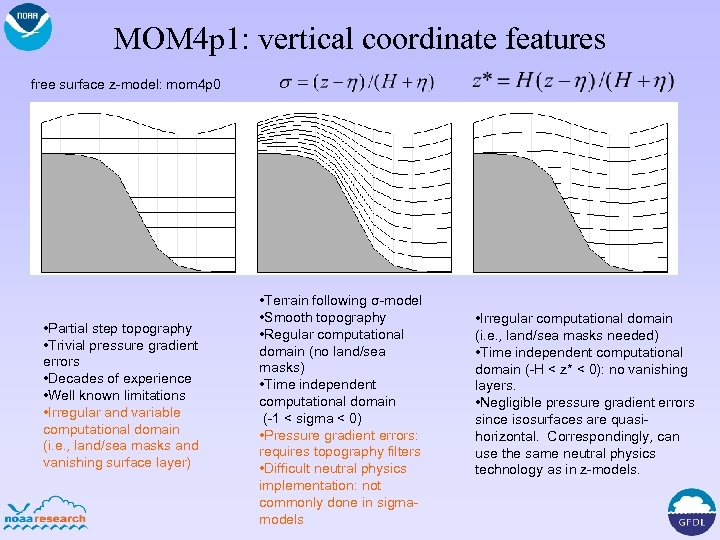 MOM 4 p 1: vertical coordinate features free surface z-model: mom 4 p 0 • Partial step topography • Trivial pressure gradient errors • Decades of experience • Well known limitations • Irregular and variable computational domain (i. e. , land/sea masks and vanishing surface layer) • Terrain following σ-model • Smooth topography • Regular computational domain (no land/sea masks) • Time independent computational domain (-1 < sigma < 0) • Pressure gradient errors: requires topography filters • Difficult neutral physics implementation: not commonly done in sigmamodels • Irregular computational domain (i. e. , land/sea masks needed) • Time independent computational domain (-H < z* < 0): no vanishing layers. • Negligible pressure gradient errors since isosurfaces are quasihorizontal. Correspondingly, can use the same neutral physics technology as in z-models.
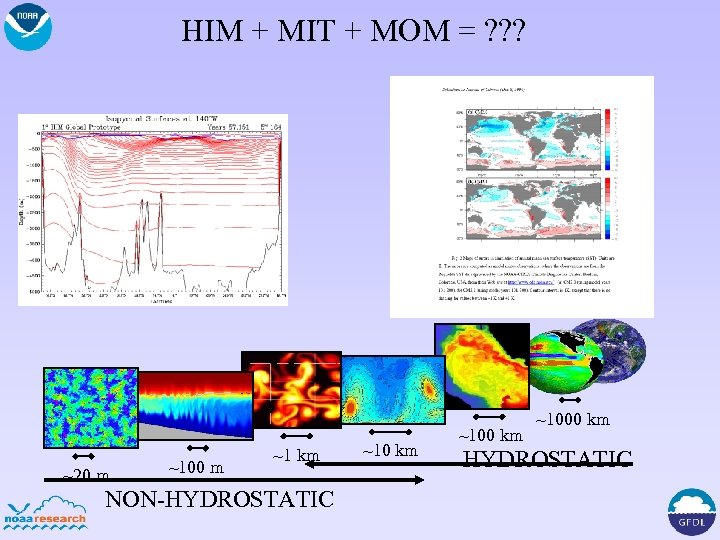
 Evolution of GFDL ocean codes Evolution is in response to many inputs – New applications: • Refined resolution climate models • Biogeochemistry and ecosystem applications • Earth system modeling • Coastal impacts of climate change • Non-hydrostatic processes at very refined resolutions – Enhanced features: • physical parameterizations (e. g. , mixed layers, mesoscale eddies) • algorithm fundamentals (e. g. , time stepping, vertical coordinates) • better understanding of the ocean (e. g. , equation formulations) – Computational efficiency and platform portability – Input from the international user communities (HIM, MITgcm, MOM 4) Main developers: Alistair Adcroft, Bob Hallberg, Steve Griffies
 Evolution Path • MOM 4 p 1: ~March 2006 with rudimentary generalized vertical coordinate features to expand mom 4 applications. • HIM-Fortran: Hallberg Isopycnal Model, publicly supported within GFDL Flexible Modeling System (FMS); GFDL development now aimed at coupled simulations to compare w/ mom 4 -based coupled model. • Research: Merge three fundamental perspectives – non-hydrostatic z-modeling from MIT (Adcroft) – hydrostatic isopycnal modeling from HIM (Hallberg) – Global ocean climate modeling from MOM 4 (Griffies) • Key NOAA application: climate impacts on coasts – Global “Back. Bone Model” ~10 km with nest to ~1 km – Tides, wave breaking, storm surge, sediment transport, etc. • ~2008 -2010 for first public code release
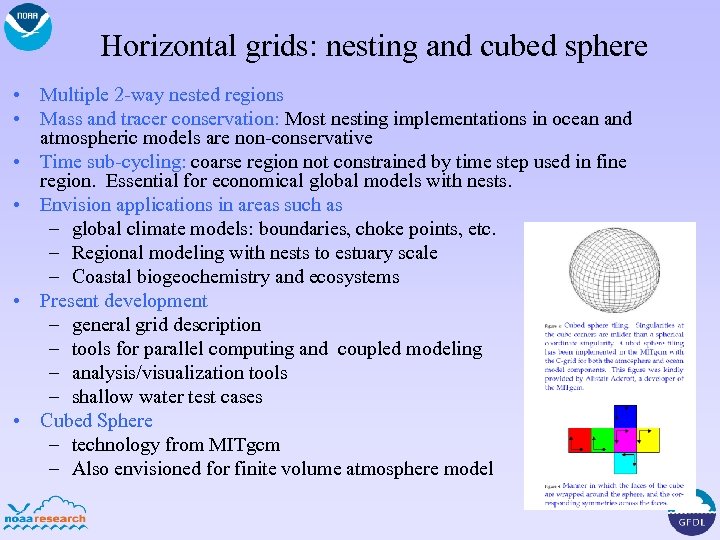 Horizontal grids: nesting and cubed sphere • Multiple 2 -way nested regions • Mass and tracer conservation: Most nesting implementations in ocean and atmospheric models are non-conservative • Time sub-cycling: coarse region not constrained by time step used in fine region. Essential for economical global models with nests. • Envision applications in areas such as – global climate models: boundaries, choke points, etc. – Regional modeling with nests to estuary scale – Coastal biogeochemistry and ecosystems • Present development – general grid description – tools for parallel computing and coupled modeling – analysis/visualization tools – shallow water test cases • Cubed Sphere – technology from MITgcm – Also envisioned for finite volume atmosphere model
 Main Applications • Coastal impacts of climate change • Earth System Modelling w/ eddying simulations (~1/3 to 1/4 degree mercator with twoway nesting in selected critical regions) • NOAA “Back. Bone” model, with ~1/10 global to be nested with finer grids in certain coastal areas. For use by many projects within NOAA. • non. Hydrostatic process studies and very refined coastal and estuary simulations • University PI and student research and education
 HIM + MIT + MOM = ? ? ? ~20 m ~100 m ~1 km NON-HYDROSTATIC ~10 km ~1000 km HYDROSTATIC
 Unified GFDL Ocean Code • Bring together our understanding of the ocean and how to simulate a wide range of scales. • Various algorithms with stepwise evolution involving suites of applications to test methods and flesh out favourable approaches. • This effort is a major research and development project, presently in its early stages at GFDL. Much research remains to determine particulars of algorithms. • Various efforts (e. g. , HOME) to develop a US community model have failed to garner funds. GFDL is committed to this project using in-house resources, and will involve outside collaborators as best as possible.