 Скачать презентацию Report to the Collaboration India-CMS Meeting BARC Mumbai
4ef7d7b2814c02aeb05e0ea039f57561.ppt
- Количество слайдов: 57



Report to the Collaboration India-CMS Meeting BARC, Mumbai 29 July 2010 A. Gurtu, TIFR
LHC run plan • February 2010: Traditional Chamonix workshop. Decision to have an extended (18 – 24 month) physics run at 7 Te. V. This was the best compromise keeping in mind the safety requirements, the cryogenic nature of the machine, where every intervention means 2 – 3 months of warming/cooling of the machine, and physics requirements. • It was felt that such an extended run, yielding approximately 1 fb-1 data, would enable meaningful search for new physics (Higgs discovery in the 160 – 170 Ge. V range, and exclusion in a wider range; and discovery of SUSY, Z’, etc, if it exists).
7 Te. V Collisions • March 30, 2010: Successful collisions at 7 Te. V energy. The machine now continues to run at this energy and experiments are taking data. For the time being the luminosity is low; they will gradually increase the number of bunches and squeeze the beams to attain higher luminosity.
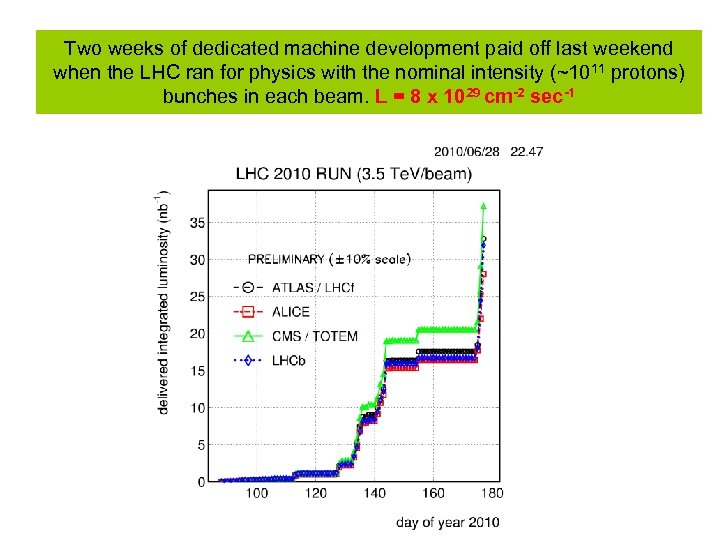
Two weeks of dedicated machine development paid off last weekend when the LHC ran for physics with the nominal intensity (~1011 protons) bunches in each beam. L = 8 x 1029 cm-2 sec-1
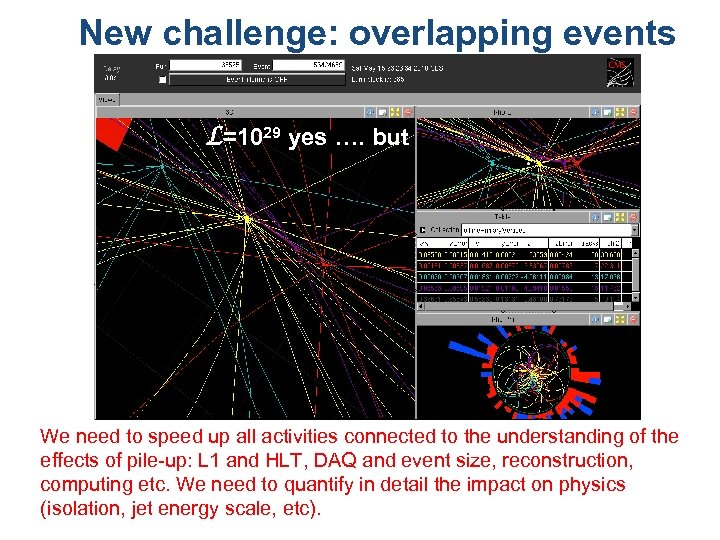
New challenge: overlapping events Multi Jet Event at 7 Te. V L=1029 yes …. but We need to speed up all activities connected to the understanding of the effects of pile-up: L 1 and HLT, DAQ and event size, reconstruction, computing etc. We need to quantify in detail the impact on physics (isolation, jet energy scale, etc).
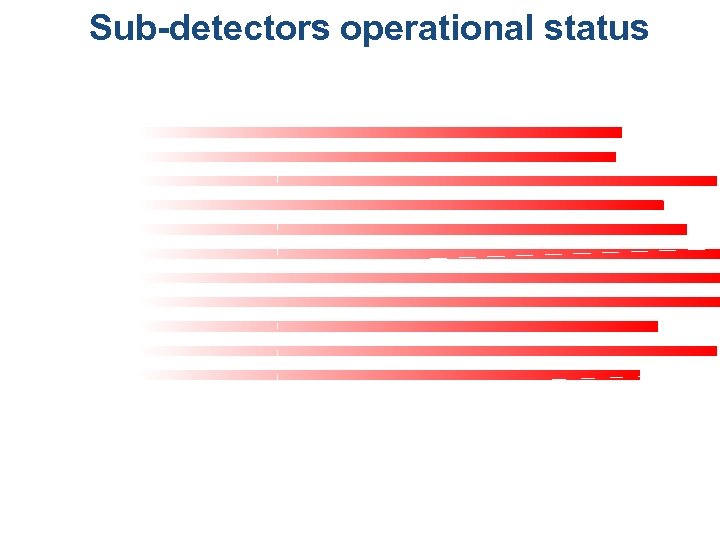
Sub-detectors operational status PIXEL TRACKER STRIP TRACKER PRE-SHOWER ECAL END-CAP ECAL BARREL HCAL FORWARD HCAL ENDCAP HCAL BARREL MUON-RPC MUON-DT MUON-CSC MUONCSC Series 1 98. 5 90 91 92 93 94 95 96 97 98 99 HCAL STRIP PIXEL MUON- HCAL ECAL PREFORWAR TRACKE DT RPC BARREL ENDCAP BARREL END-CAPSHOWER D R R 99. 8 98. 8 99. 9 100 99. 9 99. 3 98. 9 99. 8 98. 1 98. 2 1
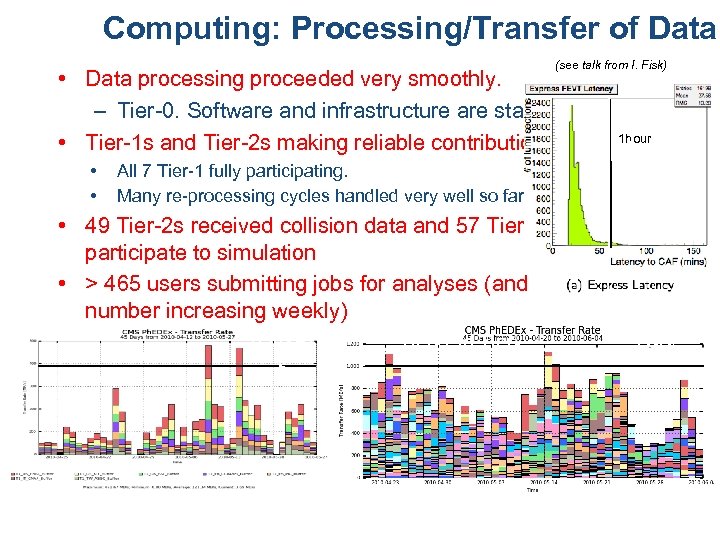
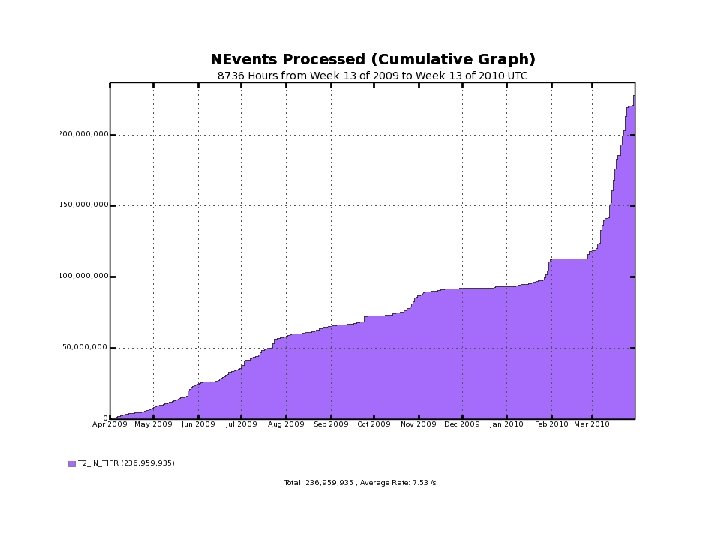
Computing: Processing/Transfer of Data (see talk from I. Fisk) • Data processing proceeded very smoothly. – Tier-0. Software and infrastructure are stable • Tier-1 s and Tier-2 s making reliable contributions • • 1 hour All 7 Tier-1 fully participating. Many re-processing cycles handled very well so far. • 49 Tier-2 s received collision data and 57 Tier-2 s participate to simulation • > 465 users submitting jobs for analyses (and number increasing weekly) Tier-0 to Tier-1 s 0. 4 GB/ s 24 h average CERN to Tier-1 Transfers Tier-1 to Tier 2 24 h average 1 GB/ s
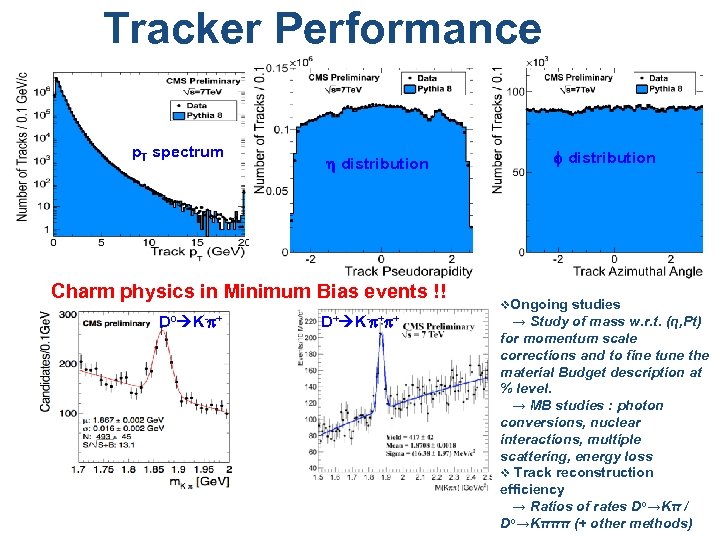
Tracker Performance p. T spectrum h distribution Charm physics in Minimum Bias events !! Do K-p+ D+ K-p+p+ f distribution v. Ongoing studies → Study of mass w. r. t. (η, Pt) for momentum scale corrections and to fine tune the material Budget description at % level. → MB studies : photon conversions, nuclear interactions, multiple scattering, energy loss v Track reconstruction efficiency → Ratios of rates Do→Kπ / Do→Kπππ (+ other methods)
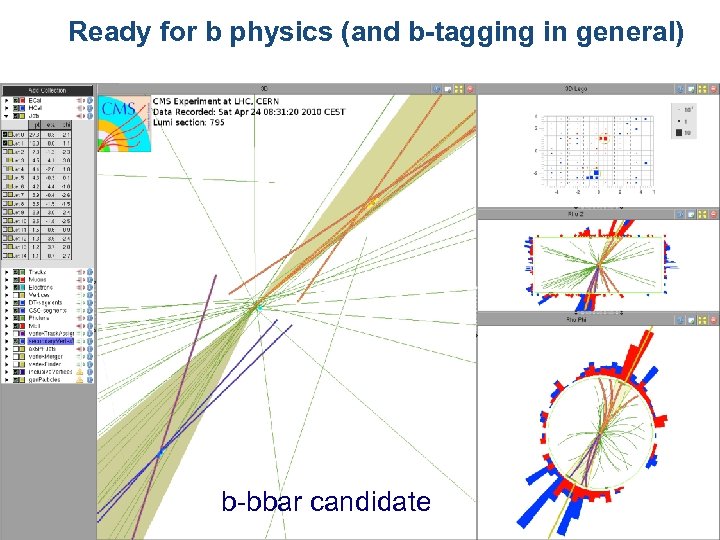
Ready for b physics (and b-tagging in general) b-bbar candidate 9
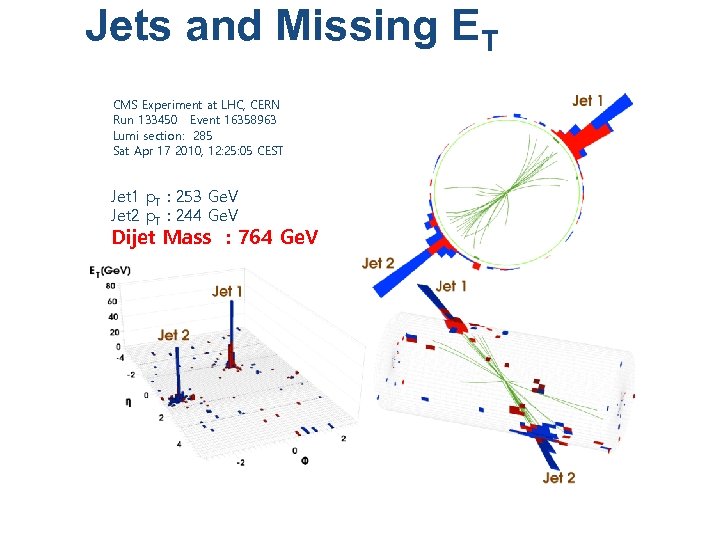
Jets and Missing ET CMS Experiment at LHC, CERN Run 133450 Event 16358963 Lumi section: 285 Sat Apr 17 2010, 12: 25: 05 CEST Jet 1 p. T : 253 Ge. V Jet 2 p. T : 244 Ge. V Dijet Mass : 764 Ge. V
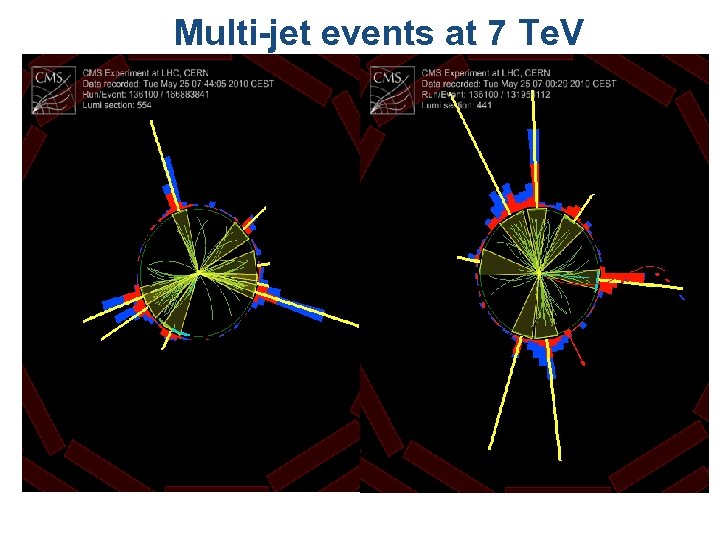
Multi-jet events at 7 Te. V
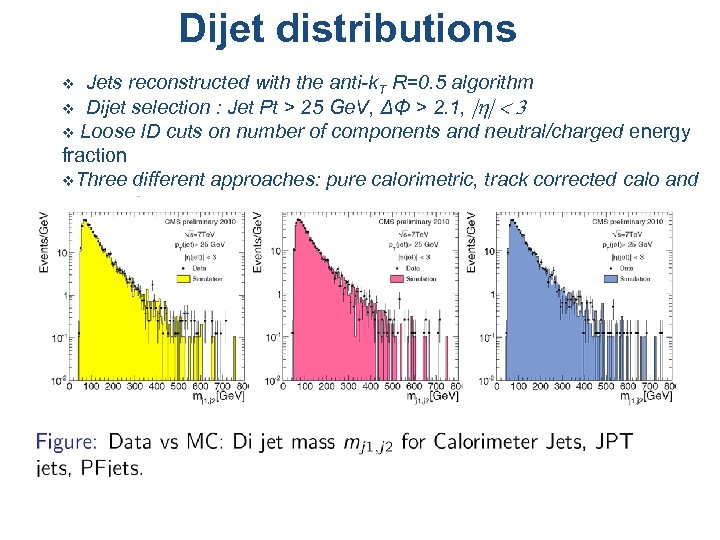
Dijet distributions Jets reconstructed with the anti-k. T R=0. 5 algorithm v Dijet selection : Jet Pt > 25 Ge. V, ΔΦ > 2. 1, |h| < 3 v Loose ID cuts on number of components and neutral/charged energy fraction v. Three different approaches: pure calorimetric, track corrected calo and particle flow. v
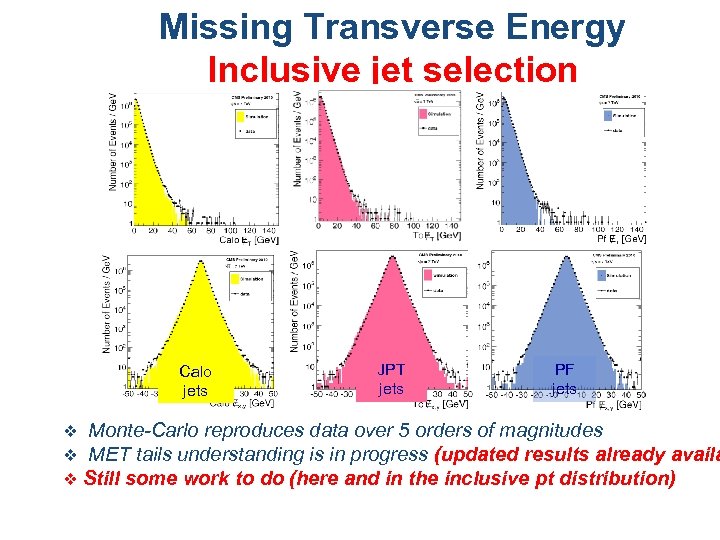
Missing Transverse Energy Inclusive jet selection Calo jets v v v JPT jets PF jets Monte-Carlo reproduces data over 5 orders of magnitudes MET tails understanding is in progress (updated results already availa Still some work to do (here and in the inclusive pt distribution)
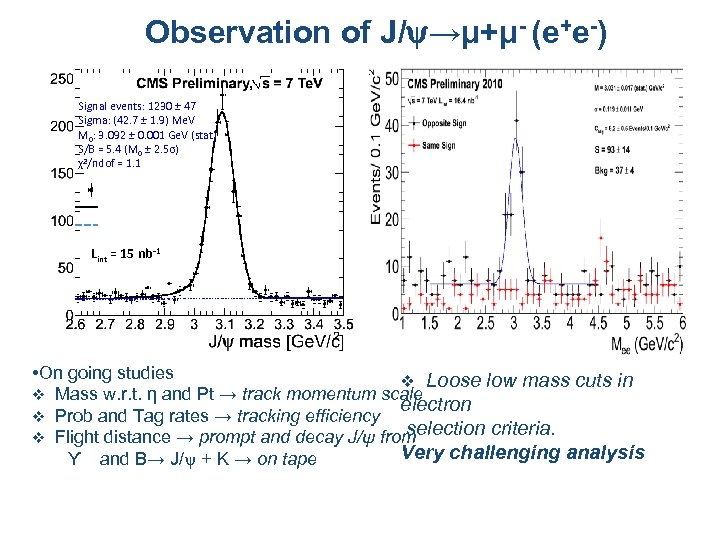
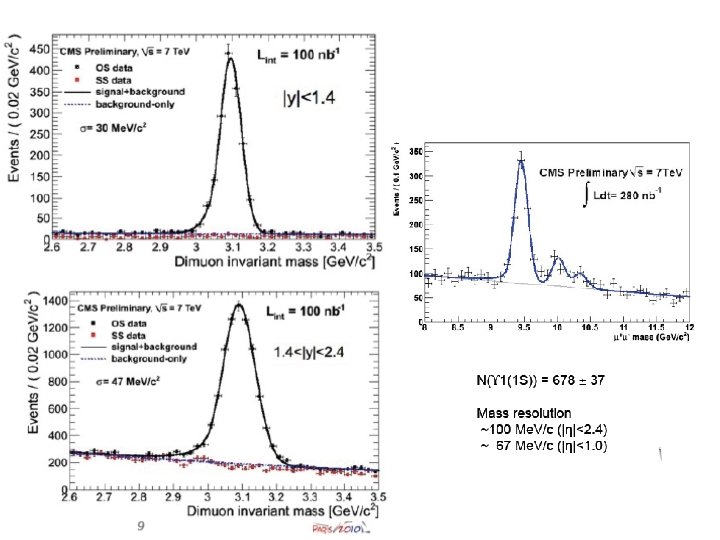
Observation of J/y→μ+μ- (e+e-) Signal events: 1230 ± 47 Sigma: (42. 7 ± 1. 9) Me. V M 0: 3. 092 ± 0. 001 Ge. V (stat) S/B = 5. 4 (M 0 ± 2. 5σ) χ2/ndof = 1. 1 Lint = 15 nb-1 • On going studies v Loose low mass cuts in v Mass w. r. t. η and Pt → track momentum scale electron v Prob and Tag rates → tracking efficiency selection criteria. v Flight distance → prompt and decay J/ψ from Very challenging analysis ϒ and B→ J/y + K → on tape
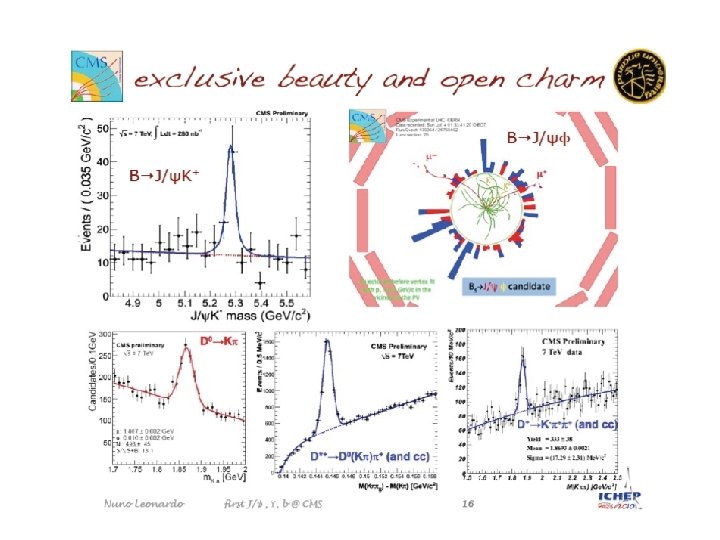
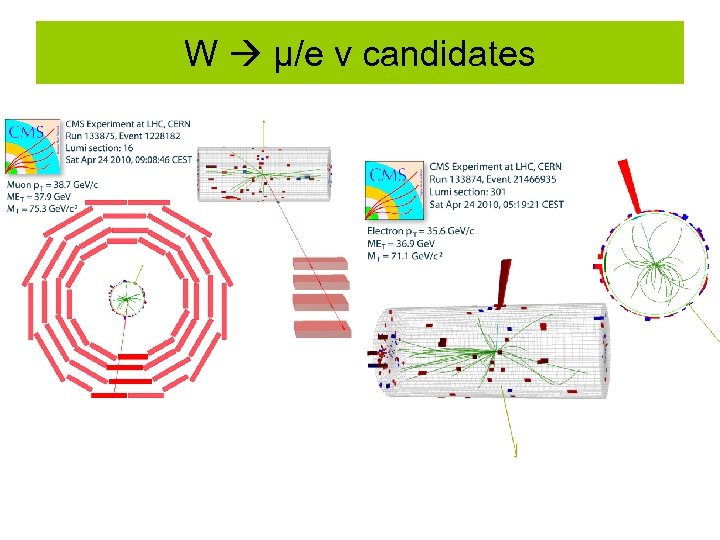
W μ/e ν candidates
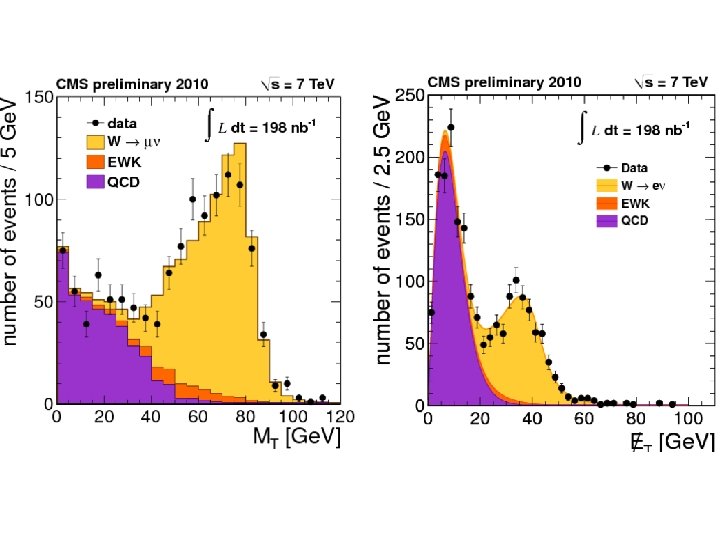
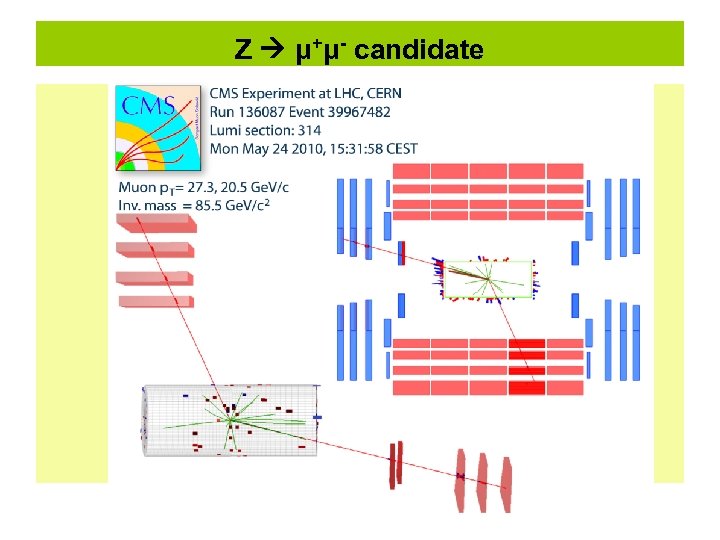
Z μ+μ- candidate
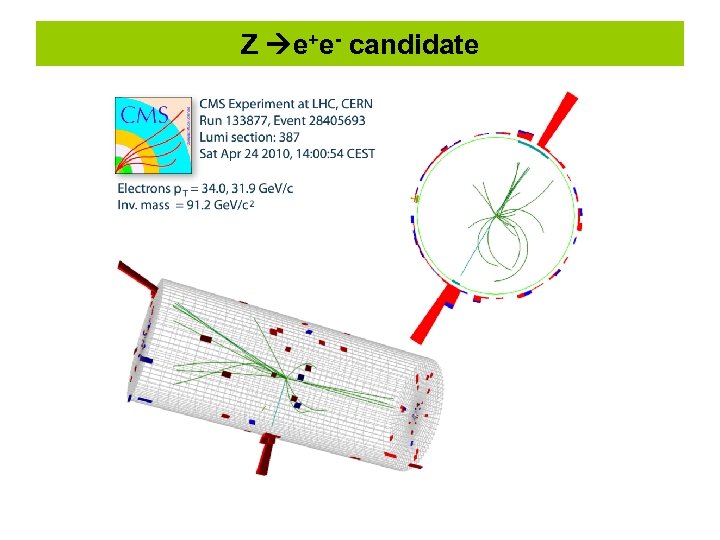
Z e+e- candidate
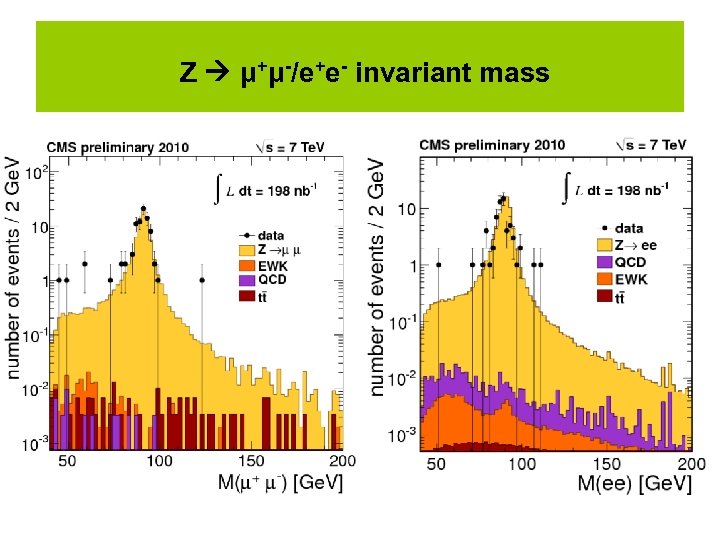
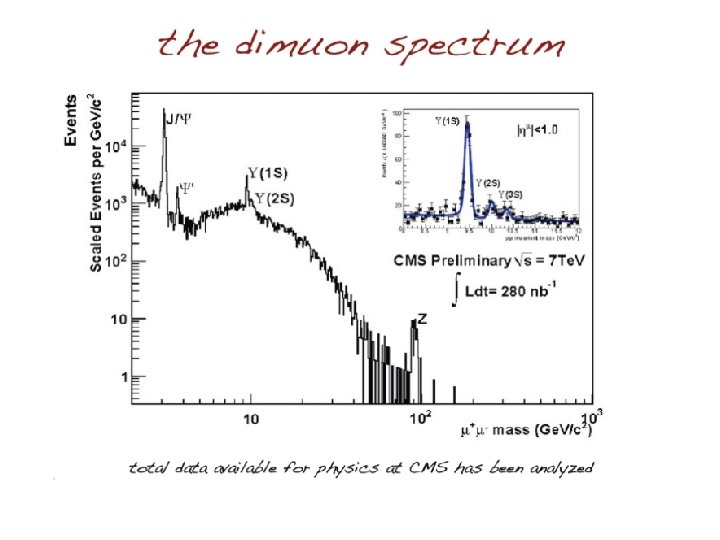
Z μ+μ-/e+e- invariant mass
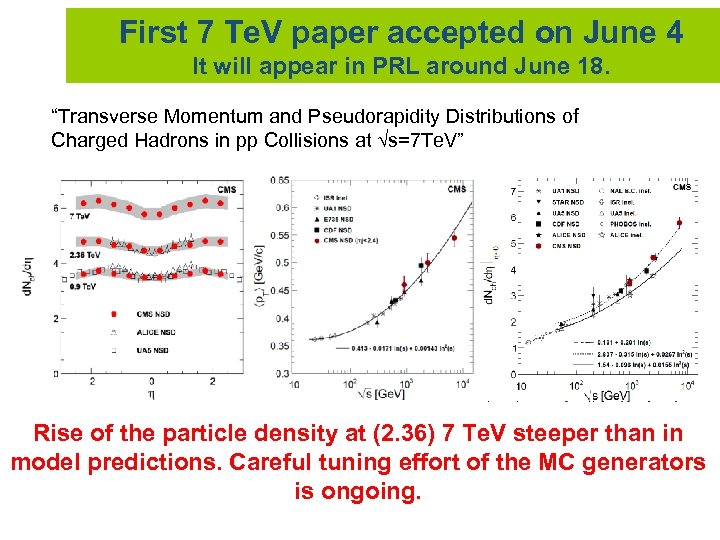
First 7 Te. V paper accepted on June 4 It will appear in PRL around June 18. “Transverse Momentum and Pseudorapidity Distributions of Charged Hadrons in pp Collisions at √s=7 Te. V” Rise of the particle density at (2. 36) 7 Te. V steeper than in model predictions. Careful tuning effort of the MC generators is ongoing.
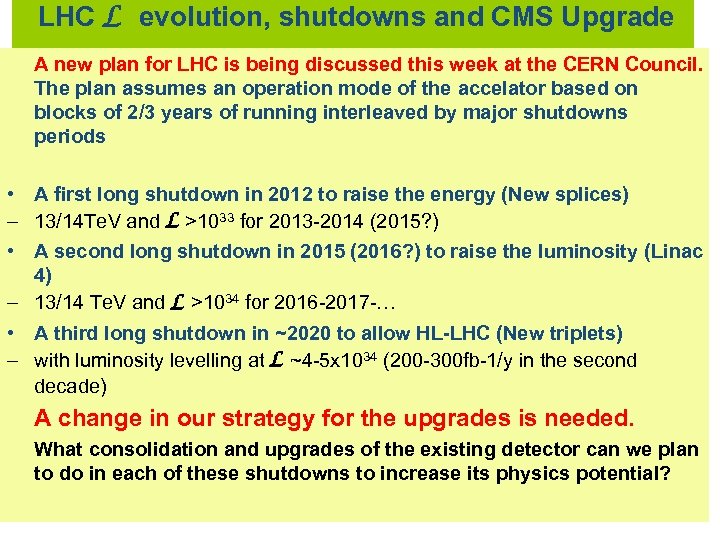
LHC L evolution, shutdowns and CMS Upgrade A new plan for LHC is being discussed this week at the CERN Council. The plan assumes an operation mode of the accelator based on blocks of 2/3 years of running interleaved by major shutdowns periods • A first long shutdown in 2012 to raise the energy (New splices) – 13/14 Te. V and L >1033 for 2013 -2014 (2015? ) • A second long shutdown in 2015 (2016? ) to raise the luminosity (Linac 4) – 13/14 Te. V and L >1034 for 2016 -2017 -… • A third long shutdown in ~2020 to allow HL-LHC (New triplets) – with luminosity levelling at L ~4 -5 x 1034 (200 -300 fb-1/y in the second decade) A change in our strategy for the upgrades is needed. What consolidation and upgrades of the existing detector can we plan to do in each of these shutdowns to increase its physics potential?
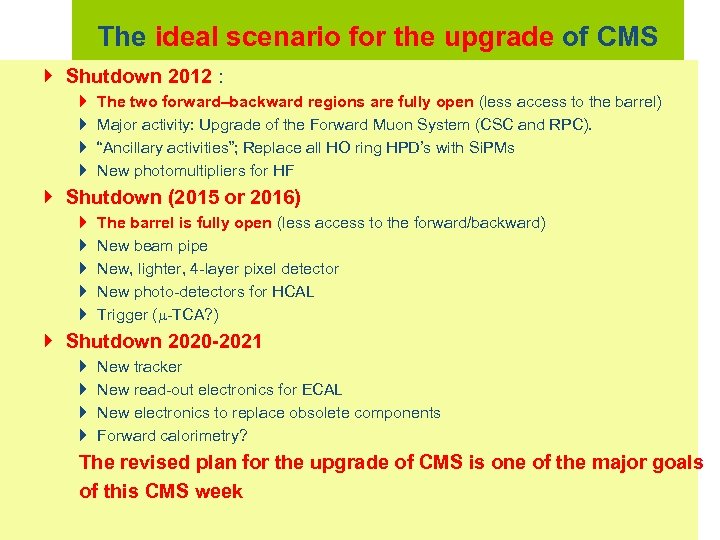
The ideal scenario for the upgrade of CMS Shutdown 2012 : The two forward–backward regions are fully open (less access to the barrel) Major activity: Upgrade of the Forward Muon System (CSC and RPC). “Ancillary activities”; Replace all HO ring HPD’s with Si. PMs New photomultipliers for HF Shutdown (2015 or 2016) The barrel is fully open (less access to the forward/backward) New beam pipe New, lighter, 4 -layer pixel detector New photo-detectors for HCAL Trigger (m-TCA? ) Shutdown 2020 -2021 New tracker New read-out electronics for ECAL New electronics to replace obsolete components Forward calorimetry? The revised plan for the upgrade of CMS is one of the major goals of this CMS week
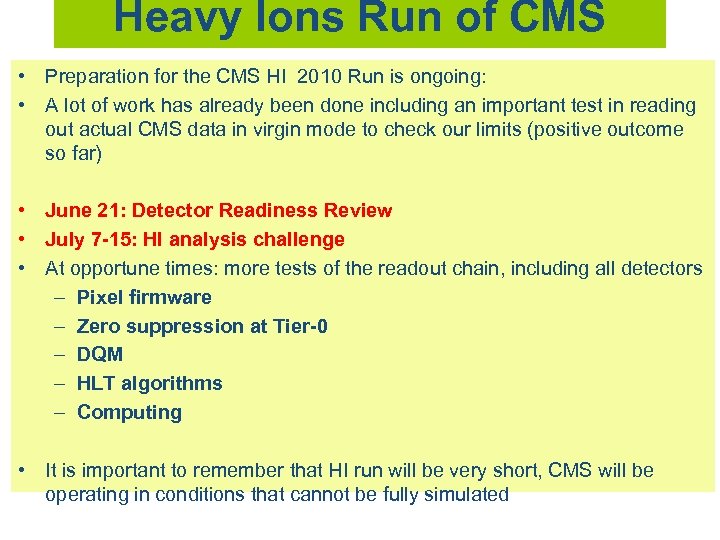
Heavy Ions Run of CMS • Preparation for the CMS HI 2010 Run is ongoing: • A lot of work has already been done including an important test in reading out actual CMS data in virgin mode to check our limits (positive outcome so far) • June 21: Detector Readiness Review • July 7 -15: HI analysis challenge • At opportune times: more tests of the readout chain, including all detectors – Pixel firmware – Zero suppression at Tier-0 – DQM – HLT algorithms – Computing • It is important to remember that HI run will be very short, CMS will be operating in conditions that cannot be fully simulated
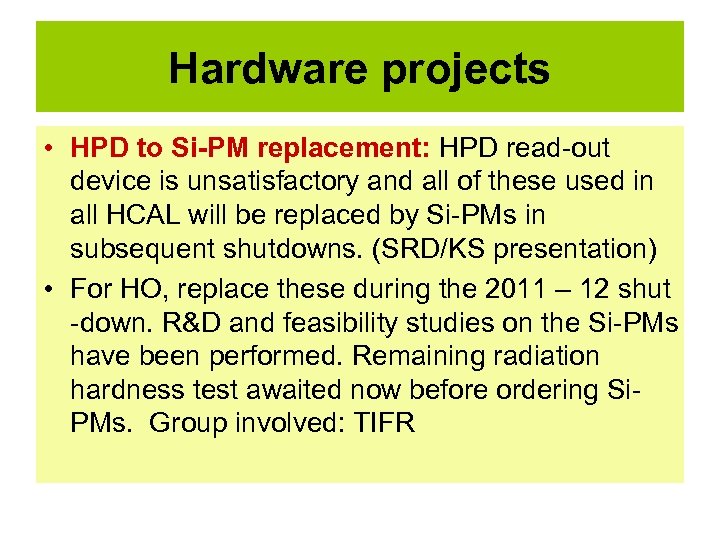
Hardware projects • HPD to Si-PM replacement: HPD read-out device is unsatisfactory and all of these used in all HCAL will be replaced by Si-PMs in subsequent shutdowns. (SRD/KS presentation) • For HO, replace these during the 2011 – 12 shut -down. R&D and feasibility studies on the Si-PMs have been performed. Remaining radiation hardness test awaited now before ordering Si. PMs. Group involved: TIFR
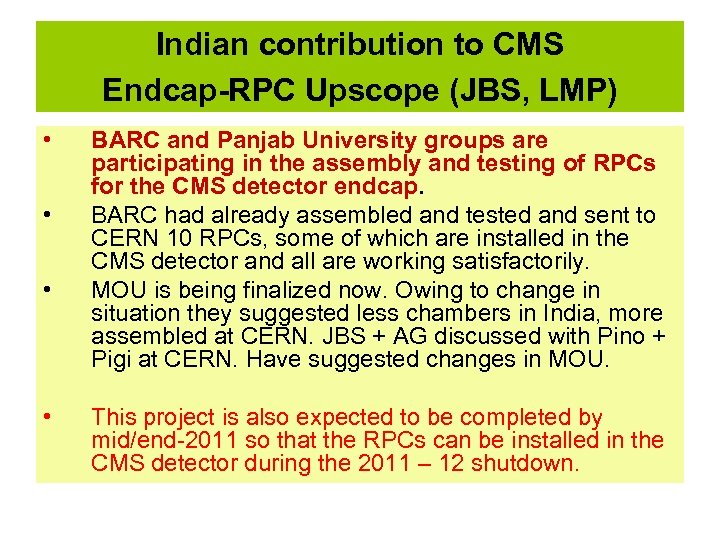
Indian contribution to CMS Endcap-RPC Upscope (JBS, LMP) • • BARC and Panjab University groups are participating in the assembly and testing of RPCs for the CMS detector endcap. BARC had already assembled and tested and sent to CERN 10 RPCs, some of which are installed in the CMS detector and all are working satisfactorily. MOU is being finalized now. Owing to change in situation they suggested less chambers in India, more assembled at CERN. JBS + AG discussed with Pino + Pigi at CERN. Have suggested changes in MOU. This project is also expected to be completed by mid/end-2011 so that the RPCs can be installed in the CMS detector during the 2011 – 12 shutdown.
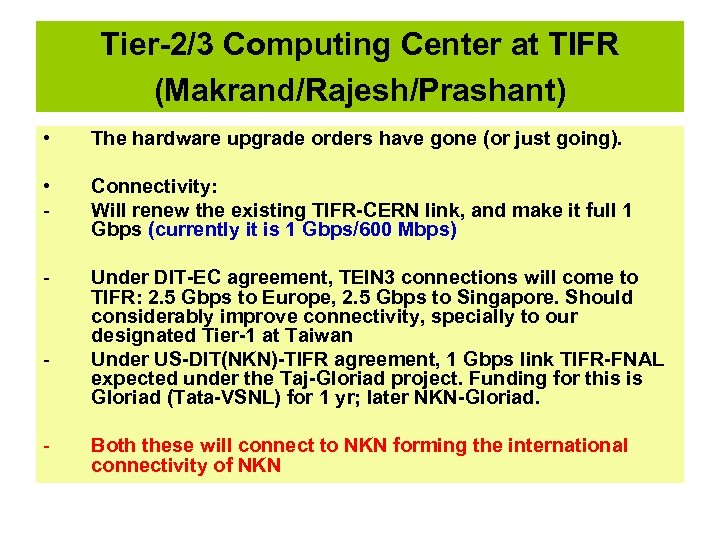
Tier-2/3 Computing Center at TIFR (Makrand/Rajesh/Prashant) • The hardware upgrade orders have gone (or just going). • - Connectivity: Will renew the existing TIFR-CERN link, and make it full 1 Gbps (currently it is 1 Gbps/600 Mbps) - Under DIT-EC agreement, TEIN 3 connections will come to TIFR: 2. 5 Gbps to Europe, 2. 5 Gbps to Singapore. Should considerably improve connectivity, specially to our designated Tier-1 at Taiwan Under US-DIT(NKN)-TIFR agreement, 1 Gbps link TIFR-FNAL expected under the Taj-Gloriad project. Funding for this is Gloriad (Tata-VSNL) for 1 yr; later NKN-Gloriad. - - Both these will connect to NKN forming the international connectivity of NKN
Prospective new India-CMS member (NISER) • Discussed at last meeting in Chandigarh.
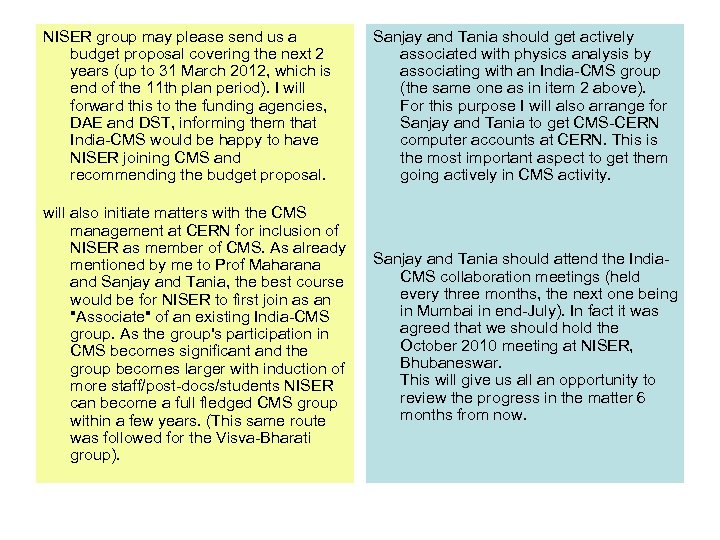
NISER group may please send us a budget proposal covering the next 2 years (up to 31 March 2012, which is end of the 11 th plan period). I will forward this to the funding agencies, DAE and DST, informing them that India-CMS would be happy to have NISER joining CMS and recommending the budget proposal. Sanjay and Tania should get actively associated with physics analysis by associating with an India-CMS group (the same one as in item 2 above). For this purpose I will also arrange for Sanjay and Tania to get CMS-CERN computer accounts at CERN. This is the most important aspect to get them going actively in CMS activity. will also initiate matters with the CMS management at CERN for inclusion of NISER as member of CMS. As already mentioned by me to Prof Maharana and Sanjay and Tania, the best course would be for NISER to first join as an "Associate" of an existing India-CMS group. As the group's participation in CMS becomes significant and the group becomes larger with induction of more staff/post-docs/students NISER can become a full fledged CMS group within a few years. (This same route was followed for the Visva-Bharati group). Sanjay and Tania should attend the India. CMS collaboration meetings (held every three months, the next one being in Mumbai in end-July). In fact it was agreed that we should hold the October 2010 meeting at NISER, Bhubaneswar. This will give us all an opportunity to review the progress in the matter 6 months from now.
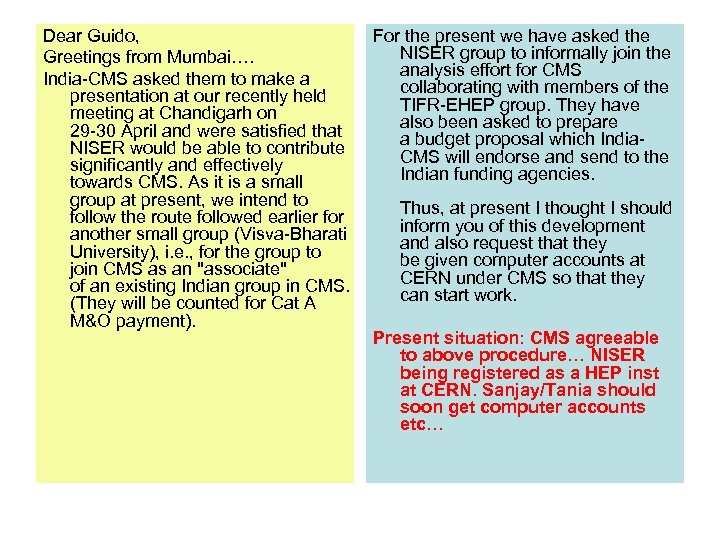
Dear Guido, Greetings from Mumbai…. India-CMS asked them to make a presentation at our recently held meeting at Chandigarh on 29 -30 April and were satisfied that NISER would be able to contribute significantly and effectively towards CMS. As it is a small group at present, we intend to follow the route followed earlier for another small group (Visva-Bharati University), i. e. , for the group to join CMS as an "associate" of an existing Indian group in CMS. (They will be counted for Cat A M&O payment). For the present we have asked the NISER group to informally join the analysis effort for CMS collaborating with members of the TIFR-EHEP group. They have also been asked to prepare a budget proposal which India. CMS will endorse and send to the Indian funding agencies. Thus, at present I thought I should inform you of this development and also request that they be given computer accounts at CERN under CMS so that they can start work. Present situation: CMS agreeable to above procedure… NISER being registered as a HEP inst at CERN. Sanjay/Tania should soon get computer accounts etc…
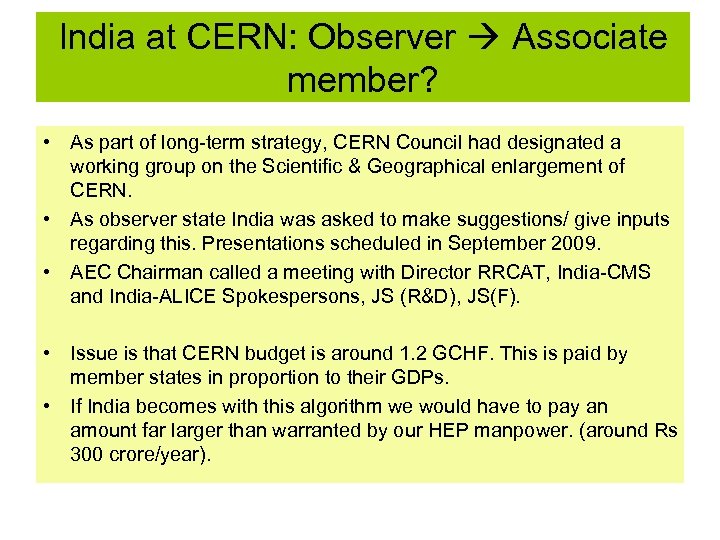
India at CERN: Observer Associate member? • As part of long-term strategy, CERN Council had designated a working group on the Scientific & Geographical enlargement of CERN. • As observer state India was asked to make suggestions/ give inputs regarding this. Presentations scheduled in September 2009. • AEC Chairman called a meeting with Director RRCAT, India-CMS and India-ALICE Spokespersons, JS (R&D), JS(F). • Issue is that CERN budget is around 1. 2 GCHF. This is paid by member states in proportion to their GDPs. • If India becomes with this algorithm we would have to pay an amount far larger than warranted by our HEP manpower. (around Rs 300 crore/year).
Indian presentation to Working Group on Scientific and Geographical Enlargement of CERN Indian delegation atul. gurtu@cern. ch, pdgupta@rrcat. gov. in, prabhatkrv@gmail. com TIFR, Mumbai RRCAT, Indore Indian Mission, Geneva
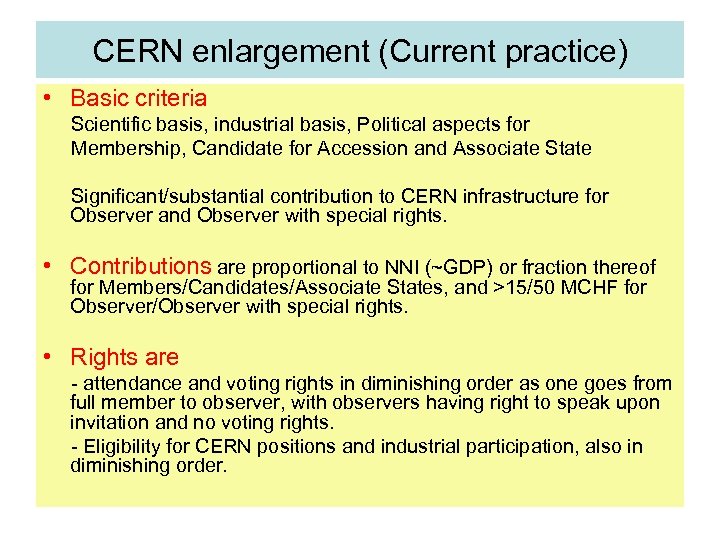
CERN enlargement (Current practice) • Basic criteria Scientific basis, industrial basis, Political aspects for Membership, Candidate for Accession and Associate State Significant/substantial contribution to CERN infrastructure for Observer and Observer with special rights. • Contributions are proportional to NNI (~GDP) or fraction thereof for Members/Candidates/Associate States, and >15/50 MCHF for Observer/Observer with special rights. • Rights are - attendance and voting rights in diminishing order as one goes from full member to observer, with observers having right to speak upon invitation and no voting rights. - Eligibility for CERN positions and industrial participation, also in diminishing order.
Comments • The rules work well when member states/candidates have similar societal profiles in terms of proportion of scientific manpower, industrial infrastructure and national income • In case of wide disparities in these parameters more flexible strategies need to be examined
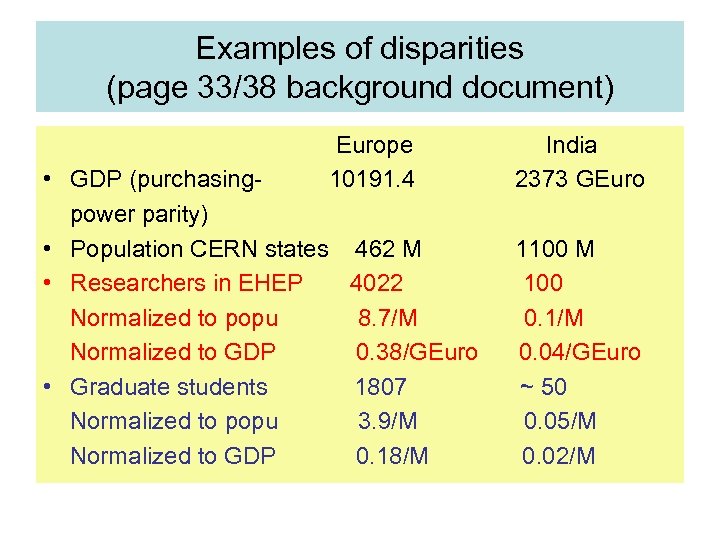
Examples of disparities (page 33/38 background document) Europe India • GDP (purchasing- 10191. 4 2373 GEuro power parity) • Population CERN states 462 M 1100 M • Researchers in EHEP 4022 100 Normalized to popu 8. 7/M 0. 1/M Normalized to GDP 0. 38/GEuro 0. 04/GEuro • Graduate students 1807 ~ 50 Normalized to popu 3. 9/M 0. 05/M Normalized to GDP 0. 18/M 0. 02/M
Comments on disparities • Compared to the ratio of GDPs, the proportion of researchers and graduate students in absolute number as well as normalized to population and GDP is very different. • Governments generally critically look at the comparable return on investment when entering into any multinational venture and it looks a difficult proposition. • What are the alternatives?
Possible alternatives 1. Mentioned by India-DAE Secretary during CERN-DG visit to India in late May 09. In many international bodies which accommodate widely varying GDP, like UN, GDP/capita is the relevant index and such a formula would find easier acceptance. 2. The Associate Member conditions could be made far more flexible, so that any potential member could choose to enter with their own preferred contribution/ rights combination. (One understands that CERN already does plan to re-look at the Assoc Member category).
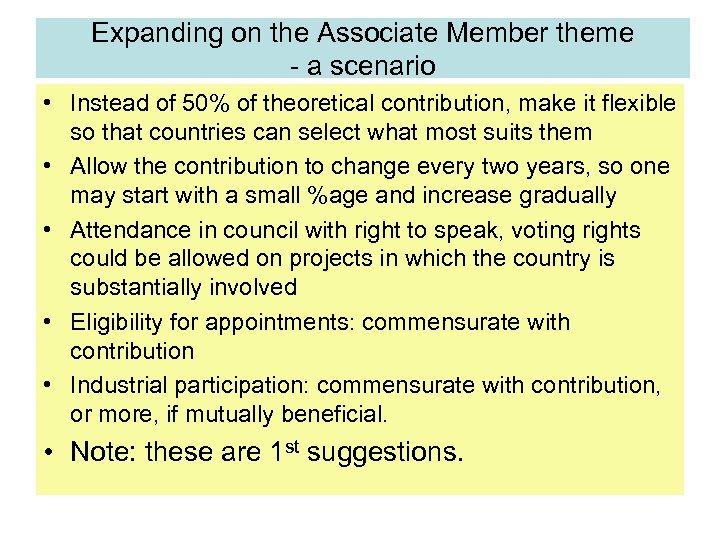
Expanding on the Associate Member theme - a scenario • Instead of 50% of theoretical contribution, make it flexible so that countries can select what most suits them • Allow the contribution to change every two years, so one may start with a small %age and increase gradually • Attendance in council with right to speak, voting rights could be allowed on projects in which the country is substantially involved • Eligibility for appointments: commensurate with contribution • Industrial participation: commensurate with contribution, or more, if mutually beneficial. • Note: these are 1 st suggestions.
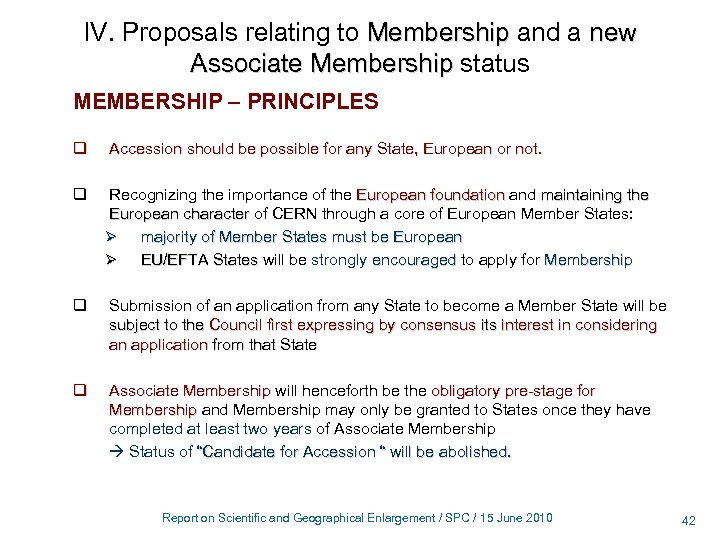
IV. Proposals relating to Membership and a new Membership Associate Membership status Associate Membership MEMBERSHIP – PRINCIPLES q Accession should be possible for any State, European or not. q Recognizing the importance of the European foundation and maintaining the European foundation European character of CERN through a core of European Member States: European character Ø majority of Member States must be European Ø EU/EFTA States will be strongly encouraged to apply for Membership EU/EFTA States encouraged q Submission of an application from any State to become a Member State will be subject to the Council first expressing by consensus its interest in considering an application from that State q Associate Membership will henceforth be the obligatory pre-stage for Associate Membership and Membership may only be granted to States once they have Membership completed at least two years of Associate Membership Status of “Candidate for Accession “ will be abolished. Report on Scientific and Geographical Enlargement / SPC / 15 June 2010 42
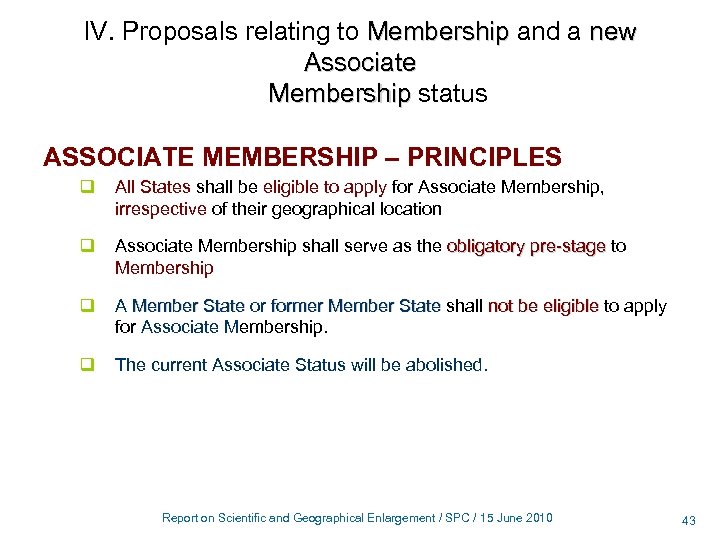
IV. Proposals relating to Membership and a new Membership Associate Membership status Membership ASSOCIATE MEMBERSHIP – PRINCIPLES q All States shall be eligible to apply for Associate Membership, irrespective of their geographical location q Associate Membership shall serve as the obligatory pre-stage to obligatory pre-stage Membership q A Member State or former Member State shall not be eligible to apply Member State former Member State not be eligible for Associate Membership. q The current Associate Status will be abolished. Report on Scientific and Geographical Enlargement / SPC / 15 June 2010 43
IV. Proposals relating to Membership and a new Membership Associate Membership status: Associate Membership PROCEDURES q Procedure for the granting of Membership Ø States that do not have Associate Member status Ø States that have Associate Member status q Procedure for the granting of and reviewing Associate Membership Report on Scientific and Geographical Enlargement / SPC / 15 June 2010 44
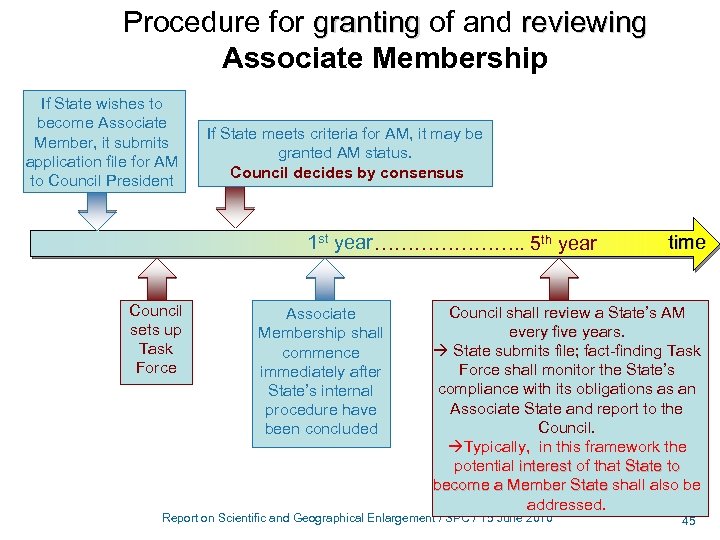
Procedure for granting of and reviewing granting Associate Membership If State wishes to become Associate Member, it submits application file for AM to Council President If State meets criteria for AM, it may be granted AM status. Council decides by consensus 1 st year …………………. . 5 th year Council sets up Task Force Associate Membership shall commence immediately after State’s internal procedure have been concluded time Council shall review a State’s AM review every five years State submits file; fact-finding Task Force shall monitor the State’s compliance with its obligations as an Associate State and report to the Council. Typically, in this framework the potential interest of that State to interest become a Member State shall also be become a Member State addressed. Report on Scientific and Geographical Enlargement / SPC / 15 June 2010 45
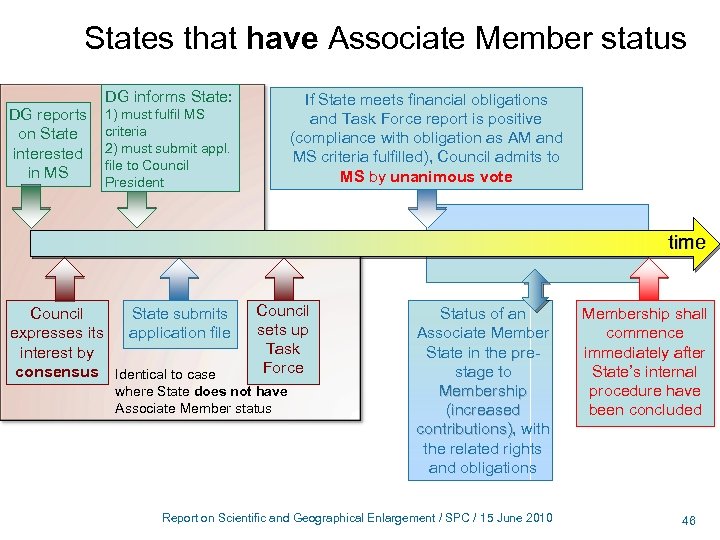
States that have Associate Member status DG informs State: DG reports 1) must fulfil MS on State criteria interested 2) must submit appl. file to Council in MS President If State meets financial obligations and Task Force report is positive (compliance with obligation as AM and MS criteria fulfilled), Council admits to MS by unanimous vote time State submits Council expresses its application file interest by consensus Identical to case Council sets up Task Force where State does not have Associate Member status Status of an Associate Member State in the prestage to Membership (increased contributions), with contributions) the related rights and obligations Report on Scientific and Geographical Enlargement / SPC / 15 June 2010 Membership shall commence immediately after State’s internal procedure have been concluded 46
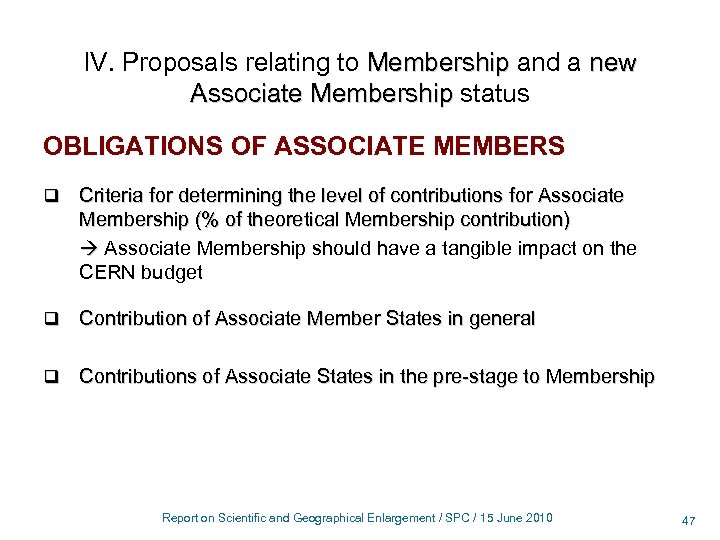
IV. Proposals relating to Membership and a new Membership Associate Membership status Associate Membership OBLIGATIONS OF ASSOCIATE MEMBERS q Criteria for determining the level of contributions for Associate Membership (% of theoretical Membership contribution) Associate Membership should have a tangible impact on the CERN budget Contribution of Associate Member States in general q Contributions of Associate States in the pre-stage to Membership q Report on Scientific and Geographical Enlargement / SPC / 15 June 2010 47
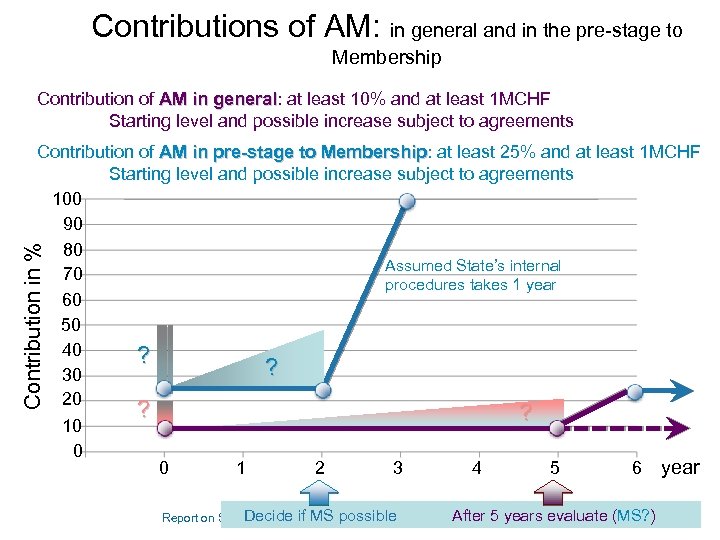
Contributions of AM: in general and in the pre-stage to Membership Contribution of AM in general: at least 10% and at least 1 MCHF AM in general Starting level and possible increase subject to agreements Contribution in % Contribution of AM in pre-stage to Membership: at least 25% and at least 1 MCHF AM in pre-stage to Membership Starting level and possible increase subject to agreements 100 90 80 Assumed State’s internal 70 procedures takes 1 year 60 50 40 ? ? 30 20 ? ? 10 0 0 1 2 3 4 5 6 year Decide if MS possible After 5 years evaluate (MS? ) Report on Scientific and Geographical Enlargement / SPC / 15 June 2010 48
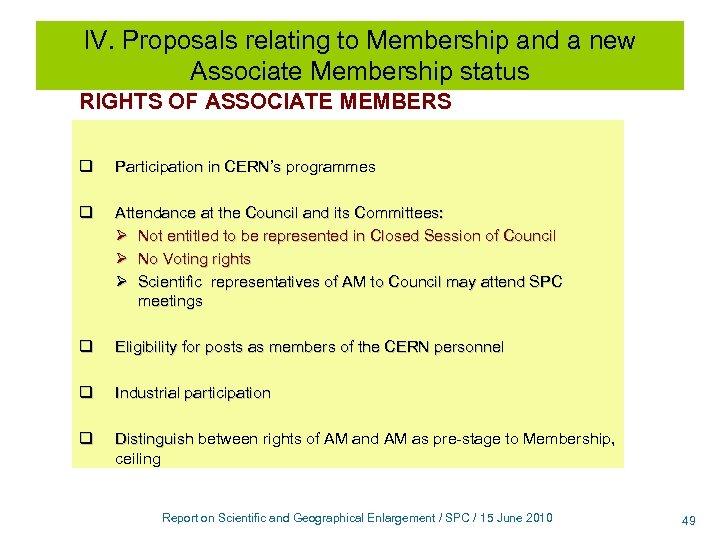
IV. Proposals relating to Membership and a new Associate Membership status RIGHTS OF ASSOCIATE MEMBERS q Participation in CERN’s programmes q Attendance at the Council and its Committees: Ø Not entitled to be represented in Closed Session of Council Ø No Voting rights Ø Scientific representatives of AM to Council may attend SPC meetings q Eligibility for posts as members of the CERN personnel q Industrial participation q Distinguish between rights of AM and AM as pre-stage to Membership, Distinguish ceiling Report on Scientific and Geographical Enlargement / SPC / 15 June 2010 49
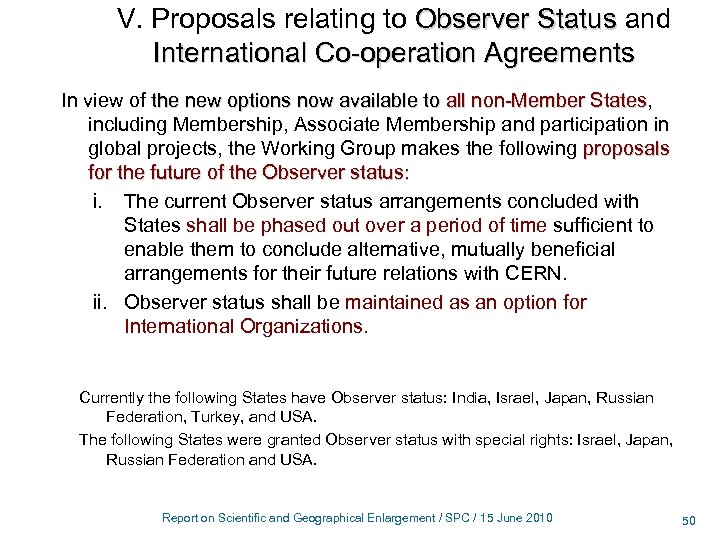
V. Proposals relating to Observer Status and Observer Status International Co-operation Agreements In view of the new options now available to all non-Member States, all non-Member States including Membership, Associate Membership and participation in global projects, the Working Group makes the following proposals for the future of the Observer status: i. The current Observer status arrangements concluded with States shall be phased out over a period of time sufficient to enable them to conclude alternative, mutually beneficial arrangements for their future relations with CERN. ii. Observer status shall be maintained as an option for International Organizations. Currently the following States have Observer status: India, Israel, Japan, Russian Federation, Turkey, and USA. The following States were granted Observer status with special rights: Israel, Japan, Russian Federation and USA. Report on Scientific and Geographical Enlargement / SPC / 15 June 2010 50
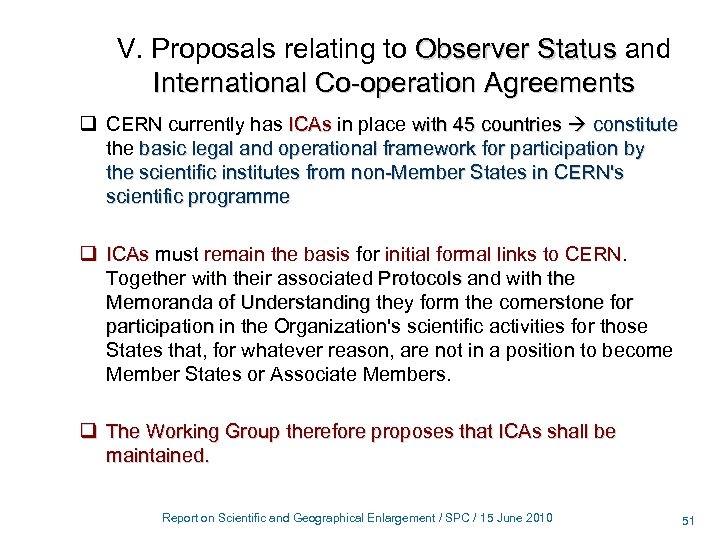
V. Proposals relating to Observer Status and Observer Status International Co-operation Agreements q CERN currently has ICAs in place with 45 countries constitute the basic legal and operational framework for participation by the scientific institutes from non-Member States in CERN's scientific programme q ICAs must remain the basis for initial formal links to CERN. Together with their associated Protocols and with the Protocols Memoranda of Understanding they form the cornerstone for Memoranda of Understanding participation in the Organization's scientific activities for those participation States that, for whatever reason, are not in a position to become Member States or Associate Members. q The Working Group therefore proposes that ICAs shall be maintained. Report on Scientific and Geographical Enlargement / SPC / 15 June 2010 51

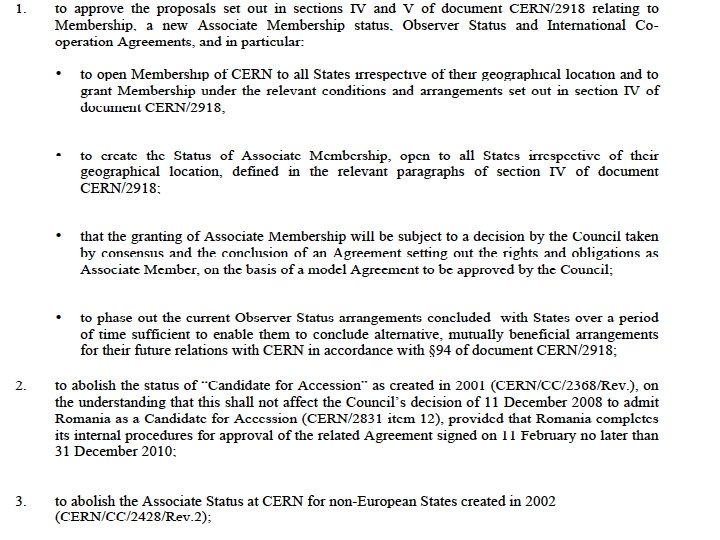
The resolution
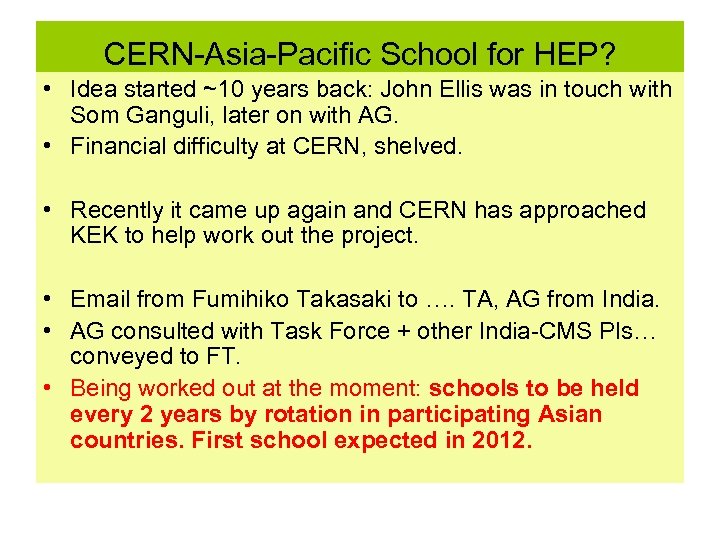
CERN-Asia-Pacific School for HEP? • Idea started ~10 years back: John Ellis was in touch with Som Ganguli, later on with AG. • Financial difficulty at CERN, shelved. • Recently it came up again and CERN has approached KEK to help work out the project. • Email from Fumihiko Takasaki to …. TA, AG from India. • AG consulted with Task Force + other India-CMS PIs… conveyed to FT. • Being worked out at the moment: schools to be held every 2 years by rotation in participating Asian countries. First school expected in 2012.
India-CMS Spokesperson • Am grateful was given opportunity to be spokesperson of India-CMS since 2003. • Will retire in January 2011 • Need to have election (like in 2008) latest by October 2010.
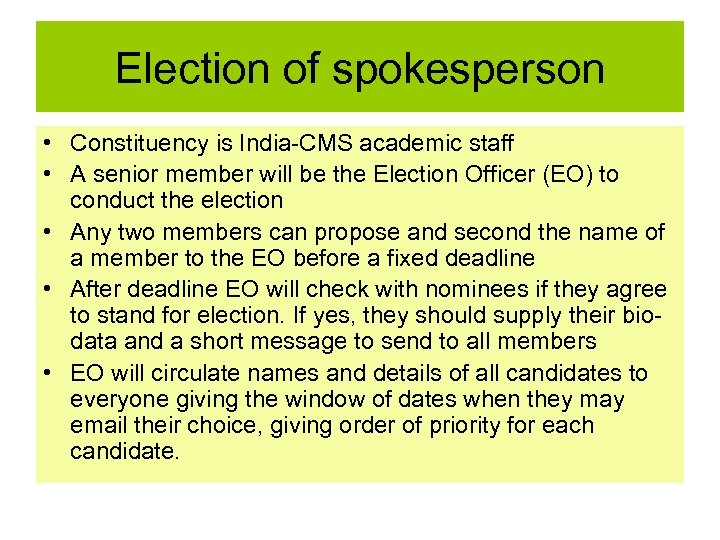
Election of spokesperson • Constituency is India-CMS academic staff • A senior member will be the Election Officer (EO) to conduct the election • Any two members can propose and second the name of a member to the EO before a fixed deadline • After deadline EO will check with nominees if they agree to stand for election. If yes, they should supply their biodata and a short message to send to all members • EO will circulate names and details of all candidates to everyone giving the window of dates when they may email their choice, giving order of priority for each candidate.
• Thank you
Скачать презентацию Report to the Collaboration India-CMS Meeting BARC Mumbai
4ef7d7b2814c02aeb05e0ea039f57561.ppt