


 Скачать презентацию Report on the Aha Huliko a workshop on extreme
2d2a422f94dee69f306f249a7cb1cf54.ppt
- Количество слайдов: 26
 Report on the ‘Aha Huliko’a workshop on extreme events Held 23 -26 January 2007, Honolulu, HI Jeff Yin National Center for Atmospheric Research Extremes Reading Group 23 May 2007
 Goals for this report • Provide some background on this extreme events workshop • Describe the group assembled for the workshop • Share some highlights from the workshop • Summarize the important points of discussion at the workshop • Give you experience of having been at the workshop without the trouble of spending a week in Hawai’i to attend it
 What are ‘Aha Huliko’a workshops? • According to workshop website: “ ‘Aha Huliko’a is a Hawaiian phrase meaning an assembly that seeks into the depth of a matter. ” • Translation deemed reasonable by a couple of friends who study the Hawaiian language • Workshops held every 1 or 2 years on specific topics in physical oceanography (15 held so far) • Funded by Office of Naval Research and University of Hawai’i Department of Oceanography
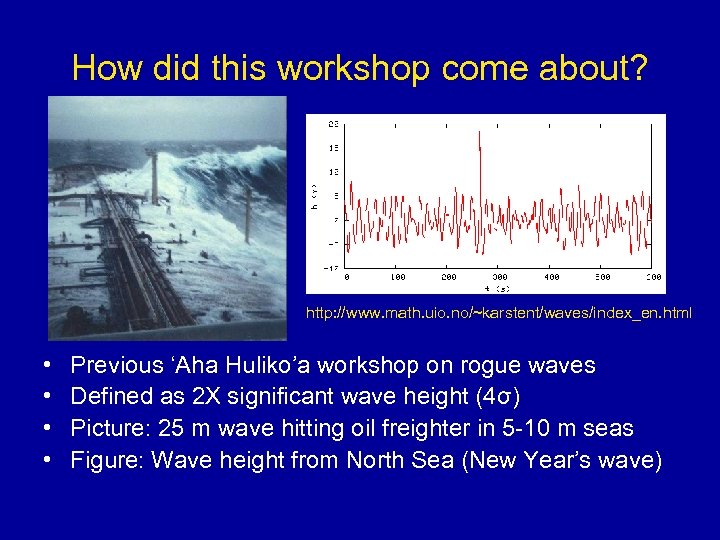 How did this workshop come about? http: //www. math. uio. no/~karstent/waves/index_en. html • • Previous ‘Aha Huliko’a workshop on rogue waves Defined as 2 X significant wave height (4σ) Picture: 25 m wave hitting oil freighter in 5 -10 m seas Figure: Wave height from North Sea (New Year’s wave)
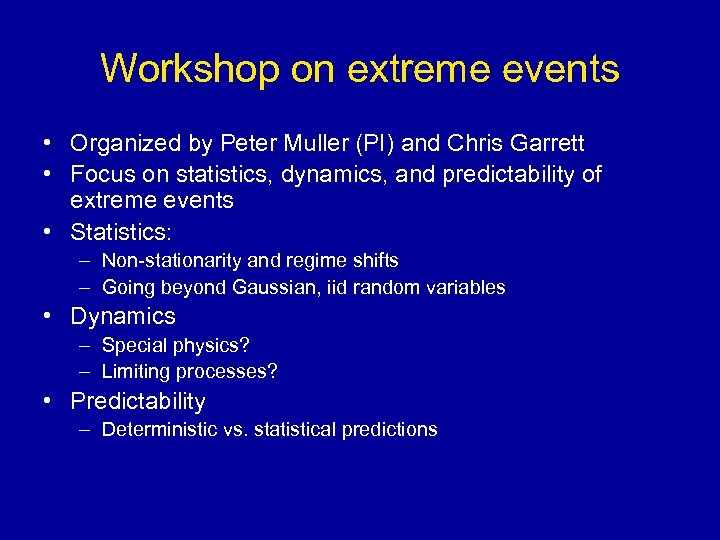 Workshop on extreme events • Organized by Peter Muller (PI) and Chris Garrett • Focus on statistics, dynamics, and predictability of extreme events • Statistics: – Non-stationarity and regime shifts – Going beyond Gaussian, iid random variables • Dynamics – Special physics? – Limiting processes? • Predictability – Deterministic vs. statistical predictions
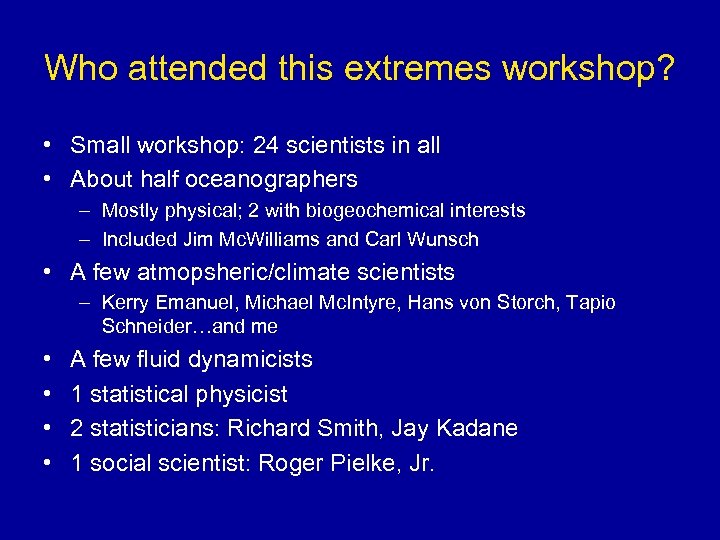 Who attended this extremes workshop? • Small workshop: 24 scientists in all • About half oceanographers – Mostly physical; 2 with biogeochemical interests – Included Jim Mc. Williams and Carl Wunsch • A few atmopsheric/climate scientists – Kerry Emanuel, Michael Mc. Intyre, Hans von Storch, Tapio Schneider…and me • • A few fluid dynamicists 1 statistical physicist 2 statisticians: Richard Smith, Jay Kadane 1 social scientist: Roger Pielke, Jr.
 What was I doing there? • Claudia Tebaldi was originally scheduled to go, but couldn’t make it and offered her spot to me • She was going to talk about extremes in global climate models (GCMs), so I took that topic and ran with it • My presentation: – I presented some general results on extremes in GCMs, including work by Claudia, Jerry Meehl, et al. – I did mention the extremes reading group at NCAR – Then I talked about my work on extreme wind events in GCMs – My main contributions: • Asking when GCMs are appropriate for studying extremes • Trying to stop arguments about “What is an extreme event? ”
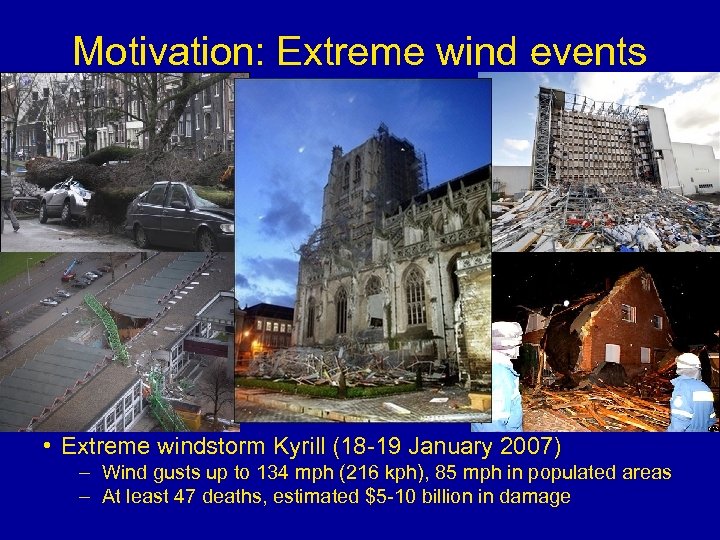 Motivation: Extreme wind events • Extreme windstorm Kyrill (18 -19 January 2007) – Wind gusts up to 134 mph (216 kph), 85 mph in populated areas – At least 47 deaths, estimated $5 -10 billion in damage
 Highlights from presentations After lunch on the first day, on sea level extremes: • Keith Thompson (Dalhousie University, oceanography and statistics): • Mark Merrifield (University of Hawai’i, oceanography):
 Highlights from presentations After lunch on the first day, on sea level extremes: • Keith Thompson (Dalhousie University, oceanography and statistics): – Introduced Generalized Extreme Value (GEV) approach in studying sea level extremes – Divided into dynamical part (tides) and residuals (storm surges) – Used GEV approach only to model tidal residuals – 2 highest sea levels not from biggest storm surges, but combination of storm surge and high tide; don’t need to get that far into tails of residuals to get extremes, need less data – Also: Markovian model of residuals (based on previous residual) – Dynamical model could account for climate change (global sea level, atmospheric forcing, river runoff, etc. )
 Highlights from presentations After lunch on the first day, on sea level extremes: • Mark Merrifield (University of Hawai’i, oceanography): – Showed news report on extreme sea level in Hawai’i due to combination of high tide, anticyclonic eddy – Trend in extreme sea levels in Honolulu: Waikiki Beach will be under water 3 -4 months a year by 2100, based on linear trend
 Highlights from presentations The statisticians: • Jay Kadane (last on first day) • Richard Smith (first on second day)
 Highlights from presentations The statisticians: • Jay Kadane (last on first day) – Frequentism vs. personalism (Bayesian philosophy!) – Can’t describe probability of rain tomorrow as a frequentist – Prior assumptions in statistical model are often personal choice, and are important for probabilities calculated from data – An extreme event is an event in the tail of my probability distribution for it; whether it is extreme is a matter of opinion!
 Highlights from presentations The statisticians: • Richard Smith (first on second day) – Presented work on precipitation extremes from rain gauge data and CCSM (NCAR climate model) – Provided group with second exposure to GEV approach – They were starting to buy it, and realize the value of being able to include covariates in the GEV approach (season, ENSO, etc. )
 Highlights from presentations Before lunch on second day (right after me) • Hans von Storch • Roger Pielke, Jr.
 Highlights from presentations Before lunch on second day (right after me) • Hans von Storch – Caution on use of statistics in climate science (like Wunsch) – Stated that no serious science backs up claims about stronger storms (in Europe) due to a warming climate so far, but expects to see stronger storms by 2100 – Most exciting part: Commentary on the social rewards of Nature and Science publications, and attention for taking exciting results to the media – Said science will correct itself in time, but errors now immediately go into the media
 Highlights from presentations Before lunch on second day (right after me) • Roger Pielke, Jr. – Made case that increases in hurricane damage are due more to societal changes (greater wealth, more building on coast) than climate changes – “Basing public policy on return periods is absurd” – Surveyed hurricane experts (on period 2050 -2100): • Change in hurricane frequency: -20% to +20% • Change in hurricane intensity: 0 to +18% – Said scientists can make more of a difference by coming up with new policy options, rather than arguing for one existing policy option over another
 Highlights from presentations Before lunch on third day: • Kerry Emanuel • Michael Mc. Intyre
 Highlights from presentations Before lunch on third day: • Kerry Emanuel – Theoretical upper bound on hurricane maximum wind speed based on SST (enthalpy difference between SST and air above) – 10% increase in hurricane potential intensity → 65% change in power dissipation index, due to greater strength and duration – Predicted that stronger future hurricanes would increase thermohaline circulation via increased subtropical mixing – Perhaps this made the poles much warmer during the Eocene (supported by GCM experiment with state-dependent mixing) – And the effect of hurricanes on ocean heat transport (or on anything else) is not in current climate models!
 Highlights from presentations Before lunch on third day: • Michael Mc. Intyre – Was scheduled to speak on “The dynamical constraints on extreme events”, but opted for a more philosophical talk on “Science and scientific uncertainty” – Fitting models in our minds is unconscious (see below) – From a Bayesian perspective: Unconscious priors – Our brains are interested in patterns where some things change while others stay the same (“organic change principle”)
 Themes for final day of discussion • • What is an extreme event? Extra physics Stationarity vs. regime shifts Impacts/predictability
 What is an extreme event? • This was a long discussion! (I tried to make it shorter) • We had a tough time coming up with a definition • Sarewitz and Pielke, Jr. , (2001) definition: – “We define extreme events as occurrences that, relative to some class of related occurrences, are either notable, rare, unique, profound, or otherwise significant in terms of their impacts, effects, or outcomes. ” • No universal statements about extremes could be made • Consensus: Extreme events are context-dependent • Agreed to create matrix: examples of extreme events vs. characteristics that some of these events had in common
 Extra physics • Large deviation theory (Oliver Buhler) – Evolution of extreme event looks like autocorrelation function – Applies to system that is Gaussian and random • Does physics limit the size of extreme events? – Not in general, and might not be seen in reality • There are phenomena (i. e. , hurricanes) for which not getting the extremes means you can’t get the mean
 Stationarity vs. regime shifts • To test for non-stationarity, need to agree on: – A prior – A statistical model – What data to use • Test must be of a particular kind of non-stationarity • Regime shift: – Could mean a change between two stationary states – Could mean a move to a different part of phase space – Could construct a statistical model where regime is a parameter • Example: Climate change detection – Requires prior assumption about natural variability
 Impacts and predictability • Daily weather events can have impact – 13, 000 annual excess deaths due to cold more than in Katrina • How important are extremes for the mean state? – In distribution with long tail, extremes can dominate mean – Extremes in one variable (waves) may determine mean in another (coastal erosion) • Predictability vs. robustness – Are you robust to all possible outcomes? – Need to say where uncertainties are, so they can be planned for – Distinguish uncertainty from ignorance • Useful plot: Probability vs. impact – Important events are high impact but not too rare
 …and then it was time for drinks! The view from the Outrigger Canoe Club