 Скачать презентацию Report on DA-06 -09 GEOSS Best Practices Registry
8a668fad135d30e4bee3256a472a435b.ppt
- Количество слайдов: 12



Report on DA-06 -09 GEOSS Best Practices Registry Prof. William Emery POC Dr. Jay Pearlman Presenter Report to GEO ADC Sept 13, 2007
Description of Work • • Request hosting proposals and recommend host to maintain GEOSS Best Practices Registry, associated with GEOSS societal benefit areas. Inputs from task CB-07 -01 b, “Identifying Best Practices, Gaps and Needs” to initially populate the Registry. 2
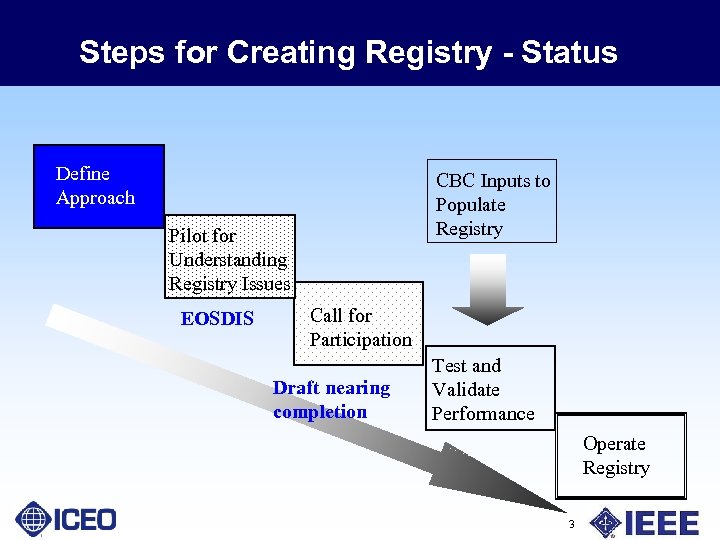
Steps for Creating Registry - Status Define Approach CBC Inputs to Populate Registry Pilot for Understanding Registry Issues EOSDIS Call for Participation Draft nearing completion Test and Validate Performance Operate Registry 3
Highlights
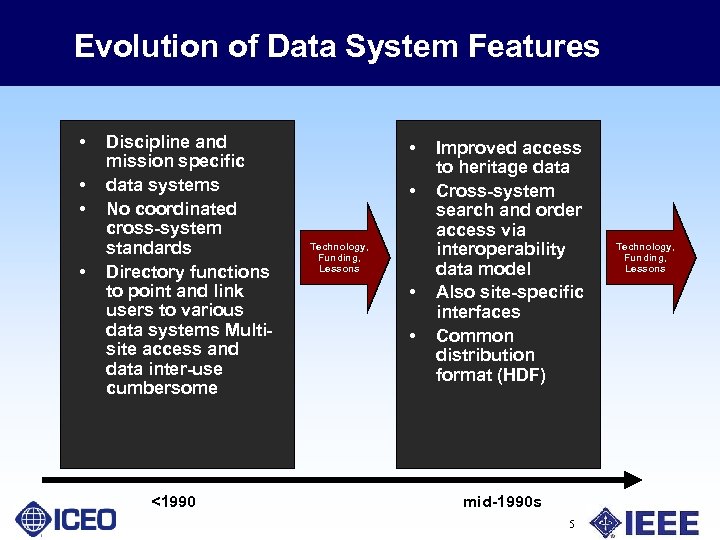
Evolution of Data System Features • • Discipline and mission specific data systems No coordinated cross-system standards Directory functions to point and link users to various data systems Multisite access and data inter-use cumbersome <1990 • • Technology, Funding, Lessons • • Improved access to heritage data Cross-system search and order access via interoperability data model Also site-specific interfaces Common distribution format (HDF) mid-1990 s 5 Technology, Funding, Lessons
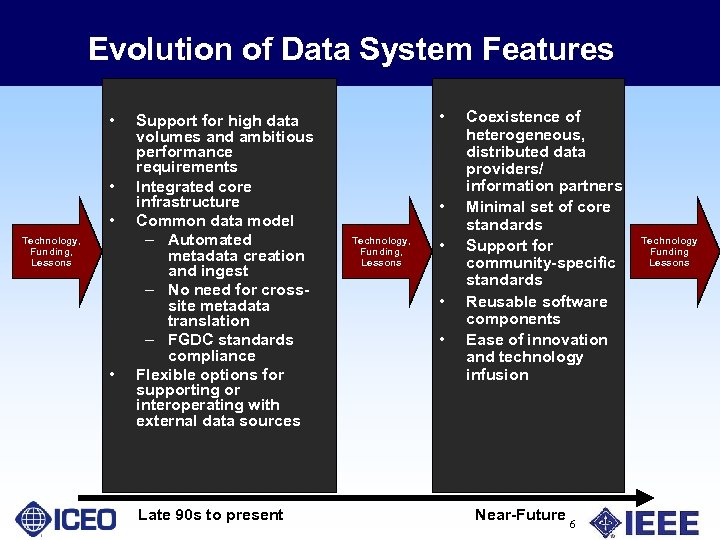
Evolution of Data System Features • • • Technology, Funding, Lessons • Support for high data volumes and ambitious performance requirements Integrated core infrastructure Common data model – Automated metadata creation and ingest – No need for crosssite metadata translation – FGDC standards compliance Flexible options for supporting or interoperating with external data sources Late 90 s to present • • Technology, Funding, Lessons • • • Coexistence of heterogeneous, distributed data providers/ information partners Minimal set of core standards Support for community-specific standards Reusable software components Ease of innovation and technology infusion Near-Future 6 Technology Funding Lessons
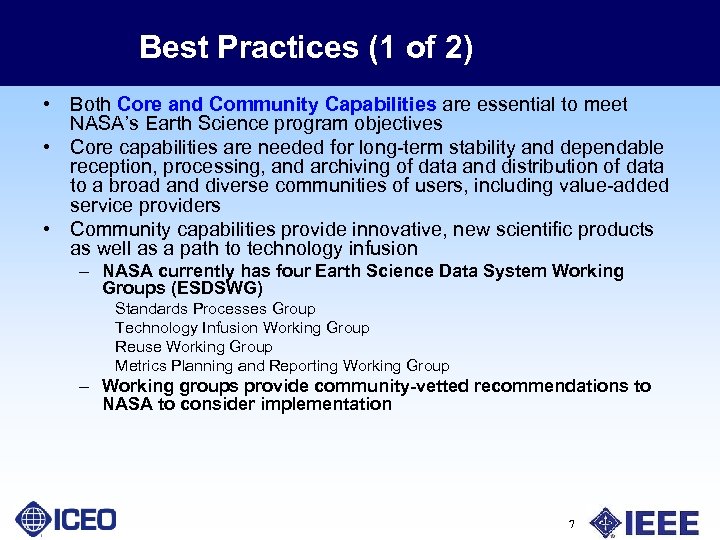
Best Practices (1 of 2) • Both Core and Community Capabilities are essential to meet NASA’s Earth Science program objectives • Core capabilities are needed for long-term stability and dependable reception, processing, and archiving of data and distribution of data to a broad and diverse communities of users, including value-added service providers • Community capabilities provide innovative, new scientific products as well as a path to technology infusion – NASA currently has four Earth Science Data System Working Groups (ESDSWG) Standards Processes Group Technology Infusion Working Group Reuse Working Group Metrics Planning and Reporting Working Group – Working groups provide community-vetted recommendations to NASA to consider implementation 7
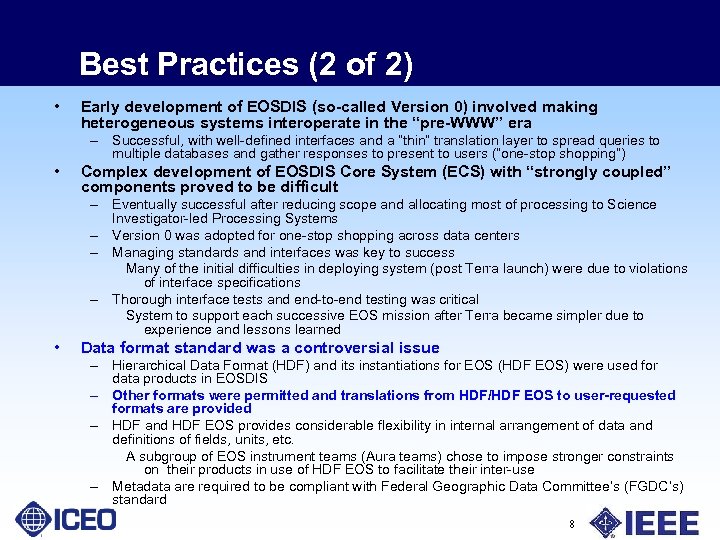
Best Practices (2 of 2) • Early development of EOSDIS (so-called Version 0) involved making heterogeneous systems interoperate in the “pre-WWW” era – Successful, with well-defined interfaces and a “thin” translation layer to spread queries to multiple databases and gather responses to present to users (“one-stop shopping”) • Complex development of EOSDIS Core System (ECS) with “strongly coupled” components proved to be difficult – Eventually successful after reducing scope and allocating most of processing to Science Investigator-led Processing Systems – Version 0 was adopted for one-stop shopping across data centers – Managing standards and interfaces was key to success Many of the initial difficulties in deploying system (post Terra launch) were due to violations of interface specifications – Thorough interface tests and end-to-end testing was critical System to support each successive EOS mission after Terra became simpler due to experience and lessons learned • Data format standard was a controversial issue – Hierarchical Data Format (HDF) and its instantiations for EOS (HDF EOS) were used for data products in EOSDIS – Other formats were permitted and translations from HDF/HDF EOS to user-requested formats are provided – HDF and HDF EOS provides considerable flexibility in internal arrangement of data and definitions of fields, units, etc. A subgroup of EOS instrument teams (Aura teams) chose to impose stronger constraints on their products in use of HDF EOS to facilitate their inter-use – Metadata are required to be compliant with Federal Geographic Data Committee’s (FGDC’s) standard 8
Task Definition (1 of 2) • Best Practices must include a. The fact that all systems will involve, technology will improve but only through responsible agency will we be able to have successful systems in the future b. Observational systems and data volumes will continue to increase and any system must be designed to accommodate these increases. c. Data never analyzed are no better than data never collected and we must optimize access, usability and data stewardship to all of our systems. 9
Task Definition (2 of 2) • • • We must be willing to start with something small and have it grow and evolve rather than trying to define the ultimate system from the start. We can try to anticipate Best Practices for 2020 but must realize that we will be wrong in our expectations. It is important for our Best Practices to be interagency and inter-government. 10
ISSUES • Coordination with Other Committees • Anticipate and Coordinate release of CFP 11
Thank You 12
Скачать презентацию Report on DA-06 -09 GEOSS Best Practices Registry
8a668fad135d30e4bee3256a472a435b.ppt