 Скачать презентацию Renewable Energy Sources in Poland Krzysztof Konaszewski Polish
63d691268b33218287e0c15763f4298d.ppt
- Количество слайдов: 43



Renewable Energy Sources in Poland Krzysztof Konaszewski Polish Association of Renewable Energy Zbigniew Leonowicz Wroclaw University of Technology 2010
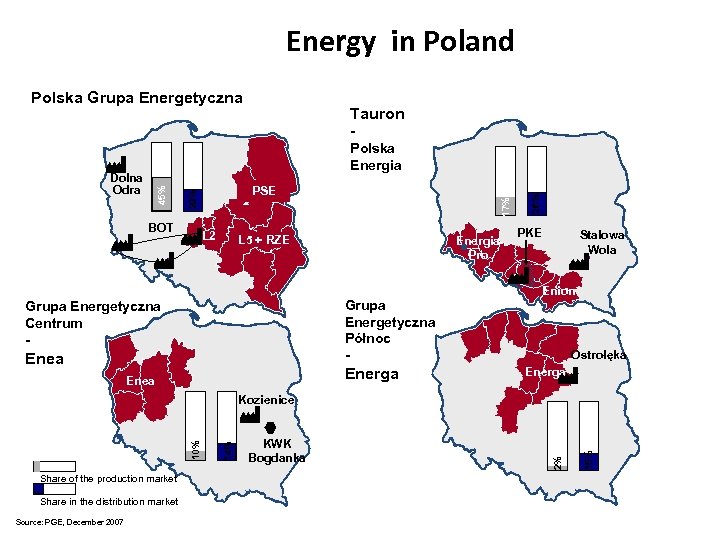
Energy in Poland Polska Grupa Energetyczna Tauron BOT L 2 17% PSE 29% 45% Dolna Odra L 5 + RZE Energia Pro Grupa Energetyczna Północ - Grupa Energetyczna Centrum - Enea Energa Enea 26% Polska Energia PKE Stalowa Wola Enion 11 % Ostrołęka Energa Share of the production market Share in the distribution market Source: PGE, December 2007 15% KWK Bogdanka 2% 14% 10% Kozienice
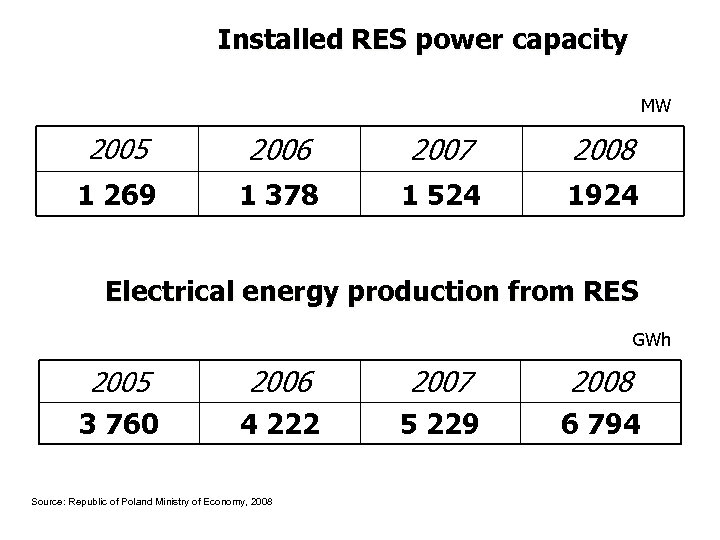
Installed RES power capacity MW 2005 2006 2007 2008 1 269 1 378 1 524 1924 Electrical energy production from RES GWh 2005 3 760 2006 2007 2008 4 222 5 229 6 794 Source: Republic of Poland Ministry of Economy, 2008
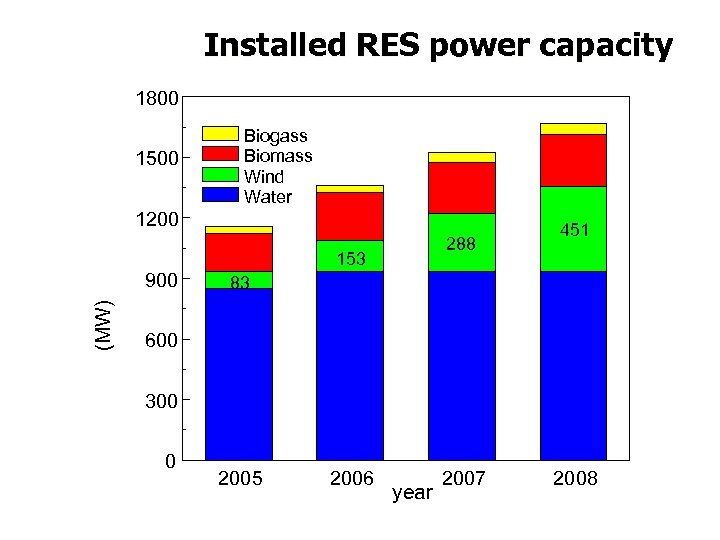
Installed RES power capacity 1800 1500 Biogass Biomass Wind Water 1200 288 153 (MW) 900 451 83 600 300 0 2005 2006 year 2007 2008
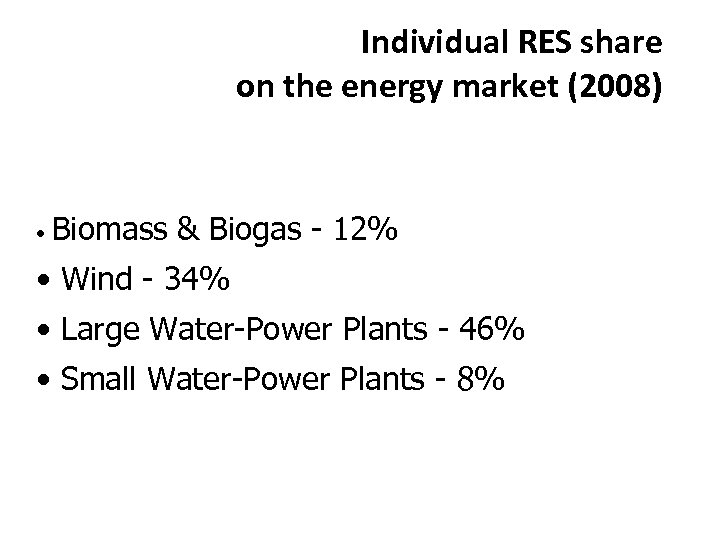
Individual RES share on the energy market (2008) • Biomass & Biogas - 12% • Wind - 34% • Large Water-Power Plants - 46% • Small Water-Power Plants - 8%
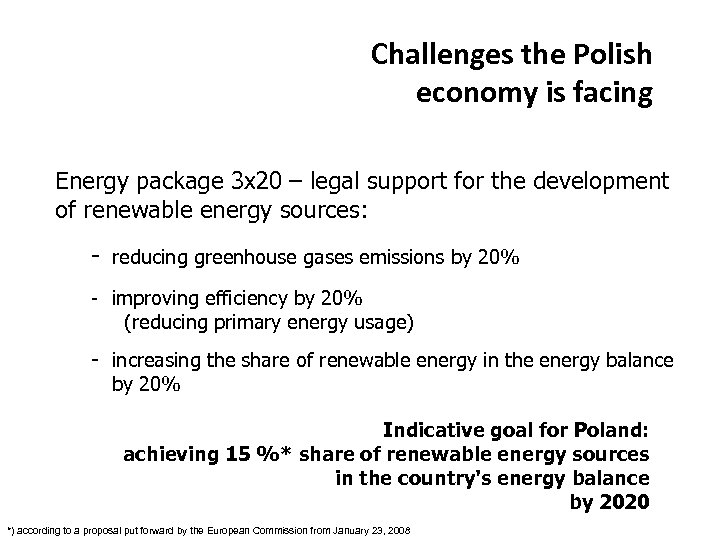
Challenges the Polish economy is facing Energy package 3 x 20 – legal support for the development of renewable energy sources: - reducing greenhouse gases emissions by 20% - improving efficiency by 20% (reducing primary energy usage) - increasing the share of renewable energy in the energy balance by 20% Indicative goal for Poland: achieving 15 %* share of renewable energy sources in the country's energy balance by 2020 *) according to a proposal put forward by the European Commission from January 23, 2008
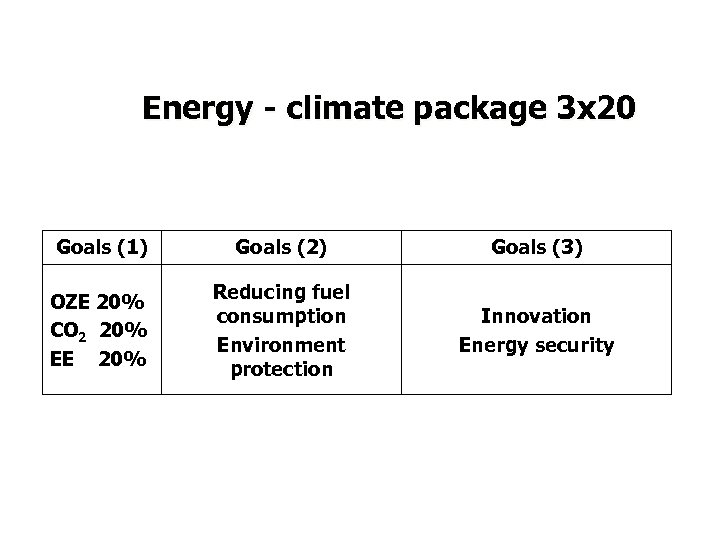
Energy - climate package 3 x 20 Goals (1) Goals (2) Goals (3) OZE 20% CO 2 20% EE 20% Reducing fuel consumption Environment protection Innovation Energy security
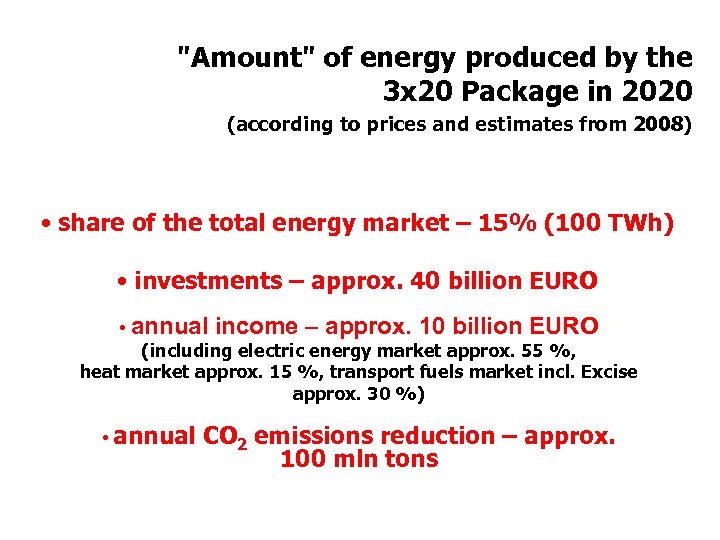
"Amount" of energy produced by the 3 x 20 Package in 2020 (according to prices and estimates from 2008) • share of the total energy market – 15% (100 TWh) • investments – approx. 40 billion EURO • annual income – approx. 10 billion EURO (including electric energy market approx. 55 %, heat market approx. 15 %, transport fuels market incl. Excise approx. 30 %) • annual CO 2 emissions reduction – approx. 100 mln tons
![Renewable energy demand forecast for Poland by 2020 [ TWh ] RES production in](https://present5.com/presentation/63d691268b33218287e0c15763f4298d/image-9.jpg "Renewable energy demand forecast for Poland by 2020 [ TWh ] RES production in")
Renewable energy demand forecast for Poland by 2020 [ TWh ] RES production in Poland in 2007 Goal option I That much RES energy should Poland produce in order to achieve its 15% share of the total production in 2020 [ 228 TWh - 2020] Goal option II That much RES energy should Poland produce in order to achieve its 15% share of the total sales in 2020 [ 160 TWh - 2020 ] - requirement counted after sales - requirement counted after production
![Gross RES energy demand acc. to types of energy [ktoe] acc. to Poland's Energy](https://present5.com/presentation/63d691268b33218287e0c15763f4298d/image-10.jpg "Gross RES energy demand acc. to types of energy [ktoe] acc. to Poland's Energy")
Gross RES energy demand acc. to types of energy [ktoe] acc. to Poland's Energy Policy project by 2030 2006 2010 2015 2020 2025 2030 Electric energy 370. 6 722. 1 1596. 9 2762. 2 3269. 0 3411. 3 Biomass 159. 2 302. 6 492. 3 808. 3 969. 2 1009. 9 Biogas 13. 8 31. 4 140. 7 349. 1 552. 0 592. 6 Wind 22. 0 6% 174. 0 24% 718. 9 45% 1330. 0 48% 1470. 0 45% 1530. 0 45% Water 175. 6 214. 0 244. 9 274. 6 276. 7 0. 0 0. 2 1. 1 2. 1 192. 8 207. 4 Photovoltaics Total national electric energy demand [TWh] Gross demand 150. 8 151. 9 160. 2 171. 8
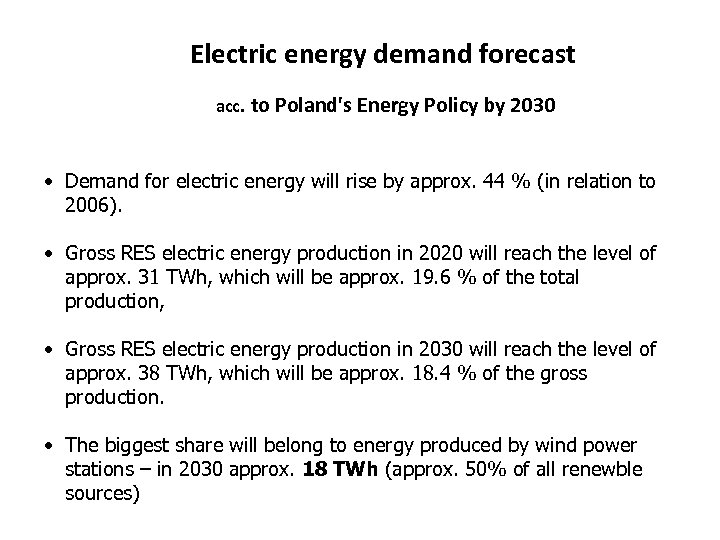
Electric energy demand forecast acc. to Poland's Energy Policy by 2030 • Demand for electric energy will rise by approx. 44 % (in relation to 2006). • Gross RES electric energy production in 2020 will reach the level of approx. 31 TWh, which will be approx. 19. 6 % of the total production, • Gross RES electric energy production in 2030 will reach the level of approx. 38 TWh, which will be approx. 18. 4 % of the gross production. • The biggest share will belong to energy produced by wind power stations – in 2030 approx. 18 TWh (approx. 50% of all renewble sources)
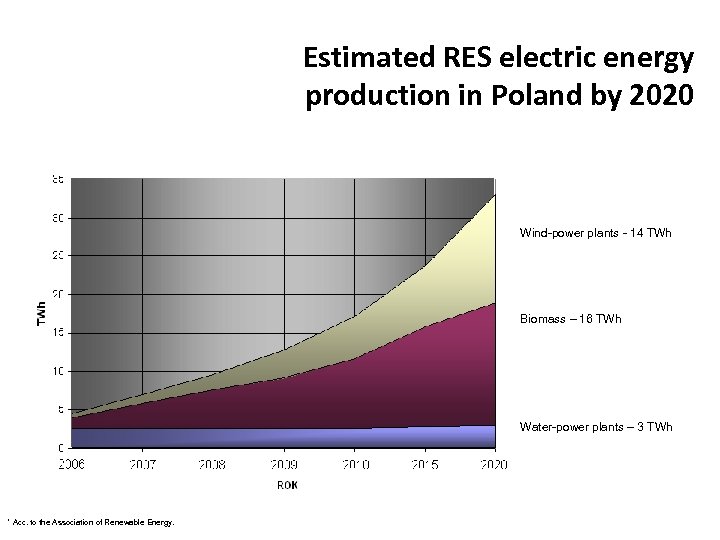
Estimated RES electric energy production in Poland by 2020 Wind-power plants - 14 TWh Biomass – 16 TWh Water-power plants – 3 TWh * Acc. to the Association of Renewable Energy.
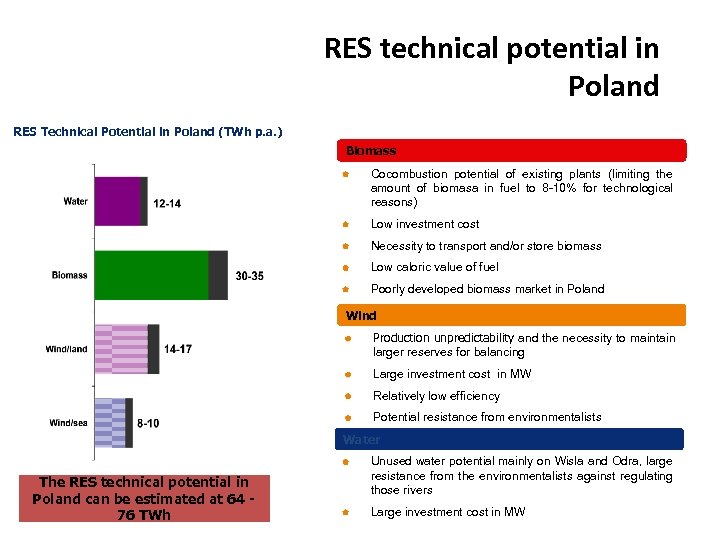
RES technical potential in Poland RES Technical Potential in Poland (TWh p. a. ) Biomass Cocombustion potential of existing plants (limiting the amount of biomasa in fuel to 8 -10% for technological reasons) Low investment cost Necessity to transport and/or store biomass Low caloric value of fuel Poorly developed biomass market in Poland Wind Production unpredictability and the necessity to maintain larger reserves for balancing Large investment cost in MW Relatively low efficiency Potential resistance from environmentalists Water The RES technical potential in Poland can be estimated at 64 76 TWh Unused water potential mainly on Wisla and Odra, large resistance from the environmentalists against regulating those rivers Large investment cost in MW
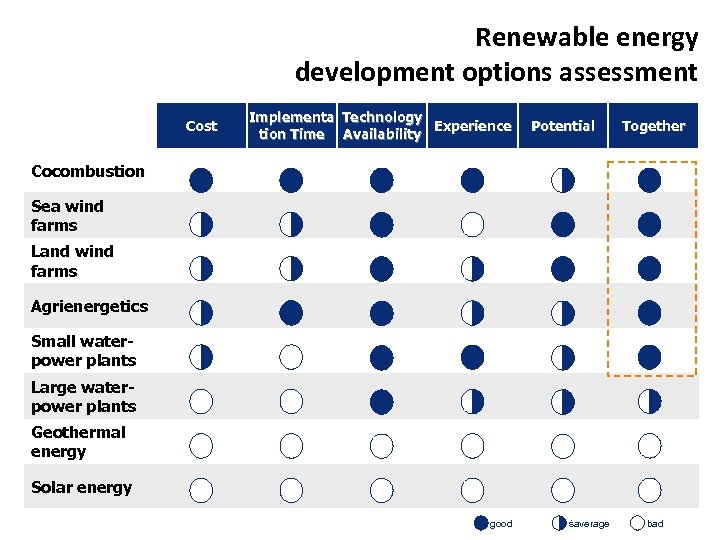
Renewable energy development options assessment Cost Implementa Technology Experience tion Time Availability Potential Together Cocombustion Sea wind farms Land wind farms Agrienergetics Small waterpower plants Large waterpower plants Geothermal energy Solar energy good śaverage bad
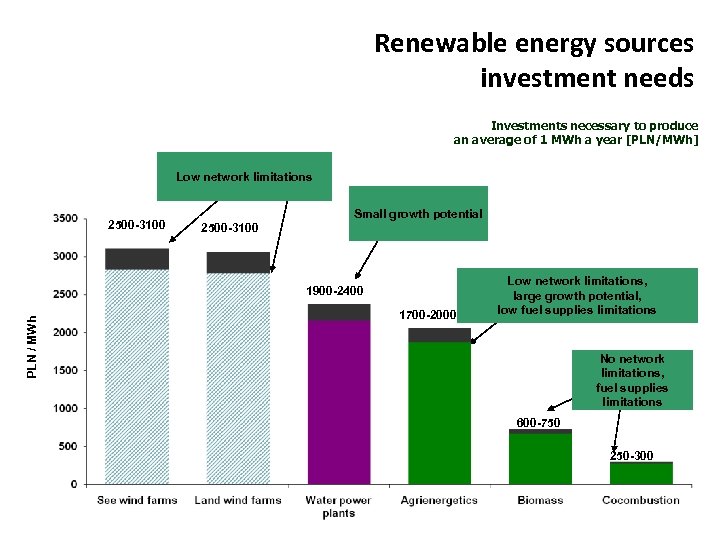
Renewable energy sources investment needs Investments necessary to produce an average of 1 MWh a year [PLN/MWh] Low network limitations 2500 -3100 Small growth potential 2500 -3100 PLN / MWh 1900 -2400 1700 -2000 Low network limitations, large growth potential, low fuel supplies limitations No network limitations, fuel supplies limitations 600 -750 250 -300
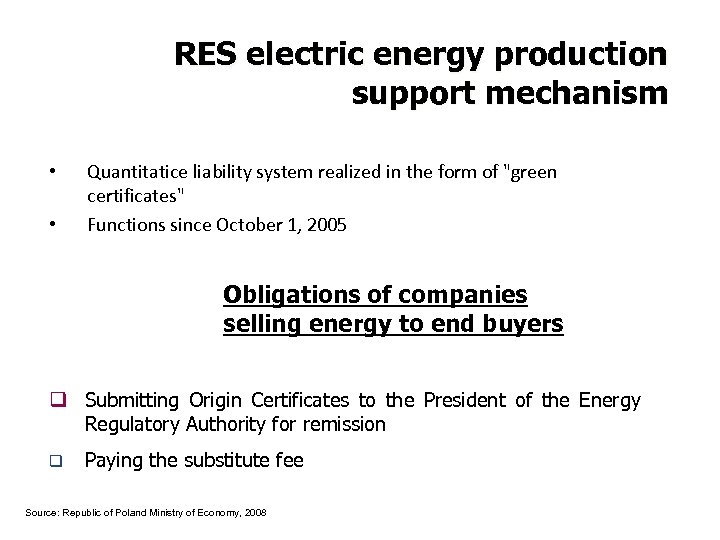
RES electric energy production support mechanism • • Quantitatice liability system realized in the form of "green certificates" Functions since October 1, 2005 Obligations of companies selling energy to end buyers q Submitting Origin Certificates to the President of the Energy Regulatory Authority for remission q Paying the substitute fee Source: Republic of Poland Ministry of Economy, 2008
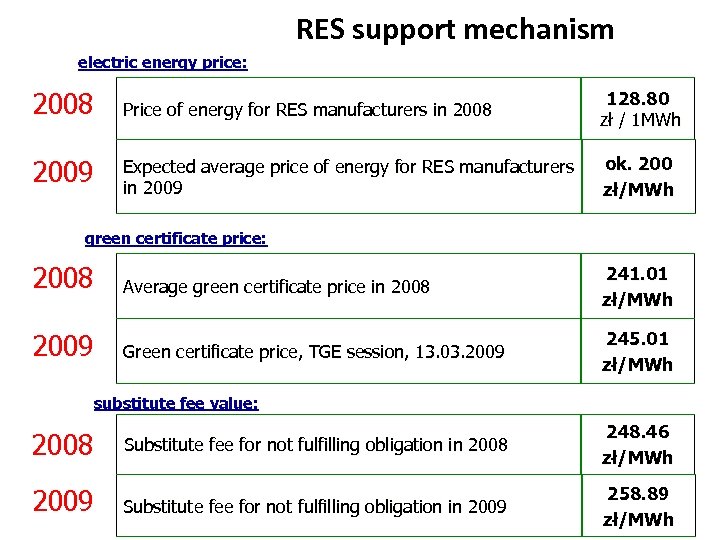
RES support mechanism electric energy price: 2008 Price of energy for RES manufacturers in 2008 128. 80 zł / 1 MWh 2009 Expected average price of energy for RES manufacturers in 2009 ok. 200 zł/MWh green certificate price: 2008 Average green certificate price in 2008 241. 01 zł/MWh 2009 Green certificate price, TGE session, 13. 03. 2009 245. 01 zł/MWh substitute fee value: 2008 2009 Substitute fee for not fulfilling obligation in 2008 248. 46 zł/MWh Substitute fee for not fulfilling obligation in 2009 258. 89 zł/MWh
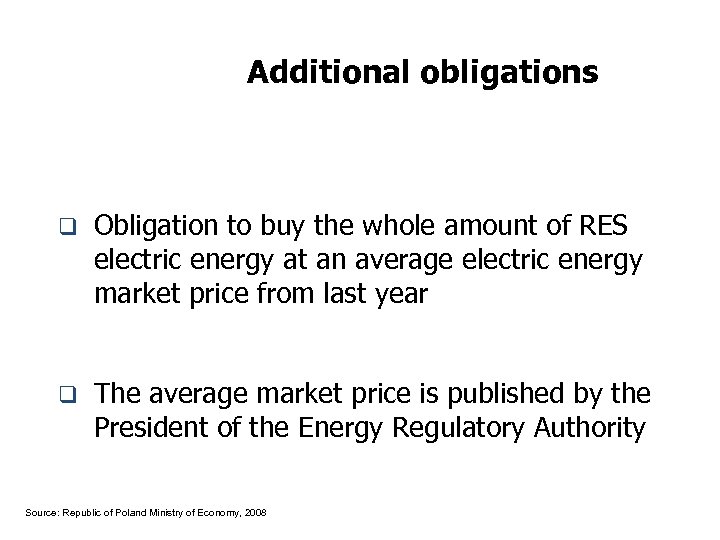
Additional obligations q Obligation to buy the whole amount of RES electric energy at an average electric energy market price from last year q The average market price is published by the President of the Energy Regulatory Authority Source: Republic of Poland Ministry of Economy, 2008
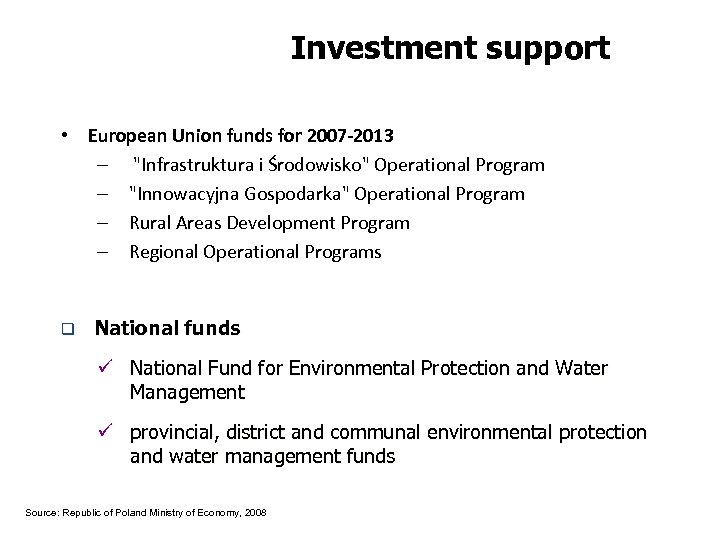
Investment support • European Union funds for 2007 -2013 – "Infrastruktura i Środowisko" Operational Program – "Innowacyjna Gospodarka" Operational Program – Rural Areas Development Program – Regional Operational Programs q National funds ü National Fund for Environmental Protection and Water Management ü provincial, district and communal environmental protection and water management funds Source: Republic of Poland Ministry of Economy, 2008
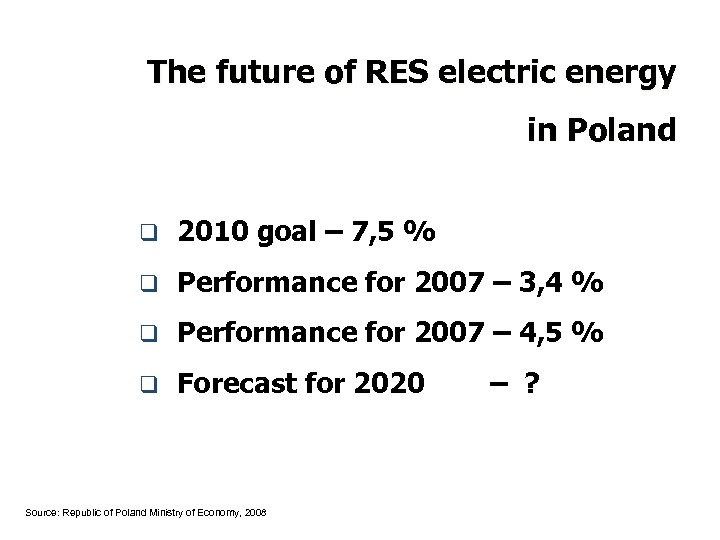
The future of RES electric energy in Poland q 2010 goal – 7, 5 % q Performance for 2007 – 3, 4 % q Performance for 2007 – 4, 5 % q Forecast for 2020 Source: Republic of Poland Ministry of Economy, 2008 – ?
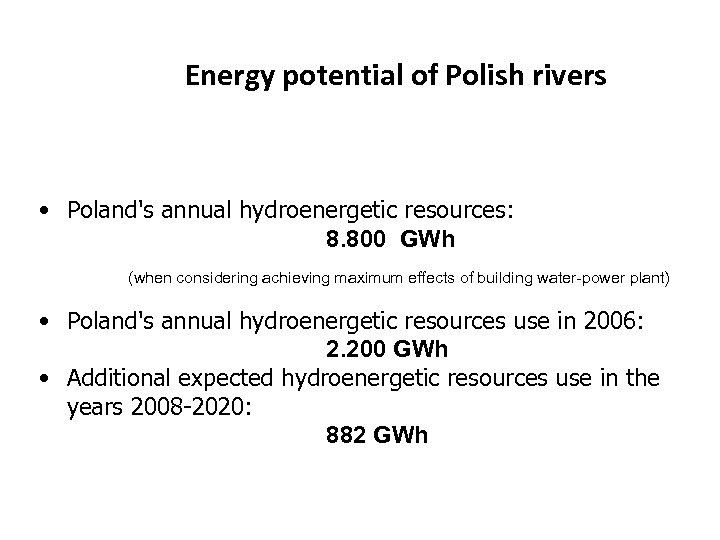
Energy potential of Polish rivers • Poland's annual hydroenergetic resources: 8. 800 GWh (when considering achieving maximum effects of building water-power plant) • Poland's annual hydroenergetic resources use in 2006: 2. 200 GWh • Additional expected hydroenergetic resources use in the years 2008 -2020: 882 GWh
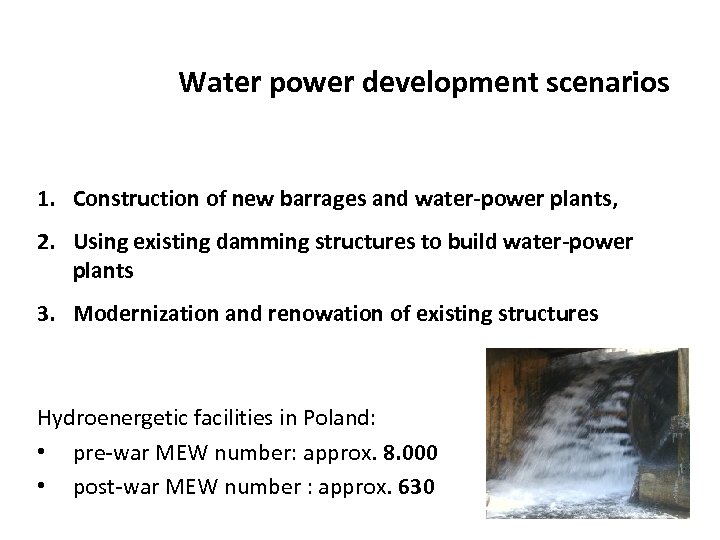
Water power development scenarios 1. Construction of new barrages and water-power plants, 2. Using existing damming structures to build water-power plants 3. Modernization and renowation of existing structures Hydroenergetic facilities in Poland: • pre-war MEW number: approx. 8. 000 • post-war MEW number : approx. 630
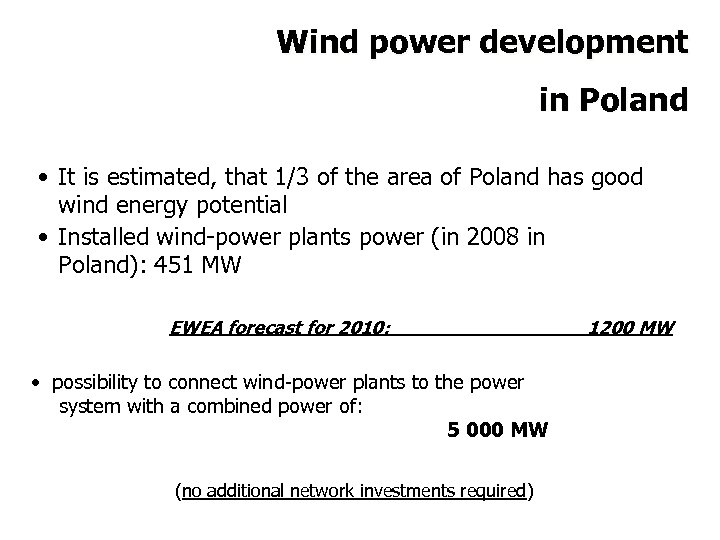
Wind power development in Poland • It is estimated, that 1/3 of the area of Poland has good wind energy potential • Installed wind-power plants power (in 2008 in Poland): 451 MW EWEA forecast for 2010: • possibility to connect wind-power plants to the power system with a combined power of: 5 000 MW (no additional network investments required) 1200 MW
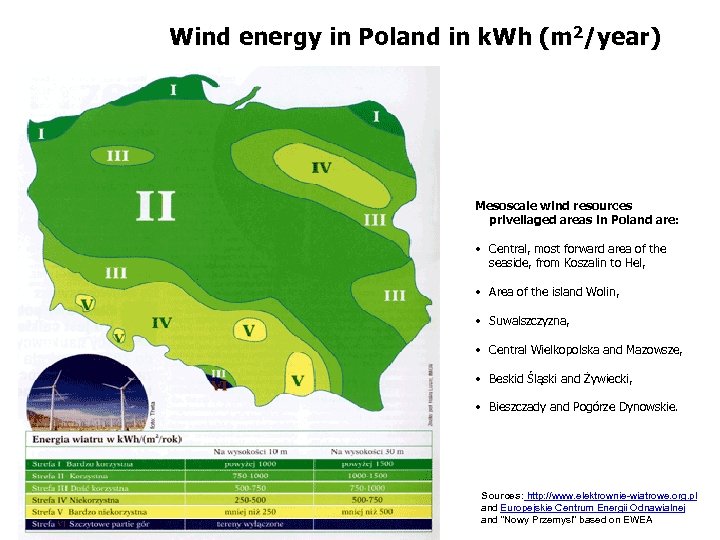
Wind energy in Poland in k. Wh (m 2/year) Mesoscale wind resources privellaged areas in Poland are: • Central, most forward area of the seaside, from Koszalin to Hel, • Area of the island Wolin, • Suwalszczyzna, • Central Wielkopolska and Mazowsze, • Beskid Śląski and Żywiecki, • Bieszczady and Pogórze Dynowskie. Sources: http: //www. elektrownie-wiatrowe. org. pl and Europejskie Centrum Energii Odnawialnej and "Nowy Przemysł" based on EWEA
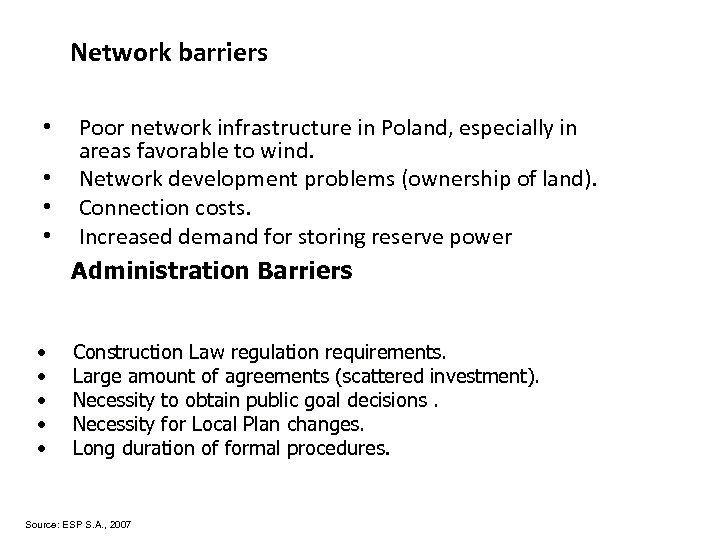
Network barriers Poor network infrastructure in Poland, especially in areas favorable to wind. • Network development problems (ownership of land). • Connection costs. • Increased demand for storing reserve power Administration Barriers • • • Construction Law regulation requirements. Large amount of agreements (scattered investment). Necessity to obtain public goal decisions. Necessity for Local Plan changes. Long duration of formal procedures. Source: ESP S. A. , 2007
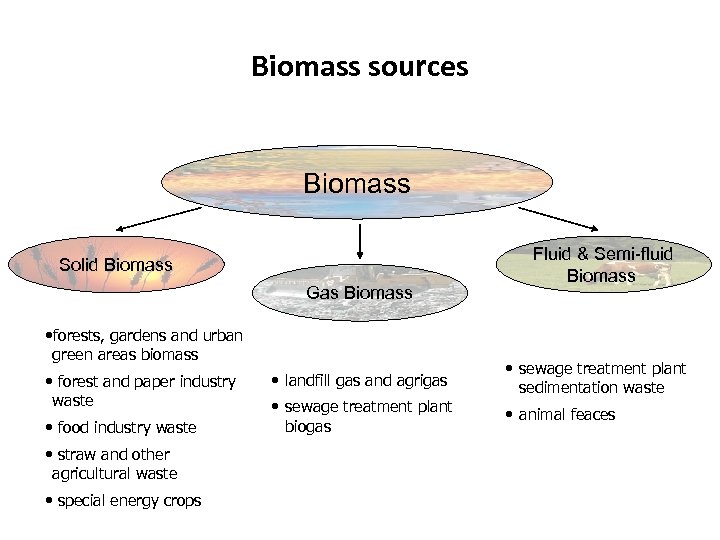
Biomass sources Biomass Solid Biomass Gas Biomass • forests, gardens and urban green areas biomass • forest and paper industry waste • food industry waste • straw and other agricultural waste • special energy crops • landfill gas and agrigas • sewage treatment plant biogas Fluid & Semi-fluid Biomass • sewage treatment plant sedimentation waste • animal feaces
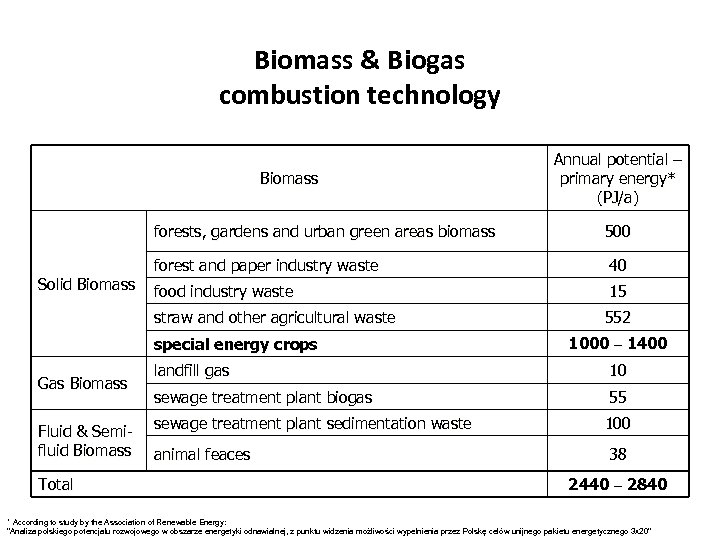
Biomass & Biogas combustion technology Biomass Annual potential – primary energy* (PJ/a) forests, gardens and urban green areas biomass forest and paper industry waste 40 food industry waste 15 straw and other agricultural waste Solid Biomass 500 552 special energy crops Gas Biomass Fluid & Semifluid Biomass Total 1000 – 1400 landfill gas 10 sewage treatment plant biogas 55 sewage treatment plant sedimentation waste 100 animal feaces 38 2440 – 2840 * According to study by the Association of Renewable Energy: "Analiza polskiego potencjału rozwojowego w obszarze energetyki odnawialnej, z punktu widzenia możliwości wypełnienia przez Polskę celów unijnego pakietu energetycznego 3 x 20"
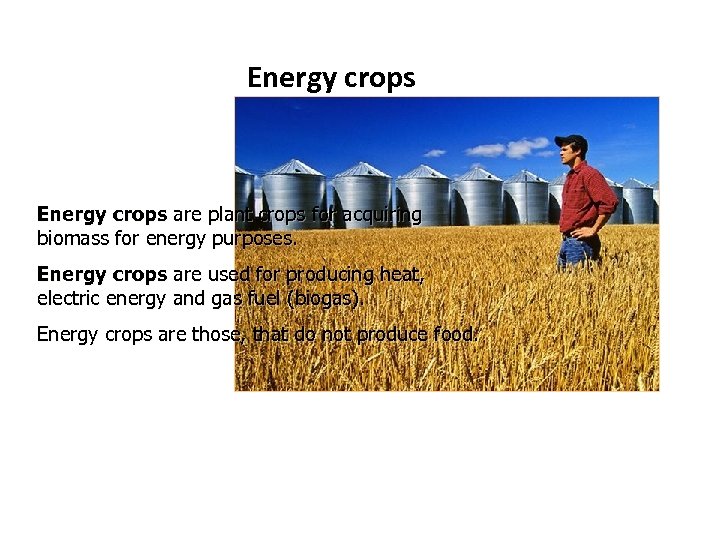
Energy crops are plant crops for acquiring biomass for energy purposes. Energy crops are used for producing heat, electric energy and gas fuel (biogas). Energy crops are those, that do not produce food.
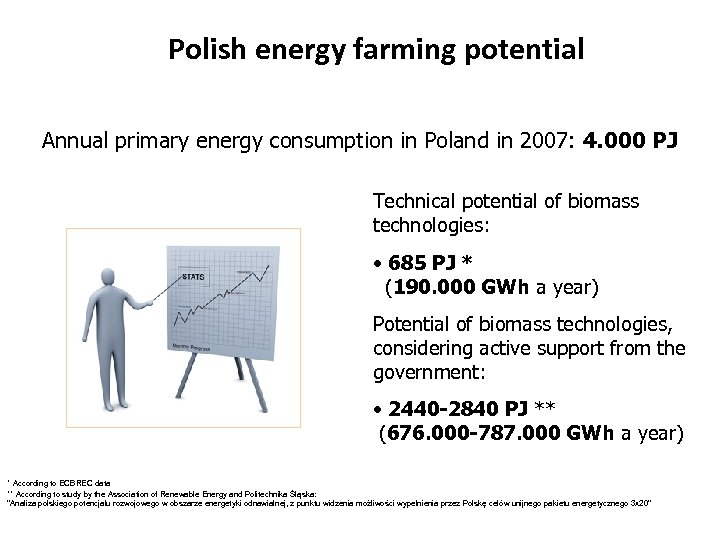
Polish energy farming potential Annual primary energy consumption in Poland in 2007: 4. 000 PJ Technical potential of biomass technologies: • 685 PJ * (190. 000 GWh a year) Potential of biomass technologies, considering active support from the government: • 2440 -2840 PJ ** (676. 000 -787. 000 GWh a year) * According to ECBREC data ** According to study by the Association of Renewable Energy and Politechnika Śląska: "Analiza polskiego potencjału rozwojowego w obszarze energetyki odnawialnej, z punktu widzenia możliwości wypełnienia przez Polskę celów unijnego pakietu energetycznego 3 x 20"
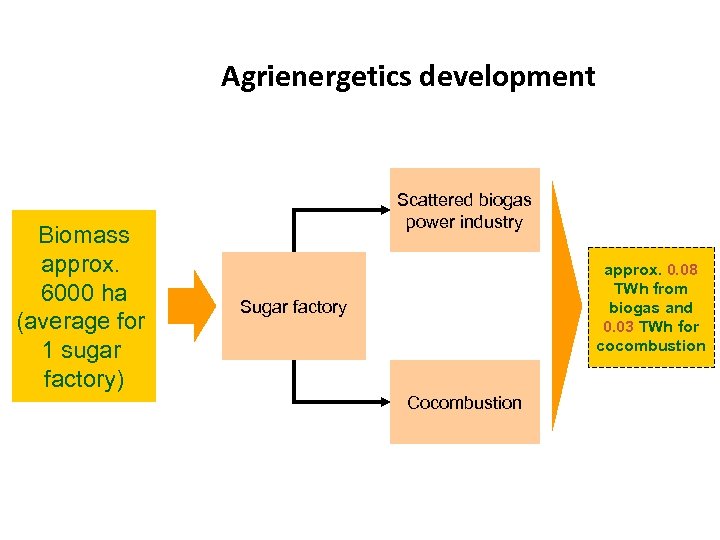
Agrienergetics development Biomass approx. 6000 ha (average for 1 sugar factory) Scattered biogas power industry approx. 0. 08 TWh from biogas and 0. 03 TWh for cocombustion Sugar factory Cocombustion
Biogas-works construction problems • Biogass production technology is not yet fully explored; • Technology import is very expensive; • Complex pemrission acquisition procedures; • Small public knowlegde about renewable energy sources; • Lack of local acceptance for biogas-works; • Expensive technology. Investment requires additional capital; • Selling heat is a problem in many of the country's regions;
Support for agrienergetics • Government biogas technology development Programs • Bonus for planting energy crops (45 €/ha) – In 2007 Farmlands Payment and Sugar Payment Act (Dz. U. z 26 stycznia 2007 r. Nr 35, poz. 217, z późn. zm. ), – allows energy crops producers to receive a surcharge of 45 euro/ha – increased interest in production from farmers of energy crops – relatively small amount of manufacturers ready to sign long-lasting contract agreements with the farmers. • Actions initiated by Chambers of Commerce and Associations
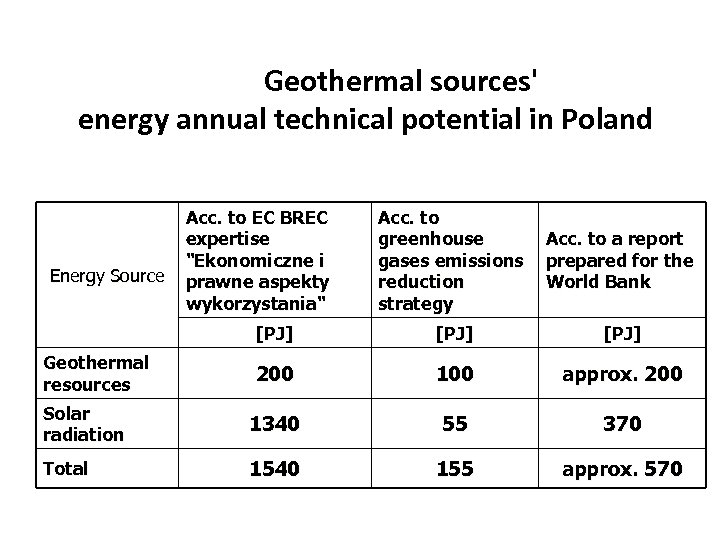
Geothermal sources' energy annual technical potential in Poland Acc. to greenhouse gases emissions reduction strategy Acc. to a report prepared for the World Bank [PJ] 200 100 approx. 200 Solar radiation 1340 55 370 Total 1540 155 approx. 570 Energy Source Geothermal resources Acc. to EC BREC expertise "Ekonomiczne i prawne aspekty wykorzystania"
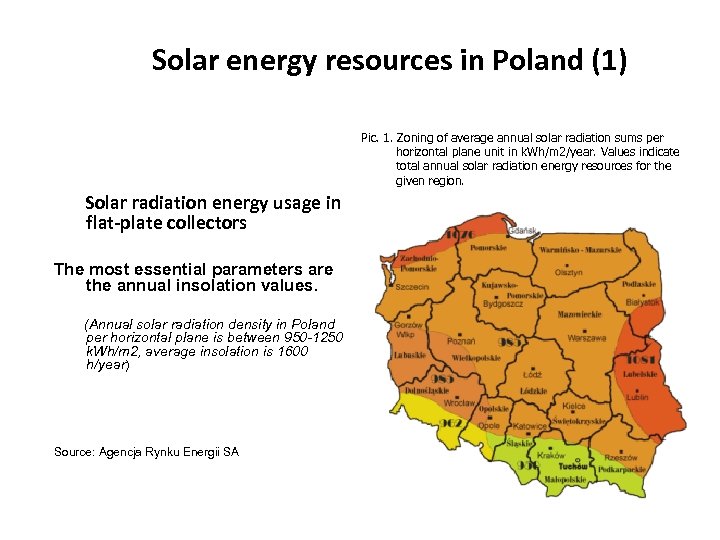
Solar energy resources in Poland (1) Pic. 1. Zoning of average annual solar radiation sums per horizontal plane unit in k. Wh/m 2/year. Values indicate total annual solar radiation energy resources for the given region. Solar radiation energy usage in flat-plate collectors The most essential parameters are the annual insolation values. (Annual solar radiation density in Poland per horizontal plane is between 950 -1250 k. Wh/m 2, average insolation is 1600 h/year) Source: Agencja Rynku Energii SA
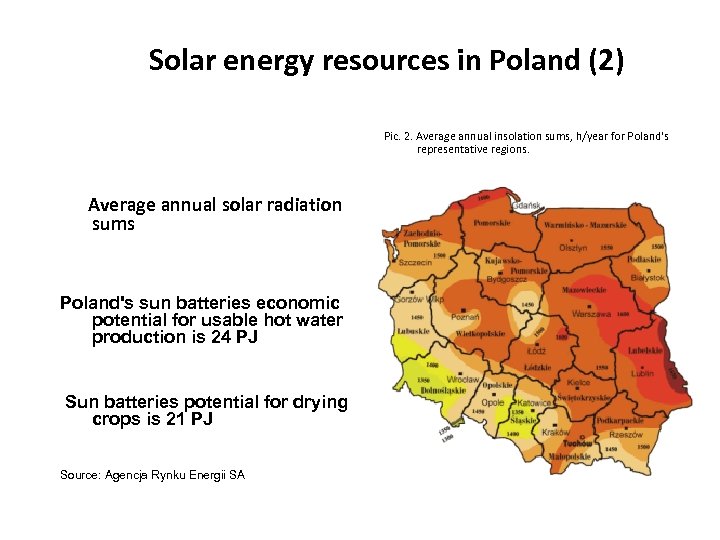
Solar energy resources in Poland (2) Pic. 2. Average annual insolation sums, h/year for Poland's representative regions. Average annual solar radiation sums Poland's sun batteries economic potential for usable hot water production is 24 PJ Sun batteries potential for drying crops is 21 PJ Source: Agencja Rynku Energii SA
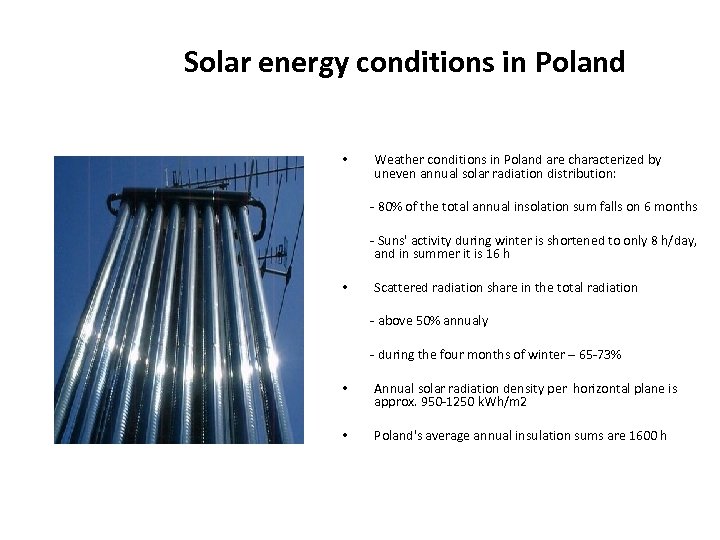
Solar energy conditions in Poland • Weather conditions in Poland are characterized by uneven annual solar radiation distribution: - 80% of the total annual insolation sum falls on 6 months - Suns' activity during winter is shortened to only 8 h/day, and in summer it is 16 h • Scattered radiation share in the total radiation - above 50% annualy - during the four months of winter – 65 -73% • Annual solar radiation density per horizontal plane is approx. 950 -1250 k. Wh/m 2 • Poland's average annual insulation sums are 1600 h
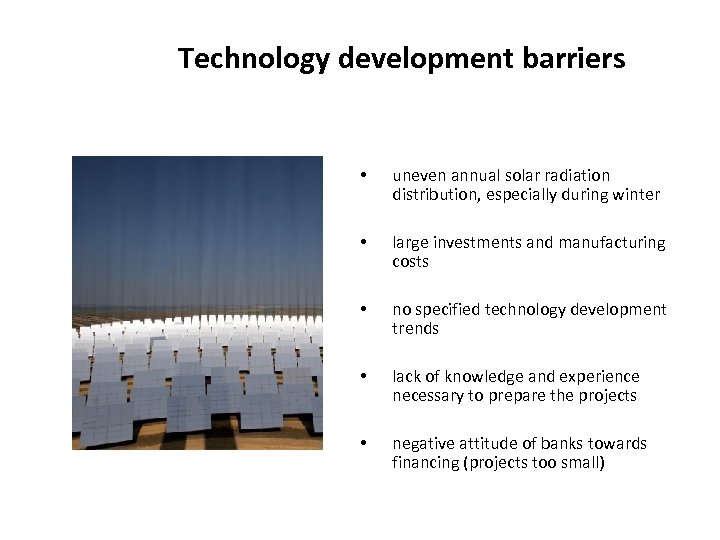
Technology development barriers • uneven annual solar radiation distribution, especially during winter • large investments and manufacturing costs • no specified technology development trends • lack of knowledge and experience necessary to prepare the projects • negative attitude of banks towards financing (projects too small)
Government plans for the development of the energy sector • Government plans specified in: "Założenia Polityki Energetycznej Polski do roku 2030" • Strategic goals: – increasing the share of energy from renewable sources in the country's fuelenergy balance to 7. 5% in 2010 – increasing the share of energy from renewable sources to 15% in 2020 in the primary carriers usage structure • Achieving the abovementioned means the necessity to perform a series of investments
Increase of RES share in the energy balance means: Increased energy resources usage effectiveness, Better environment condition thanks to the reduction of pollutant emissions to the atmosphere and water and waste production, Increased energetic security, Elicitation and usage of the full agricultural potential in Poland.
RES Status in 2010 • The share of renewable energy in gross national electricity consumption was at the end of 2009 5, 5% instead of 7, 5% • all sources of OZE generated approx. 8. 6 TWh of electricity, while gross electricity consumption at the level of the 149 TWh • very serious concern that the objective in the field of renewable energy development • 2, 5 TWh of electricity from RES is missing
Status 2010 • most of the energy from OZE comes from large power system using a co-combustion of biomass with coal in power stations and power gives the system currently in Poland, 4, 2 TWh. • hydroelectricity provide 2. 4 TWh, wind production is 1 TWh of electricity, • the rest of the renewable energy comes from the combustion of biomass and biogas in industrial plants and small sources.
Future until 2020 • From 1 January 2011, Poland begins to pursue the objective of 15% share of renewable energy sources in total primary energy in 2020. • Directive 2009/28/EC -national plan of action in the field of renewable energy sources (NAPS) • first verification of the progress in 2012.
Renewable Energy Association www. seo. org. pl
Скачать презентацию Renewable Energy Sources in Poland Krzysztof Konaszewski Polish
63d691268b33218287e0c15763f4298d.ppt