 Скачать презентацию RENEWABLE ENERGY Chih-Yung Wen Department of Aeronautics
16596b87d8069cdb30067e48f3f78c6f.ppt
- Количество слайдов: 55



RENEWABLE ENERGY Chih-Yung Wen Department of Aeronautics and Astronautics, National Cheng-Kung University, Taiwan Office: #5832 Email: cywen@mail. ncku. edu. tw
RENEWABLE ENERGY TA: Chieh-Ming Chen Department of Aeronautics and Astronautics, National Cheng-Kung University, Taiwan Office: #5908 Email: njiiaa 100@gmail. com
Outline Ø Introduction of energetics and Fuel cell (8 hrs, Prof. Chih-Yung Wen) Ø Power Management and PV Cell power system (8 hrs, Prof. Chin-E Lin) Ø Solar Thermal Energy (6 hrs, Prof. Keh-Chin Chang) Ø Wind energy (8 hrs, Prof. J. J Miau)
RENEWABLE ENERGY Grading 1. Quiz 40% 2. Attendance 30% 3. Final exam 30%
Outline Study the problem of energy (thermodynamics of open systems) and develop industrial applications in direct relation with the phenomena of thermal transfers and engineering sciences: in particular, thermo-solar energy conversion, photovoltaic conversion, nuclear energy, wind energy…etc.
Outline Class note Website: http: //www. iaa. ncku. edu. tw/~cywen/co urse/energy%20 tec/energtec. htm
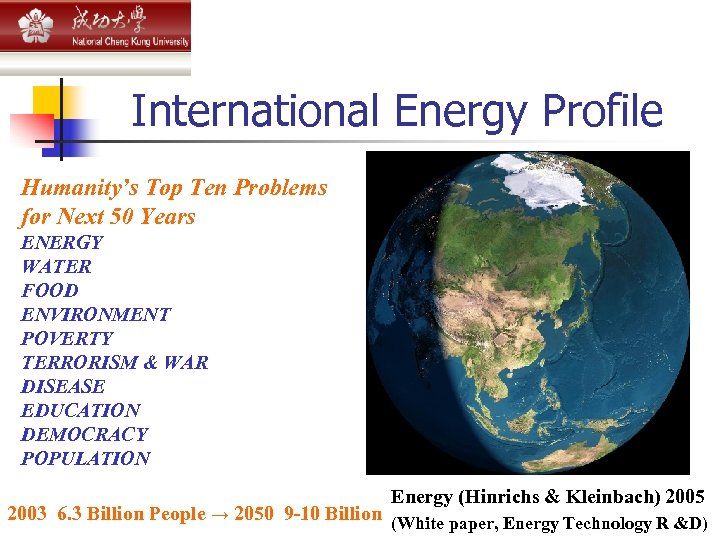
International Energy Profile Humanity’s Top Ten Problems for Next 50 Years ENERGY WATER FOOD ENVIRONMENT POVERTY TERRORISM & WAR DISEASE EDUCATION DEMOCRACY POPULATION Energy (Hinrichs & Kleinbach) 2005 2003 6. 3 Billion People → 2050 9 -10 Billion (White paper, Energy Technology R &D)
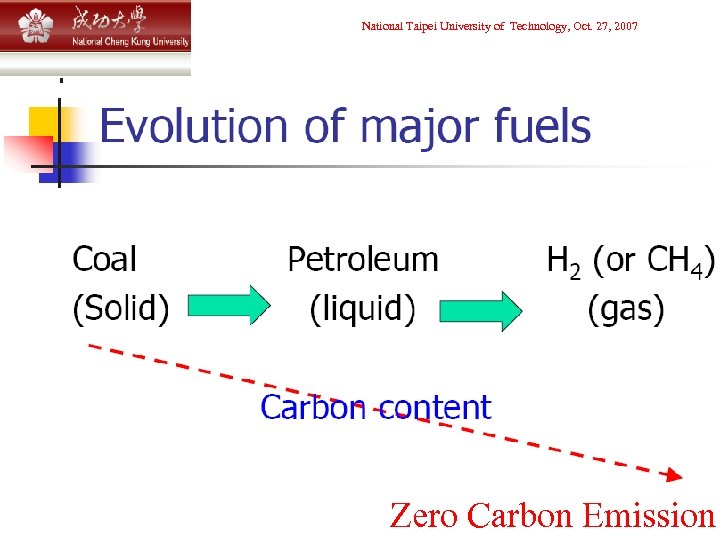
International Energy Profile Ø Ø Energy classifications: Traditional energy, Renewable energy, Hydrogen energy and Waste energy Traditional Energy: Fossil fuel energy (Coal, Petroleum, Natural gas) and Nuclear energy
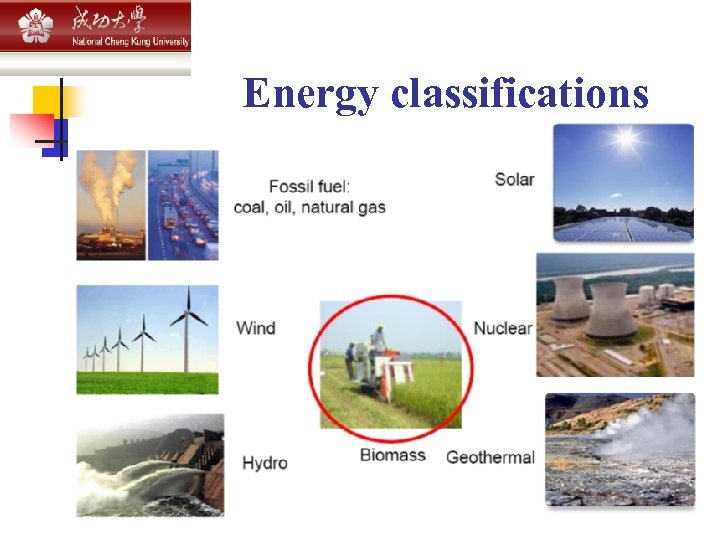
Energy classifications
National Taipei University of Technology, Oct. 27, 2007 Renewable Energies n n Renewable energy is energy which comes from natural resources such as sunlight, wind, rain, tides, and geothermal heat, which are renewable (naturally replenished). About 16% of global final energy consumption comes from renewables, with 10% coming from traditional biomass, which is mainly used for heating, and 3. 4% from hydroelectricity.
National Taipei University of Technology, Oct. 27, 2007 Renewable Energies n New renewables (small hydro, modern biomass, wind, solar, geothermal, and biofuels) accounted for another 3% and are growing very rapidly. The share of renewables in electricity generation is around 19%, with 16% of global electricity coming from hydroelectricity and 3% from new renewables.
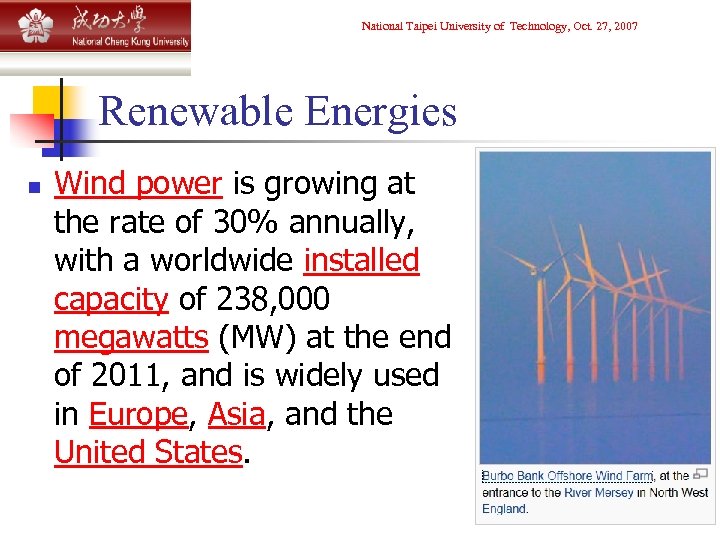
National Taipei University of Technology, Oct. 27, 2007 Renewable Energies n Wind power is growing at the rate of 30% annually, with a worldwide installed capacity of 238, 000 megawatts (MW) at the end of 2011, and is widely used in Europe, Asia, and the United States.
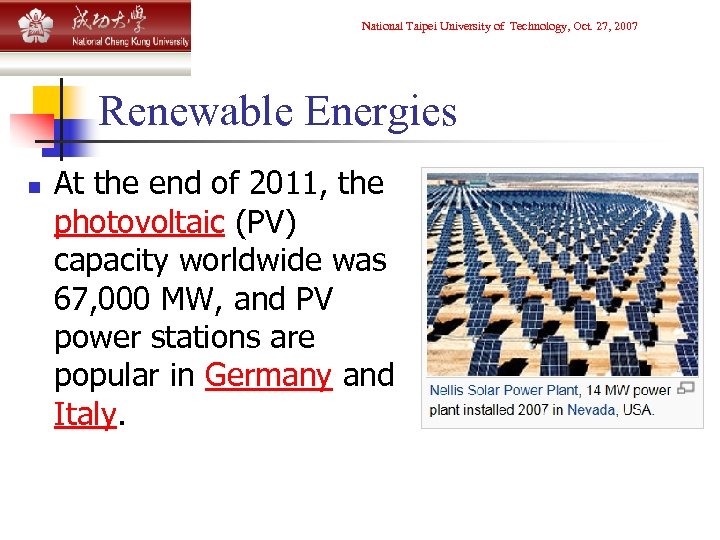
National Taipei University of Technology, Oct. 27, 2007 Renewable Energies n At the end of 2011, the photovoltaic (PV) capacity worldwide was 67, 000 MW, and PV power stations are popular in Germany and Italy.
National Taipei University of Technology, Oct. 27, 2007 Renewable Energies n Solar thermal power stations operate in the USA and Spain, and the largest of these is the 354 megawatt (MW) SEGS power plant in the Mojave Desert.
National Taipei University of Technology, Oct. 27, 2007 Renewable Energies n n The world's largest geothermal power installation is the Geysers in California, with a rated capacity of 750 MW. Brazil has one of the largest renewable energy programs in the world, involving production of ethanol fuel from sugarcane, and ethanol now provides 18% of the country's automotive fuel. Ethanol fuel is also widely available in the USA. eg. E 5 gasoline
National Taipei University of Technology, Oct. 27, 2007 Renewable Energies n n n Solar Energy (Concentrating Solar Power) → Solar thermal energy → Photovoltaic Wind Energy Hydroelectric Power Geothermal Energy Biomass Energy Ocean thermal Energy
National Taipei University of Technology, Oct. 27, 2007
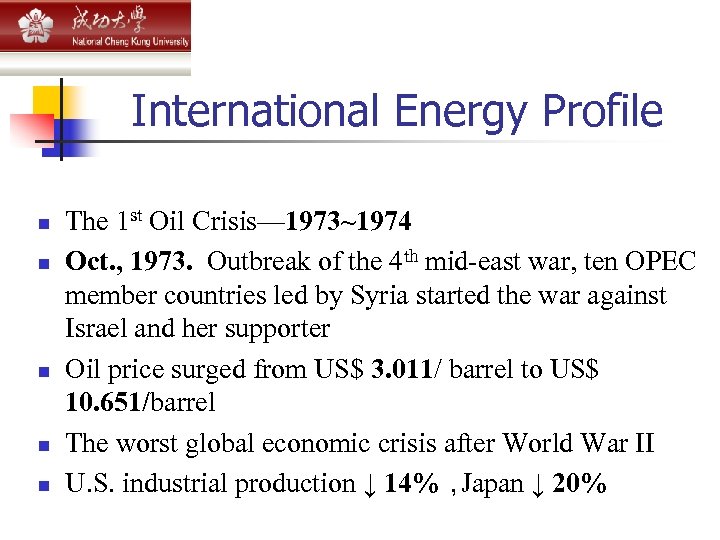
International Energy Profile n n n The 1 st Oil Crisis— 1973~1974 Oct. , 1973. Outbreak of the 4 th mid-east war, ten OPEC member countries led by Syria started the war against Israel and her supporter Oil price surged from US$ 3. 011/ barrel to US$ 10. 651/barrel The worst global economic crisis after World War II U. S. industrial production ↓ 14%, Japan ↓ 20%
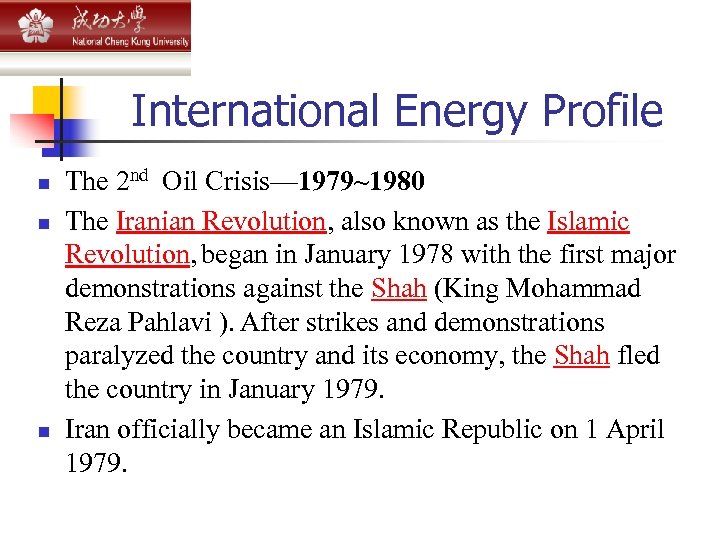
International Energy Profile n n n The 2 nd Oil Crisis— 1979~1980 The Iranian Revolution, also known as the Islamic Revolution, began in January 1978 with the first major demonstrations against the Shah (King Mohammad Reza Pahlavi ). After strikes and demonstrations paralyzed the country and its economy, the Shah fled the country in January 1979. Iran officially became an Islamic Republic on 1 April 1979.
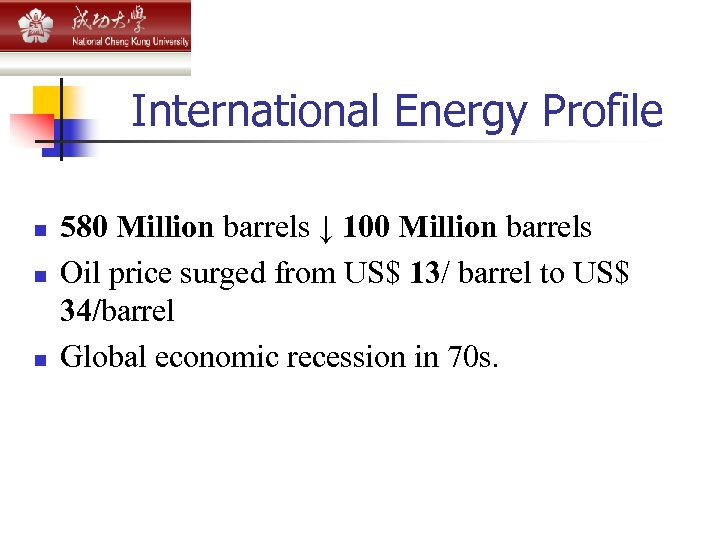
International Energy Profile n n n 580 Million barrels ↓ 100 Million barrels Oil price surged from US$ 13/ barrel to US$ 34/barrel Global economic recession in 70 s.
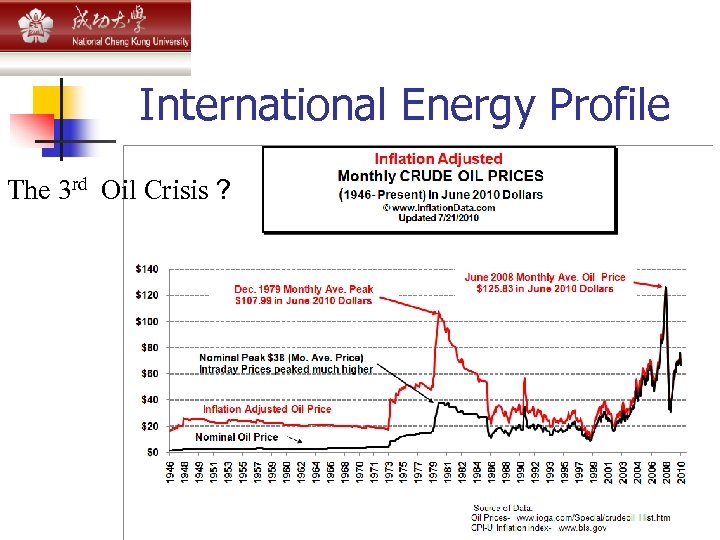
International Energy Profile The 3 rd Oil Crisis?
International Energy Profile n Supply vs. Demand n BRIC: Brazil, Russia, India, China
International Energy Profile n n Internet (Facebook) revolution Egypt, Libya (next? ) Oil price surged from US$ 80/ barrel to US$ 125/barrel
台灣能源概況
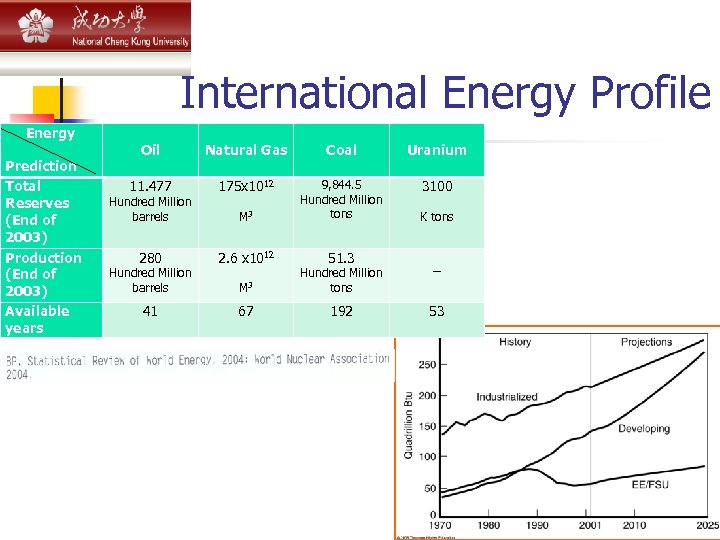
International Energy Profile Energy Prediction Total Reserves (End of 2003) Production (End of 2003) Available years Oil 11. 477 Natural Gas Coal Uranium 175 x 1012 M 3 9, 844. 5 Hundred Million tons 3100 280 2. 6 x 10¹² M 3 51. 3 Hundred Million tons - 41 67 192 53 Hundred Million barrels K tons
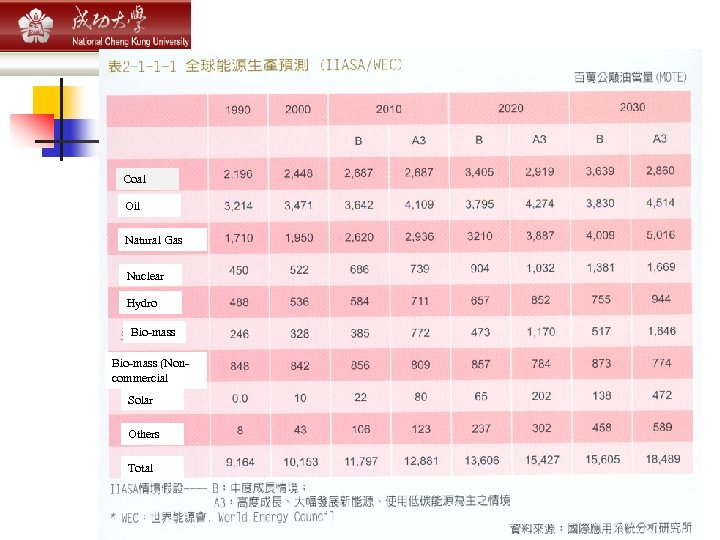
Introduction Coal Oil Natural Gas Nuclear Hydro Bio-mass (Noncommercial Solar Others Total
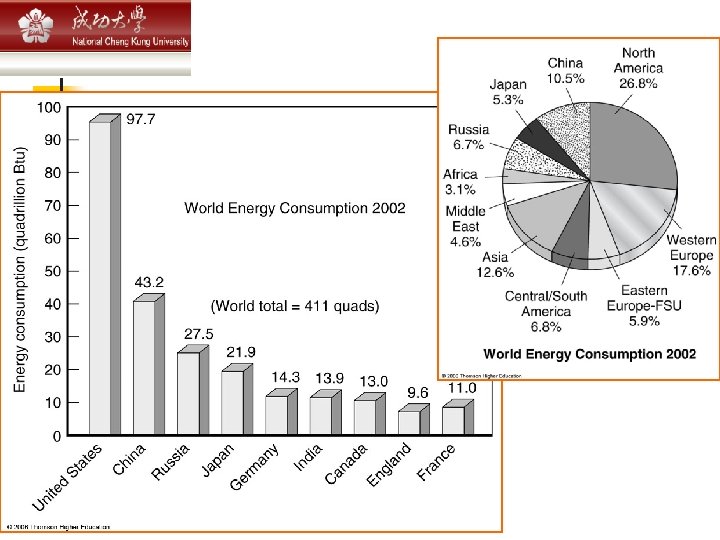
Introduction
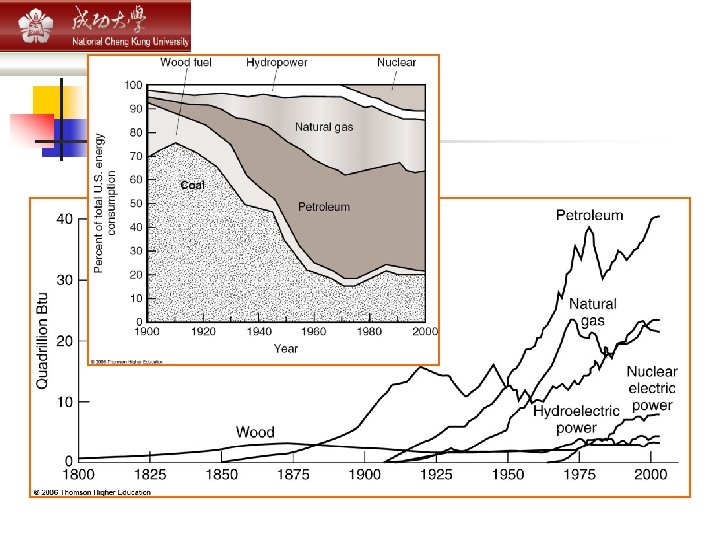
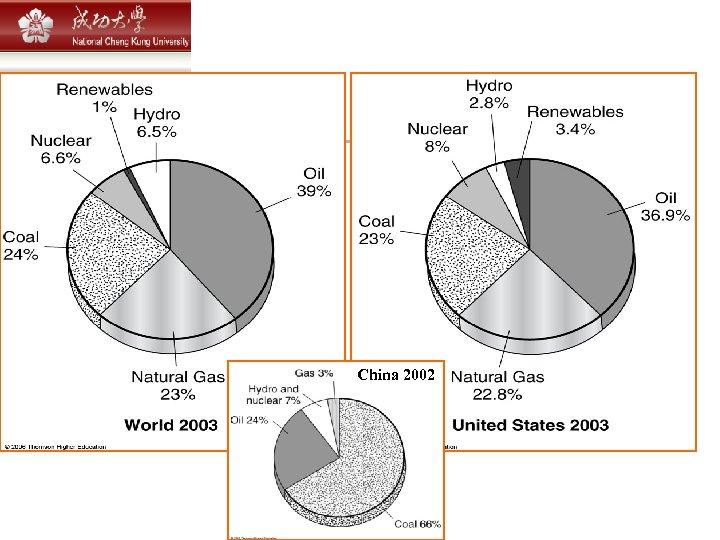
China 2002
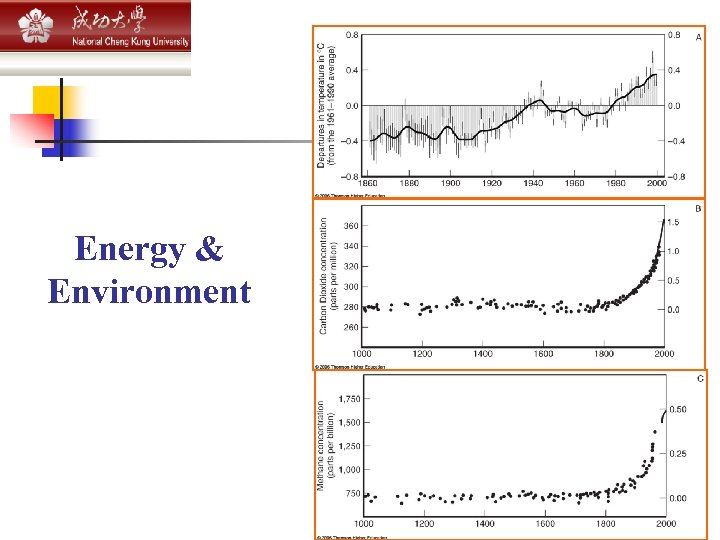
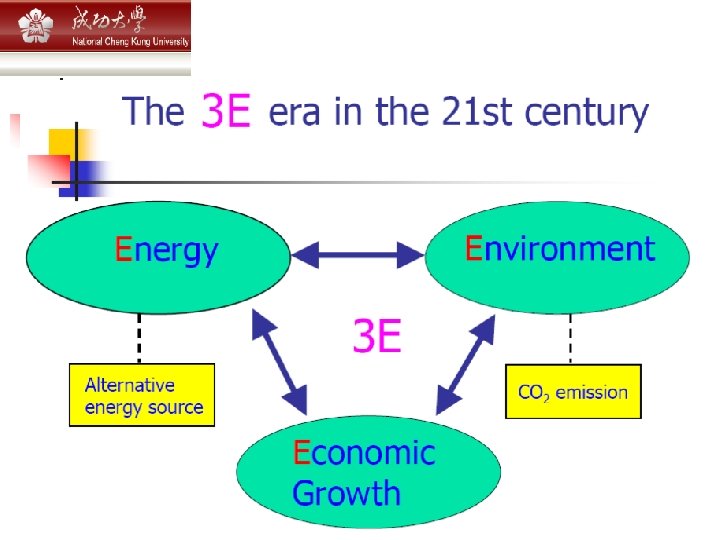
Energy & Environment
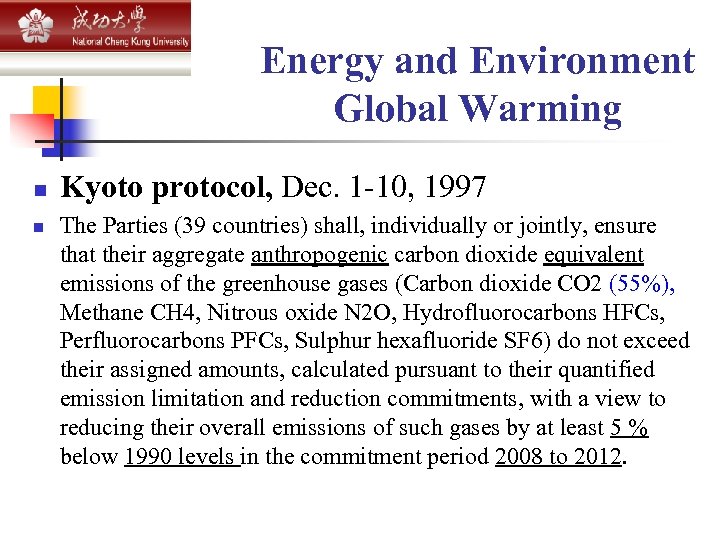
Energy and Environment Global Warming n n Kyoto protocol, Dec. 1 -10, 1997 The Parties (39 countries) shall, individually or jointly, ensure that their aggregate anthropogenic carbon dioxide equivalent emissions of the greenhouse gases (Carbon dioxide CO 2 (55%), Methane CH 4, Nitrous oxide N 2 O, Hydrofluorocarbons HFCs, Perfluorocarbons PFCs, Sulphur hexafluoride SF 6) do not exceed their assigned amounts, calculated pursuant to their quantified emission limitation and reduction commitments, with a view to reducing their overall emissions of such gases by at least 5 % below 1990 levels in the commitment period 2008 to 2012.
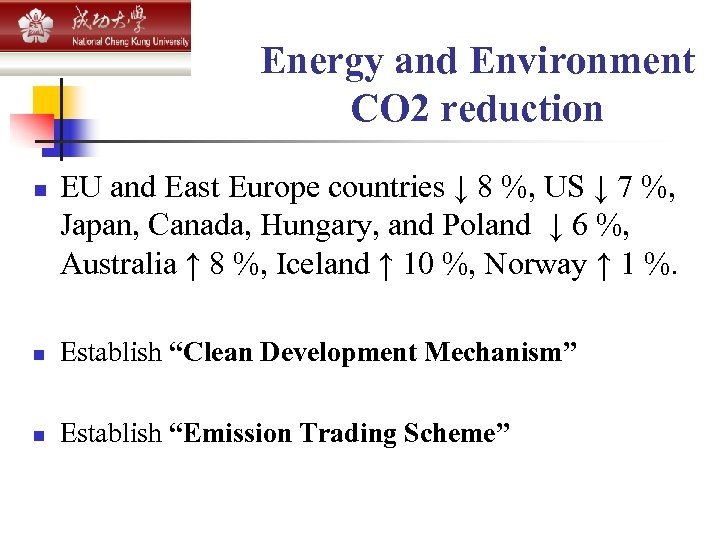
Energy and Environment CO 2 reduction n EU and East Europe countries ↓ 8 %, US ↓ 7 %, Japan, Canada, Hungary, and Poland ↓ 6 %, Australia ↑ 8 %, Iceland ↑ 10 %, Norway ↑ 1 %. n Establish “Clean Development Mechanism” n Establish “Emission Trading Scheme”
Energy and Environment Kyoto protocol Implement and/or further elaborate policies and measures in accordance with its national circumstances, such as: (i) Enhancement of energy efficiency in relevant sectors of the national economy; (ii) Protection and enhancement of sinks and reservoirs of greenhouse gases not controlled by the Montreal Protocol, taking into account its commitments under relevant international environmental agreements; promotion of sustainable forest management practices, afforestation and reforestation;
Energy and Environment Kyoto protocol Implement and/or further elaborate policies and measures in accordance with its national circumstances, such as: (iii) Promotion of sustainable forms of agriculture in light of climate change considerations; (iv) Research on, and promotion, development and increased use of, new and renewable forms of energy, of carbon dioxide sequestration technologies and of advanced and innovative environmentally sound technologies;
Energy and Environment Kyoto protocol Implement and/or further elaborate policies and measures in accordance with its national circumstances, such as: (v) Progressive reduction or phasing out of market imperfections, fiscal incentives, tax and duty exemptions and subsidies in all greenhouse gas emitting sectors that run counter to the objective of convention and application of market instruments; (vi) Encouragement of appropriate reforms in relevant sectors aimed at promoting policies and measures which limit or reduce emissions of greenhouse gases not controlled by the Montreal Protocol;
Energy and Environment Kyoto protocol Implement and/or further elaborate policies and measures in accordance with its national circumstances, such as: (vii) Measures to limit and/or reduce emissions of greenhouse gases not controlled by the Montreal Protocol in the transport sector; (viii) Limitation and/or reduction of methane emissions through recovery and use in waste management, as well as in the production, transport and distribution of energy;
Energy and Environment Kyoto protocol Implement and/or further elaborate policies and measures in accordance with its national circumstances, such as: (iii) Promotion of sustainable forms of agriculture in light of climate change considerations; (iv) Research on, and promotion, development and increased use of, new and renewable forms of energy, of carbon dioxide sequestration technologies and of advanced and innovative environmentally sound technologies;
Energy and Environment Copenhagen Climate Submit, December 7 to 18, 2009 Ø Ø to create international awareness to prevent climate change and global warming, and to create a new climate treaty to replace the Kyoto Protocol that runs out in 2012 Still no conclusive action!!
National Taipei University of Technology, Oct. 27, 2007 Zero Carbon Emission
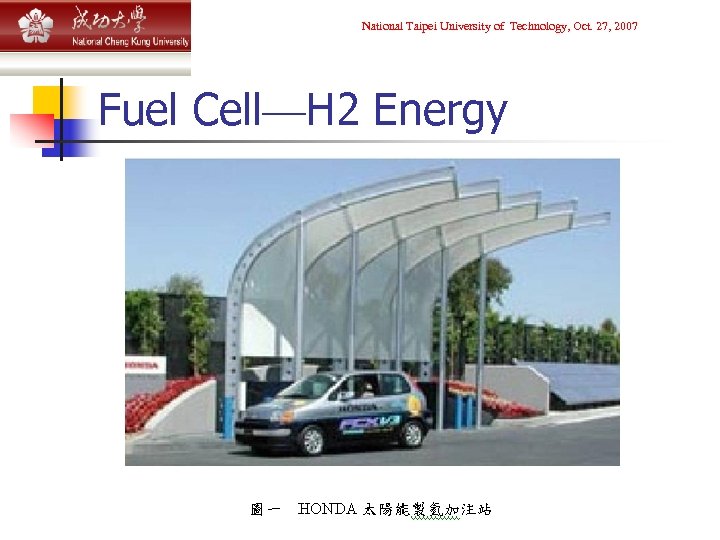
National Taipei University of Technology, Oct. 27, 2007 Fuel Cell—H 2 Energy
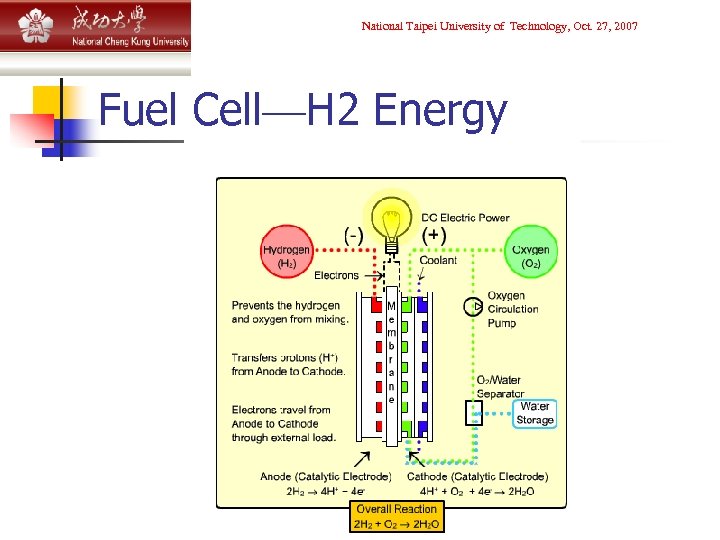
National Taipei University of Technology, Oct. 27, 2007 Fuel Cell—H 2 Energy
National Taipei University of Technology, Oct. 27, 2007 Fossil Fuel Energy n n n Boosting Power Plant Efficient Low Emission Boiler Systems—LEBS Pressurized Fluidized Bed Combustion—PFBC Integrated Gasification Combined Cycle—IGCC Indirectly Fired Cycle—IFC Advanced Turbine Systems—ATS
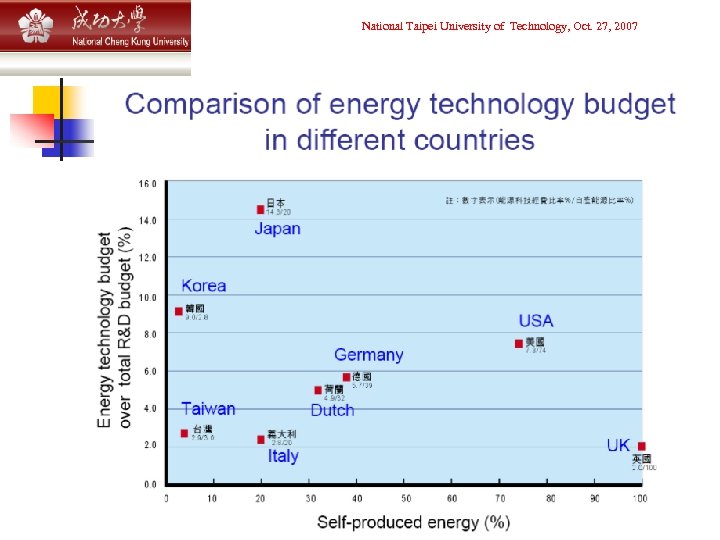
National Taipei University of Technology, Oct. 27, 2007 台灣能源概況
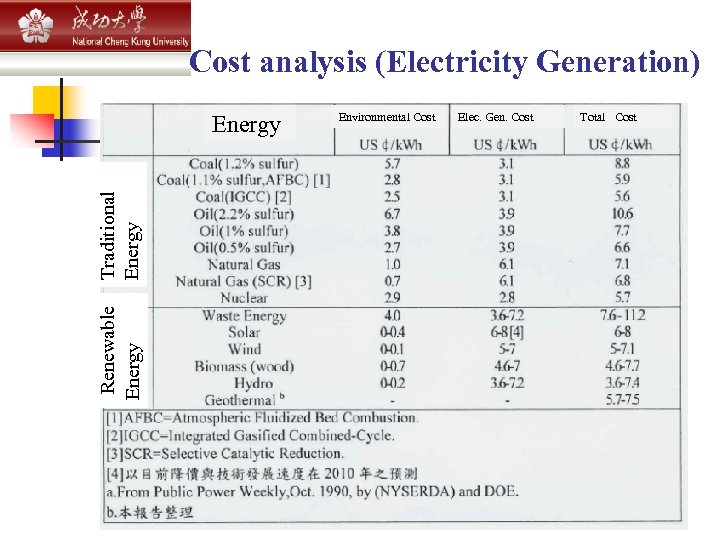
Cost analysis (Electricity Generation) Energy Renewable Traditional Energy Environmental Cost Elec. Gen. Cost Total Cost
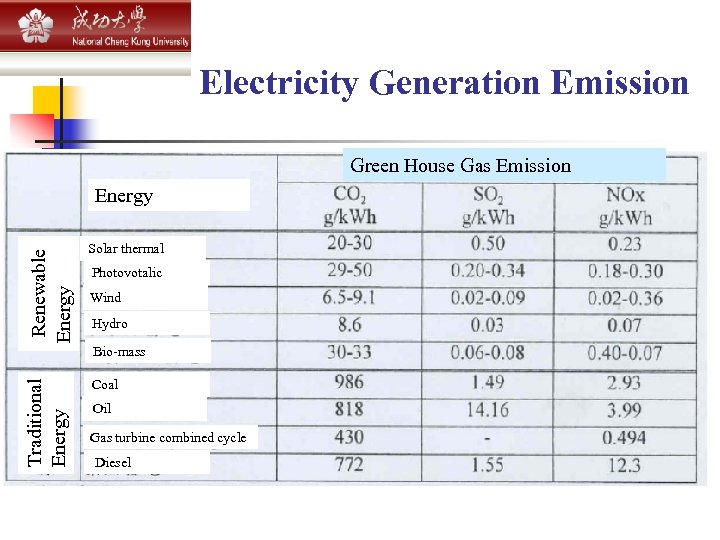
Electricity Generation Emission Green House Gas Emission Solar thermal Energy Photovotalic Traditional Energy Renewable Energy Wind Hydro Bio-mass Coal Oil Gas turbine combined cycle Diesel
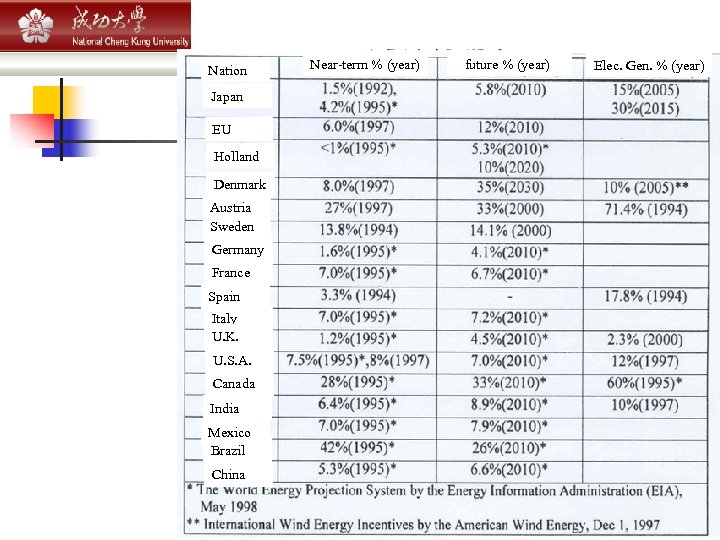
Nation Japan EU Holland Denmark Austria Sweden Germany France Spain Italy U. K. U. S. A. Canada India Mexico Brazil China Near-term % (year) future % (year) Elec. Gen. % (year)
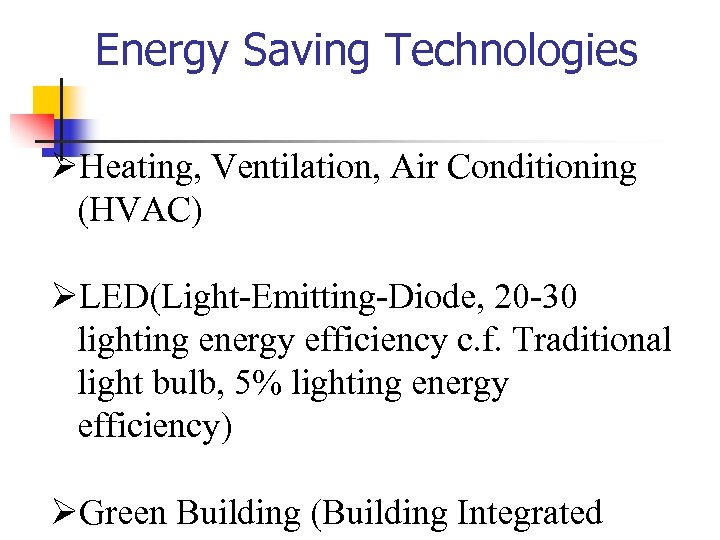
Energy Saving Technologies ØHeating, Ventilation, Air Conditioning (HVAC) ØLED(Light-Emitting-Diode, 20 -30 lighting energy efficiency c. f. Traditional light bulb, 5% lighting energy efficiency) ØGreen Building (Building Integrated
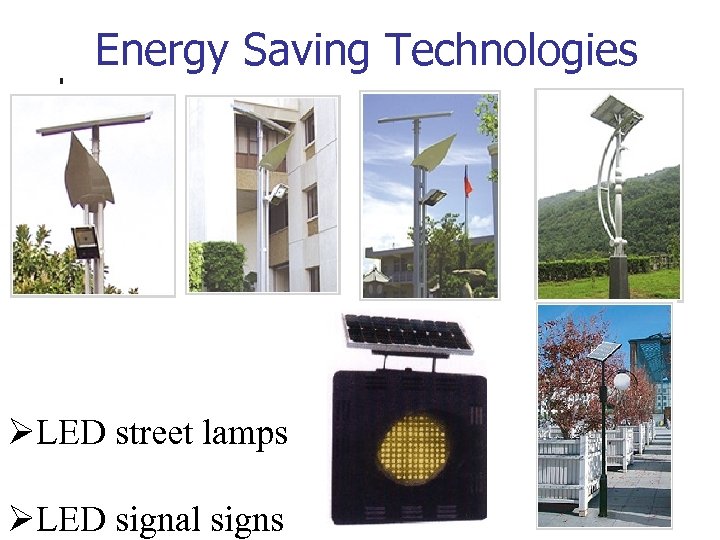
Energy Saving Technologies ØLED street lamps ØLED signal signs
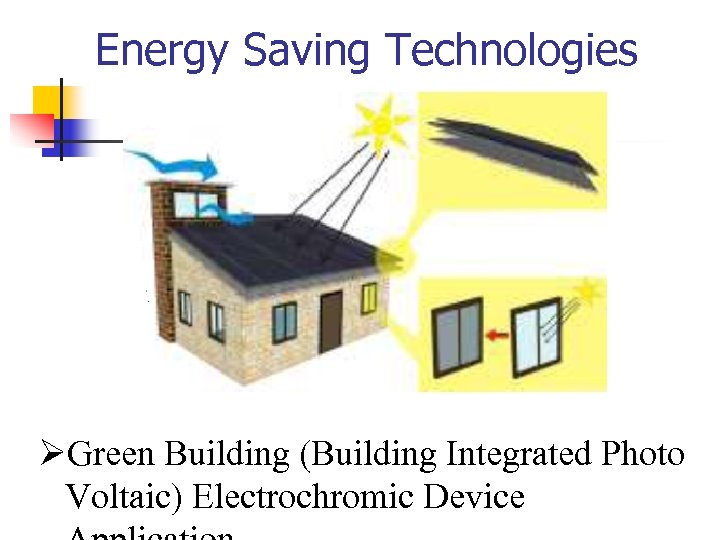
Energy Saving Technologies ØGreen Building (Building Integrated Photo Voltaic) Electrochromic Device
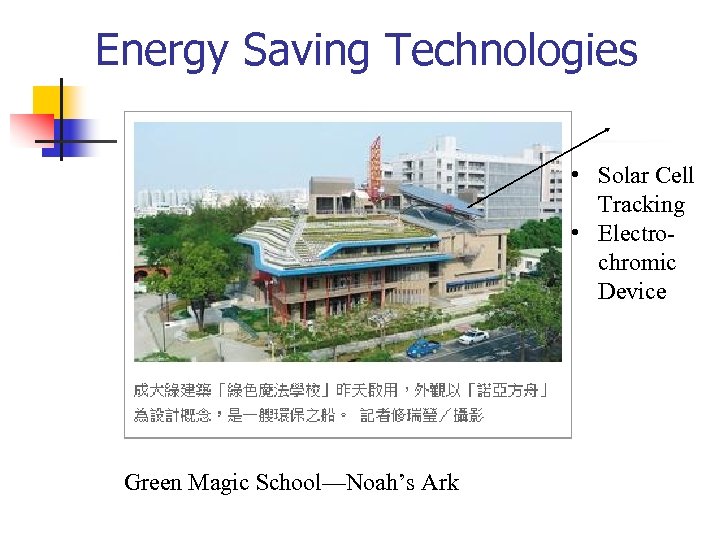
Energy Saving Technologies • Solar Cell Tracking • Electrochromic Device Green Magic School—Noah’s Ark
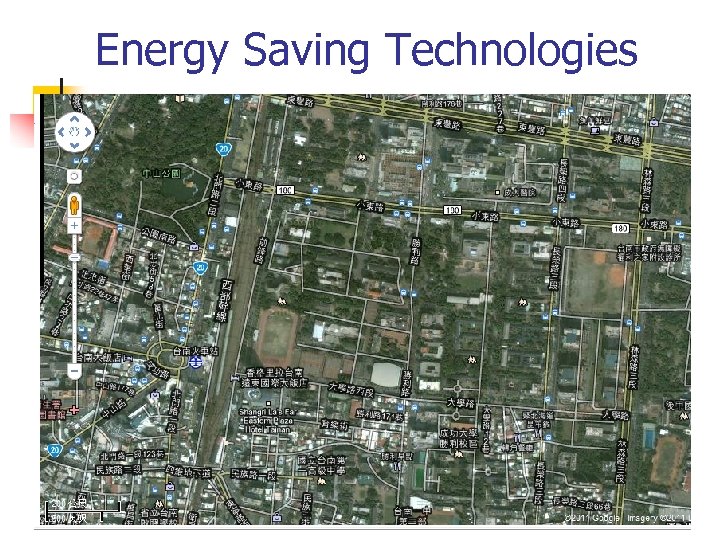
Energy Saving Technologies Green Magic School—Noah’s Ark
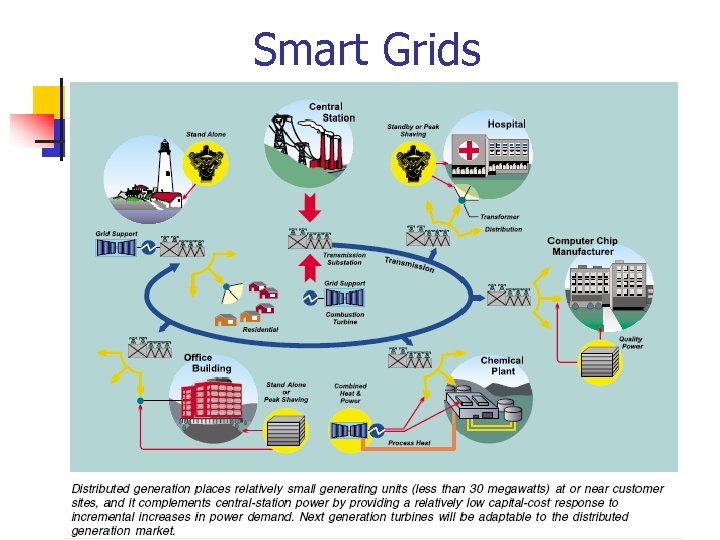
Smart Grids
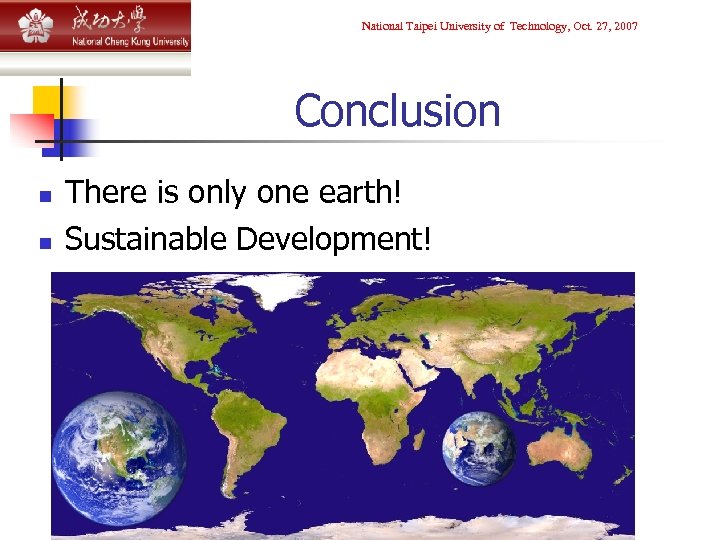
National Taipei University of Technology, Oct. 27, 2007 Conclusion n n There is only one earth! Sustainable Development!

National Taipei University of Technology, Oct. 27, 2007 Thanks for your attention
Скачать презентацию RENEWABLE ENERGY Chih-Yung Wen Department of Aeronautics
16596b87d8069cdb30067e48f3f78c6f.ppt