 Скачать презентацию Renewable Energy Basics West Central CERT Our
196eb45d2362f6270d4b8c427b1e8816.ppt
- Количество слайдов: 32



Renewable Energy Basics West Central CERT
Our Mission Giving community members a voice in energy planning by connecting them with the technical resources necessary to identify and implement community-scale energy efficiency and renewable energy projects www. Clean. Energy. Resource. Teams. org
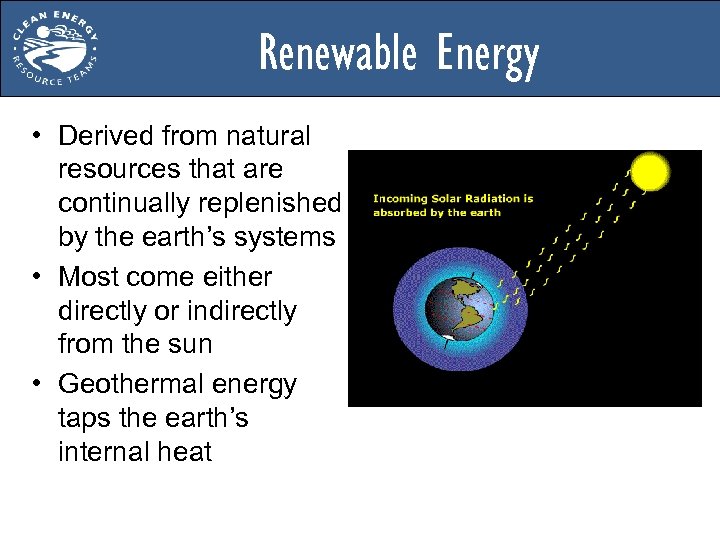
Renewable Energy • Derived from natural resources that are continually replenished by the earth’s systems • Most come either directly or indirectly from the sun • Geothermal energy taps the earth’s internal heat
Renewables • Wind • Biomass – Biogas – Biofuels • Solar – Photovoltaic (electricity) • Geothermal – Solar Thermal (heat)
But Remember: Efficiency First! • Efficiency improvements MUST be the first step in any renewable energy project. • Estimated $1 : $3 savings ratio • Get an energy audit from your utility’s Conservation Improvement Program (CIP)
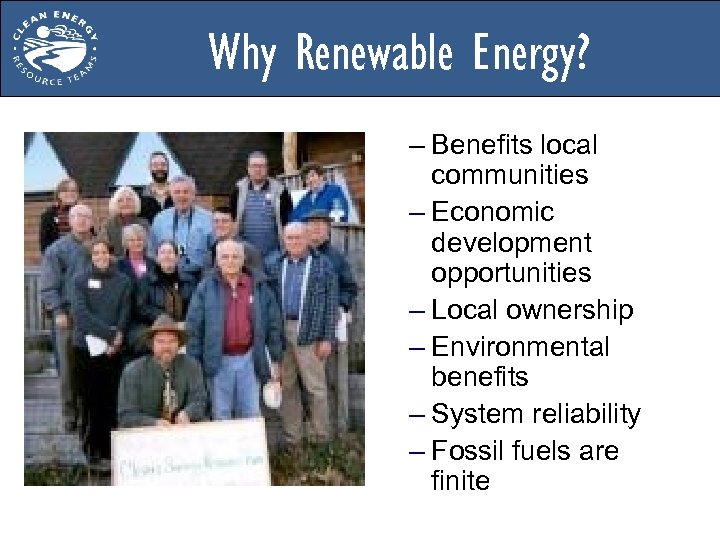
Why Renewable Energy? – Benefits local communities – Economic development opportunities – Local ownership – Environmental benefits – System reliability – Fossil fuels are finite
Minnesota Energy Policy 2007 • Renewable Energy Standard of 25% by 2025 – 7% by 2010; 12% by 2012; 17% by 2016 – 30% by 2020 for Xcel • Next Generation Energy Act – Reduce greenhouse gas emissions 80% by 2050 – Aggressive energy savings goal— 1. 5% of revenues – Community-Based Energy Development Tariff – Economy-wide climate change action plan – Required reductions in CO 2 from power sector
Focus on: C-BED Community-Based Energy Development • Requires utilities to consider (but not necessarily commit to) community wind projects • Provides for a special payment structure (for electricity sold to the utility) to make financing for the community developer easier: • Higher payments during the first 10 years of the project – Lower payments in second 10 years • Provides definitional guidelines for what constitutes a “community wind” project
Did you know… …In the United States during 2007, only 1% of large scale wind projects were locally owned. In Minnesota, 27% of large scale wind projects were locally owned!
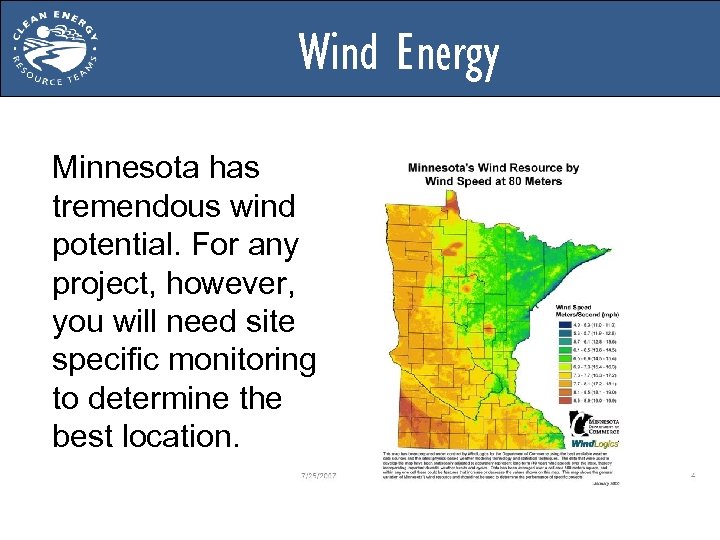
Wind Energy Minnesota has tremendous wind potential. For any project, however, you will need site specific monitoring to determine the best location.
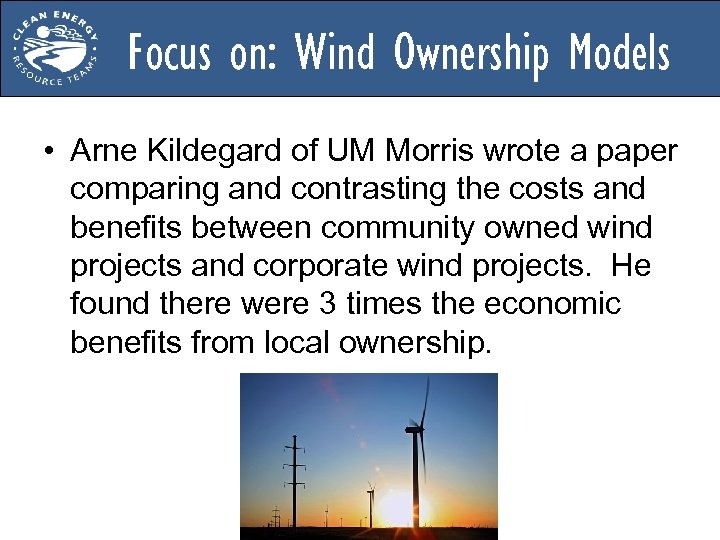
Focus on: Wind Ownership Models • Arne Kildegard of UM Morris wrote a paper comparing and contrasting the costs and benefits between community owned wind projects and corporate wind projects. He found there were 3 times the economic benefits from local ownership.
Focus on: Wind Ownership Models • In the summer of 2008, CERTs partnered with Initiative Foundations and others to address various issues that land owners interested in wind development should be aware of when approached by wind developers. In general: • Land leases = lower risks and lower rewards • Local ownership = greater risks and greater rewards
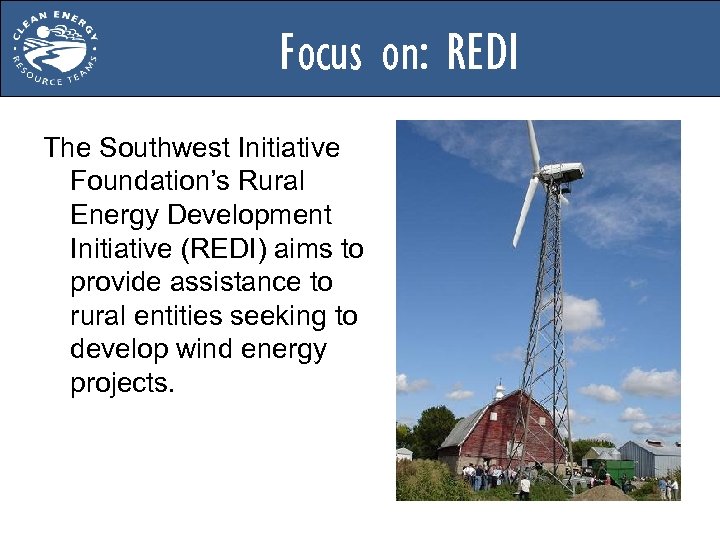
Focus on: REDI The Southwest Initiative Foundation’s Rural Energy Development Initiative (REDI) aims to provide assistance to rural entities seeking to develop wind energy projects.
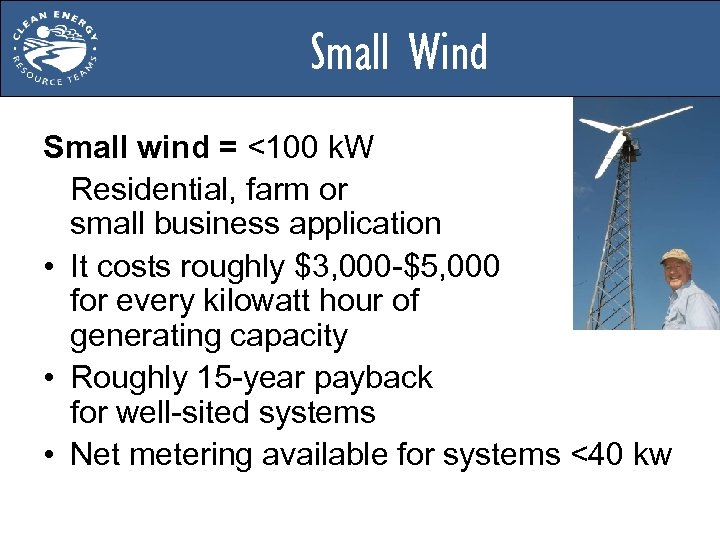
Small Wind Small wind = <100 k. W Residential, farm or small business application • It costs roughly $3, 000 -$5, 000 for every kilowatt hour of generating capacity • Roughly 15 -year payback for well-sited systems • Net metering available for systems <40 kw
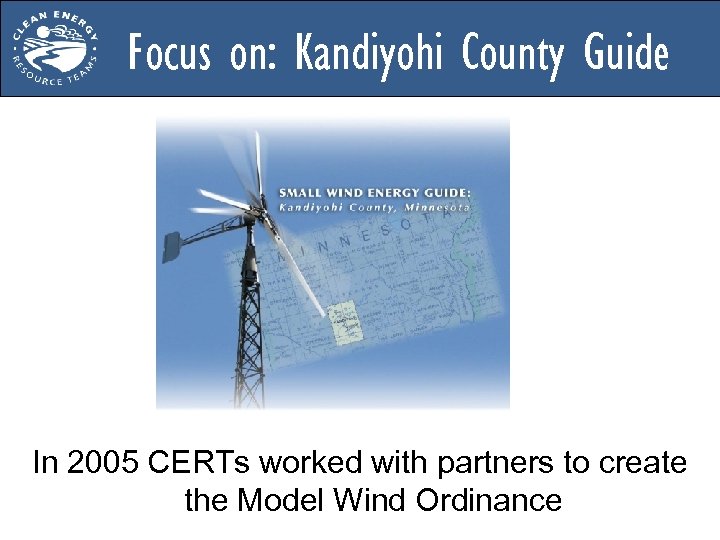
Focus on: Kandiyohi County Guide In 2005 CERTs worked with partners to create the Model Wind Ordinance
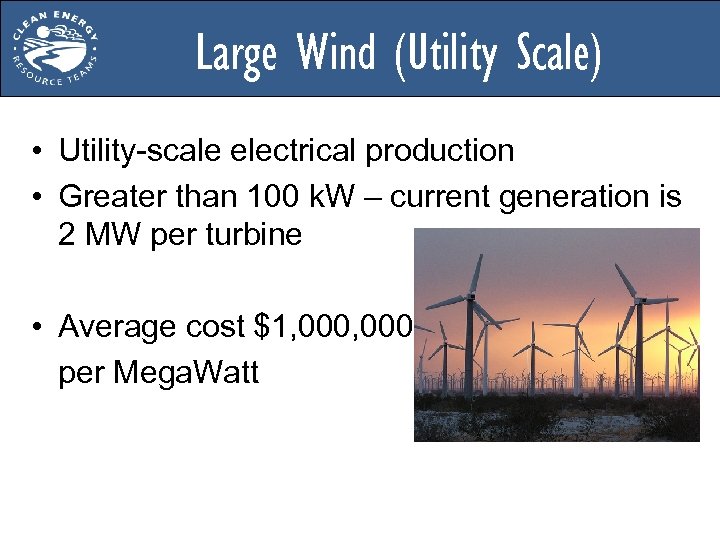
Large Wind (Utility Scale) • Utility-scale electrical production • Greater than 100 k. W – current generation is 2 MW per turbine • Average cost $1, 000 per Mega. Watt
USDA Renewable Energy Program • The USDA Rural Development Renewable Energy Grants can cover up to 25% of an eligible project’s costs.
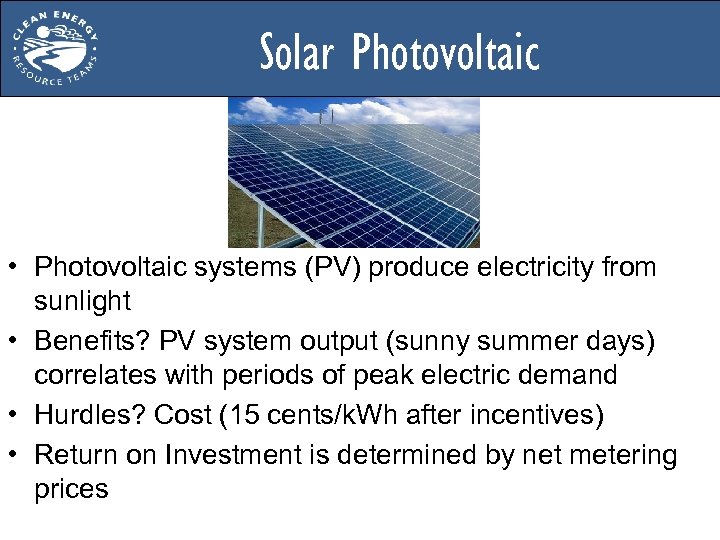
Solar Photovoltaic • Photovoltaic systems (PV) produce electricity from sunlight • Benefits? PV system output (sunny summer days) correlates with periods of peak electric demand • Hurdles? Cost (15 cents/k. Wh after incentives) • Return on Investment is determined by net metering prices
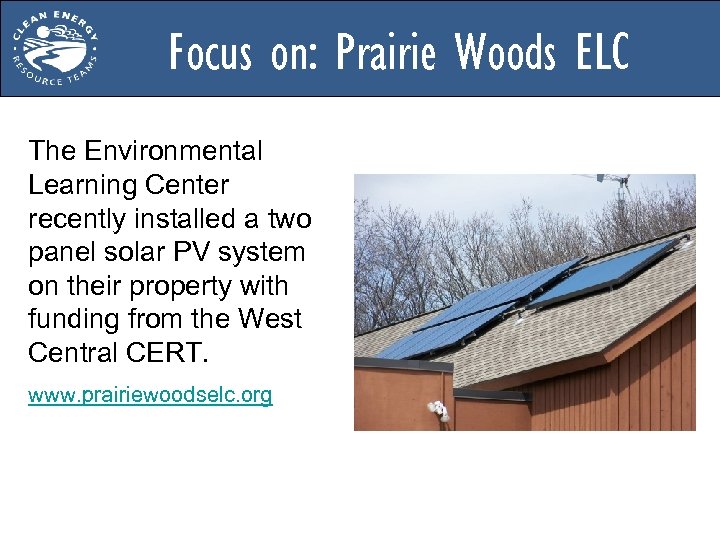
Focus on: Prairie Woods ELC The Environmental Learning Center recently installed a two panel solar PV system on their property with funding from the West Central CERT. www. prairiewoodselc. org
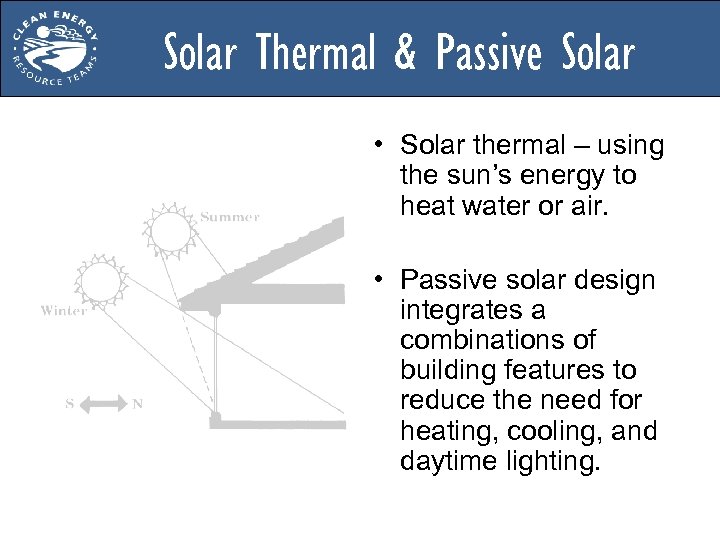
Solar Thermal & Passive Solar • Solar thermal – using the sun’s energy to heat water or air. • Passive solar design integrates a combinations of building features to reduce the need for heating, cooling, and daytime lighting.
Solar Manufacturer – Starbuck, MN • Manufactures solar thermal collectors, domestic hot water heaters, and space heating systems. • Two 4’x 8’ collectors can produce 50% to 70% of the annual hot water needed for a family of four in MN. • Return on Investment differs for what kind of water heating system you currently use
Biomass • Biomass is any organic material not derived from fossil fuels that can be converted to a fuel useful for generating electricity. • Dedicated crops: woody hybrid poplars, switchgrass, etc. • Waste products: wood residues, agricultural residues, animal waste Co-firing biomass with coal • Gasification – community digesters
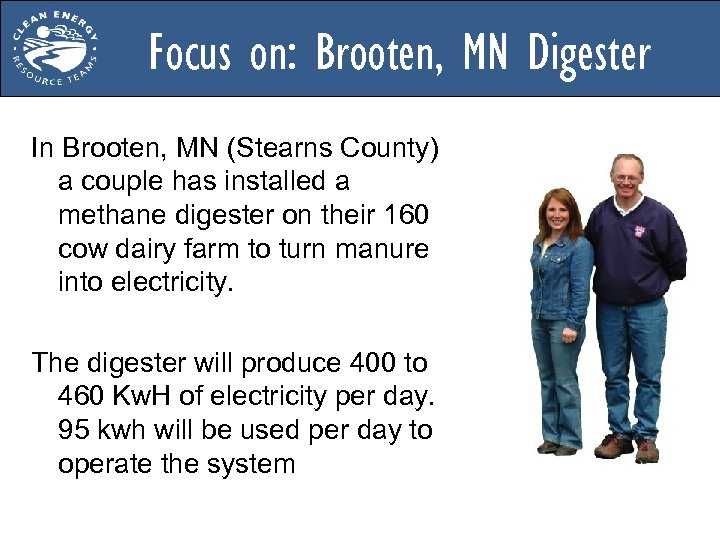
Focus on: Brooten, MN Digester In Brooten, MN (Stearns County) a couple has installed a methane digester on their 160 cow dairy farm to turn manure into electricity. The digester will produce 400 to 460 Kw. H of electricity per day. 95 kwh will be used per day to operate the system
U of M Morris Biomass Gasifier • The plant is used to explore the gasification technology in converting plant-based fuel stocks into energy in the form of synthetic gas that is intended to replace the use of fossil fuels such as natural gas. • http: //renewables. morris. umn. edu/biomass/
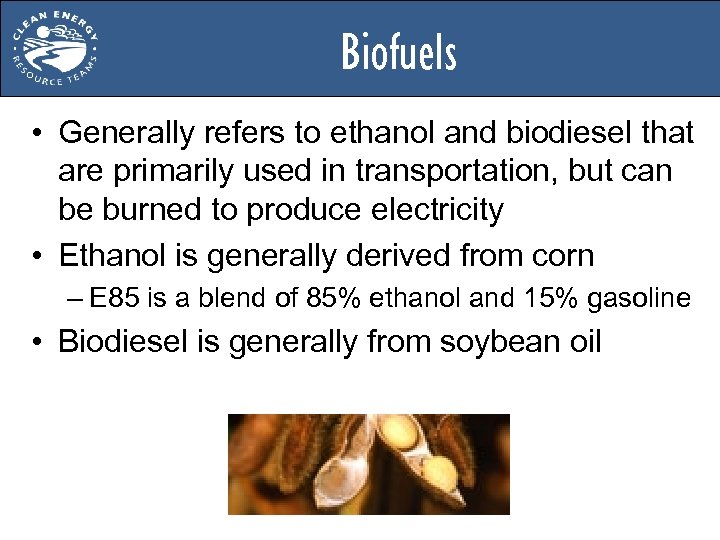
Biofuels • Generally refers to ethanol and biodiesel that are primarily used in transportation, but can be burned to produce electricity • Ethanol is generally derived from corn – E 85 is a blend of 85% ethanol and 15% gasoline • Biodiesel is generally from soybean oil
Biofuel Stations in WC MN • http: //www. cleanairchoice. org/E 85 In. County. asp? St ate=MN • Swift: 4 • Grant: 3 • Chippewa: 4 • Douglas: 3 • Lac Qui Parle: 2 • Traverse: 2 • Yellow Medicine: 4 • Big Stone: 2 • Renville: 9 • Stevens: 5 • Mc. Leod: 3 • Pope: 2 • Sibley: 3 • Stearns: 16 • Nicollet: 3 • Meeker: 4 • Kandiohi: 6
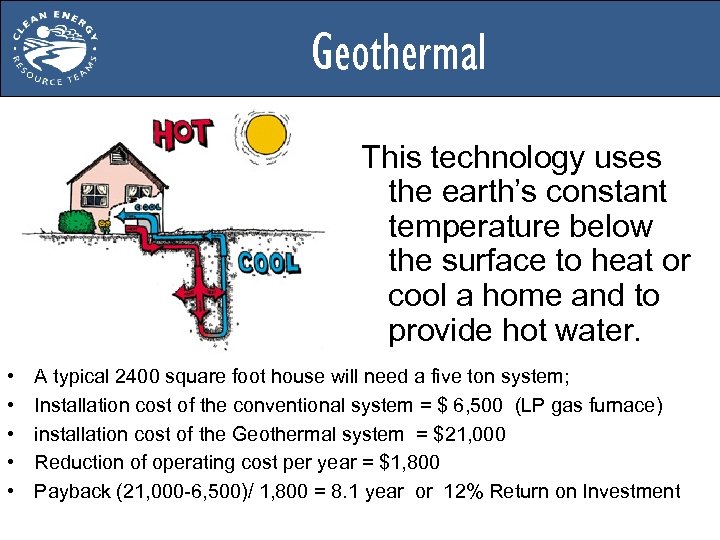
Geothermal This technology uses the earth’s constant temperature below the surface to heat or cool a home and to provide hot water. • • • A typical 2400 square foot house will need a five ton system; Installation cost of the conventional system = $ 6, 500 (LP gas furnace) installation cost of the Geothermal system = $21, 000 Reduction of operating cost per year = $1, 800 Payback (21, 000 -6, 500)/ 1, 800 = 8. 1 year or 12% Return on Investment

Focus on: ECONAR Heat Pumps • Located in Appleton and Elk River, MN • Manufacture ground-source heat pumps designed for MN’s cold weather climate. • ECONAR Geothermal Heat Pumps may qualify for a Federal Energy Tax Credit of up to $300.
Renewable Energy Resources • www. cleanenergyresourceteams. org – CERTs • www. commerce. state. mn. us – MN Energy Office • www. mnrenewables. org - Minnesota Renewable Energy Society (MRES) • www. fresh-energy. org – Fresh Energy • www. windustry. org – Windustry
Renewable Energy Resources • www. dsireusa. org – Database of State Incentives for Renewables and Efficiency • www. eere. energy. gov – Office of Energy Efficiency and Renewable Energy (DOE) • www. nrel. gov – National Renewable Energy Laboratory • www. eere. energy. gov/consumerinfo/tech_re ports. html
Renewable Energy Resources • www. focusonenergy. com • www. awea. org – American Wind Energy Association • www. ucsusa. org - Union of Concerned Scientists • http: //analysis. nrel. gov/repis/online_reports. asp - REPi. S Online • http: //www. state. mn. us/mn/external. Docs/Comme rce/Can_I_have_a_wind_turbine_100807042643 _Wind. FAQ. pdf Department of Commerce: Can I Have a Wind Turbine
For More Info on WC CERT Visit our Web site at www. Clean. Energy Resource. Teams. org www. Clean. Energy. Resource. Teams. org
Скачать презентацию Renewable Energy Basics West Central CERT Our
196eb45d2362f6270d4b8c427b1e8816.ppt