 Скачать презентацию Renewable Energy as a Mechanism for Reducing Pollution
56513643db326bfb19ff2ed8dd6f32fc.ppt
- Количество слайдов: 17



Renewable Energy as a Mechanism for Reducing Pollution North Carolina DENR/DAQ Mercury/CO 2 Workshop Raleigh. North Carolina April 20, 2004 Harnessing the power of voluntary markets… to improve the environment Alden Hathaway Environmental Resources Trust, Inc. Copyright Environmental Resources Trust, Inc. (ERT), 2003. Request to reproduce all or part of this material should be made to ERT.
OVERVIEW n n n n Clean Air Act (CAA) Framework CAA as Drivers for Wind MWCOG Case Study Chicago Eco. Power® Report Potential Market Opportunities Necessary Policy Changes Related Marketing Innovations
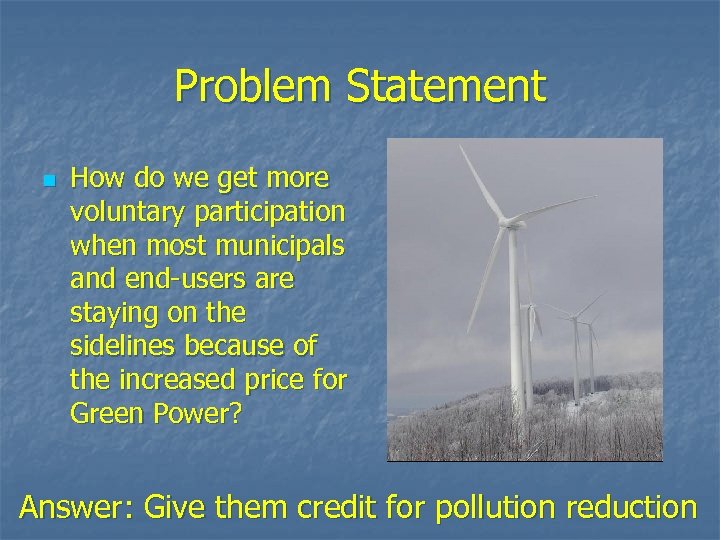
Problem Statement n How do we get more voluntary participation when most municipals and end-users are staying on the sidelines because of the increased price for Green Power? Answer: Give them credit for pollution reduction
CLEAN AIR ACT FRAMEWORK n Act drafted without renewable energy in mind n CAA requires regional air quality plans (State Implementation Plans or SIPs) n To date, EPA has never approved renewable energy as an air pollution control measure under a SIP n “Window of opportunity” created - new quantification methods, 8 -hour ozone standard, and regional haze regulations
CAA POLICIES AS MARKET DRIVERS n n State/local governments choose from wide range of air pollution control measures Emission reductions from traditional control measures largely exhausted in dirty air areas States and municipalities interested in air quality benefits of renewable energy (particularly wind) Lowering NOx emissions results in reduced ozone transport and less regional haze
CAA POLICIES AS MARKET DRIVERS n State and local governments are a key market for renewable energy, for example consider wind; n Increasing market demand is the “linchpin” for wind power development n Wind plants are financed based on the future revenue stream from wind purchases n Municipalities and states often serve as important “anchor” customers (e. g. , City of Chicago)
MWCOG CASE STUDY n n Metropolitan Washington (MW) area (MD-DC -VA) designated as “severe” ozone nonattainment area under 1 -hour standard Met. Wash. Council of Governments (COG) submitted revised regional air quality plan (SIP) to EPA Region III in March 2004 for 60 day review
MWCOG CASE STUDY n n Case demonstrates market potential of SIP emissions reduction credit under the CAA Mont. Co. seeking to purchase 5% of its energy from wind Energy conservation planned to offset “green power” premium Co. issued request for proposals in late Feb. 2004
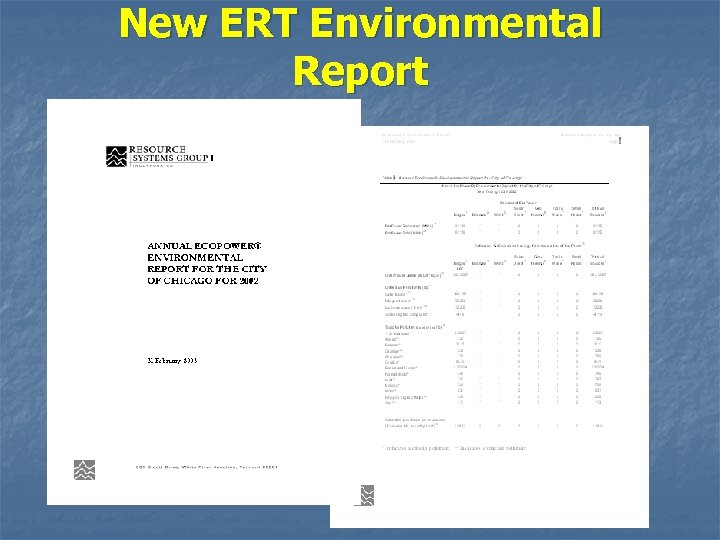
New ERT Environmental Report Prepared under a Grant from the Great Lakes Protection Fund
Methodology n n Methodology Breakthrough in Chicago Report Confidentiality agreements with utilities provide access to previously unavailable data to generate emissions avoidance report
Results of Chicago Report n n n Analysis proves that renewable energy backs down fossil fuel plants, coal, oil, gas rather than nuclear or hydro; Renewable energy backs down fossil fuel plants because of zero or near zero marginal operating costs; Analysis utilizes actual power plant dispatch ranking data – specific plants dispatched in order of economic cost; Analysis compares actual power plant dispatch ranking data and actual continuous emissions monitor data to verify emission and operational changes; Data based on continuous monitors are current vs. time lag (up to two years) with other methodologies; Data in Chicago shows 2300 lbs CO 2 per MWh vs. 815 lbs per MWh “System Mix” methodology
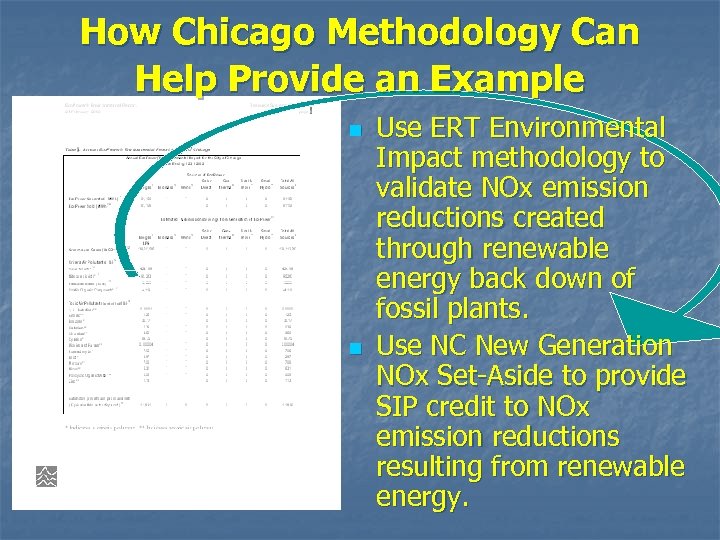
How Chicago Methodology Can Help Provide an Example n n Use ERT Environmental Impact methodology to validate NOx emission reductions created through renewable energy back down of fossil plants. Use NC New Generation NOx Set-Aside to provide SIP credit to NOx emission reductions resulting from renewable energy.
NECESSARY ACTION n n n MOU’s between DOE and EPA Regional Offices to support EERE Revision of CAA regulations and policy to place RE on level playing field; Comments on EPA’s proposed Interstate Air Quality Rule and planned supplemental rule EPA issuance of improved guidance and training for Regions, States, & local govrmt. Development of model documentation
POTENTIAL MARKET OPPORTUNITIES n n Regional air quality plans to meet 8 -hour ozone standard in Midwest and East n Marketing window of opportunity in next few years n Wind energy as important option n SIP plans due April 2007 Regional air quality plans to meet regional haze regulations in West
RELATED MARKETING INNOVATIONS n Promote increased cost-effectiveness of wind purchases through: n n Bundling with energy efficiency and innovative financing approaches Blending with landfill gas & other lower-priced renewable energy
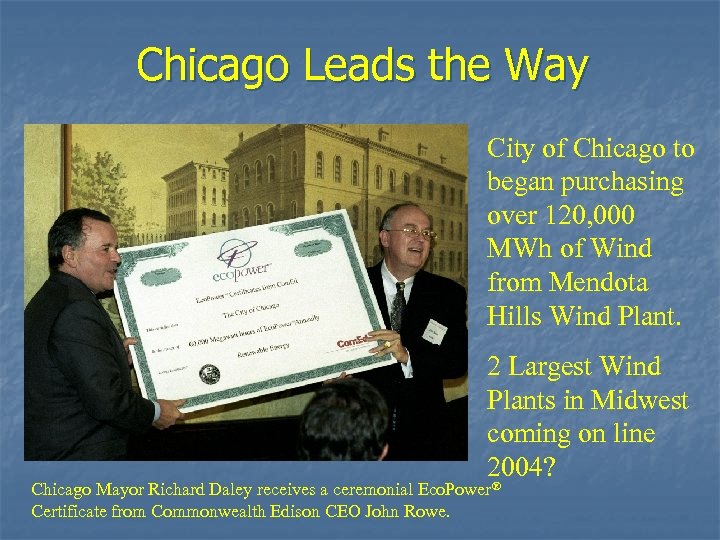
Chicago Leads the Way City of Chicago to began purchasing over 120, 000 MWh of Wind from Mendota Hills Wind Plant. 2 Largest Wind Plants in Midwest coming on line 2004? ® Chicago Mayor Richard Daley receives a ceremonial Eco. Power Certificate from Commonwealth Edison CEO John Rowe.
Questions? Debra Jacobson Lecturer in Energy Law, GWU Law School 703 -356 -7448 Alden Hathaway Director Green Power Programs ERT, Inc. 202 -785 -8577 Copyright Environmental Resources Trust, Inc. (ERT), 2001. Request to reproduce all or part of this material should be made to ERT.
Скачать презентацию Renewable Energy as a Mechanism for Reducing Pollution
56513643db326bfb19ff2ed8dd6f32fc.ppt