


 Скачать презентацию Rendering Equation Various Solutions cis 782 Advanced Computer
d78caaa90ddcb5428303a40bd22ace3c.ppt
- Количество слайдов: 63
 Rendering Equation Various Solutions cis 782 Advanced Computer Graphics Raghu Machiraju © Machiraju/Möller
 Reading • Chapter 16. 5 of “Physically Based Rendering” by Pharr&Humphreys • Chapter 19, 20 in “Principles of Digital Image Synthesis, ” by A. Glassner • “Realistic Image Synthesis Using Photon Mapping, ” by H. W. Jensen © Machiraju/Möller
 Biased vs. Unbiased Algorithm • unbiased algorithms: – Noise very apparent OR we need tons of rays – Variance (error) decreases in a predictable way • Biased approaches – Irradiance caching + photon mapping – Smooth results – Cheap (only little more computing time than Whitted ray-tracing) © Machiraju/Möller
 Biased vs. Unbiased Algorithm • If we find little noise in the image: – For unbiased methods • can be fairly sure that image is correct – For biased methods • don’t have this assurance • Increasing the sampling rate might not get rid of existing artifacts © Machiraju/Möller
 Irradiance Caching A. How to come up with such a (sparse) set of samples? B. How to store these samples? C. How to interpolate from neighbors? © Machiraju/Möller
 Images from “Radiance” © Machiraju/Möller
 Caching Techniques • Irradiance caching: – Compute irradiance at selected points and interpolate. • Photon mapping: – Trace “photons” from the lights and store them in a photon map, that can be used during rendering. © Machiraju/Möller
 Photon Mapping • Basic idea : Density estimation with a discrete density of photons • 2 -step algorithm – Photon trace: • • Simulates the transport of individual photons Photons emitted from source Photons deposited on surfaces Photons reflected from surfaces to other surfaces – Rendering • Photons collected by rendering © Machiraju/Möller
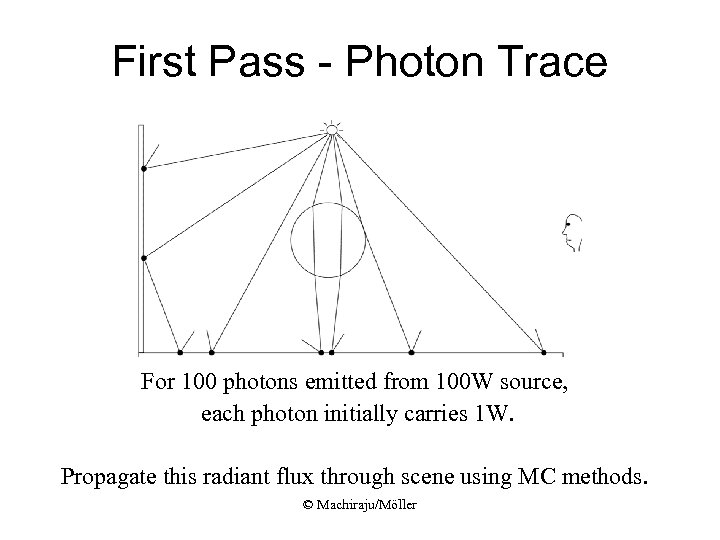 First Pass - Photon Trace For 100 photons emitted from 100 W source, each photon initially carries 1 W. Propagate this radiant flux through scene using MC methods. © Machiraju/Möller
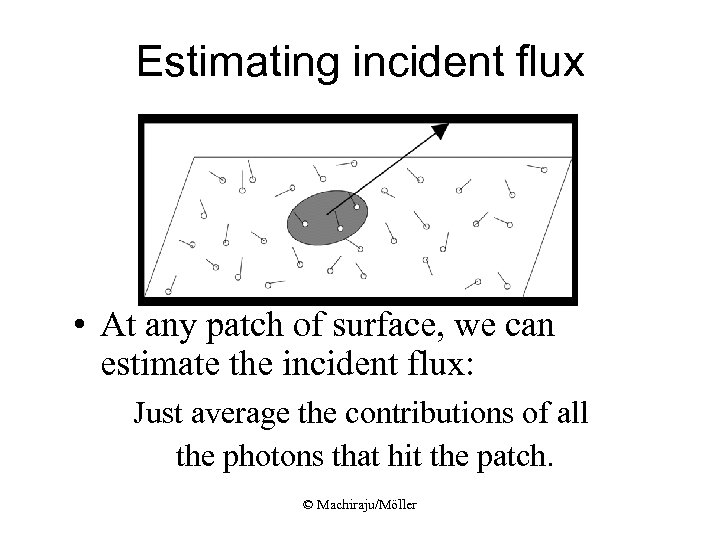 Estimating incident flux • At any patch of surface, we can estimate the incident flux: Just average the contributions of all the photons that hit the patch. © Machiraju/Möller
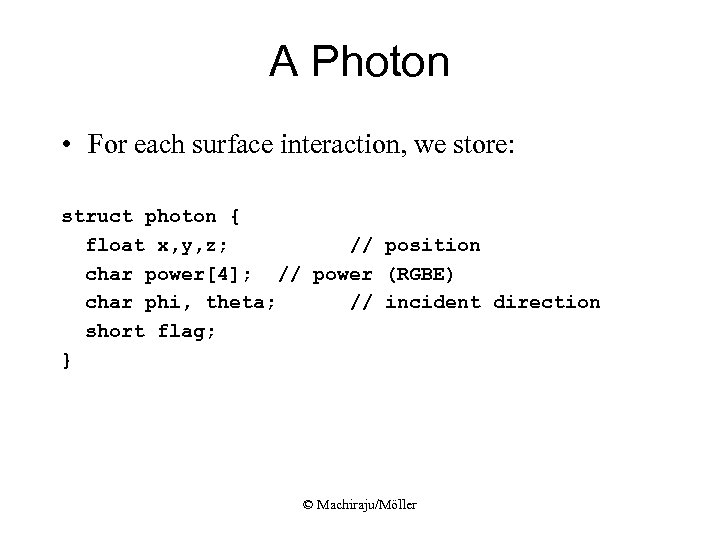 A Photon • For each surface interaction, we store: struct photon { float x, y, z; // position char power[4]; // power (RGBE) char phi, theta; // incident direction short flag; } © Machiraju/Möller
 Photon Storage • Store this information about surface interactions in photon map (kd-tree) • Photon storage is decoupled from geometry © Machiraju/Möller
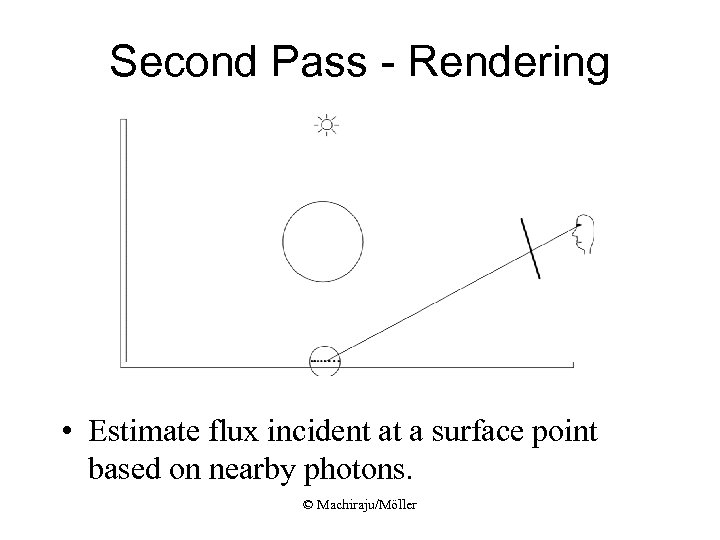 Second Pass - Rendering • Estimate flux incident at a surface point based on nearby photons. © Machiraju/Möller
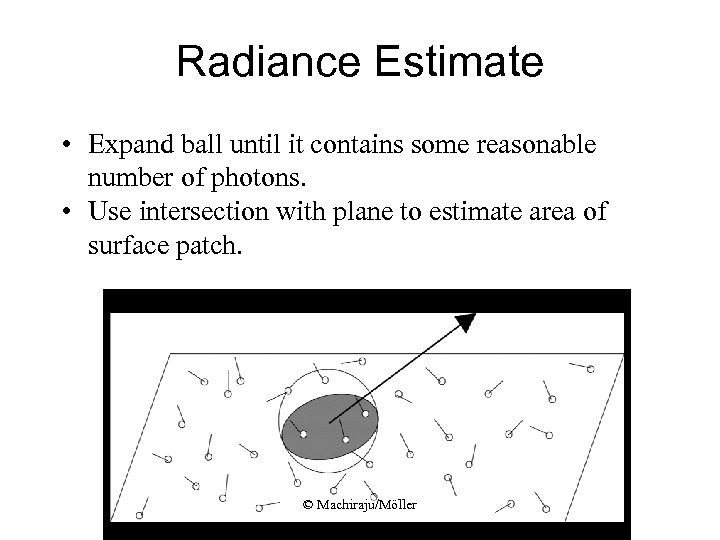 Radiance Estimate • Expand ball until it contains some reasonable number of photons. • Use intersection with plane to estimate area of surface patch. © Machiraju/Möller
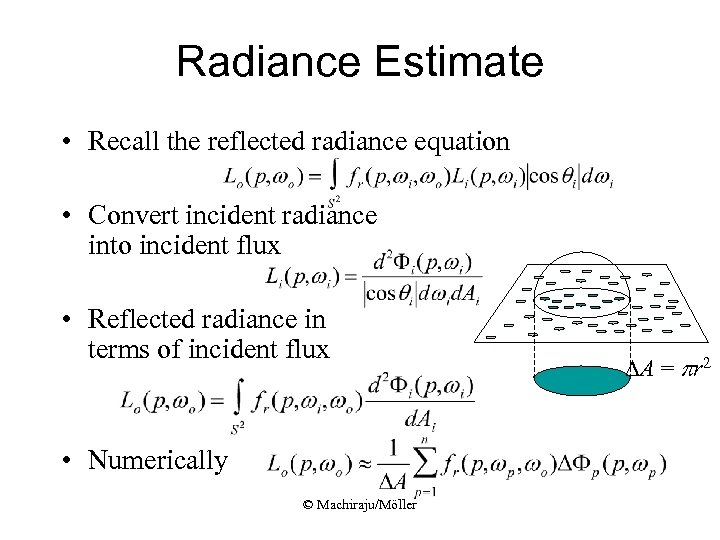 Radiance Estimate • Recall the reflected radiance equation • Convert incident radiance into incident flux • Reflected radiance in terms of incident flux • Numerically © Machiraju/Möller DA = pr 2
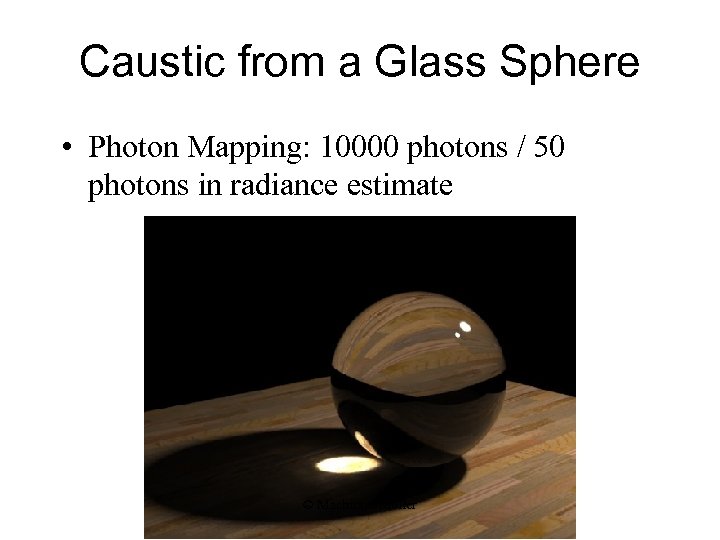 Caustic from a Glass Sphere • Photon Mapping: 10000 photons / 50 photons in radiance estimate © Machiraju/Möller
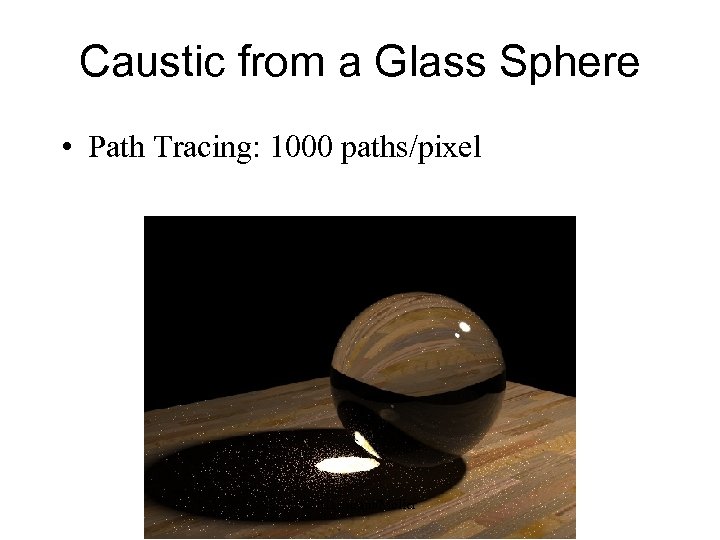 Caustic from a Glass Sphere • Path Tracing: 1000 paths/pixel © Machiraju/Möller
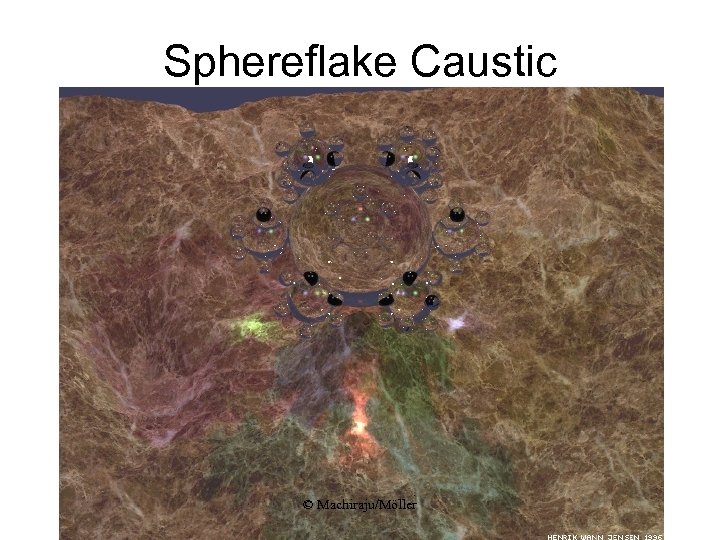 Sphereflake Caustic © Machiraju/Möller
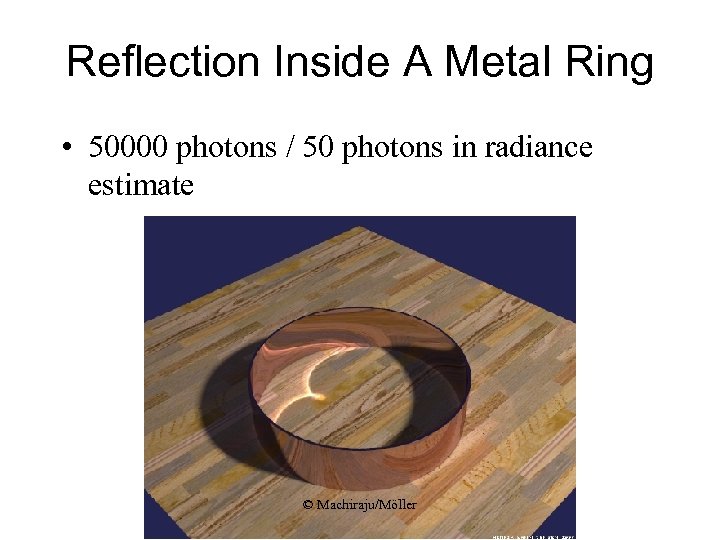 Reflection Inside A Metal Ring • 50000 photons / 50 photons in radiance estimate © Machiraju/Möller
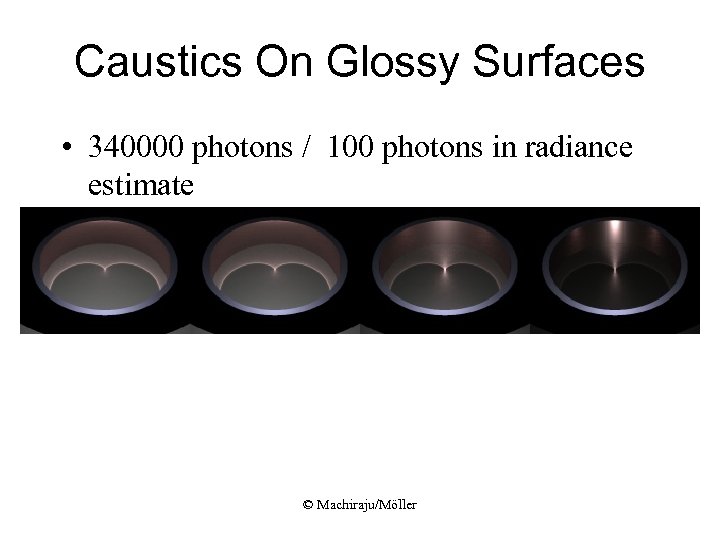 Caustics On Glossy Surfaces • 340000 photons / 100 photons in radiance estimate © Machiraju/Möller
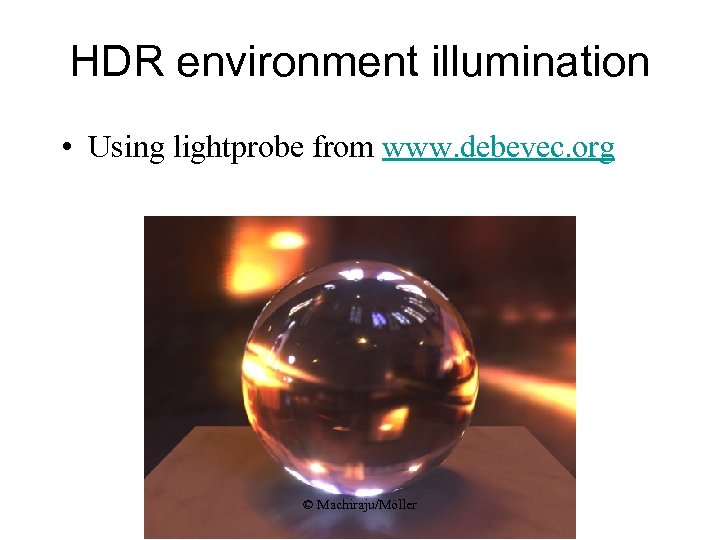 HDR environment illumination • Using lightprobe from www. debevec. org © Machiraju/Möller
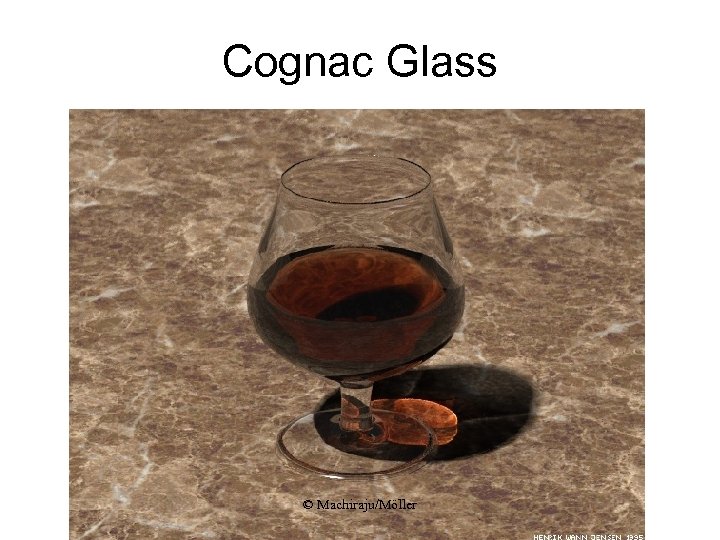 Cognac Glass © Machiraju/Möller
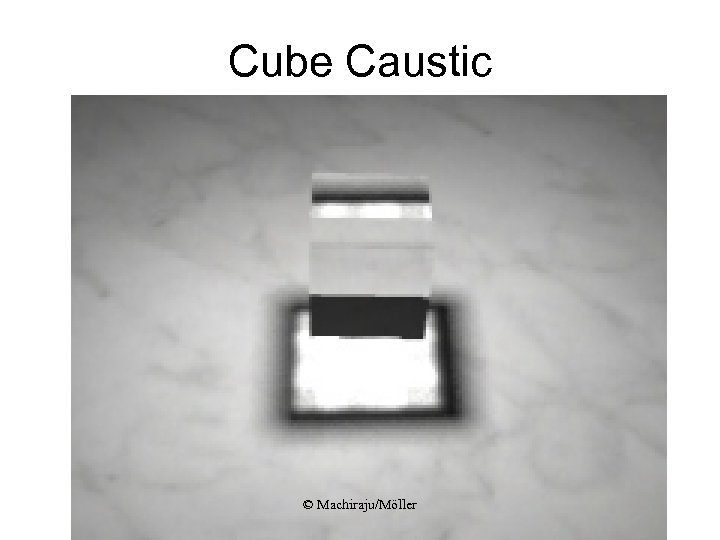 Cube Caustic © Machiraju/Möller
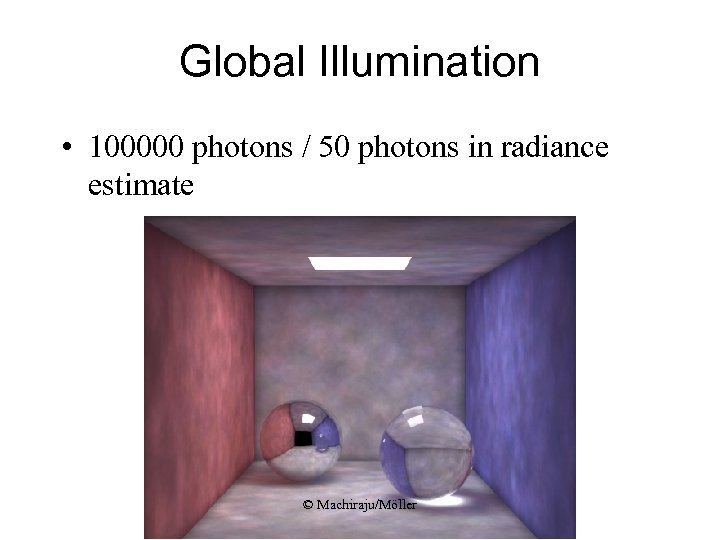 Global Illumination • 100000 photons / 50 photons in radiance estimate © Machiraju/Möller
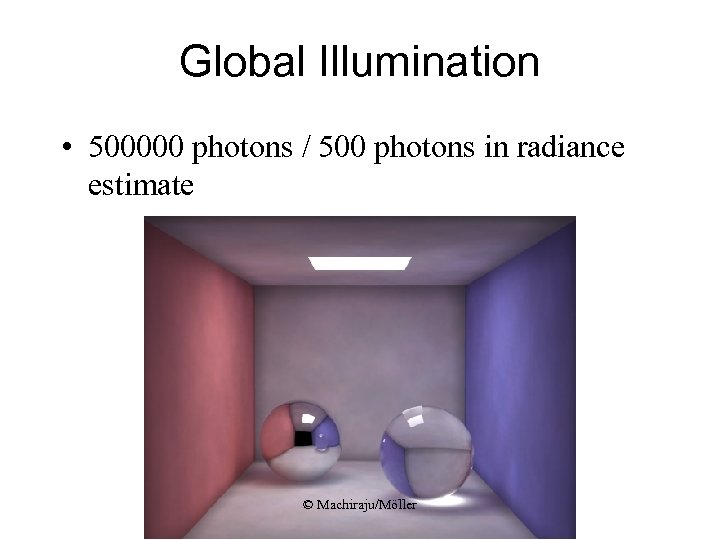 Global Illumination • 500000 photons / 500 photons in radiance estimate © Machiraju/Möller
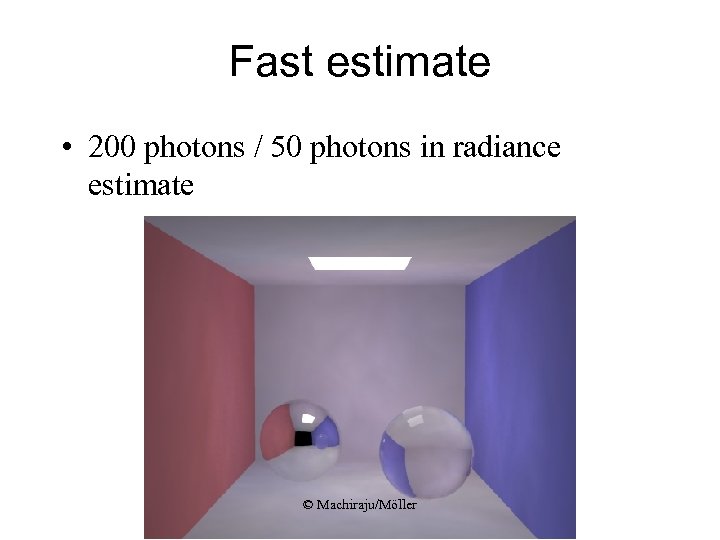 Fast estimate • 200 photons / 50 photons in radiance estimate © Machiraju/Möller
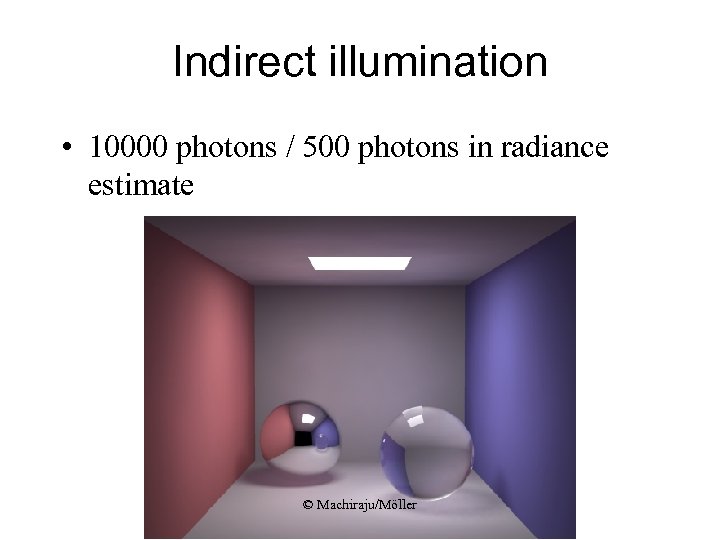 Indirect illumination • 10000 photons / 500 photons in radiance estimate © Machiraju/Möller
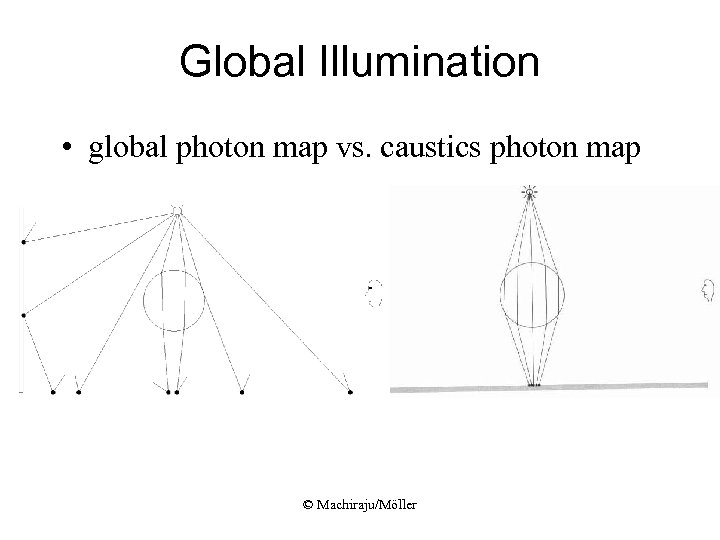 Global Illumination • global photon map vs. caustics photon map © Machiraju/Möller
 Photon tracing • Photon emission • Photon scattering • Photon storing © Machiraju/Möller
 Photon emission • • Given F Watt lightbulb. Emit N photons. Each photon has the power F/N Watt Photon power depends on the number of emitted photons. Not on the number of photons in the photon map. © Machiraju/Möller
 What is a photon? • Flux (power) - not radiance! • Collection of physical photons – A fraction of the light source power – Several wavelengths combined into one entity © Machiraju/Möller
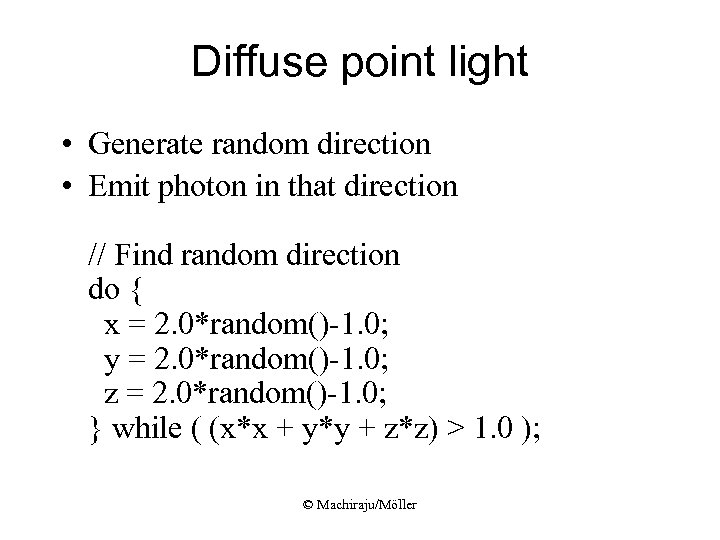 Diffuse point light • Generate random direction • Emit photon in that direction // Find random direction do { x = 2. 0*random()-1. 0; y = 2. 0*random()-1. 0; z = 2. 0*random()-1. 0; } while ( (x*x + y*y + z*z) > 1. 0 ); © Machiraju/Möller
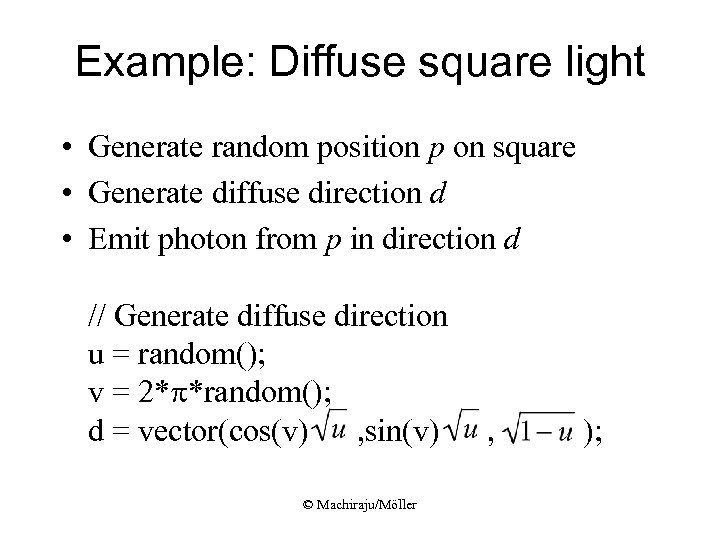 Example: Diffuse square light • Generate random position p on square • Generate diffuse direction d • Emit photon from p in direction d // Generate diffuse direction u = random(); v = 2*p*random(); d = vector(cos(v) , sin(v) © Machiraju/Möller , );
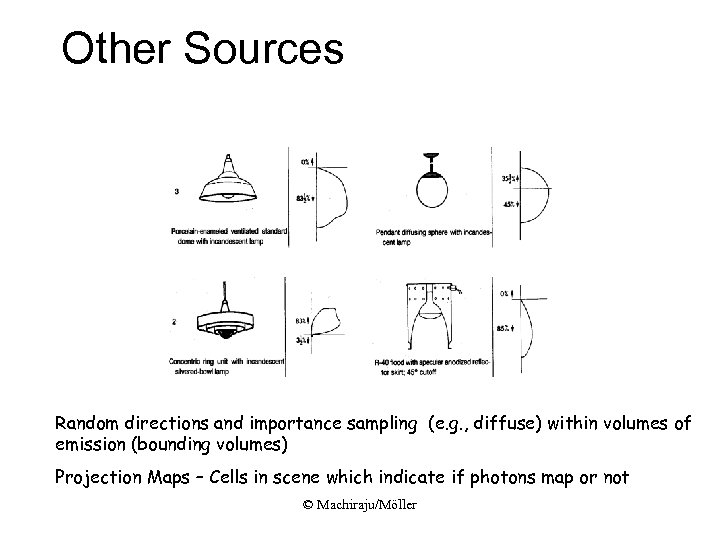 Other Sources Random directions and importance sampling (e. g. , diffuse) within volumes of emission (bounding volumes) Projection Maps – Cells in scene which indicate if photons map or not © Machiraju/Möller
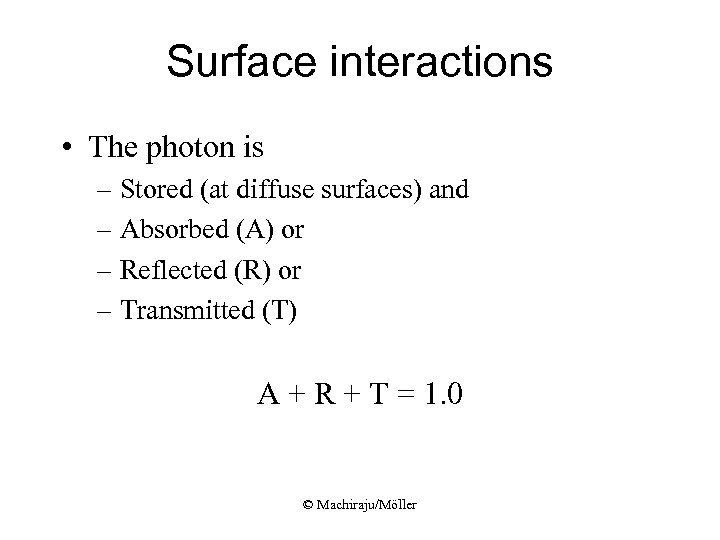 Surface interactions • The photon is – Stored (at diffuse surfaces) and – Absorbed (A) or – Reflected (R) or – Transmitted (T) A + R + T = 1. 0 © Machiraju/Möller
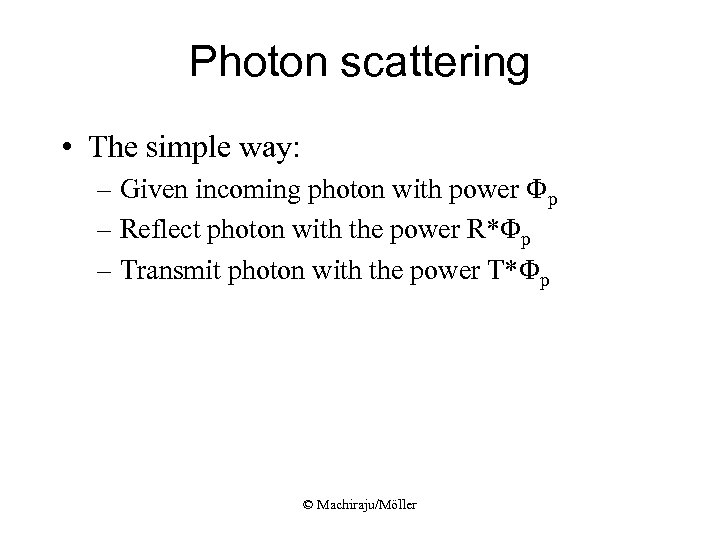 Photon scattering • The simple way: – Given incoming photon with power Fp – Reflect photon with the power R*Fp – Transmit photon with the power T*Fp © Machiraju/Möller
 Photon scattering • The simple way: – Given incoming photon with power Fp – Reflect photon with the power R*Fp – Transmit photon with the power T*Fp • Risk: Too many low-powered photons wasteful! • When do we stop (systematic bias)? • Photons with similar power is a good thing. © Machiraju/Möller
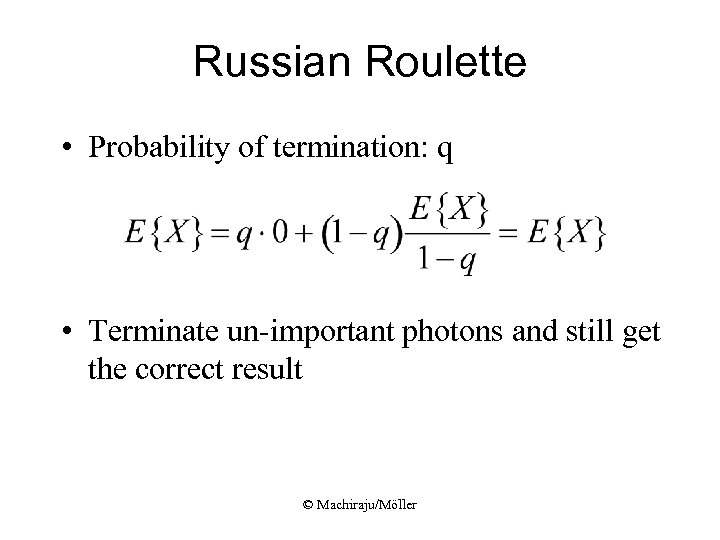 Russian Roulette • Probability of termination: q • Terminate un-important photons and still get the correct result © Machiraju/Möller
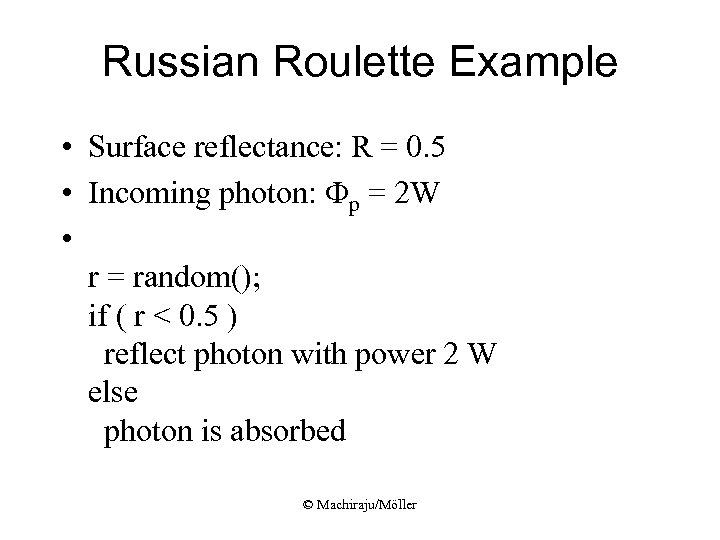 Russian Roulette Example • Surface reflectance: R = 0. 5 • Incoming photon: Fp = 2 W • r = random(); if ( r < 0. 5 ) reflect photon with power 2 W else photon is absorbed © Machiraju/Möller
 Russian Roulette Intuition • • Surface reflectance: R = 0. 5 200 incoming photons with power: Fp= 2 W Reflect 100 photons with power 2 W instead of 200 photons with power 1 W © Machiraju/Möller
 Russian Roulette • Very important! • Use to eliminate un-important photons • Gives photons with similar power © Machiraju/Möller
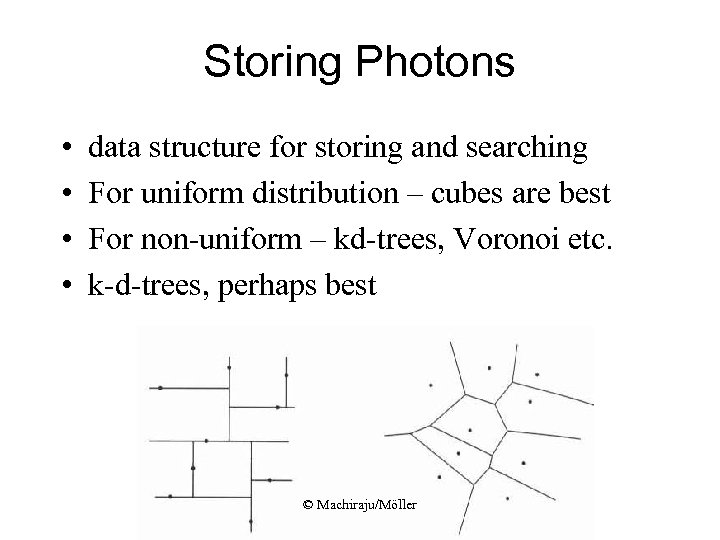 Storing Photons • • data structure for storing and searching For uniform distribution – cubes are best For non-uniform – kd-trees, Voronoi etc. k-d-trees, perhaps best © Machiraju/Möller
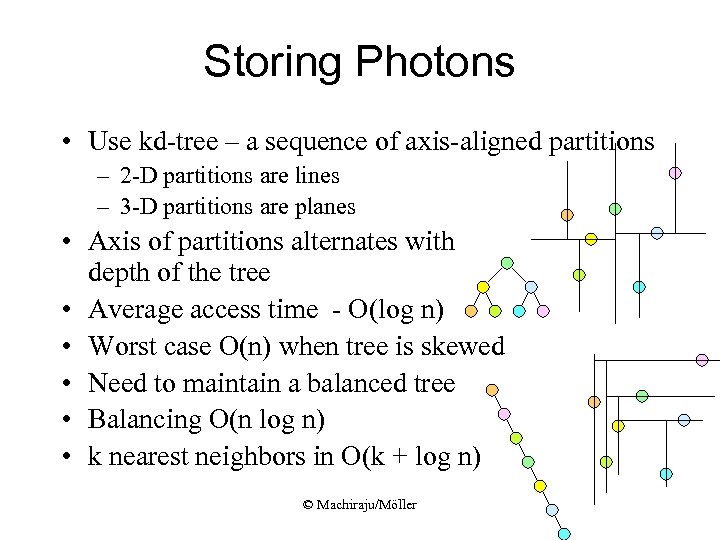 Storing Photons • Use kd-tree – a sequence of axis-aligned partitions – 2 -D partitions are lines – 3 -D partitions are planes • Axis of partitions alternates with depth of the tree • Average access time - O(log n) • Worst case O(n) when tree is skewed • Need to maintain a balanced tree • Balancing O(n log n) • k nearest neighbors in O(k + log n) © Machiraju/Möller
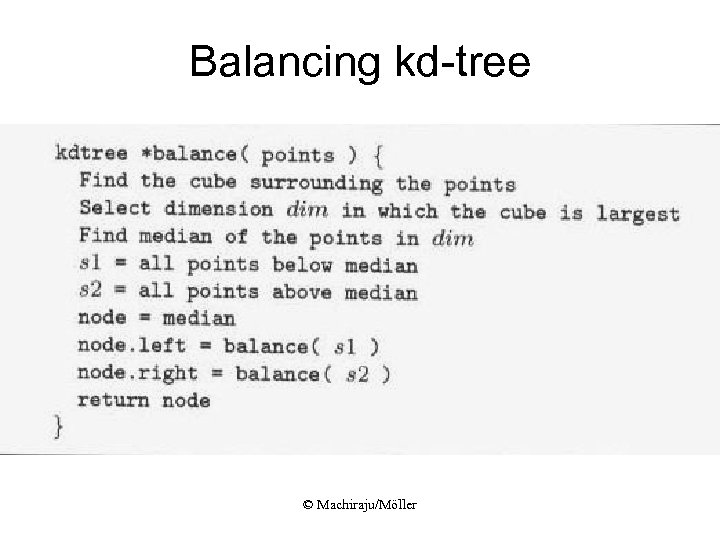 Balancing kd-tree © Machiraju/Möller
 Multiple Photon Maps • Interpolation from the map causes blurriness • For specular interactions Whitted Ray-Tracing • Otherwise divide photon map into – direct light map Li, d – Indirect light map Li, i – Caustic map Li, c © Machiraju/Möller
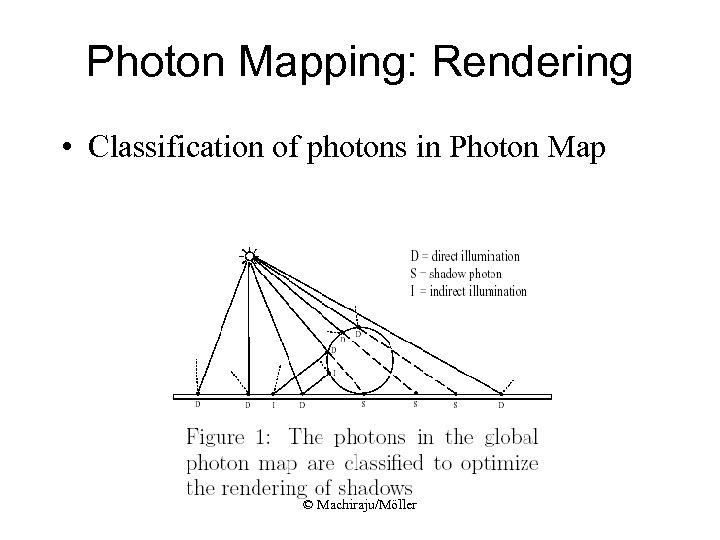 Photon Mapping: Rendering • Classification of photons in Photon Map © Machiraju/Möller
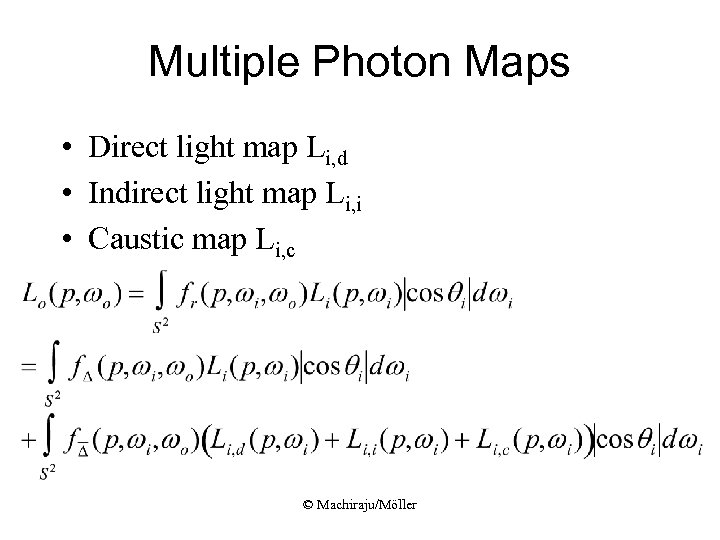 Multiple Photon Maps • Direct light map Li, d • Indirect light map Li, i • Caustic map Li, c © Machiraju/Möller
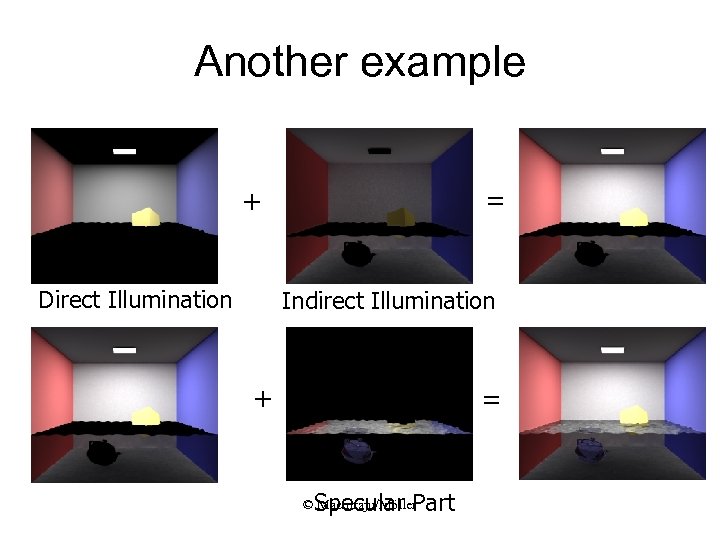 Another example = + Direct Illumination Indirect Illumination + = Specular Part © Machiraju/Möller
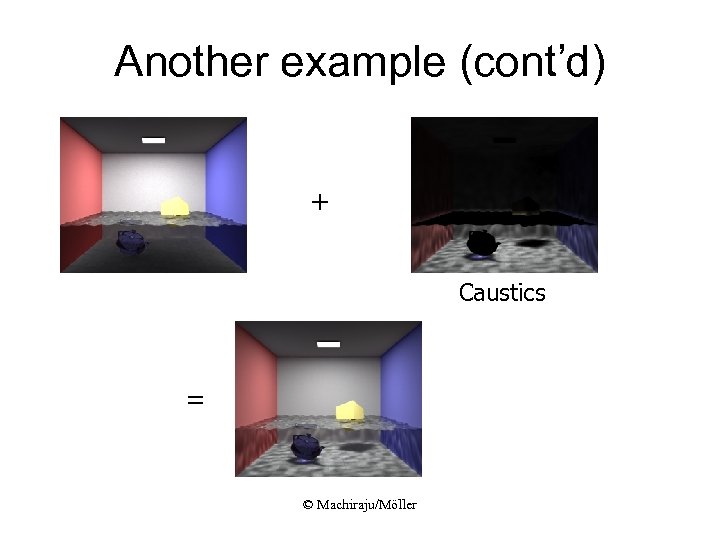 Another example (cont’d) + Caustics = © Machiraju/Möller
 Features • Photon tracing is unbiased – Radiance estimate is biased but consistent – The reconstruction error is local • Illumination representation is decoupled from the geometry © Machiraju/Möller
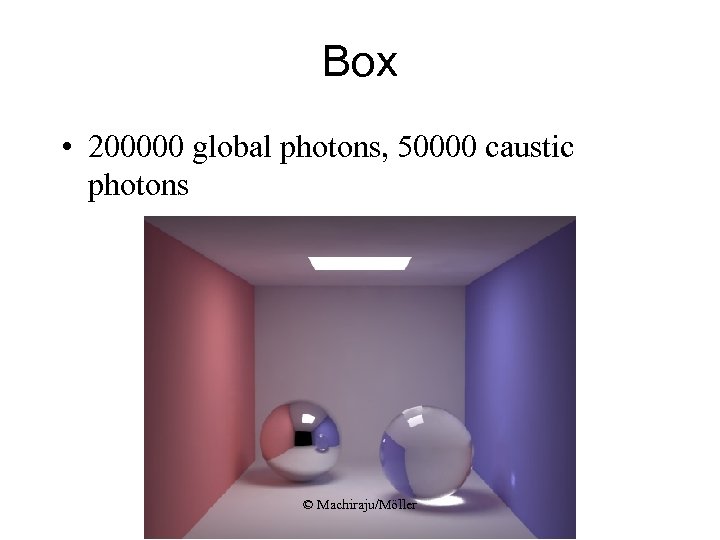 Box • 200000 global photons, 50000 caustic photons © Machiraju/Möller
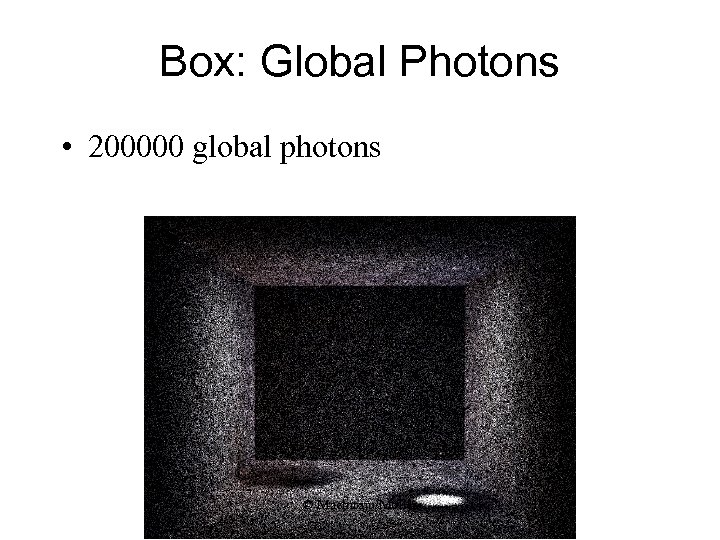 Box: Global Photons • 200000 global photons © Machiraju/Möller
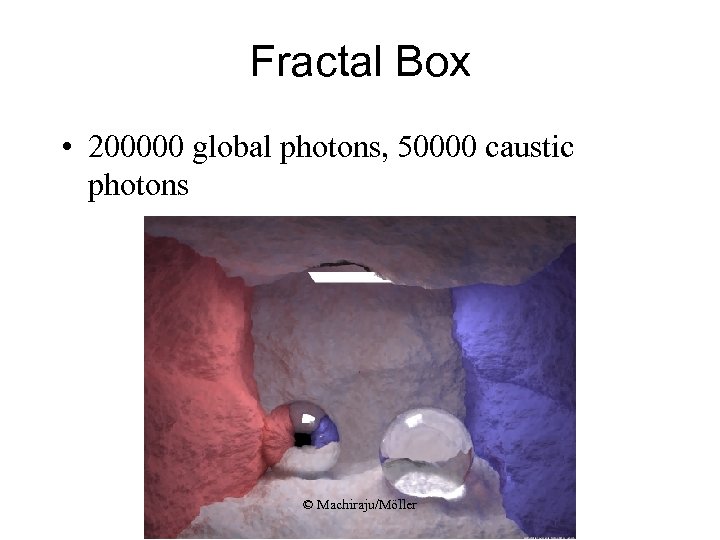 Fractal Box • 200000 global photons, 50000 caustic photons © Machiraju/Möller
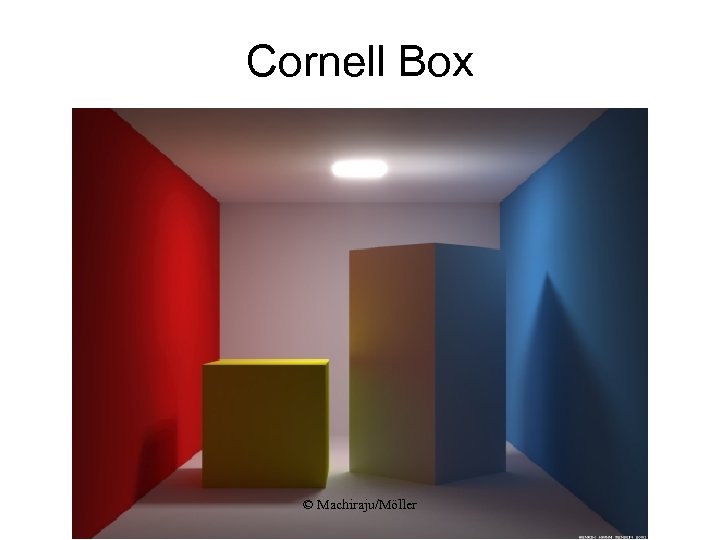 Cornell Box © Machiraju/Möller
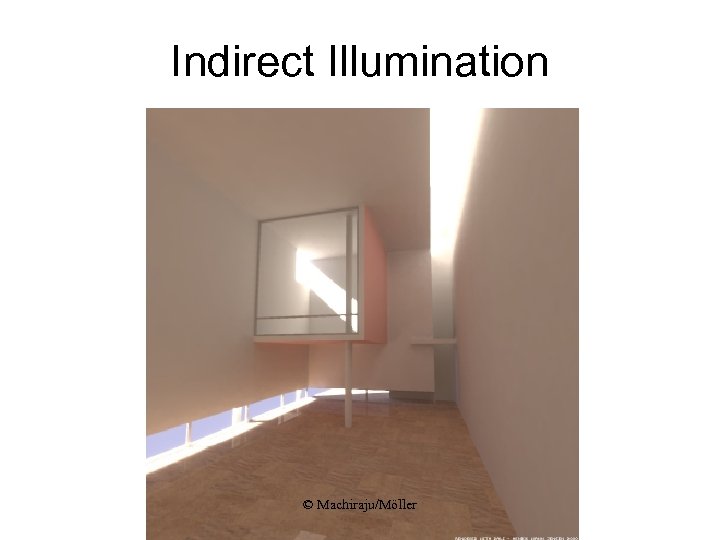 Indirect Illumination © Machiraju/Möller
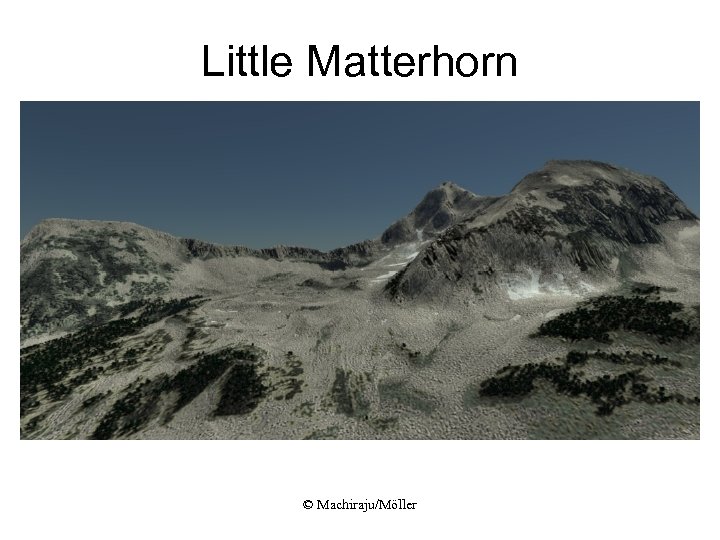 Little Matterhorn © Machiraju/Möller
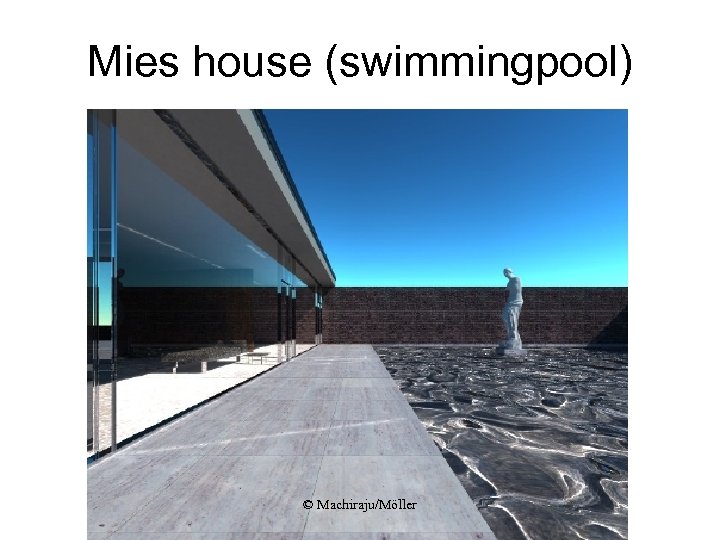 Mies house (swimmingpool) © Machiraju/Möller
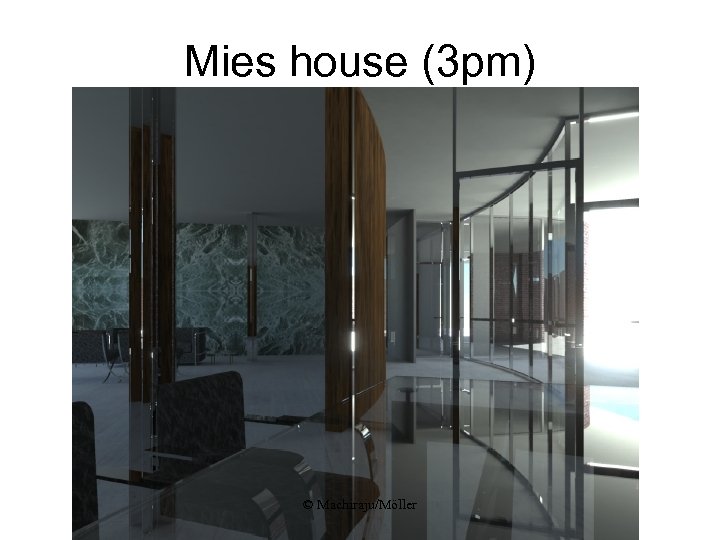 Mies house (3 pm) © Machiraju/Möller
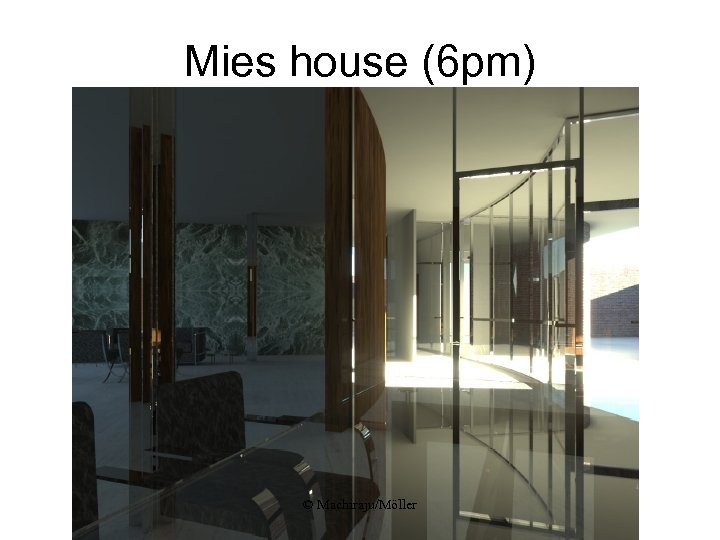 Mies house (6 pm) © Machiraju/Möller
 Final Gathering © Machiraju/Möller
 Recap • Decouple representation of illumination from geometry • Photon Map – – Illumination as points in a global data structure – Cache of light paths. • Estimate illumination based on density – Error is of low frequency – Not high frequency noise • Unbiased method! Average expected value is not correct ! • Consistent – technique will converge as more points/photons are added • Photon Mapping, Photon Tracing, Photon Map © Machiraju/Möller
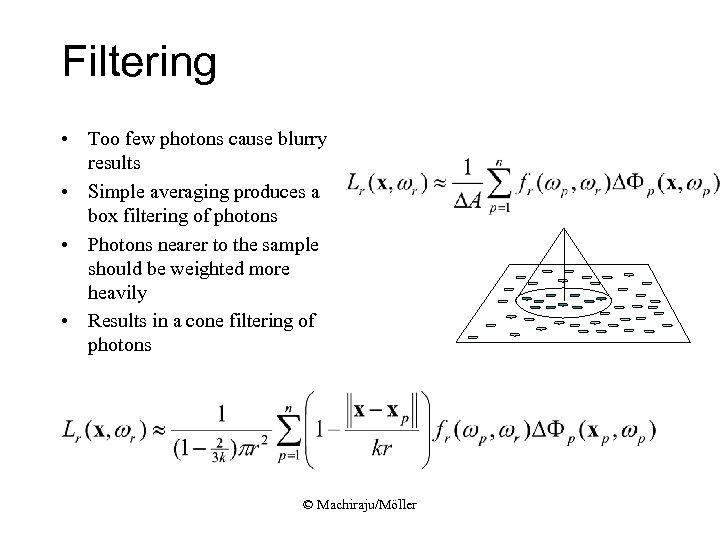 Filtering • Too few photons cause blurry results • Simple averaging produces a box filtering of photons • Photons nearer to the sample should be weighted more heavily • Results in a cone filtering of photons © Machiraju/Möller
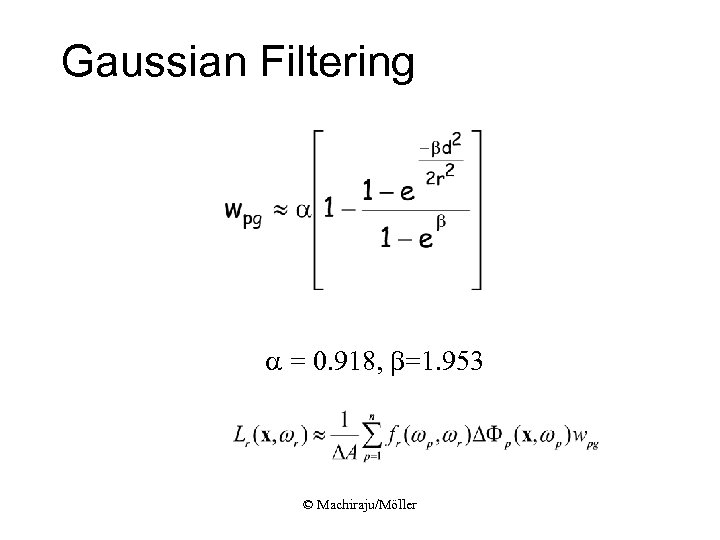 Gaussian Filtering a = 0. 918, b=1. 953 © Machiraju/Möller