


 Скачать презентацию Renal function and clinical outcomes of patients undergoing
d3b0535721cf8cc72dcb142fe81e880e.ppt
- Количество слайдов: 21
 Renal function and clinical outcomes of patients undergoing ICD and CRTD implantation. Data from the Israeli ICD Registry Alon Eisen, Mahmoud Souleiman, Boris Strasberg, Shlomit Ben-Zvi, Ilan Goldenberg, Natalie Gevrielov Yusim, Ron Sela, Shimon Rosenheck, Nahum A. Freedberg, Michael Geist, Michael Glikson, Moti Haim On behalf of the Israeli working group of pacing and electrophysiology of the Israel Heart Society Rabin Medical Center, Petah Tikva, Israel Tel Aviv university, Tel Aviv, Israel
 Disclosures - None
 Background Heart failure (HF) and chronic kidney disease (CKD) are associated with increased morbidity and mortality and the combination of both, augment the risk substanially. n Implantable cardioverter defibrillators (ICDs) and cardiac resynchronization therapy (CRT) reduce mortality in patients with HF and left ventricular dysfunction. n
 Background Most studies that demonstrated the benefits of these device therapies in HF have limited data regarding patients with CKD. n Due to sparse data, the impact of CKD on clinical outcomes in patients undergoing ICD and CRT implantation is controversial, as is the influence of device therapy on renal function. n
 Aim n To examine the association between renal function and clinical outcomes in patients undergoing ICD and CRTD implantation
 Methods n n n Data were collected from the Israeli ICD registry. July 2010 - October 2012 in 21 implanting centers in Israel. Glomerular filtration rate (e. GFR) was assessed using the MDRD formula. Baseline renal function was defined as the e. GFR during the initial hospitalization of device implantation. Mean follow up- 353 days.
 Outcomes n n 1) 2) 3) 4) Primary outcome: all cause mortality. Secondary outcomes: Combined end point of death or ventricular arrhythmias. Combined end point of death or hospitalization due to HF. Appropriate ICD therapy of ventricular tachyarrhythmia. Inappropriate ICD shocks.
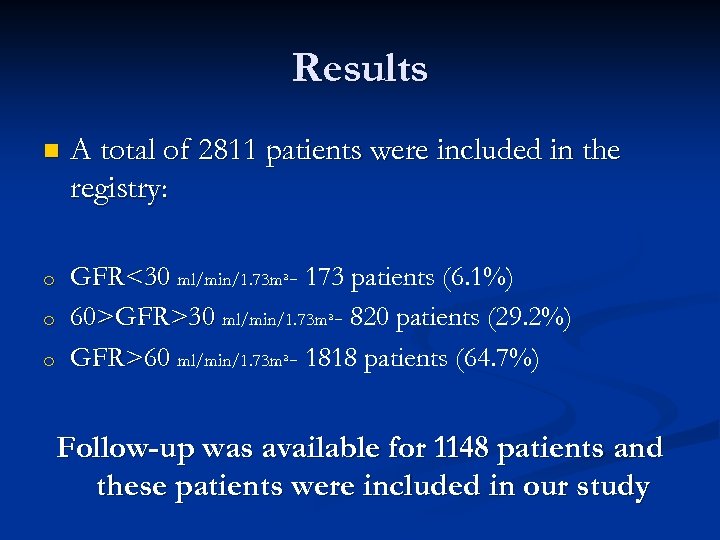 Results n A total of 2811 patients were included in the registry: o GFR<30 ml/min/1. 73 m²- 173 patients (6. 1%) 60>GFR>30 ml/min/1. 73 m²- 820 patients (29. 2%) GFR>60 ml/min/1. 73 m²- 1818 patients (64. 7%) o o Follow-up was available for 1148 patients and these patients were included in our study
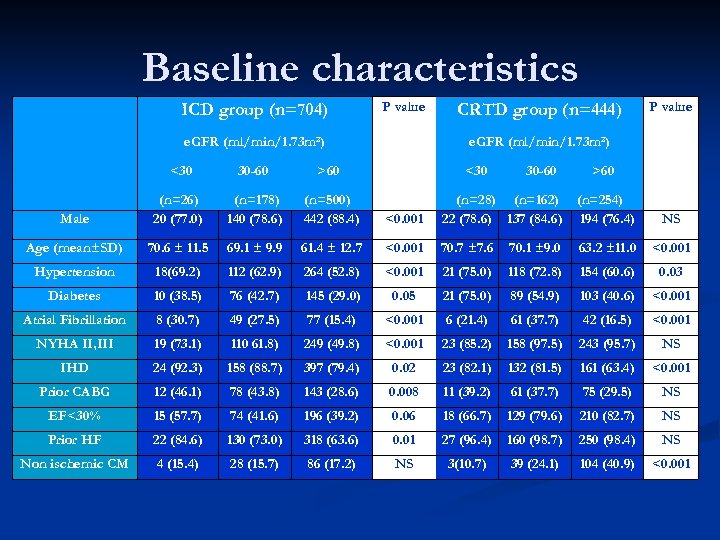 Baseline characteristics ICD group (n=704) P value e. GFR (ml/min/1. 73 m²) <30 30 -60 Male (n=178) 140 (78. 6) (n=500) 442 (88. 4) Age (mean±SD) 70. 6 ± 11. 5 69. 1 ± 9. 9 Hypertension 18(69. 2) Diabetes P value e. GFR (ml/min/1. 73 m²) >60 (n=26) 20 (77. 0) CRTD group (n=444) <30 30 -60 >60 <0. 001 (n=28) (n=162) 22 (78. 6) 137 (84. 6) (n=254) 194 (76. 4) NS 61. 4 ± 12. 7 <0. 001 70. 7 ± 7. 6 70. 1 ± 9. 0 63. 2 ± 11. 0 <0. 001 112 (62. 9) 264 (52. 8) <0. 001 21 (75. 0) 118 (72. 8) 154 (60. 6) 0. 03 10 (38. 5) 76 (42. 7) 145 (29. 0) 0. 05 21 (75. 0) 89 (54. 9) 103 (40. 6) <0. 001 Atrial Fibrillation 8 (30. 7) 49 (27. 5) 77 (15. 4) <0. 001 6 (21. 4) 61 (37. 7) 42 (16. 5) <0. 001 NYHA II, III 19 (73. 1) 110 61. 8) 249 (49. 8) <0. 001 23 (85. 2) 158 (97. 5) 243 (95. 7) NS IHD 24 (92. 3) 158 (88. 7) 397 (79. 4) 0. 02 23 (82. 1) 132 (81. 5) 161 (63. 4) <0. 001 Prior CABG 12 (46. 1) 78 (43. 8) 143 (28. 6) 0. 008 11 (39. 2) 61 (37. 7) 75 (29. 5) NS EF<30% 15 (57. 7) 74 (41. 6) 196 (39. 2) 0. 06 18 (66. 7) 129 (79. 6) 210 (82. 7) NS Prior HF 22 (84. 6) 130 (73. 0) 318 (63. 6) 0. 01 27 (96. 4) 160 (98. 7) 250 (98. 4) NS Non ischemic CM 4 (15. 4) 28 (15. 7) 86 (17. 2) NS 3(10. 7) 39 (24. 1) 104 (40. 9) <0. 001
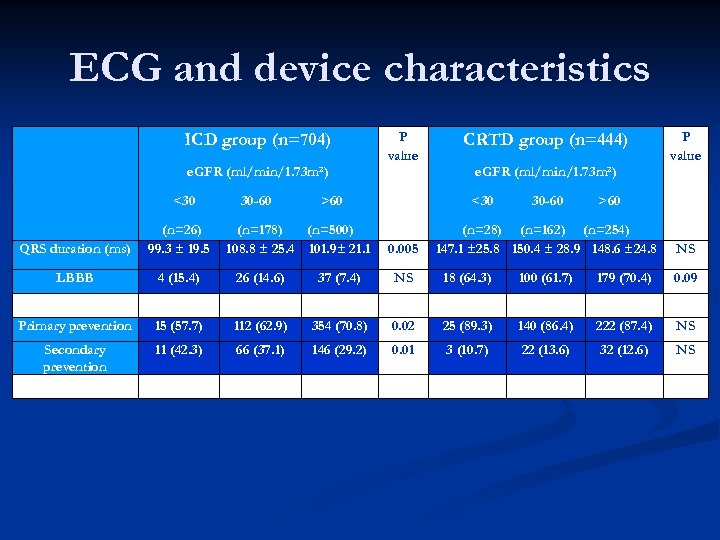 ECG and device characteristics ICD group (n=704) e. GFR (ml/min/1. 73 m²) <30 30 -60 P value >60 (n=178) (n=500) 108. 8 ± 25. 4 101. 9± 21. 1 CRTD group (n=444) e. GFR (ml/min/1. 73 m²) <30 30 -60 P value >60 QRS duration (ms) (n=26) 99. 3 ± 19. 5 LBBB 4 (15. 4) 26 (14. 6) 37 (7. 4) NS 18 (64. 3) 100 (61. 7) 179 (70. 4) 0. 09 Primary prevention 15 (57. 7) 112 (62. 9) 354 (70. 8) 0. 02 25 (89. 3) 140 (86. 4) 222 (87. 4) NS Secondary prevention 11 (42. 3) 66 (37. 1) 146 (29. 2) 0. 01 3 (10. 7) 22 (13. 6) 32 (12. 6) NS 0. 005 (n=28) (n=162) (n=254) 147. 1 ± 25. 8 150. 4 ± 28. 9 148. 6 ± 24. 8 NS
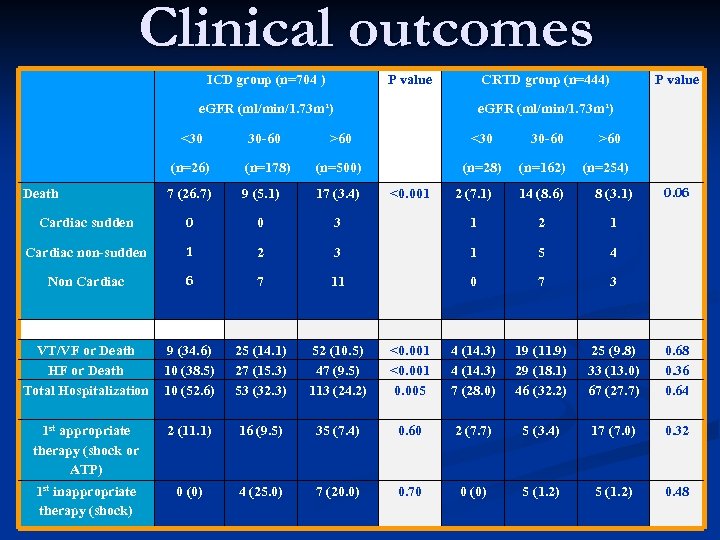 Clinical outcomes ICD group (n=704 ) P value CRTD group (n=444) P value e. GFR (ml/min/1. 73 m²) <30 30 -60 >60 <30 30 -60 >60 (n=26) (n=178) (n=500) Death e. GFR (ml/min/1. 73 m²) (n=28) (n=162) (n=254) 7 (26. 7) 9 (5. 1) 17 (3. 4) Cardiac sudden 0 0 Cardiac non-sudden 1 Non Cardiac <0. 001 0. 06 2 (7. 1) 14 (8. 6) 8 (3. 1) 3 1 2 3 1 5 4 6 7 11 0 7 3 VT/VF or Death HF or Death Total Hospitalization 9 (34. 6) 10 (38. 5) 10 (52. 6) 25 (14. 1) 27 (15. 3) 53 (32. 3) 52 (10. 5) 47 (9. 5) 113 (24. 2) <0. 001 0. 005 4 (14. 3) 7 (28. 0) 19 (11. 9) 29 (18. 1) 46 (32. 2) 25 (9. 8) 33 (13. 0) 67 (27. 7) 0. 68 0. 36 0. 64 1 st appropriate therapy (shock or ATP) 2 (11. 1) 16 (9. 5) 35 (7. 4) 0. 60 2 (7. 7) 5 (3. 4) 17 (7. 0) 0. 32 1 st inappropriate therapy (shock) 0 (0) 4 (25. 0) 7 (20. 0) 0. 70 0 (0) 5 (1. 2) 0. 48
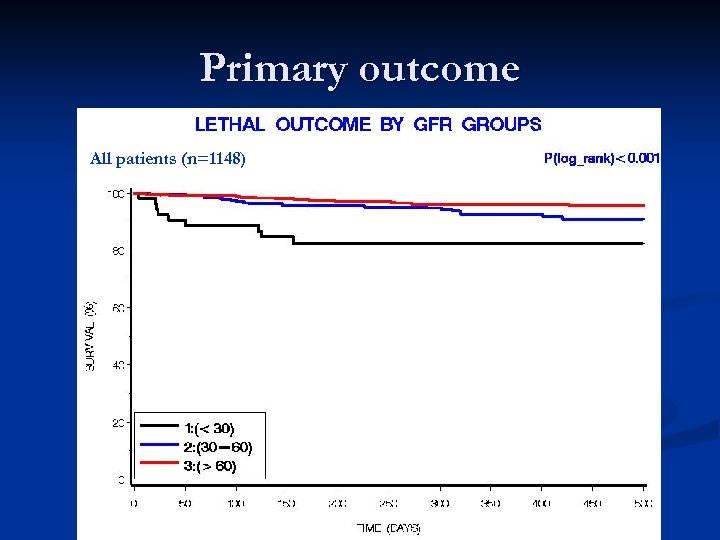 Primary outcome All patients (n=1148)
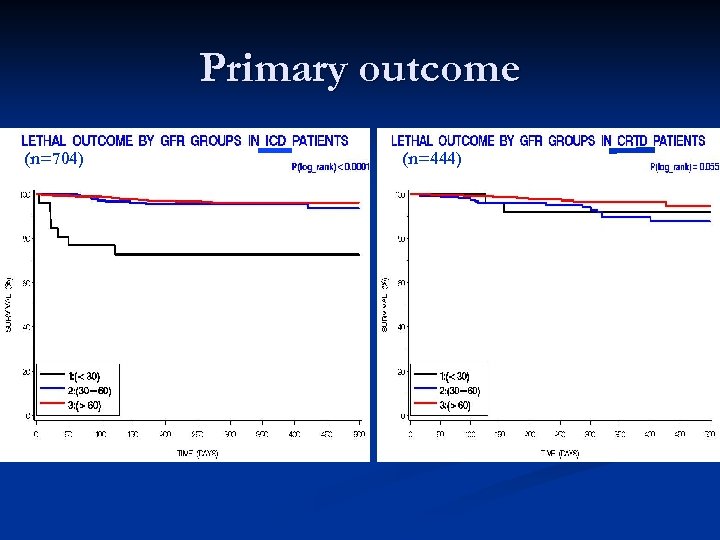 Primary outcome (n=704) (n=444)
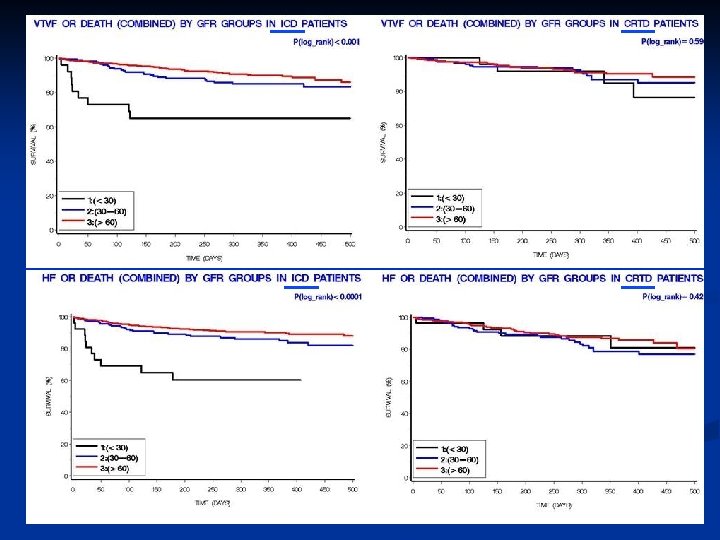
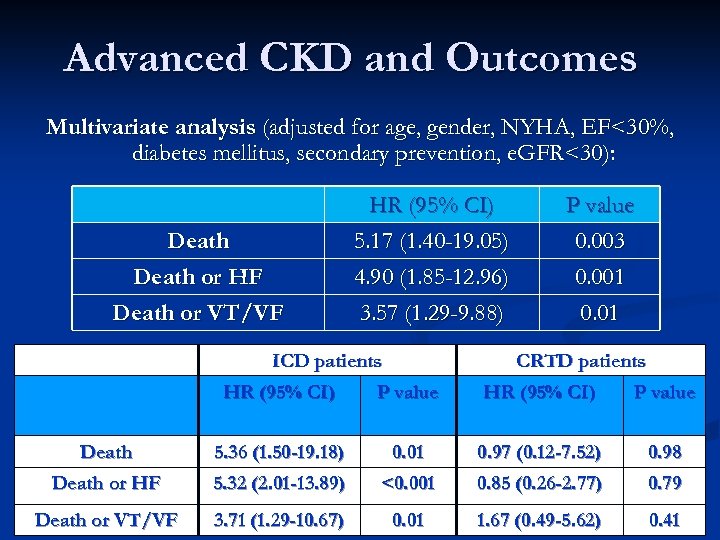 Advanced CKD and Outcomes Multivariate analysis (adjusted for age, gender, NYHA, EF<30%, diabetes mellitus, secondary prevention, e. GFR<30): Death or HF Death or VT/VF HR (95% CI) 5. 17 (1. 40 -19. 05) 4. 90 (1. 85 -12. 96) 3. 57 (1. 29 -9. 88) ICD patients P value 0. 003 0. 001 0. 01 CRTD patients HR (95% CI) P value Death 5. 36 (1. 50 -19. 18) 0. 01 0. 97 (0. 12 -7. 52) 0. 98 Death or HF 5. 32 (2. 01 -13. 89) <0. 001 0. 85 (0. 26 -2. 77) 0. 79 Death or VT/VF 3. 71 (1. 29 -10. 67) 0. 01 1. 67 (0. 49 -5. 62) 0. 41
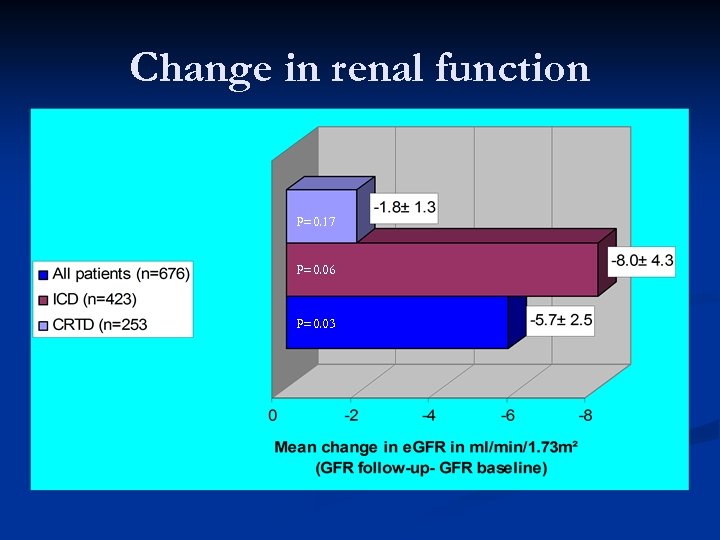 Change in renal function P=0. 17 P=0. 06 P=0. 03
 Discussion n CKD is associated with increased mortality, heart failure and ventricular arrhythmia in patients who undergo device therapy for HF. This is mainly driven by poor outcome of ICD patients with CKD. However, mortality rate of CRTD patients was similar regardless of renal function.
 Discussion Patients who are candidates for CRTD should not be denied this therapy because of advanced CKD. n The discrepancy between the effect of CKD in patients with regular ICDs vs. patients with CRTDs may point to the importance of the CRT component rather than the ICD component of the CRTD system. n
 Limitations A retrospective analysis. n Renal function was measured in different laboratories. n Echocardiographic data during follow-up were not assessed. n
 Conclusion n n CKD is associated with increased mortality after ICD implantation but not after CRTD within the first year of implantation. Advanced CKD should not be considered a reason for exclusion from CRTD implantation.
 Thank you