


 Скачать презентацию Renaissance Reformation Unit 2 Review Ch 1
aba10770a9ac631e3f1b024aa21ef486.ppt
- Количество слайдов: 43
 Renaissance & Reformation Unit 2 Review Ch. 1
 Italian diplomat who wrote The Prince, that analyzed the politics of the Renaissance Name symbolizes someone clever Niccolo Machiavelli
 inventor of a printing press with moveable type, printed the first copies of the bible. J. G. Gutenberg
 Italian painter famous for the School of Athens and his paintings of Mary, who died at the age of 37. R. S. Raphael
 Henry of Navarre granted Huguenots (French Protestants) freedom of Religion. E. Of N. Edict of Nantes
 Italian city-state and republic became the birthplace of the Renaissance. Not Venice or Rome Florence
 Dutch painter developed the technique of painting with oil paints. J. V. E. Jan Van Eyck
 ruler of Florence from 1469 -1492; who used his wealth to support artists, philosophers and writers. L. De M. Lorenzo de Medici
 Who wrote: “O God, that I were a man! I would eat his heart in the market-place. ” Beatrice said it to Benedict Shakespeare
 In what play did Shakespeare write this line? Much Ado About Nothing
 Renaissance artist, scientist, inventor, and genius who painted the Fresco The Last Supper. L. da Vinci
 Before this event, Catholic monks spent months creating illuminated manuscripts that only the very rich could afford to buy. After this event, middle class people learned to read and write and could afford to buy their own copy of the bible. Gutenberg did it. Invention of Printing Press
 Queen of England 15581603, brought power & prosperity to England, patron of arts. Good Queen Bess Elizabeth I
 Started the Reformation by nailing 95 Theses to his church door in Wittenberg. M. L. Martin Luther
 King of England who broke with the Catholic church, founded Anglican Church. 6 wives Henry VIII
 Meeting of Catholic bishops to reform the church, too late to stop Reformation. C. Of T. Council of Trent
 Someone who preached religious beliefs that were not accepted in that country, tortured & burned at the stake. Luther was declared one. heretic
 Dutch Renaissance philosopher who criticized the church in his work “In Praise of Folly”. sumar. E Erasmus
 Preached the doctrine of predestination, from Switzerland. J. C. John Calvin
 English playwright who drew his ideas from medieval legends, classical mythology, and history; wrote about the universal human qualities such as jealousy, ambition, love. W. S. Shakespeare
 The sale of these by the Catholic church was an example of church corruption. Get out of Hell Free Card Indulgences
 Started in Spain, persecution of Jews and Protestants. Jesuits led it. Inquisition
 Civil War in the Holy Roman Empire (German states) between Protestants & Catholics. 16181648 30 Years War
 During her 5 year reign as Queen of England she tried to restore Catholic religion. Bloody Mary I
 Artistic technique for showing relationships and space between objects. Point of View Perspective
 Italian sculptor and painter whose works included La Pieta, David and the Sistine Chapel ceiling. M. B. Michelangelo
 Ended the 30 Years War by granting freedom of worship in private. Treaty Peace of Westphalia
 Doctrine that taught that a person’s fate is determined by God from the moment of their birth, nothing they do in life can change that. Fate Predestination
 Where the northern Renaissance began. Dutch Flanders
 English scholar who wrote Utopia, beheaded by Henry VIII for refusing to recognize the Anglican Church & the King’s divorce. Sir & Saint. Thomas More
 Renaissance movement based on the literature and ideas of the Greeks and Romans, such as the worth of each individual. Homo sapianism Humanism
 Movement that stressed worldly not religious ideas. Se_ _ _ism secularism
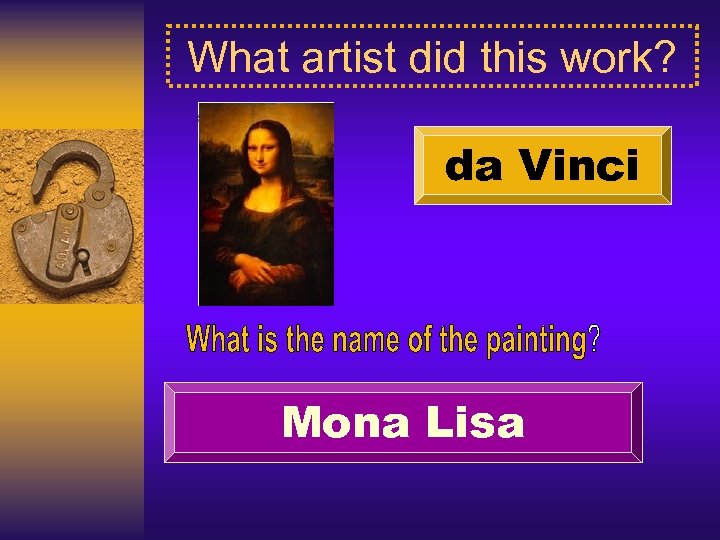 What artist did this work? da Vinci Mona Lisa
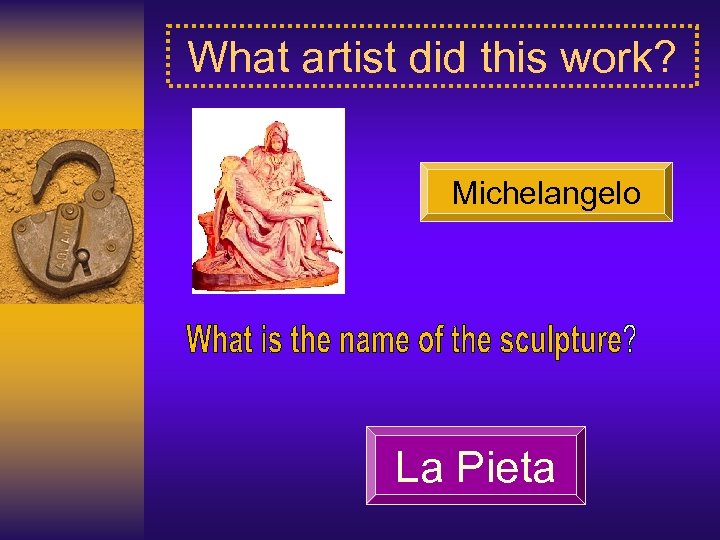 What artist did this work? Michelangelo La Pieta
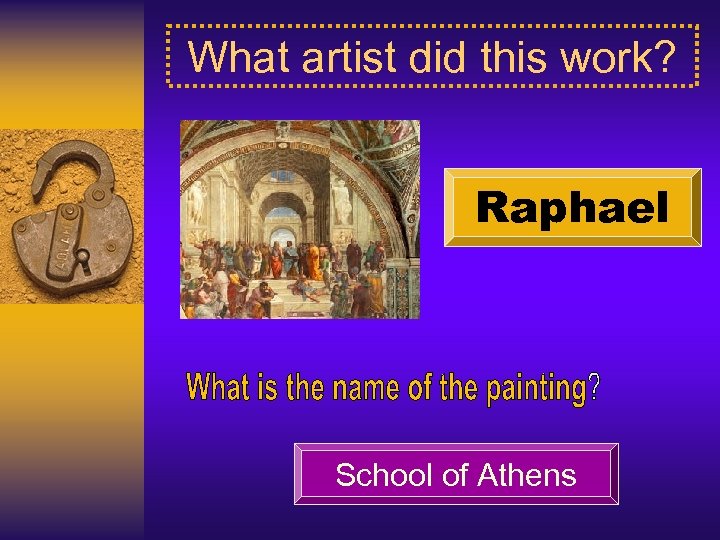 What artist did this work? Raphael School of Athens
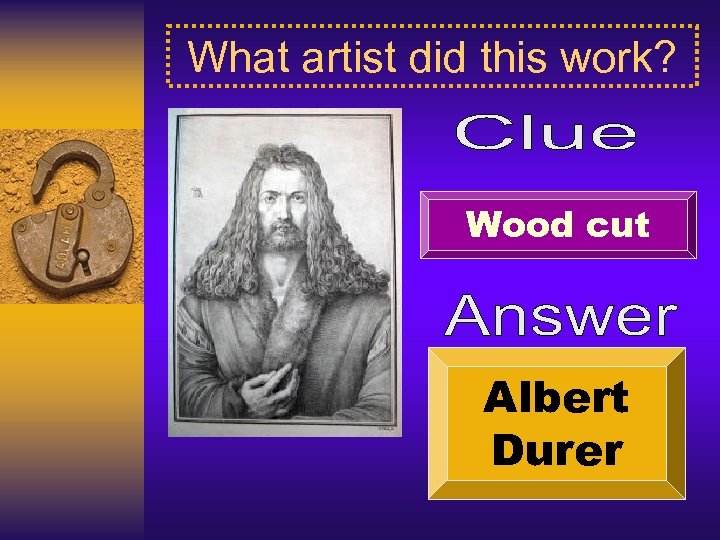 What artist did this work? Wood cut Albert Durer
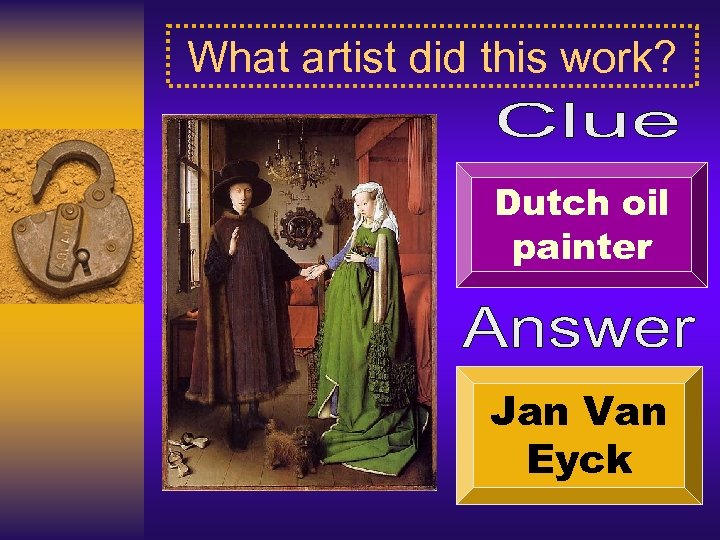 What artist did this work? Dutch oil painter Jan Van Eyck
 What were the major causes of the Renaissance? • Crusades • Sophistication of Italian City-States • Growth of Banking & Trade • Excess Wealth: de Medici family of Florence • Control of Mediterranean Trade • Printing Press
 What were the main effects of the Renaissance? • Advances in Science & Technology led to European Exploration of World • Secularism led to Protestant Reformation • Humanism encouraged growth of Democracy & Human Rights • Women’s Rights • led to Age of Classical Music and Art
 What techniques were used by Renaissance artists? nperspective nlight & motion nstudy of human form nemotion nnew & drama subject matter>secularism nscience & mathematics ncomposition nchanging the world & balance perspective of man & his role in
 What were the causes of the Reformation? • Renaissance • Secularism • Invention of the Printing Press • Corruption in Catholic Church • Sale of Indulgences • Martin Luther
 What were the main effects of the Reformation? • Division within the Christian faith • Religious Wars • Inquisition & Persecution • Began Separation of Church and State
 Essay Questions: 1. Pick two Renaissance artists and use their work to explain the artistic style of Renaissance Art. 2. Explain the impact the printing press had on the Protestant Reformation. Use factual details.