 Скачать презентацию Remoteness Index Dexter Pante Likas Umali and Sabrina
a5d3f695b6018b0bf94d7cf6dd8b5198.ppt
- Количество слайдов: 19




Remoteness Index Dexter Pante, Likas Umali and Sabrina Ongkiko
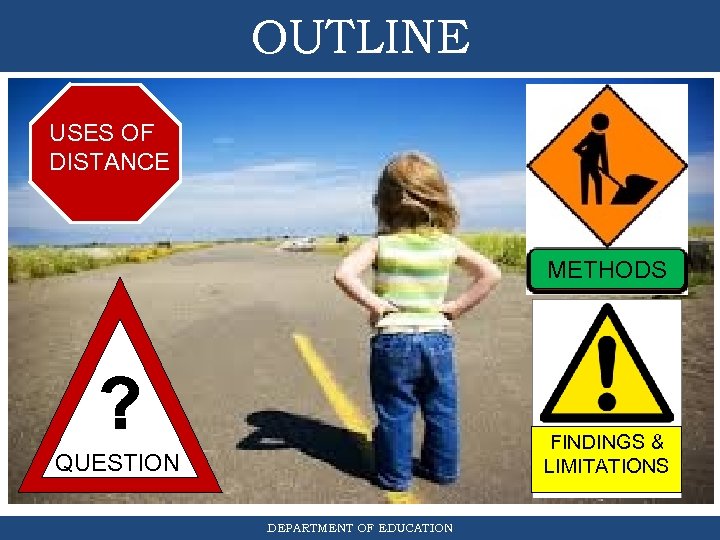
OUTLINE USES OF DISTANCE METHODS FINDINGS & LIMITATIONS QUESTION DEPARTMENT OF EDUCATION
INTRODUCTION Close your eyes Imagine a world without distance 1. How would you know if you are too close to your seatmate? 2. Whether your pocket money for this workshop is sufficient? 3. How much time is left for my presentation? DEPARTMENT OF EDUCATION
INTRODUCTION • Concept of distance is very important in education planning and resource allocation q Multigrade Education q Hardship Pay q Alternative Delivery Mode • No standard definition exists yet for remote or accessible schools DEPARTMENT OF EDUCATION
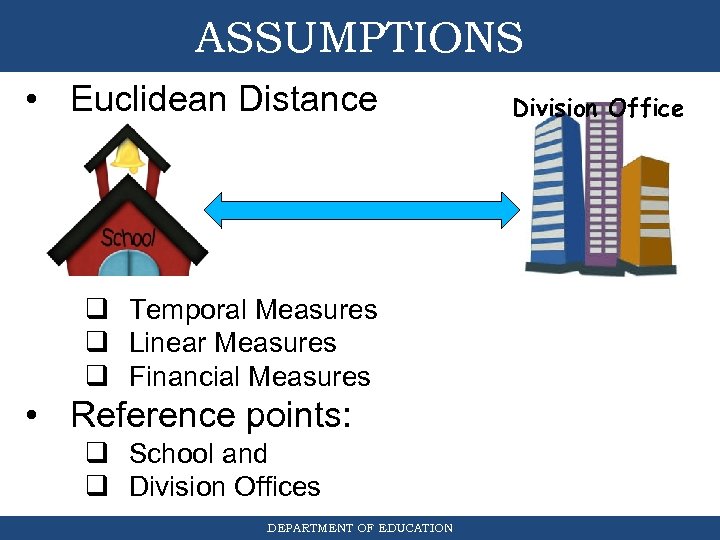
ASSUMPTIONS • Euclidean Distance q Temporal Measures q Linear Measures q Financial Measures • Reference points: q School and q Division Offices DEPARTMENT OF EDUCATION Division Office
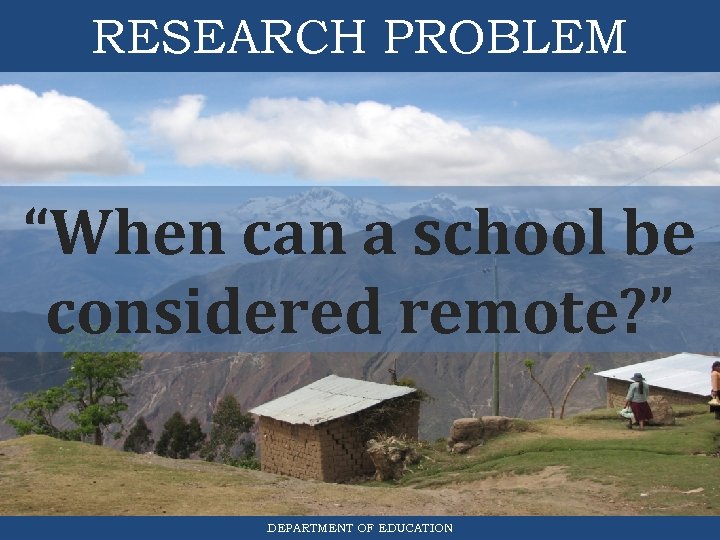
RESEARCH PROBLEM “When can a school be considered remote? ” DEPARTMENT OF EDUCATION
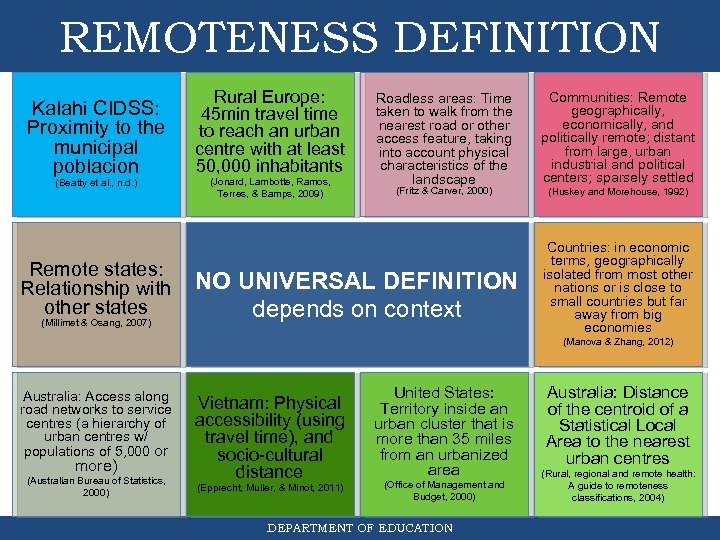
REMOTENESS DEFINITION Kalahi CIDSS: Proximity to the municipal poblacion (Beatty et al. , n. d. ) Remote states: Relationship with other states (Millimet & Osang, 2007) Rural Europe: 45 min travel time to reach an urban centre with at least 50, 000 inhabitants (Jonard, Lambotte, Ramos, Terres, & Bamps, 2009) Roadless areas: Time taken to walk from the nearest road or other access feature, taking into account physical characteristics of the landscape (Fritz & Carver, 2000) NO UNIVERSAL DEFINITION depends on context Communities: Remote geographically, economically, and politically remote; distant from large, urban industrial and political centers; sparsely settled (Huskey and Morehouse, 1992) Countries: in economic terms, geographically isolated from most other nations or is close to small countries but far away from big economies (Manova & Zhang, 2012) Australia: Access along road networks to service centres (a hierarchy of urban centres w/ populations of 5, 000 or more) (Australian Bureau of Statistics, 2000) Vietnam: Physical accessibility (using travel time), and socio-cultural distance (Epprecht, Muller, & Minot, 2011) United States: Territory inside an urban cluster that is more than 35 miles from an urbanized area (Office of Management and Budget, 2000) DEPARTMENT OF EDUCATION Australia: Distance of the centroid of a Statistical Local Area to the nearest urban centres (Rural, regional and remote health: A guide to remoteness classifications, 2004)
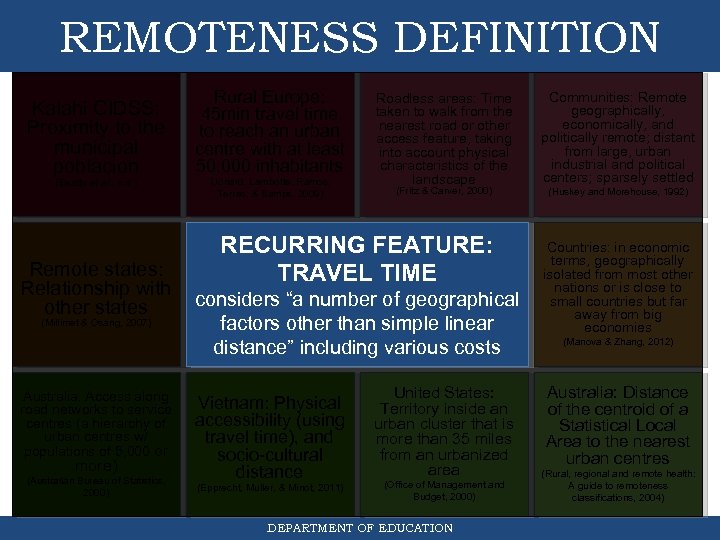
REMOTENESS DEFINITION Kalahi CIDSS: Proximity to the municipal poblacion (Beatty et al. , n. d. ) Rural Europe: 45 min travel time to reach an urban centre with at least 50, 000 inhabitants (Jonard, Lambotte, Ramos, Terres, & Bamps, 2009) Roadless areas: Time taken to walk from the nearest road or other access feature, taking into account physical characteristics of the landscape (Fritz & Carver, 2000) RECURRING FEATURE: TRAVEL TIME Remote states: Relationship with considers “a number of geographical other states (Millimet & Osang, 2007) factors other than simple linear distance” including various costs Australia: Access along road networks to service centres (a hierarchy of urban centres w/ populations of 5, 000 or more) (Australian Bureau of Statistics, 2000) Vietnam: Physical accessibility (using travel time), and socio-cultural distance (Epprecht, Muller, & Minot, 2011) United States: Territory inside an urban cluster that is more than 35 miles from an urbanized area (Office of Management and Budget, 2000) DEPARTMENT OF EDUCATION Communities: Remote geographically, economically, and politically remote; distant from large, urban industrial and political centers; sparsely settled (Huskey and Morehouse, 1992) Countries: in economic terms, geographically isolated from most other nations or is close to small countries but far away from big economies (Manova & Zhang, 2012) Australia: Distance of the centroid of a Statistical Local Area to the nearest urban centres (Rural, regional and remote health: A guide to remoteness classifications, 2004)
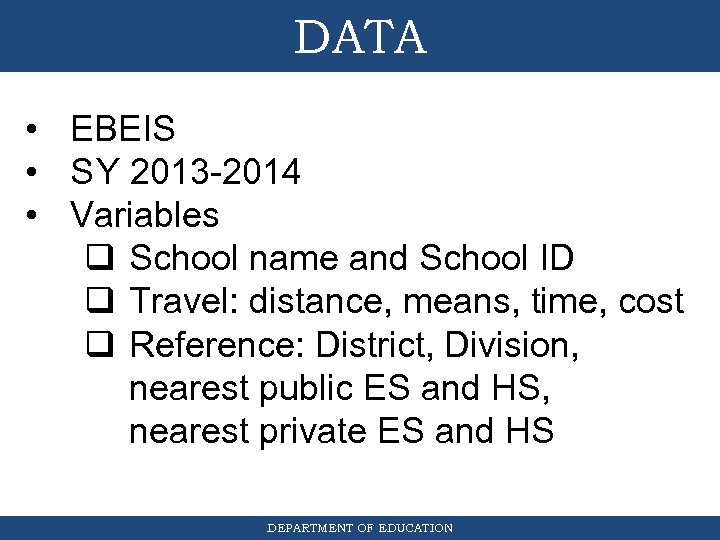
DATA • EBEIS • SY 2013 -2014 • Variables q School name and School ID q Travel: distance, means, time, cost q Reference: District, Division, nearest public ES and HS, nearest private ES and HS DEPARTMENT OF EDUCATION
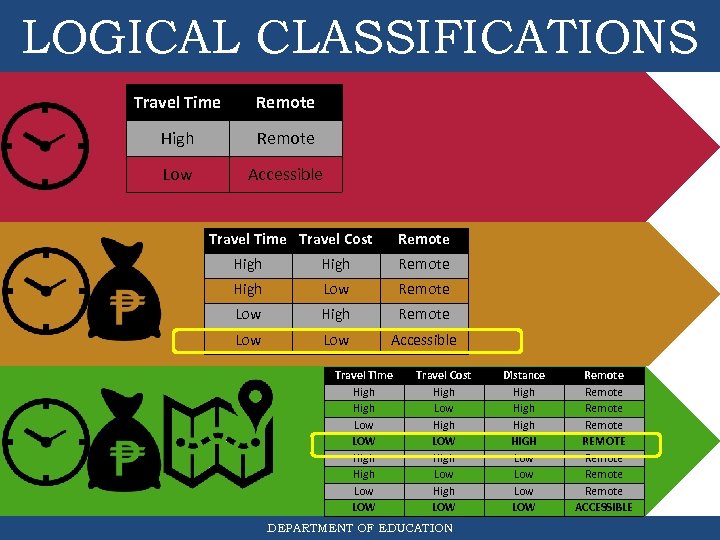
LOGICAL CLASSIFICATIONS Travel Time Remote High Remote Low Accessible Travel Time Travel Cost Remote High Low Remote Low High Remote Low Accessible Travel Time High Low LOW Travel Cost High Low High LOW DEPARTMENT OF EDUCATION Distance High HIGH Low Low LOW Remote REMOTE Remote ACCESSIBLE
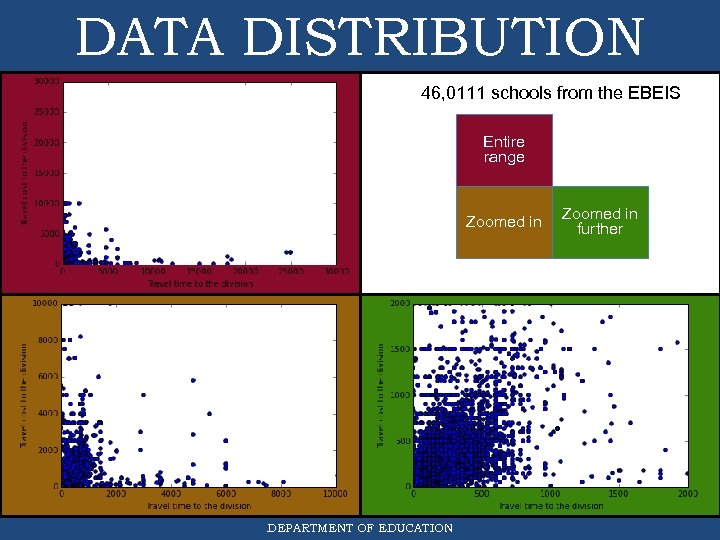
DATA DISTRIBUTION 46, 0111 schools from the EBEIS Entire range zoomed in Zoomed in DEPARTMENT OF EDUCATION Zoomed in further
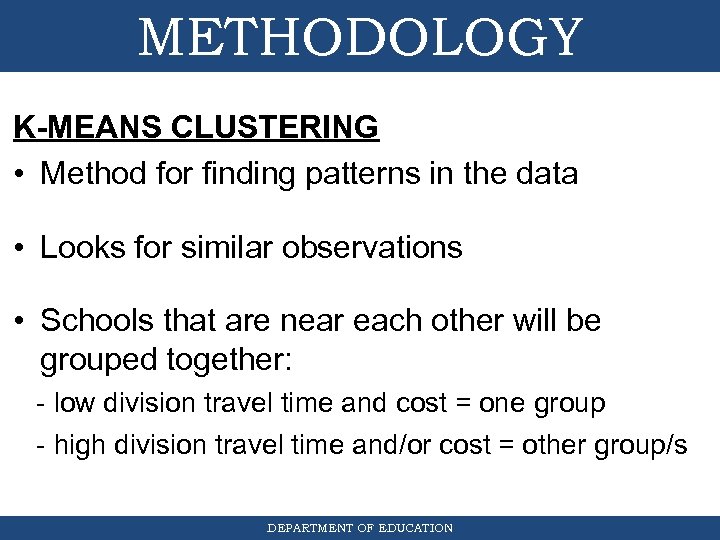
METHODOLOGY K-MEANS CLUSTERING • Method for finding patterns in the data • Looks for similar observations • Schools that are near each other will be grouped together: - low division travel time and cost = one group - high division travel time and/or cost = other group/s DEPARTMENT OF EDUCATION
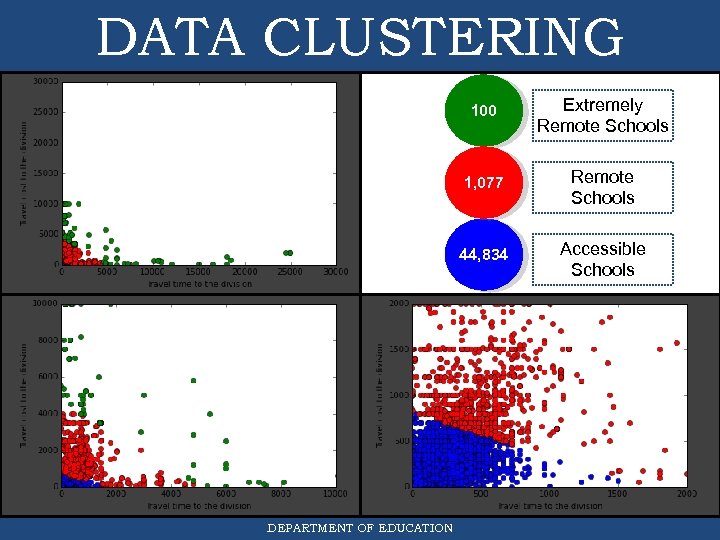
DATA CLUSTERING 100 zoomed in 1, 077 44, 834 DEPARTMENT OF EDUCATION Extremely Remote Schools Accessible Schools
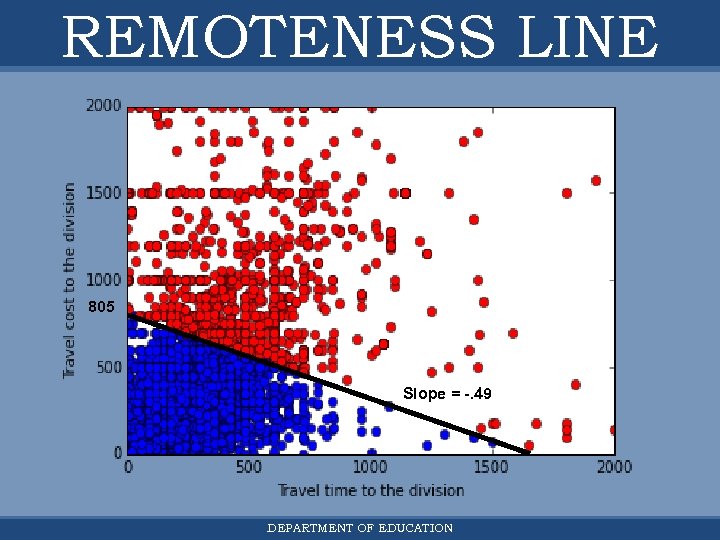
REMOTENESS LINE zoomed in 805 Slope = -. 49 DEPARTMENT OF EDUCATION
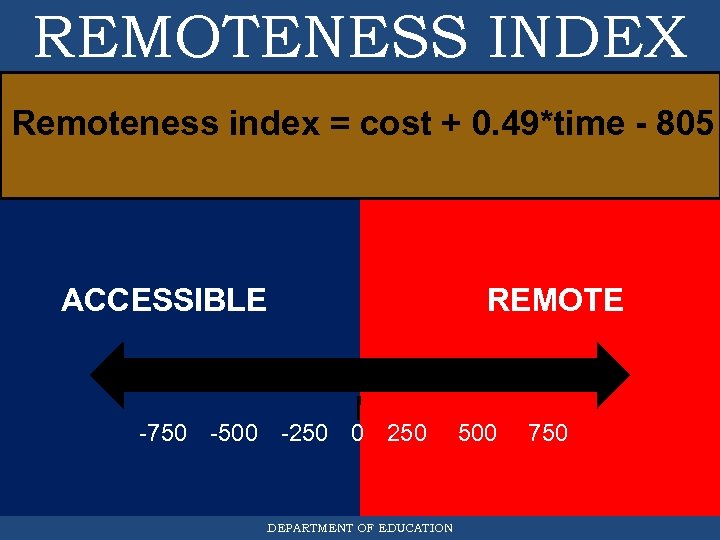
REMOTENESS INDEX Remoteness index = cost + 0. 49*time - 805 ACCESSIBLE -750 -500 -250 0 250 DEPARTMENT OF EDUCATION REMOTE 500 750
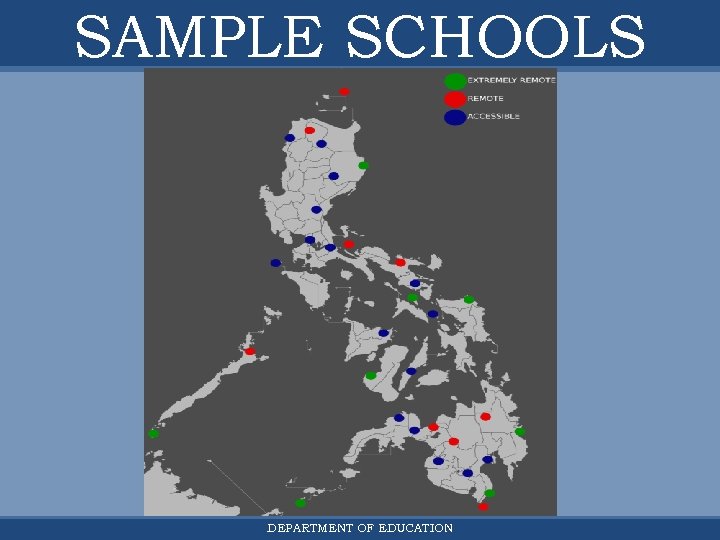
SAMPLE SCHOOLS DEPARTMENT OF EDUCATION
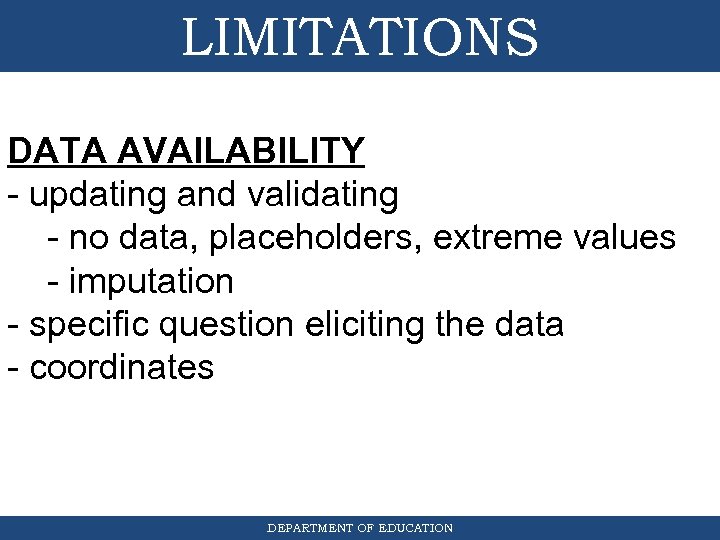
LIMITATIONS DATA AVAILABILITY - updating and validating - no data, placeholders, extreme values - imputation - specific question eliciting the data - coordinates DEPARTMENT OF EDUCATION
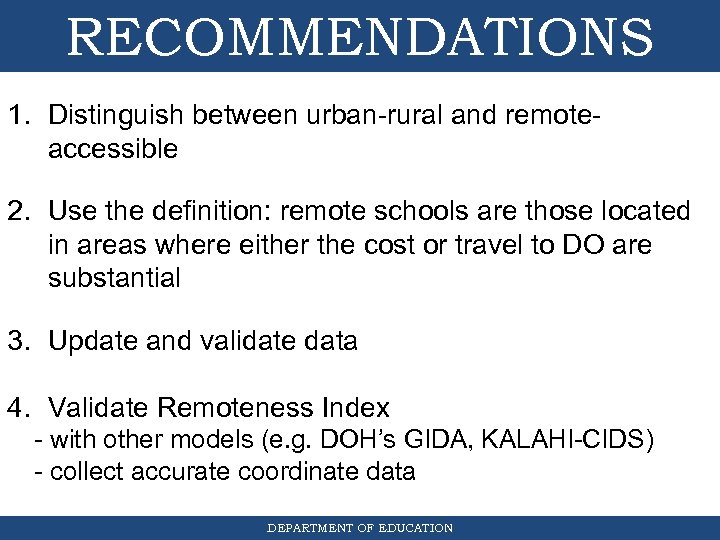
RECOMMENDATIONS 1. Distinguish between urban-rural and remoteaccessible 2. Use the definition: remote schools are those located in areas where either the cost or travel to DO are substantial 3. Update and validate data 4. Validate Remoteness Index - with other models (e. g. DOH’s GIDA, KALAHI-CIDS) - collect accurate coordinate data DEPARTMENT OF EDUCATION
REFERENCES Australian Bureau of Statistics. (2000). Australian social trends. Australian Bureau of Statistics. Beatty, A. , Ben. Yishay, A. , Felix, A. , King, E. , Lalisan, A. , Orbeta, A. , … Sethi, S. (n. d. ). Impact Evaluation of the Kalahi-CIDSS: Baseline Report. Berman, M. (n. d. ). Remoteness and Mobility: Transportation Routes, Technologies, and Sustainability in Arctic Communities. Black, Paul E. , "Euclidean distance", in Dictionary of Algorithms and Data Structures [online], Vreda Pieterse and Paul E. Black, eds. 17 December 2004. Available from: http: //www. nist. gov/dads/HTML/euclidndstnc. html Epprecht, M. , Muller, D. , & Minot, N. (2011). How remote are Vietnam's ethnic minorities? An analysis of spatial patterns of poverty and inequality. The Annals of Regional Science, 46(2), 349 -368. Fritz, S. , & Carver, S. (2000). Modelling remoteness in roadless areas using GIS. 4 th International Conference on Integrating Geographic Information Systems and Environmental Modeling. Millimet, D. L. , & Osang, T. (2007). Do state borders matter for US intranational trade? The role of history and internal migration. Canadian Journal of Economics, 40(1), 93 -126. Office of Management and Budget. (2000). Standards for Defining Metropolitan and Micropolitan Statistical Areas; Notice. Federal Register (65) No. 249. Rural, regional and remote health: A guide to remoteness classifications. (2004). Canberra: Australian Institute of Health and Welfare. DEPARTMENT OF EDUCATION
Скачать презентацию Remoteness Index Dexter Pante Likas Umali and Sabrina
a5d3f695b6018b0bf94d7cf6dd8b5198.ppt