 Скачать презентацию Remote Sensing of Spatial Distributions of Greenhouse Gases
e23306af8ba52f54dd5c42c366454553.ppt
- Количество слайдов: 24



Remote Sensing of Spatial Distributions of Greenhouse Gases in the Los Angles Basin Dejian Fu 1, 2, Thomas J. Pongetti 1, Stanley P. Sander 1, 2 1 NASA Jet Propulsion Laboratory, California Institute of Technology, Pasadena, CA 91109, USA Ross Cheung 2, 3, Jochen Stutz 2, 3, Chang. Hyoun Park 2, 3, Qinbin Li 2, 3 2 UCLA Joint Institute for Regional Earth System Science and Engineering, University of California, Los Angeles, CA 90095, USA 3 Department of Atmospheric and Oceanic Sciences, University of California, Los Angeles, CA 90095, USA
Introduction Ø The Los Angeles air basin is a significant anthropogenic source of greenhouse gases and pollutants including CO 2, CH 4, N 2 O, and CO, contributing significantly to regional and global climate change. Ø Recent legislation in California, the California Global Warming Solutions Act (AB 32), established a statewide cap for greenhouse gas emissions for 2020 based on 1990 emissions. Ø Verifying the effectiveness of regional greenhouse gas emissions controls requires high-precision, regional-scale measurement methods combined with models that capture the principal anthropogenic and biogenic sources and sinks. Ø We present a novel approach for monitoring the spatial distributions of greenhouse gases in the Los Angeles basin using high resolution remote sensing spectroscopy. Ø We participated in the Cal. Nex 2010 campaign to provide greenhouse gas distributions for comparison between top-down and bottom-up emission estimates.
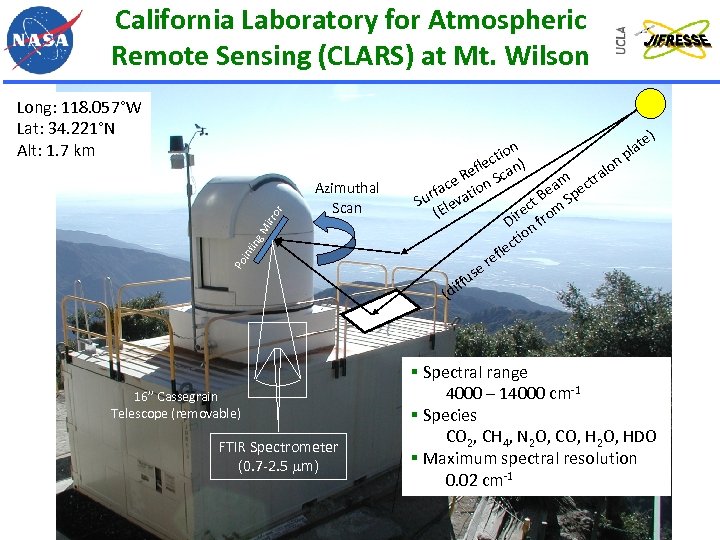
California Laboratory for Atmospheric Remote Sensing (CLARS) at Mt. Wilson Long: 118. 057°W Lat: 34. 221°N Alt: 1. 7 km Azimuthal Scan Po int ing Mi rro r ) te la 16” Cassegrain Telescope (removable) FTIR Spectrometer (0. 7 -2. 5 m) n ctio ) np le an lo ef m ctra e R on Sc a ac Be Spe urf evati S l ct (E re from Di n o cti fle re se fu if (d § Spectral range 4000 – 14000 cm-1 § Species CO 2, CH 4, N 2 O, CO, H 2 O, HDO § Maximum spectral resolution 0. 02 cm-1
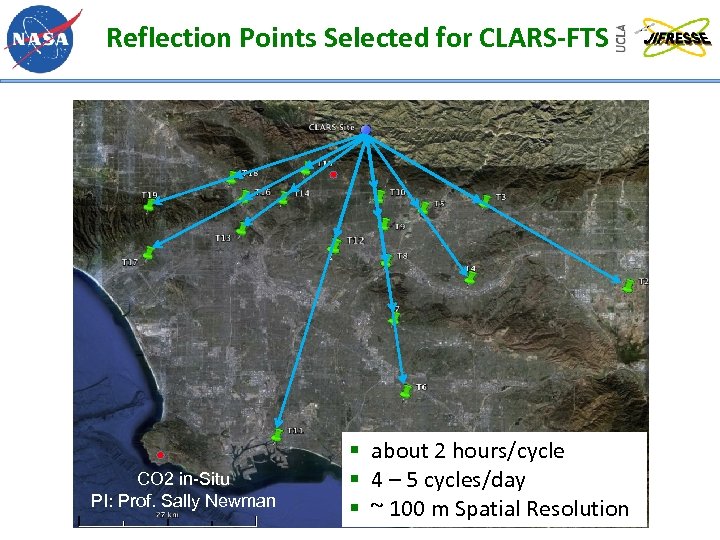
Reflection Points Selected for CLARS-FTS CO 2 in-Situ PI: Prof. Sally Newman § about 2 hours/cycle § 4 – 5 cycles/day § ~ 100 m Spatial Resolution
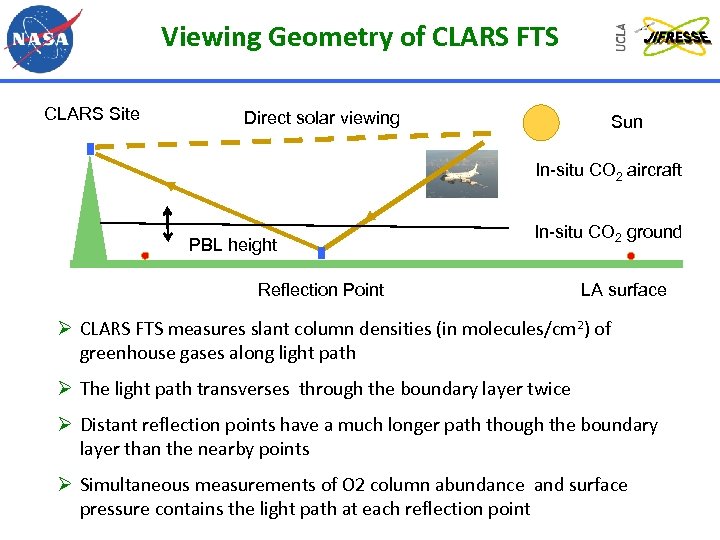
Viewing Geometry of CLARS FTS CLARS Site Direct solar viewing Sun In-situ CO 2 aircraft PBL height In-situ CO 2 ground Reflection Point LA surface Ø CLARS FTS measures slant column densities (in molecules/cm 2) of greenhouse gases along light path Ø The light path transverses through the boundary layer twice Ø Distant reflection points have a much longer path though the boundary layer than the nearby points Ø Simultaneous measurements of O 2 column abundance and surface pressure contains the light path at each reflection point
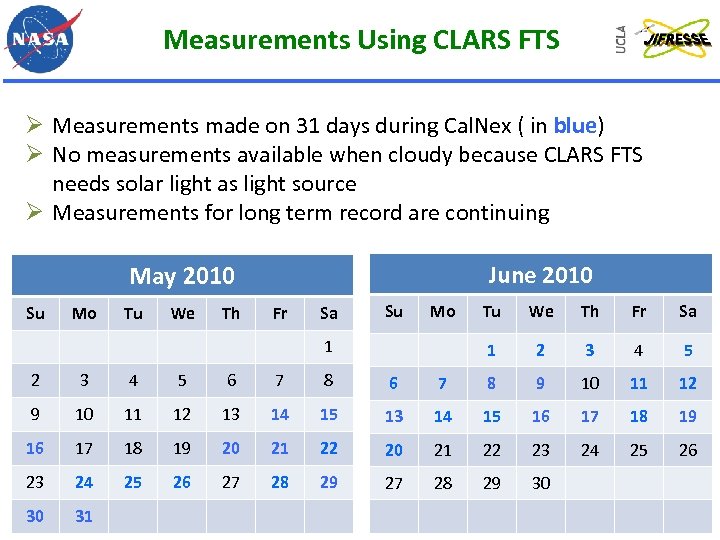
Measurements Using CLARS FTS Ø Measurements made on 31 days during Cal. Nex ( in blue) Ø No measurements available when cloudy because CLARS FTS needs solar light as light source Ø Measurements for long term record are continuing June 2010 May 2010 Su Mo Tu We Th Fr Sa Su Mo We Th Fr Sa 1 1 Tu 2 3 4 5 6 7 8 9 10 11 12 13 14 15 16 17 18 19 20 21 22 23 24 25 26 27 28 29 30 30 31
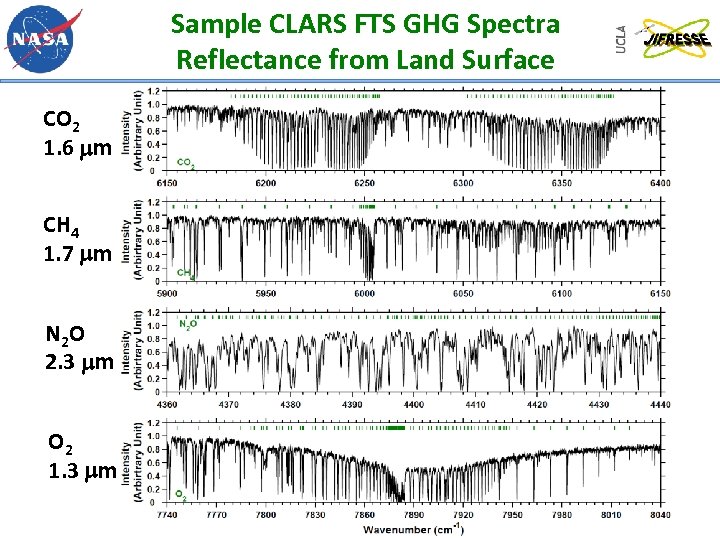
Sample CLARS FTS GHG Spectra Reflectance from Land Surface CO 2 1. 6 mm CH 4 1. 7 mm N 2 O 2. 3 mm O 2 1. 3 mm
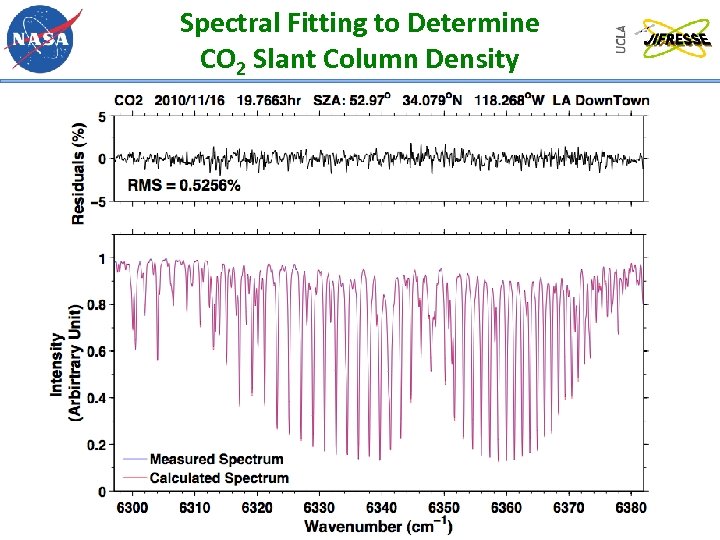
Spectral Fitting to Determine CO 2 Slant Column Density
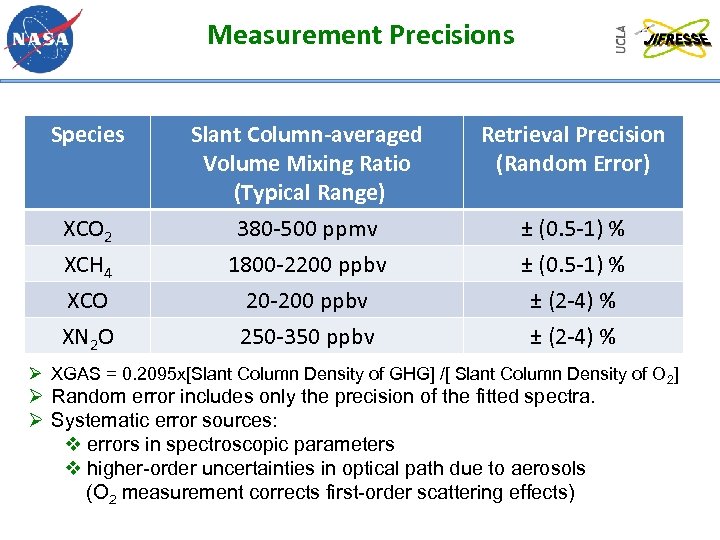
Measurement Precisions Species Retrieval Precision (Random Error) XCO 2 XCH 4 Slant Column-averaged Volume Mixing Ratio (Typical Range) 380 -500 ppmv 1800 -2200 ppbv XCO XN 2 O 20 -200 ppbv 250 -350 ppbv ± (2 -4) % ± (0. 5 -1) % Ø XGAS = 0. 2095 x[Slant Column Density of GHG] /[ Slant Column Density of O 2] Ø Random error includes only the precision of the fitted spectra. Ø Systematic error sources: v errors in spectroscopic parameters v higher-order uncertainties in optical path due to aerosols (O 2 measurement corrects first-order scattering effects)
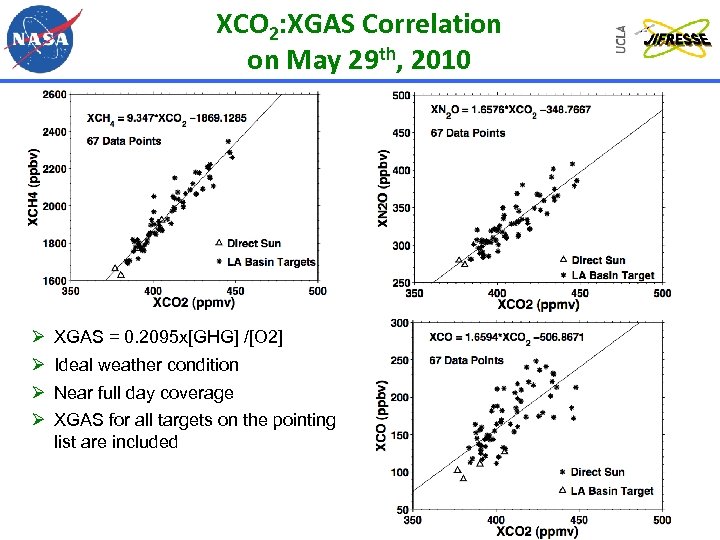
XCO 2: XGAS Correlation on May 29 th, 2010 Ø Ø XGAS = 0. 2095 x[GHG] /[O 2] Ideal weather condition Near full day coverage XGAS for all targets on the pointing list are included
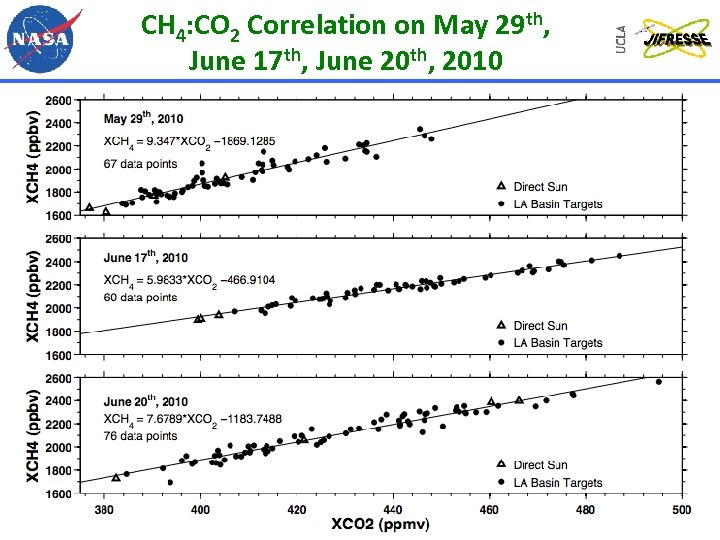
CH 4: CO 2 Correlation on May 29 th, June 17 th, June 20 th, 2010
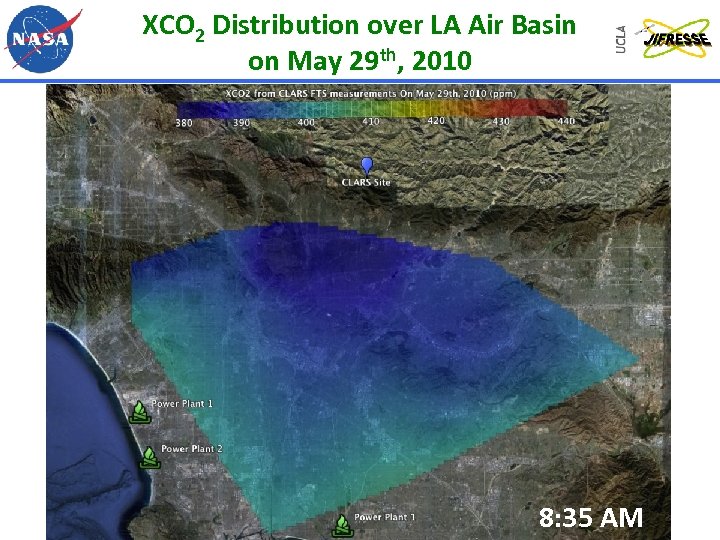
XCO 2 Distribution over LA Air Basin on May 29 th, 2010 8: 35 AM
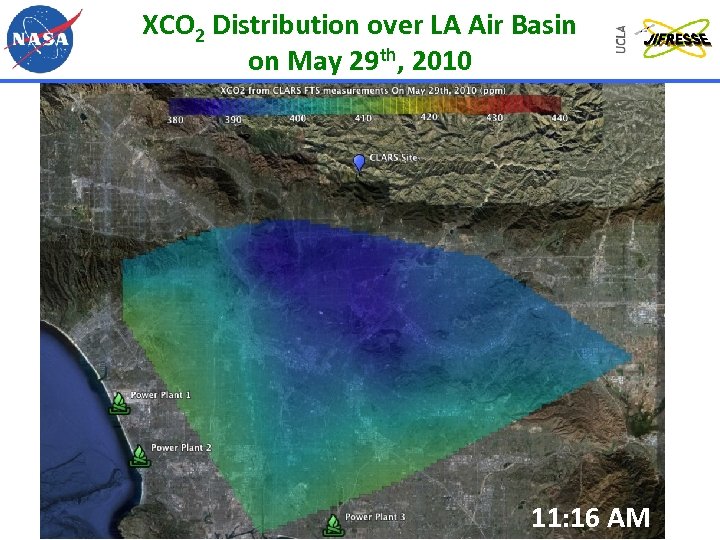
XCO 2 Distribution over LA Air Basin on May 29 th, 2010 11: 16 AM
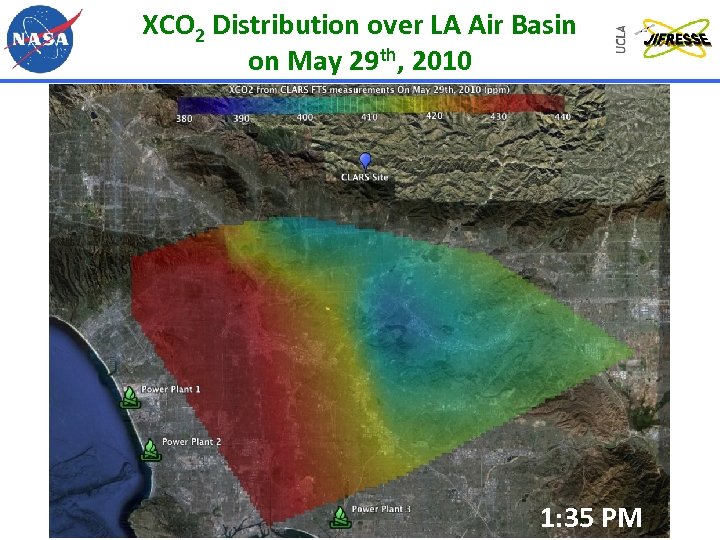
XCO 2 Distribution over LA Air Basin on May 29 th, 2010 1: 35 PM
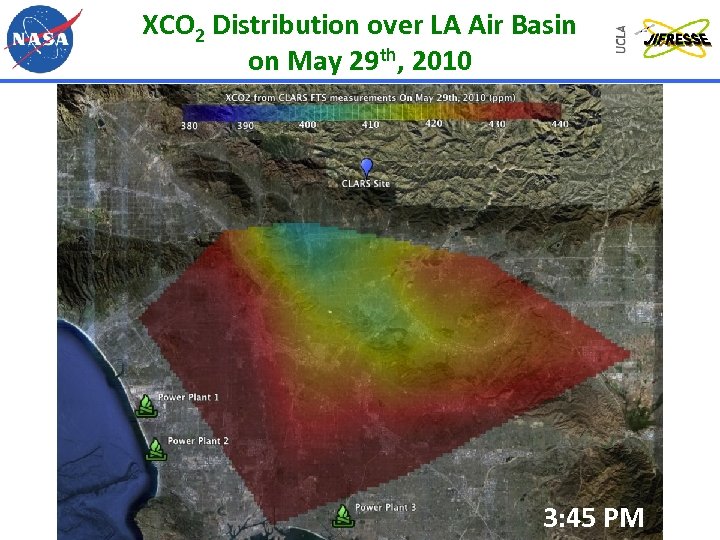
XCO 2 Distribution over LA Air Basin on May 29 th, 2010 3: 45 PM
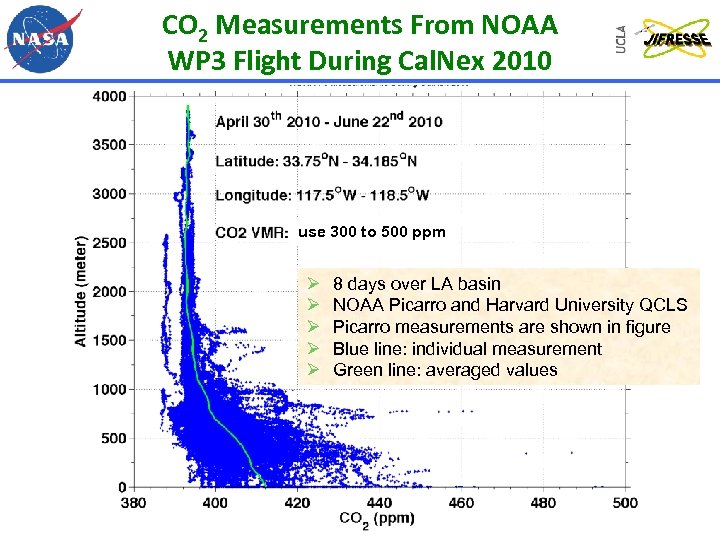
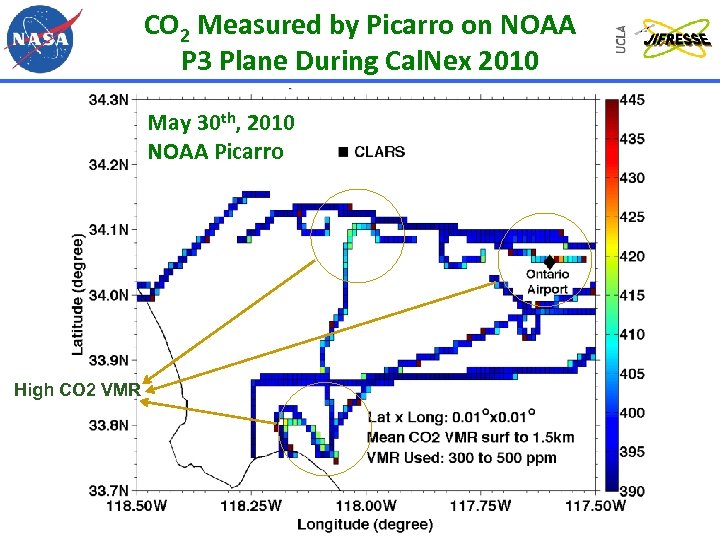
CO 2 Measurements From NOAA WP 3 Flight During Cal. Nex 2010 use 300 to 500 ppm Ø Ø Ø 8 days over LA basin NOAA Picarro and Harvard University QCLS Picarro measurements are shown in figure Blue line: individual measurement Green line: averaged values
CO 2 Measured by Picarro on NOAA P 3 Plane During Cal. Nex 2010 May 30 th, 2010 NOAA Picarro High CO 2 VMR
Validation Method Ø Challenges when compare in situ measurements to CLARS FTS measurements directly Ø Spatial differences (vertical and horizontal directions) Ø Temporal differences Ø Possible solution 1 Use in situ measurements to validate simulations of WRF-VPRM and WRFCHEM models v The status and results of modeling work will be present by Dr. Chang. Hyoun Park et al. (Poster #20) on Wednesday afternoon 2 Use simulations of WRF-VPRM and WRF-CHEM models to validate CLARS FTS v Integrate slant column density within those model grid boxes along CLARS FTS viewing direction v Compare to the CLARS FTS measurements
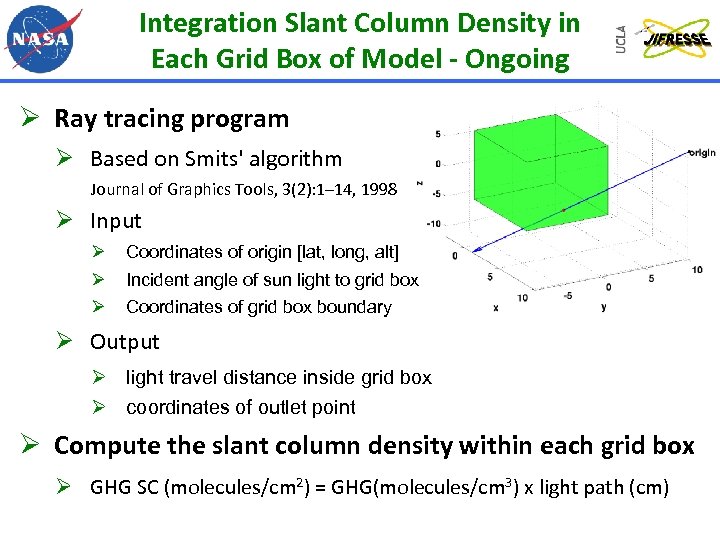
Integration Slant Column Density in Each Grid Box of Model - Ongoing Ø Ray tracing program Ø Based on Smits' algorithm Journal of Graphics Tools, 3(2): 1– 14, 1998 Ø Input Ø Ø Ø Coordinates of origin [lat, long, alt] Incident angle of sun light to grid box Coordinates of grid box boundary Ø Output Ø light travel distance inside grid box Ø coordinates of outlet point Ø Compute the slant column density within each grid box Ø GHG SC (molecules/cm 2) = GHG(molecules/cm 3) x light path (cm)
Summary and Future Work for CLARS FTS Ø During Cal. Nex campaign (May 14 th to June 20 th, 2010), CLARS FTS made measurements on 31 days (out of 38 days). Ø Measurements are continuing after Cal. Nex campaign for long term record. Ø XCO 2, XCH 4, XCO, XN 2 O are computed using measured column densities. The XGAS show correlations that will be used to determine the emission rates of GHG. Ø Validation/improvement of retrieval method using correlative data (ground -based and aircraft) are ongoing. Ø The WRF-VPRM and WRF-CHEM models for Los Angeles are being developed by the group of Qinbin Li at UCLA. The model will directly assimilate GHG and CO slant columns to derive top-down emissions (poster P 20 by Dr. Chang. Hyoun Park et al. on Wednesday afternoon)
Acknowledgements Ø Drs. Geoffrey C. Toon and Jean-Francois Blavier at JPL Ø NOAA Ø California Air Resources Board Ø NASA Ø UCLA JIFRESSE Ø Your Attention Los Angeles Air Basin December 31 st, 2009
![Estimation of Measurement Uncertainty Ø Optimal Estimation Formulism [Rodgers 2000] S = (KT Se-1](https://present5.com/presentation/e23306af8ba52f54dd5c42c366454553/image-22.jpg "Estimation of Measurement Uncertainty Ø Optimal Estimation Formulism [Rodgers 2000] S = (KT Se-1")
Estimation of Measurement Uncertainty Ø Optimal Estimation Formulism [Rodgers 2000] S = (KT Se-1 K + Sa-1)-1 Where S is a n by n covariance matrix K is a n by m Jacobian matrix Se is a m by m covariance matrix of measurement noise Sa is a n by n covariance matrix of a priori uncertainty n is the number of parameters contributing to measurement uncertainty m is the number of spectral data points
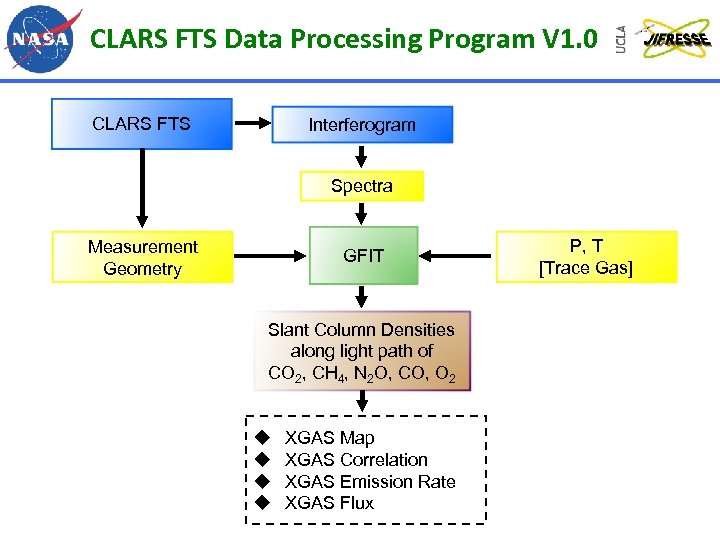
CLARS FTS Data Processing Program V 1. 0 CLARS FTS Interferogram Spectra Measurement Geometry GFIT Slant Column Densities along light path of CO 2, CH 4, N 2 O, CO, O 2 u u XGAS Map XGAS Correlation XGAS Emission Rate XGAS Flux P, T [Trace Gas]
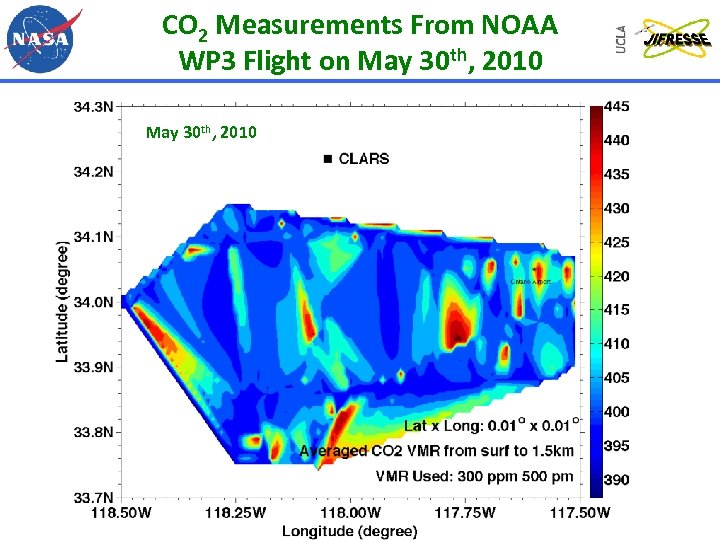
CO 2 Measurements From NOAA WP 3 Flight on May 30 th, 2010
Скачать презентацию Remote Sensing of Spatial Distributions of Greenhouse Gases
e23306af8ba52f54dd5c42c366454553.ppt