


 Скачать презентацию Remote Sensing of Aerosols Zhanqing Li R
588ccc4d1a01220936b9b05d10d6c6d9.ppt
- Количество слайдов: 22
 Remote Sensing of Aerosols Zhanqing Li & R. Dickerson Dept. of Atmos. & Oceanic Science University of Maryland
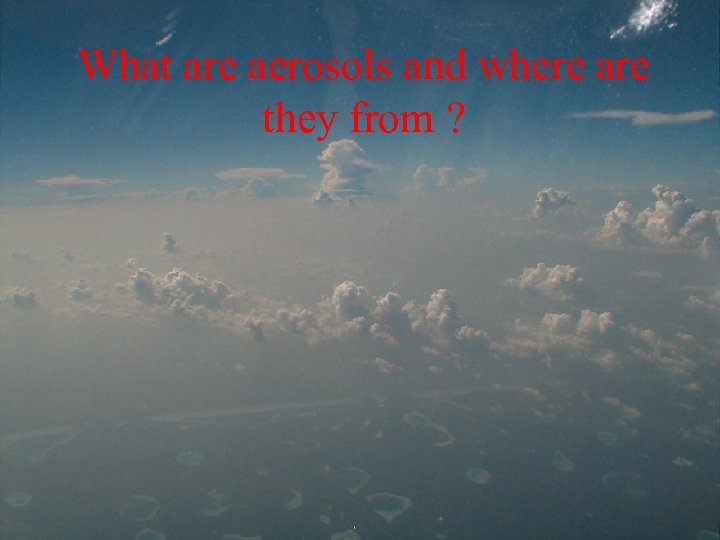 What are aerosols and where are they from ?
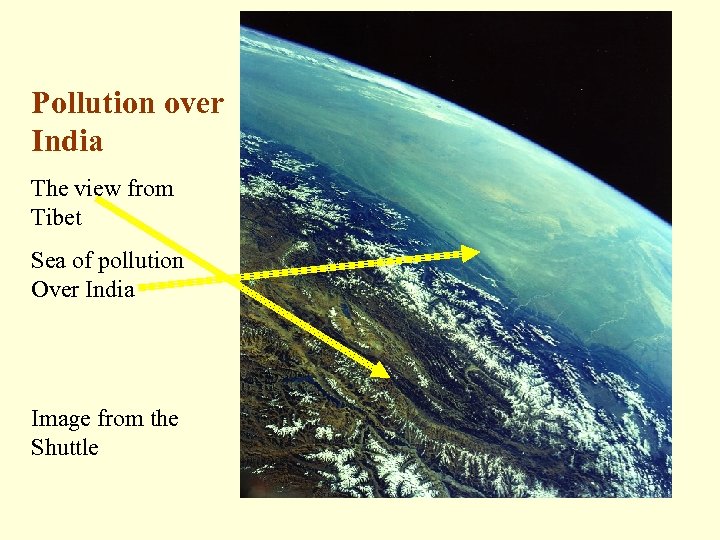 Pollution over India The view from Tibet Sea of pollution Over India Image from the Shuttle
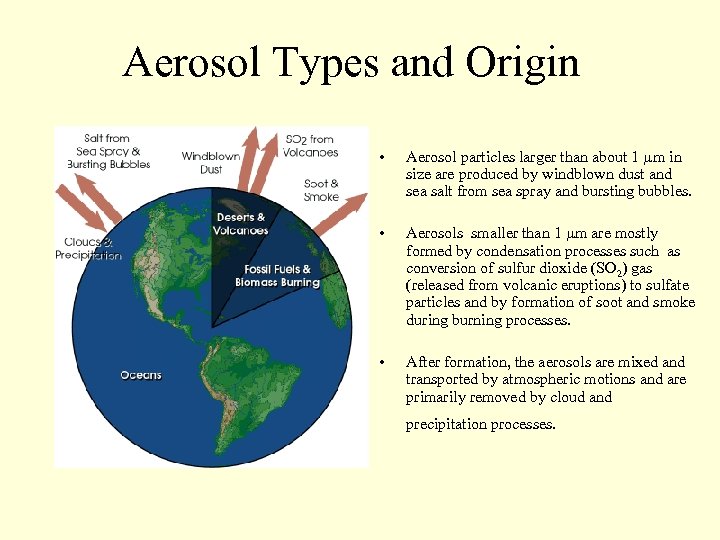 Aerosol Types and Origin • • • Aerosol particles larger than about 1 mm in size are produced by windblown dust and sea salt from sea spray and bursting bubbles. Aerosols smaller than 1 µm are mostly formed by condensation processes such as conversion of sulfur dioxide (SO 2) gas (released from volcanic eruptions) to sulfate particles and by formation of soot and smoke during burning processes. After formation, the aerosols are mixed and transported by atmospheric motions and are primarily removed by cloud and precipitation processes.
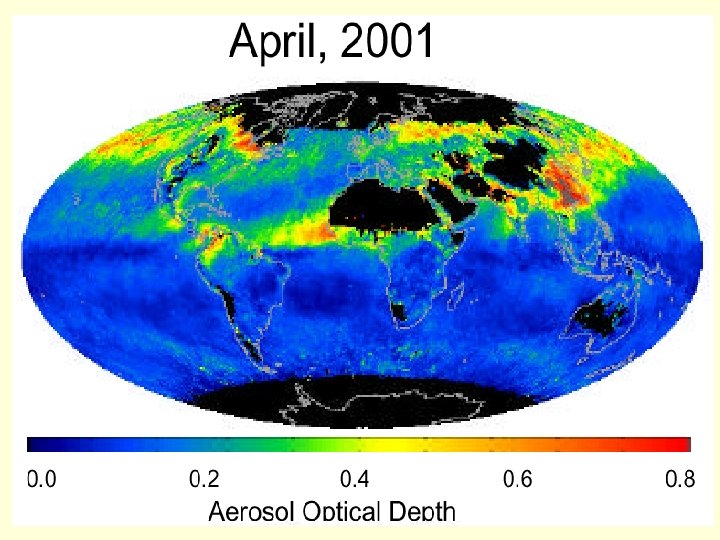
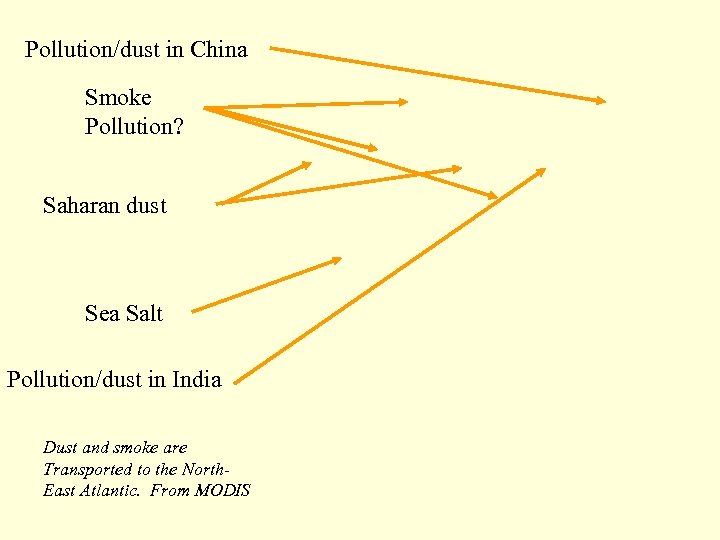 Pollution/dust in China Smoke Pollution? Saharan dust Sea Salt Pollution/dust in India Dust and smoke are Transported to the North. East Atlantic. From MODIS
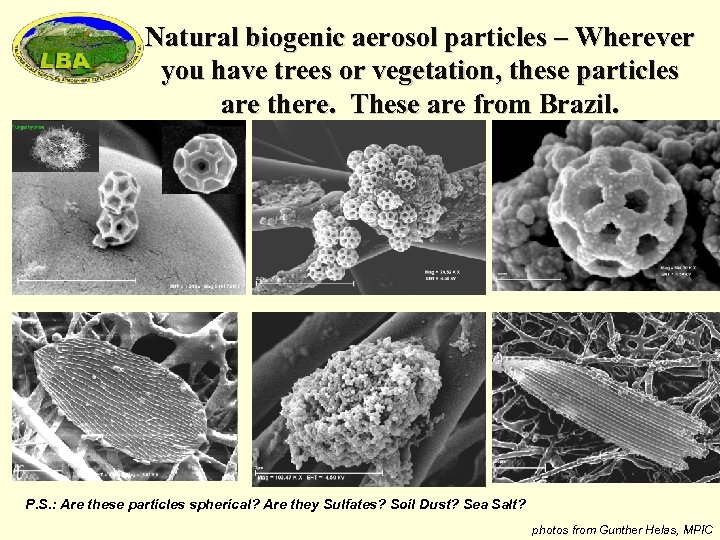 Natural biogenic aerosol particles – Wherever you have trees or vegetation, these particles are there. These are from Brazil. P. S. : Are these particles spherical? Are they Sulfates? Soil Dust? Sea Salt? photos from Gunther Helas, MPIC
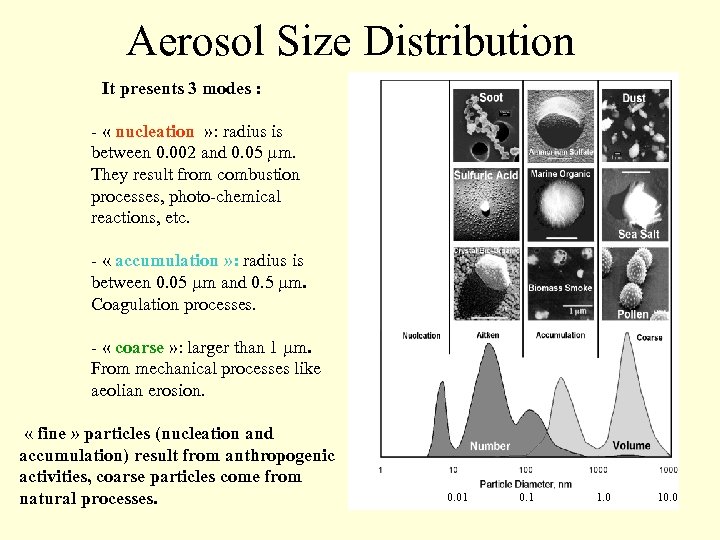 Aerosol Size Distribution It presents 3 modes : - « nucleation » : radius is between 0. 002 and 0. 05 mm. They result from combustion processes, photo-chemical reactions, etc. - « accumulation » : radius is between 0. 05 mm and 0. 5 mm. Coagulation processes. - « coarse » : larger than 1 mm. From mechanical processes like aeolian erosion. « fine » particles (nucleation and accumulation) result from anthropogenic activities, coarse particles come from natural processes. 0. 01 0. 1 1. 0 10. 0
 Aerosol Observations
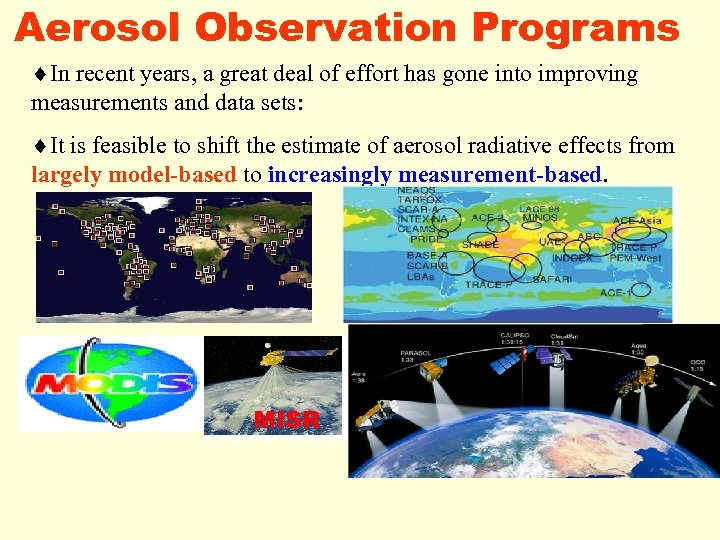 Aerosol Observation Programs ¨In recent years, a great deal of effort has gone into improving measurements and data sets: ¨It is feasible to shift the estimate of aerosol radiative effects from largely model-based to increasingly measurement-based. MISR
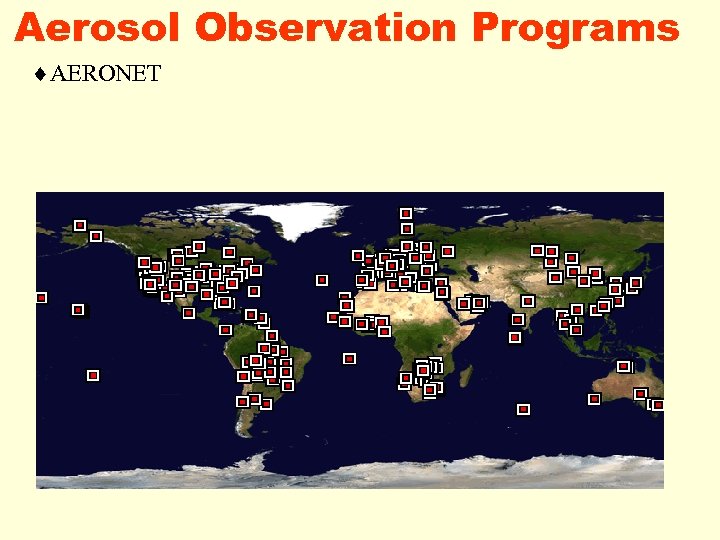 Aerosol ¨AERONET Observation Programs
 NASA’s AERONET • The AERONET (AErosol RObotic NETwork) program: a federation of ground-based remote sensing aerosol networks. • AERONET provides global observations of spectral aerosol optical depth (AOD), inversion products, and precipitable water. • Quality levels: Level 1. 0 (unscreened), Level 1. 5 (cloudscreened), and Level 2. 0 (cloud-screened and quality-assured).
 NASA’s AERONET
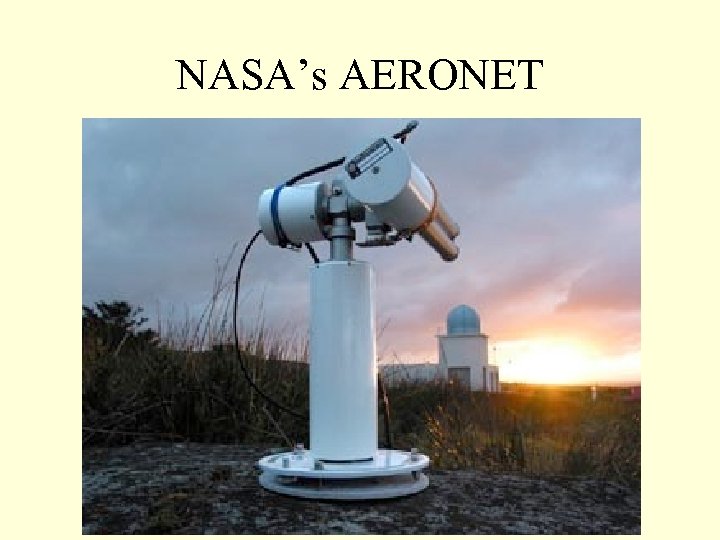
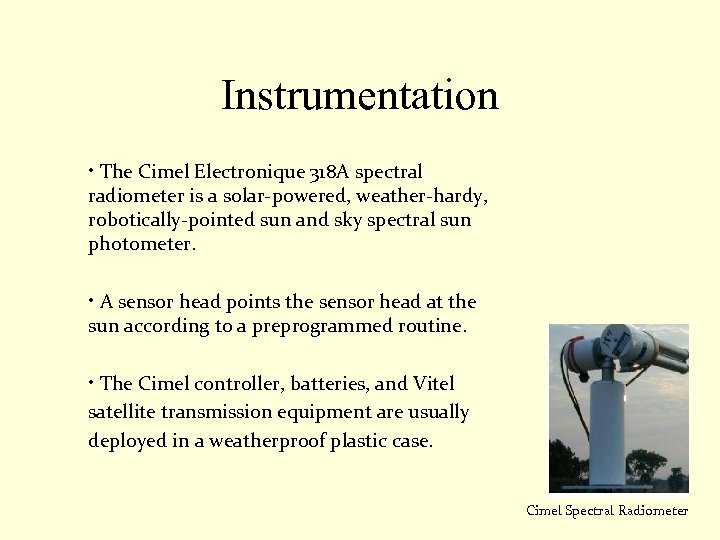 Instrumentation • The Cimel Electronique 318 A spectral radiometer is a solar-powered, weather-hardy, robotically-pointed sun and sky spectral sun photometer. • A sensor head points the sensor head at the sun according to a preprogrammed routine. • The Cimel controller, batteries, and Vitel satellite transmission equipment are usually deployed in a weatherproof plastic case. Cimel Spectral Radiometer
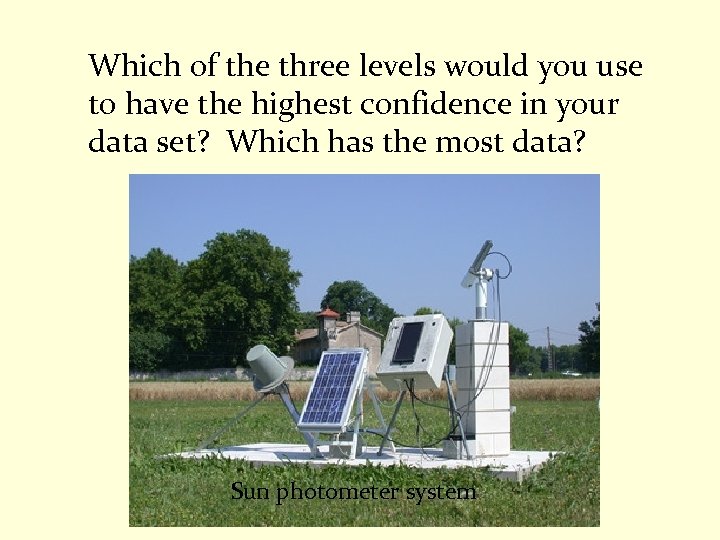 Which of the three levels would you use to have the highest confidence in your data set? Which has the most data? Sun photometer system
 Spectral Radiometer The radiometer makes two basic measurements-either direct sun or sky-both within several programmed sequences. The direct sun measurements are made in eight spectral bands requiring approximately 10 seconds at wavelengths of 340, 380, 440, 500, 670, 870, 940 and 1020 nm the 940 nm channel is used for column water abundance determination A preprogrammed sequence of measurements is taken by these instruments from 7 am-7 pm daily.
 Sun Photometer Tutorial http: //calipsooutreach. hamptonu. edu/sunphoto-sim/photometer. html http: //aeronet. gsfc. nasa. gov/cgibin/type_one_station_opera_v 2_new? site=GSFC&nachal=2&level=1 http: //aeronet. gsfc. nasa. gov/new_web/DRAGONUSA_2013_Houston. html
 On NASA AERONET site 1. Find a nearby Cimel sun photometer 2. Determine the annual average AOD and seasonal cycle 3. Look at a few individual days. 4. July 2011 was dry and hot; August 2011 was rainy. Can you see a difference? 5. Pick a polluted location and a pristine one – examine the differences. 6. Repeat for water vapor, Angstrom exp.
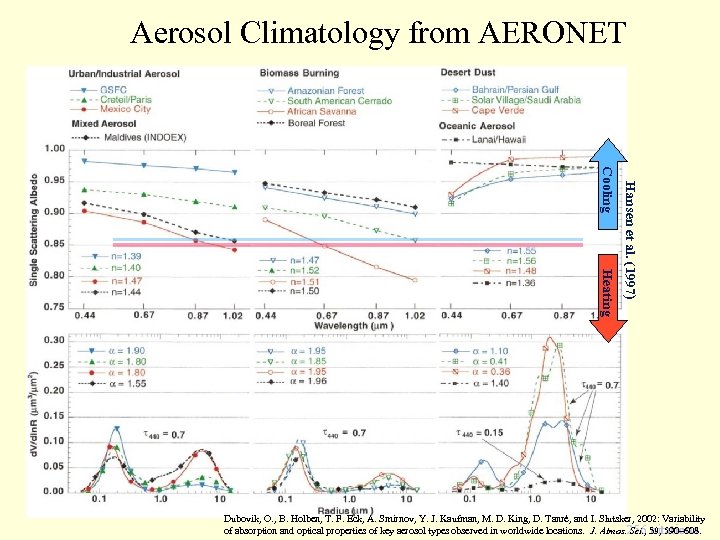 Aerosol Climatology from AERONET Heating Hansen et al. (1997) Cooling Dubovik, O. , B. Holben, T. F. Eck, A. Smirnov, Y. J. Kaufman, M. D. King, D. Tanré, and I. Slutsker, 2002: Variability of absorption and optical properties of key aerosol types observed in worldwide locations. J. Atmos. 256 citations Sci. , 590– 608.
 Summary • Remote sensing with sun photometers is a powerful tool for monitoring AOD and other aerosol properties. • Industrial aerosols tend to be small and highly reflective in developed countries. • Mineral dust is larger and absorbs more radiation. • Biomass burning can be sootier and absorb even more radiation. • AERONET provides a world-wide network. • Only works when you can see the sun. • This is ok for satellite “validation”
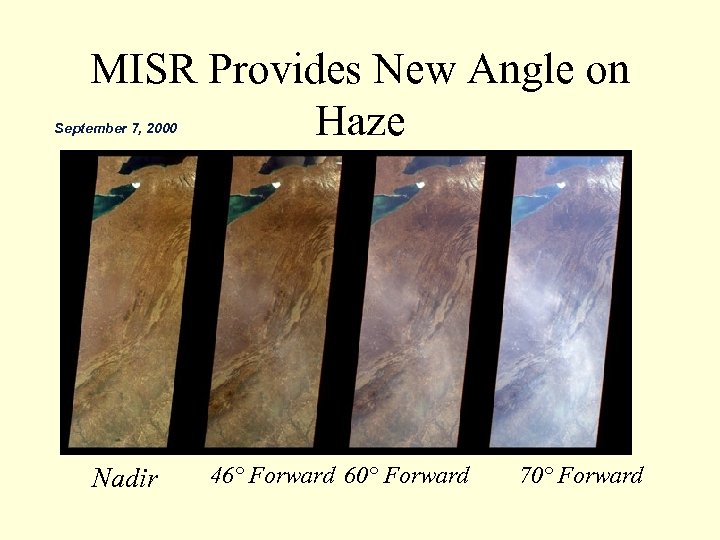 MISR Provides New Angle on Haze September 7, 2000 Nadir 46° Forward 60° Forward 70° Forward
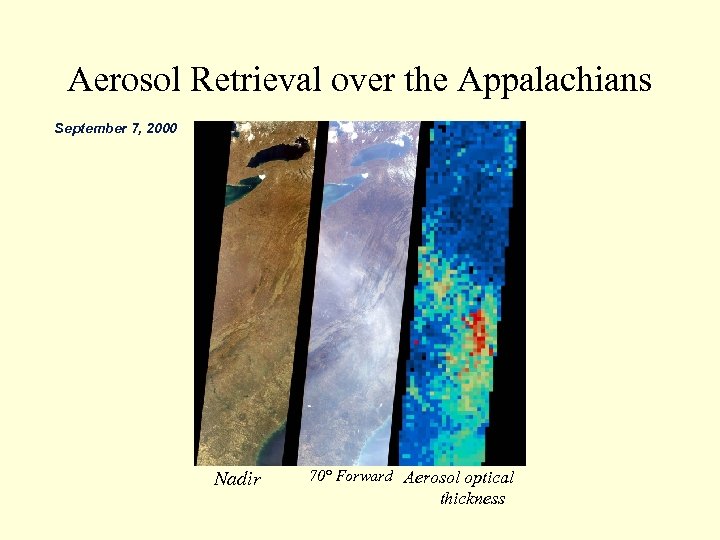 Aerosol Retrieval over the Appalachians September 7, 2000 Nadir 70° Forward Aerosol optical thickness