


 Скачать презентацию Remote Sensing in Decision Making- an International Perspective
511630fe1a01e140ef4def933bc7ff51.ppt
- Количество слайдов: 23
 Remote Sensing in Decision Making- an International Perspective Ashbindu Singh as@rona. unep. org
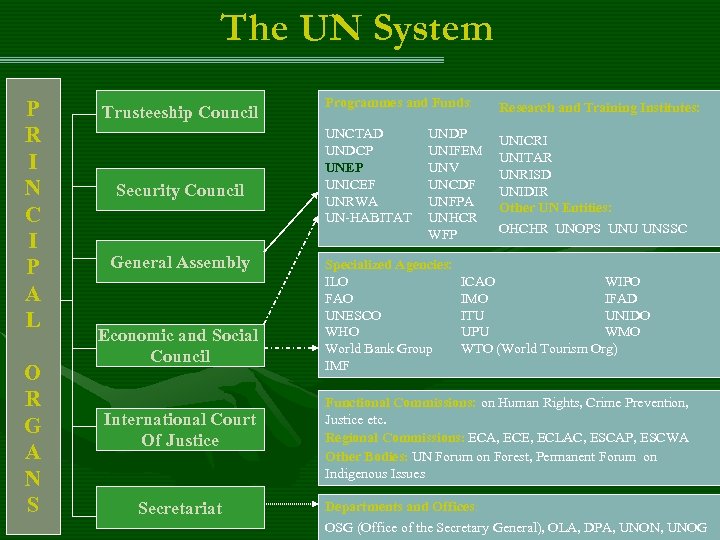 The UN System P R I N C I P A L O R G A N S Trusteeship Council Security Council General Assembly Economic and Social Council International Court Of Justice Secretariat Programmes and Funds: Research and Training Institutes: UNCTAD UNDCP UNEP UNICEF UNRWA UN-HABITAT UNICRI UNITAR UNRISD UNIDIR Other UN Entities: OHCHR UNOPS UNU UNSSC UNDP UNIFEM UNV UNCDF UNFPA UNHCR WFP Specialized Agencies: ILO FAO UNESCO WHO World Bank Group IMF ICAO WIPO IMO IFAD ITU UNIDO UPU WMO WTO (World Tourism Org) Functional Commissions: on Human Rights, Crime Prevention, Justice etc. Regional Commissions: ECA, ECE, ECLAC, ESCAP, ESCWA Other Bodies: UN Forum on Forest, Permanent Forum on Indigenous Issues Departments and Offices: OSG (Office of the Secretary General), OLA, DPA, UNON, UNOG
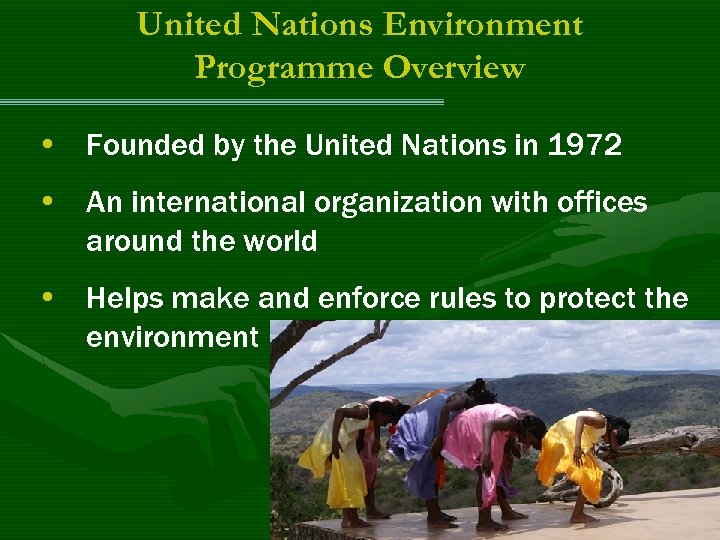 United Nations Environment Programme Overview • Founded by the United Nations in 1972 • An international organization with offices around the world • Helps make and enforce rules to protect the environment
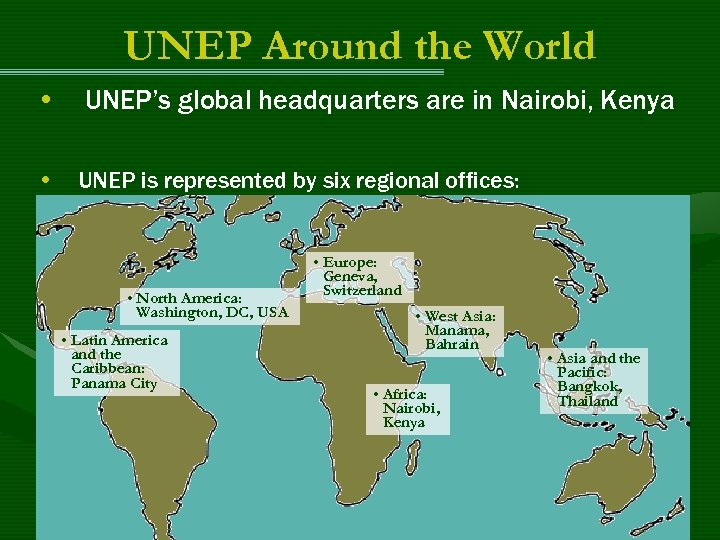 UNEP Around the World • UNEP’s global headquarters are in Nairobi, Kenya • UNEP is represented by six regional offices: • North America: Washington, DC, USA • Latin America and the Caribbean: Panama City • Europe: Geneva, Switzerland • West Asia: Manama, Bahrain • Africa: Nairobi, Kenya • Asia and the Pacific: Bangkok, Thailand
 UNEP is the Voice of the Environment within the United Nations System • UNEP’s mission is to provide leadership and • Encourage partnership in caring for the environment by inspiring, informing, and enabling nations and peoples to improve their quality of life without compromising that of future generations
 Global Environmental Challenges • Climate change: impact, mitigation, adaptation • Water quantity and quality • Land use change, deforestation • Loss of biodiversity • Land degradation, desertification • Air pollution in megacities • Urban waste , toxic waste, e waste, nuclear waste
 UNEP’s Main Roles • Monitor the state of the world environment • Identify solutions –International agreements –Voluntary initiatives • Help implement solutions
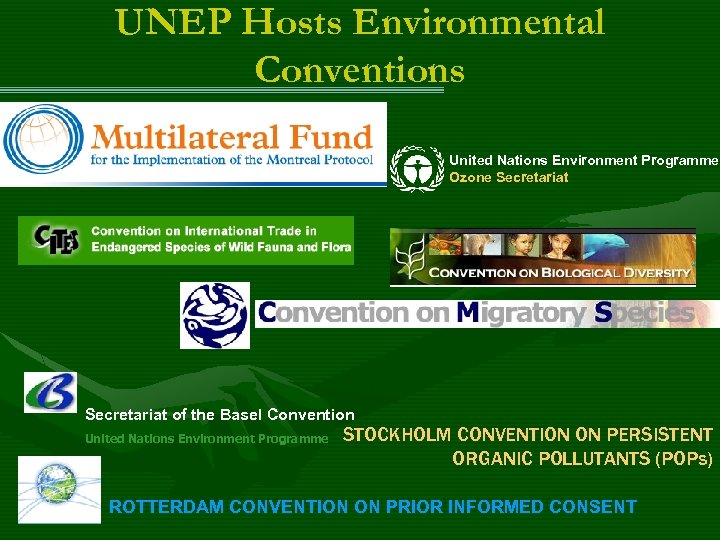 UNEP Hosts Environmental Conventions United Nations Environment Programme Ozone Secretariat of the Basel Convention United Nations Environment Programme STOCKHOLM CONVENTION ON PERSISTENT ORGANIC POLLUTANTS (POPs) ROTTERDAM CONVENTION ON PRIOR INFORMED CONSENT
 Role of international organisations in the field of remote sensing • UNEP and other UN agencies are users of remote sensing derived information; • Integrate data from multiple sources to address issues affecting people and environment • Capacity building in developing countries
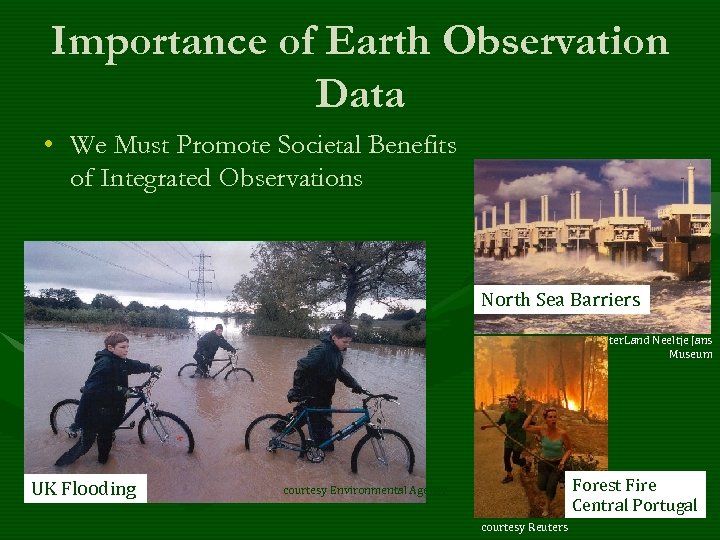 Importance of Earth Observation Data • We Must Promote Societal Benefits of Integrated Observations North Sea Barriers Water. Land Neeltje Jans Museum UK Flooding Forest Fire Central Portugal courtesy Environmental Agency courtesy Reuters
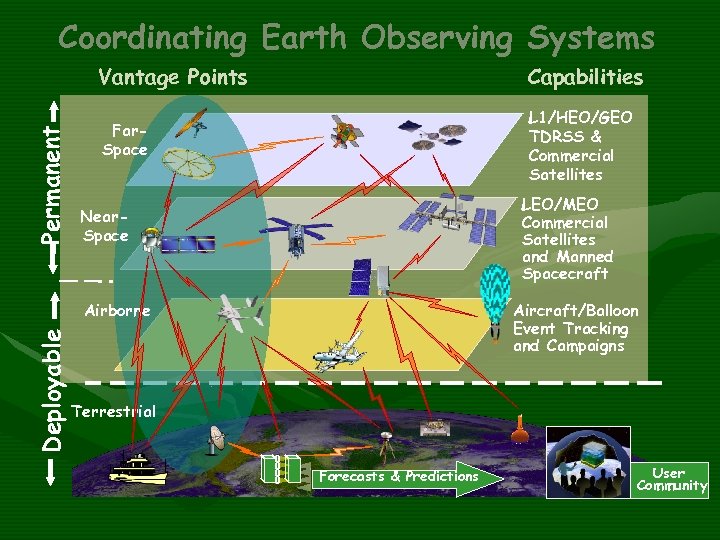 Coordinating Earth Observing Systems Permanent Vantage Points Capabilities Far. Space L 1/HEO/GEO TDRSS & Commercial Satellites LEO/MEO Commercial Satellites and Manned Spacecraft Near. Space Aircraft/Balloon Event Tracking and Campaigns Deployable Airborne Terrestrial Forecasts & Predictions User Community
 Building Global Political Momentu • UN Conference on Environment and Development (Earth Summit) June 1992; Rio de Janeiro • Millennium Development Goals - September 2000; UN General Assembly • World Summit on Sustainable Development (Rio + 10) - August 2002; Johannesburg • G 8 Summit – June 2003; Evian • Earth Observation Summit - July 2003; Washington D. C. • Earth Observation Summit III – February 2005; Brussels
 Vision for GEOSS (Global Earth Observation System of Systems) To realize a future wherein decisions and actions for the benefit of humankind are informed via coordinated, comprehensive and sustained Earth observations and information.
 Group on Earth Observation (GEO) Earth Observation Summit III: • Creation of the Group on Earth Observation • Implement the Global Earth Observation System of Systems • GEOSS 10 -year plan with 2, 6 and 10 year targets To monitor continuously the state of the Earth To increase understanding of dynamic Earth processes To enhance prediction of the Earth system To further implement international environmental treaty obligations GEOSS will meet the need for timely, quality, long-term, global information as a basis for sound decision making, and will. . .
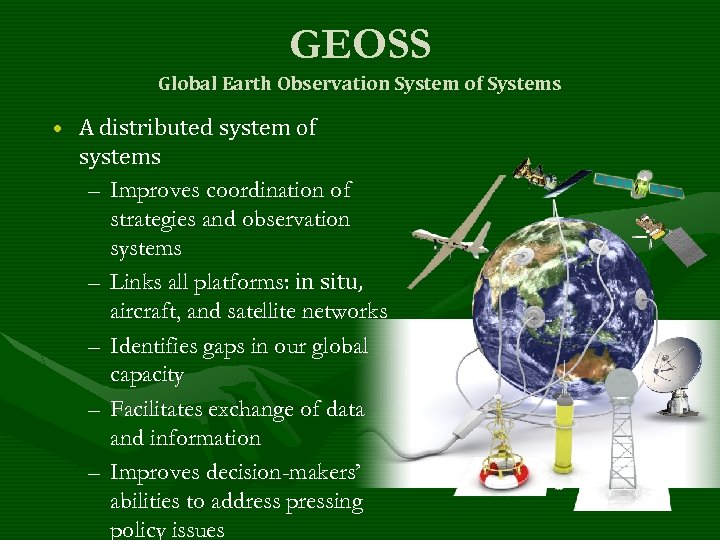 GEOSS Global Earth Observation System of Systems • A distributed system of systems – Improves coordination of strategies and observation systems – Links all platforms: in situ, aircraft, and satellite networks – Identifies gaps in our global capacity – Facilitates exchange of data and information – Improves decision-makers’ abilities to address pressing policy issues
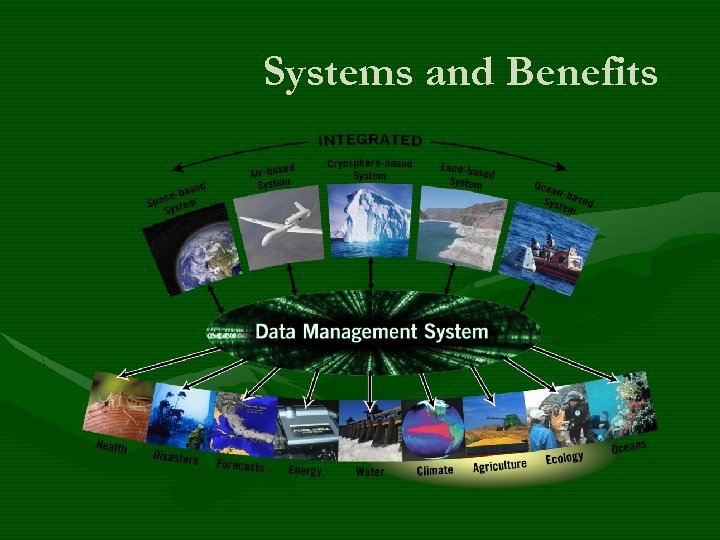 Systems and Benefits
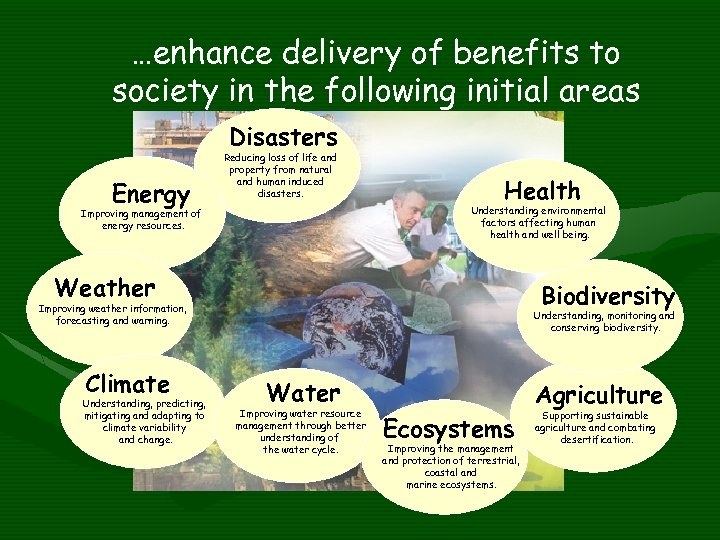 …enhance delivery of benefits to society in the following initial areas Disasters Energy Reducing loss of life and property from natural and human induced disasters. Health Understanding environmental factors affecting human health and well being. Improving management of energy resources. Weather Biodiversity Improving weather information, forecasting and warning. Climate Understanding, predicting, mitigating and adapting to climate variability and change. Understanding, monitoring and conserving biodiversity. Water Improving water resource management through better understanding of the water cycle. Ecosystems Improving the management and protection of terrestrial, coastal and marine ecosystems. Agriculture Supporting sustainable agriculture and combating desertification.
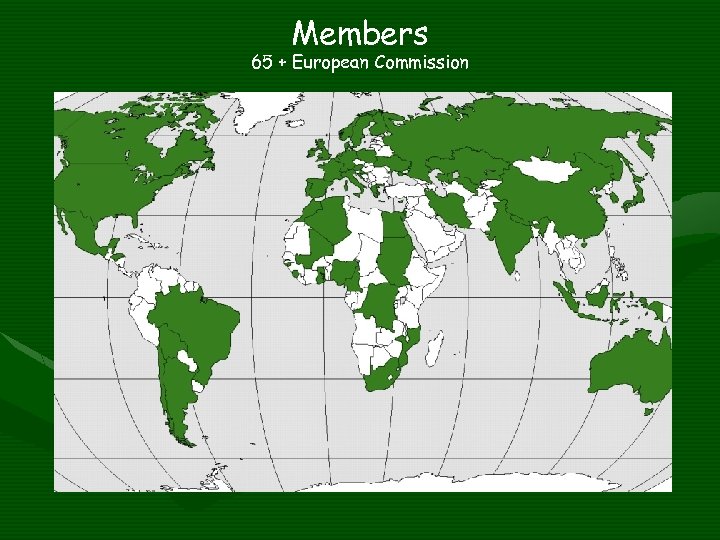 Members 65 + European Commission
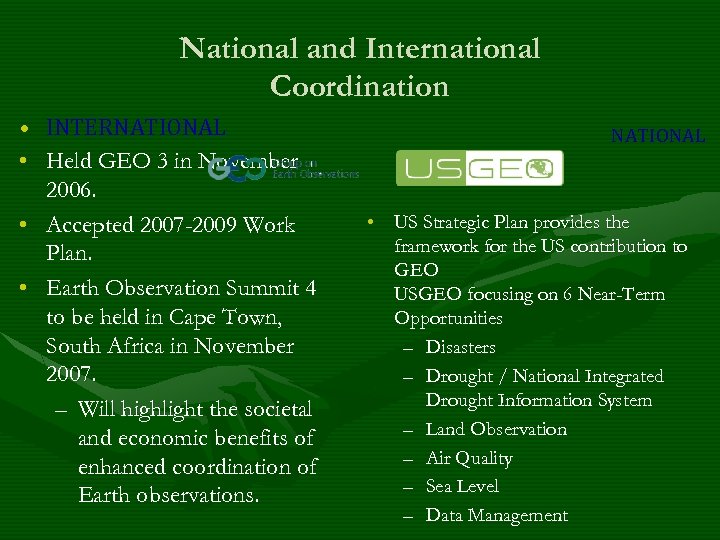 National and International Coordination • INTERNATIONAL • Held GEO 3 in November 2006. • Accepted 2007 -2009 Work Plan. • Earth Observation Summit 4 to be held in Cape Town, South Africa in November 2007. – Will highlight the societal and economic benefits of enhanced coordination of Earth observations. NATIONAL • US Strategic Plan provides the framework for the US contribution to GEO USGEO focusing on 6 Near-Term Opportunities – Disasters – Drought / National Integrated Drought Information System – Land Observation – Air Quality – Sea Level – Data Management
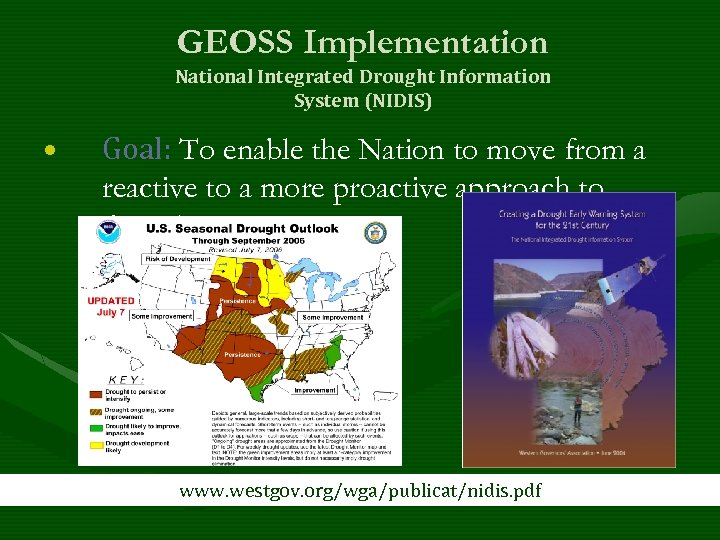 GEOSS Implementation National Integrated Drought Information System (NIDIS) • Goal: To enable the Nation to move from a reactive to a more proactive approach to droughts. www. westgov. org/wga/publicat/nidis. pdf
 Challenges In Creating Such a System • Data policyassuring full and open data exchange and access • Observing scope - achieving the needed spatial, temporal and spectral coverage • Data quality producing calibrated data sets in useful formats from multiple sensors and venues • Cost- acquiring sufficient resources to deploy observing systems and manage the resulting data and information • Security assuring safe operations and peaceful uses of observing systems • Complexitycreating a system equal to the task of delivering useful information about the very complex Earth system
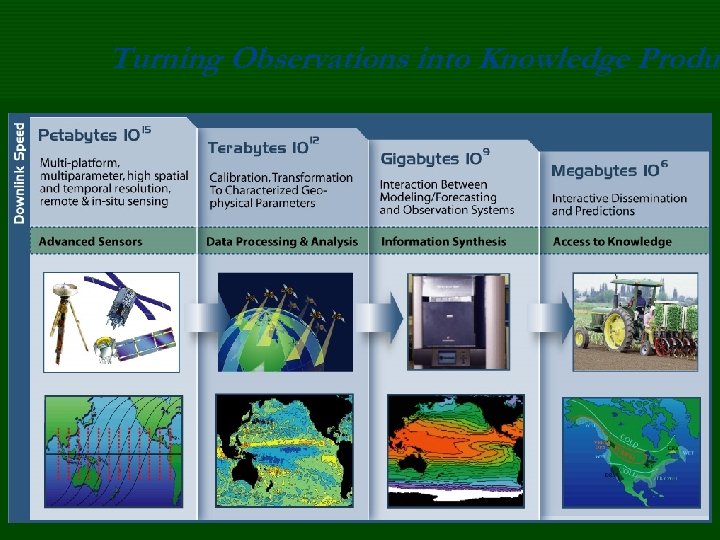 Turning Observations into Knowledge Produc Produ
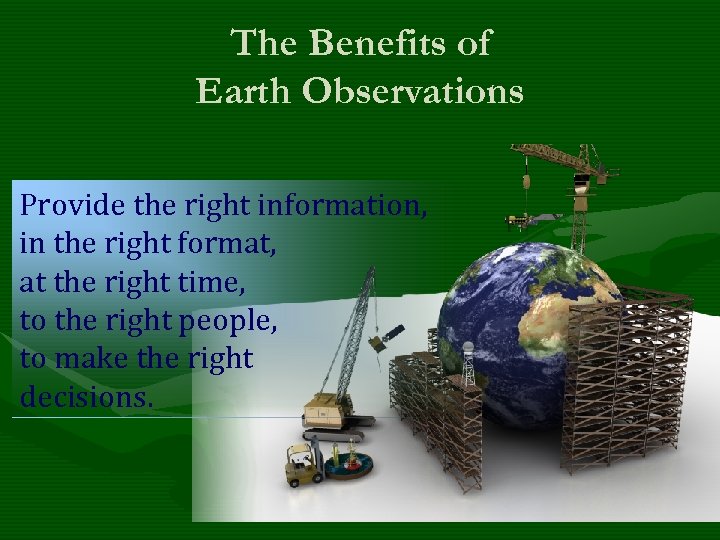 The Benefits of Earth Observations Provide the right information, in the right format, at the right time, to the right people, to make the right decisions.