 Скачать презентацию Remote Sensing in Brazil National Institute for Space
2049055f98ed57f4ed75f5f9b607e692.ppt
- Количество слайдов: 35



Remote Sensing in Brazil National Institute for Space Research INPE Leila Fonseca Image Processing Division INPE 1
Evolution of remote sensing use and applications in Brazil • Up to mid 70´s: all the work which demanded earth information were met by using aerial photogrammetry technology • 1965 -1985: considered the golden period of aerial photogrammetry since this technology was cartelized and was the most expensive in the world • In this period great projets, which demanded updated mappings and with high international grants came up in Brazil (Coffee plantation survey in the entire São Paulo state) 2
Evolution of remote sensing use and applications in Brazil • After 1985 when the first orbital remote sensing companies were set up, some institutions or companies, which could not afford the aerial photogrammetric products, started to use satellite imagery • Initially, the research focused on environmental sector such as fire monitoring, deforestation evaluation. All of them used traditional tools 3
Evolution of remote sensing use and applications in Brazil • In the 90´s the use of satellite images increased considerably due to: the quick spreading of such technology; to the high cost of aerial photo technology; spread personal computer image processing tools • As of 1999 with Landsat-7 launching and 2000 with High resolution IKONOS operation, many applications which were performed using aerial photos, could then be done using satellites images 4
New high resolution satellites • Quick Bird (USA): 0. 61 meters spatial resolution • IKONOS (USA): 1. 0 meter spatial resolution • EROS (ISRAEL): 1. 8 meter spatial resolution • This technology has made information acquisition cheaper: the same produts generated using aerial photo (maps in scales 1: 2000, 1: 5000; urban data) can now be acquired for 1/10 of the price we payed 10 years ago 5
Remote Sensing Companies • Two groups: – Aerial remote sensing: use photogrammetry technology (20) • BASE, Aerofoto, Cruzeiro, Aerosul, Engefoto, Esteio and more 15 smaller ones – Orbital remote sensing: use satellite imagery technology (40) • IMAGEM, Sensora, Intersat, Geoambiente, Threetek and more 30 smaller ones 6
Remote Sensing Companies • Pioneer company: IMAGE (1986) – Leader in Latin America and Brazil (250 persons) • Other companies were set up in the 90´s due to a great increase in the market 7
New Technologies 8
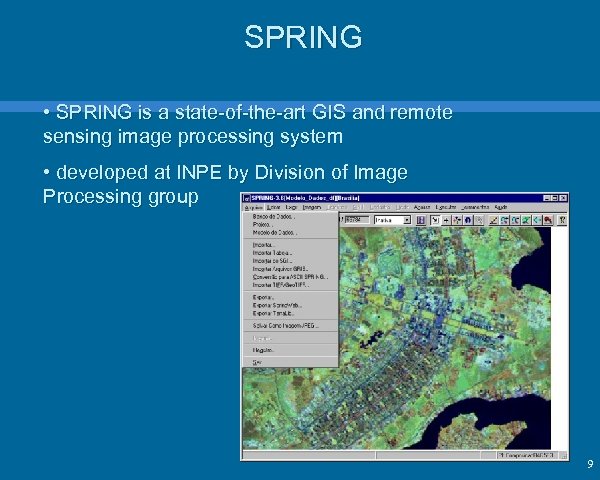
SPRING • SPRING is a state-of-the-art GIS and remote sensing image processing system • developed at INPE by Division of Image Processing group 9
SPRING • provides integration of raster and vector data representations in a single environment • INPE has invested more than 140 men/year o • used for important projects in Brazil such as: Multi-temporal evaluation of deforestation in the Amazon; Ecological-Economical Zoning for Brazil; The National Soils Database 10
SPRING • A Multi-platform system, including Windows 95/98/NT, Linux and Solaris support for • A widely accessible freeware for the GIS community with a quick learning curve • new algorithms (spatial analysis) • Is totally free on http: //www. dpi. inpe. br • Training courses: http: //www. dpi. inpe/cursos 11
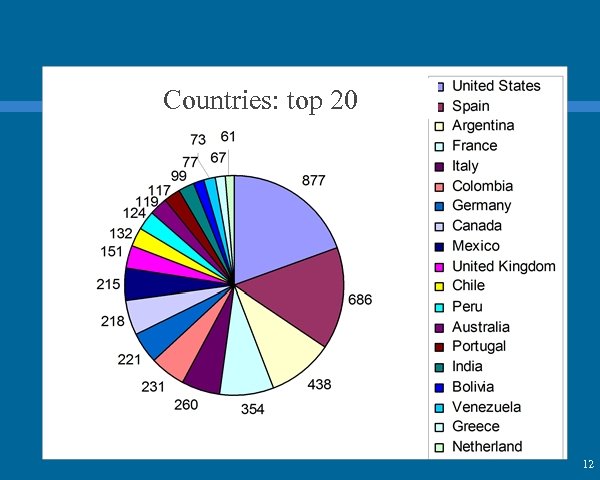
Countries: top 20 12
CBERS China-Brazil Earth Resources Satellite • Spatial program: cooperation between the Brazil and Chine • CBERS-1 satellite was launched on October 14, 1999, aboard the Chinese rocket Long March 4 B, from the Launch Center in Taiyuan, province of Shanxi, approximately 750 kilometers southwest of Beijing • http: //www. inpe. br/programas/cbers/english/index. htm 13
CBERS • multi-sensor payload with different spatial resolutions and data collecting frequencies • WFI (Wide Field Imager, swath of 890 km with spatial resolution of 260 m): • CCD (high resolution, 113 km wide strip with 20 m spatial resolution) • IRMSS (Infrared Multispectral Scanner, 120 km swath with the resolution of 80 m, 160 m in thermal channel ) • Data collection system (real-time retransmission of environmental data gathered on the ground ) 14
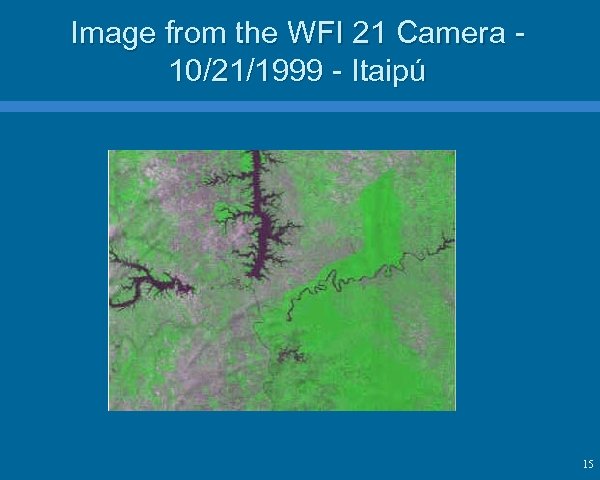
Image from the WFI 21 Camera 10/21/1999 - Itaipú 15
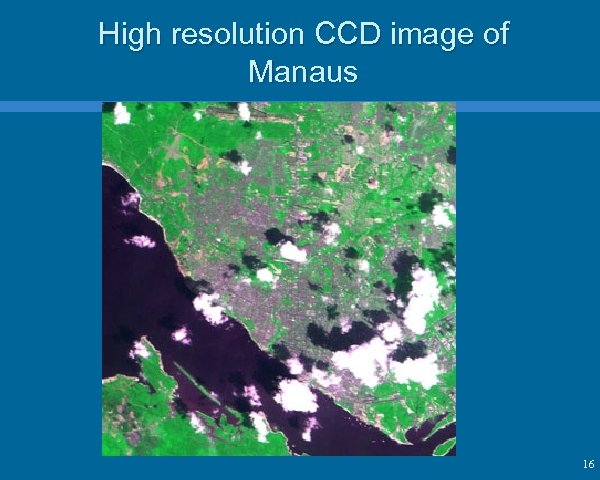
High resolution CCD image of Manaus 16
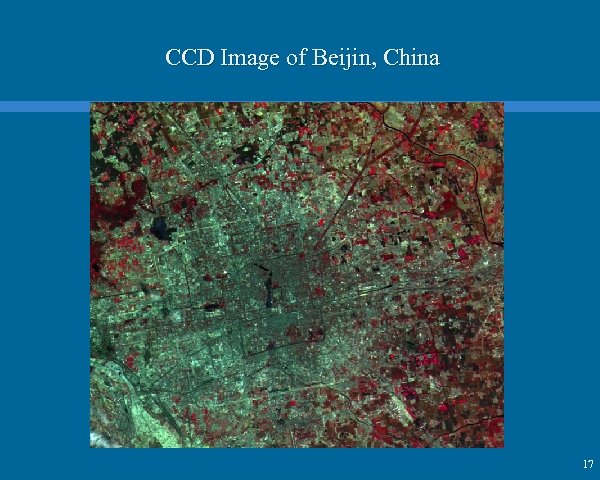
CCD Image of Beijin, China 17
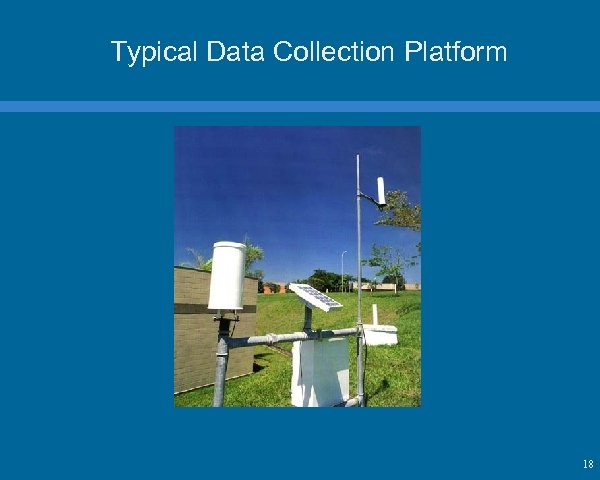
Typical Data Collection Platform 18
Results • participation in the International Space Station due to the experience acquired through the CBERS program • the establishment of an industrial sector in the space area in Brazil • Brazil is prepared to get involved in complex and ambitious tasks in the space area • Studies for the development of more satellites from the CBERS series 19
Some important projects 20
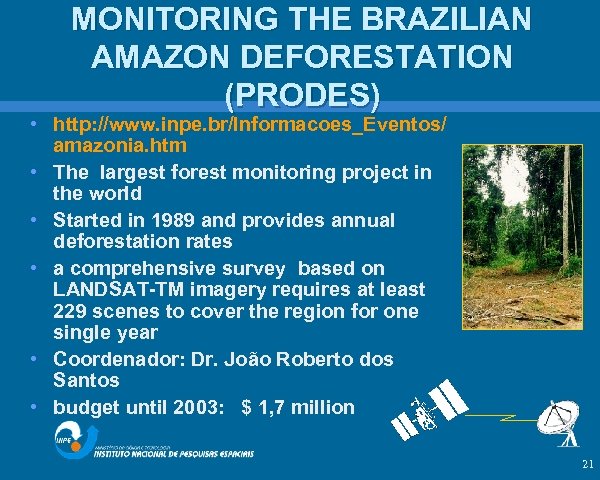
MONITORING THE BRAZILIAN AMAZON DEFORESTATION. (PRODES) • http: //www. inpe. br/Informacoes_Eventos/ amazonia. htm • The largest forest monitoring project in the world • Started in 1989 and provides annual deforestation rates • a comprehensive survey based on LANDSAT-TM imagery requires at least 229 scenes to cover the region for one single year • Coordenador: Dr. João Roberto dos Santos • budget until 2003: $ 1, 7 million 21
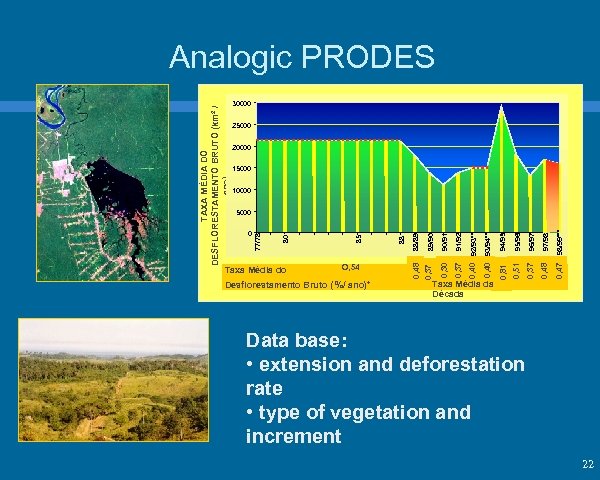
30000 25000 20000 15000 10000 94/95 95/96 96/97 97/98 98/99*** 0, 51 0, 37 0, 48 0, 47 Taxa Média da Década 0, 81 91/92 0, 37 0, 40 93/94** 90/91 0, 40 92/93** 89/90 0, 30 88 0, 37 Desflorestamento Bruto ( %/ ano)* 88/89 O, 54 0, 48 Taxa Média do 85 0 80 5000 77/78 TAXA MÉDIA DO DESFLORESTAMENTO BRUTO (km² / ano) Analogic PRODES Data base: • extension and deforestation rate • type of vegetation and increment 22
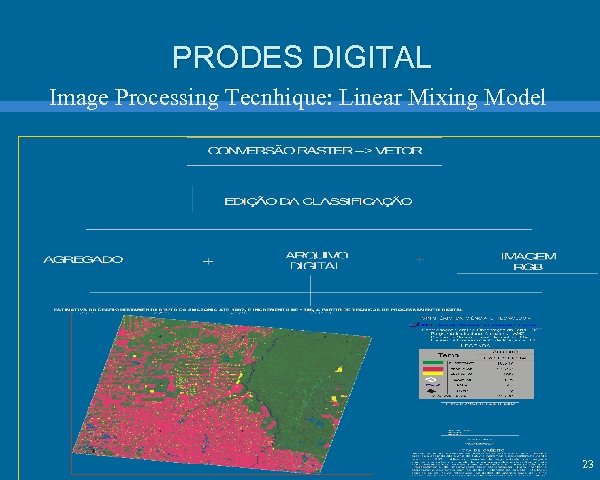
PRODES DIGITAL Image Processing Tecnhique: Linear Mixing Model 23
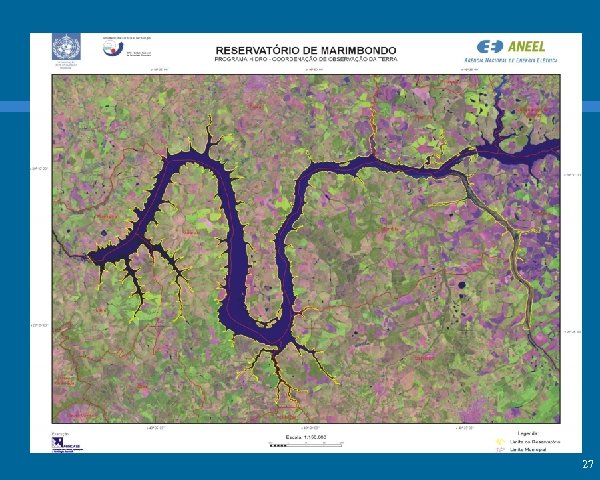
Mapping of flooded area by brazilian hydroelectric resevoirs using satellite images ANEEL - National Electric Energy Agency INPE – National Institute for Space Research WMO – World Meteorologic Organization 24
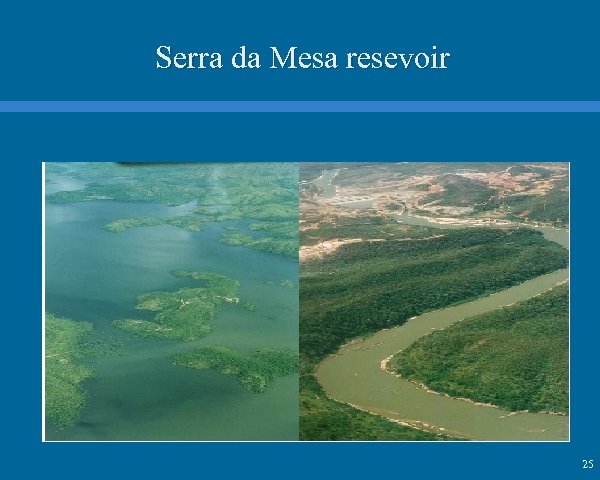
Serra da Mesa resevoir 25
Objective • Provide na uniform data base on the area flooded by hydroelectric resevoirs to support a fair financial compensation of municipalities • 124 resevoirs were mapped in 3 months • Over 90 TM-5 images were processed and incorporated into GIS (SPRING) • Normalized water index was used to define the boundary between water and land • Manual editing was needed to account for erros related to macrophytes and islands • Accuracy of the methodology was assessed by comparing topographic maps available for the more recent resevoirs 26
27
Conclusion • The methodoly was efficient (low cost and computationally quick) • The results were quickly implemented in public policies • The way the projet was set up allowed public administrator having direct acess to the data • Fexible: allow updating at any time • The results showed that the official area flooded by resevoirs was smaller than the real area 28
Remote Sensing for water management in arid and semi-arid areas: The Brazilian Experience Dra Evlyn (INPE) www. obt. inpe. br: evlyn water) 29
Remote sensing applications • • • Desertification assessment Crop irrigation monitoring Aquaculture zoning Cartography (X band SAR interferometry) Reservoir management 30
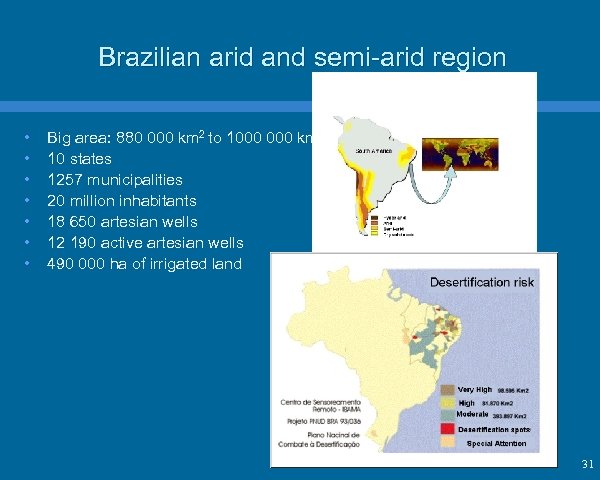
Brazilian arid and semi-arid region • • Big area: 880 000 km 2 to 1000 km 2 10 states 1257 municipalities 20 million inhabitants 18 650 artesian wells 12 190 active artesian wells 490 000 ha of irrigated land 31
Brazilian agencies using RS for water management – Water Resources Secretariat at the Ministry of Environment, Water Resources and Legal Amazon (MMA) – Semi-arid Research Unity (CPATSA) of the Brazilian Agricultural Research Corporation (EMBRAPA) – National Water Agency (ANA – Brazilian Geological Survey (CPRM) at the Ministry of Mines and Energy (MME) – National Electric Energy Agency (ANEEL) – MME – S. Francisco River Basin Development Company (CODEVASF) – Ceara Meteorology and Water Resources Institute (FUNCEME) 32
Concluding remarks • The use of remote sensing techniques for water resources management in Brazil is far behind of other applications. – lack of cloud free remote sensing data at a time frequency compatible to the water resource monitoring needs; – lack of human resources capable of coupling with the complexity of remote sensing applications to water resources. 33
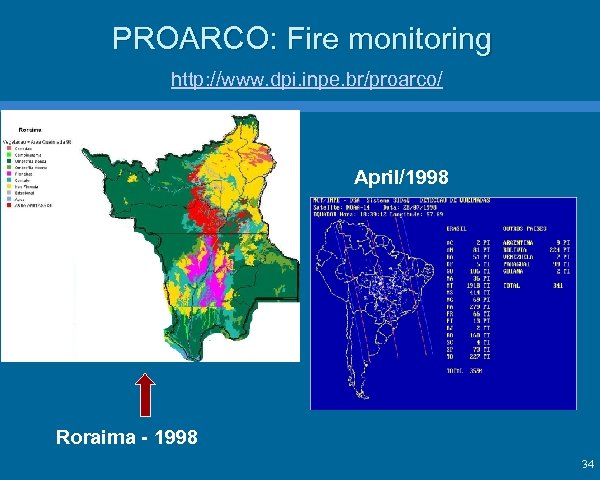
PROARCO: Fire monitoring http: //www. dpi. inpe. br/proarco/ April/1998 Roraima - 1998 34
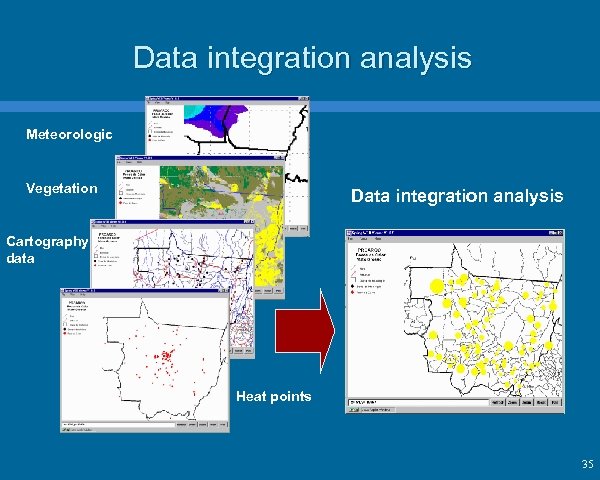
Data integration analysis Meteorologic Vegetation Data integration analysis Cartography data Heat points 35
Скачать презентацию Remote Sensing in Brazil National Institute for Space
2049055f98ed57f4ed75f5f9b607e692.ppt