


 Скачать презентацию Remote Sensing and Image Processing 10 Dr Mathias
5a8c084140b4ece1d0541b67f6f060f6.ppt
- Количество слайдов: 23
 Remote Sensing and Image Processing: 10 Dr. Mathias (Mat) Disney UCL Geography Office: 301, 3 rd Floor, Chandler House Tel: 7670 4290 (x 24290) Email: mdisney@geog. ucl. ac. uk www. geog. ucl. ac. uk/~mdisney 1
 Revision: Lecture 1 • Introductions and definitions – EO/RS is obtaining information at a distance from target • Spatial, spectral, temporal, angular, polarization etc. – Measure reflected / emitted / backscattered EMR and INFER biophysical properties from these – Range of platforms and applications, sensors, types of remote sensing (active / passive) • Why EO? – Global coverage (potentially), synoptic, repeatable…. – Can do in inaccessible regions 2
 Lecture 1 • Intro to EM spectrum • • Continuous range of …UV, Visible, near IR, thermal, microwave, radio… shorter (higher f) == higher energy longer (lower f) == lower energy 3
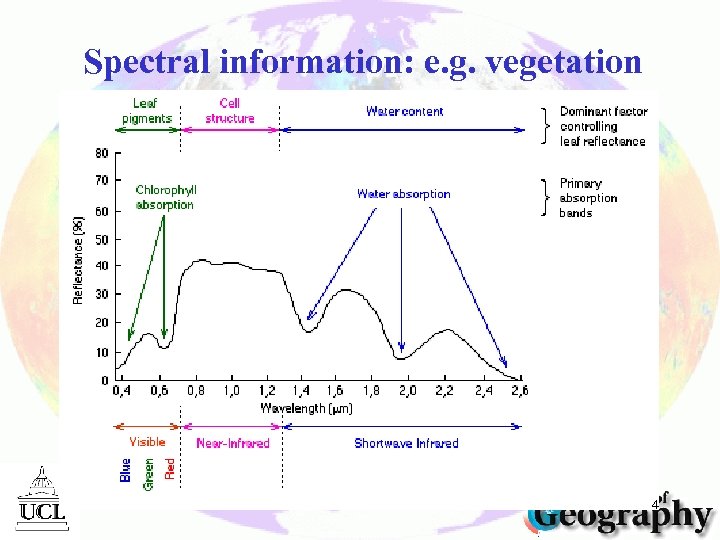 Spectral information: e. g. vegetation 4
 Lecture 2 • Image processing – NOT same as remote sensing – Display and enhancement; information extraction • Display – Colour composites of different bands • E. g. standard false colour composite (NIR, R, G on red, green, blue to highlight vegetation) – Colour composites of different dates – Density slicing, thresholding • Enhancement – Histogram manipulation • Make better use of dynamic range via histogram stretching, histogram equalisation etc. 5
 Lecture 3: Blackbody concept & EMR • Blackbody – Absorbs and re-radiates all radiation incident upon it at maximum possible rate per unit area (Wm-2), at each wavelength, , for a given temperature T (in K) • Total emitted radiation from a blackbody, M , described by Stefan-Boltzmann Law M = T 4 – TSun 6000 K M , sun 73. 5 MWm-2 – TEarth 300 K M , Earth 460 Wm-2 • Wien’s Law (Displacement Law) – Energy per unit wavelength E( ) is function of T and – As T↓ peak of emitted radiation gets longer • For blackbodies at different T, note m. T is constant, k = 2897 m. K i. e. m = k/T – m, sun = 0. 48 m – m, Earth = 9. 66 m 6
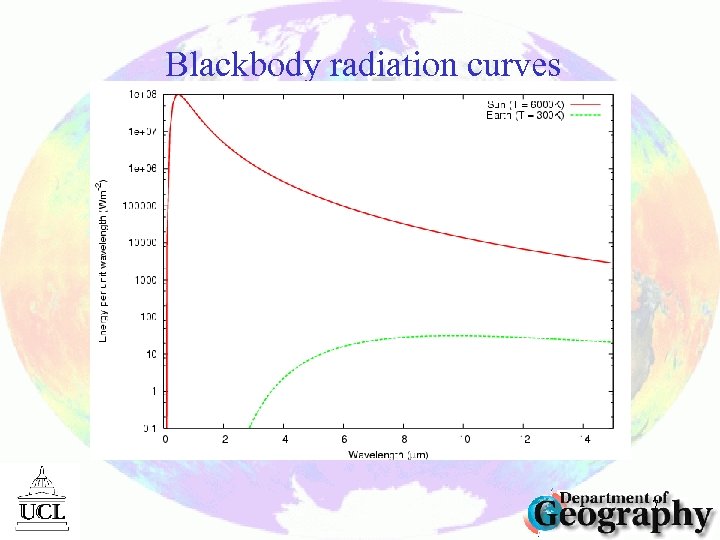 Blackbody radiation curves 7
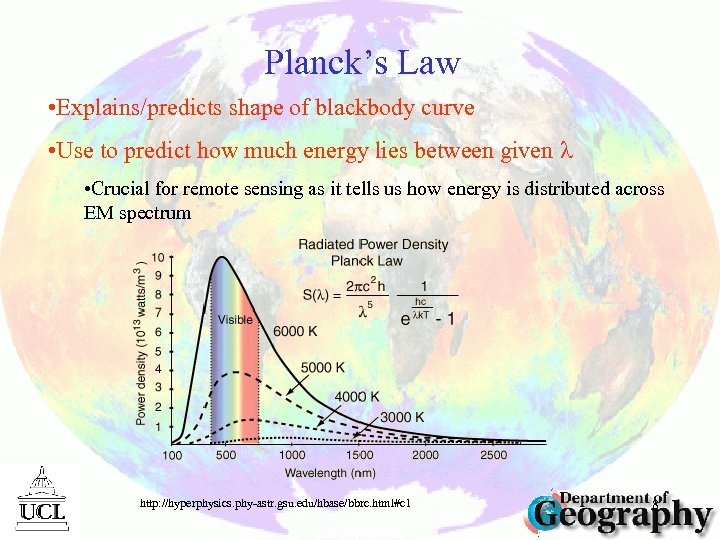 Planck’s Law • Explains/predicts shape of blackbody curve • Use to predict how much energy lies between given • Crucial for remote sensing as it tells us how energy is distributed across EM spectrum http: //hyperphysics. phy-astr. gsu. edu/hbase/bbrc. html#c 1 8
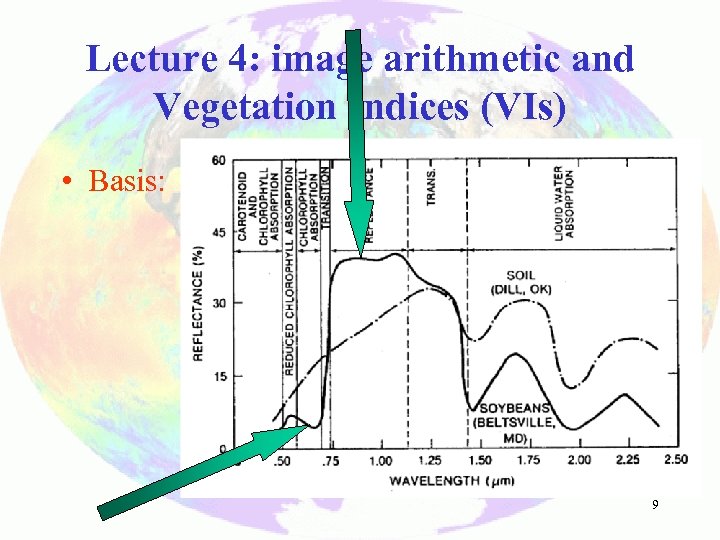 Lecture 4: image arithmetic and Vegetation Indices (VIs) • Basis: 9
 Why VIs? • Empirical relationships with range of vegetation / climatological parameters · f. APAR – fraction of absorbed photosynthetically active radiation (the bit of solar EM spectrum plants use) · NPP – net primary productivity (net gain of biomass by growing plants) · simple to understand/implement · fast – per scene operation (ratio, difference etc. ), not per pixel (unlike spatial filtering) 10
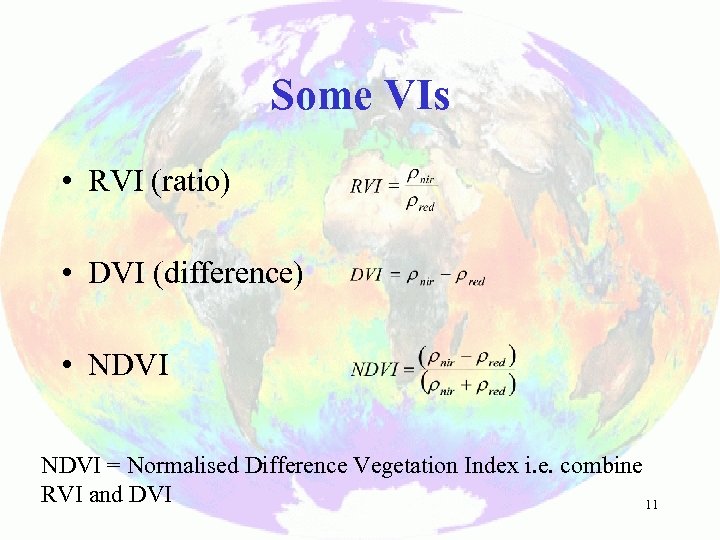 Some VIs • RVI (ratio) • DVI (difference) • NDVI = Normalised Difference Vegetation Index i. e. combine RVI and DVI 11
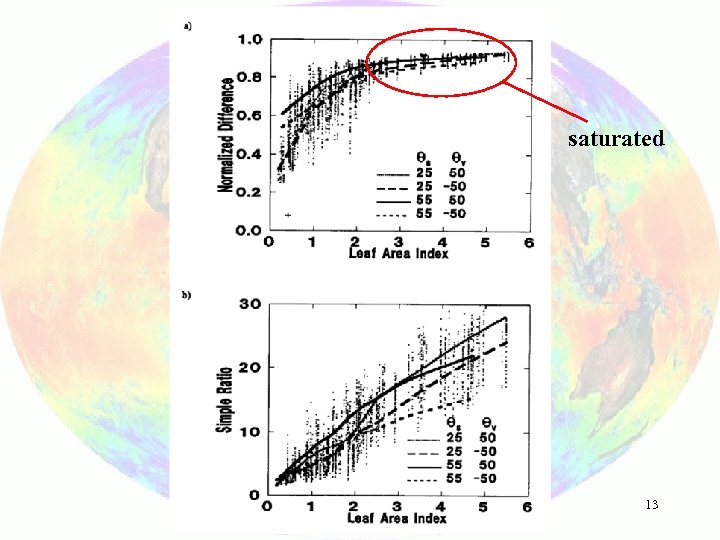
 limitations of NDVI · NDVI is empirical i. e. no physical meaning · atmospheric effects: · esp. aerosols (turbid - decrease) · Correct via direct methods - atmospheric correction or indirect methods e. g. new idices e. g. atmos. -resistant VI (ARVI/GEMI) · sun-target-sensor effects (BRDF): · Max. value composite (MVC) - ok on cloud, not so effective on BRDF · saturation problems !!! · saturates at LAI of > 3 12
 saturated 13
 Lecture 5: atmosphere and surface interactions • Top-of-atmosphere (TOA) signal is NOT target signal – function of target reflectance – plus atmospheric component (scattering, absorption) – need to choose appropriate regions of EM spectrum to view target (atmospheric windows) • Surface reflectance is anisotropic – i. e. looks different in different directions – described by BRDF – angular signal contains information on size, shape and distribution of objects on surface 14
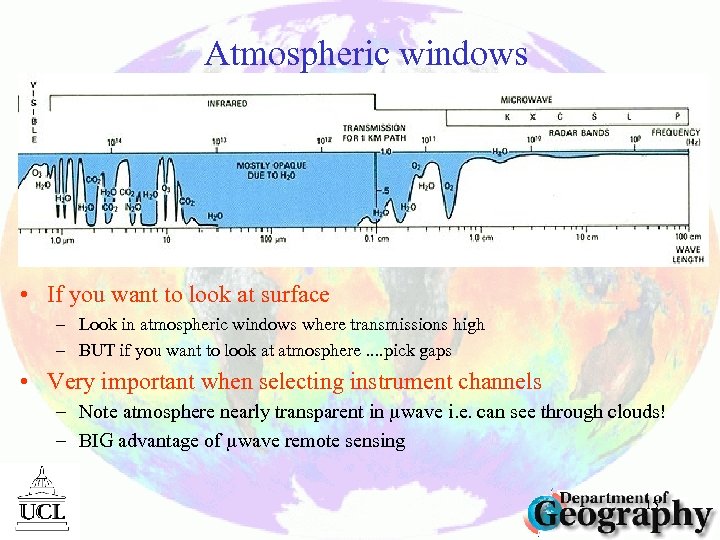 Atmospheric windows • If you want to look at surface – Look in atmospheric windows where transmissions high – BUT if you want to look at atmosphere. . pick gaps • Very important when selecting instrument channels – Note atmosphere nearly transparent in wave i. e. can see through clouds! – BIG advantage of wave remote sensing 15
 Lecture 6: Spatial filtering • Spatial filters divided into two broad categories – Feature detection e. g. edges • High pass filter – Image enhancement e. g. smoothing “speckly” data e. g. RADAR • Low pass filters 16
 Lecture 7: Resolution • Spatial resolution – Ability to separate objects spatially (function of optics and orbit) • Spectral resolution – location, width and sensitivity of chosen bands (function of detector and filters) • Temporal resolution – time between observations (function of orbit and swath width) • Radiometric resolution – precision of observations (NOT accuracy!) (determined by detector sensitivity and quantisation) 17
 Low v high resolution? • Tradeoff of coverage v detail (and data volume) • Spatial resolution? – Low spatial resolution means can cover wider area – High res. gives more detail BUT may be too much data (and less energy per pixel) • Spectral resolution? – Broad bands = less spectral detail BUT greater energy per band – Dictated by sensor application • visible, SWIR, thermal? ? From http: //modis. gsfc. nasa. gov/about/specs. html 18
 Lecture 8: temporal sampling • Sensor orbit – geostationary orbit - over same spot • BUT distance means entire hemisphere is viewed e. g. METEOSAT – polar orbit can use Earth rotation to view entire surface • Sensor swath – Wide swath allows more rapid revisit • typical of moderate res. instruments for regional/global applications – Narrow swath == longer revisit times • typical of higher resolution for regional to local applications 19
 Tradeoffs • Tradeoffs always made over resolutions…. – We almost always have to achieve compromise between greater detail (spatial, spectral, temporal, angular etc) and range of coverage – Can’t cover globe at 1 cm resolution – too much information! – Resolution determined by application (and limitations of sensor design, orbit, cost etc. ) 20
 Lecture 9: vegetation and terrestrial carbon cycle • Terrestrial carbon cycle is global • Primary impact on surface is vegetation / soil system • So need monitoring at large scales, regularly, and some way of monitoring vegetation…… – Hence remote sensing in conjunction with in situ measurement and modelling 21
 Vegetation and carbon · We can use complex models of carbon cycle · Driven by climate, land use, vegetation type and dynamics, soil etc. · Dynamic Global Vegetation Models (DGVMS) · Use EO data to provide…. · Land cover · Estimates of “phenology” veg. dynamics (e. g. LAI) · Gross and net primary productivity (GPP/NPP) 22
 EO and carbon cycle: current · Use global capability of MODIS, MISR, AVHRR, SPOT-VGT. . . etc. · · Estimate vegetation cover (LAI) Dynamics (phenology, land use change etc. ) Productivity (NPP) Disturbance (fire, deforestation etc. ) · Compare with models and measurements · AND/OR use to constrain/drive models 23