


 Скачать презентацию REMOTE MONITORING AN INDUSTRY PERSPECTIVE Tech Ventures
eceacdcfee0871c2ee32a0d2906bc32b.ppt
- Количество слайдов: 19
 REMOTE MONITORING: AN INDUSTRY PERSPECTIVE Tech. Ventures / Professor Mohan Sawhney March 7, 2006 Prepared by Michael Dickman, William Nicolau, and Alfonso Yanez Remote Monitoring: An Industry Perspective by Dickman, Nicolau, and Yanez, 2006. 0
 EXECUTIVE SUMMARY • Remote monitoring (RM) a diverse sector that requires multiple competencies and applies across industries – Industry-specific definitions but several characteristics in common – RM been around in some form for a long time, but RM now enabling both new uses for existing technologies and entirely new types of applications • Research shows RM applications best classified by interactivity and mission criticality – How active or passive is the technology? – How critical is this use to the organization? Catastrophe-prevention or nice-to-have? • Complexity of RM value chain indicates players likely to specialize in one to two segments • Have analyzed five industry verticals, highlighting importance of customizing technology, deployment, and sales efforts to industry needs – Government & homeland security, retail & consumer goods, transportation & logistics, oil & gas, and health care & medical devices • Many exciting opportunities exist in RM for both entrepreneurs and existing companies with relevant technologies and/or capabilities – Winners will provide software driven applications with real-time, interactive remote control capability that offers almost unlimited, fast, wireless information gathering/reporting, easy-to-use for relevant field personnel Remote Monitoring: An Industry Perspective by Dickman, Nicolau, and Yanez, 2006. 1
 AGENDA Introduction and framework • Definition, brief history, and what is new • Overview of remote monitoring landscape and value chain Industry vertical deep-dives • Government & homeland security • Retail & consumer goods • Transportation & logistics • Oil & gas • Health care & medical devices Takeaways and opportunities Remote Monitoring: An Industry Perspective by Dickman, Nicolau, and Yanez, 2006. 2
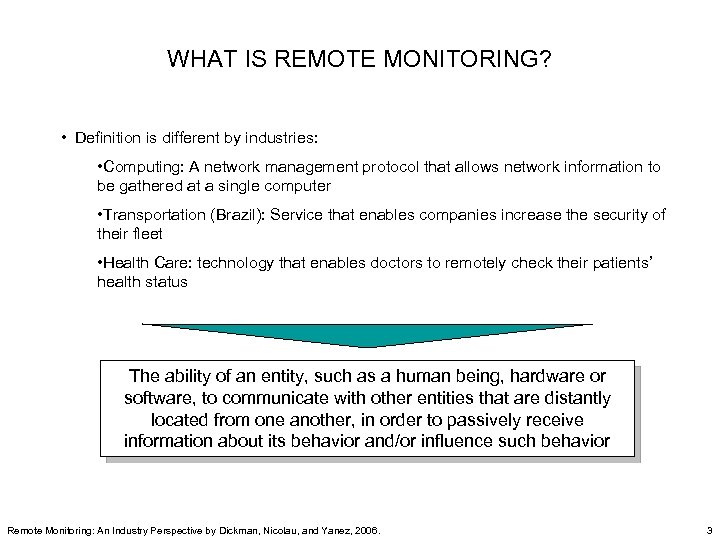 WHAT IS REMOTE MONITORING? • Definition is different by industries: • Computing: A network management protocol that allows network information to be gathered at a single computer • Transportation (Brazil): Service that enables companies increase the security of their fleet • Health Care: technology that enables doctors to remotely check their patients’ health status The ability of an entity, such as a human being, hardware or software, to communicate with other entities that are distantly located from one another, in order to passively receive information about its behavior and/or influence such behavior Remote Monitoring: An Industry Perspective by Dickman, Nicolau, and Yanez, 2006. 3
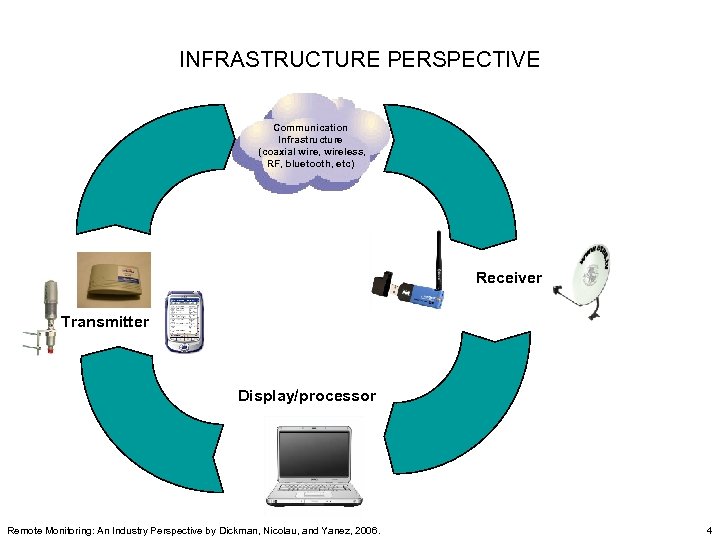 INFRASTRUCTURE PERSPECTIVE Communication Infrastructure (coaxial wire, wireless, RF, bluetooth, etc) Receiver Transmitter Display/processor Remote Monitoring: An Industry Perspective by Dickman, Nicolau, and Yanez, 2006. 4
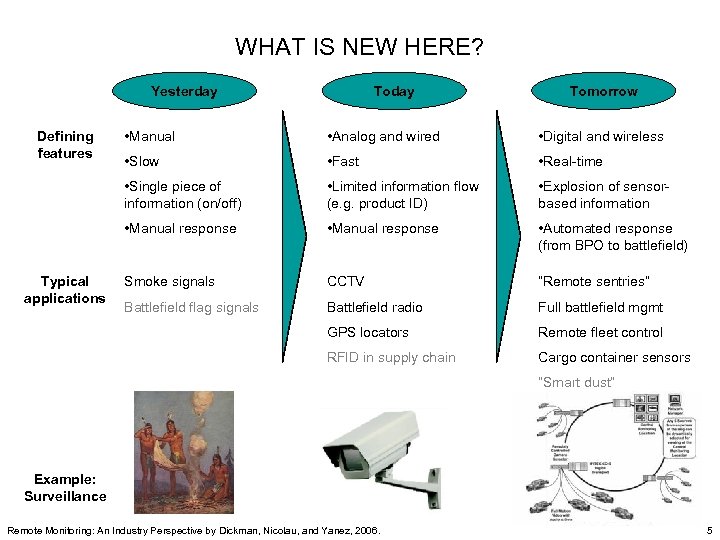 WHAT IS NEW HERE? Yesterday Tomorrow • Analog and wired • Digital and wireless • Slow • Fast • Real-time • Limited information flow (e. g. product ID) • Explosion of sensorbased information • Manual response • Automated response (from BPO to battlefield) Smoke signals CCTV “Remote sentries” Battlefield flag signals Battlefield radio Full battlefield mgmt GPS locators Remote fleet control RFID in supply chain Typical applications • Manual • Single piece of information (on/off) Defining features Cargo container sensors “Smart dust” Example: Surveillance Remote Monitoring: An Industry Perspective by Dickman, Nicolau, and Yanez, 2006. 5
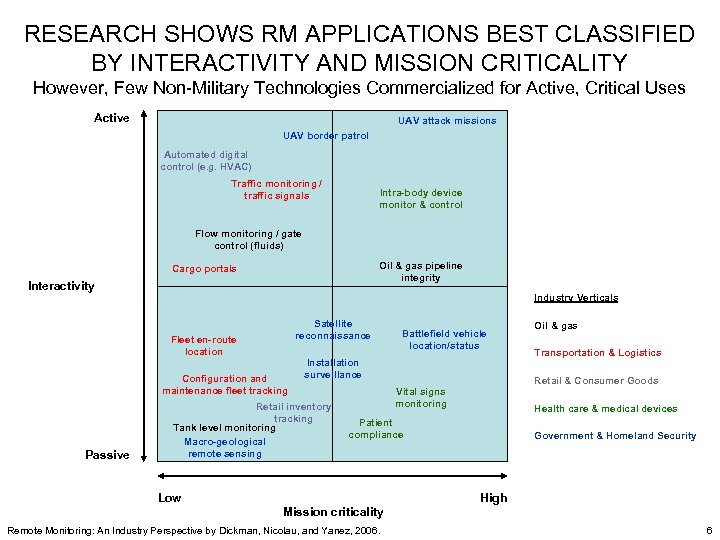 RESEARCH SHOWS RM APPLICATIONS BEST CLASSIFIED BY INTERACTIVITY AND MISSION CRITICALITY However, Few Non-Military Technologies Commercialized for Active, Critical Uses Active UAV attack missions UAV border patrol Automated digital control (e. g. HVAC) Traffic monitoring / traffic signals Intra-body device monitor & control Flow monitoring / gate control (fluids) Oil & gas pipeline integrity Cargo portals Interactivity Industry Verticals Satellite reconnaissance Fleet en-route location Configuration and maintenance fleet tracking Passive Battlefield vehicle location/status Installation surveillance Retail inventory tracking Tank level monitoring Macro-geological remote sensing Transportation & Logistics Retail & Consumer Goods Vital signs monitoring Health care & medical devices Patient compliance Low Oil & gas Government & Homeland Security High Mission criticality Remote Monitoring: An Industry Perspective by Dickman, Nicolau, and Yanez, 2006. 6
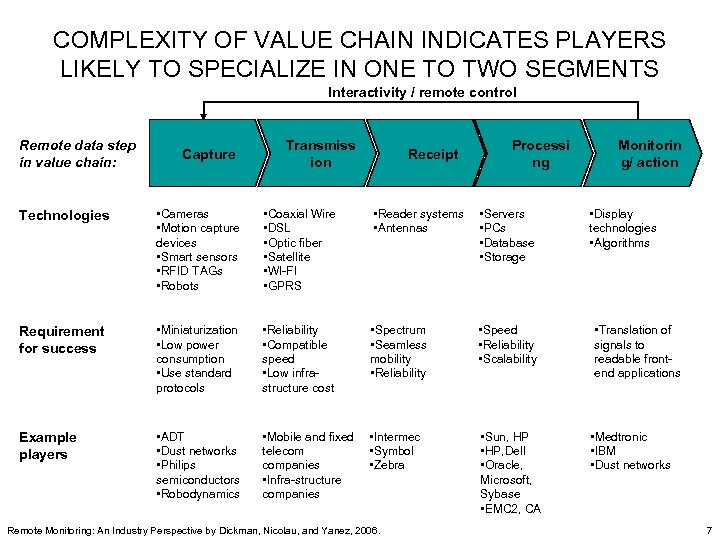 COMPLEXITY OF VALUE CHAIN INDICATES PLAYERS LIKELY TO SPECIALIZE IN ONE TO TWO SEGMENTS Interactivity / remote control Remote data step in value chain: Capture Transmiss ion Receipt Processi ng Technologies • Cameras • Motion capture devices • Smart sensors • RFID TAGs • Robots • Coaxial Wire • DSL • Optic fiber • Satellite • WI-FI • GPRS • Reader systems • Antennas • Servers • PCs • Database • Storage Requirement for success • Miniaturization • Low power consumption • Use standard protocols • Reliability • Compatible speed • Low infrastructure cost • Spectrum • Seamless mobility • Reliability • Speed • Reliability • Scalability Example players • ADT • Dust networks • Philips semiconductors • Robodynamics • Mobile and fixed telecom companies • Infra-structure companies • Intermec • Symbol • Zebra • Sun, HP • HP, Dell • Oracle, Microsoft, Sybase • EMC 2, CA Remote Monitoring: An Industry Perspective by Dickman, Nicolau, and Yanez, 2006. Monitorin g/ action • Display technologies • Algorithms • Translation of signals to readable frontend applications • Medtronic • IBM • Dust networks 7
 AGENDA Introduction and framework • Definition, brief history, and what is new • Overview of remote monitoring landscape and value chain Industry vertical deep-dives • Government & homeland security • Retail & consumer goods • Transportation & logistics • Oil & gas • Health care & medical devices Takeaways and opportunities Remote Monitoring: An Industry Perspective by Dickman, Nicolau, and Yanez, 2006. 8
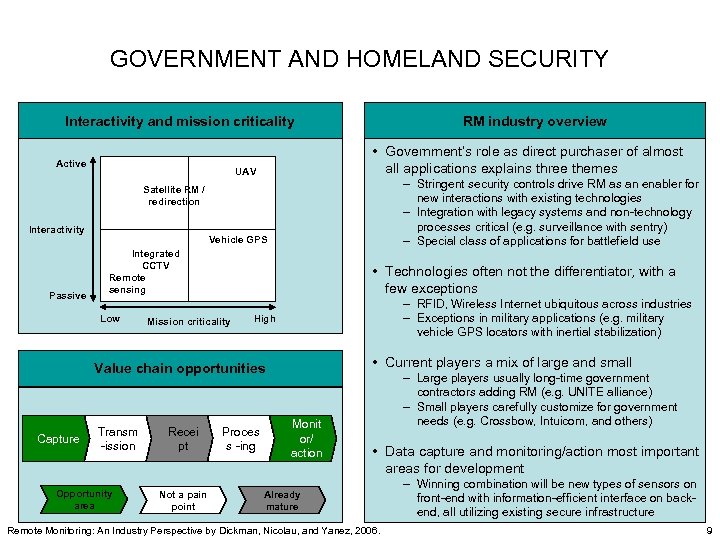 GOVERNMENT AND HOMELAND SECURITY Interactivity and mission criticality Active RM industry overview • Government’s role as direct purchaser of almost all applications explains three themes UAV – Stringent security controls drive RM as an enabler for new interactions with existing technologies – Integration with legacy systems and non-technology processes critical (e. g. surveillance with sentry) – Special class of applications for battlefield use Satellite RM / redirection Interactivity Passive Vehicle GPS Integrated CCTV Remote sensing Low • Technologies often not the differentiator, with a few exceptions Mission criticality – RFID, Wireless Internet ubiquitous across industries – Exceptions in military applications (e. g. military vehicle GPS locators with inertial stabilization) High • Current players a mix of large and small Value chain opportunities Capture Transm -ission Opportunity area Recei pt Not a pain point Proces s -ing Monit or/ action – Large players usually long-time government contractors adding RM (e. g. UNITE alliance) – Small players carefully customize for government needs (e. g. Crossbow, Intuicom, and others) • Data capture and monitoring/action most important areas for development Already mature Remote Monitoring: An Industry Perspective by Dickman, Nicolau, and Yanez, 2006. – Winning combination will be new types of sensors on front-end with information-efficient interface on backend, all utilizing existing secure infrastructure 9
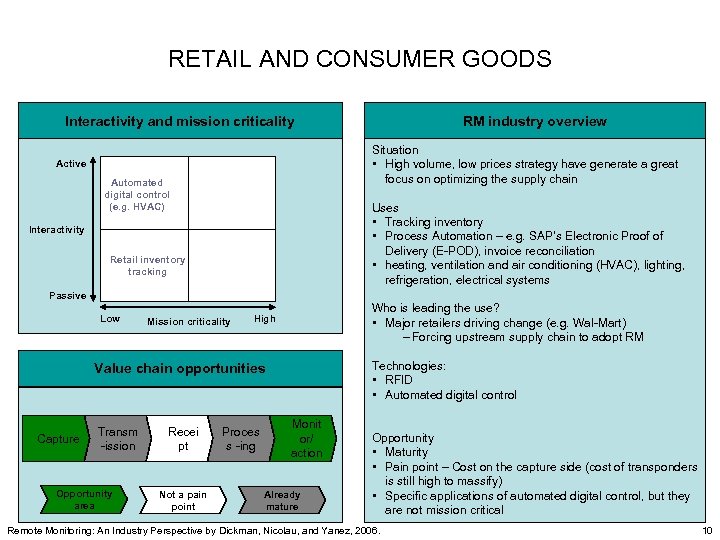 RETAIL AND CONSUMER GOODS Interactivity and mission criticality RM industry overview Situation • High volume, low prices strategy have generate a great focus on optimizing the supply chain Active Automated digital control (e. g. HVAC) Uses • Tracking inventory • Process Automation – e. g. SAP’s Electronic Proof of Delivery (E-POD), invoice reconciliation • heating, ventilation and air conditioning (HVAC), lighting, refrigeration, electrical systems Interactivity Retail inventory tracking Passive Low Mission criticality Who is leading the use? • Major retailers driving change (e. g. Wal-Mart) – Forcing upstream supply chain to adopt RM High Technologies: • RFID • Automated digital control Value chain opportunities Capture Transm -ission Opportunity area Recei pt Not a pain point Proces s -ing Monit or/ action Already mature Opportunity • Maturity • Pain point – Cost on the capture side (cost of transponders is still high to massify) • Specific applications of automated digital control, but they are not mission critical Remote Monitoring: An Industry Perspective by Dickman, Nicolau, and Yanez, 2006. 10
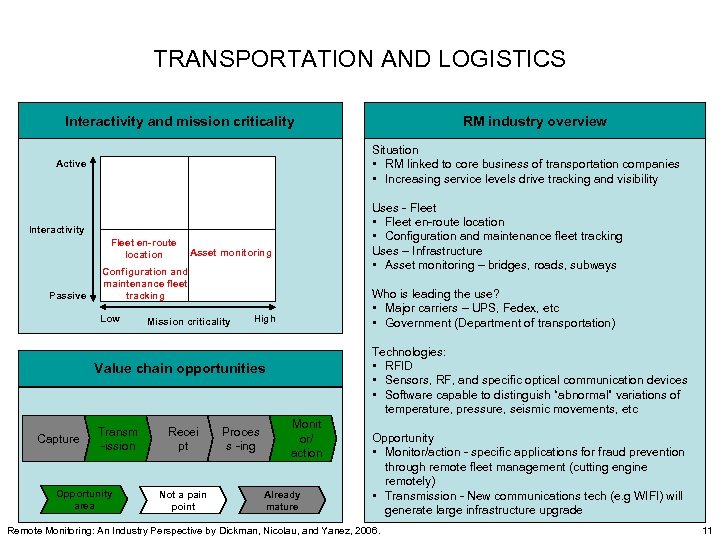 TRANSPORTATION AND LOGISTICS Interactivity and mission criticality Situation • RM linked to core business of transportation companies • Increasing service levels drive tracking and visibility Active Uses - Fleet • Fleet en-route location • Configuration and maintenance fleet tracking Uses – Infrastructure • Asset monitoring – bridges, roads, subways Interactivity Fleet en-route location Passive Asset monitoring Configuration and maintenance fleet tracking Low Mission criticality Who is leading the use? • Major carriers – UPS, Fedex, etc • Government (Department of transportation) High Technologies: • RFID • Sensors, RF, and specific optical communication devices • Software capable to distinguish “abnormal” variations of temperature, pressure, seismic movements, etc Value chain opportunities Capture RM industry overview Transm -ission Opportunity area Recei pt Not a pain point Proces s -ing Monit or/ action Already mature Opportunity • Monitor/action - specific applications for fraud prevention through remote fleet management (cutting engine remotely) • Transmission - New communications tech (e. g WIFI) will generate large infrastructure upgrade Remote Monitoring: An Industry Perspective by Dickman, Nicolau, and Yanez, 2006. 11
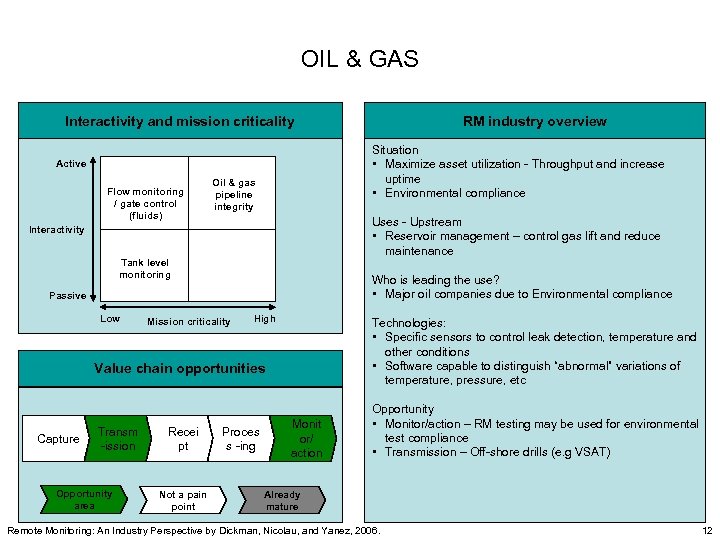 OIL & GAS Interactivity and mission criticality Situation • Maximize asset utilization - Throughput and increase uptime • Environmental compliance Active Flow monitoring / gate control (fluids) Oil & gas pipeline integrity Uses - Upstream • Reservoir management – control gas lift and reduce maintenance Interactivity Tank level monitoring Who is leading the use? • Major oil companies due to Environmental compliance Passive Low Mission criticality High Technologies: • Specific sensors to control leak detection, temperature and other conditions • Software capable to distinguish “abnormal” variations of temperature, pressure, etc Value chain opportunities Capture Transm -ission Opportunity area Recei pt Not a pain point RM industry overview Proces s -ing Monit or/ action Opportunity • Monitor/action – RM testing may be used for environmental test compliance • Transmission – Off-shore drills (e. g VSAT) Already mature Remote Monitoring: An Industry Perspective by Dickman, Nicolau, and Yanez, 2006. 12
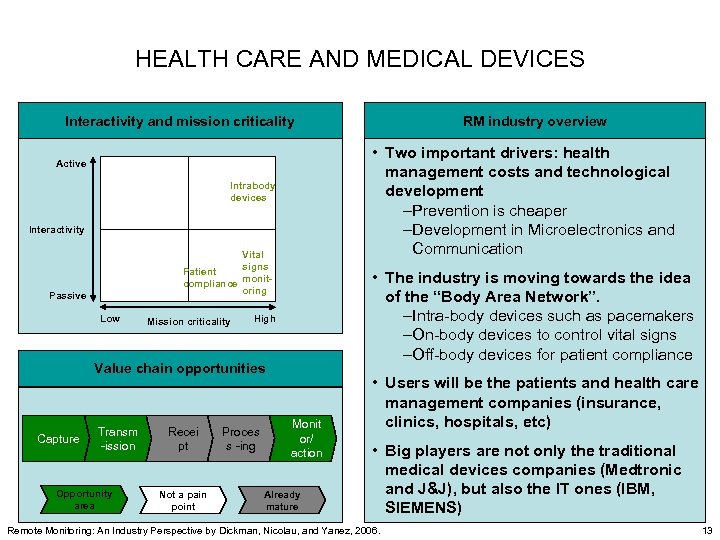 HEALTH CARE AND MEDICAL DEVICES Interactivity and mission criticality • Two important drivers: health management costs and technological development –Prevention is cheaper –Development in Microelectronics and Communication Active Intrabody devices Interactivity Vital signs Patient compliance monitoring Passive Low Mission criticality • The industry is moving towards the idea of the “Body Area Network”. –Intra-body devices such as pacemakers –On-body devices to control vital signs –Off-body devices for patient compliance High Value chain opportunities Capture Transm -ission Opportunity area Recei pt Not a pain point Proces s -ing RM industry overview Monit or/ action Already mature • Users will be the patients and health care management companies (insurance, clinics, hospitals, etc) • Big players are not only the traditional medical devices companies (Medtronic and J&J), but also the IT ones (IBM, SIEMENS) Remote Monitoring: An Industry Perspective by Dickman, Nicolau, and Yanez, 2006. 13
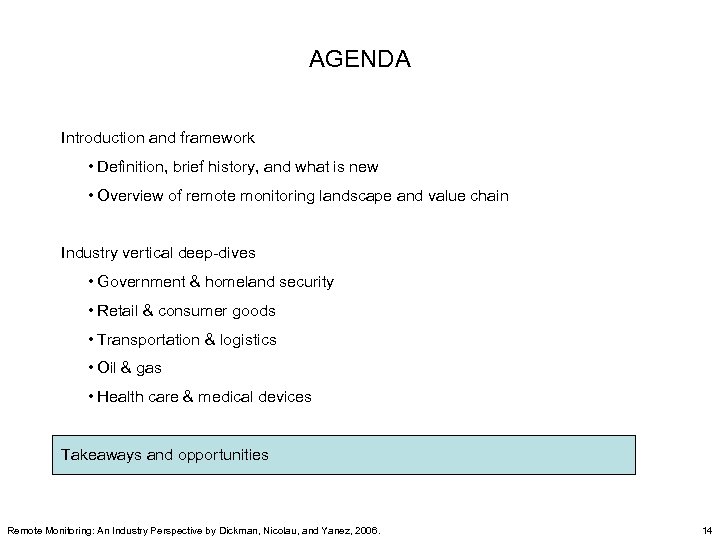 AGENDA Introduction and framework • Definition, brief history, and what is new • Overview of remote monitoring landscape and value chain Industry vertical deep-dives • Government & homeland security • Retail & consumer goods • Transportation & logistics • Oil & gas • Health care & medical devices Takeaways and opportunities Remote Monitoring: An Industry Perspective by Dickman, Nicolau, and Yanez, 2006. 14
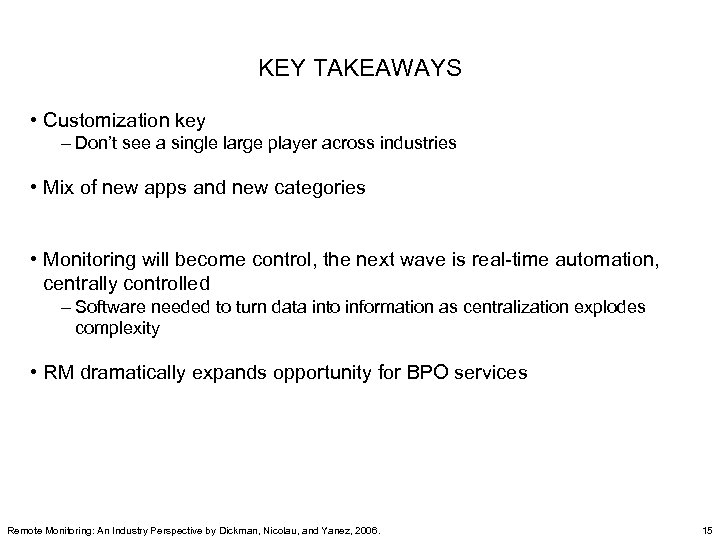 KEY TAKEAWAYS • Customization key – Don’t see a single large player across industries • Mix of new apps and new categories • Monitoring will become control, the next wave is real-time automation, centrally controlled – Software needed to turn data into information as centralization explodes complexity • RM dramatically expands opportunity for BPO services Remote Monitoring: An Industry Perspective by Dickman, Nicolau, and Yanez, 2006. 15
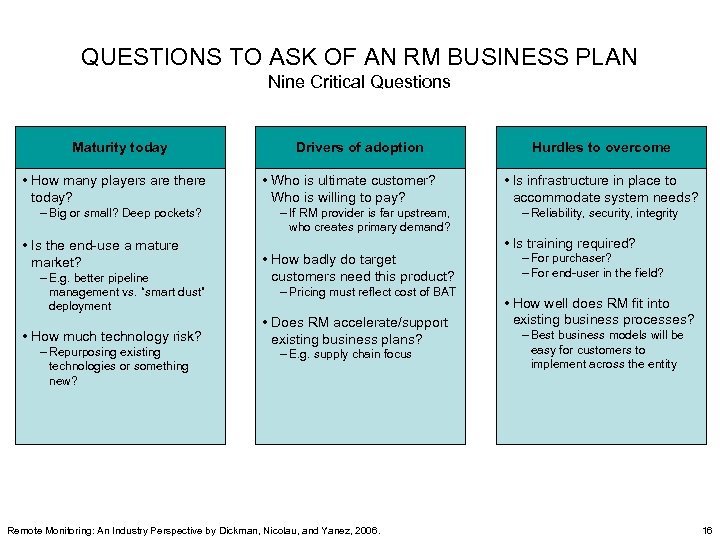 QUESTIONS TO ASK OF AN RM BUSINESS PLAN Nine Critical Questions Maturity today • How many players are there today? – Big or small? Deep pockets? • Is the end-use a mature market? – E. g. better pipeline management vs. “smart dust” deployment • How much technology risk? – Repurposing existing technologies or something new? Drivers of adoption • Who is ultimate customer? Who is willing to pay? – If RM provider is far upstream, who creates primary demand? Hurdles to overcome • Is infrastructure in place to accommodate system needs? – Reliability, security, integrity • Is training required? • How badly do target customers need this product? – Pricing must reflect cost of BAT • Does RM accelerate/support existing business plans? – E. g. supply chain focus Remote Monitoring: An Industry Perspective by Dickman, Nicolau, and Yanez, 2006. – For purchaser? – For end-user in the field? • How well does RM fit into existing business processes? – Best business models will be easy for customers to implement across the entity 16
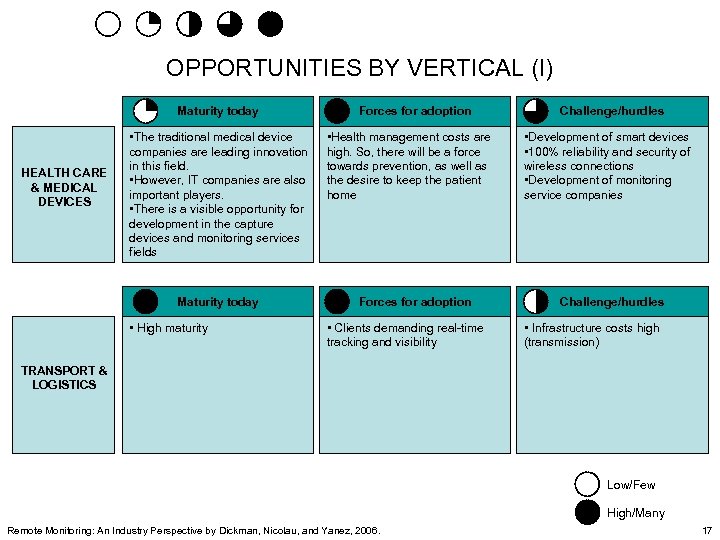 OPPORTUNITIES BY VERTICAL (I) Maturity today HEALTH CARE & MEDICAL DEVICES • The traditional medical device companies are leading innovation in this field. • However, IT companies are also important players. • There is a visible opportunity for development in the capture devices and monitoring services fields Maturity today • High maturity Forces for adoption • Health management costs are high. So, there will be a force towards prevention, as well as the desire to keep the patient home Forces for adoption • Clients demanding real-time tracking and visibility Challenge/hurdles • Development of smart devices • 100% reliability and security of wireless connections • Development of monitoring service companies Challenge/hurdles • Infrastructure costs high (transmission) TRANSPORT & LOGISTICS Low/Few High/Many Remote Monitoring: An Industry Perspective by Dickman, Nicolau, and Yanez, 2006. 17
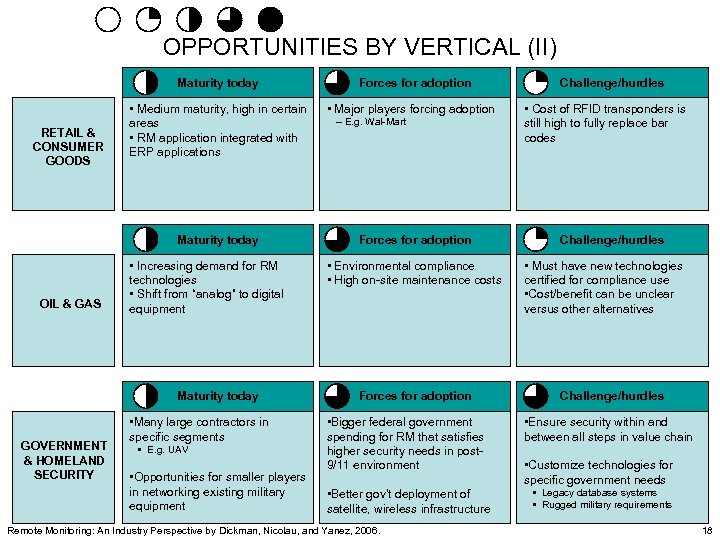 OPPORTUNITIES BY VERTICAL (II) Maturity today RETAIL & CONSUMER GOODS • Medium maturity, high in certain areas • RM application integrated with ERP applications Maturity today OIL & GAS • Increasing demand for RM technologies • Shift from “analog” to digital equipment Maturity today GOVERNMENT & HOMELAND SECURITY • Many large contractors in specific segments • E. g. UAV • Opportunities for smaller players in networking existing military equipment Forces for adoption • Major players forcing adoption – E. g. Wal-Mart Forces for adoption • Environmental compliance • High on-site maintenance costs Forces for adoption • Bigger federal government spending for RM that satisfies higher security needs in post 9/11 environment • Better gov’t deployment of satellite, wireless infrastructure Remote Monitoring: An Industry Perspective by Dickman, Nicolau, and Yanez, 2006. Challenge/hurdles • Cost of RFID transponders is still high to fully replace bar codes Challenge/hurdles • Must have new technologies certified for compliance use • Cost/benefit can be unclear versus other alternatives Challenge/hurdles • Ensure security within and between all steps in value chain • Customize technologies for specific government needs • Legacy database systems • Rugged military requirements 18