


 Скачать презентацию REMODECE-EIE 05 124 SI 2 419657 Residential Monitoring to Decrease Energy
6127d0132688ab5bdb3432539a40a02a.ppt
- Количество слайдов: 46
 REMODECE-EIE/05/124/SI 2. 419657 Residential Monitoring to Decrease Energy Use and Carbon Emissions in Europe Aníbal de Almeida adealmeida@isr. uc. pt ISR - Universidade de Coimbra Dep. Electrical Engineering, Pólo II 3030 -290 Coimbra, Portugal ISR – Universidade de Coimbra
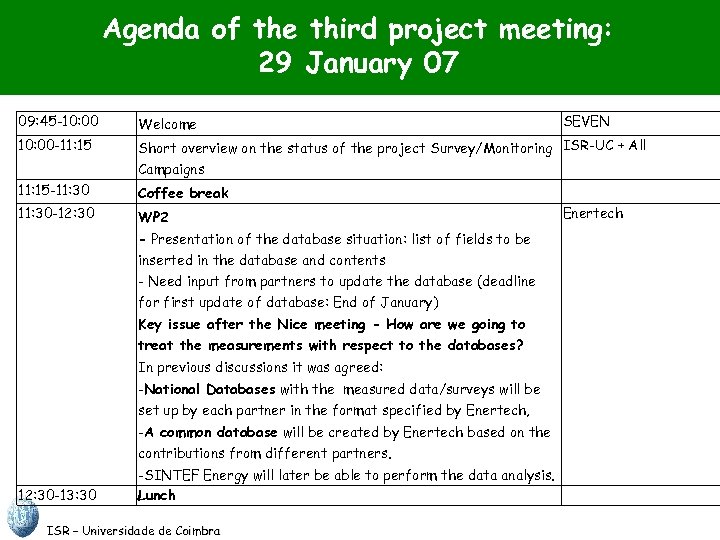 Agenda of the third project meeting: 29 January 07 09: 45 -10: 00 Welcome SEVEN 10: 00 -11: 15 Short overview on the status of the project Survey/Monitoring ISR-UC + All Campaigns 11: 15 -11: 30 Coffee break 11: 30 -12: 30 WP 2 - Presentation of the database situation: list of fields to be inserted in the database and contents - Need input from partners to update the database (deadline for first update of database: End of January) Key issue after the Nice meeting - How are we going to treat the measurements with respect to the databases? In previous discussions it was agreed: -National Databases with the measured data/surveys will be set up by each partner in the format specified by Enertech, -A common database will be created by Enertech based on the contributions from different partners. 12: 30 -13: 30 -SINTEF Energy will later be able to perform the data analysis. Lunch ISR – Universidade de Coimbra Enertech
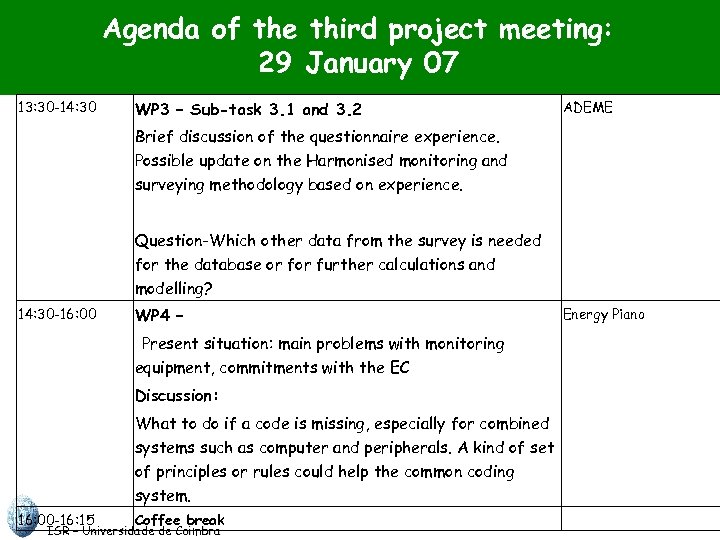 Agenda of the third project meeting: 29 January 07 13: 30 -14: 30 WP 3 – Sub-task 3. 1 and 3. 2 ADEME Brief discussion of the questionnaire experience. Possible update on the Harmonised monitoring and surveying methodology based on experience. Question-Which other data from the survey is needed for the database or further calculations and modelling? 14: 30 -16: 00 WP 4 – Present situation: main problems with monitoring equipment, commitments with the EC Discussion: What to do if a code is missing, especially for combined systems such as computer and peripherals. A kind of set of principles or rules could help the common coding system. 16: 00 -16: 15 Coffee break ISR – Universidade de Coimbra Energy Piano
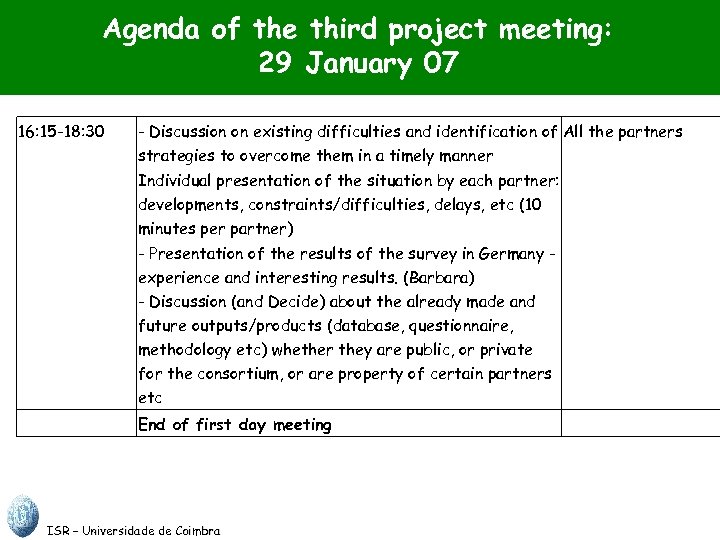 Agenda of the third project meeting: 29 January 07 16: 15 -18: 30 - Discussion on existing difficulties and identification of All the partners strategies to overcome them in a timely manner Individual presentation of the situation by each partner: developments, constraints/difficulties, delays, etc (10 minutes per partner) - Presentation of the results of the survey in Germany experience and interesting results. (Barbara) - Discussion (and Decide) about the already made and future outputs/products (database, questionnaire, methodology etc) whether they are public, or private for the consortium, or are property of certain partners etc End of first day meeting ISR – Universidade de Coimbra
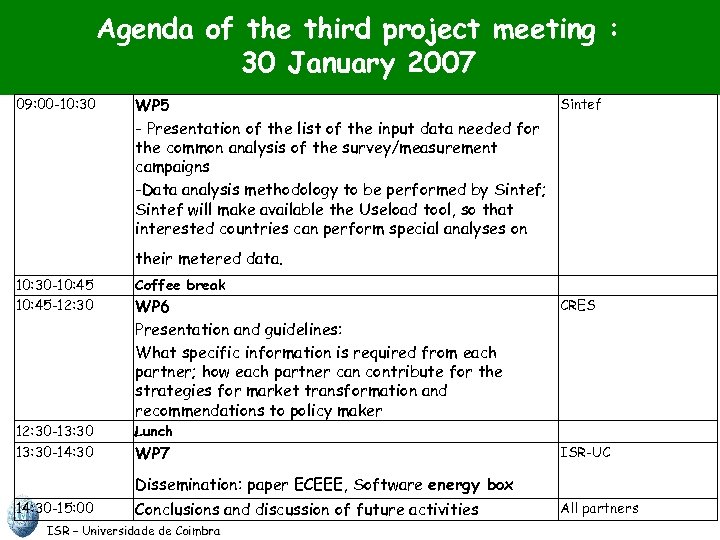 Agenda of the third project meeting : 30 January 2007 09: 00 -10: 30 Sintef WP 5 - Presentation of the list of the input data needed for the common analysis of the survey/measurement campaigns -Data analysis methodology to be performed by Sintef; Sintef will make available the Useload tool, so that interested countries can perform special analyses on their metered data. 10: 30 -10: 45 -12: 30 Coffee break 12: 30 -13: 30 Lunch 13: 30 -14: 30 WP 7 WP 6 Presentation and guidelines: What specific information is required from each partner; how each partner can contribute for the strategies for market transformation and recommendations to policy maker CRES ISR-UC Dissemination: paper ECEEE, Software energy box 14: 30 -15: 00 Conclusions and discussion of future activities ISR – Universidade de Coimbra All partners
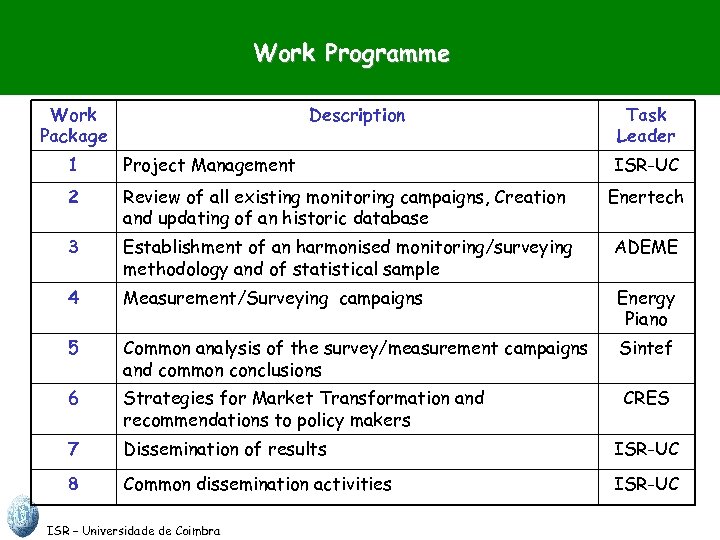 Work Programme Work Package Description Task Leader 1 Project Management 2 Review of all existing monitoring campaigns, Creation and updating of an historic database Enertech 3 Establishment of an harmonised monitoring/surveying methodology and of statistical sample ADEME 4 Measurement/Surveying campaigns Energy Piano 5 Common analysis of the survey/measurement campaigns and common conclusions Sintef 6 Strategies for Market Transformation and recommendations to policy makers CRES 7 Dissemination of results ISR-UC 8 Common dissemination activities ISR-UC ISR – Universidade de Coimbra ISR-UC
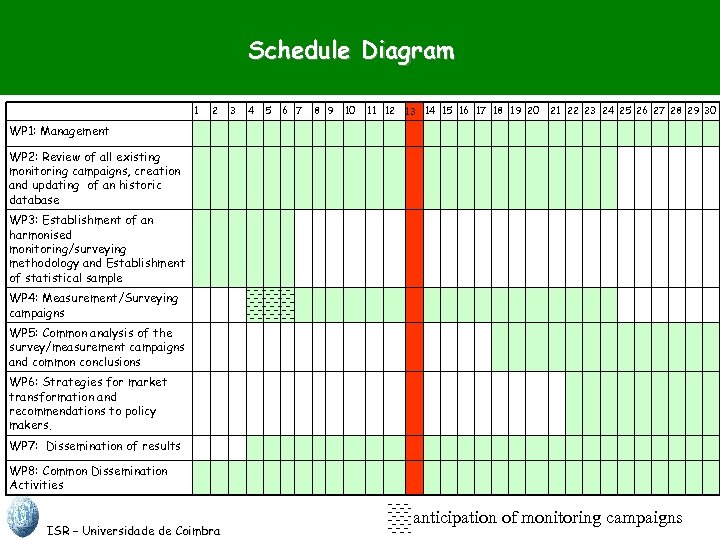 Schedule Diagram 1 2 3 4 5 6 7 8 9 10 11 12 13 14 15 16 17 18 19 20 21 22 23 24 25 26 27 28 29 30 WP 1: Management WP 2: Review of all existing monitoring campaigns, creation and updating of an historic database WP 3: Establishment of an harmonised monitoring/surveying methodology and Establishment of statistical sample WP 4: Measurement/Surveying campaigns WP 5: Common analysis of the survey/measurement campaigns and common conclusions WP 6: Strategies for market transformation and recommendations to policy makers. WP 7: Dissemination of results WP 8: Common Dissemination Activities ISR – Universidade de Coimbra anticipation of monitoring campaigns
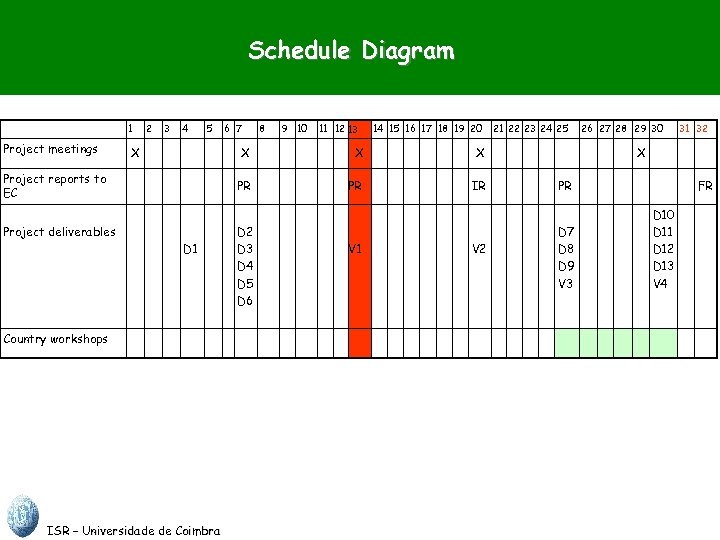 Schedule Diagram 1 Project meetings 2 3 4 5 6 7 8 9 10 11 12 13 14 15 16 17 18 19 20 X Project reports to EC Project deliverables D 1 Country workshops ISR – Universidade de Coimbra X X PR IR 21 22 23 24 25 D 2 D 3 D 4 D 5 D 6 V 1 V 2 26 27 28 29 30 31 32 X PR D 7 D 8 D 9 V 3 FR D 10 D 11 D 12 D 13 V 4
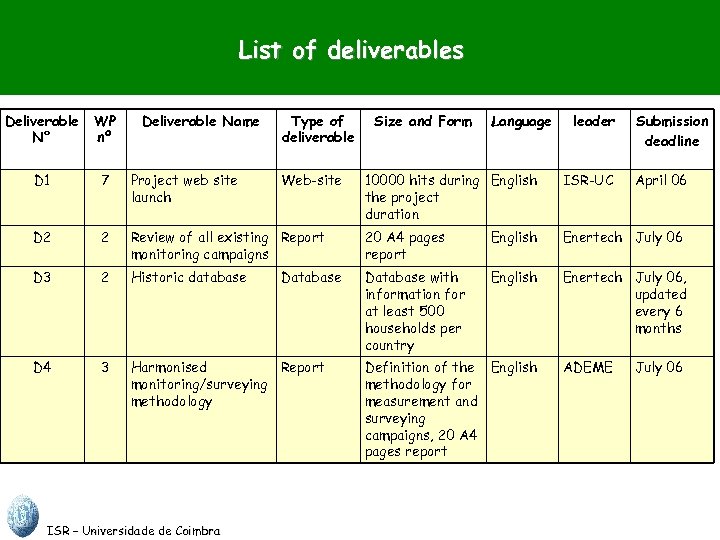 List of deliverables Deliverable N° WP nº Deliverable Name D 1 7 Project web site launch D 2 2 D 3 D 4 Type of deliverable Language leader Submission deadline 10000 hits during English the project duration ISR-UC Review of all existing Report monitoring campaigns 20 A 4 pages report English Enertech July 06 2 Historic database Database with information for at least 500 households per country English Enertech July 06, updated every 6 months 3 Harmonised Report monitoring/surveying methodology ISR – Universidade de Coimbra Web-site Size and Form Database Definition of the English methodology for measurement and surveying campaigns, 20 A 4 pages report ADEME April 06 July 06
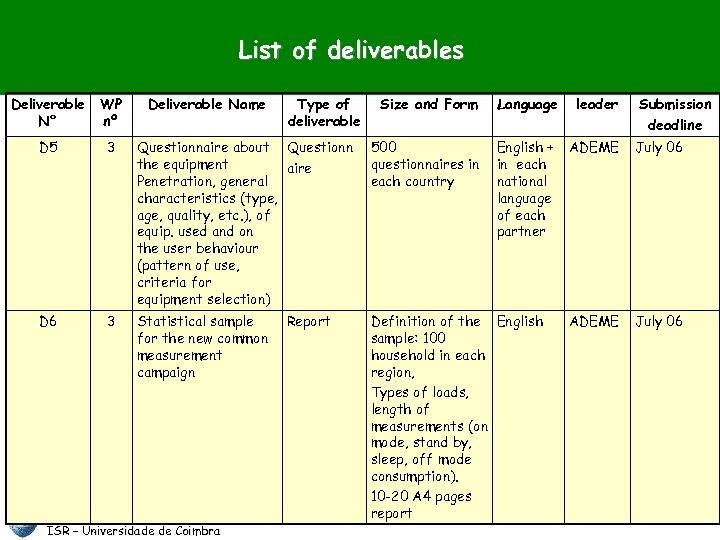 List of deliverables Deliverable N° WP nº D 5 3 D 6 3 Deliverable Name Size and Form Language leader Questionnaire about Questionn the equipment aire Penetration, general characteristics (type, age, quality, etc. ), of equip. used and on the user behaviour (pattern of use, criteria for equipment selection) 500 questionnaires in each country English + in each national language of each partner ADEME July 06 Statistical sample for the new common measurement campaign Definition of the English sample: 100 household in each region, Types of loads, length of measurements (on mode, stand by, sleep, off mode consumption). 10 -20 A 4 pages report ADEME July 06 ISR – Universidade de Coimbra Type of deliverable Report Submission deadline
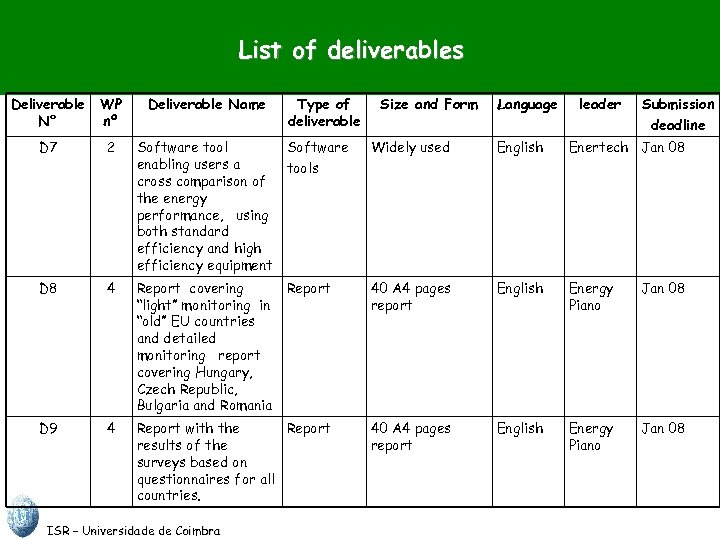 List of deliverables Deliverable N° WP nº Deliverable Name D 7 2 Software tool Software enabling users a tools cross comparison of the energy performance, using both standard efficiency and high efficiency equipment Widely used English Enertech Jan 08 D 8 4 Report covering “light” monitoring in “old” EU countries and detailed monitoring report covering Hungary, Czech Republic, Bulgaria and Romania Report 40 A 4 pages report English Energy Piano Jan 08 D 9 4 Report with the Report results of the surveys based on questionnaires for all countries. 40 A 4 pages report English Energy Piano Jan 08 ISR – Universidade de Coimbra Type of deliverable Size and Form Language leader Submission deadline
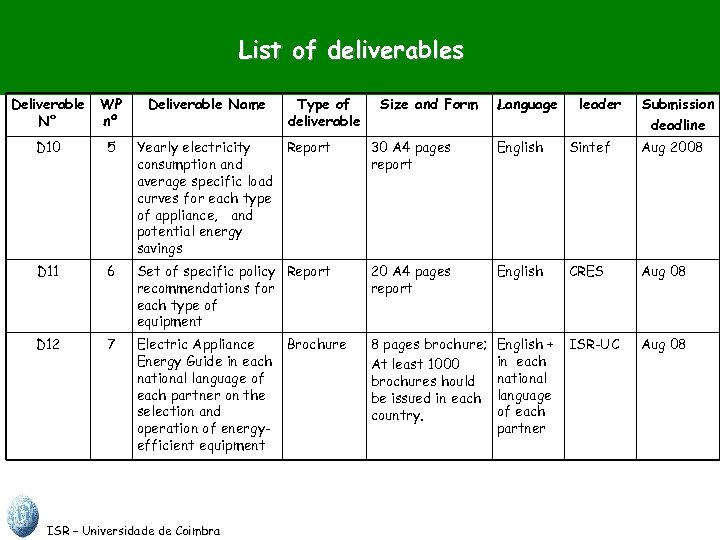 List of deliverables Deliverable N° WP nº Deliverable Name D 10 5 Yearly electricity Report consumption and average specific load curves for each type of appliance, and potential energy savings 30 A 4 pages report English Sintef Aug 2008 D 11 6 Set of specific policy Report recommendations for each type of equipment 20 A 4 pages report English CRES Aug 08 D 12 7 Electric Appliance Energy Guide in each national language of each partner on the selection and operation of energyefficient equipment 8 pages brochure; At least 1000 brochures hould be issued in each country. English + in each national language of each partner ISR-UC Aug 08 ISR – Universidade de Coimbra Type of deliverable Brochure Size and Form Language leader Submission deadline
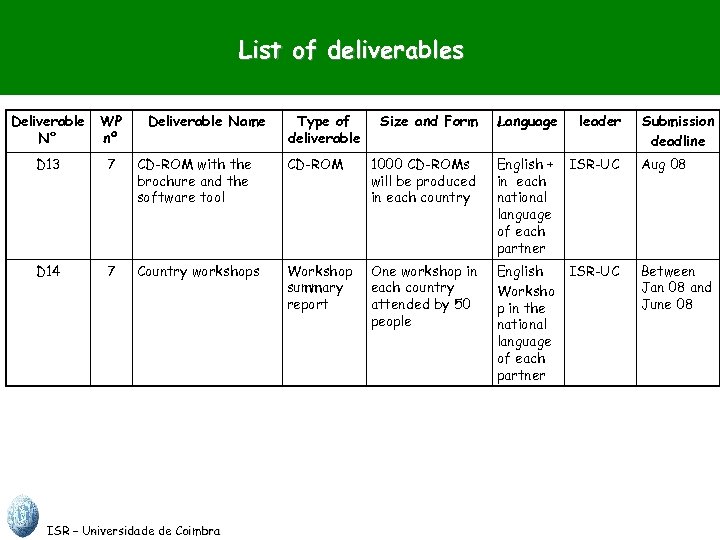 List of deliverables Deliverable N° WP nº Deliverable Name D 13 7 CD-ROM with the brochure and the software tool CD-ROM 1000 CD-ROMs will be produced in each country English + in each national language of each partner D 14 7 Country workshops Workshop summary report One workshop in each country attended by 50 people English ISR-UC Worksho p in the national language of each partner ISR – Universidade de Coimbra Type of deliverable Size and Form Language leader ISR-UC Submission deadline Aug 08 Between Jan 08 and June 08
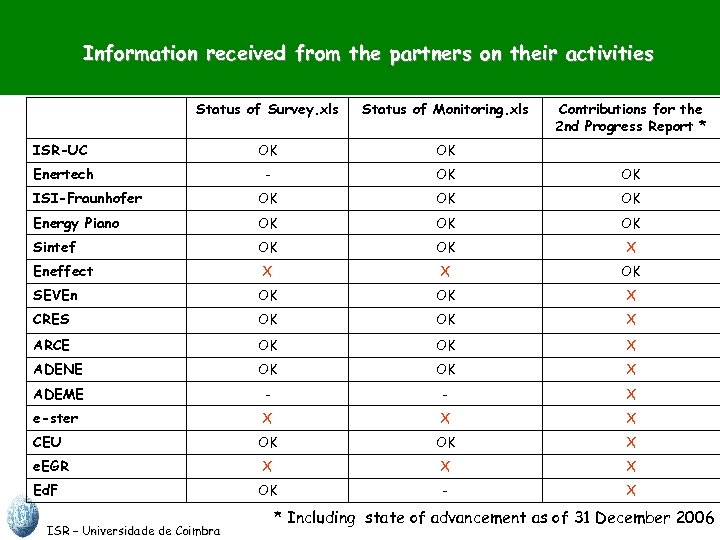 Information received from the partners on their activities Status of Survey. xls Status of Monitoring. xls ISR-UC OK OK Enertech - OK OK ISI-Fraunhofer OK OK OK Energy Piano OK OK OK Sintef OK OK X X X OK SEVEn OK OK X CRES OK OK X ARCE OK OK X ADENE OK OK X ADEME - - X e-ster X X X CEU OK OK X e. EGR X X X OK - X Eneffect Ed. F ISR – Universidade de Coimbra Contributions for the 2 nd Progress Report * * Including state of advancement as of 31 December 2006
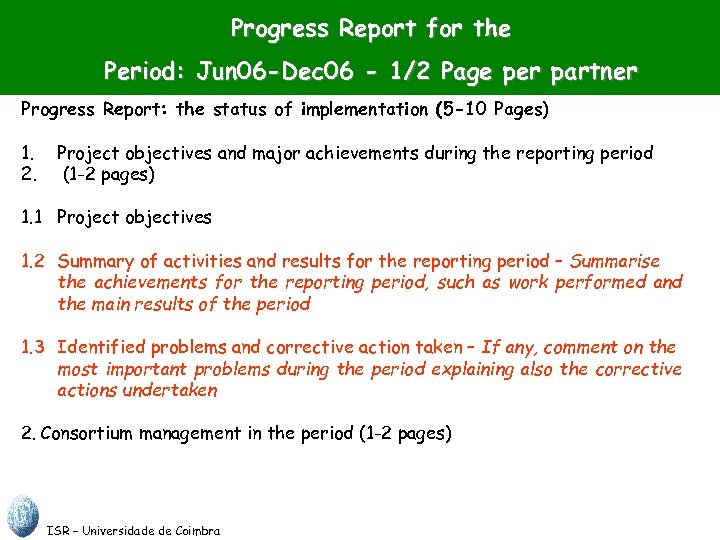 Progress Report for the Period: Jun 06 -Dec 06 - 1/2 Page per partner Progress Report: the status of implementation (5 -10 Pages) 1. 2. Project objectives and major achievements during the reporting period (1 -2 pages) 1. 1 Project objectives 1. 2 Summary of activities and results for the reporting period – Summarise the achievements for the reporting period, such as work performed and the main results of the period 1. 3 Identified problems and corrective action taken – If any, comment on the most important problems during the period explaining also the corrective actions undertaken 2. Consortium management in the period (1 -2 pages) ISR – Universidade de Coimbra
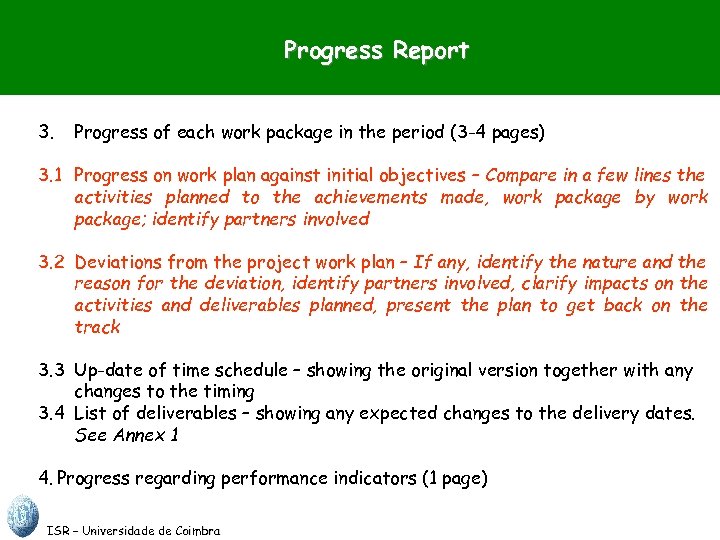 Progress Report 3. Progress of each work package in the period (3 -4 pages) 3. 1 Progress on work plan against initial objectives – Compare in a few lines the activities planned to the achievements made, work package by work package; identify partners involved 3. 2 Deviations from the project work plan – If any, identify the nature and the reason for the deviation, identify partners involved, clarify impacts on the activities and deliverables planned, present the plan to get back on the track 3. 3 Up-date of time schedule – showing the original version together with any changes to the timing 3. 4 List of deliverables – showing any expected changes to the delivery dates. See Annex 1 4. Progress regarding performance indicators (1 page) ISR – Universidade de Coimbra
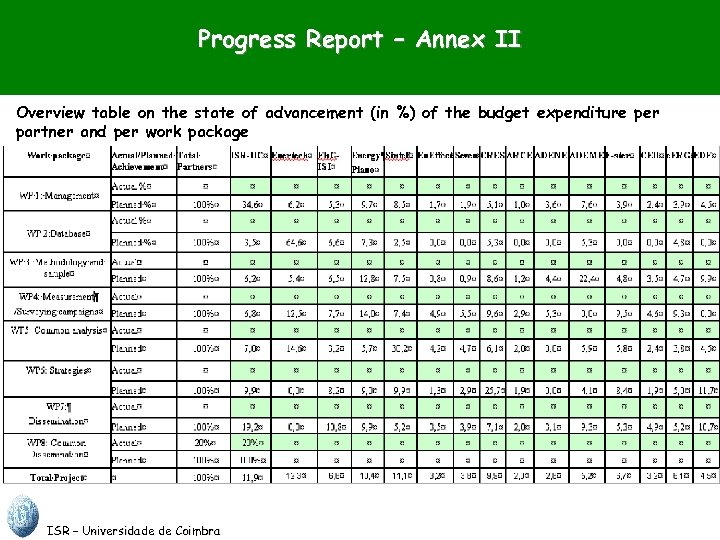 Progress Report – Annex II Overview table on the state of advancement (in %) of the budget expenditure per partner and per work package ISR – Universidade de Coimbra
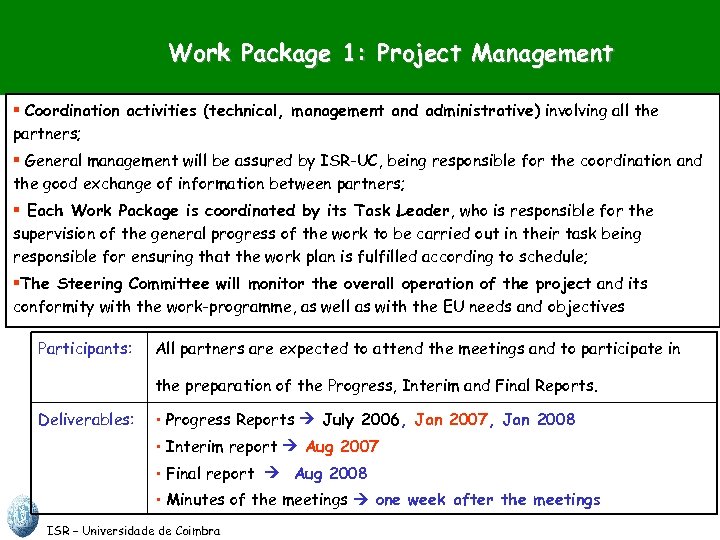 Work Package 1: Project Management § Coordination activities (technical, management and administrative) involving all the partners; § General management will be assured by ISR-UC, being responsible for the coordination and the good exchange of information between partners; § Each Work Package is coordinated by its Task Leader, who is responsible for the supervision of the general progress of the work to be carried out in their task being responsible for ensuring that the work plan is fulfilled according to schedule; §The Steering Committee will monitor the overall operation of the project and its conformity with the work-programme, as well as with the EU needs and objectives Participants: All partners are expected to attend the meetings and to participate in the preparation of the Progress, Interim and Final Reports. Deliverables: • Progress Reports July 2006, Jan 2007, Jan 2008 • Interim report Aug 2007 • Final report Aug 2008 • Minutes of the meetings one week after the meetings ISR – Universidade de Coimbra
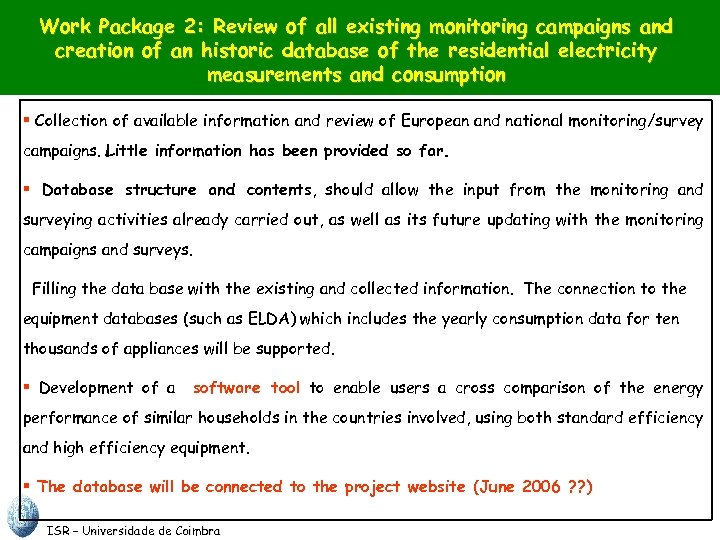 Work Package 2: Review of all existing monitoring campaigns and creation of an historic database of the residential electricity measurements and consumption § Collection of available information and review of European and national monitoring/survey campaigns. Little information has been provided so far. § Database structure and contents, should allow the input from the monitoring and surveying activities already carried out, as well as its future updating with the monitoring campaigns and surveys. Filling the data base with the existing and collected information. The connection to the equipment databases (such as ELDA) which includes the yearly consumption data for ten thousands of appliances will be supported. § Development of a software tool to enable users a cross comparison of the energy performance of similar households in the countries involved, using both standard efficiency and high efficiency equipment. § The database will be connected to the project website (June 2006 ? ? ) ISR – Universidade de Coimbra
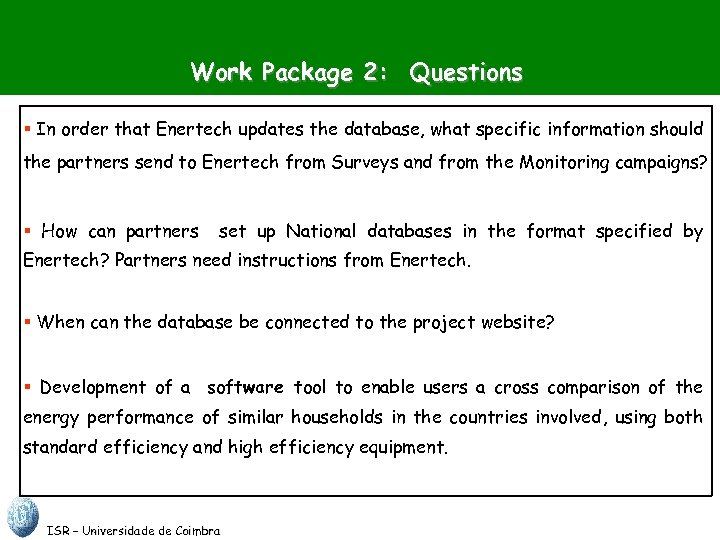 Work Package 2: Questions § In order that Enertech updates the database, what specific information should the partners send to Enertech from Surveys and from the Monitoring campaigns? § How can partners set up National databases in the format specified by Enertech? Partners need instructions from Enertech. § When can the database be connected to the project website? § Development of a software tool to enable users a cross comparison of the energy performance of similar households in the countries involved, using both standard efficiency and high efficiency equipment. ISR – Universidade de Coimbra
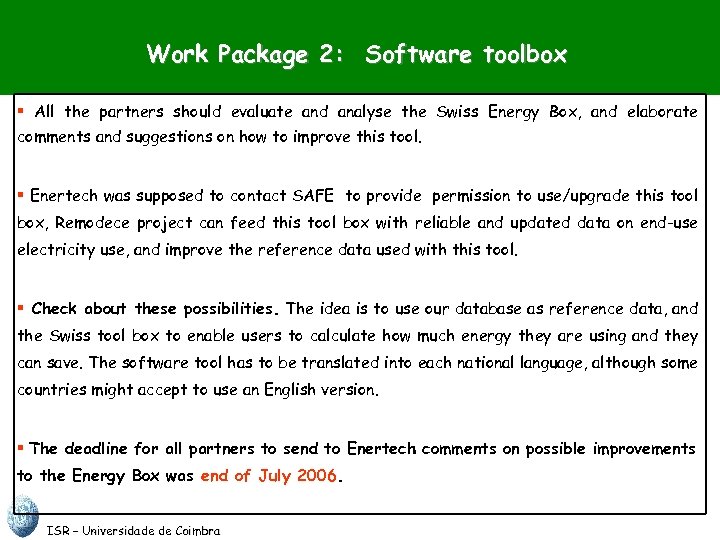 Work Package 2: Software toolbox § All the partners should evaluate and analyse the Swiss Energy Box, and elaborate comments and suggestions on how to improve this tool. § Enertech was supposed to contact SAFE to provide permission to use/upgrade this tool box, Remodece project can feed this tool box with reliable and updated data on end-use electricity use, and improve the reference data used with this tool. § Check about these possibilities. The idea is to use our database as reference data, and the Swiss tool box to enable users to calculate how much energy they are using and they can save. The software tool has to be translated into each national language, although some countries might accept to use an English version. § The deadline for all partners to send to Enertech comments on possible improvements to the Energy Box was end of July 2006. ISR – Universidade de Coimbra
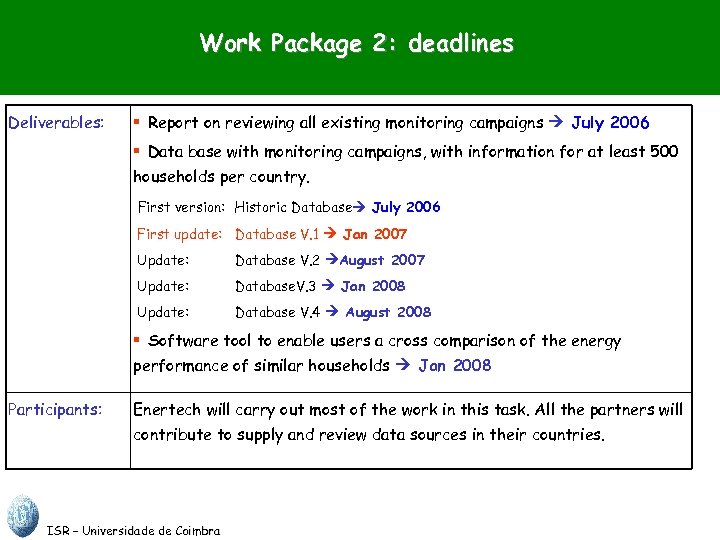 Work Package 2: deadlines Deliverables: § Report on reviewing all existing monitoring campaigns July 2006 § Data base with monitoring campaigns, with information for at least 500 households per country. First version: Historic Database July 2006 First update: Database V. 1 Jan 2007 Update: Database V. 2 August 2007 Update: Database. V. 3 Jan 2008 Update: Database V. 4 August 2008 § Software tool to enable users a cross comparison of the energy performance of similar households Jan 2008 Participants: Enertech will carry out most of the work in this task. All the partners will contribute to supply and review data sources in their countries. ISR – Universidade de Coimbra
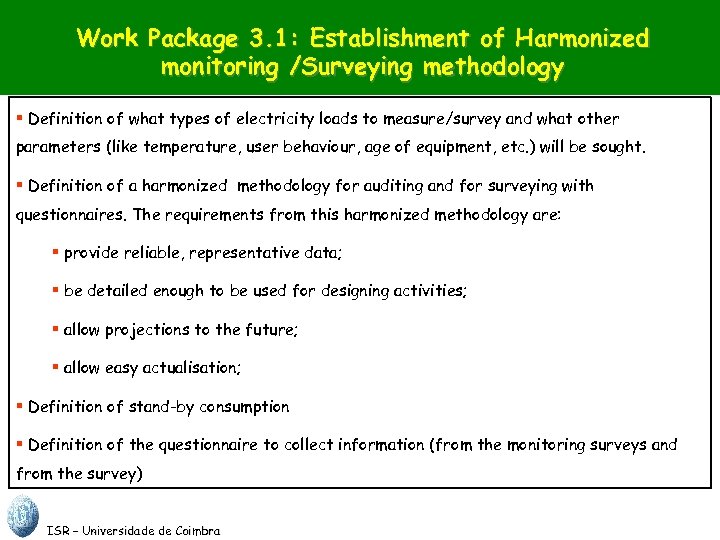 Work Package 3. 1: Establishment of Harmonized monitoring /Surveying methodology § Definition of what types of electricity loads to measure/survey and what other parameters (like temperature, user behaviour, age of equipment, etc. ) will be sought. § Definition of a harmonized methodology for auditing and for surveying with questionnaires. The requirements from this harmonized methodology are: § provide reliable, representative data; § be detailed enough to be used for designing activities; § allow projections to the future; § allow easy actualisation; § Definition of stand-by consumption § Definition of the questionnaire to collect information (from the monitoring surveys and from the survey) ISR – Universidade de Coimbra
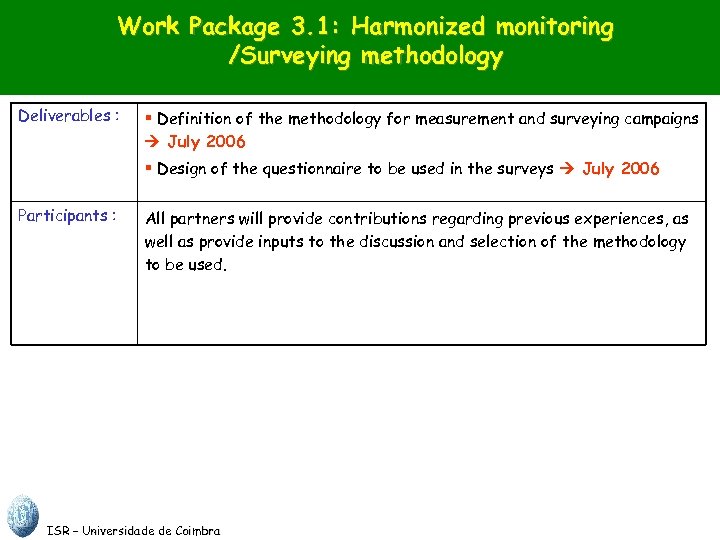 Work Package 3. 1: Harmonized monitoring /Surveying methodology Deliverables : § Definition of the methodology for measurement and surveying campaigns July 2006 § Design of the questionnaire to be used in the surveys July 2006 Participants : All partners will provide contributions regarding previous experiences, as well as provide inputs to the discussion and selection of the methodology to be used. ISR – Universidade de Coimbra
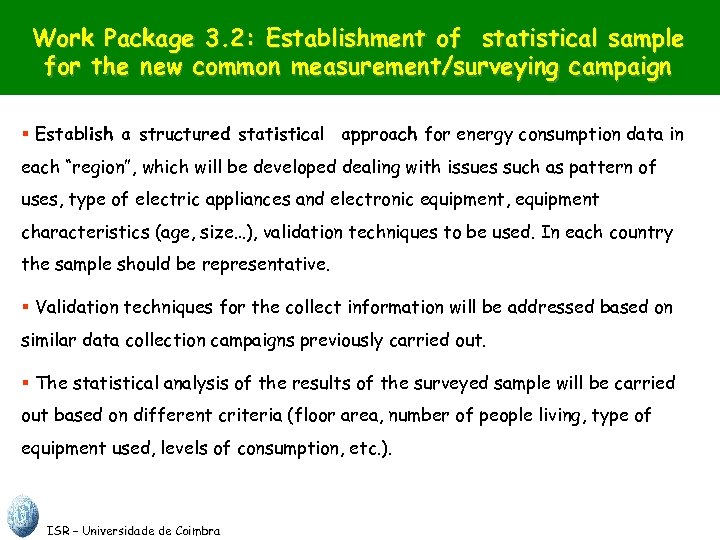 Work Package 3. 2: Establishment of statistical sample for the new common measurement/surveying campaign § Establish a structured statistical approach for energy consumption data in each “region”, which will be developed dealing with issues such as pattern of uses, type of electric appliances and electronic equipment, equipment characteristics (age, size…), validation techniques to be used. In each country the sample should be representative. § Validation techniques for the collect information will be addressed based on similar data collection campaigns previously carried out. § The statistical analysis of the results of the surveyed sample will be carried out based on different criteria (floor area, number of people living, type of equipment used, levels of consumption, etc. ). ISR – Universidade de Coimbra
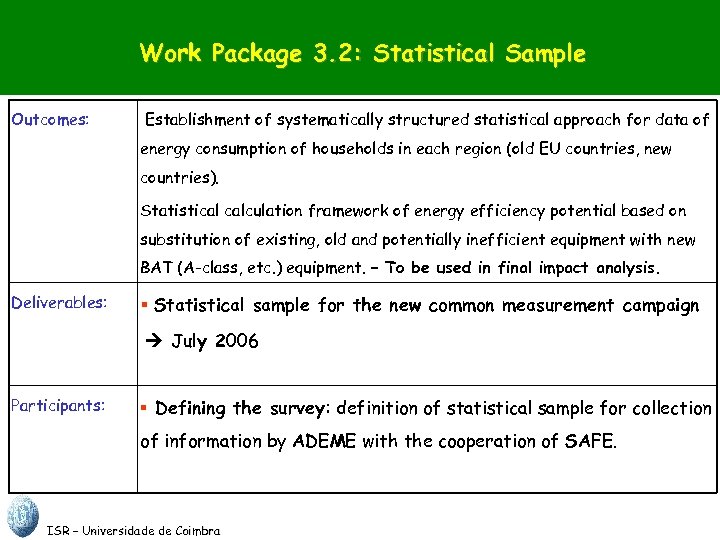 Work Package 3. 2: Statistical Sample Outcomes: Establishment of systematically structured statistical approach for data of energy consumption of households in each region (old EU countries, new countries). Statistical calculation framework of energy efficiency potential based on substitution of existing, old and potentially inefficient equipment with new BAT (A-class, etc. ) equipment. – To be used in final impact analysis. Deliverables: § Statistical sample for the new common measurement campaign July 2006 Participants: § Defining the survey: definition of statistical sample for collection of information by ADEME with the cooperation of SAFE. ISR – Universidade de Coimbra
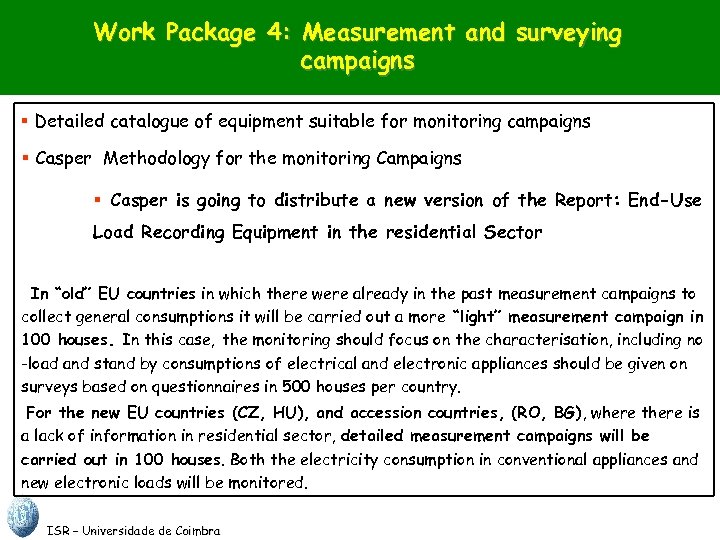 Work Package 4: Measurement and surveying campaigns § Detailed catalogue of equipment suitable for monitoring campaigns § Casper Methodology for the monitoring Campaigns § Casper is going to distribute a new version of the Report: End-Use Load Recording Equipment in the residential Sector In “old” EU countries in which there were already in the past measurement campaigns to collect general consumptions it will be carried out a more “light” measurement campaign in 100 houses. In this case, the monitoring should focus on the characterisation, including no -load and stand by consumptions of electrical and electronic appliances should be given on surveys based on questionnaires in 500 houses per country. For the new EU countries (CZ, HU), and accession countries, (RO, BG), where there is a lack of information in residential sector, detailed measurement campaigns will be carried out in 100 houses. Both the electricity consumption in conventional appliances and new electronic loads will be monitored. ISR – Universidade de Coimbra
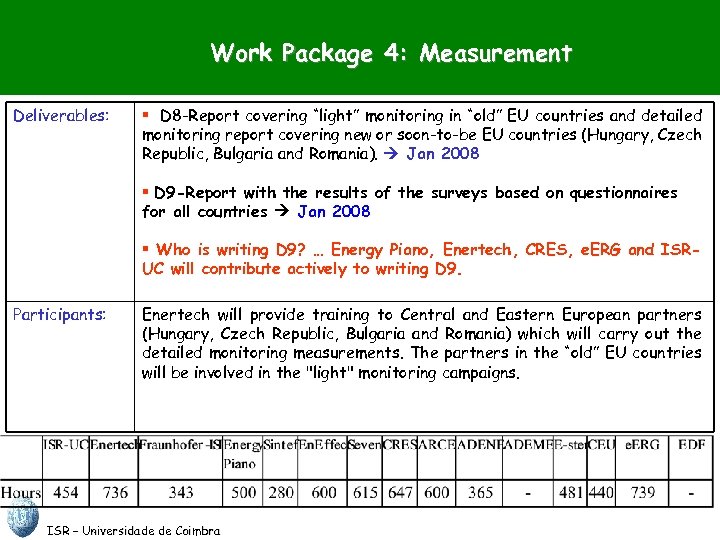 Work Package 4: Measurement Deliverables: § D 8 -Report covering “light” monitoring in “old” EU countries and detailed monitoring report covering new or soon-to-be EU countries (Hungary, Czech Republic, Bulgaria and Romania). Jan 2008 § D 9 -Report with the results of the surveys based on questionnaires for all countries Jan 2008 § Who is writing D 9? … Energy Piano, Enertech, CRES, e. ERG and ISRUC will contribute actively to writing D 9. Participants: Enertech will provide training to Central and Eastern European partners (Hungary, Czech Republic, Bulgaria and Romania) which will carry out the detailed monitoring measurements. The partners in the “old” EU countries will be involved in the "light" monitoring campaigns. ISR – Universidade de Coimbra
 Work Package 5: Common analysis of the survey/measurement campaigns and common conclusions § Calculation of the average yearly electricity consumption, the average specific load curves, as well as consumption trends for each type of appliance, based on the database information, updated with the collected data. § Determination by simulation of the potential energy savings and of the reduction of the carbon emissions that could be achieved in the European Union by using more efficient equipment and by changing behaviour. § Statistical analyses of the data by employing stratification of customers into suiting customer groups, and regression analysis to determine climate sensitivity will be performed. There will be separate analyses for each season (summer, winter, autumn/spring) and day type (workday, weekend). § The customers will be grouped according to sociological data (where applicable): number of inhabitants, building type (detached, semi detached, apartment), type of tariff etc. The output from the analyses will be load-profiles for each significant end-use separated into seasons and day-types. § When data have been analysed, and load-profiles are available for a country or region, the data will be applied to determine the best practices for energy savings. Segmentation charts and tables will enable determination of energy saving initiatives and will be used to determine the optimal area of energy efficiency activity to get the highest environmental and economic return. ISR – Universidade de Coimbra
 Work Package 5: Common analysis of the survey/measurement campaigns and common conclusions Input data from previous tasks: In order to do a common analysis of the survey/measurement campaigns to make common conclusions, it is necessary that the partners that have measurements of home equipment from previous tasks – send them to SINTEF and the partners have to clarify what type of data and format the partners has to use in sending data to SINTEF. ISR – Universidade de Coimbra
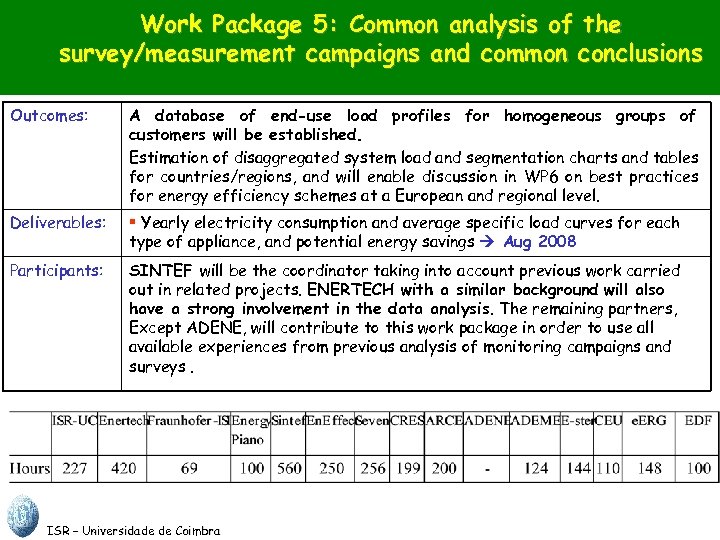 Work Package 5: Common analysis of the survey/measurement campaigns and common conclusions Outcomes: A database of end-use load profiles for homogeneous groups of customers will be established. Estimation of disaggregated system load and segmentation charts and tables for countries/regions, and will enable discussion in WP 6 on best practices for energy efficiency schemes at a European and regional level. Deliverables: § Yearly electricity consumption and average specific load curves for each type of appliance, and potential energy savings Aug 2008 Participants: SINTEF will be the coordinator taking into account previous work carried out in related projects. ENERTECH with a similar background will also have a strong involvement in the data analysis. The remaining partners, Except ADENE, will contribute to this work package in order to use all available experiences from previous analysis of monitoring campaigns and surveys. ISR – Universidade de Coimbra
 Work Package 6: Strategies for market transformation and recommendations to policy makers In order to have a more precise results for the successful market transformation there has to be a multilevel approach: Institutional level: The new building directive (EPBD), energy labelling, mandatory minimum efficiency standards (i. e. in air-conditioning, etc), white certificates, the proposal for directive on Energy End-Use Efficiency and Energy Services, have to be analysed. Supportive Schemes level: Technology procurement, voluntary agreements, plans for information campaigns for the public, training schemes for retail staff, Demand Side Management (DSM) through utility companies, etc, have to be examined at this level. Fiscal level: One of the key issues during the transformation of the markets is the financial support. This includes subsidies, tax incentives, etc. ISR – Universidade de Coimbra
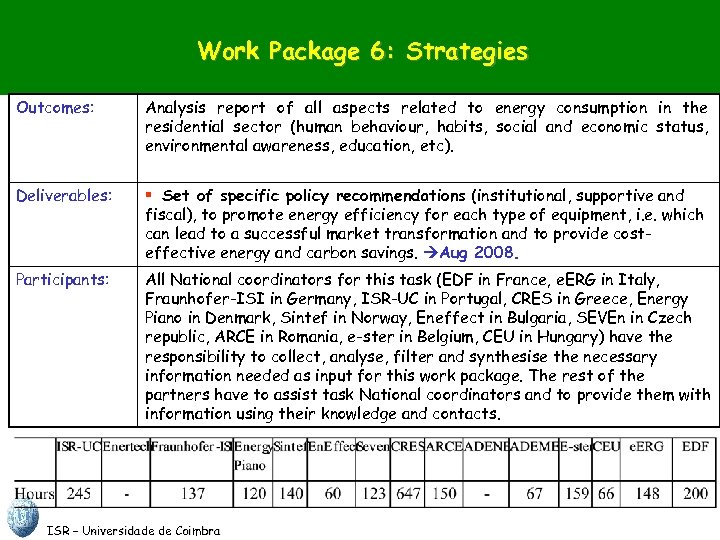 Work Package 6: Strategies Outcomes: Analysis report of all aspects related to energy consumption in the residential sector (human behaviour, habits, social and economic status, environmental awareness, education, etc). Deliverables: § Set of specific policy recommendations (institutional, supportive and fiscal), to promote energy efficiency for each type of equipment, i. e. which can lead to a successful market transformation and to provide costeffective energy and carbon savings. Aug 2008. Participants: All National coordinators for this task (EDF in France, e. ERG in Italy, Fraunhofer-ISI in Germany, ISR-UC in Portugal, CRES in Greece, Energy Piano in Denmark, Sintef in Norway, Eneffect in Bulgaria, SEVEn in Czech republic, ARCE in Romania, e-ster in Belgium, CEU in Hungary) have the responsibility to collect, analyse, filter and synthesise the necessary information needed as input for this work package. The rest of the partners have to assist task National coordinators and to provide them with information using their knowledge and contacts. ISR – Universidade de Coimbra
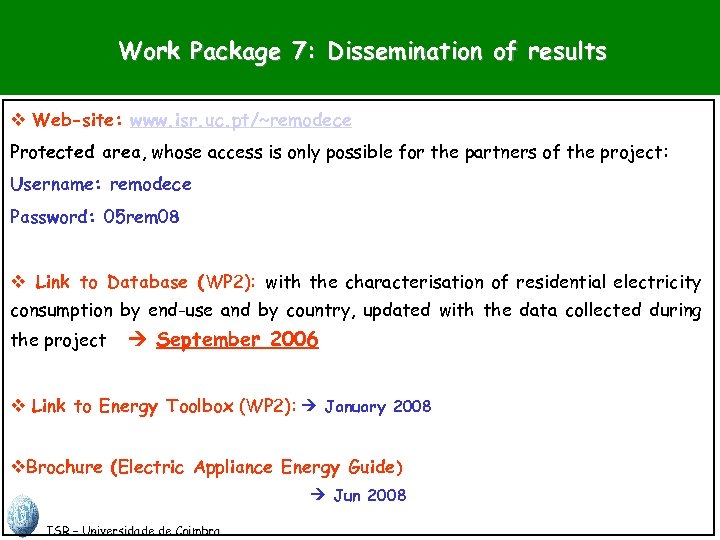 Work Package 7: Dissemination of results v Web-site: www. isr. uc. pt/~remodece Protected area, whose access is only possible for the partners of the project: Username: remodece Password: 05 rem 08 v Link to Database (WP 2): with the characterisation of residential electricity consumption by end-use and by country, updated with the data collected during the project September 2006 v Link to Energy Toolbox (WP 2): January 2008 v. Brochure (Electric Appliance Energy Guide) Jun 2008 ISR – Universidade de Coimbra
 Work Package 7: Dissemination of results § Workshops, one in each country involving the relevant stakeholders; § Other publications. The main results of the project will be published in press releases, in articles in technical journals, trade publications and in international conferences. § Presentation of the paper: “Residential Monitoring to Decrease Energy Use and carbon Emissions in Europe”, in the EEDAL Conference, London, 21 -23 June, 2006. § Paper will be presented at the ECEEE summer Study, June 2007 ISR – Universidade de Coimbra
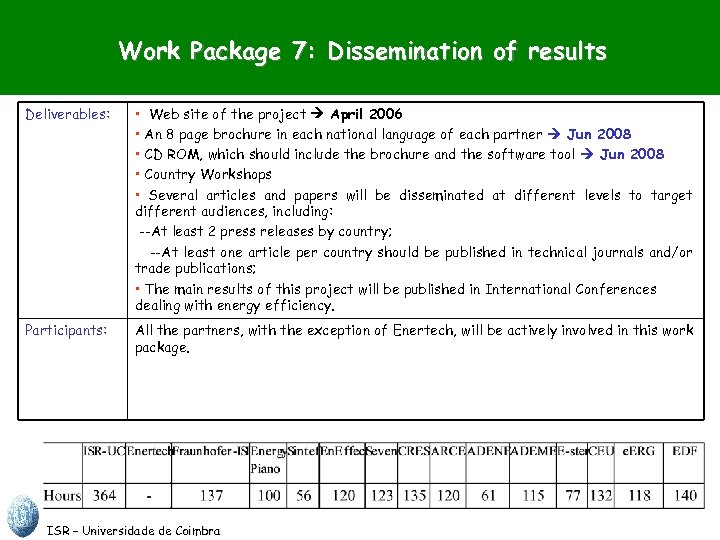 Work Package 7: Dissemination of results Deliverables: • Web site of the project April 2006 • An 8 page brochure in each national language of each partner Jun 2008 • CD ROM, which should include the brochure and the software tool Jun 2008 • Country Workshops • Several articles and papers will be disseminated at different levels to target different audiences, including: --At least 2 press releases by country; --At least one article per country should be published in technical journals and/or trade publications; • The main results of this project will be published in International Conferences dealing with energy efficiency. Participants: All the partners, with the exception of Enertech, will be actively involved in this work package. ISR – Universidade de Coimbra
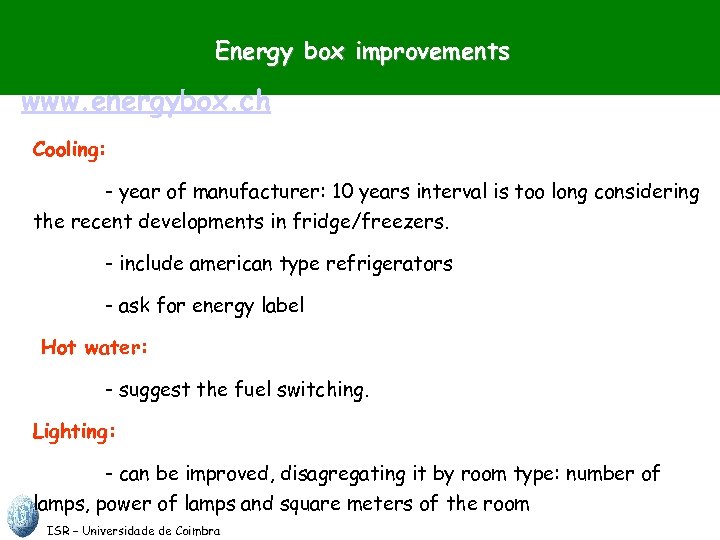 Energy box improvements www. energybox. ch Cooling: - year of manufacturer: 10 years interval is too long considering the recent developments in fridge/freezers. - include american type refrigerators - ask for energy label Hot water: - suggest the fuel switching. Lighting: - can be improved, disagregating it by room type: number of lamps, power of lamps and square meters of the room ISR – Universidade de Coimbra
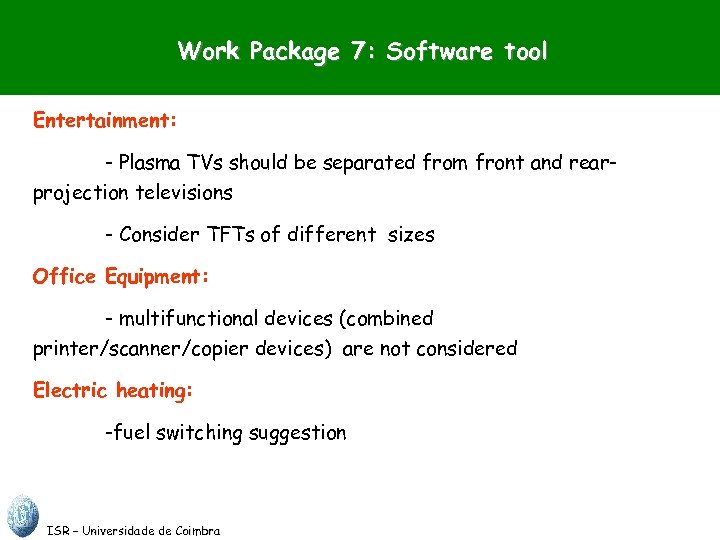 Work Package 7: Software tool Entertainment: - Plasma TVs should be separated from front and rearprojection televisions - Consider TFTs of different sizes Office Equipment: - multifunctional devices (combined printer/scanner/copier devices) are not considered Electric heating: -fuel switching suggestion ISR – Universidade de Coimbra
 Present Status in Portugal ISR – Universidade de Coimbra
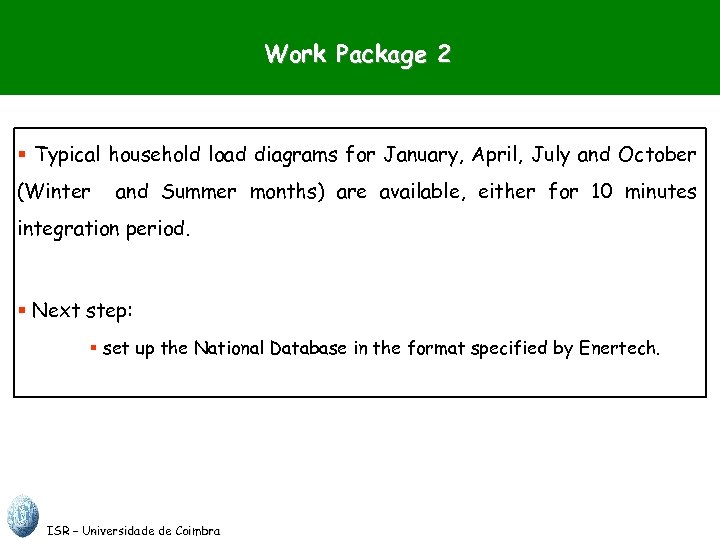 Work Package 2 § Typical household load diagrams for January, April, July and October (Winter and Summer months) are available, either for 10 minutes integration period. § Next step: § set up the National Database in the format specified by Enertech. ISR – Universidade de Coimbra
 Work Package 3. 1: Establishment of Harmonized monitoring /Surveying methodology § Present status of the survey: The questionnaire has been translated to Portuguese (doc and excel). Interviews are being carried out to fill in the questionnaires. More than 50 questionnaires have already been filled in. § Information on Survey/Type of methodology: Collaboration with the utility for the selection of the households. Interviews will be carried out in 500 households. ISR – Universidade de Coimbra
 Work Package 3. 2: Establishment of statistical sample for the new common measurement/surveying campaign Representativeness selection of households: § the statistical sample for collection of information has been defined § guarantee of representative sample for the measurement and for the surveying campaigns: § regional representativeness, covering four regions of Portugal (north, south, centre region and Lisbon region) with different climates and different standards of living § structural criteria like: type of household, range of consumption § random selection of customers (preferably those having Remote Meters installed, based on a database from the utility. ISR – Universidade de Coimbra
 Work Package 4: Measurement and surveying campaigns § Equipment used for monitoring campaigns: § SEM 10 § Wattmeter Enertech § Luxmeter (Enertech) § Wattmeter (Enertech) with ampliers and Pulsemeter (used for measuring the mains supply and air conditioning loads) § Monthly Load Diagrams (time step of 10 minutes) are being collected in collaboration with the Utility. ISR – Universidade de Coimbra
 Work Package 4: Measurement and surveying campaigns § Representative of the sample § Random selection of customers based on a database from the utility. Only customers with electronic telemeters installed are being considered for monitoring. Customers are selected based on the range of their annual electricity consumption. Four main classes of consumption have been defined by the utility, and the number of customers in each range of consumption to be analysed has been weighted by the total consumption in each range. ISR – Universidade de Coimbra
![Selected Customers for monitoring Power range k. W Nº of customers selected ]50, 1257]](https://present5.com/presentation/6127d0132688ab5bdb3432539a40a02a/image-45.jpg "Selected Customers for monitoring Power range k. W Nº of customers selected ]50, 1257]") Selected Customers for monitoring Power range k. W Nº of customers selected ]50, 1257] 15 [1258, 2425] 37 [2426, 3780] 58 [3781, 202580] 90 Our expectation is to have a success rate of 50%. ISR – Universidade de Coimbra
Selected Customers for monitoring Power range k. W Nº of customers selected ]50, 1257] 15 [1258, 2425] 37 [2426, 3780] 58 [3781, 202580] 90 Our expectation is to have a success rate of 50%. ISR – Universidade de Coimbra
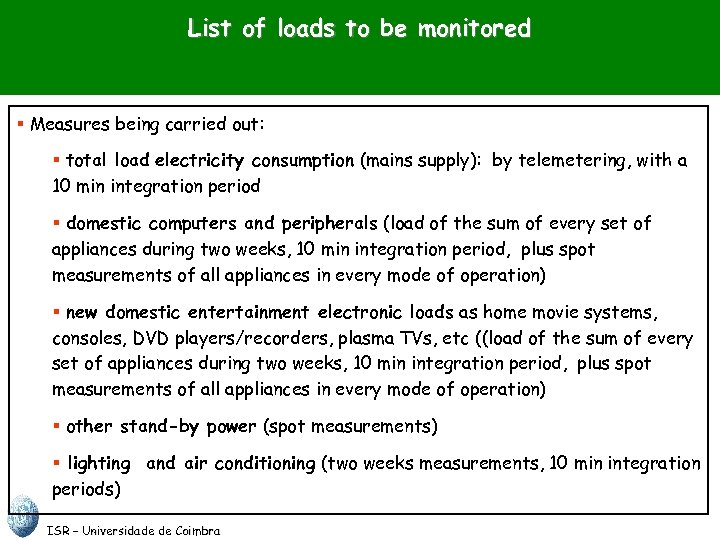 List of loads to be monitored § Measures being carried out: § total load electricity consumption (mains supply): by telemetering, with a 10 min integration period § domestic computers and peripherals (load of the sum of every set of appliances during two weeks, 10 min integration period, plus spot measurements of all appliances in every mode of operation) § new domestic entertainment electronic loads as home movie systems, consoles, DVD players/recorders, plasma TVs, etc ((load of the sum of every set of appliances during two weeks, 10 min integration period, plus spot measurements of all appliances in every mode of operation) § other stand-by power (spot measurements) § lighting and air conditioning (two weeks measurements, 10 min integration periods) ISR – Universidade de Coimbra