 Скачать презентацию Remittance Trends Diaspora Bonds and Remittance-Backed Securities Borko
16b6fe3819d25935ce86f5d679dbbff3.ppt
- Количество слайдов: 15



Remittance Trends, Diaspora Bonds and Remittance-Backed Securities Borko Handjiski, Senior Economist World Bank
Outline Remittance trends in the Baltics and other EU countries 1 2 Diaspora bonds: An instrument to attract savings of diaspora 2 Remittance backed securities: An instrument to improve access to finance 3
Remittance trends 3
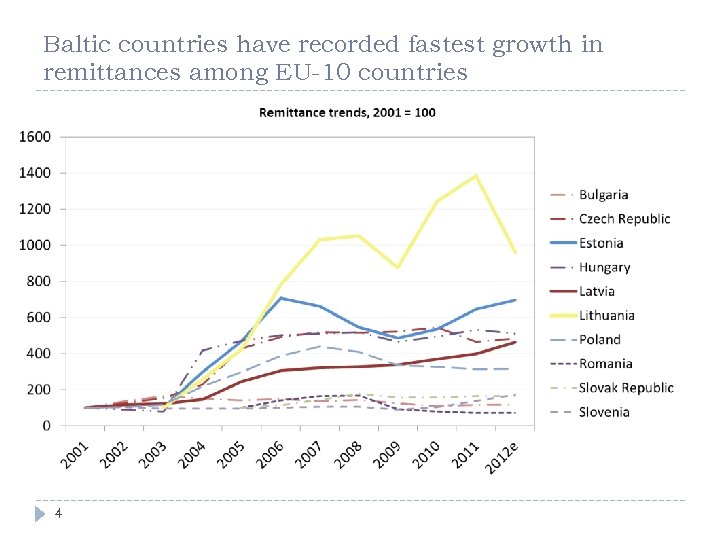
Baltic countries have recorded fastest growth in remittances among EU-10 countries 4
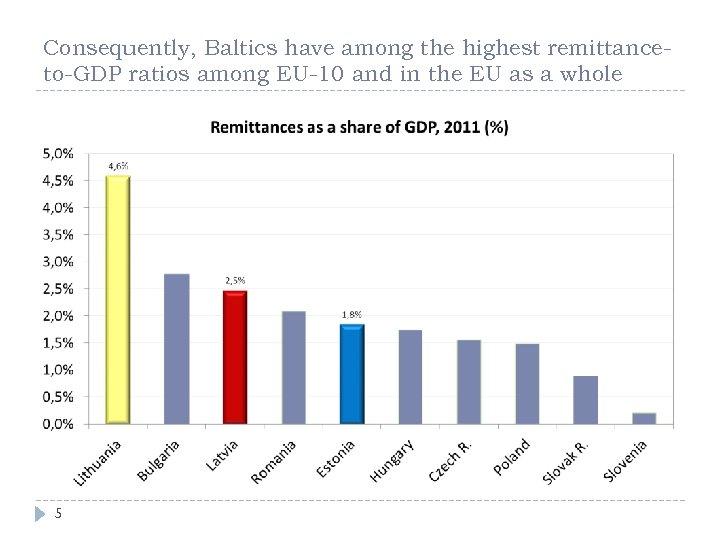
Consequently, Baltics have among the highest remittanceto-GDP ratios among EU-10 and in the EU as a whole 5
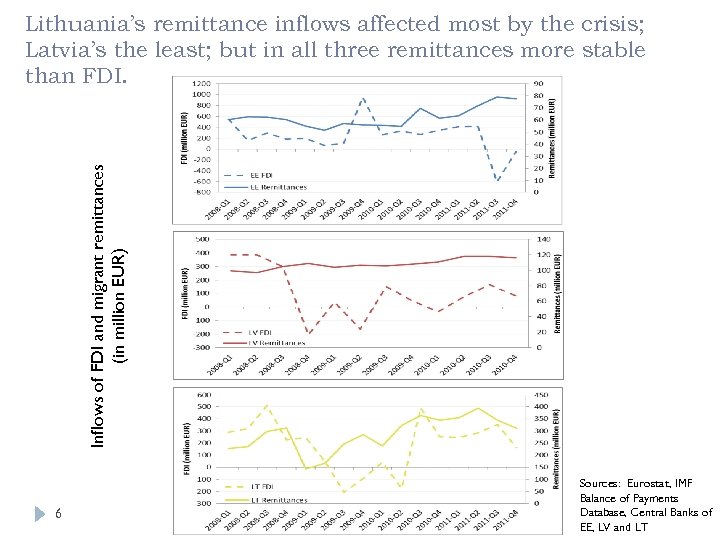
Inflows of FDI and migrant remittances (in million EUR) Lithuania’s remittance inflows affected most by the crisis; Latvia’s the least; but in all three remittances more stable than FDI. 6 Sources: Eurostat, IMF Balance of Payments Database, Central Banks of EE, LV and LT
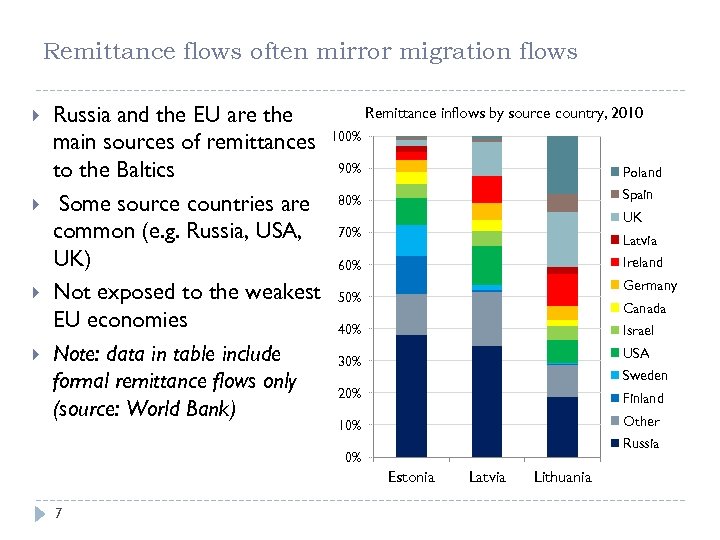
Remittance flows often mirror migration flows Russia and the EU are the main sources of remittances to the Baltics Some source countries are common (e. g. Russia, USA, UK) Not exposed to the weakest EU economies Note: data in table include formal remittance flows only (source: World Bank) Remittance inflows by source country, 2010 100% 90% Poland 80% Spain 70% Latvia UK Ireland 60% Germany 50% Canada 40% Israel USA 30% Sweden 20% Finland 10% Other Russia 0% Estonia 7 Latvia Lithuania
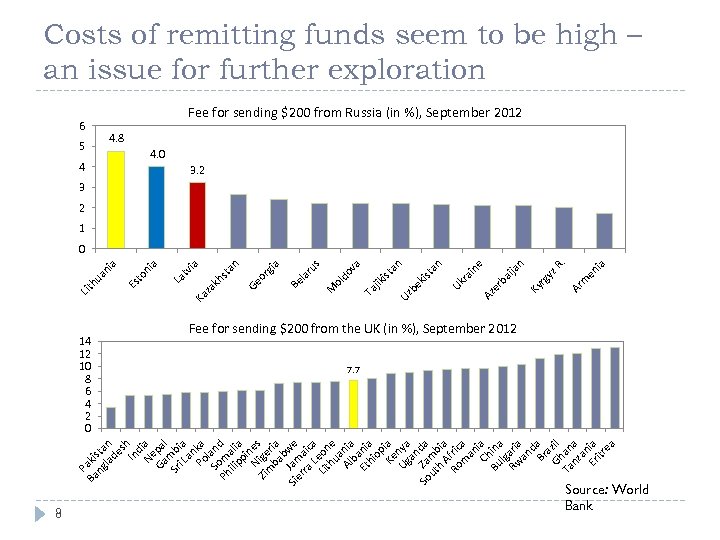
P Ba aki ng sta la n de sh In d Ne ia Ga pa l Sr mbi i. L a an Po ka l S an Ph om d ilip alia pi n Ni es Zim ge ba ria b Sie Jam we rra ai L ca Lit eon hu e a Al nia ba Et nia hi op Ke ia Ug nya an So Za da ut mb h ia A Ro fric m a an Ch ia Bu ina lg Rw aria an d Br a a Gh zil Ta an nz a an Er ia itr ea 14 12 10 8 6 4 2 0 8 a R. en i m Ar yz rg Ky n e in ija ba er Az Uk ra an kis t be a an st iki Ta j ov ol d s ru Be la ia rg Ge o M Uz ia ak hs ta n Ka z a 4 La tv ni 5 to 6 Es ia an hu Lit Costs of remitting funds seem to be high – an issue for further exploration Fee for sending $200 from Russia (in %), September 2012 4. 8 4. 0 3. 2 3 2 1 0 Fee for sending $200 from the UK (in %), September 2012 7. 7 Source: World Bank
Diaspora bonds and remittance-backed securities 9
Why interest in diaspora bonds? Remittances are a way of tapping into diaspora income flows on a regular basis, while issuance of foreign currency-denominated bonds to diaspora is a way of tapping into diaspora’s wealth, i. e. savings. Empirical analysis shows that migrant (diaspora) savings are several times higher than annual remittance flows 10
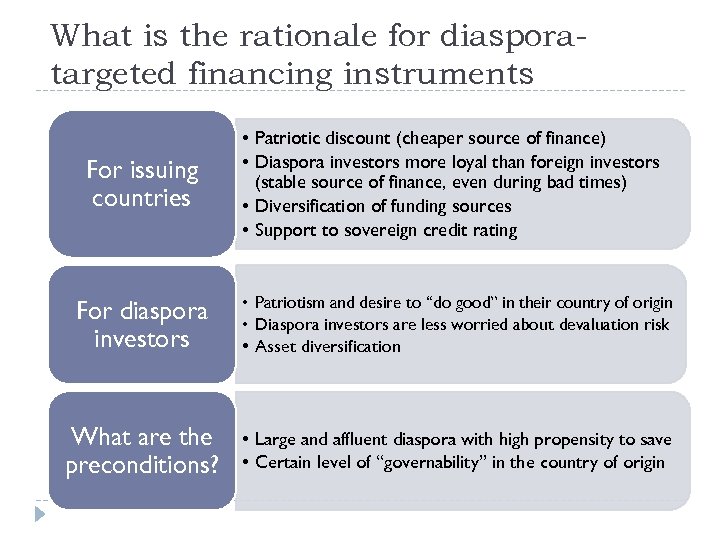
What is the rationale for diasporatargeted financing instruments For issuing countries • Patriotic discount (cheaper source of finance) • Diaspora investors more loyal than foreign investors (stable source of finance, even during bad times) • Diversification of funding sources • Support to sovereign credit rating For diaspora investors • Patriotism and desire to “do good” in their country of origin • Diaspora investors are less worried about devaluation risk • Asset diversification What are the preconditions? • Large and affluent diaspora with high propensity to save • Certain level of “governability” in the country of origin
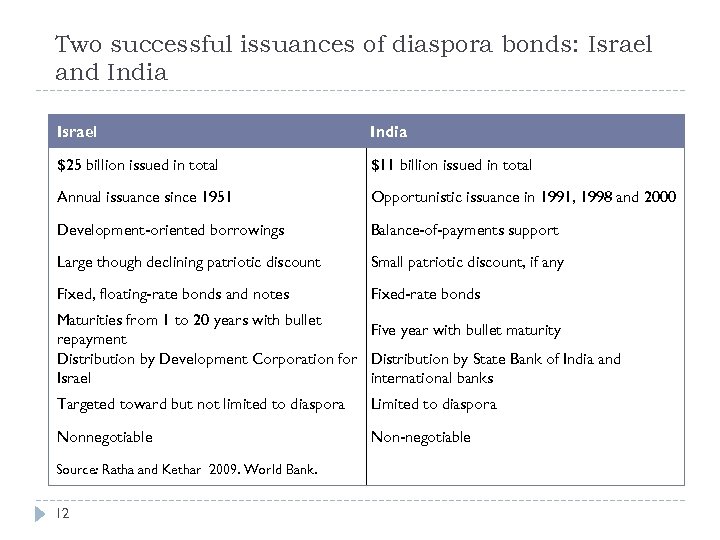
Two successful issuances of diaspora bonds: Israel and India Israel India $25 billion issued in total $11 billion issued in total Annual issuance since 1951 Opportunistic issuance in 1991, 1998 and 2000 Development-oriented borrowings Balance-of-payments support Large though declining patriotic discount Small patriotic discount, if any Fixed, floating-rate bonds and notes Fixed-rate bonds Maturities from 1 to 20 years with bullet Five year with bullet maturity repayment Distribution by Development Corporation for Distribution by State Bank of India and Israel international banks Targeted toward but not limited to diaspora Limited to diaspora Nonnegotiable Non-negotiable Source: Ratha and Kethar 2009. World Bank. 12
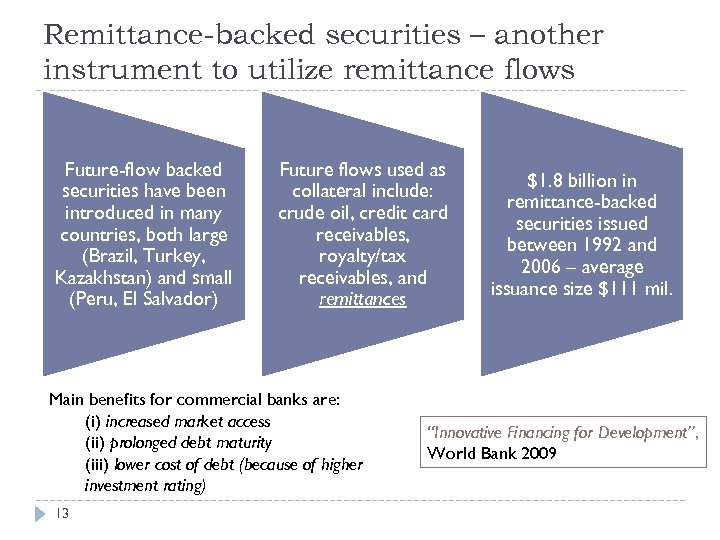
Remittance-backed securities – another instrument to utilize remittance flows Future-flow backed securities have been introduced in many countries, both large (Brazil, Turkey, Kazakhstan) and small (Peru, El Salvador) Future flows used as collateral include: crude oil, credit card receivables, royalty/tax receivables, and remittances Main benefits for commercial banks are: (i) increased market access (ii) prolonged debt maturity (iii) lower cost of debt (because of higher investment rating) 13 $1. 8 billion in remittance-backed securities issued between 1992 and 2006 – average issuance size $111 mil. “Innovative Financing for Development”, World Bank 2009

Global Knowledge Partnership on Migration and Development (KNOMAD) World Bank initiative for an open and multidisciplinary platform to generate and exchange information on migration and development Expected KNOMAD outputs • Analytical research products on migration and development • Operational policy toolkits, fact books • Web-based anthologies, archives, blogs • Best practices: A menu of policy choices for the policy makers • Few pilot projects and capacity building activities The KNOMAD initiative is currently in inception phase and will be launched at the IMF/WB Spring Meetings 2013 14 More information: http: //blogs. worldbank. org/peoplemove/ and www. knomad. org

THANK YOU! www. worldbank. org/eca/migration www. worldbank. org/migration http: //blogs. worldbank. org/peoplemove/ www. worldbank. org/paymentsystems http: //www. KNOMAD. org 15 www. mirpal. org
Скачать презентацию Remittance Trends Diaspora Bonds and Remittance-Backed Securities Borko
16b6fe3819d25935ce86f5d679dbbff3.ppt