


 Скачать презентацию Reminders for oral exam Reading Aloud Ø
1987df00b63283eed5e8e65937d36bde.ppt
- Количество слайдов: 15
 Reminders for oral exam
 Reading Aloud Ø Pronounce well the end consonants: - es, s, ed, t, d, k and n Ø Pronounce accurately with the right stress on the syllable - infer, Orchestra, CHAracter, determine Ø Pause at these punctuations: - commas, full-stops, colons and semicolons
 Reading Aloud Ø Pause at words such as ‘hesitated’, ‘wondered’ and ‘pondered’ Ø Make voice soft or loud for emphasis Eg. The room was so quiet (read softly) Ø Read smoothly. Try not to stumble over your words, miss out or re-read words Ø Read clearly Ø Read expressively
 Typical questions for Spoken Interaction Ø Something about the picture Eg. How do you feel about the person taking part in the activity in the picture? Eg. What do you think the crowd might be cheering about? (Answer the question and pick out details from the picture to support your opinion) Ø Something about yourself Eg. Do you enjoy being part of a large crowd? Eg. Tell me about a memorable journey you have experienced. (Give your preference, details, examples, reasons and reactions)
 Typical questions for Spoken Interaction Ø Take a stand question Eg. How far do you agree that individuals behave differently when they become part of a crowd? Eg. ‘Dancing is the best way of getting and staying fit!’ How far do you agree with this statement? (Take a stand give reasons, elaboration and examples)
 Things that you can do to prepare for picture discussion • Prepare a list of vocabulary to replace overly used words/ phrases (eg. Nice, happy, sad, excited) • Go around and observe the people and things around you; deduce the purpose behind the activity you see and deduce the relationship of the people who are involved in the activity.
 Component 2: Spoken Interaction Impression management issues • • • Look at the examiner in the eye. Be confident – do not fidget!! Smile appropriately Acknowledge by nodding slightly. Mind your posture & body language.
 Component 2: Spoken Interaction Common words & phrases 1. “Well…. ” – to stall time and to show that you are thinking. 2. “As a matter of fact…. ” – to continue an issue with examples. Eg. Q: Have you ever been to a live concert before? Yes, I have – as a matter of fact, I’ve just attended a concert recently at the Esplanade… 3. “Personally speaking…”
 Component 2: Spoken Interaction Common words & phrases 4. “In my opinion…” Eg. Qn: Do you think casinos should be set up in Singapore? Well…in my opinion, casinos should not be set up in the near future. 5. “I believe that…” – to replace “think”, “feel” 6. “I concur with the view that…” – to replace “agree” 7. “I differ with the view that students wearing school uniforms will perform better in their studies”
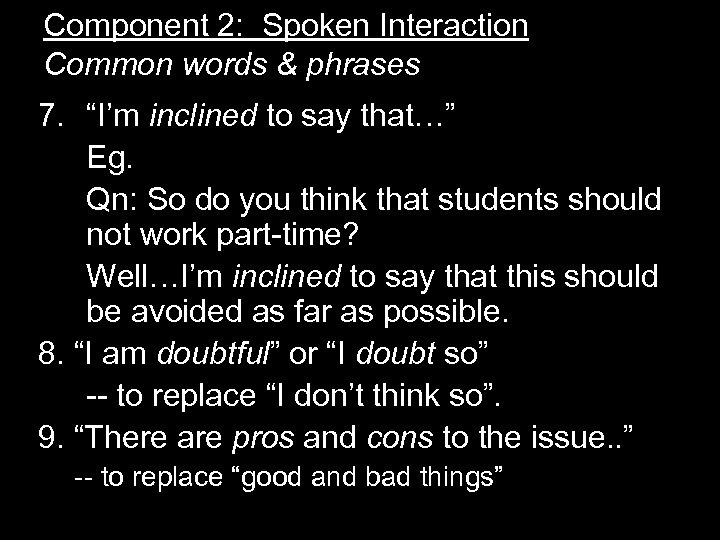 Component 2: Spoken Interaction Common words & phrases 7. “I’m inclined to say that…” Eg. Qn: So do you think that students should not work part-time? Well…I’m inclined to say that this should be avoided as far as possible. 8. “I am doubtful” or “I doubt so” -- to replace “I don’t think so”. 9. “There are pros and cons to the issue. . ” -- to replace “good and bad things”
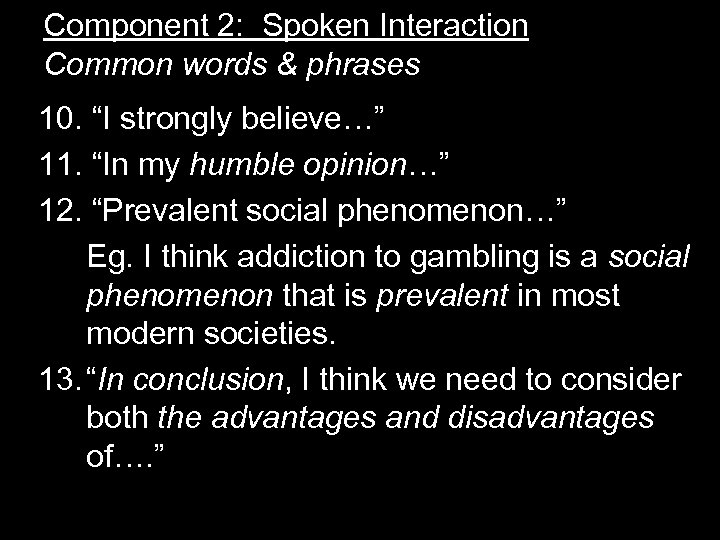 Component 2: Spoken Interaction Common words & phrases 10. “I strongly believe…” 11. “In my humble opinion…” 12. “Prevalent social phenomenon…” Eg. I think addiction to gambling is a social phenomenon that is prevalent in most modern societies. 13. “In conclusion, I think we need to consider both the advantages and disadvantages of…. ”
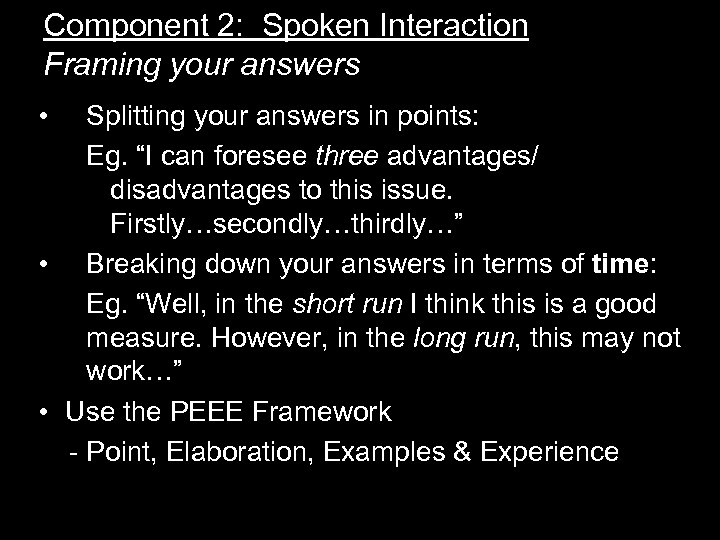 Component 2: Spoken Interaction Framing your answers • Splitting your answers in points: Eg. “I can foresee three advantages/ disadvantages to this issue. Firstly…secondly…thirdly…” • Breaking down your answers in terms of time: Eg. “Well, in the short run I think this is a good measure. However, in the long run, this may not work…” • Use the PEEE Framework - Point, Elaboration, Examples & Experience
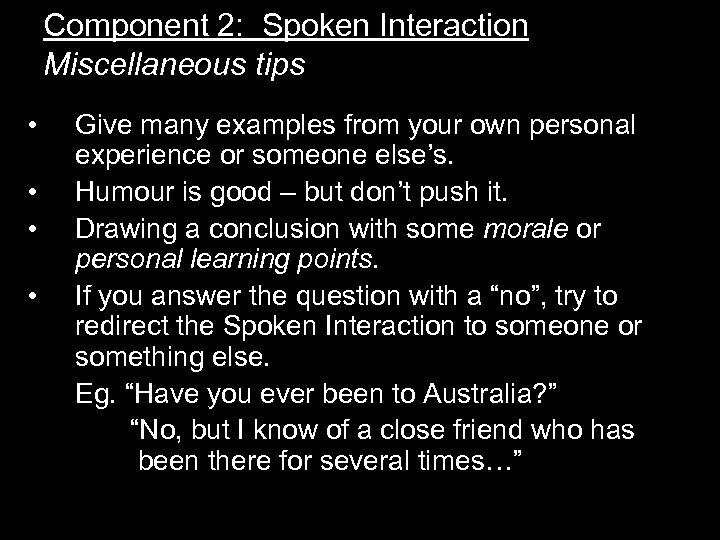 Component 2: Spoken Interaction Miscellaneous tips • • Give many examples from your own personal experience or someone else’s. Humour is good – but don’t push it. Drawing a conclusion with some morale or personal learning points. If you answer the question with a “no”, try to redirect the Spoken Interaction to someone or something else. Eg. “Have you ever been to Australia? ” “No, but I know of a close friend who has been there for several times…”
 Component 2: Spoken Interaction Miscellaneous tips • • • The conversation component is really about you – ie. your opinions of certain issues. Thus, you can prepare for this component by listing out a set of “FAQs” about yourself (eg. What are your views about students working part-time? ; what is your greatest achievement in life? ; what is your ambition? ) You may not be able to cover every possible issue, but at least it gets you into the mode of thinking…
 Component 2: Spoken Interaction Practice • • • “Have you ever been on a camping trip? Do you enjoy it? ” “Tell me about your favourite hobby”. “Do you think Singaporean youths are too pampered? ” “Have there been a time in your life when you’ve been cheated by a close friend? ” “Do you think that the Singapore lifestyle is too stressful? ” How can we encourage youth to give back to society?