


 Скачать презентацию RELIGION Chapter 7 What Is Religion and
1ac05124b7e75915399a2242ef4bb63e.ppt
- Количество слайдов: 49
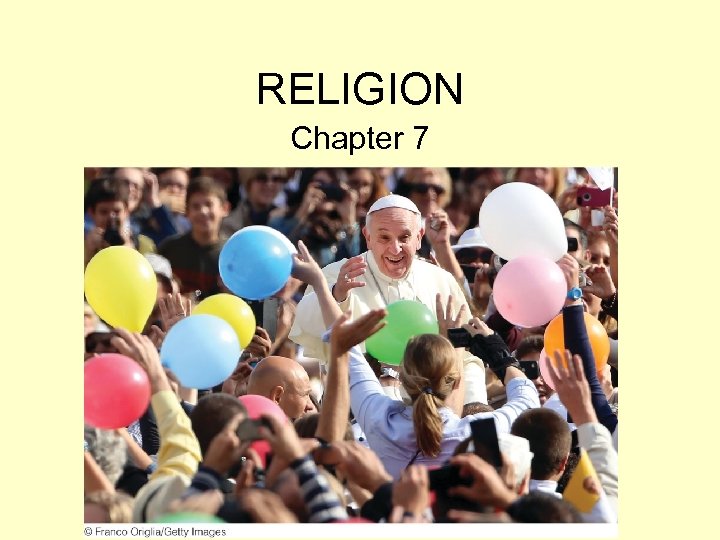 RELIGION Chapter 7
 What Is Religion, and What Role Does It Play in Culture? • Religion: “A system of beliefs and practices that attempts to order life in terms of culturally perceived ultimate priorities” -- Stoddard and Prorak • “Perceived ultimate priorities” often – Things a follower “should” do – Ways a follower “should” behave
 Manifestations of Religion • Worship • Belief that certain people possess special divinely granted abilities • Belief in one or more deities • Practices – Ritual and prayer – Marking life events • Birth, Marriage, Enter Adulthood, Death • Secularism: Decline in organized religious observances
 Where Did the Major Religions of the World Originate, and How Do Religions Diffuse? Concepts of divinity • Monotheistic religions: Worship a single deity • Polytheistic religions: Worship more than one deity, even thousands • Animistic religions: Belief that inanimate objects posses spirits and should be revered
 Classification of Religions • Universalizing religions: • Actively seek converts • Believe that they offer universal appropriateness and appeal • Christianity, Islam, Buddhism • Ethnic religions: • Adherents are born into the faith • Do not actively seek converts • Spatially located, Judaism the exception
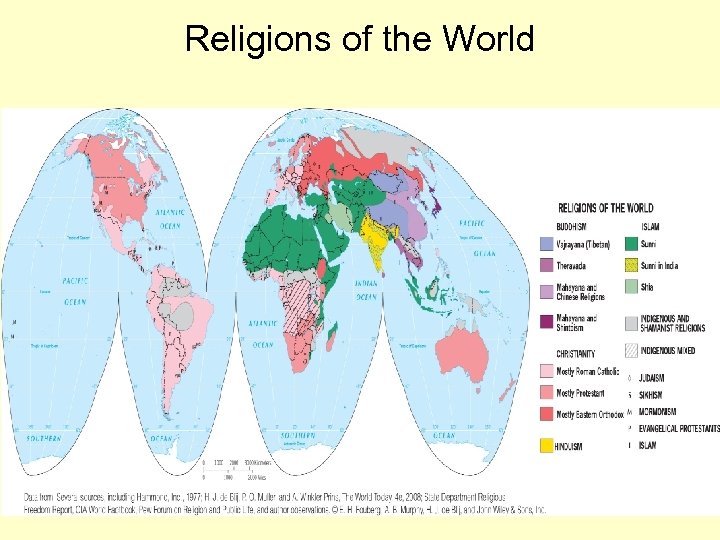 Religions of the World
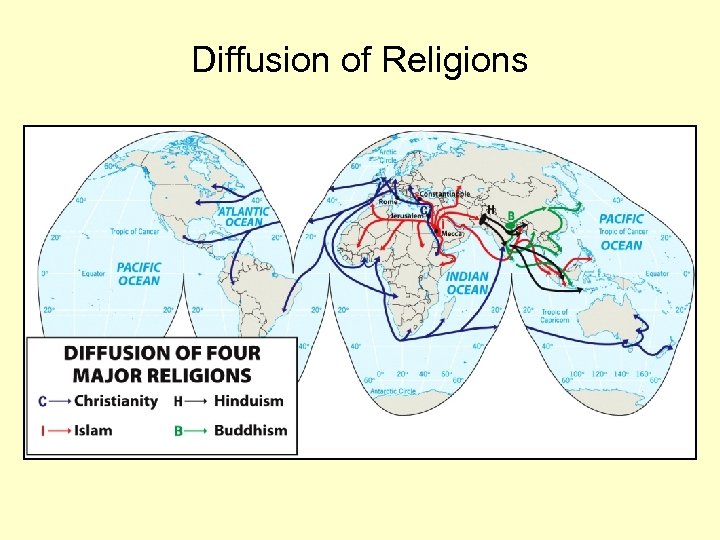 Diffusion of Religions
 From the Hearth of South Asia • Hinduism – Originated in Indus River Valley over 4000 years ago – Practices and beliefs: Ritual bathing, karma, reincarnation, nirvana, dharma – Sacred site: Ganges River, city of Varanasi – God/Gods: Brahman (the universal soul), others are expressions of Brahman – Social manifestation: Caste system – Diffusion • South Asia • Southeast Asia
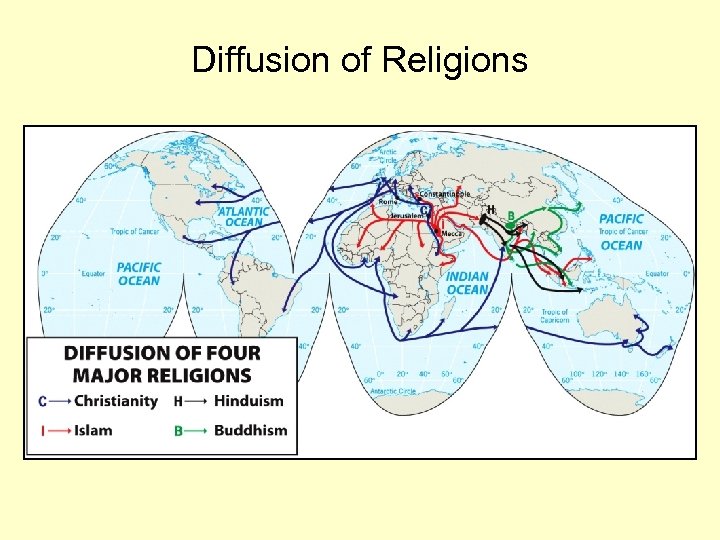 Diffusion of Religions
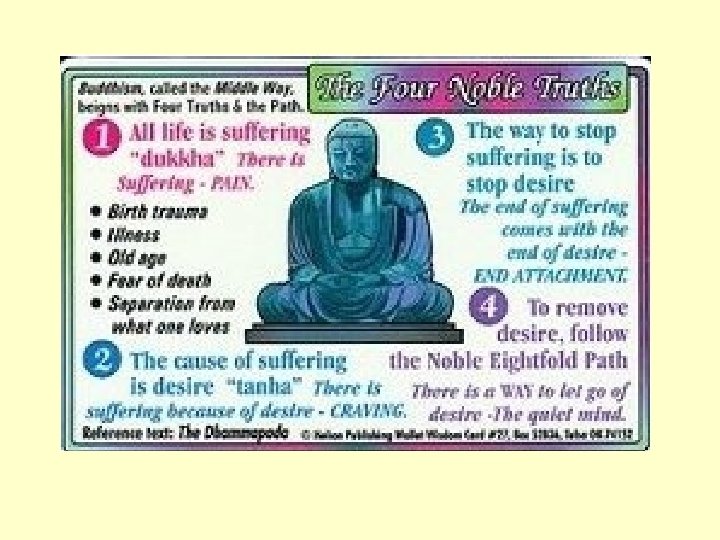
 From the Hearth of South Asia • Buddhism – – – – Splintered from Hinduism 2500 years ago Originated in a region from Nepal south to the Ganges River area Beliefs: Anyone can achieve salvation, reach enlightenment through 4 Noble Truths Founder: Siddartha Gautama (the Buddha) Sacred sites: Stupas Diffusion • Tibet in the north • East Asia • 347 million adherents
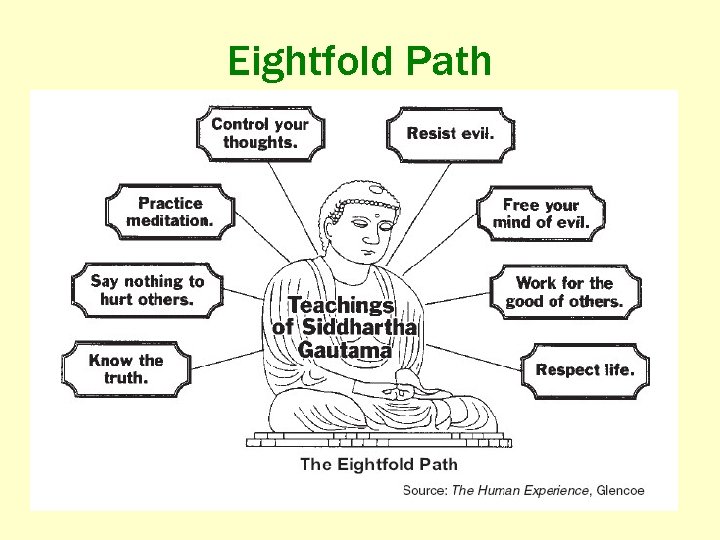 Eightfold Path
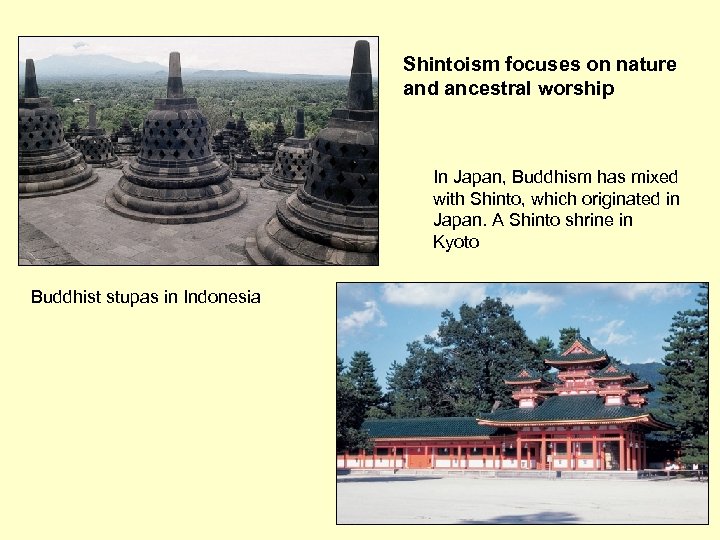 Shintoism focuses on nature and ancestral worship In Japan, Buddhism has mixed with Shinto, which originated in Japan. A Shinto shrine in Kyoto Buddhist stupas in Indonesia
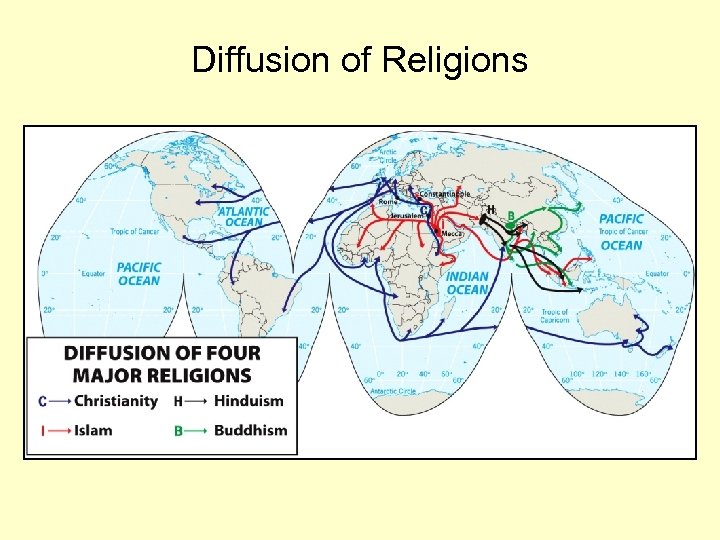 Diffusion of Religions
 From the Hearth of Huang He (Yellow) River Valley • Taoism – Originated in China more than 2500 years ago – Belief in oneness of humanity and nature – Founder: Lao-Tsu (Laozi) – Sacred text: Book of the Way (Daode Jing) – Social manifestation: Feng shui – Organizing living spaces in order to channel the life forces that exist in nature in favorable ways – Diffusion: East Asia
 From the Hearth of Huang He (Yellow) River Valley • Confucianism – Originated in China about 2500 years ago – Belief that the real meaning of life lies in the present – Founder: Confucius (Kong Fuzi) – Sacred text: Confucian Classics – Diffusion: • East Asia • Southeast Asia
 From the Hearth of the Eastern Mediterranean • Zoroastrianism – Thought by some to be the first monotheistic religion, developed about same time as Judaism • Judaism – Originated in Southwest Asia about 4000 years ago – Beliefs • First major monotheistic religion, • Covenant between God (one God) and Abraham (the chosen people) – Sacred text: Torah – First patriarch, or leader: Abraham
 Judaism (continued) • Sacred sites – Jerusalem (Western Wall) – Land between the Mediterranean and the Jordan River • Social manifestation: Zionism • Diffusion (Diaspora) – European cities during the diaspora • Ashkenazim: Central Europe • Sephardim: North Africa and Iberian Peninsula – North America – Return to Israel over last 100 years • Zionism
 From the Hearth of the Eastern Mediterranean • Christianity – Originated in Southwest Asia about 2000 years ago – Beliefs • Monotheistic religion • Follow teachings of Jesus (son of God) to achieve eternal life – How to live according to God’s plan – Sacred text: Bible – Founder: Jesus Christ
 Christianity (continued) – Sacred sites • Bethlehem (Jesus’ birthplace) • Jerusalem (Jesus’ death/resurrection) – Divisions • 1054: Split into o Eastern Orthodox (Constantinople) o Roman Catholic (Rome) • 1400 s– 1500 s: Protestants • 33, 000 denominations today – Diffusion: • Western Europe • World wide during colonialism and after • 2. 2 billion adherents
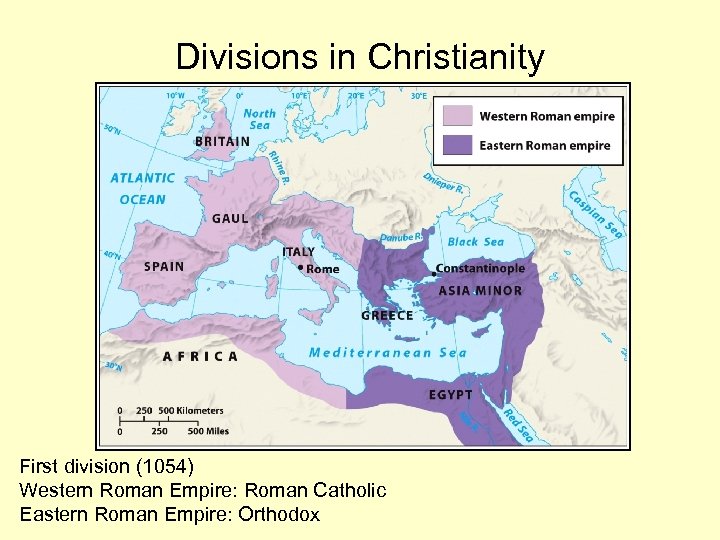 Divisions in Christianity First division (1054) Western Roman Empire: Roman Catholic Eastern Roman Empire: Orthodox
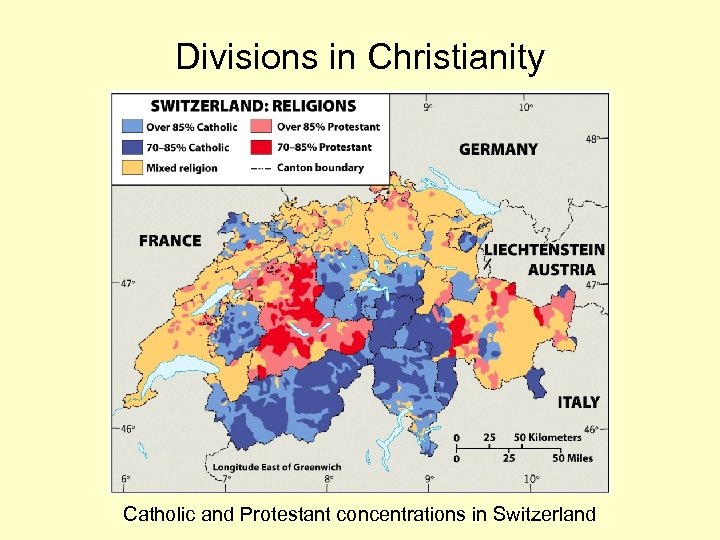 Divisions in Christianity Catholic and Protestant concentrations in Switzerland
 From the Hearth of the Eastern Mediterranean • Islam – Originated on Arabian Peninsula about 1500 years ago (youngest of monotheistic religions) – Beliefs • Monotheistic religion • Revelations Muhammad received from Allah (God) • Five Pillars – Sacred text: Qu’ran – Founder: Muhammad
 Islam (continued) – Sacred sites • Mecca (birth of Muhammad) • Medina (death of Muhammad) • Jerusalem (Muhammad rose to heaven) • Dome of the Rock – Divisions: Shortly after Muhammad’s death • Sunni Muslims (great majority) • Shi’ite Muslims (concentrated in Iran) – Diffusion • Arabian peninsula by Kings and armies • Across North Africa, into Spain (Trade) • East to South and Southeast Asia • 1. 57 billion adherents
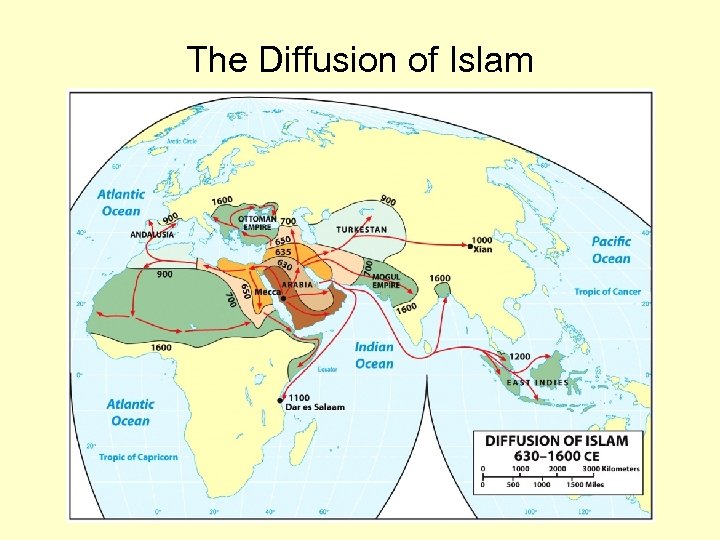 The Diffusion of Islam
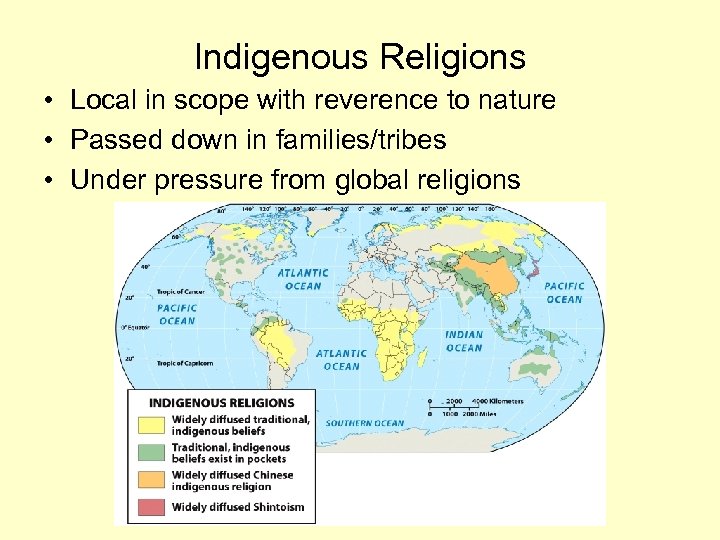 Indigenous Religions • Local in scope with reverence to nature • Passed down in families/tribes • Under pressure from global religions
 Shamanism • A community faith tradition • Shaman: A religious leader, teacher, healer, and visionary • Have appeared in – Africa – Native America – Southeast Asia – East Asia • Lack elaborate organization
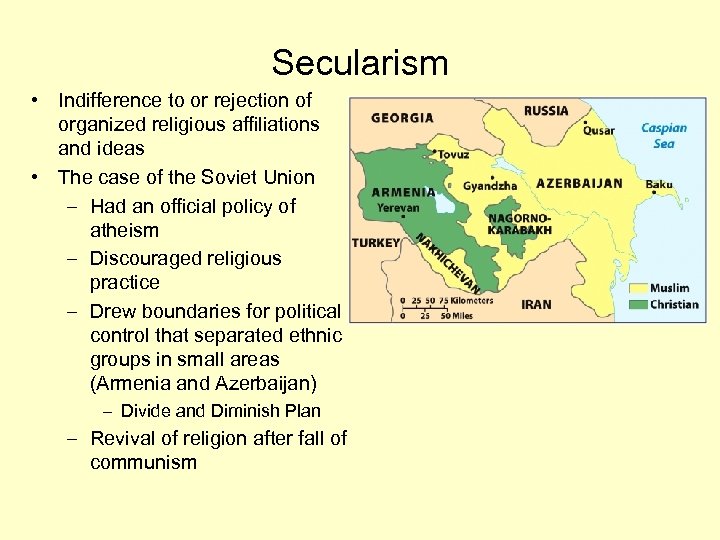 Secularism • Indifference to or rejection of organized religious affiliations and ideas • The case of the Soviet Union – Had an official policy of atheism – Discouraged religious practice – Drew boundaries for political control that separated ethnic groups in small areas (Armenia and Azerbaijan) – Divide and Diminish Plan – Revival of religion after fall of communism
 How Is Religion Seen in the Cultural Landscape? • Sacred sites: Places or spaces people infuse with religious meaning • Pilgrimage: Purposeful travel to a religious site to pay respects or participate in a ritual
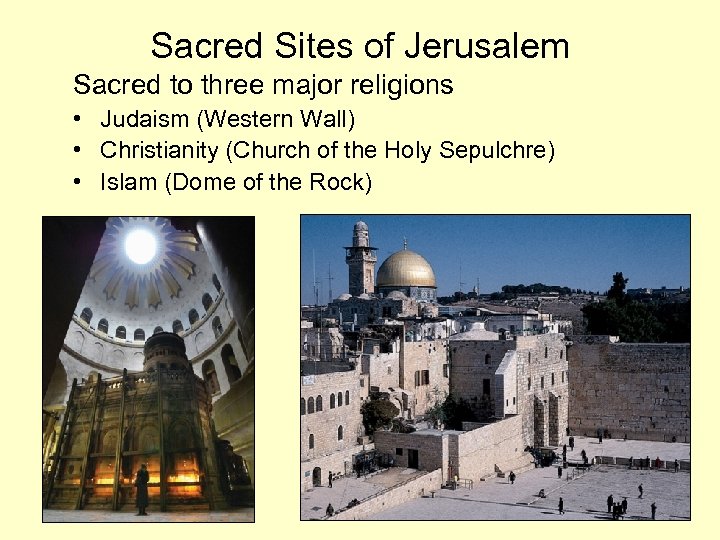 Sacred Sites of Jerusalem Sacred to three major religions • Judaism (Western Wall) • Christianity (Church of the Holy Sepulchre) • Islam (Dome of the Rock)
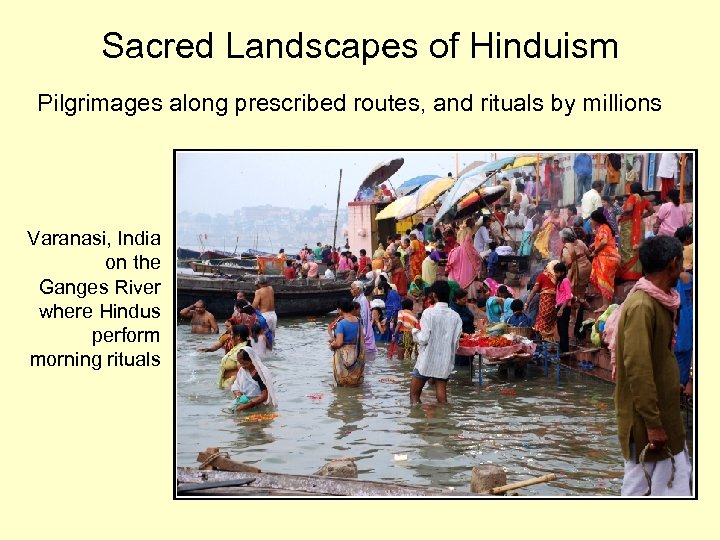 Sacred Landscapes of Hinduism Pilgrimages along prescribed routes, and rituals by millions Varanasi, India on the Ganges River where Hindus perform morning rituals
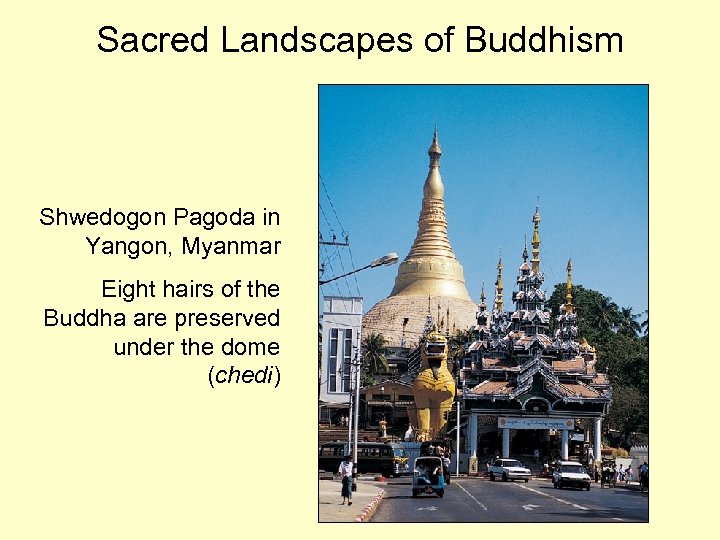 Sacred Landscapes of Buddhism Shwedogon Pagoda in Yangon, Myanmar Eight hairs of the Buddha are preserved under the dome (chedi)
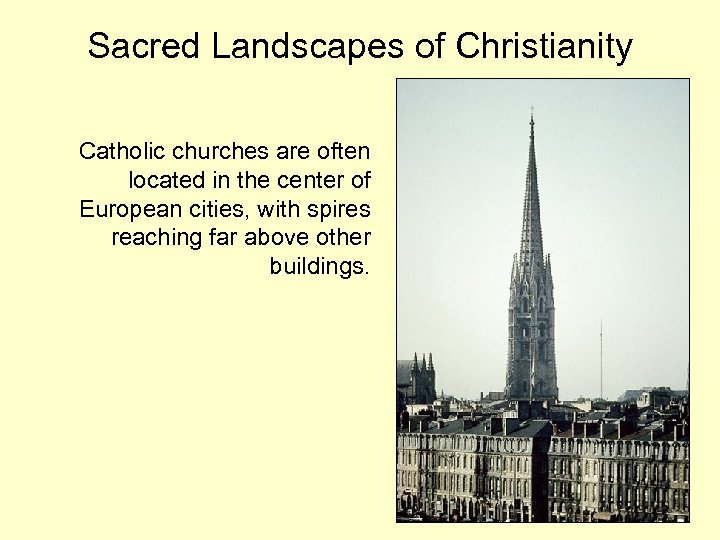 Sacred Landscapes of Christianity Catholic churches are often located in the center of European cities, with spires reaching far above other buildings.
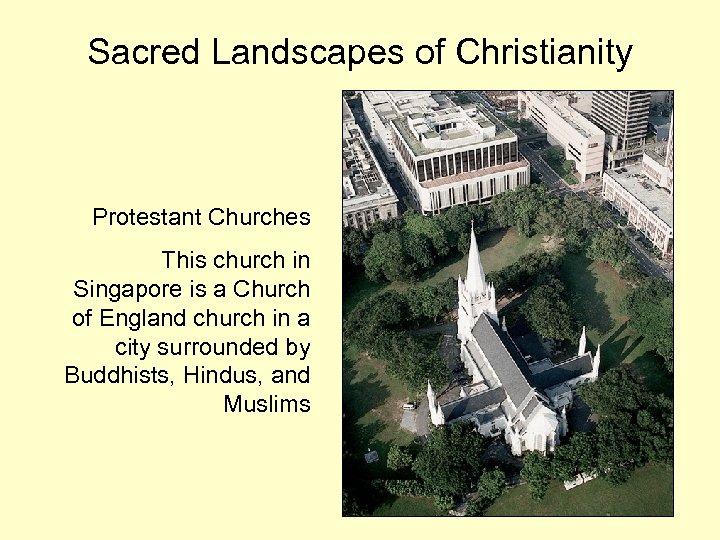 Sacred Landscapes of Christianity Protestant Churches This church in Singapore is a Church of England church in a city surrounded by Buddhists, Hindus, and Muslims
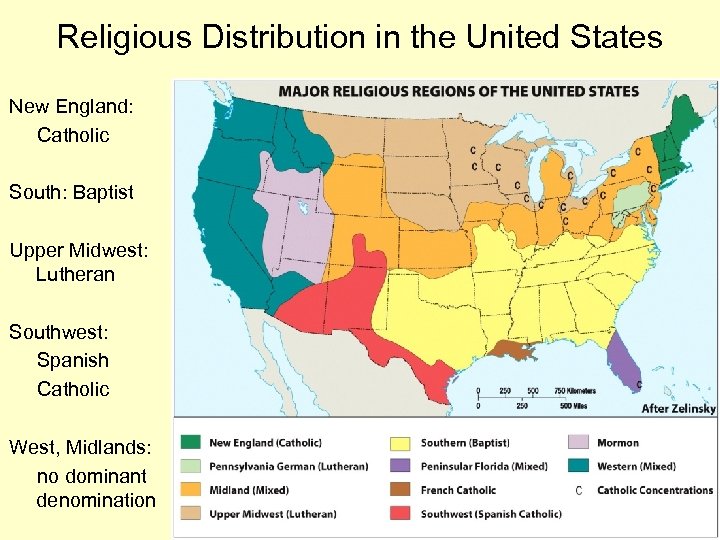 Religious Distribution in the United States New England: Catholic South: Baptist Upper Midwest: Lutheran Southwest: Spanish Catholic West, Midlands: no dominant denomination
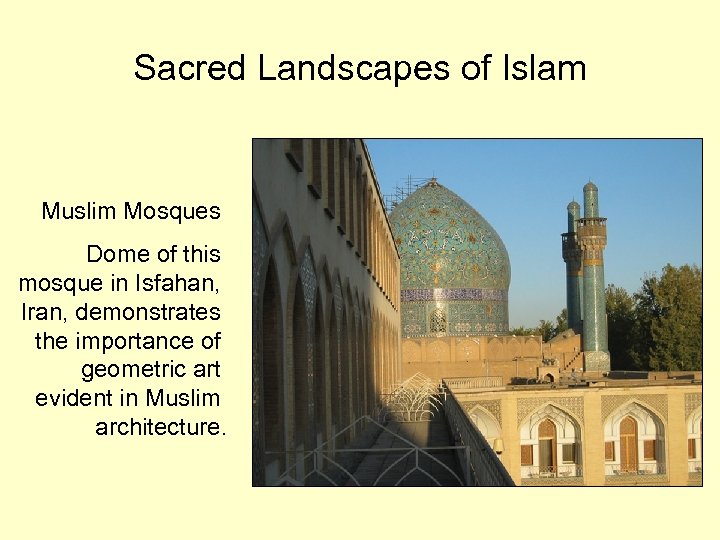 Sacred Landscapes of Islam Muslim Mosques Dome of this mosque in Isfahan, Iran, demonstrates the importance of geometric art evident in Muslim architecture.
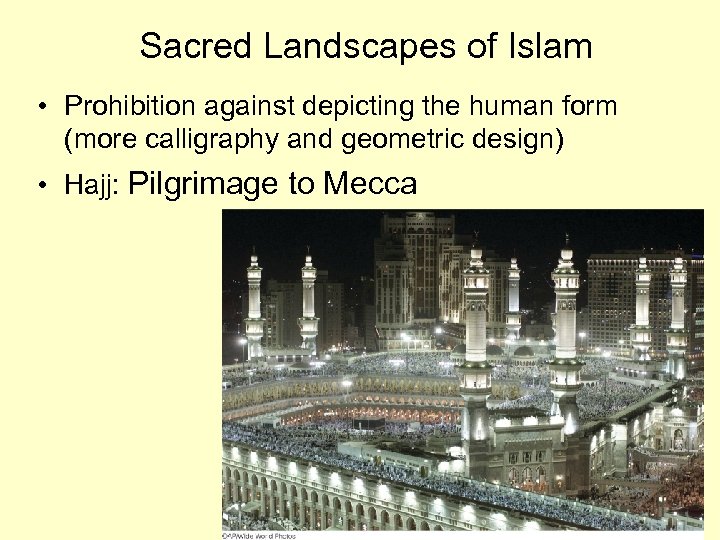 Sacred Landscapes of Islam • Prohibition against depicting the human form (more calligraphy and geometric design) • Hajj: Pilgrimage to Mecca
 What Role Does Religion Play in Political Conflicts? • Interfaith boundaries: Boundaries between the world’s major faiths – Ex. : Christian-Muslim boundaries in Africa • Intrafaith boundaries: Boundaries within a single major faith – Ex. : Protestants and Catholics
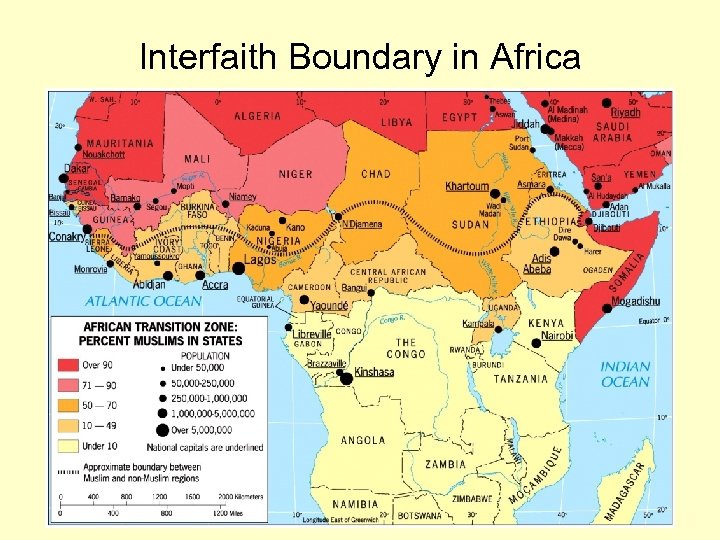 Interfaith Boundary in Africa
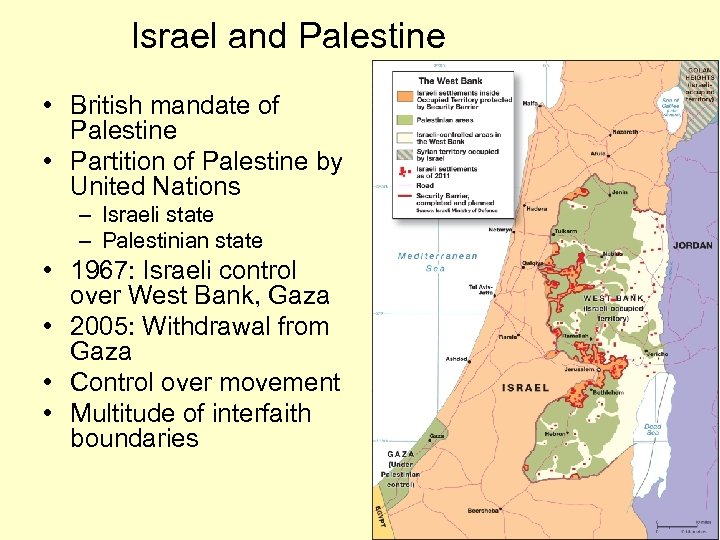 Israel and Palestine • British mandate of Palestine • Partition of Palestine by United Nations – Israeli state – Palestinian state • 1967: Israeli control over West Bank, Gaza • 2005: Withdrawal from Gaza • Control over movement • Multitude of interfaith boundaries
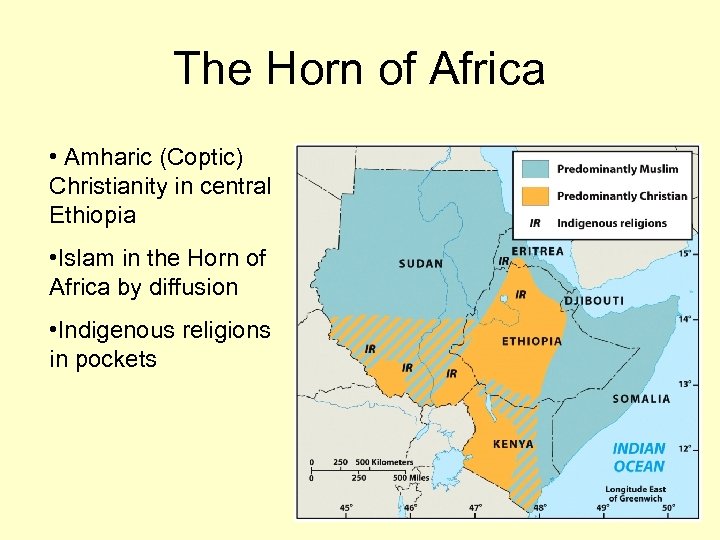 The Horn of Africa • Amharic (Coptic) Christianity in central Ethiopia • Islam in the Horn of Africa by diffusion • Indigenous religions in pockets
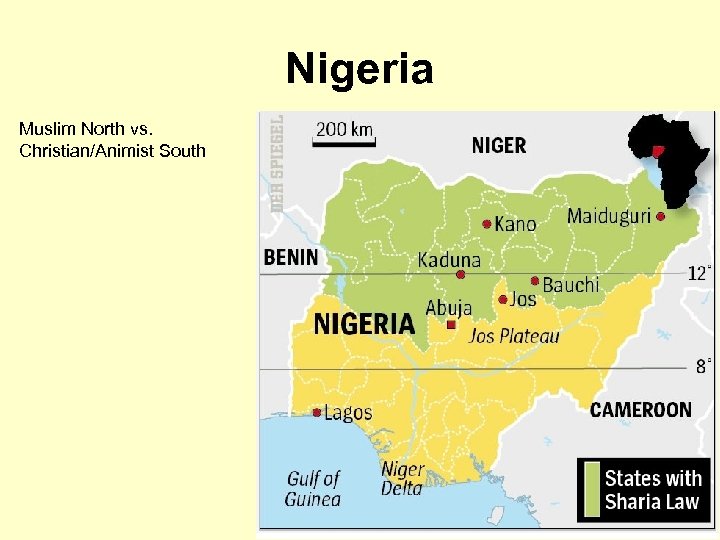 Nigeria Muslim North vs. Christian/Animist South
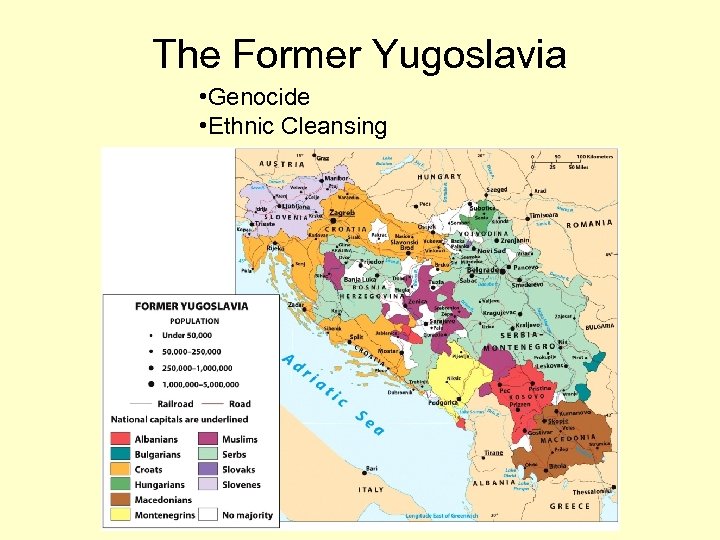 The Former Yugoslavia • Genocide • Ethnic Cleansing
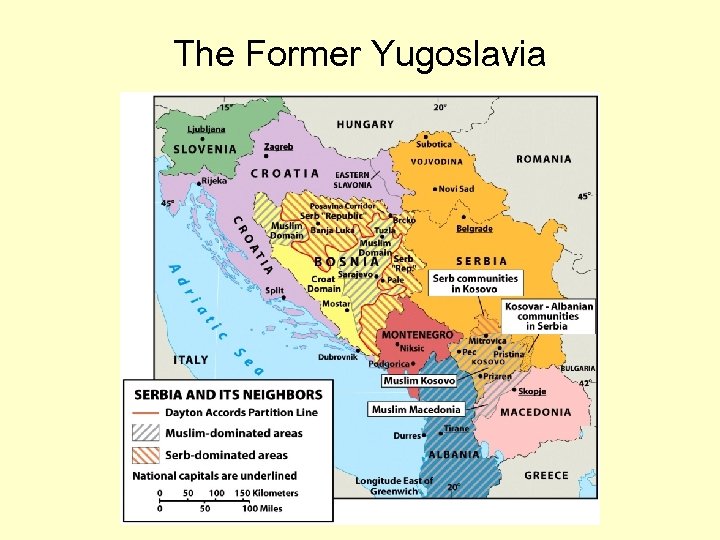 The Former Yugoslavia
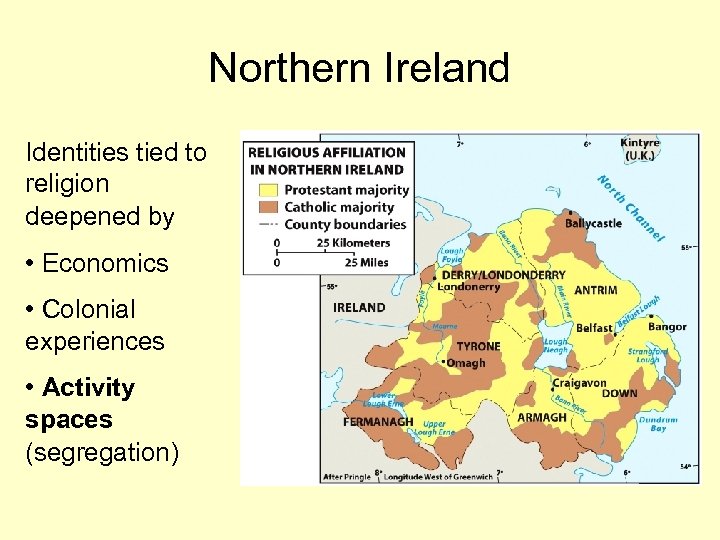 Northern Ireland Identities tied to religion deepened by • Economics • Colonial experiences • Activity spaces (segregation)
 Religious Fundamentalism and Extremism • Religious fundamentalism – A return to the basics of a faith – Found worldwide • Religious extremism: Fundamentalism carried to the point of violence. • Impact of globalization – Increased conservative reaction – Increased liberalism and accommodation
 Fundamentalism in Christianity • Catholicism – Birth control, abortion, and family planning – Role of women – Sects that continue to use Latin in services • Protestantism – Literal interpretation of the Bible – Opposition to abortion – Opposition to gay marriage – Political influence
 Fundamentalism in Judaism • Orthodox Judaism – Most conservative – Includes several varieties • Kach and Kahane Chai – Followers of Rabbi Meir Kahane – Anti-Arabism
 Fundamentalism in Islam • • Shari’a law Rule by ayatollahs in Iran Rule by Taliban in Afghanistan Jihad (holy war) – Wahhabi Islam (hearth in Saudi Arabia) – Osama bin Laden and al-Qaeda – ISIS