 Скачать презентацию Reliable Distributed Systems Peer to Peer Peer-to-Peer
e755b0798bb8ecfe49c7e0b56615ec10.ppt
- Количество слайдов: 48



Reliable Distributed Systems Peer to Peer
Peer-to-Peer (p 2 p) Systems n n The term refers to a kind of distributed computing system in which the “main” service is provided by having the client systems talk directly to one-another In contrast, traditional systems are structured with servers at the core and clients around the edges
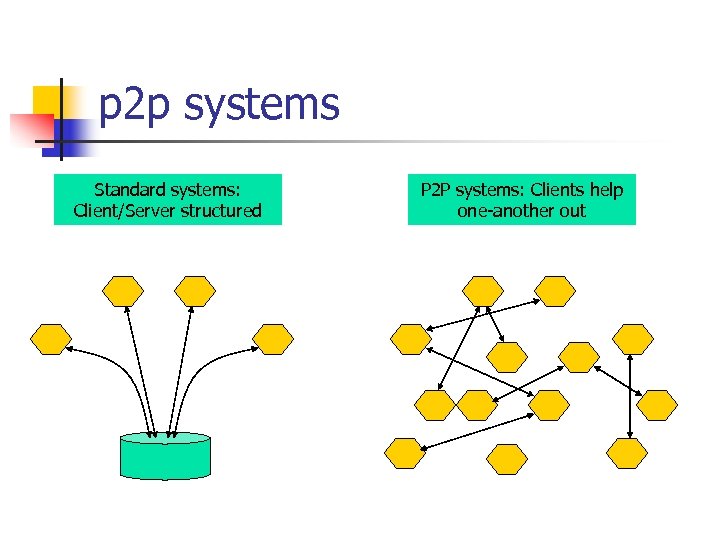
p 2 p systems Standard systems: Client/Server structured P 2 P systems: Clients help one-another out
An “important” topic n … or at least, it gets a lot of press n Recording industry claims that p 2 p downloads are killing profits! n n Used to be mostly file sharing, but now online radio feeds (RSS feeds) are a big deal too U. Wash. study showed that 80% of their network bandwidth was spent on music/video downloads! n n DVDs are largest, and accounted for the lion’s share A great many objects were downloaded many times Strangely, many downloads took months to complete… Most went to a tiny handful of machines in dorm rooms
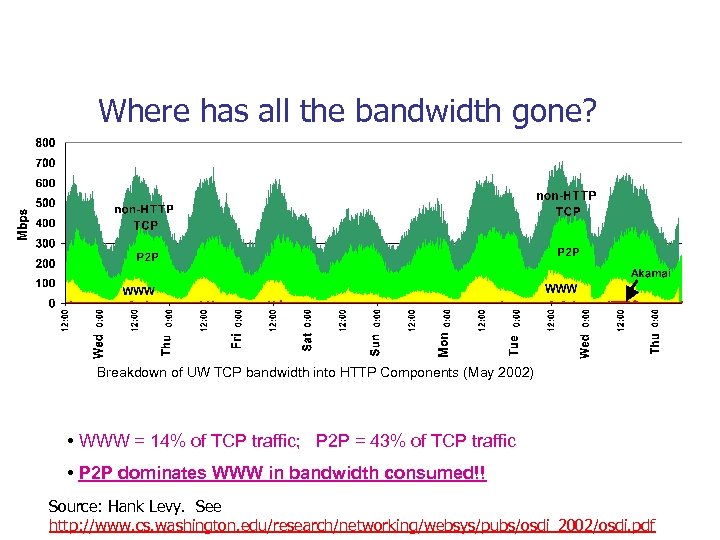
Where has all the bandwidth gone? Breakdown of UW TCP bandwidth into HTTP Components (May 2002) • WWW = 14% of TCP traffic; P 2 P = 43% of TCP traffic • P 2 P dominates WWW in bandwidth consumed!! Source: Hank Levy. See http: //www. cs. washington. edu/research/networking/websys/pubs/osdi_2002/osdi. pdf
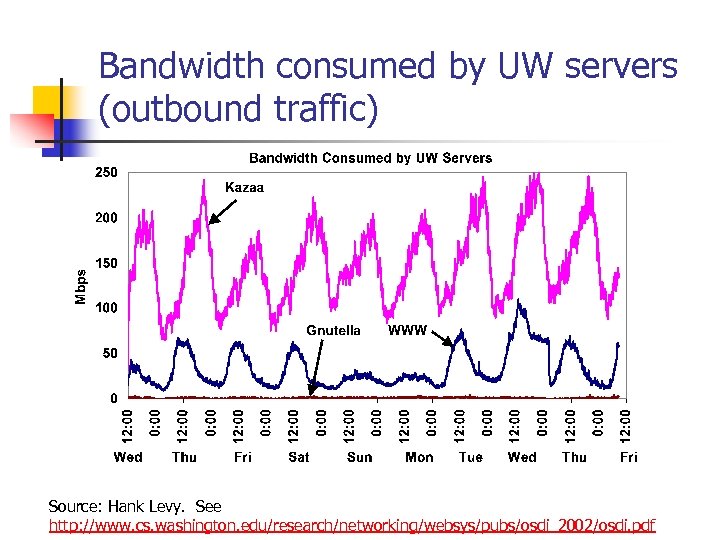
Bandwidth consumed by UW servers (outbound traffic) Source: Hank Levy. See http: //www. cs. washington. edu/research/networking/websys/pubs/osdi_2002/osdi. pdf
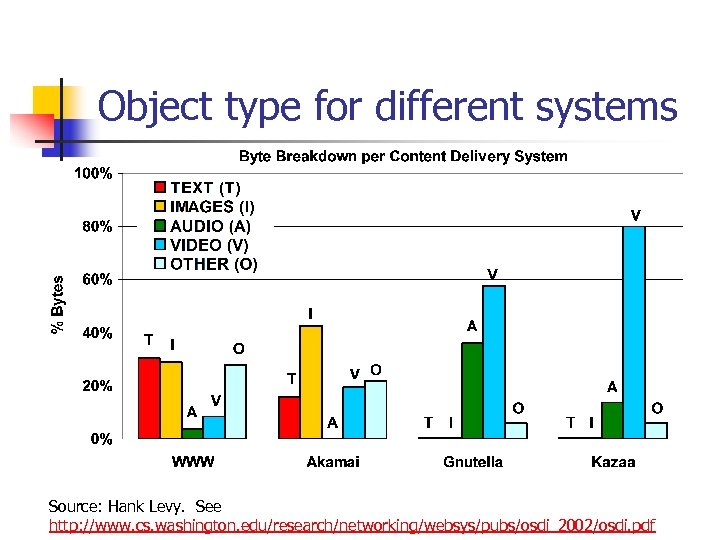
Object type for different systems Source: Hank Levy. See http: //www. cs. washington. edu/research/networking/websys/pubs/osdi_2002/osdi. pdf
Today: An Overview n Today we’ll look at the area as a whole n n Origins: Illegal fire sharing Early academic work: “Distributed hash tables” Subsequent spread of field into many other areas: steganographic storage, erasure codes, gossip protocols and epidemic data dissemination, etc In upcoming lectures we’ll look at details of some research systems
An old idea… n If you think about it, most of the protocols we’ve discussed are “peer to peer” in a broad sense n n n Pretty much everything Lamport was interested in uses direct client-to-client communication Group communication systems often do have servers, but not all need them… But the term really has a stronger meaning n n n Denotes systems where the “data that matters” is passed among cooperating client systems And there may be huge numbers of clients Evokes image of resistance fighters working to overthrow an evil IP empire
Attributes of p 2 p systems n They can be enormous n n n We often talk about hundreds of thousands or millions of client nodes, coming and going rapidly If there are servers, they are small in number and have limited roles These clients are everywhere n n n Even in Kenya or Nepal… places with lousy network connectivity Often behind firewalls or NAT boxes Some are supercomputers. But many are slow
The issue with NAT boxes n When a system uses firewalls or NAT boxes n Client systems inside the network can usually talk to servers outside it n n n The NAT knows about the TCP 3 -way handshake and “creates a tunnel” on the fly It remaps the (IP address, port) pair as packets pass by, so it looks as if the NAT (not the client) is making the connection and receiving the replies… But connectivity from outside to inside is blocked n In fact, because client IP address is mapped, the client simply can’t be addressed other than through the NAT!
The first peer-to-peer system n The term, and the intuition, emerged from the Napster file sharing service n n In fact Napster has a set of servers But these just keep a directory on behalf of clients and orchestrate publicity inserts Servers build the web pages users see Actual music and DVD downloads are done from client to client
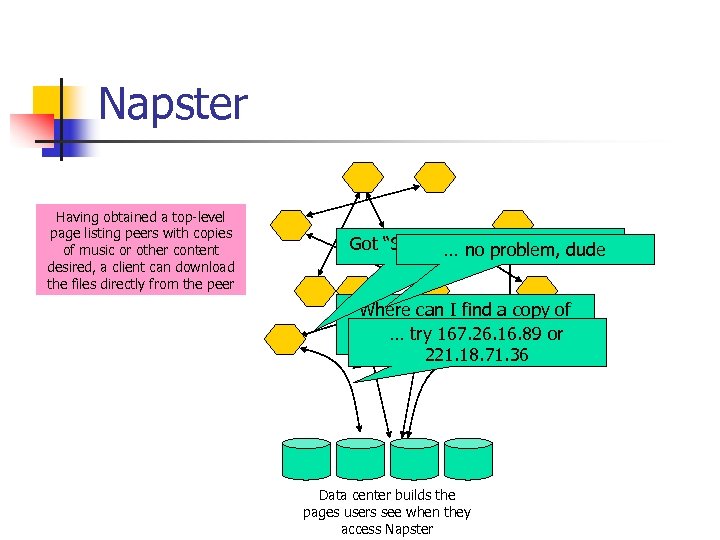
Napster Having obtained a top-level page listing peers with copies of music or other content desired, a client can download the files directly from the peer Got “Sting”? …Can problem, copy? no I have a dude Where can I find a copy of “Sting: Fields of Barley”? … try 167. 26. 16. 89 or 221. 18. 71. 36 Data center builds the pages users see when they access Napster
Quick aside n Should “intellectual property” be free? n n Topic of much debate right now Lessig: “East Code vs West Code” n n n East Code is a term for “laws on the books” West Code is a term for software His point? n n We need to evolve a balance between what we demand (law), what we can implement (code), and what will promote the general wellfare What regime gives the most benefit for the most people?
Why did Napster go this route? n When service launched, developers hoped to work around legal limits on sharing media n n n They reasoned: let client systems advertise “stuff” If some of that stuff happens to be music, that’s the responsibility of the person who does it The directory system “helps clients advertise wares” but doesn’t “endorse” the sharing of protected intellectual property. Client who chooses to do so is violating the law They make their money on advertising they insert Judges saw it differently… n “Napster’s clear purpose is to facilitate theft of IP…”
Characteristics of big populations n With huge numbers of users n n n Surprisingly many “come and go” on short time scales One study: mean residence time in Freenet was just a few seconds… and many clients were never heard of again! British telcom reassigns IP addresses for all its networked users every few hours!
List of (technical) issues with Napster n Many clients just aren’t accessible n n n Firewalls can limit incoming connections to clients Many client systems come and go (churn) Round trip times to Nepal are slow… Slow “upload” speeds are common connections Clients might withdraw a file unexpectedly n E. g. if low on disk space, or if they download something on top of a song they aren’t listening to anymore
More (technical) issues with Napster n Industry has been attacking the service… and not just in court of law n n Denial of service assaults on core servers Some clients lie about content (e. g. serve Frank Sinatra in response to download for Eminem) Hacking Napster “clients” to run the protocol in various broken (disruptive) ways And trying to figure out who is serving which files, in order to sue those people
What problems are “fundamental”? n n n If we assume clients serve up the same stuff people download, the number of sources for a less popular item will be very small Under assumption that churn is a constant, these less popular items will generally not be accessible. But experiments show that clients fall into two categories: n n n Well-connected clients that hang around Poorly-connected clients that also churn … this confuses the question
What problems are fundamental? n n One can have, some claim, as many electronic personas as one has the time and energy to create. – Judith S. Donath. So-called “Sybil attack…. ” n n Attacker buys a high performance computer cluster It registers many times with Napster using a variety of IP addresses (maybe 10’s of thousands of times) Thinking these are real, Napster lists them in download pages. Real clients get poor service or even get snared Studies show that no p 2 p system can easily defend against Sybil attacks!
Refined Napster structure n Early Napster just listed anything. Later: n n Enhanced directory servers to probe clients, track their health. Uses an automated reporting of download problems to trim “bad sources” from list Ranks data sources to preferentially list clients who… n n Have been up for a long time, and Seem to have fast connections, and Appear to be “close” to the client doing the download (uses notion of “Internet distance”) Implement parallel downloads and even an experimental method for doing “striped” downloads (first block from source A, second from source B, third from C, etc) n Leverages asymmetric download/uplink speeds
Meanwhile, p 2 p took off n n By the time Napster was ruled illegal, it had 15 million users. 5 million of them joined in just a few months! With Napster out of business, a vacuum arose n n Some users teamed up to define an open standard called “Gnutella” and to develop many protocol implementations Gnutella eliminates the server n n n Judge singled it out in deciding that Napster was illegal Also, a true peer-to-peer network seems harder to defeat than one that is only partly peer-to-peer Credo: “All information should be free”
How Gnutella works n Rough outline n User joins the network using a broadcast with increasing TTL values n n n “Is anyone out there? ” Links itself to the first Gnutella node to respond To find content, protocol searches in a similar way n n n Broadcasts “I’m looking for Eminem: Whack. Her” Keeps increasing TTL value… eventually gives up if no system respond Hopefully, popular content will turn up nearby
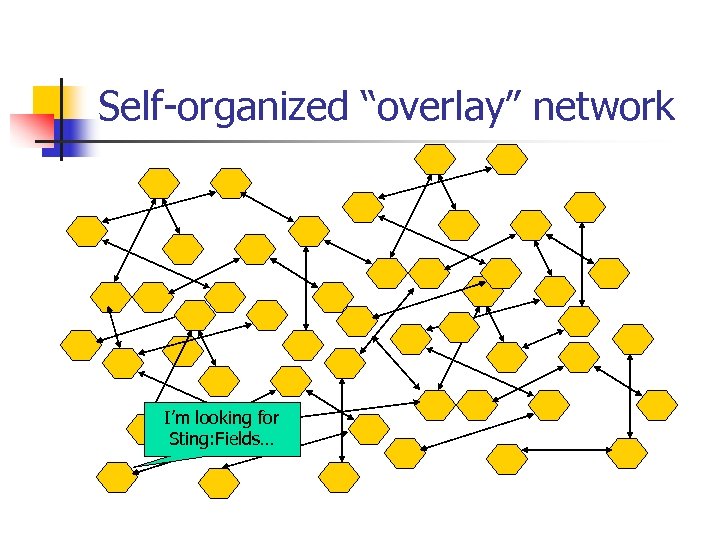
Self-organized “overlay” network I’m looking for Sting: Fields…
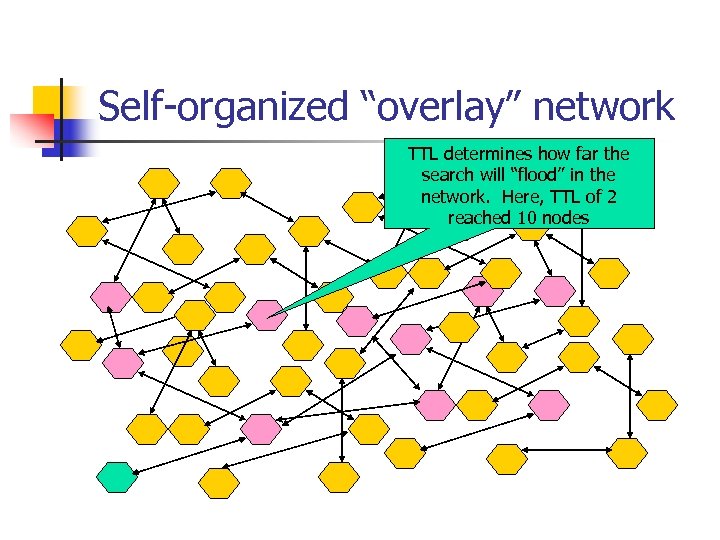
Self-organized “overlay” network TTL determines how far the search will “flood” in the network. Here, TTL of 2 reached 10 nodes
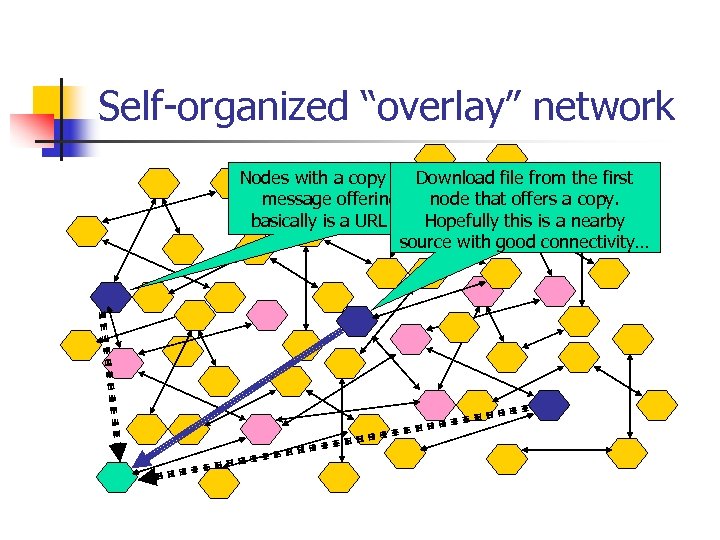
Self-organized “overlay” network Nodes with a copy send back a file from the first Download message offering it. node that offers a copy. This basically is a URL for the file Hopefully this is a nearby source with good connectivity…
Gnutella has “issues” n In experimental studies of the system n n n Very high rates of join requests and queries are sometimes observed Departures (churn) found to disrupt the Gnutella communication graph Requests for rare or misspelled content turn into world-wide broadcasts n Rare is… um… rare. Misspellings are common.
Berkeley, MIT research in p 2 p n Universities were first to view p 2 p as an interesting research area n n n CAN: “Content addressable network” proposed by Berkeley Chord: MIT “distributed hash table” Both systems separate the “indexing” problem from actual storage
Distributed hash tables (DHTs) n Idea is to support a simple index with API: n n n Insert(key, value) – saves (key, value) tuple Lookup(key) – looks up key and returns value Implement it in a p 2 p network, not a server… n n Exactly how we implement it varies Normally, each p 2 p client has just part of the tuples, hence must route query to the right place
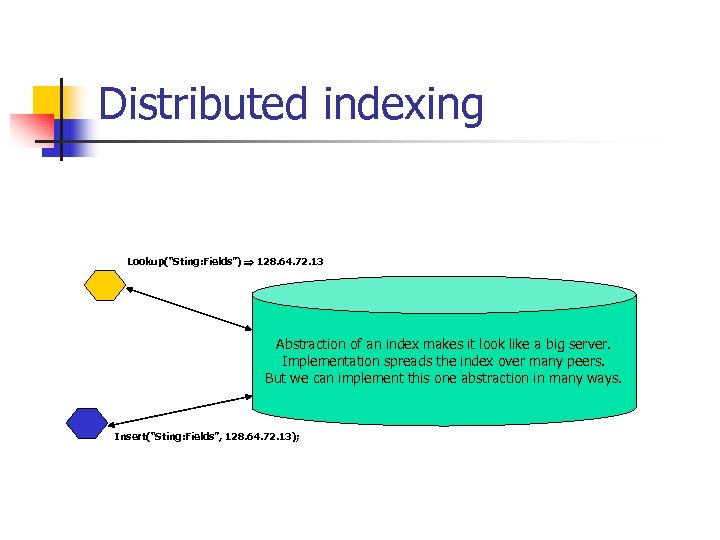
Distributed indexing Lookup(“Sting: Fields”) 128. 64. 72. 13 Abstraction of an index makes it look like a big server. Implementation spreads the index over many peers. But we can implement this one abstraction in many ways. Insert(“Sting: Fields”, 128. 64. 72. 13);
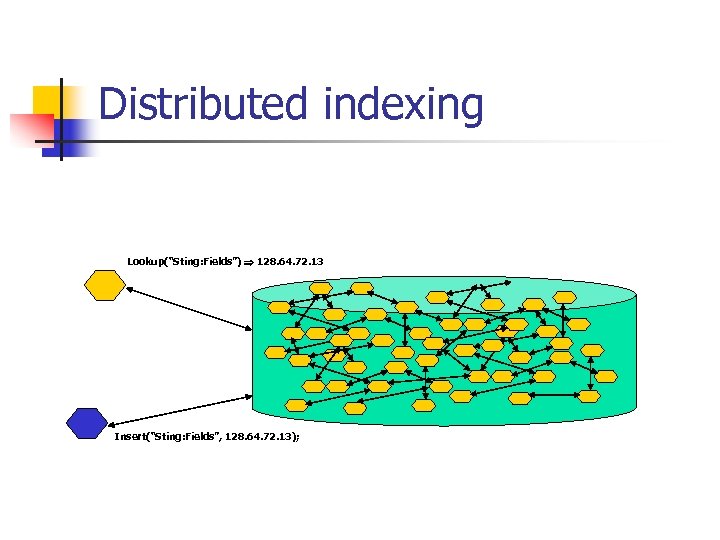
Distributed indexing Lookup(“Sting: Fields”) 128. 64. 72. 13 Insert(“Sting: Fields”, 128. 64. 72. 13);
Some details n Keep in mind n There are lots of protocols that can solve this problem: the protocol used is not part of the problem statement n n Some DHTs allow updates (e. g. if data moves, or nodes crash). Others are write once. Most DHTs allow many tuples with the same key and can return the whole list, or a random subset of size k, etc
So what can we insert? n Normally, we want to keep the values small… like an IP address n So the (key, value) pairs might tell us where to look for something but probably not the actual thing n n Value could be (and often is) a URL Once we have the DHT running we can use it to build a p 2 p file system
DHTs: Area quickly took off n n Can, Chord: DHTs, already mentioned Pastry: From Rice and MSR, uses “Plaxton trees” (a kind of lookup tree) Tapestry: Berkeley (similar to Pastry) Kelips, Beehive: Cornell (use replication to get much faster responses) … and too many more to list!
Representative research topics n Can we make a DHT… n n n … … “resilient” to churn? hide content and guarantee anonymity? secure and robust against attack? support high quality parallel striped downloads? Can we use a DHT… n n To support scalable content distribution (IP multicast isn’t popular with ISPs)? To implement a new style of Internet addressing (i. e. replace IP routing or multicast)?
Are there legitimate uses of p 2 p file systems? n n n One thought: corporations might want to index “everything in their file store” or to archive stuff Digital libraries might use p 2 p to avoid keeping extra copies of special or extremely big objects Risk of “bit rot” is a big concern n Suppose some huge set of PCs collaborates to preserve important documents n n n Might also encrypt them – various options exist… How many replicas needed to avoid risk that “rare events” will destroy all copies simultaneously? A topic of study in Oceanstore and at UCSD
Are there legitimate uses of p 2 p file systems? n p 2 p could be a great way to legally share information within a team of collaborators at work, or some other “interest group” n n n Think of these as little groups superimposed on a massive p 2 p network using the same technology Idea would be: “We help each other out” Some argue that p 2 p systems could be valuable in resisting repressive political regimes n n Like “coffee house” meetings in pre-revolutionary Russia Can repressive regimes survive if they can’t control the flow of information?
Spyware: The real thing n Imagine a popular p 2 p system that n n Encrypts content: need key to make sense of it Achieves a high degree of anonymity n n Pretty much everyone helps to serve each request, but nobody actually has a copy of the whole file on their drive – e. g. I have a few bits, you have a few bits Real sources and nodes accessing content concealed from intruders Robust against disruptive attack Needs to be popular: Spies hide in crowds
Philosophical debate n Is technology “political”? n Here we have a technology invented to n n n Rip off IP from owners Conceal crime from law enforcement Pretty much unstoppable without incredibly intrusive oversight mechanisms What’s the story here? Are we all anarchists? Some people believe technology is negative, some positive, some neutral n n What about p 2 p technology? Are we allowed to answer “all of the above”?
p 2 p outside of file sharing n Key idea was that p 2 p systems could “gossip” about replicated data n n Now and then, each node picks some “peer” (at random, more or less) Sends it a snapshot of its own data n n Or asks for a snapshot of the peer’s data n n Called “push gossip” “Pull” gossip Or both: a push-pull interaction
![Gossip “epidemics” n n [t=0] Suppose that I know something [t=1] I pick you…](https://present5.com/presentation/e755b0798bb8ecfe49c7e0b56615ec10/image-41.jpg "Gossip “epidemics” n n [t=0] Suppose that I know something [t=1] I pick you…")
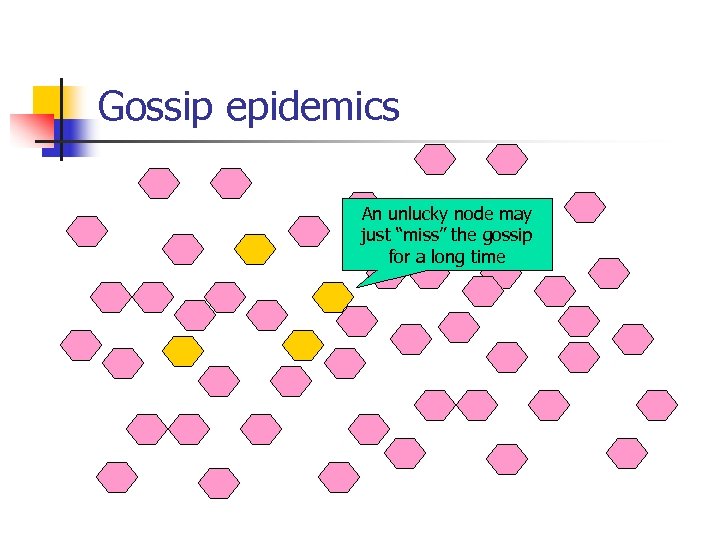
Gossip “epidemics” n n [t=0] Suppose that I know something [t=1] I pick you… Now two of us know it. [t=2] We each pick … now 4 know it… Information spread: exponential rate. n n Due to re-infection (gossip to an infected node) spreads as 1. 8 k after k rounds But in O(log(N)) time, N nodes are infected
Gossip epidemics An unlucky node may just “miss” the gossip for a long time
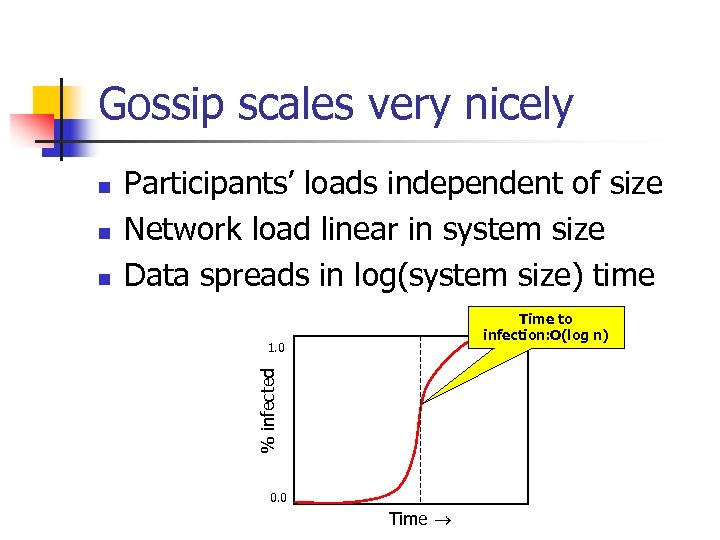
Gossip scales very nicely n n Participants’ loads independent of size Network load linear in system size Data spreads in log(system size) time Time to infection: O(log n) 1. 0 % infected n 0. 0 Time
Facts about gossip epidemics n Extremely robust n n Data travels on exponentially many paths! Hard to even slow it down… n n Suppose 50% of our packets are simply lost… … we’ll need 1 additional round: a trivial delay! Push-pull works best. For push-only/pull-only a few nodes can remain uninfected for a long time Later we’ll see that many optimizations are needed in practice… but the approach works!
Uses of gossip epidemics n To robustly multicast data n n Slow, but very sure of getting through To repair inconsistency in replicas To support “all to all” monitoring and distributed management For distributed data mining and discovery
A contemporary perspective n p 2 p computing has many pros and many cons, and for most purposes the cons outweigh the pros n n A “hard to control” technology Firewalls cause many annoyances Rather slow to propagate updates But at the same time n Incredibly robust against disruption
Contemporary response? n So… use p 2 p techniques, but mostly n n n In data centers or LANs where there are no firewalls In uses where slow update times aren’t an issue Often means that we need to marry p 2 p mechanism to a more “urgent” protocol like our multicast protocols
Peek ahead n We’ll look at several p 2 p technologies n n n Chord, Pastry, Kelips: three DHTs Bimodal Multicast: Uses gossip in a multicast protocol to get superior scalability Astrolabe: Uses gossip to implement a scalable monitoring, management and control infrastructure (also great for data mining)
Скачать презентацию Reliable Distributed Systems Peer to Peer Peer-to-Peer
e755b0798bb8ecfe49c7e0b56615ec10.ppt