 Скачать презентацию Relationship between social support and mental health status
6481323f5919bafe79bfd51ef45dfffb.ppt
- Количество слайдов: 15



Relationship between social support and mental health status among caregivers of AD and MCI Huali Wang, MD, Ph. D Dementia Care & Research Center Peking University Institute of Mental Health Board of Directors International Psychogeriatric Association (IPA) Vice President Alzheimer’s Disease Chinese (ADC)
Conflict of Interest Disclosure Huali Wang, MD, Ph. D Has no real or apparent conflicts of interest to report. Research funding from National Institute on Aging and the Fogarty International Center (R 21 AG 028180 -01 A 2), and Alzheimer’s Association (NIRG-04 -1184). The case registry of cognitive impairment was supported by Natural Science Foundation of China (30500178, 30971044) and Ministry of Science and Technology (2007 AA 02 Z 421).
BACKGROUND • It is estimated that there were around 5 million people of AD in China. • Family members are still the major source of caregiving in China. Dementia caregiving may have great effect on the mental health status of family caregivers. • Social support and social network may play an important role in mediating the outcome of caregiving. Zhang ZX, et al. Arch Neurol, 2005, 62: 447 -453 Wang H, et al. Ageing International, 2010, 35: 72 -84.
OBJECTIVE • To explore the relationship between mental health status, effects of caregiving and social support among caregivers of AD and MCI in China.
RESEARCH PARTICIPANTS • A sample was drawn from memory clinics in Beijing and Wuhan, China. • 48 caregivers – 24 MCI informants/caregivers – 24 caregivers for people with mild/moderate dementia.
METHODS • A mixed-method approach – quantitative questionnaire • mental health status: SAS, SDS • effects of caregiving: CBS • social support: SSS – qualitative semi-structured interviews to explore their views on potential social stigma.
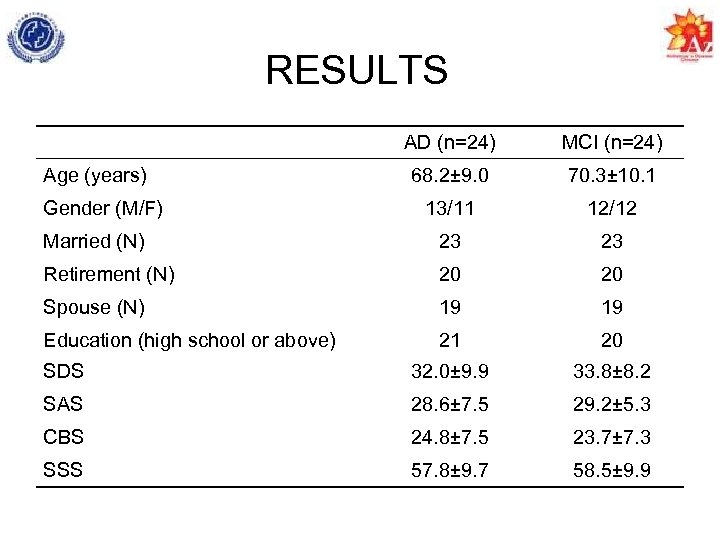
RESULTS AD (n=24) MCI (n=24) 68. 2± 9. 0 70. 3± 10. 1 13/11 12/12 Married (N) 23 23 Retirement (N) 20 20 Spouse (N) 19 19 Education (high school or above) 21 20 SDS 32. 0± 9. 9 33. 8± 8. 2 SAS 28. 6± 7. 5 29. 2± 5. 3 CBS 24. 8± 7. 5 23. 7± 7. 3 SSS 57. 8± 9. 7 58. 5± 9. 9 Age (years) Gender (M/F)
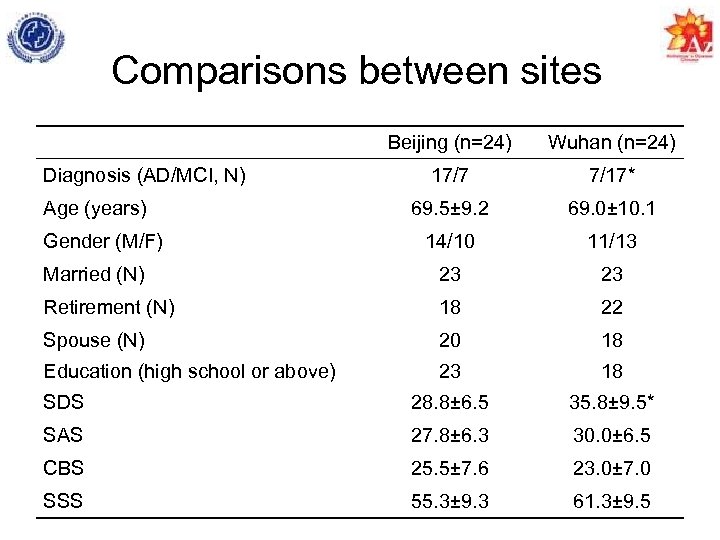
Comparisons between sites Beijing (n=24) Wuhan (n=24) 17/7 7/17* 69. 5± 9. 2 69. 0± 10. 1 14/10 11/13 Married (N) 23 23 Retirement (N) 18 22 Spouse (N) 20 18 Education (high school or above) 23 18 SDS 28. 8± 6. 5 35. 8± 9. 5* SAS 27. 8± 6. 3 30. 0± 6. 5 CBS 25. 5± 7. 6 23. 0± 7. 0 SSS 55. 3± 9. 3 61. 3± 9. 5 Diagnosis (AD/MCI, N) Age (years) Gender (M/F)
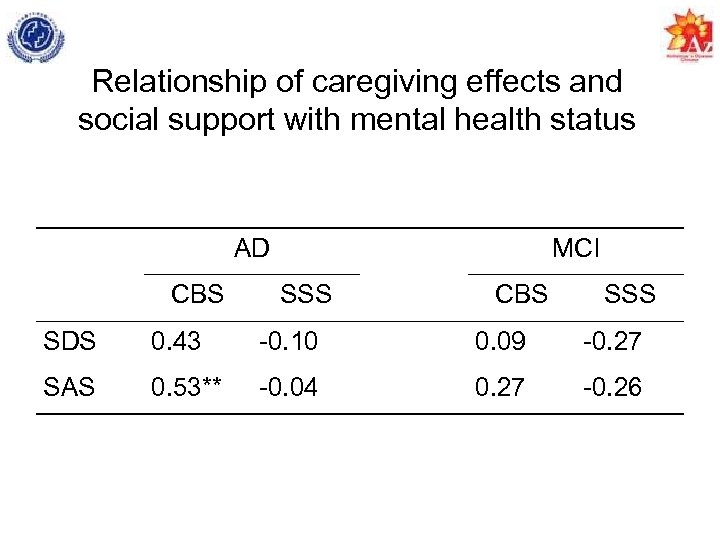
Relationship of caregiving effects and social support with mental health status AD CBS MCI SSS CBS SSS SDS 0. 43 -0. 10 0. 09 -0. 27 SAS 0. 53** -0. 04 0. 27 -0. 26
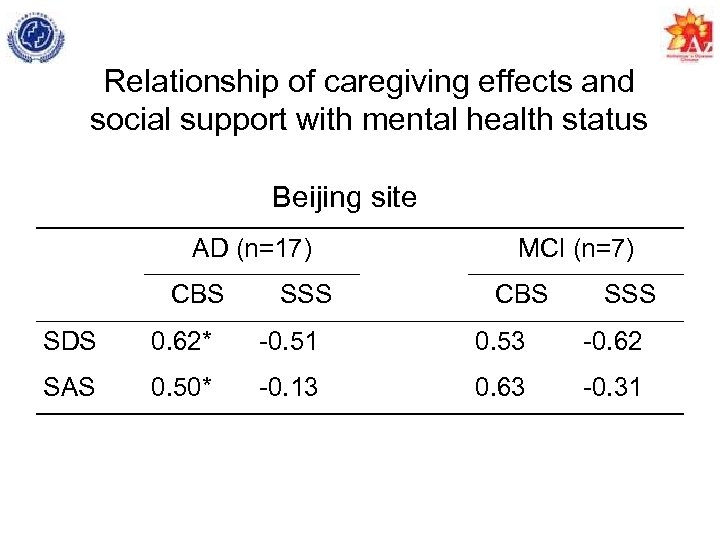
Relationship of caregiving effects and social support with mental health status Beijing site AD (n=17) CBS SSS MCI (n=7) CBS SSS SDS 0. 62* -0. 51 0. 53 -0. 62 SAS 0. 50* -0. 13 0. 63 -0. 31
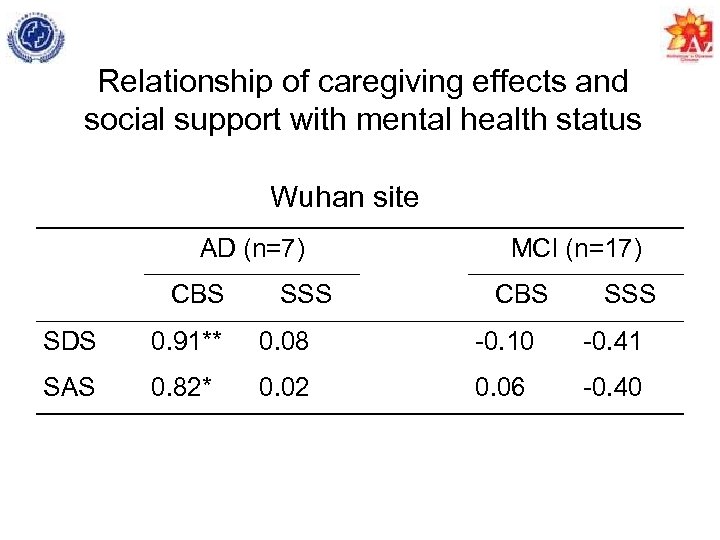
Relationship of caregiving effects and social support with mental health status Wuhan site AD (n=7) CBS SSS MCI (n=17) CBS SSS SDS 0. 91** 0. 08 -0. 10 -0. 41 SAS 0. 82* 0. 02 0. 06 -0. 40
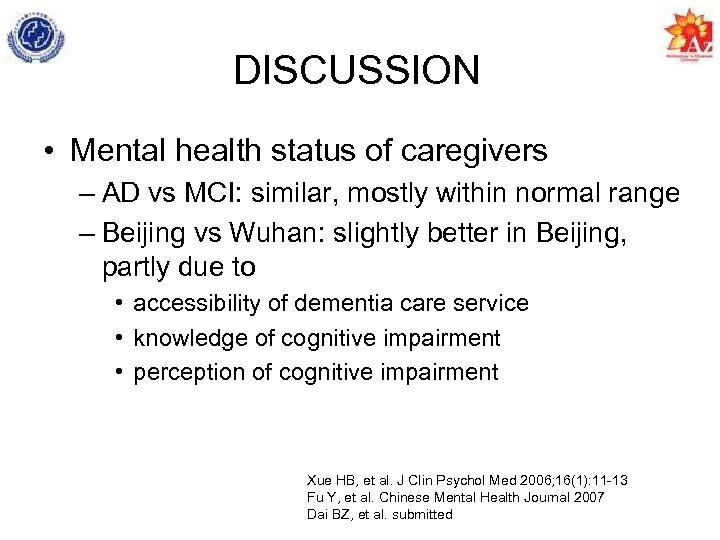
DISCUSSION • Mental health status of caregivers – AD vs MCI: similar, mostly within normal range – Beijing vs Wuhan: slightly better in Beijing, partly due to • accessibility of dementia care service • knowledge of cognitive impairment • perception of cognitive impairment Xue HB, et al. J Clin Psychol Med 2006; 16(1): 11 -13 Fu Y, et al. Chinese Mental Health Journal 2007 Dai BZ, et al. submitted
• Relationship between CBS and mental health status – Significant in AD group, independent of sites – Higher perceived burden of caregiving, poorer of emotional feelings, though within normal range • A trend, though not significant, that better social support was associated with better emotional feelings. – Ceiling effects of emotional feelings – Sample size concerns
CONCLUSION • There was geographic variation in mental health status of caregivers for people with cognitive impairment. • Perceived caregiver burden may impact the emotional feelings of caregivers for people with AD. • The findings suggest that raising awareness and disseminating knowledge of cognitive impairment and dementia is important in improving mental health status of caregivers.

THANK YOU
Скачать презентацию Relationship between social support and mental health status
6481323f5919bafe79bfd51ef45dfffb.ppt