


 Скачать презентацию Reinventing the accelerator for the high-energy frontier J
eef8006f76b43d78b4688c3b43b54654.ppt
- Количество слайдов: 44
 Reinventing the accelerator for the high-energy frontier J. B. Rosenzweig UCLA Department of Physics and Astronomy Fermilab Colloquium - January 4, 2006 The history of discovery in high-energy physics has been intimately connected with progress in methods of accelerating particles for the past 75 years. This remains true today, as the post. LHC era in particle physics will require significant innovation and investment in a superconducting linear collider (LC). The choice of the LC as the next-generation discovery machine, and the selection of superconducting technology has thrown promising competing techniques -- such as very large hadron colliders, muon colliders, and high-field, high frequency LCs -- into the background. We discuss the state of such conventional options, and the likelihood of their eventual success. We then follow with a much longer view: a survey of a new, burgeoning frontier in high energy accelerators, where intense lasers, charged particle beams, and plasmas are all combined in a cross-disciplinary effort to reinvent the accelerator from its fundamental principles on up. FNAL Colloquium
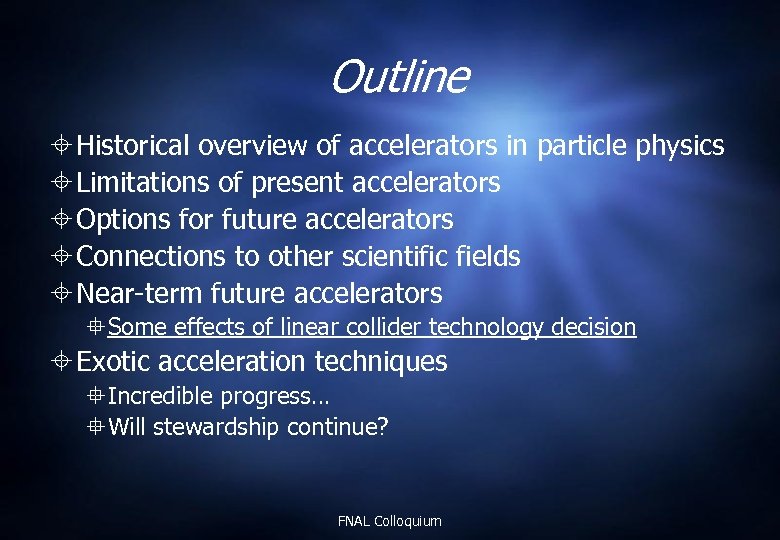 Outline Historical overview of accelerators in particle physics Limitations of present accelerators Options for future accelerators Connections to other scientific fields Near-term future accelerators Some effects of linear collider technology decision Exotic acceleration techniques Incredible progress… Will stewardship continue? FNAL Colloquium
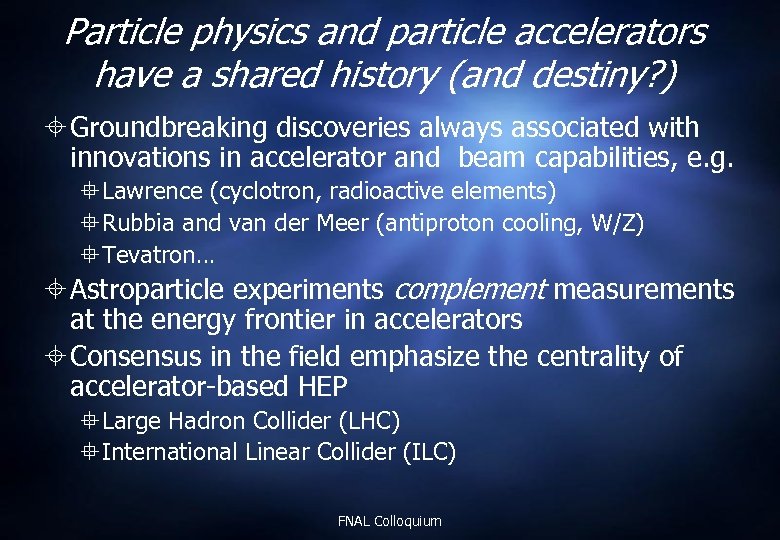 Particle physics and particle accelerators have a shared history (and destiny? ) Groundbreaking discoveries always associated with innovations in accelerator and beam capabilities, e. g. Lawrence (cyclotron, radioactive elements) Rubbia and van der Meer (antiproton cooling, W/Z) Tevatron… Astroparticle experiments complement measurements at the energy frontier in accelerators Consensus in the field emphasize the centrality of accelerator-based HEP Large Hadron Collider (LHC) International Linear Collider (ILC) FNAL Colloquium
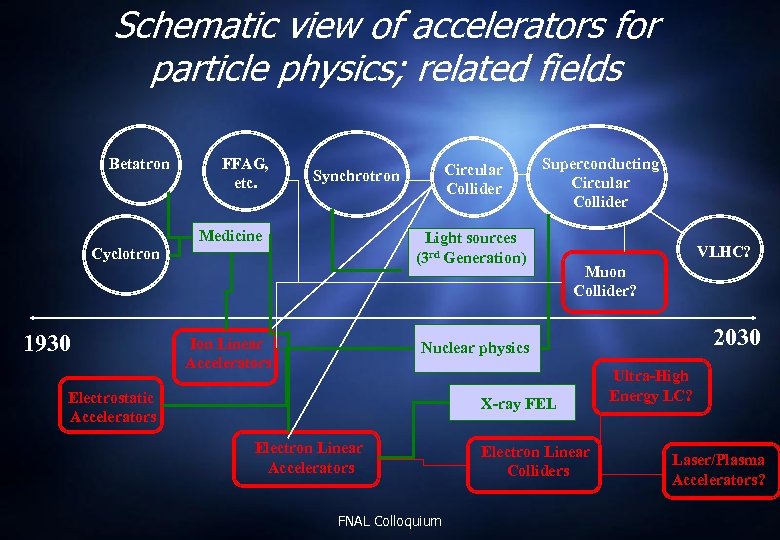 Schematic view of accelerators for particle physics; related fields Betatron FFAG, etc. Medicine Superconducting Circular Collider Light sources (3 rd Generation) Cyclotron 1930 Circular Collider Synchrotron Ion Linear Accelerators VLHC? Muon Collider? 2030 Nuclear physics Electrostatic Accelerators X-ray FEL Electron Linear Accelerators FNAL Colloquium Electron Linear Colliders Ultra-High Energy LC? Laser/Plasma Accelerators?
 Now mature ideas have driven HEP accelerators forward… Induction acceleration (betatron) Resonant electromagnetic acceleration (cyclotron) Normal and superconducting RF cavities (linac, synchrotron) Alternating gradient magnetic focusing (synchrotron) Fixed targetry, exotic particle sources (synchrotron, linac) Colliding beams in synchrotrons (circular collider) Colliding beams in linear accelerators (linear collider) Cooling of particle beam phase space (colliders) Particle polarization (fixed targets/colliders) Are these enough for the future? Do we need to re-invent the accelerator? FNAL Colloquium
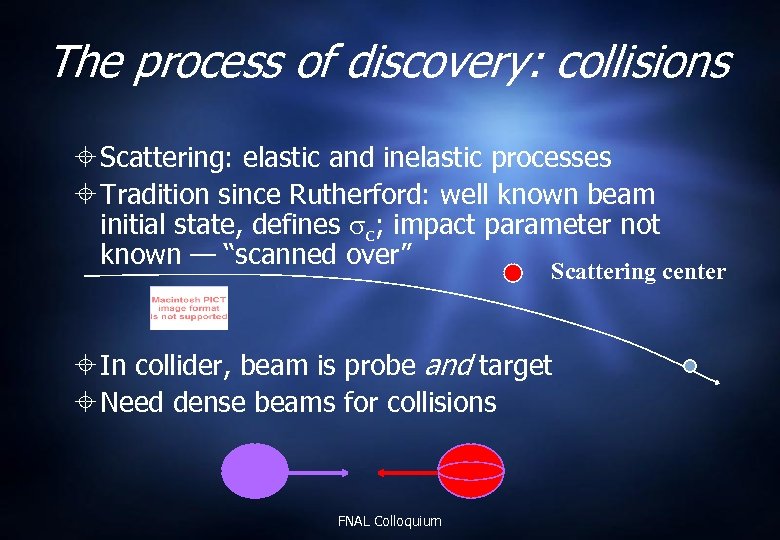 The process of discovery: collisions Scattering: elastic and inelastic processes Tradition since Rutherford: well known beam initial state, defines c; impact parameter not known — “scanned over” Scattering center In collider, beam is probe and target Need dense beams for collisions FNAL Colloquium
 Why “colliders”? Fixed target energy for particle creation Colliding beams (e. g. e+e-) makes lab frame into center of mass… Exponential growth in COM energy over time Livingston plot: “Moore’s Law” for accelerators Challenge in energy, but not only…”luminosity” as well FNAL Colloquium
 Present limitations of collider energy Synchrotron radiation power loss Forces future e+-e- colliders to be linear LEP (180 Ge. V COM) is last of breed Large(!) circular machines for heavier particles Consider muons for lepton colliders? Scaling in size/cost Approaching unitary limits Few 104 m in dimension Few $109 FNAL Colloquium Tevatron complex at FNAL 27 km circumference (linacs, rings, buffalo…)
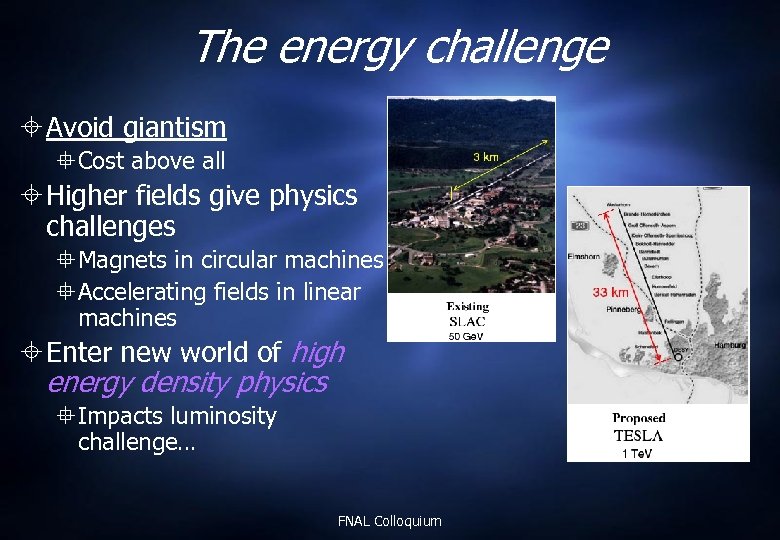 The energy challenge Avoid giantism Cost above all Higher fields give physics challenges Magnets in circular machines Accelerating fields in linear machines Enter new world of high energy density physics Impacts luminosity challenge… FNAL Colloquium
 The Luminosity Challenge Circular colliders provide high repetition rate Linear colliders have much lower repetition rate Use many particles/bunch; solution brings problems Inherent scaling for higher energy not enough FNAL Colloquium
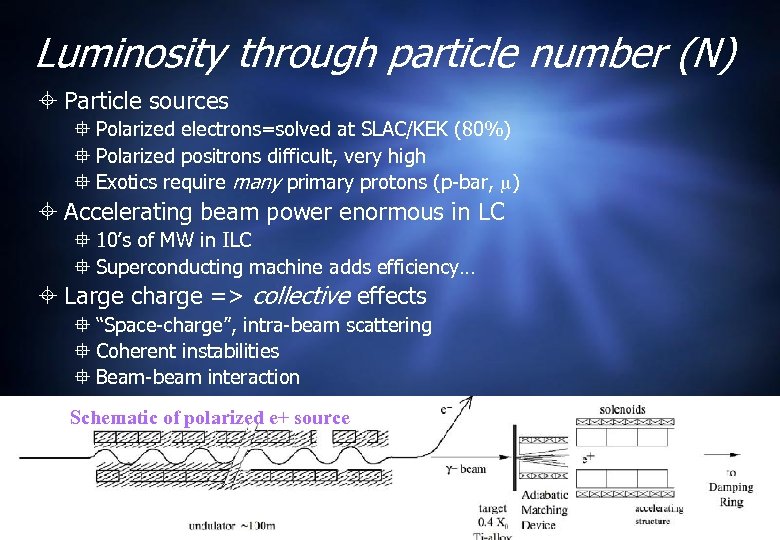 Luminosity through particle number (N) Particle sources Polarized electrons=solved at SLAC/KEK (80%) Polarized positrons difficult, very high Exotics require many primary protons (p-bar, ) Accelerating beam power enormous in LC 10’s of MW in ILC Superconducting machine adds efficiency… Large charge => collective effects “Space-charge”, intra-beam scattering Coherent instabilities Beam-beam interaction Schematic of polarized e+ source FNAL Colloquium
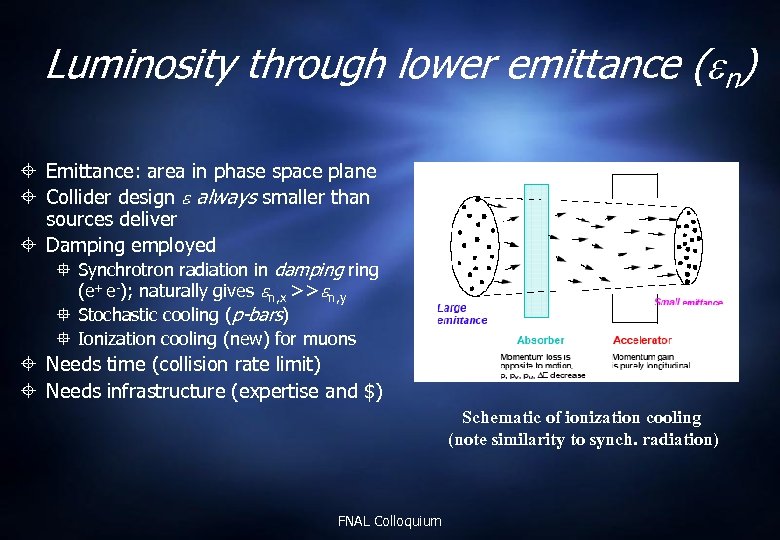 Luminosity through lower emittance ( n) Emittance: area in phase space plane Collider design always smaller than sources deliver Damping employed Synchrotron radiation in damping ring (e+ e-); naturally gives n, x >> n, y Stochastic cooling (p-bars) Ionization cooling (new) for muons Needs time (collision rate limit) Needs infrastructure (expertise and $) Schematic of ionization cooling (note similarity to synch. radiation) FNAL Colloquium
 Luminosity through better focusing ( ) Beam size at focus is ( )1/2 For linear coliders: y~few nm(!), x~100 nm. Need chromatic corrections for y is “depth of focus”; minimized at bunch length Smaller beams with stronger focusing Exotic solutions Ultra-strong magnets Permanent magnet quadrupoles Superconducting quadrupoles Plasma lenses? Asymmetric beams in LC to mitigate effects of extremely high charge density FNAL Colloquium World’s strongest quadrupole (570 T/m field gradient), built at UCLA PBPL
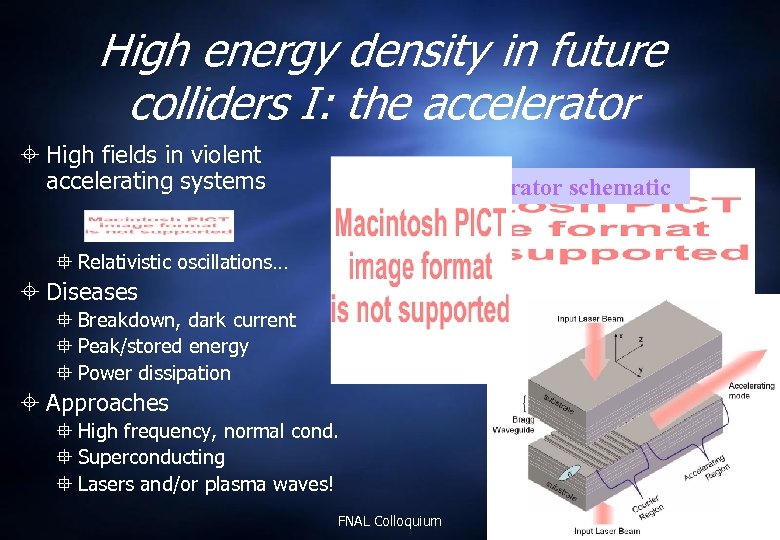 High energy density in future colliders I: the accelerator High fields in violent accelerating systems Linear accelerator schematic Relativistic oscillations… Diseases Breakdown, dark current Peak/stored energy Power dissipation Approaches High frequency, normal cond. Superconducting Lasers and/or plasma waves! FNAL Colloquium
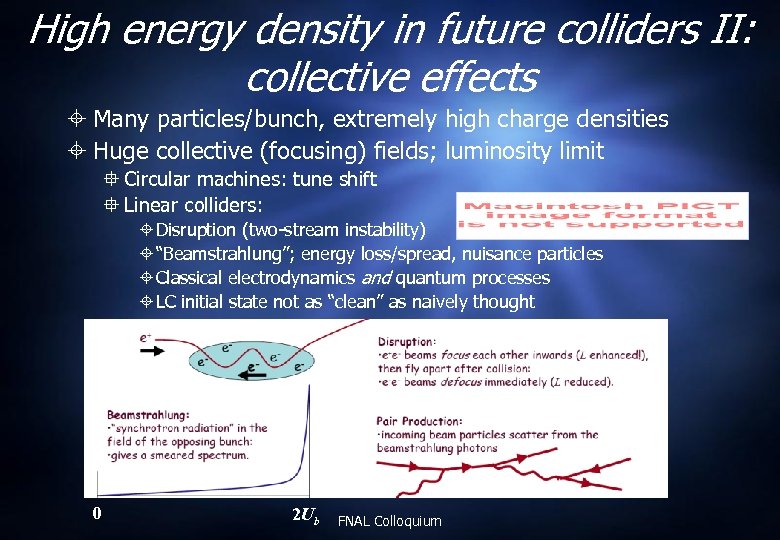 High energy density in future colliders II: collective effects Many particles/bunch, extremely high charge densities Huge collective (focusing) fields; luminosity limit Circular machines: tune shift Linear colliders: Disruption (two-stream instability) “Beamstrahlung”; energy loss/spread, nuisance particles Classical electrodynamics and quantum processes LC initial state not as “clean” as naively thought 0 2 Ub FNAL Colloquium
 Approaches to new collider paradigms Advancement of existing techniques Higher field (SC) magnets (VLHC) Use of more exotic colliding particles (muons) Higher gradient RF cavities (X-band LC) Superconducting RF cavities (TESLA LC) Another Talk Revolutionary new approaches (high gradient frontier) New sources: i. e. , lasers New accelerating structures and/or media: i. e. , plasmas Cryostat with 16 T Nb 3 Sn magnet at LBNL Truly immersed in high energy density physics FNAL Colloquium Muon collider schematic (R. Johnson, 2005)
 The road to the next accelerator First fork in the road: Snowmass 2001 Consensus that LC is next machine post-LHC VLHC and muons demoted… Second fork: ITRP Selection of Linear Collider Technology Barish committee evaluates “warm” v. “cold” accelerator technology Somewhat surprisingly (to many in field), superconducting option favored The crystal ball clears due to ITRP decision, 8/19/2004 FNAL Colloquium
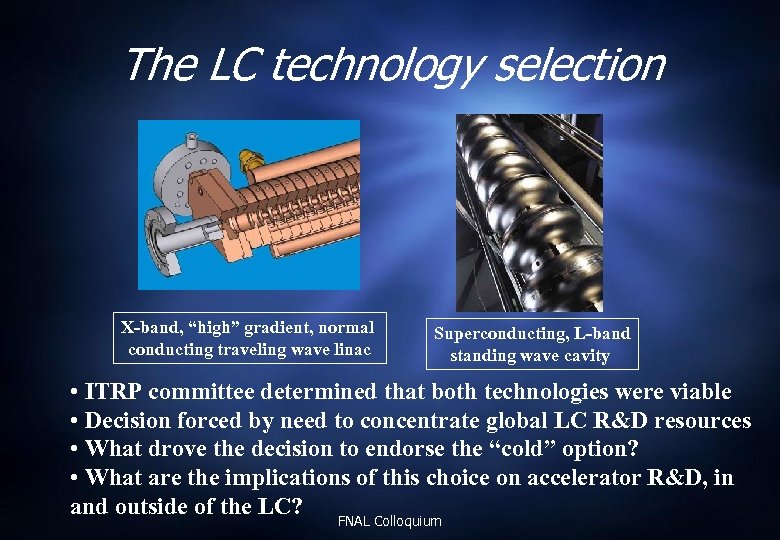 The LC technology selection X-band, “high” gradient, normal conducting traveling wave linac Superconducting, L-band standing wave cavity • ITRP committee determined that both technologies were viable • Decision forced by need to concentrate global LC R&D resources • What drove the decision to endorse the “cold” option? • What are the implications of this choice on accelerator R&D, in and outside of the LC? FNAL Colloquium
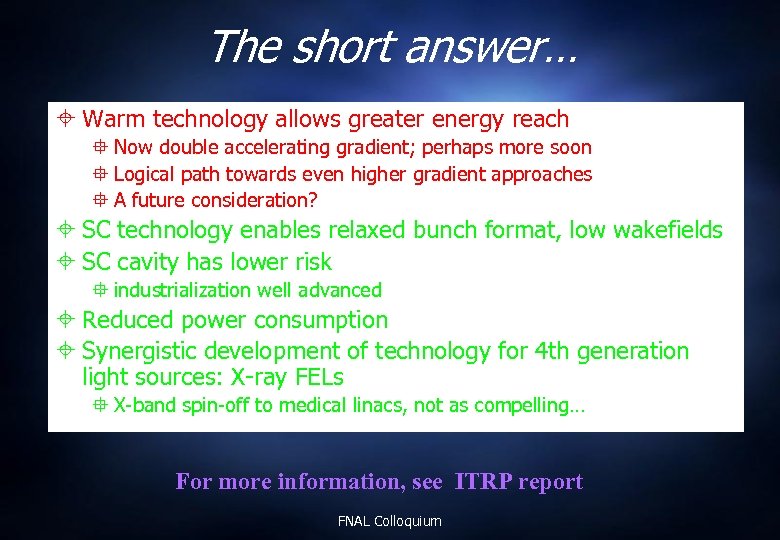 The short answer… Warm technology allows greater energy reach Now double accelerating gradient; perhaps more soon Logical path towards even higher gradient approaches A future consideration? SC technology enables relaxed bunch format, low wakefields SC cavity has lower risk industrialization well advanced Reduced power consumption Synergistic development of technology for 4 th generation light sources: X-ray FELs X-band spin-off to medical linacs, not as compelling… For more information, see ITRP report FNAL Colloquium
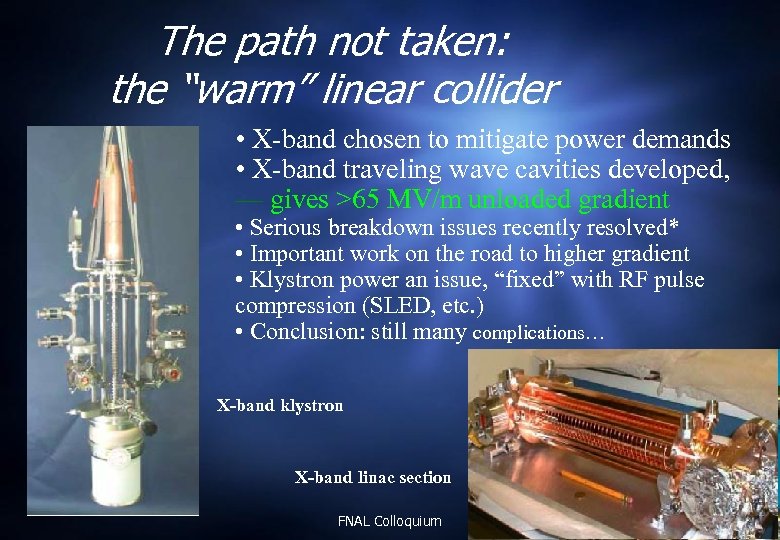 The path not taken: the “warm” linear collider • X-band chosen to mitigate power demands • X-band traveling wave cavities developed, — gives >65 MV/m unloaded gradient • Serious breakdown issues recently resolved* • Important work on the road to higher gradient • Klystron power an issue, “fixed” with RF pulse compression (SLED, etc. ) • Conclusion: still many complications… X-band klystron X-band linac section FNAL Colloquium
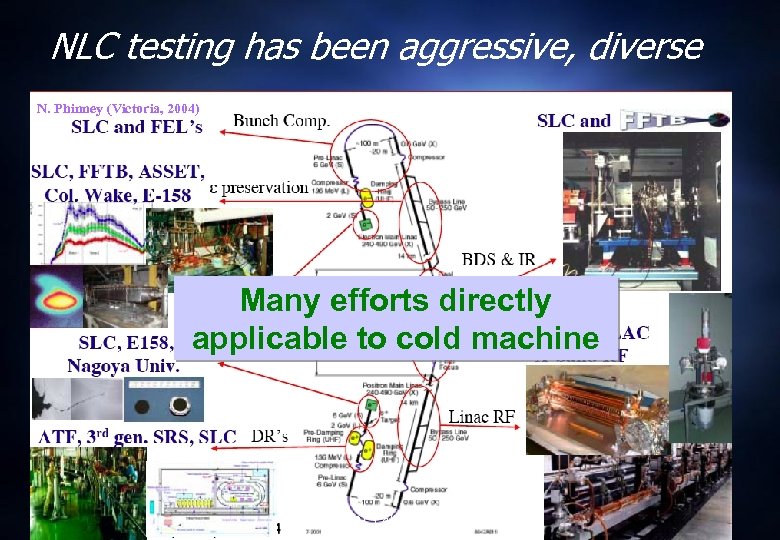 NLC testing has been aggressive, diverse N. Phinney (Victoria, 2004) Many efforts directly applicable to cold machine FNAL Colloquium
 The linear collider technology: “TESLA” Superconducting RF cavities Very high intrinsic Q (>109), 6 orders of magnitude higher than NC Extremely beam-loaded operation Many pulses, s apart, in ms fill Power goes into beam, not wall Even with “tax” from Carnot efficiency, SC >2 x efficient Large apertures (L-band), wakes and beam-breakup much less an issue Excellent high power technology Other applications (FEL, spallation, muons) FNAL Colloquium
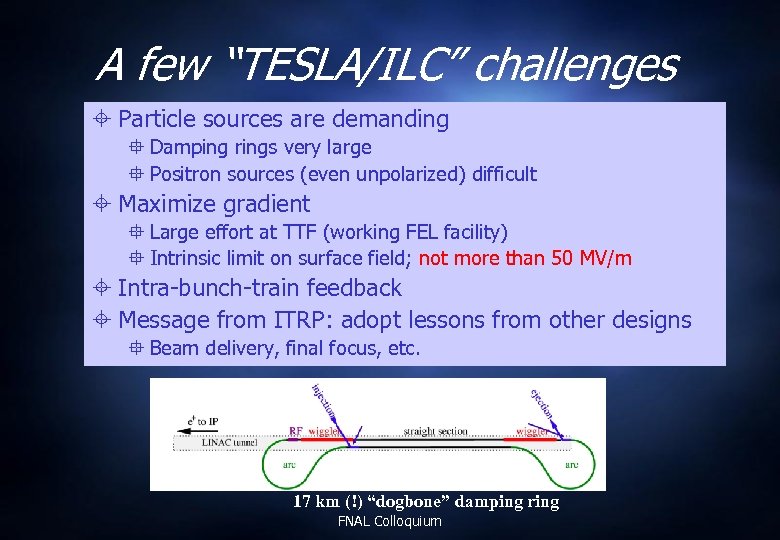 A few “TESLA/ILC” challenges Particle sources are demanding Damping rings very large Positron sources (even unpolarized) difficult Maximize gradient Large effort at TTF (working FEL facility) Intrinsic limit on surface field; not more than 50 MV/m Intra-bunch-train feedback Message from ITRP: adopt lessons from other designs Beam delivery, final focus, etc. 17 km (!) “dogbone” damping ring FNAL Colloquium
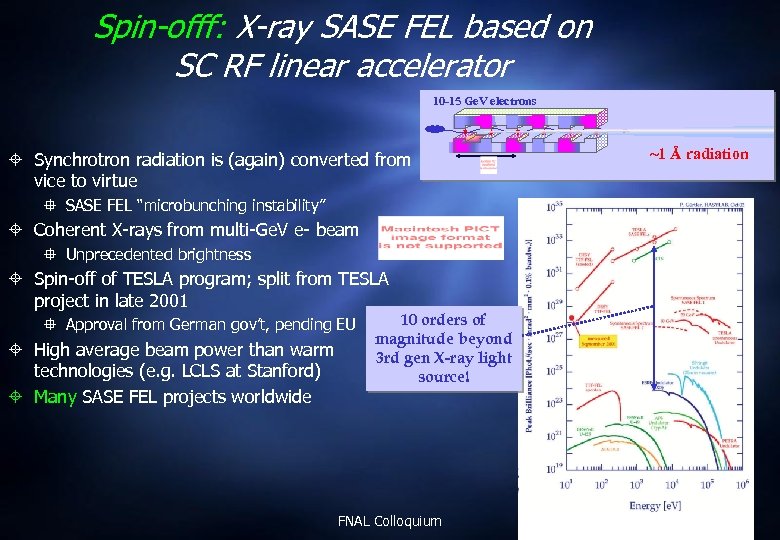 Spin-offf: X-ray SASE FEL based on SC RF linear accelerator 10 -15 Ge. V electrons Synchrotron radiation is (again) converted from vice to virtue SASE FEL “microbunching instability” Coherent X-rays from multi-Ge. V e- beam Unprecedented brightness Spin-off of TESLA program; split from TESLA project in late 2001 Approval from German gov’t, pending EU High average beam power than warm technologies (e. g. LCLS at Stanford) Many SASE FEL projects worldwide 10 orders of magnitude beyond 3 rd gen X-ray light source! FNAL Colloquium ~1 Å radiation
 Are we on the road to a 3 Te. V LC? Surprise? SC LC option does not scale well Intrinsic low gradient 24 MV/m TESLA 500 Ge. V 35 MV/m TESLA 800 Ge. V ~42 MV/m theoretical limit X-band still difficult Power sources, efficiencies High gradient means high frequency Where is power source? Look to wakefields (vice-to-virtue, again) Source of energy is coherent radiation from bunched, relativistic e- beam Also powers more exotic schemes… FNAL Colloquium
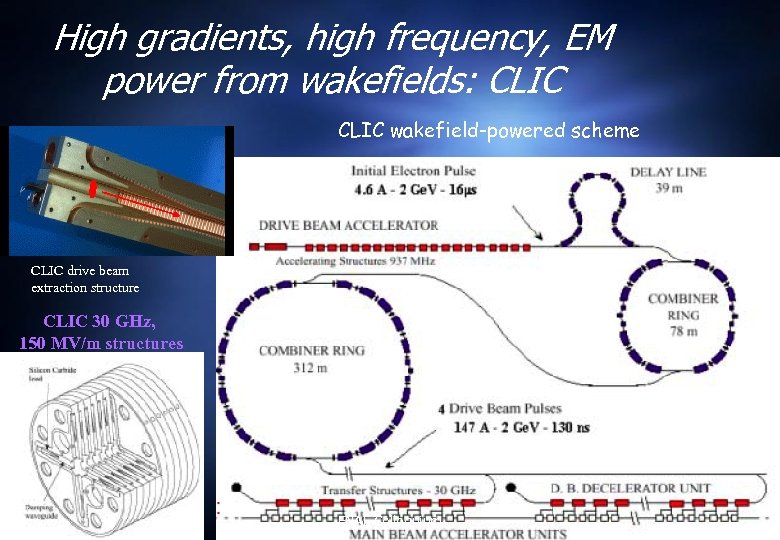 High gradients, high frequency, EM power from wakefields: CLIC wakefield-powered scheme CLIC drive beam extraction structure CLIC 30 GHz, 150 MV/m structures FNAL Colloquium
 Linacs: where have we been, and why? NC linac development was driven by post-WWII availability of high power wave sources Basic acceleration scheme hasn’t changed much, nor have wave sources Newer high freq. EM sources have ultra-high peak power Wakefield sources (CLIC and beyond) Optical source: ultra-high power (>TW) lasers Can we use these new sources for linear accelerators? Fields from 100 MV/m -> 100 GV/m FNAL Colloquium
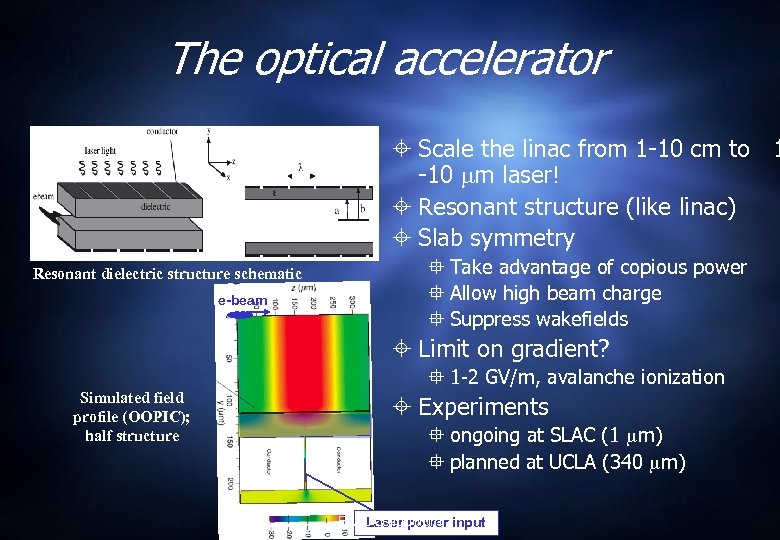 The optical accelerator Scale the linac from 1 -10 cm to 1 -10 m laser! Resonant structure (like linac) Slab symmetry Resonant dielectric structure schematic e-beam Take advantage of copious power Allow high beam charge Suppress wakefields Limit on gradient? 1 -2 GV/m, avalanche ionization Simulated field profile (OOPIC); half structure Experiments ongoing at SLAC (1 m) planned at UCLA (340 m) FNAL Colloquium input Laser power
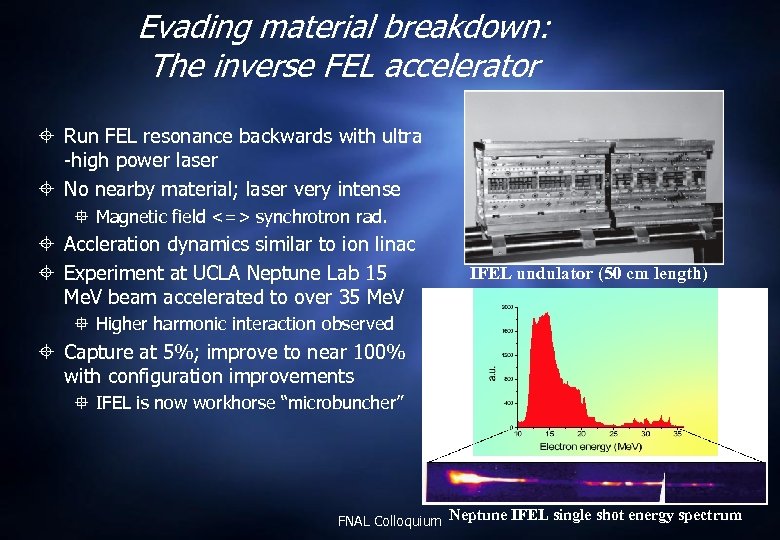 Evading material breakdown: The inverse FEL accelerator Run FEL resonance backwards with ultra -high power laser No nearby material; laser very intense Magnetic field <=> synchrotron rad. Accleration dynamics similar to ion linac Experiment at UCLA Neptune Lab 15 Me. V beam accelerated to over 35 Me. V IFEL undulator (50 cm length) Higher harmonic interaction observed Capture at 5%; improve to near 100% with configuration improvements IFEL is now workhorse “microbuncher” FNAL Colloquium Neptune IFEL single shot energy spectrum
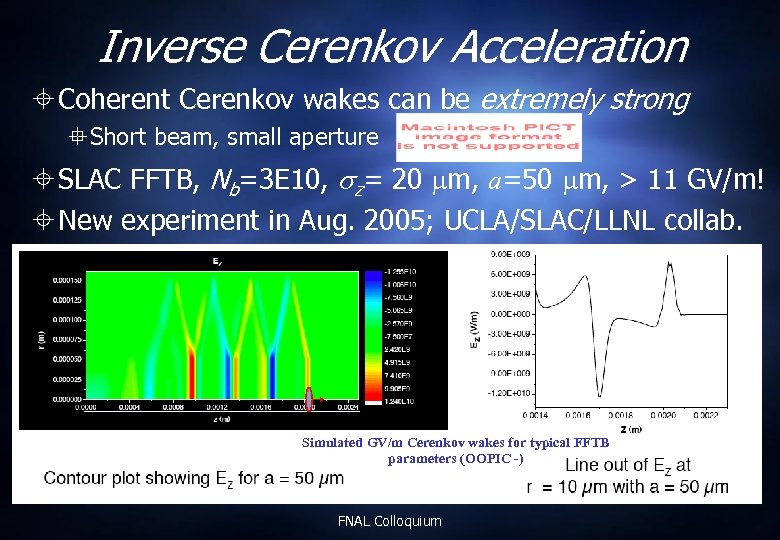 Inverse Cerenkov Acceleration Coherent Cerenkov wakes can be extremely strong Short beam, small aperture SLAC FFTB, Nb=3 E 10, sz= 20 m, a=50 m, > 11 GV/m! New experiment in Aug. 2005; UCLA/SLAC/LLNL collab. Simulated GV/m Cerenkov wakes for typical FFTB parameters (OOPIC -) FNAL Colloquium
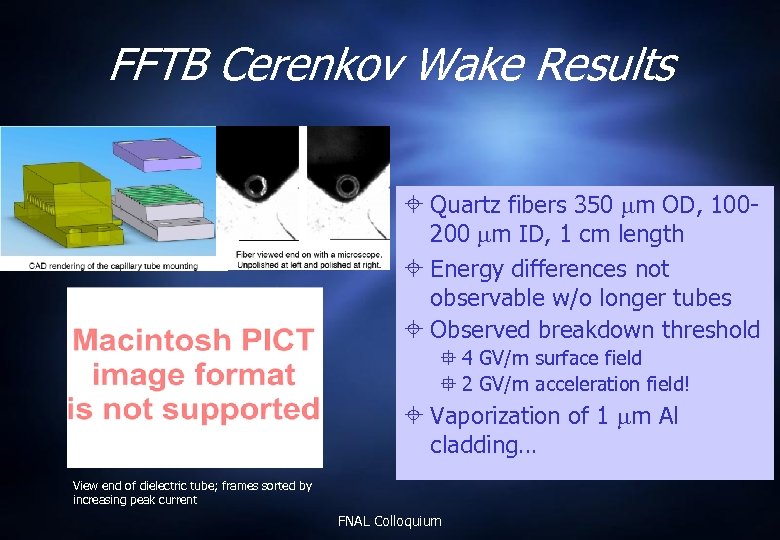 FFTB Cerenkov Wake Results Quartz fibers 350 m OD, 100200 m ID, 1 cm length Energy differences not observable w/o longer tubes Observed breakdown threshold 4 GV/m surface field 2 GV/m acceleration field! Vaporization of 1 m Al cladding… View end of dielectric tube; frames sorted by increasing peak current FNAL Colloquium
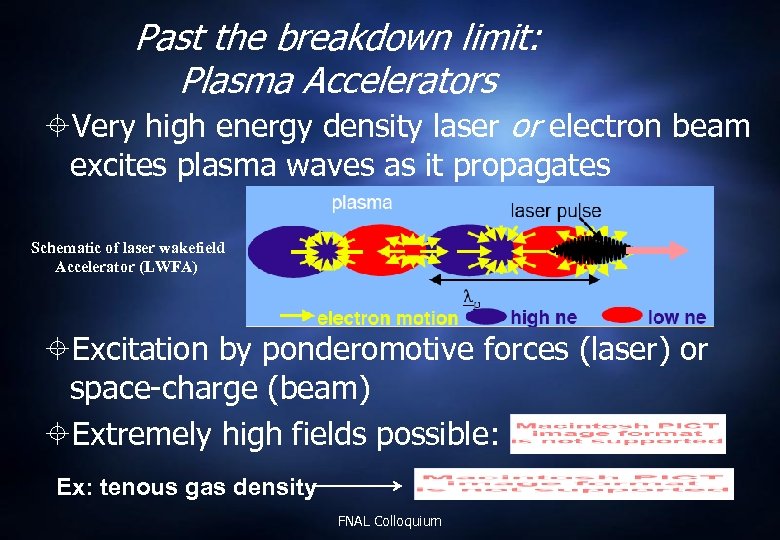 Past the breakdown limit: Plasma Accelerators Very high energy density laser or electron beam excites plasma waves as it propagates Schematic of laser wakefield Accelerator (LWFA) Excitation by ponderomotive forces (laser) or space-charge (beam) Extremely high fields possible: Ex: tenous gas density FNAL Colloquium
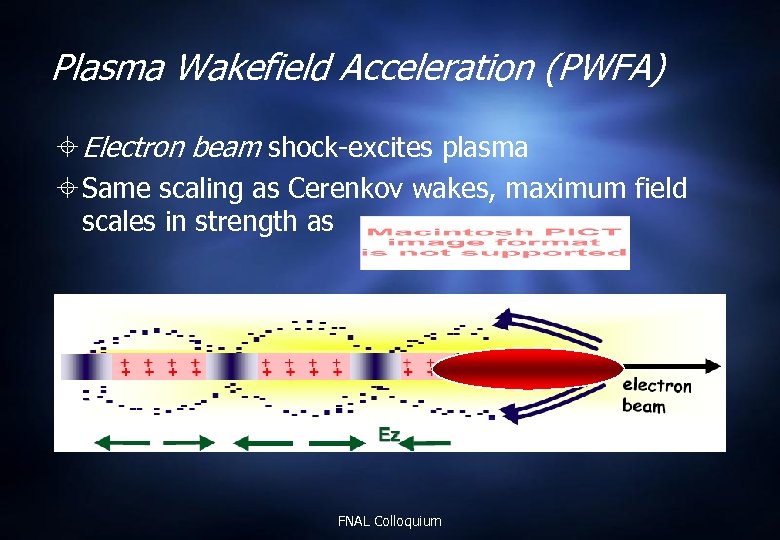 Plasma Wakefield Acceleration (PWFA) Electron beam shock-excites plasma Same scaling as Cerenkov wakes, maximum field scales in strength as FNAL Colloquium
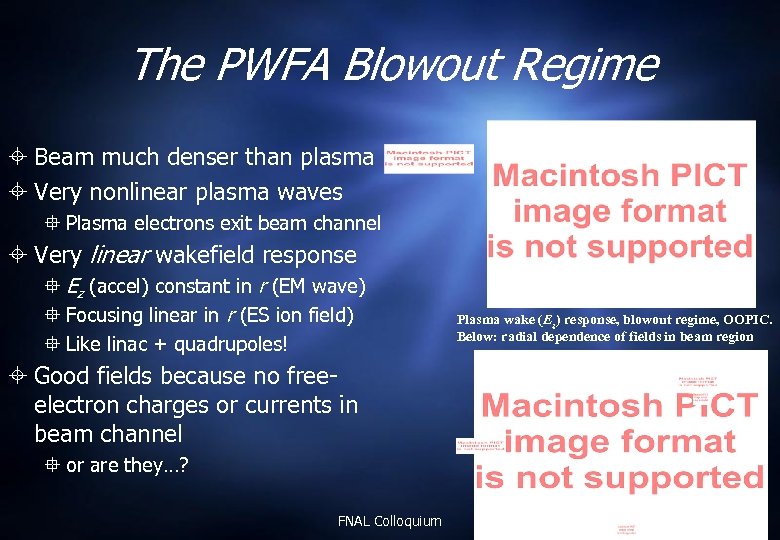 The PWFA Blowout Regime Beam much denser than plasma Very nonlinear plasma waves Plasma electrons exit beam channel Very linear wakefield response Ez (accel) constant in r (EM wave) Focusing linear in r (ES ion field) Like linac + quadrupoles! Good fields because no freeelectron charges or currents in beam channel or are they…? FNAL Colloquium Plasma wake (Ez) response, blowout regime, OOPIC. Below: radial dependence of fields in beam region
 PWFA Experiments: Large fractional energy gain and loss at FNAL 15 Me. V Beam nearly stopped in 7 cm of plasma in UCLA/FNAL A 0 experiment Accelerating wake is also stable; good efficiency Acceleration to > 24. 3 Me. V (~130 Me. V/m), 60% gain. FNAL Colloquium
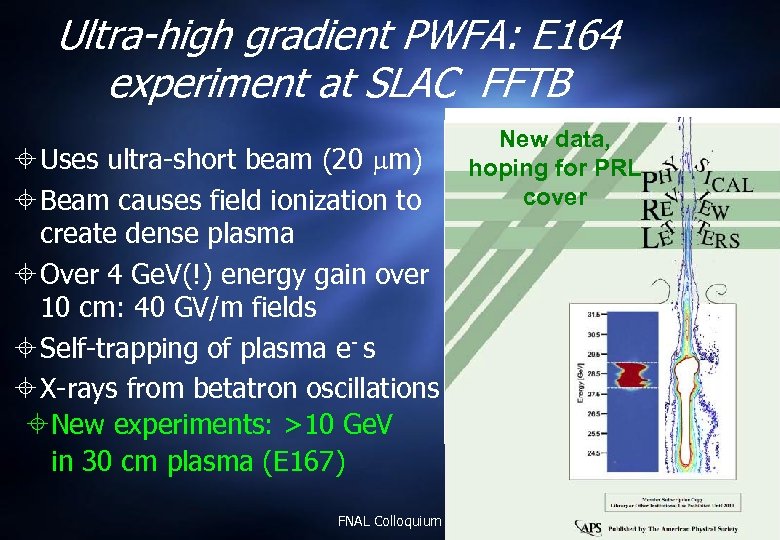 Ultra-high gradient PWFA: E 164 experiment at SLAC FFTB Uses ultra-short beam (20 m) Beam causes field ionization to create dense plasma Over 4 Ge. V(!) energy gain over 10 cm: 40 GV/m fields Self-trapping of plasma e- s X-rays from betatron oscillations New experiments: >10 Ge. V in 30 cm plasma (E 167) FNAL Colloquium New data, hoping for PRL cover ne=2. 5 x 10 17 cm-3 plasma M. Hogan, et al.
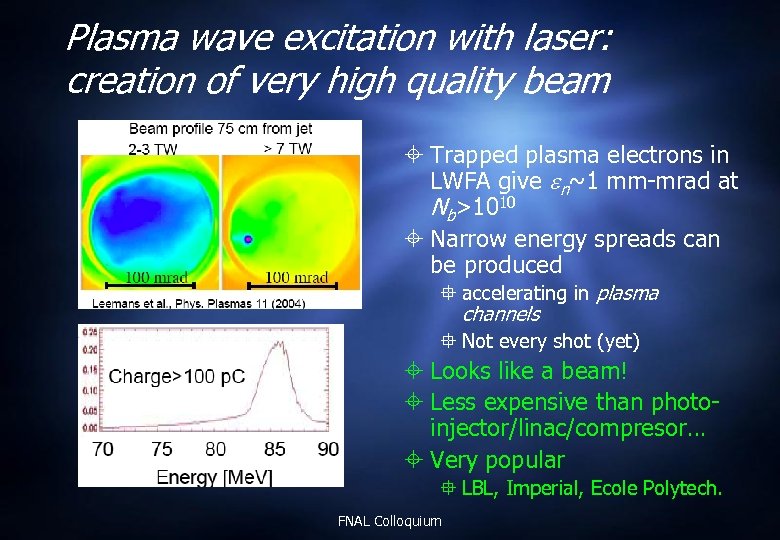 Plasma wave excitation with laser: creation of very high quality beam Trapped plasma electrons in LWFA give n~1 mm-mrad at Nb>1010 Narrow energy spreads can be produced accelerating in plasma channels Not every shot (yet) Looks like a beam! Less expensive than photoinjector/linac/compresor… Very popular LBL, Imperial, Ecole Polytech. FNAL Colloquium
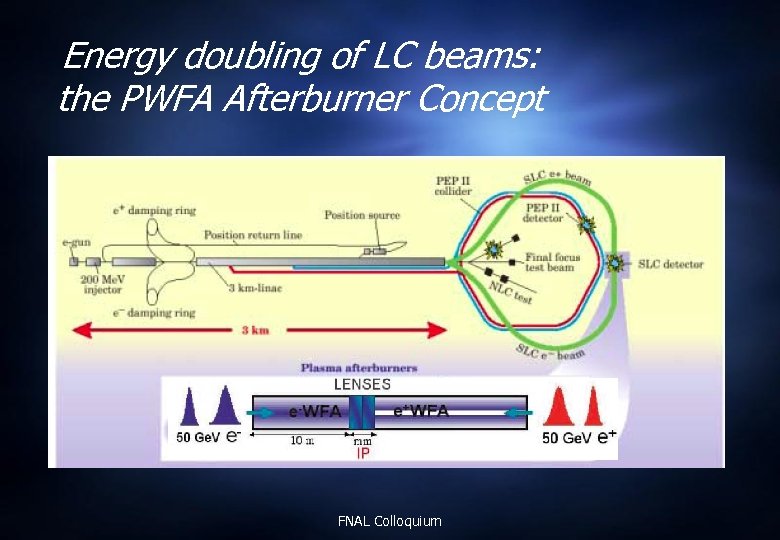 Energy doubling of LC beams: the PWFA Afterburner Concept FNAL Colloquium
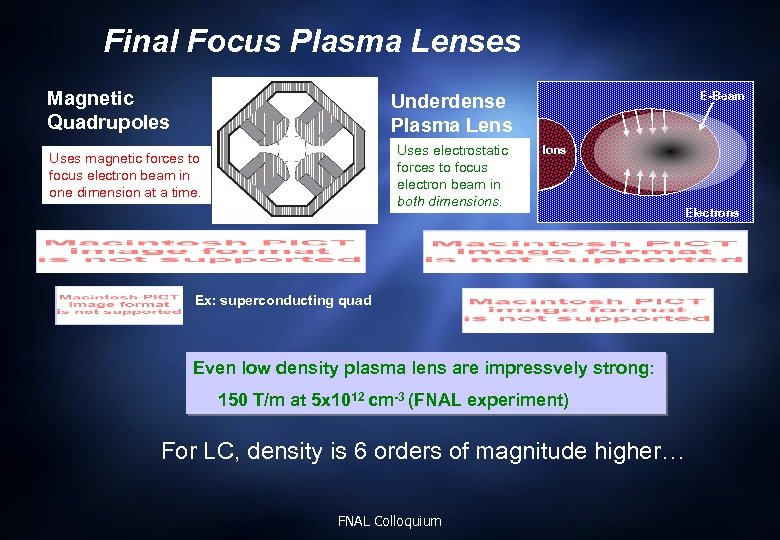 Final Focus Plasma Lenses Magnetic Quadrupoles E-Beam Underdense Plasma Lens Uses electrostatic forces to focus electron beam in both dimensions. Ions C ou rte sy JB R Uses magnetic forces to focus electron beam in one dimension at a time. Ex: superconducting quad Even low density plasma lens are impressvely strong: 150 T/m at 5 x 1012 cm-3 (FNAL experiment) For LC, density is 6 orders of magnitude higher… FNAL Colloquium Electrons
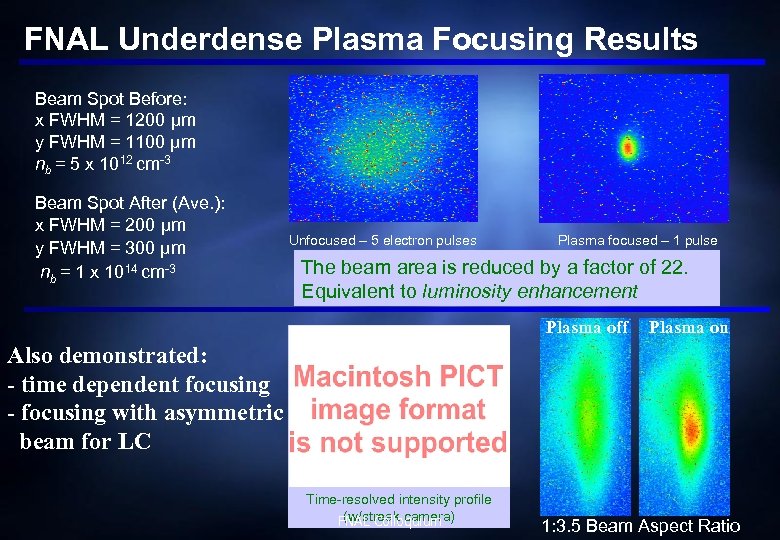 FNAL Underdense Plasma Focusing Results Beam Spot Before: x FWHM = 1200 µm y FWHM = 1100 µm nb = 5 x 1012 cm-3 Beam Spot After (Ave. ): x FWHM = 200 µm y FWHM = 300 µm nb = 1 x 1014 cm-3 Unfocused – 5 electron pulses Plasma focused – 1 pulse The beam area is reduced by a factor of 22. Equivalent to luminosity enhancement Plasma off Plasma on Also demonstrated: - time dependent focusing - focusing with asymmetric beam for LC Time-resolved intensity profile (w/streak camera) FNAL Colloquium 1: 3. 5 Beam Aspect Ratio
 Storm clouds on the horizon… Linear collider-like beams are extremely dense when subject to focusing in PWFA Field ionization Ultra-relativistic plasma e- response Instabilities (hosing, etc. ) Ion collapse Ions move to axis under enormous beam fields… Complete collapse for afterburner parameters OOPIC simulation of ion density Implications for plasma lenses inside of “afterburner” beam Vice-to-virtue: fusion scenario! (from J. B. Rosenzweig, A. M. Cook, A. Scott, M. C. Thompson, R. Yoder, 95, 195002 (2005)) FNAL Colloquium
 Challenges and prospects for advanced accelerator application to future LCs Optical and plasma accelerators a challenge in experiment Very large fields Very small dimensions and time scales Multidisciplinary in the extreme Many collective effects to worry about (HED) We have orders of magnitude in learning curve Breath-taking recent progress More people needed; students eager/welcome FNAL Colloquium
 Overall Status of Advanced Accelerators for HEP People have worked on future accelerator concepts with some urgency for >20 years Despite lack of resources, we have many accomplishments to show for this effort; options that look promising… How do we take advantage? FNAL Colloquium
 Observations on proceeding With the LC technology decision, significant resources efforts will be thrown into LC development Re-organize and reprioritize High frequency RF acceleration initiative (Do. E) HEPAP subpanel on advanced accelerators Do. E/NSF very positive; HEP accelerator stewardship at stake Programs healthy now Synergy with nearby fields (FEL, etc. ) Overseas competition is heating up; US leadership in doubt Future support needs to increase Need vocal support from HEP field; also man/brain power! FNAL Colloquium