


 Скачать презентацию Regulatory Tactics 4 Categories 1 Prevention of
e468ccf68af949ba6ad1bf75d5748394.ppt
- Количество слайдов: 14
 Regulatory Tactics – 4 Categories 1. Prevention of Entry 2. Eradication – 2 steps – Domestic Quarantine – Eradication 3. Retardation – Often used when eradication fails 4. Mitigation of Losses
 Quarantine as a Regulatory Technique • Inspections – Intensity of inspection dictated by level of Pest Risk (cf. pp 232 – 233) – – Point-of-Origin (Phytosanitary Certificate) Point-of-Entry Field Inspections Regional Inspections & Surveys • Quarantine Effectiveness – considered a temporary control – Eradication planning is always part of a quarantine
 Quarantine continued • • Quarantine Costs: Inspection, compliance, eradication Quarantine Value – – – • Buy time for eradication/control development Keep initial pest populations small Restricts biotypes of initial populations Responses to intercepted pests – Costs borne by owner – – Goods returned Goods destroyed Goods may be held in isolation for confirmation Goods may be treated (usually fumigation)
 Quarantine Examples • Citrus Canker in Florida – Spatio-temporal map shows the quarantine is a losing battle • Golden Nematode in NY – Quarantined successfully since before WWII • Mediterranean Fruit Fly – On-going battle
 Eradication • May be primary or secondary to quarantine – Secondary to Quarantine. Eradication backs up a quarantine. Requires; • • • Pest detection at low levels Ability to mobilize quickly Controls must be effective & used excessively Reintroduction is barred Example – Mediterranean Fruit Fly
 Primary Eradication • Quarantine backs up eradication effort – Target is already well established (or native) – Quarantine is always domestic, often multiple simultaneous quarantines (different jurisdictions) – Must be able to establish a “moving quarantine” – Must be able to tell with certainty when a pest has been eradicated from an area
 Eradication Pros • Once the pest is gone, no more costs • Long term avoidance of adverse effects of pest management actions • Eradication of a key pest may also eliminate other pests (e. g. secondary pests) • Eradication of key pests makes non-chemical control of other pests more feasible • New technologies make eradication more feasible
 Eradication Cons • Low chance of success, most successes have been with eradication as secondary to quarantine • Incurs exceptionally high environmental impact • Removal of a pest has unpredictable impact on system
 Additional Regulatory Tools • Control Districts • Enforced Crop Production Rules • Licensing and Certification • GMO-related
 Control Districts A jurisdictional area such as a county or group of counties, specifically identified as a district in which the presence of a certain pest is prohibited or controlled through a public agency. Most common types: • Plant control – landowners responsible for control & subject to fine. • Mosquito – Public agency has the right to implement control on private land
 Enforced Crop Production Rules IPM techniques is that are required by statute or ordinance, imposed on all growers in a given area, and enforced, usually by penalty. Major types: • Crop or Host-Free Periods • Planting Date Restrictions • Cultivar Restrictions • Compulsory Sanitation Measures
 Licensing and Certification Ensures that infested or contaminated material is not transported, sold commercially, or used as breeding stock. • Seed & Stock Certification (domestic) • Certification for Export Markets
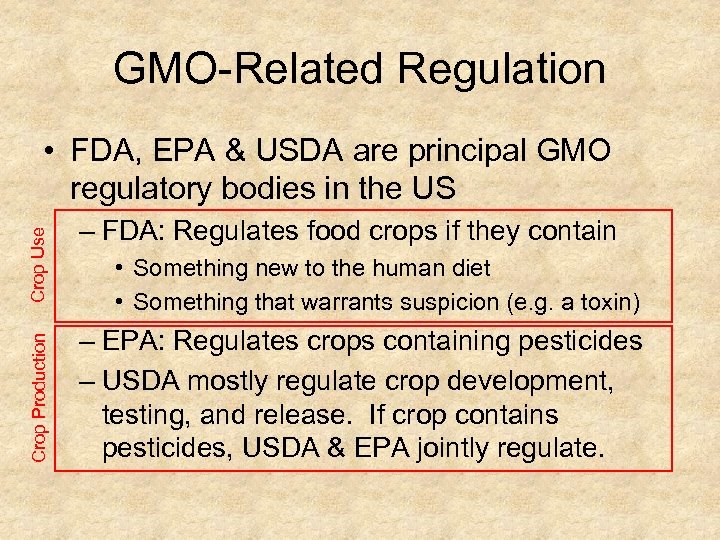 GMO-Related Regulation Crop Production Crop Use • FDA, EPA & USDA are principal GMO regulatory bodies in the US – FDA: Regulates food crops if they contain • Something new to the human diet • Something that warrants suspicion (e. g. a toxin) – EPA: Regulates crops containing pesticides – USDA mostly regulate crop development, testing, and release. If crop contains pesticides, USDA & EPA jointly regulate.
 IPM Implementation • Chapter 19 – Societal and Environmental Limitations to IPM Tactics – Societal constraints and public attitudes – Environmental issues • Chapter 18 – IPM Programs: Development and Implementation • Chapter 20 – IPM into the Future