


 Скачать презентацию Regulatory Powers and Enforcement Christopher Hodges MA Ph
275e2bf1251502df2497e203556e0fe4.ppt
- Количество слайдов: 19
 Regulatory Powers and Enforcement Christopher Hodges MA Ph. D FSALS Professor of Justice Systems, and Fellow of Wolfson College, University of Oxford Head of the Swiss Re/CMS Research Programme on Dispute Resolution Systems Honorary Professor, the China University of Political Science and Law, Beijing
 A Broadening in the Role of Regulation and hence of Regulators & Enforcers § Traditional remit: safety or economics (price/competition) § UK Regulators’ Code: supporting compliance & growth § How can regulators/enforcers support compliance, performance, improvement, growth, innovation? § How should we design enforcement policies and regulatory systems?

 The Questions § Why do people conform to or break rules? So § How do we get people to conform to rules? § How can regulators/enforcers support compliance, performance, improvement, growth, innovation? § How should we design enforcement policies and regulatory systems?
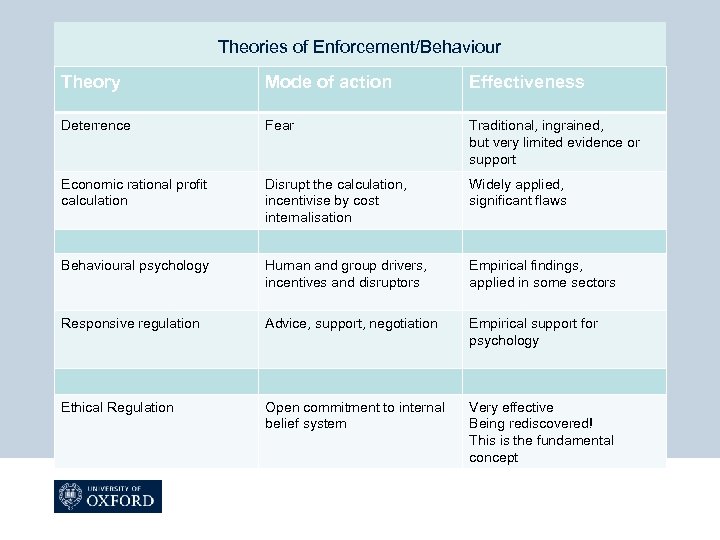 Theories of Enforcement/Behaviour Theory Mode of action Effectiveness Deterrence Fear Traditional, ingrained, but very limited evidence or support Economic rational profit calculation Disrupt the calculation, incentivise by cost internalisation Widely applied, significant flaws Behavioural psychology Human and group drivers, incentives and disruptors Empirical findings, applied in some sectors Responsive regulation Advice, support, negotiation Empirical support for psychology Ethical Regulation Open commitment to internal belief system Very effective Being rediscovered! This is the fundamental concept
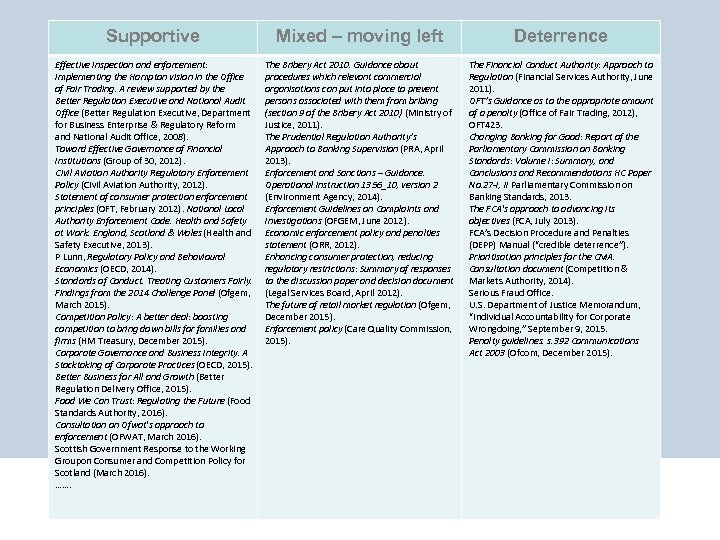 Supportive Mixed – moving left Deterrence Effective inspection and enforcement: implementing the Hampton vision in the Office of Fair Trading. A review supported by the Better Regulation Executive and National Audit Office (Better Regulation Executive, Department for Business Enterprise & Regulatory Reform and National Audit Office, 2008). Toward Effective Governance of Financial Institutions (Group of 30, 2012). Civil Aviation Authority Regulatory Enforcement Policy (Civil Aviation Authority, 2012). Statement of consumer protection enforcement principles (OFT, February 2012). National Local Authority Enforcement Code. Health and Safety at Work. England, Scotland & Wales (Health and Safety Executive, 2013). P Lunn, Regulatory Policy and Behavioural Economics (OECD, 2014). Standards of Conduct. Treating Customers Fairly. Findings from the 2014 Challenge Panel (Ofgem, March 2015). Competition Policy: A better deal: boosting competition to bring down bills for families and firms (HM Treasury, December 2015). Corporate Governance and Business Integrity. A Stocktaking of Corporate Practices (OECD, 2015). Better Business for All and Growth (Better Regulation Delivery Office, 2015). Food We Can Trust: Regulating the Future (Food Standards Authority, 2016). Consultation on Ofwat's approach to enforcement (OFWAT, March 2016). Scottish Government Response to the Working Groupon Consumer and Competition Policy for Scotland (March 2016). ……. The Bribery Act 2010. Guidance about procedures which relevant commercial organisations can put into place to prevent persons associated with them from bribing (section 9 of the Bribery Act 2010) (Ministry of Justice, 2011). The Prudential Regulation Authority’s Approach to Banking Supervision (PRA, April 2013). Enforcement and Sanctions – Guidance. Operational Instruction 1356_10, version 2 (Environment Agency, 2014). Enforcement Guidelines on Complaints and Investigations (OFGEM, June 2012). Economic enforcement policy and penalties statement (ORR, 2012). Enhancing consumer protection, reducing regulatory restrictions: Summary of responses to the discussion paper and decision document (Legal Services Board, April 2012). The future of retail market regulation (Ofgem, December 2015). Enforcement policy (Care Quality Commission, 2015). The Financial Conduct Authority: Approach to Regulation (Financial Services Authority, June 2011). OFT’s Guidance as to the appropriate amount of a penalty (Office of Fair Trading, 2012), OFT 423. Changing Banking for Good: Report of the Parliamentary Commission on Banking Standards: Volume I: Summary, and Conclusions and Recommendations HC Paper No. 27 -I, II Parliamentary Commission on Banking Standards, 2013. The FCA's approach to advancing its objectives (FCA, July 2013). FCA’s Decision Procedure and Penalties (DEPP) Manual (“credible deterrence”). Prioritisation principles for the CMA. Consultation document (Competition & Markets Authority, 2014). Serious Fraud Office. U. S. Department of Justice Memorandum, “Individual Accountability for Corporate Wrongdoing, ” September 9, 2015. Penalty guidelines. s. 392 Communications Act 2003 (Ofcom, December 2015).
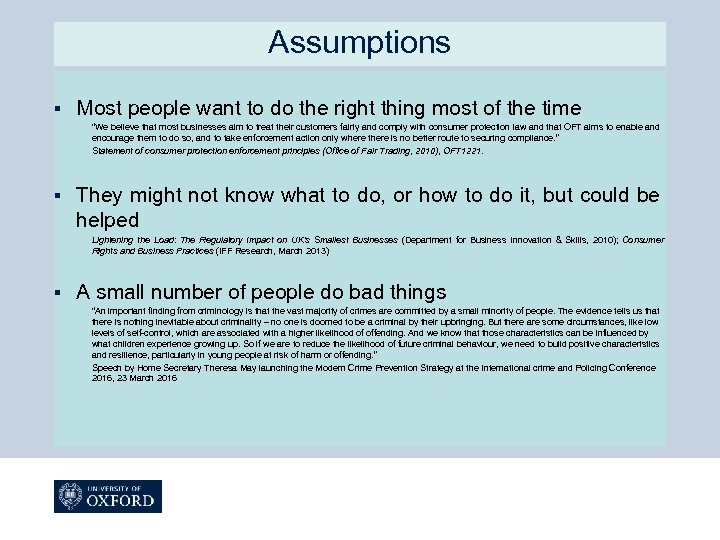 Assumptions § Most people want to do the right thing most of the time “We believe that most businesses aim to treat their customers fairly and comply with consumer protection law and that OFT aims to enable and encourage them to do so, and to take enforcement action only where there is no better route to securing compliance. ” Statement of consumer protection enforcement principles (Office of Fair Trading, 2010), OFT 1221. § They might not know what to do, or how to do it, but could be helped Lightening the Load: The Regulatory Impact on UK's Smallest Businesses (Department for Business Innovation & Skills, 2010); Consumer Rights and Business Practices (IFF Research, March 2013) § A small number of people do bad things “An important finding from criminology is that the vast majority of crimes are committed by a small minority of people. The evidence tells us that there is nothing inevitable about criminality – no one is doomed to be a criminal by their upbringing. But there are some circumstances, like low levels of self-control, which are associated with a higher likelihood of offending. And we know that those characteristics can be influenced by what children experience growing up. So if we are to reduce the likelihood of future criminal behaviour, we need to build positive characteristics and resilience, particularly in young people at risk of harm or offending. ” Speech by Home Secretary Theresa May launching the Modern Crime Prevention Strategy at the International crime and Policing Conference 2016, 23 March 2016
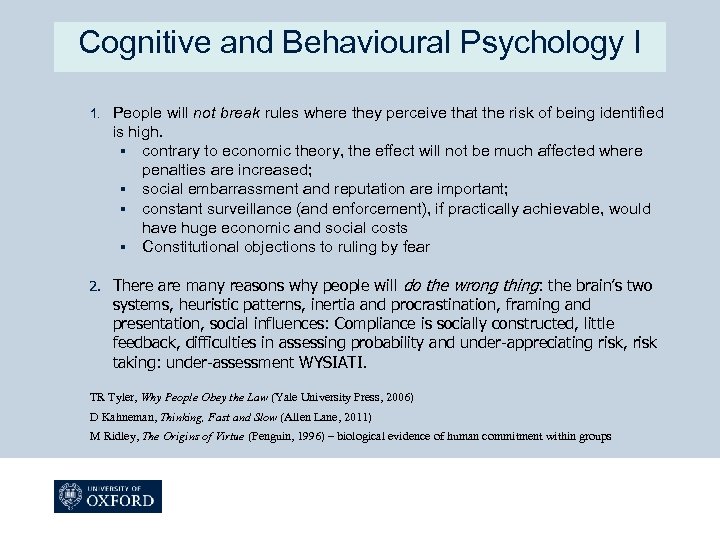 Cognitive and Behavioural Psychology I 1. People will not break rules where they perceive that the risk of being identified is high. § contrary to economic theory, the effect will not be much affected where penalties are increased; § social embarrassment and reputation are important; § constant surveillance (and enforcement), if practically achievable, would have huge economic and social costs § Constitutional objections to ruling by fear 2. There are many reasons why people will do the wrong thing: the brain’s two systems, heuristic patterns, inertia and procrastination, framing and presentation, social influences: Compliance is socially constructed, little feedback, difficulties in assessing probability and under-appreciating risk, risk taking: under-assessment WYSIATI. TR Tyler, Why People Obey the Law (Yale University Press, 2006) D Kahneman, Thinking, Fast and Slow (Allen Lane, 2011) M Ridley, The Origins of Virtue (Penguin, 1996) – biological evidence of human commitment within groups
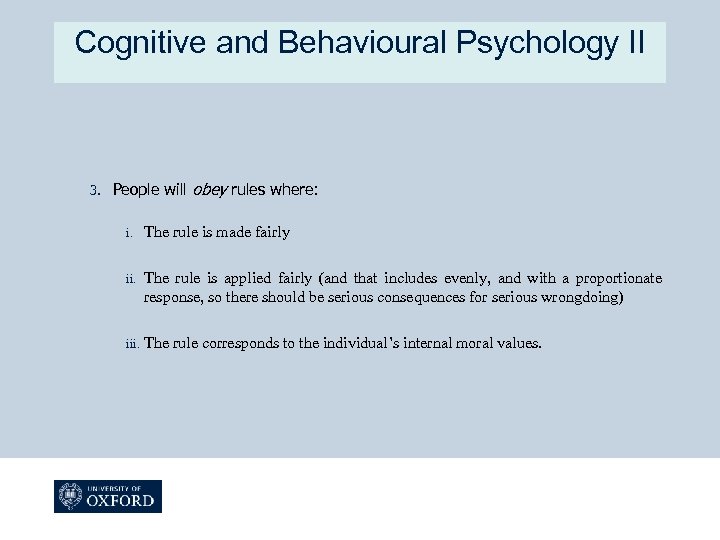 Cognitive and Behavioural Psychology II 3. People will obey rules where: i. The rule is made fairly ii. The rule is applied fairly (and that includes evenly, and with a proportionate response, so there should be serious consequences for serious wrongdoing) iii. The rule corresponds to the individual’s internal moral values.
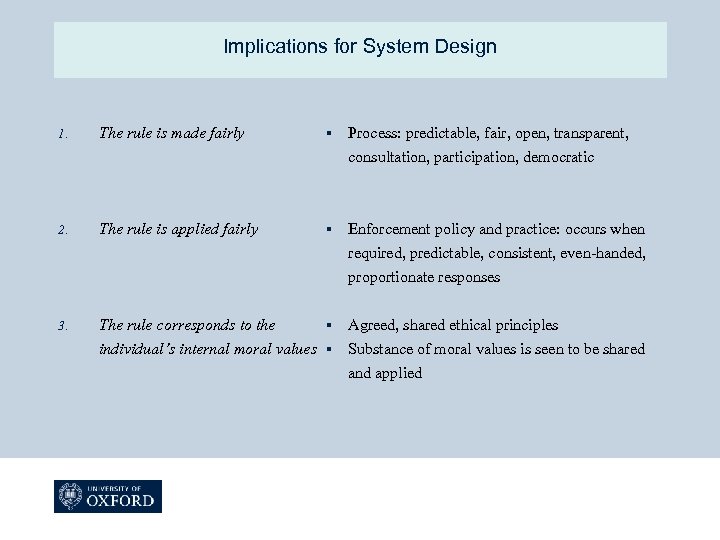 Implications for System Design 1. The rule is made fairly § Process: predictable, fair, open, transparent, consultation, participation, democratic 2. The rule is applied fairly § Enforcement policy and practice: occurs when required, predictable, consistent, even-handed, proportionate responses 3. The rule corresponds to the § individual’s internal moral values § Agreed, shared ethical principles Substance of moral values is seen to be shared and applied
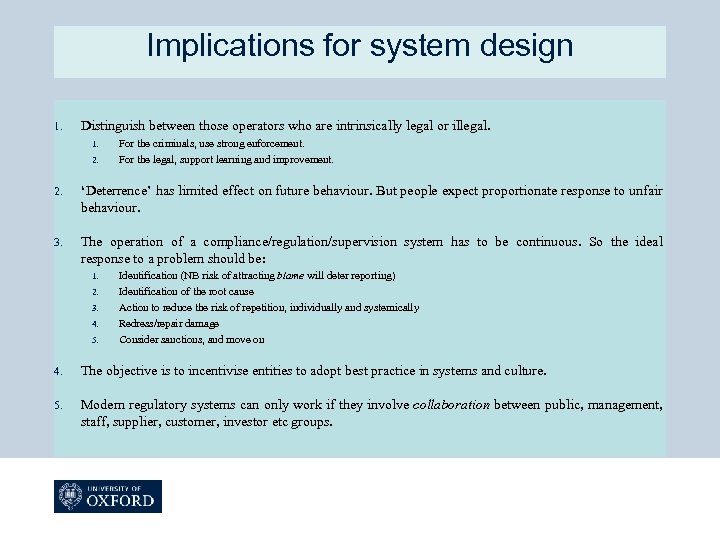 Implications for system design 1. Distinguish between those operators who are intrinsically legal or illegal. 1. 2. For the criminals, use strong enforcement. For the legal, support learning and improvement. 2. ‘Deterrence’ has limited effect on future behaviour. But people expect proportionate response to unfair behaviour. 3. The operation of a compliance/regulation/supervision system has to be continuous. So the ideal response to a problem should be: 1. 2. 3. 4. 5. Identification (NB risk of attracting blame will deter reporting) Identification of the root cause Action to reduce the risk of repetition, individually and systemically Redress/repair damage Consider sanctions, and move on 4. The objective is to incentivise entities to adopt best practice in systems and culture. 5. Modern regulatory systems can only work if they involve collaboration between public, management, staff, supplier, customer, investor etc groups.
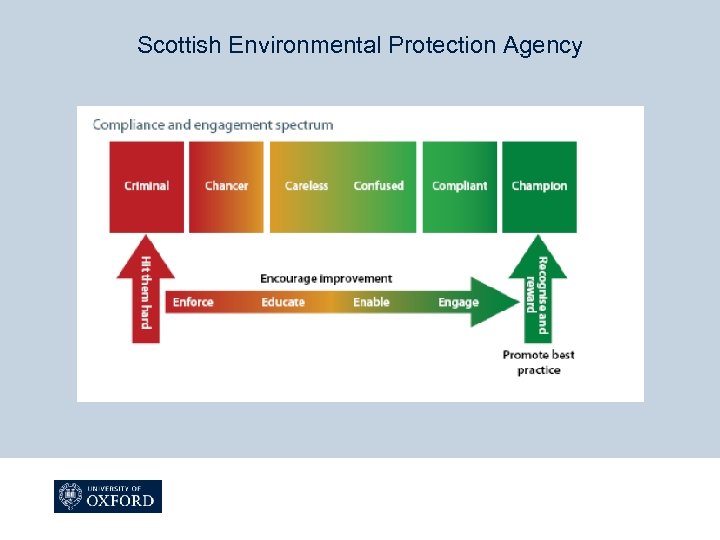 Scottish Environmental Protection Agency
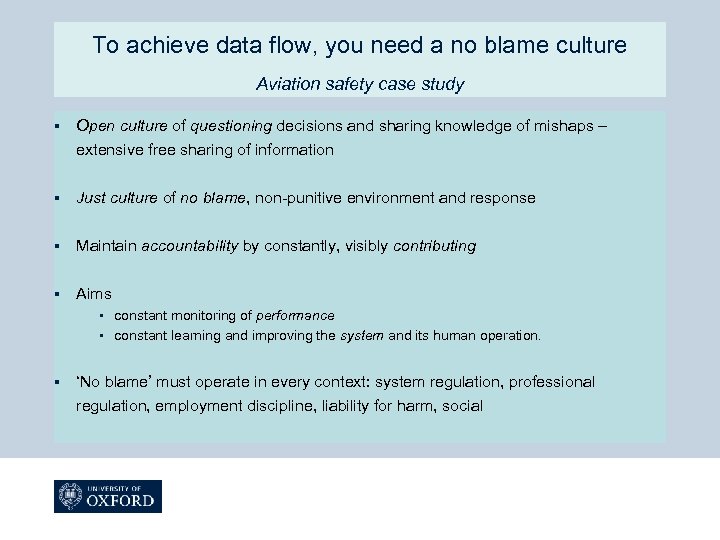 To achieve data flow, you need a no blame culture Aviation safety case study § Open culture of questioning decisions and sharing knowledge of mishaps – extensive free sharing of information § Just culture of no blame, non-punitive environment and response § Maintain accountability by constantly, visibly contributing § Aims § constant monitoring of performance § constant learning and improving the system and its human operation. § ‘No blame’ must operate in every context: system regulation, professional regulation, employment discipline, liability for harm, social
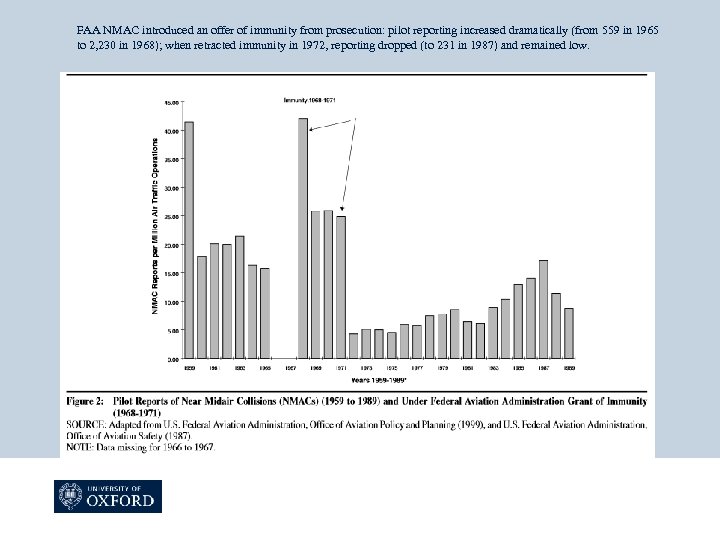 FAA NMAC introduced an offer of immunity from prosecution: pilot reporting increased dramatically (from 559 in 1965 to 2, 230 in 1968); when retracted immunity in 1972, reporting dropped (to 231 in 1987) and remained low.
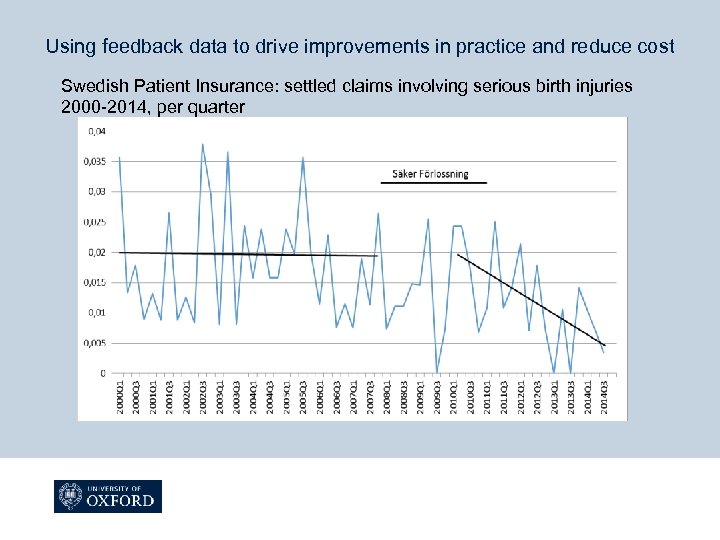 Using feedback data to drive improvements in practice and reduce cost Swedish Patient Insurance: settled claims involving serious birth injuries 2000 -2014, per quarter
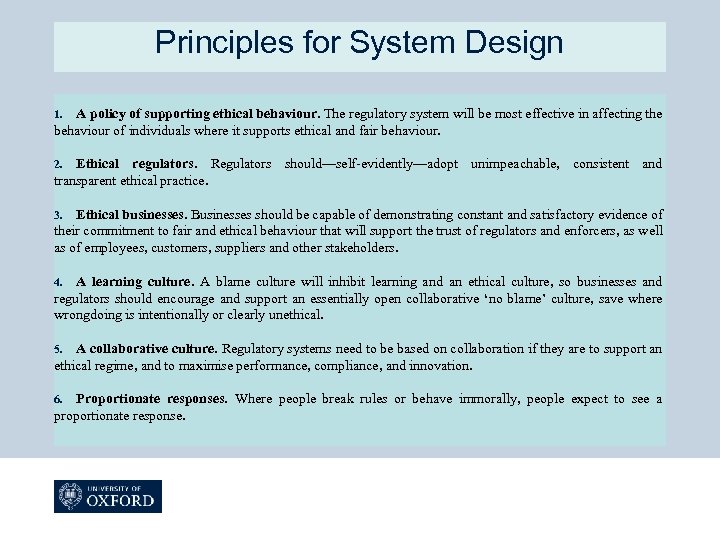 Principles for System Design A policy of supporting ethical behaviour. The regulatory system will be most effective in affecting the behaviour of individuals where it supports ethical and fair behaviour. 1. Ethical regulators. Regulators should—self-evidently—adopt unimpeachable, consistent and transparent ethical practice. 2. Ethical businesses. Businesses should be capable of demonstrating constant and satisfactory evidence of their commitment to fair and ethical behaviour that will support the trust of regulators and enforcers, as well as of employees, customers, suppliers and other stakeholders. 3. A learning culture. A blame culture will inhibit learning and an ethical culture, so businesses and regulators should encourage and support an essentially open collaborative ‘no blame’ culture, save where wrongdoing is intentionally or clearly unethical. 4. A collaborative culture. Regulatory systems need to be based on collaboration if they are to support an ethical regime, and to maximise performance, compliance, and innovation. 5. Proportionate responses. Where people break rules or behave immorally, people expect to see a proportionate response. 6.
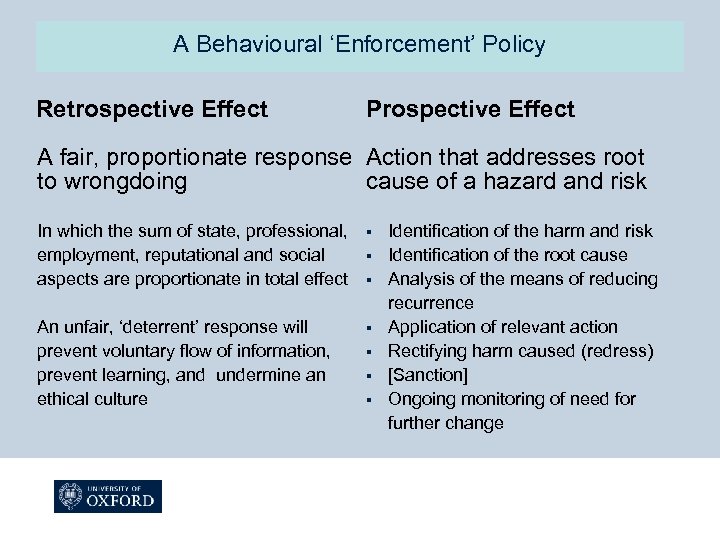 A Behavioural ‘Enforcement’ Policy Retrospective Effect Prospective Effect A fair, proportionate response Action that addresses root to wrongdoing cause of a hazard and risk In which the sum of state, professional, § Identification of the harm and risk employment, reputational and social § Identification of the root cause aspects are proportionate in total effect § Analysis of the means of reducing recurrence An unfair, ‘deterrent’ response will § Application of relevant action prevent voluntary flow of information, § Rectifying harm caused (redress) prevent learning, and undermine an § [Sanction] ethical culture § Ongoing monitoring of need for further change
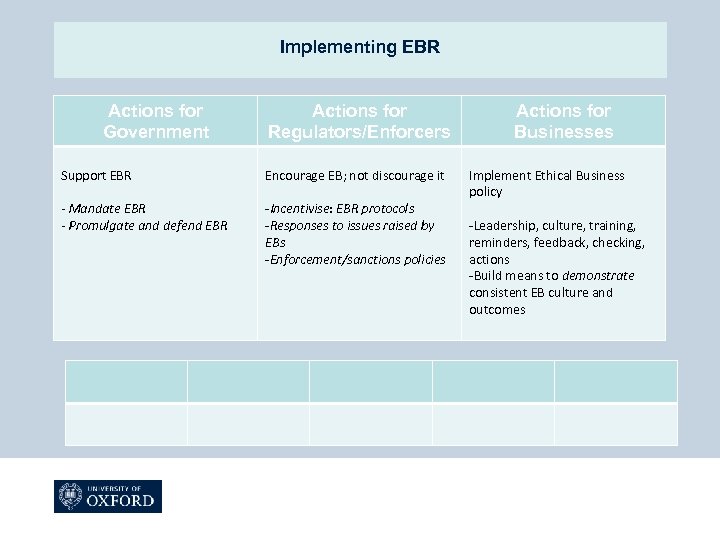 Implementing EBR Actions for Government Actions for Regulators/Enforcers Support EBR Encourage EB; not discourage it - Mandate EBR - Promulgate and defend EBR -Incentivise: EBR protocols -Responses to issues raised by EBs -Enforcement/sanctions policies Actions for Businesses Implement Ethical Business policy -Leadership, culture, training, reminders, feedback, checking, actions -Build means to demonstrate consistent EB culture and outcomes