


 Скачать презентацию Regulatory implications of servitization in the EU Can
fab0fe1b62f1cd2b05e6a274fb91bed4.ppt
- Количество слайдов: 33
 Regulatory implications of servitization in the EU: Can lawyers follow the suit of digitised industry? Janja Hojnik University of Oxford, Faculty of Law EU Law Discussion Group 4 May 2016
 Background • Deindustrialization of developed economies – % GDP from manufacturing < 15% • Economic crisis: overreliance on financial services • Industrial renaissance – reindustrialisation bring jobs back to Europe. – But providing products alone is insufficient – Manufacturers should also offer services
 » There are no such thing as service industry. There are only industries whose service components are greater or less than those of other industries. Everybody is in service. « • Theodore Levitt (1972)
 Servitization • Vandermerwe & Rada (1988): ‘the increasing offering of fuller market packages or ‘bundles’ of customer focused combination of goods, services, support, self-service and knowledge in order to add value to core corporate offerings’. • Baines (2009): „the process of creating value by adding services to products“ • Other authors: servicising, servicisation, service infusion, service design, going downstream, new manufacturing, integrated solutions, product of service, tertiarization, functionalization, service-oriented manufacturing (SOM) etc.
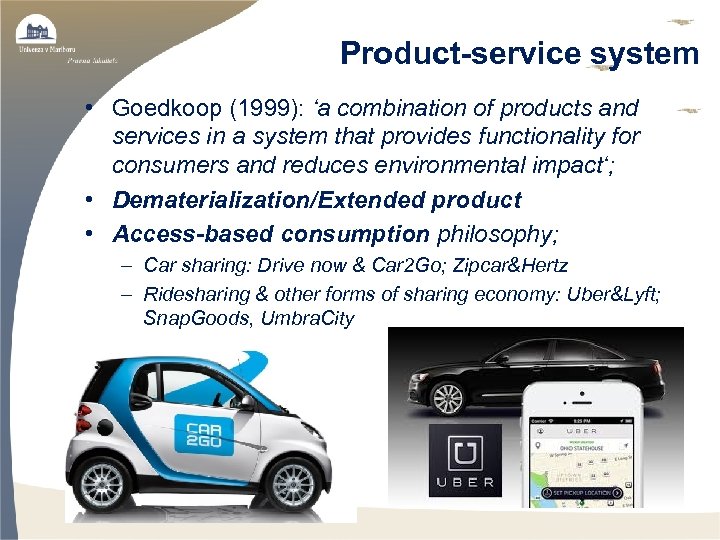 Product-service system • Goedkoop (1999): ‘a combination of products and services in a system that provides functionality for consumers and reduces environmental impact‘; • Dematerialization/Extended product • Access-based consumption philosophy; – Car sharing: Drive now & Car 2 Go; Zipcar&Hertz – Ridesharing & other forms of sharing economy: Uber&Lyft; Snap. Goods, Umbra. City
 Solution oriented business models • Producers as solution providers “People don't want to buy a quarter-inch drill, they want a quarter-inch hole. ” T. Levitt
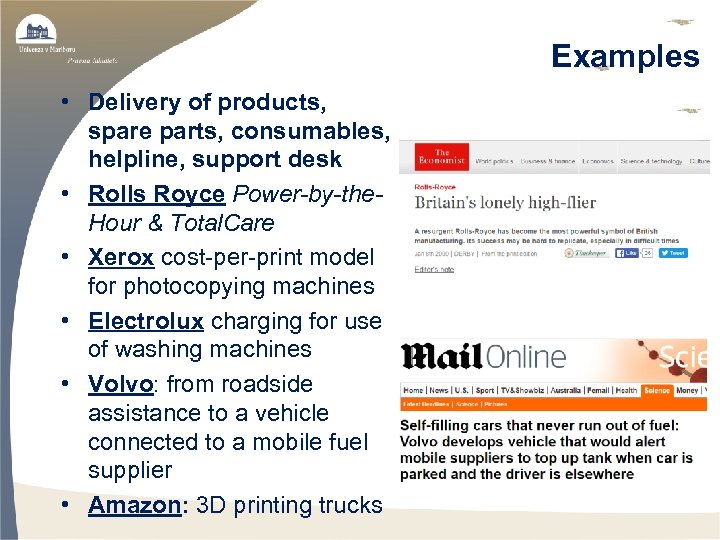 Examples • Delivery of products, spare parts, consumables, helpline, support desk • Rolls Royce Power-by-the. Hour & Total. Care • Xerox cost-per-print model for photocopying machines • Electrolux charging for use of washing machines • Volvo: from roadside assistance to a vehicle connected to a mobile fuel supplier • Amazon: 3 D printing trucks
 Economic studies • Crozet & Milet (2015): analysing French firms; compared to firms that produce goods only, firms that start selling services increase their profitability by 3. 7 to 5. 3 percent, increase their number of employees by 30 percent, and boost their sales of goods by 3. 6 percent. • A study by Oxford Economics (2013) – an international survey of almost 400 senior executives from industrial sectors: the proportion of companies competing through services contracts or products-as-a-service is expected to increase by more than 150 percent by 2016.
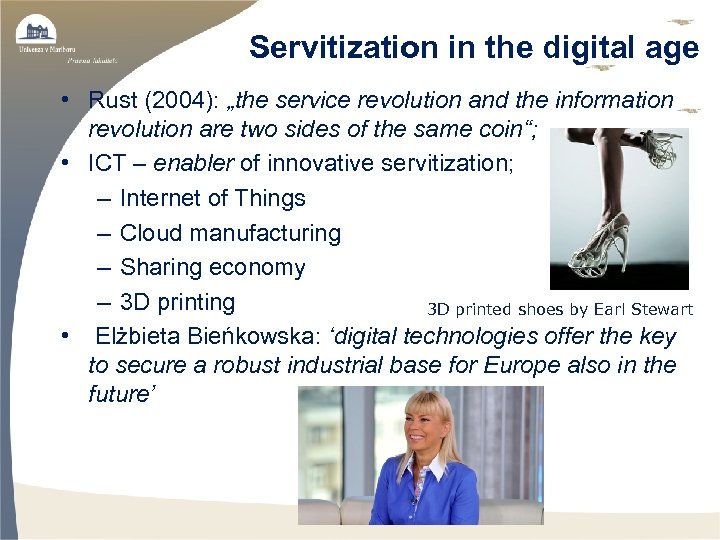 Servitization in the digital age • Rust (2004): „the service revolution and the information revolution are two sides of the same coin“; • ICT – enabler of innovative servitization; – Internet of Things – Cloud manufacturing – Sharing economy – 3 D printing 3 D printed shoes by Earl Stewart • Elżbieta Bieńkowska: ‘digital technologies offer the key to secure a robust industrial base for Europe also in the future’
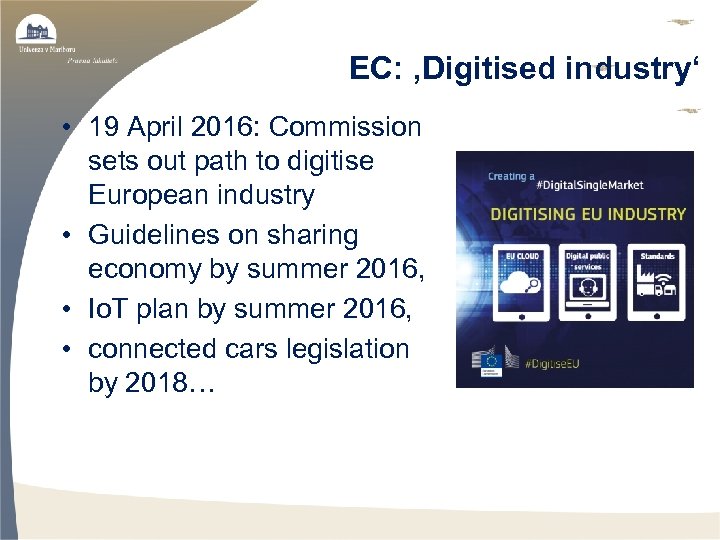 EC: ‚Digitised industry‘ • 19 April 2016: Commission sets out path to digitise European industry • Guidelines on sharing economy by summer 2016, • Io. T plan by summer 2016, • connected cars legislation by 2018…
 An actual revolution? • EU High-Level Group on Business Services: servitization ‘offers opportunities to revolutionize the manufacturing sector’, • EU funded Spree project: servitization ‘has an unprecedented potential to radically modify production and consumption patterns and to achieve absolute decoupling of economy, ecology and societal change. ’ • EU Commission: ‘manufacturing and services are two sides of the same coin … in the modern economy, you cannot choose the one or the other (…). You must do both’.
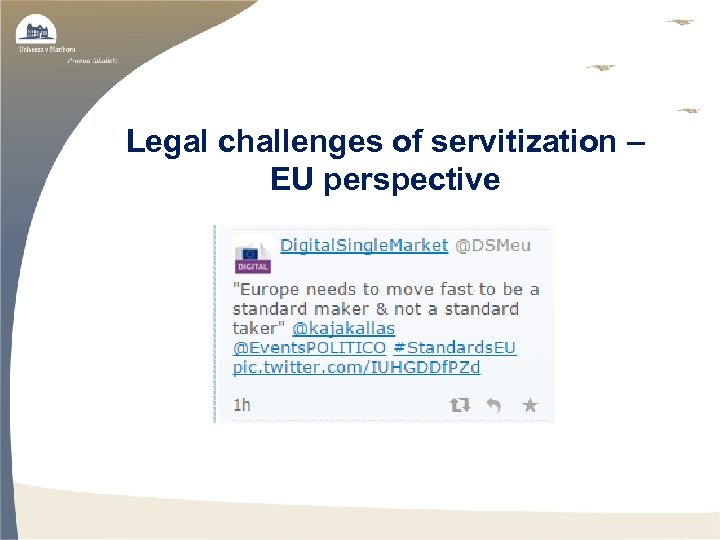 Legal challenges of servitization – EU perspective
 Is law going to restrict or promote servitization? • Smart things require smart regulatory solutions • Applying established legal principles for new market circumstances; • Balancing safety, liability, competition, innovation, flexibility etc. • Respecting the established constitutional and institutional settings in the regulatory process: industry involvement, self-regulation…
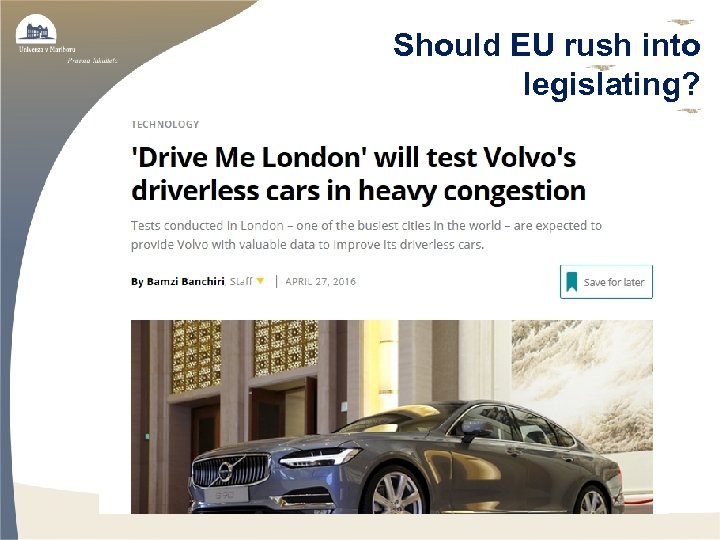 Should EU rush into legislating?
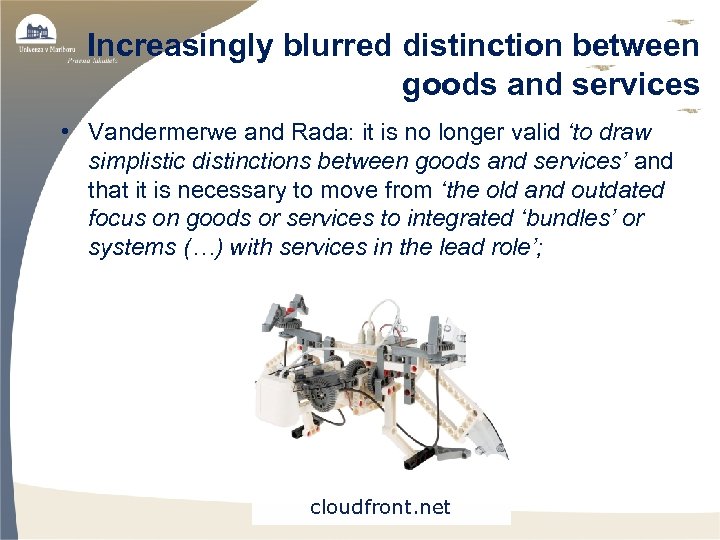 Increasingly blurred distinction between goods and services • Vandermerwe and Rada: it is no longer valid ‘to draw simplistic distinctions between goods and services’ and that it is necessary to move from ‘the old and outdated focus on goods or services to integrated ‘bundles’ or systems (…) with services in the lead role’; cloudfront. net
 Increasingly blurred distinction between goods and services • Hunnings compared in 1980 sending Financial Times by post and by fax: – lawyers old-fashioned when dealing with new techonologies; – ‘conceptual blockage which prevents this equivalence being acted upon is the lawyer's reluctance to move from Newtonian physics to quantum physics. ’ • Marenco: ‘the distinction between goods and services is largely formal and has no real economic significance. This distinction is sometimes awkward and normally ought not to entail legal consequences’.
 EU Court in Used. Soft (C-128/11) • it made no difference whether a copy of a computer program was made available to the customer by means of downloading or by means of a CD or DVD; • the online transmission method was the ‘functional equivalent’ to the supply of a material medium; • Is EU Court moving away from the dominance approach and takes a step towards the integration approach? http: //www. ipdigit. eu/
 2 groups of servitization models • transactions where ownership of the product is transferred to the consumer with some services being added to the product to enhance its value – SALES CONTRACTS under the Consumer Rights Directive • transactions where ownership of the product remains with the trader and only the service is transferred to the consumer – SERVICE CONTRACTS under the CRD • What about production of unique pieces by smart machines as a standardized (mass) product? • And Volvo offering mobile top ups of cars’ tanks?
 Single market & DSM • ‘legislators tend to treat machines from the digital age like machines from the industrial revolution, but connected to the Internet, somehow’ • ‘If the single market is not ready in time, the digitalisation of industry will be shaped by companies outside the EU, notably the US. ’ Reinhold Festge (WDMA) Data in industry: Who owns this data? Who will be allowed to analyse it? The creator of the machine? The owner? The maintenance company? The software developer?
 Competition law • Locking-out competition: • Big Data challenges: data perspective arises as the next strategic step for manufacturers after adopting servitization. Practices of tying and bundling • Vertical integration (e. g. motor vehicle repairs by brand -owner) • Services offered „without a charge“ • Sharing economy as a threat to fair competition http: //bigdataanalyticsnews. com/
 Consumer law • Locking-in customers; • Consumer centric business models, providing holistic, more tailored solutions for consumers, instead of sole products; • Servitization strategy as a side effect looks after the interests of the consumer; • Is consumer law getting redundant?
 Liability & Safety • Limited applicability of the Product Liability Directive: – Software supplied over the Internet – Digital design files for 3 D printed objects • Should the EU institutions reconsider adopting a directive on service supplier liability? • Liability & safety issues concerning automated systems (factory robots, connected cars, drones…) – simple tools in the hands of other actors?
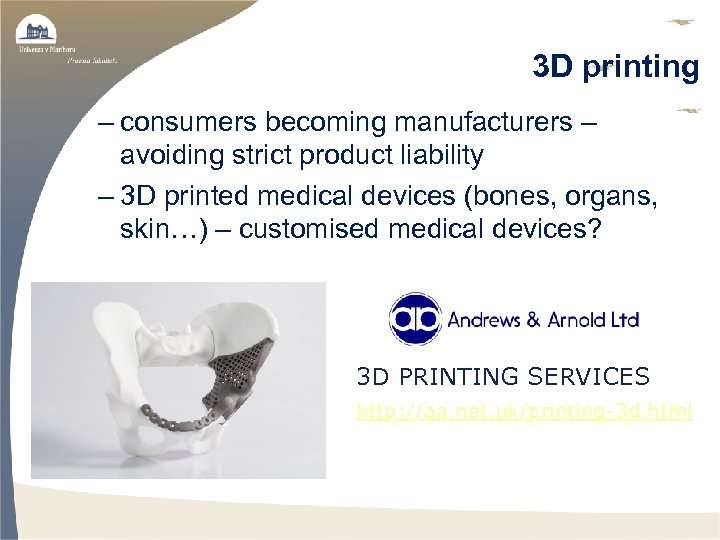 3 D printing – consumers becoming manufacturers – avoiding strict product liability – 3 D printed medical devices (bones, organs, skin…) – customised medical devices? 3 D PRINTING SERVICES http: //aa. net. uk/printing-3 d. html
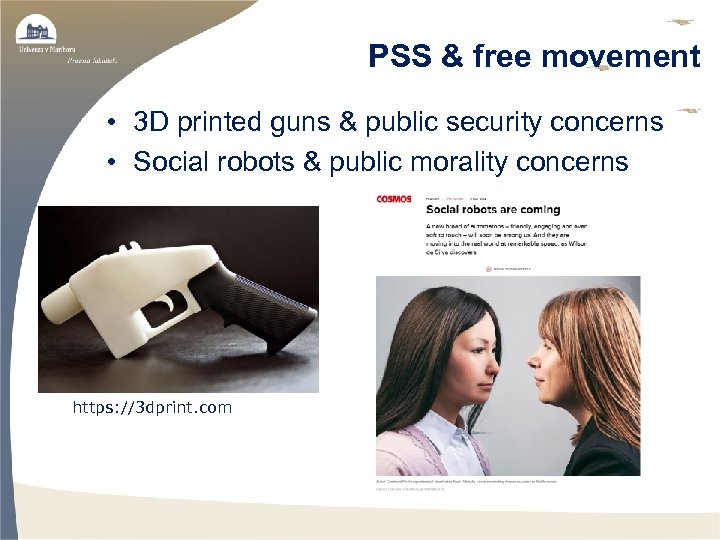 PSS & free movement • 3 D printed guns & public security concerns • Social robots & public morality concerns https: //3 dprint. com
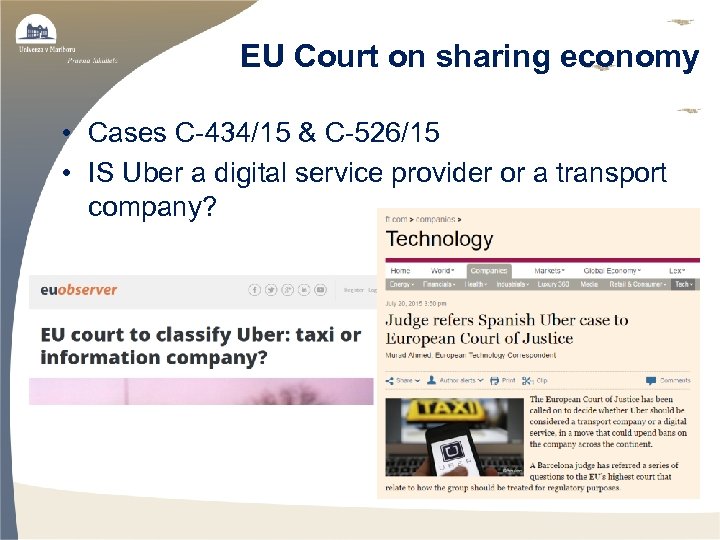 EU Court on sharing economy • Cases C-434/15 & C-526/15 • IS Uber a digital service provider or a transport company?
 Servitization v globalisation • Regulatory barriers on trade with services; – European cars in Japan are sold at a 90 percent mark-up compared to European listed prices; • Restricted temporary movement of physical persons; – Negotiations on a Environmental Goods Agreement between EU and 16 other WTO members - including services related to exports of environmental goods; • Io. T and restrictions on an open Internet; • Restrictions on trade with double use products & cryptography. http: //physicsworld. com/
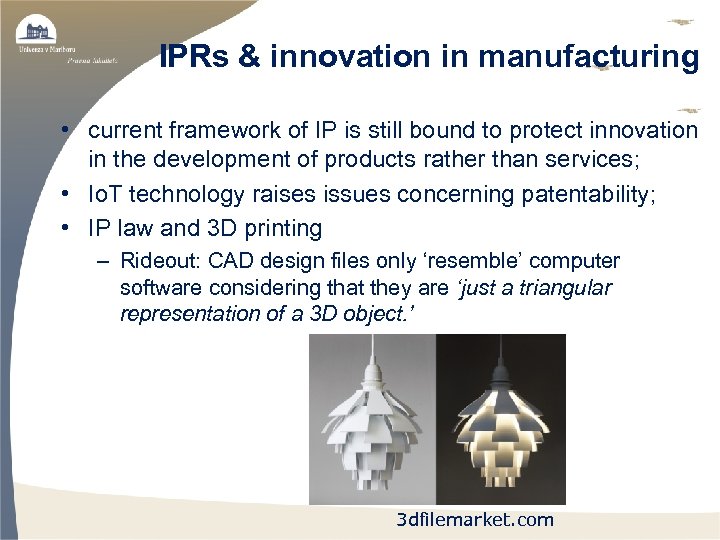 IPRs & innovation in manufacturing • current framework of IP is still bound to protect innovation in the development of products rather than services; • Io. T technology raises issues concerning patentability; • IP law and 3 D printing – Rideout: CAD design files only ‘resemble’ computer software considering that they are ‘just a triangular representation of a 3 D object. ’ 3 dfilemarket. com
 Servitisation & resource efficient Europe • UN Programme for Environment: servitization is having ‘the potential to re-orient the current standards of consumption and production, thus enabling a move towards a more sustainable society’; • Access-based consumption – bike sharing, car sharing… • smart public lighting; • smart irrigation; • smart homes with energy efficient ovens, thermostats and refrigerators; • Energy Efficiency Directive (2012): Energy services; • Principle of extended producer responsibility (EPR) & EU waste management legislation.
 Other relevant legal fields • • Standardisation Financial services Telecommunications Medical law Public procurement Taxation Criminal law & forensic procedures…
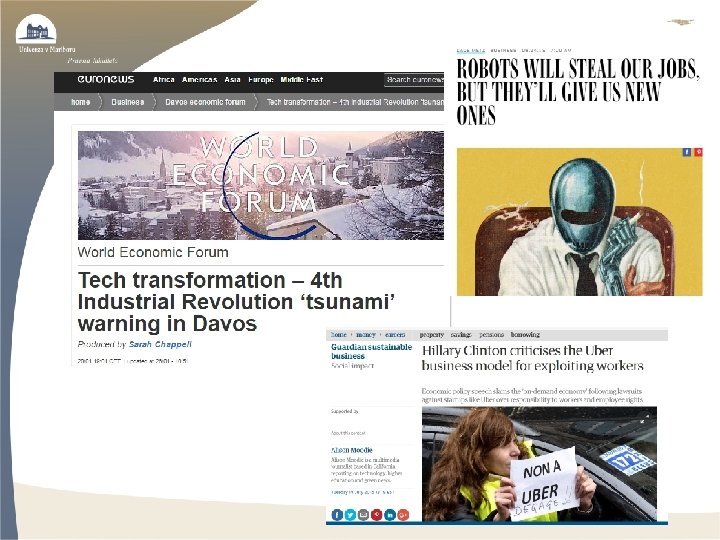
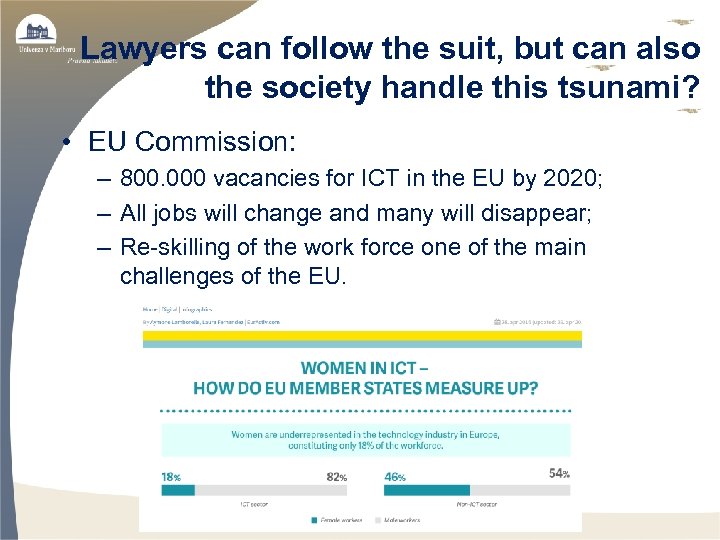 Lawyers can follow the suit, but can also the society handle this tsunami? • EU Commission: – 800. 000 vacancies for ICT in the EU by 2020; – All jobs will change and many will disappear; – Re-skilling of the work force one of the main challenges of the EU.
 Thank you for your attention! janja. hojnik@um. si