


 Скачать презентацию Regulatory Governance in the Philippines A Profile Ledivina
cce4db223ce5416f4c0932423fd4a724.ppt
- Количество слайдов: 38
 Regulatory Governance in the Philippines: A Profile Ledivina V. Carino et al
 Outline • Introduction to Philippine concept of regulatory governance • Constitutional and legal framework • Institutional framework • Regulatory mechanisms at work • Research agenda
 The Philippines: a Brief Socio-Economic Profile § The Philippines’ economic system has evolved from the country’s long experience of colonial rule. § 1950 s “Filipino First Policy” aimed to achieve economic independence. § Significant deregulation, liberalisation and aggressive privatisation since 1980 s
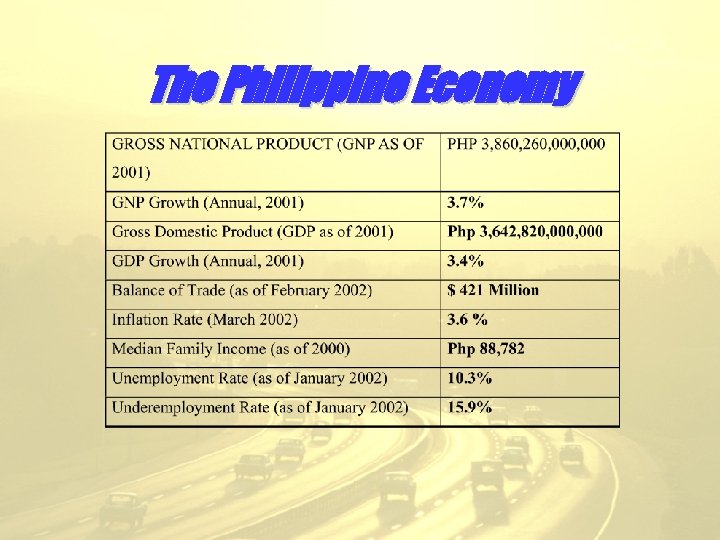 The Philippine Economy
 Regulatory Governance § Definition: How regulation and competition are managed to achieve societal goals § View of regulatory governance § Not a monopoly of the state § Control, influence, incentives, enabling, facilitating § Change of context of doing business § Devolution / Globalisation
 The Legal Framework • The 1987 Constitution and the entry of the Philippines into the World Trade Organisation often complementary, sometimes conflicting. § The 1987 Constitution is very nationalistic – as had been articulated by earlier Constitutions. § It has provisions in (limited) support of free enterprise.
 Aims of Regulatory Governance • For economic growth • To encourage private enterprise • For country’s integrity as a sovereign state and as a democracy • In the service of poverty alleviation and other issues of the public interest
 The Nationalistic Constitutional Framework § protect Filipino enterprises against unfair foreign competition and trade practices (Sec. 1) § encourage the formation and operation of enterprises whose capital is wholly owned by Filipinos (Par. 1, Sec. 10)
 The Nationalistic Constitutional Framework • “The State shall develop a self-reliant and independent national economy effectively controlled by Filipinos. ” • regulate and exercise authority over foreign investments (Par. 3, Sec. 10) • preference to qualified Filipinos in the granting of rights, privileges, and concessions (Par. 2, Sec. 10)
 The Nationalistic Constitutional Framework • promote the preferential use of Filipino labour, domestic materials and locally produced goods (sec. 12) • Limit participation of foreign investors in board and may not be executives of public utilities • Limit practice of profession except as prescribed by law
 The Nationalistic Constitutional Framework • Nationality-indifferent and marketoriented policies have burden of proof of not contravening the Constitution. • Examples – Luzon Petrochemical site (1990) – Manila Hotel (1997) – Phil Shipyard (2000)
 Constitutionally Limited Support to Free Enterprise • “The State recognises the indispensable role of the private sector, encourages private enterprise and provides incentives to needed investments. ” • BUT State may intervene in the economy – To promote distributive justice – When common good so demands
 Laws Regulating the Economy • Regulate the conduct of business • Restrict entry and competition • Devolve regulation
 Laws Regulating the Conduct of Business Øa socially conscious, free market that regulates itself Øencourage the widest participation of ownership Øenhance the democratisation of wealth Øensure fairness and transparency
 Laws Regulating the Conduct of Business ØIncentives for investments (except security, health and morals and constitutional bans) ØDeregulation in banking, telecoms, transportation ØTrade liberalisation (ex. Retail trade) ØCommitments to WTO (ex. money laundering law)
 Laws Restricting Entry and Competition § nationalistic restrictions: § Safeguard Measures Act (RA 8800) § non-nationalistic restrictions: § public utility franchising § monopoly rights given to public enterprises § licensing, and rules to remove barriers to competition
 Law Devolving Regulation § Devolved areas: Health, agriculture, social welfare, environment § Others explicitly granted: agricultural lands, zoning, local transport# § Business licenses and permits § For comfort and convenience of inhabitants § Local Government Code of 1991 (RA 7160)
 Institutional Framework § Legislative Involvement in Regulation § House of Representatives: Legislative Franchises; Trade and Industry; Banks and Financial Intermediaries; Economic Affairs; and a special committee on entrepreneurship development. § Senate: Economic Affairs; Trade and Commerce; Public Services; and Banks and Financial Institutions § The Judiciary § Checks and balances: The E-VAT Law
 The Regulatory Agencies v 19 government agencies primarily in economic regulation v. Balance of involvement and independence § § Governing body: collegial? Qualifications? Autonomy: where in admnistrative system? Fiscal autonomy and accountability Appeal from decisions
 Banking and Finance § Bangko Sentral ng Pilipinas the new Central (BSP, Bank) § Securities and Exchange Commission (SEC) § Philippine Deposit Insurance Corporation (PDIC) § Office of the Insurance Commissioner (OIC)
 Trade and Commerce § Department of Trade and Industry (DTI) § Bureau of Product Standards (BPS) § Bureau of Trade Regulation and Consumer Protection (BTRCP) § Board of Investments (BOI) § Tariff Commission (TC)
 Water Utilities § National Water Resources Board (NWRB) § Metropolitan Waterworks and Sewerage System Regulatory Office (MWSS-RO)
 Energy § Department of Energy (DOE) § Energy Regulatory Commission (ERC)
 Transport and Communications § Civil Aeronautics Board (CAB) § Maritime Industry Authority (MARINA) § Land Transportation Franchising and Regulatory Boa (LTFRB) § Air Transportation Office (ATO) § National Telecommunications Commission (NTC)
 Labor Sector § Philippine Overseas Employment Administrati (POEA) § Occupational Health and Safety Center (OSHC
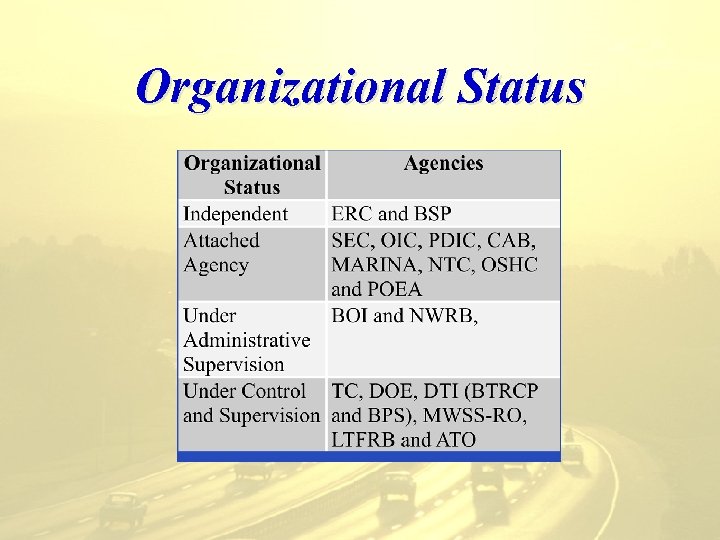 Organizational Status
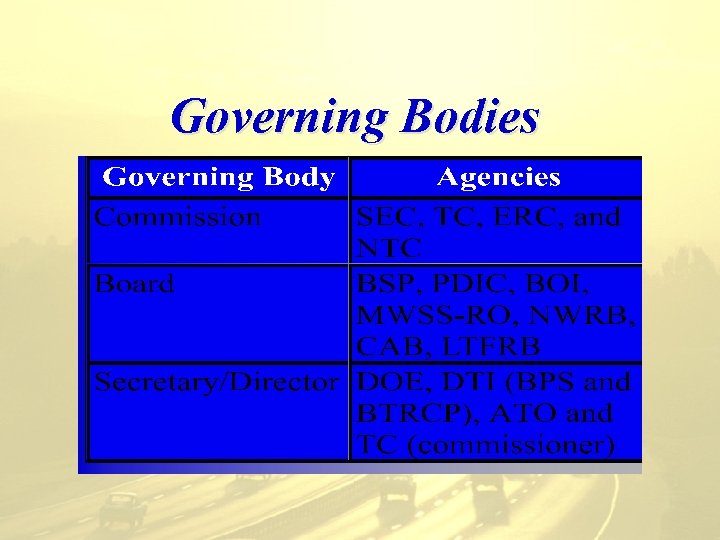 Governing Bodies
 Membership of Boards/Commissions § Terms of Office: BSP, SEC, PDIC, ERC and BOI have terms fixed by law § Qualifications § generally relate to “recognized competence” in an academic field § conflict of interest
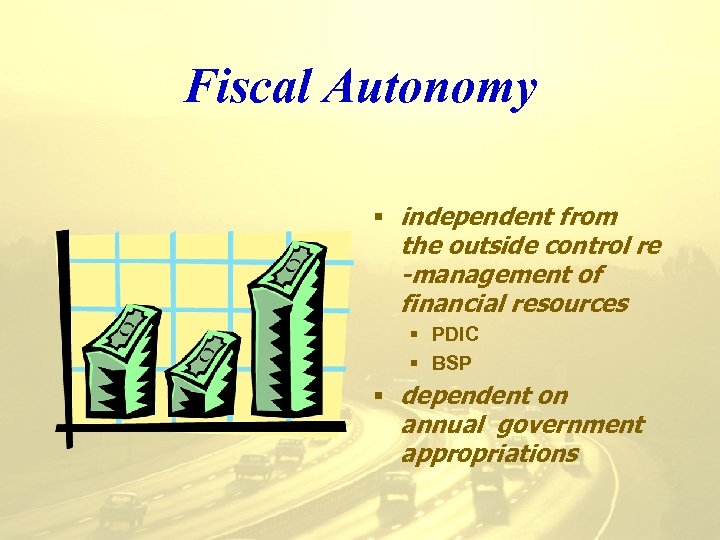 Fiscal Autonomy § independent from the outside control re -management of financial resources § PDIC § BSP § dependent on annual government appropriations
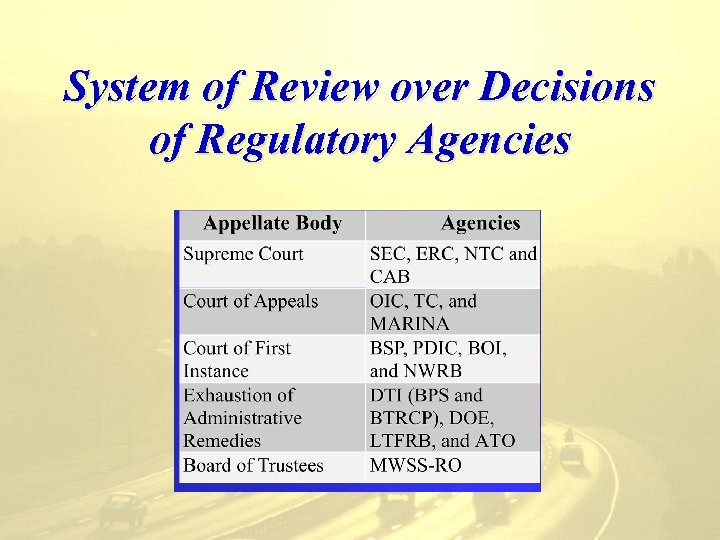 System of Review over Decisions of Regulatory Agencies
 Accountability § To State: audit of finances and performance § To regulated § To clients and public at large § As civil servants
 Challenges of Regulatory Governance • Overlapping jurisdictions and divergent views of the public interest (ex. Cement importation) • Self-regulatory mechanisms • Independence of the regulators
 Overlapping Jurisdictions: The Case of the Cement Industry § jurisdiction over the imposition of safeguard measures § definition of public interest from different perspectives § nationalism amidst globalization
 Self-Regulating Organisation § Philippine Stock Exchange (PSE) § the composition of the board § the exchange must be de-mutualised § Philippine Council for NGO Certification (PCNC)
 Independence of Regulators § MWSS-RO case § the RO has no legal character § RO’s relation to the Concessionaires § RO’s powers and functions
 Research Agenda § Philosophical and Ethical Underpinnings § Nationalism vs Globalisation § Corruption and Regulation § Challenges of Regulatory Governance
 Challenges to Regulatory Governance § Regulation and Competition Policy § Political Economy of Regulation (Power sector) § Privatisation and Regulation (MWSS Regulatory Office) § Regulation and Access of the Poor (Telecoms) § Regulation by local government or the private sector
 -END-
-END-