 Скачать презентацию Regular Expressions and Automata Lecture 2 September 3
f32473194757c053ce61dfeddd3e9dd9.ppt
- Количество слайдов: 41



Regular Expressions and Automata Lecture #2 September 3 2009 1
Natural Language Understanding • Associate each input (acoustic signal/character string) with a meaning representation. • Carried out by a series of components: – Each component acts as a translator from one representation to another – In general, each component adds successively ‘richer’ information to the output 2
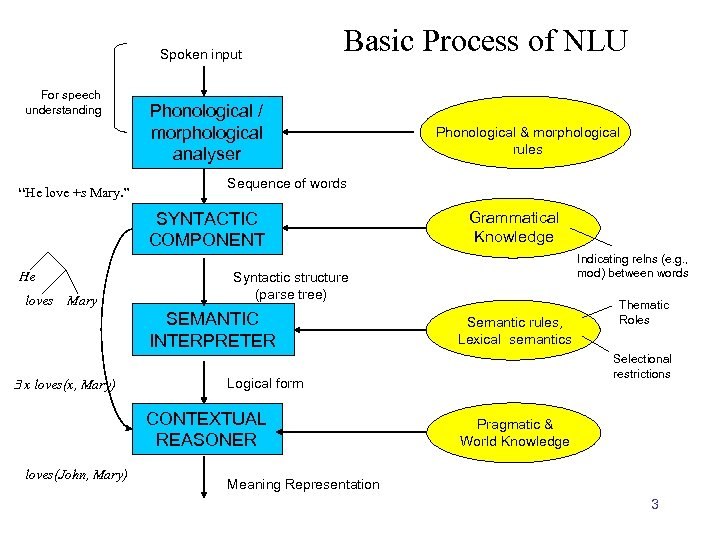
Spoken input For speech understanding “He love +s Mary. ” Basic Process of NLU Phonological / morphological analyser Sequence of words SYNTACTIC COMPONENT He loves Mary Indicating relns (e. g. , mod) between words Semantic rules, Lexical semantics Thematic Roles Selectional restrictions Logical form CONTEXTUAL REASONER loves(John, Mary) Grammatical Knowledge Syntactic structure (parse tree) SEMANTIC INTERPRETER x loves(x, Mary) Phonological & morphological rules Pragmatic & World Knowledge Meaning Representation 3
Representations and Algorithms for NLP • Representations: formal models used to capture linguistic knowledge • Algorithms manipulate representations to analyze or generate linguistic phenomena • Simplest often produce best performance but…. the 80/20 Rule and “low-hanging fruit” 4
NLP Representations • State Machines – FSAs, FSTs, HMMs, ATNs, RTNs • Rule Systems – CFGs, Unification Grammars, Probabilistic CFGs • Logic-based Formalisms – 1 st Order Predicate Calculus, Temporal and other Higher Order Logics • Models of Uncertainty – Bayesian Probability Theory 5
NLP Algorithms • Most are parsers or transducers: accept or reject input, and construct new structure from input – State space search • Pair a partial structure with a part of the input • Spaces too big and ‘best’ is hard to define – Dynamic programming • Avoid recomputing structures that are common to multiple solutions 6
Today • Review some of the simple representations and ask ourselves how we might use them to do interesting and useful things – Regular Expressions – Finite State Automata • How much can you get out of a simple tool? 7
Regular Expressions • Can be viewed as a way to specify: – Search patterns over text string – Design of a particular kind of machine, called a Finite State Automaton (FSA) • These are really equivalent 8
Uses of Regular Expressions in NLP • As grep, perl: Simple but powerful tools for large corpus analysis and ‘shallow’ processing – What word is most likely to begin a sentence? – What word is most likely to begin a question? – In your own email, are you more or less polite than the people you correspond with? • With other unix tools, allow us to – Obtain word frequency and co-occurrence statistics – Build simple interactive applications (e. g. , Eliza) • Regular expressions define regular languages or sets 9
Regular Expressions • Regular Expression: Formula in algebraic notation for specifying a set of strings • String: Any sequence of alphanumeric characters – Letters, numbers, spaces, tabs, punctuation marks • Regular Expression Search – Pattern: specifying the set of strings we want to search for – Corpus: the texts we want to search through 10
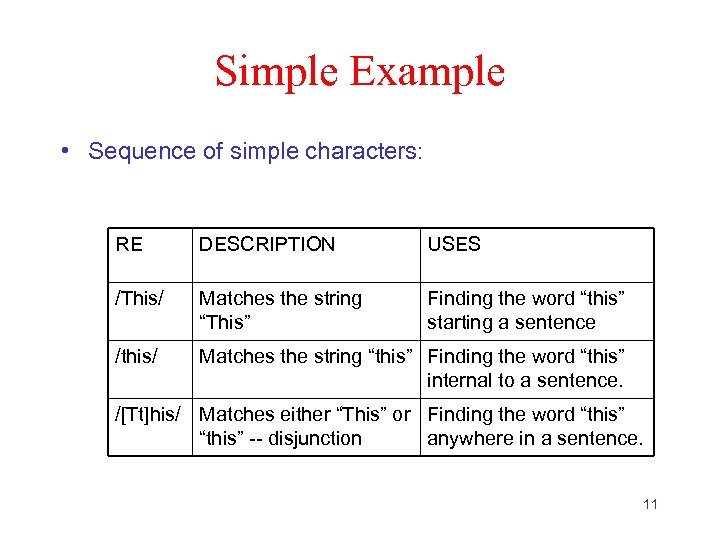
Simple Example • Sequence of simple characters: RE DESCRIPTION USES /This/ Matches the string “This” Finding the word “this” starting a sentence /this/ Matches the string “this” Finding the word “this” internal to a sentence. /[Tt]his/ Matches either “This” or Finding the word “this” -- disjunction anywhere in a sentence. 11
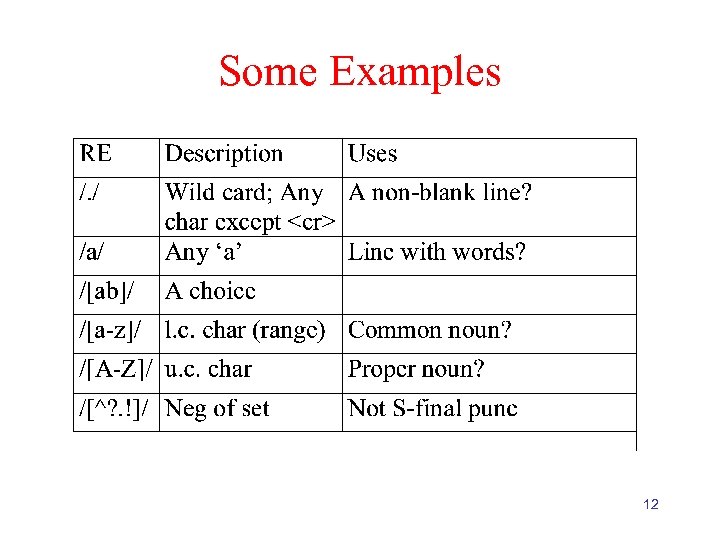
Some Examples 12
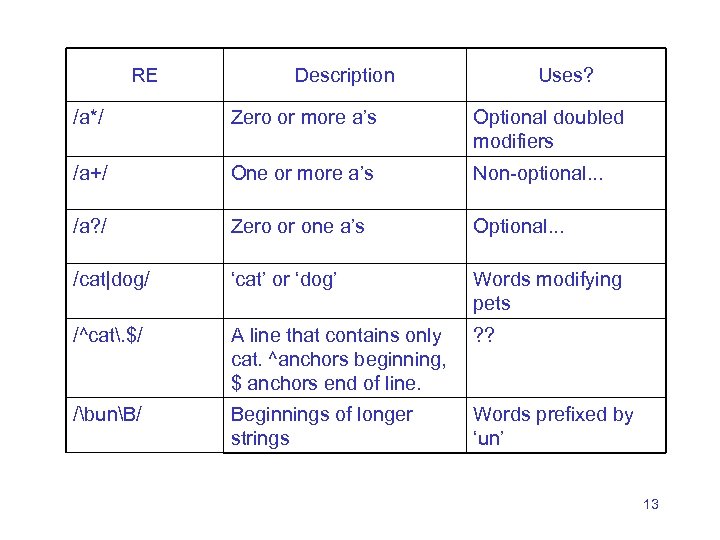
RE Description Uses? /a*/ Zero or more a’s Optional doubled modifiers /a+/ One or more a’s Non-optional. . . /a? / Zero or one a’s Optional. . . /cat|dog/ ‘cat’ or ‘dog’ Words modifying pets /^cat. $/ A line that contains only cat. ^anchors beginning, $ anchors end of line. ? ? /bunB/ Beginnings of longer strings Words prefixed by ‘un’ 13
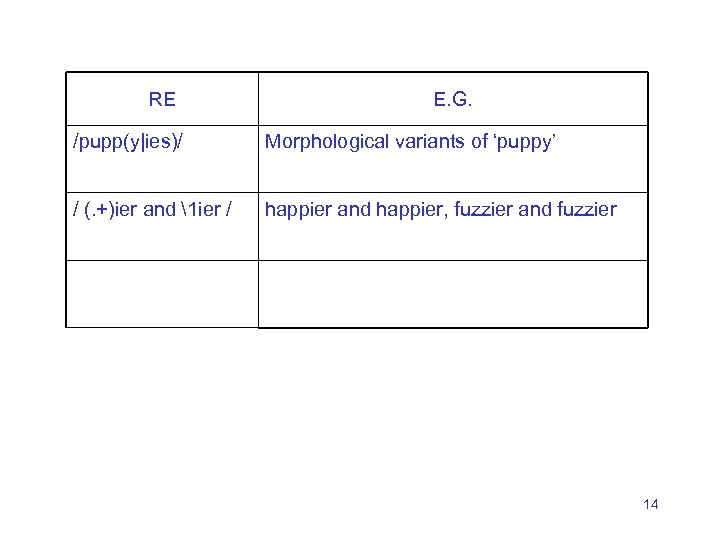
RE E. G. /pupp(y|ies)/ Morphological variants of ‘puppy’ / (. +)ier and 1 ier / happier and happier, fuzzier and fuzzier 14
![Optionality and Repetition • /[Ww]oodchucks? / matches woodchucks, Woodchucks, woodchuck, Woodchuck • /colou? r/](https://present5.com/presentation/f32473194757c053ce61dfeddd3e9dd9/image-15.jpg "Optionality and Repetition • /[Ww]oodchucks? / matches woodchucks, Woodchucks, woodchuck, Woodchuck • /colou? r/")
Optionality and Repetition • /[Ww]oodchucks? / matches woodchucks, Woodchucks, woodchuck, Woodchuck • /colou? r/ matches color or colour • /he{3}/ matches heee • /(he){3}/ matches hehehe • /(he){3, } matches a sequence of at least 3 he’s 15
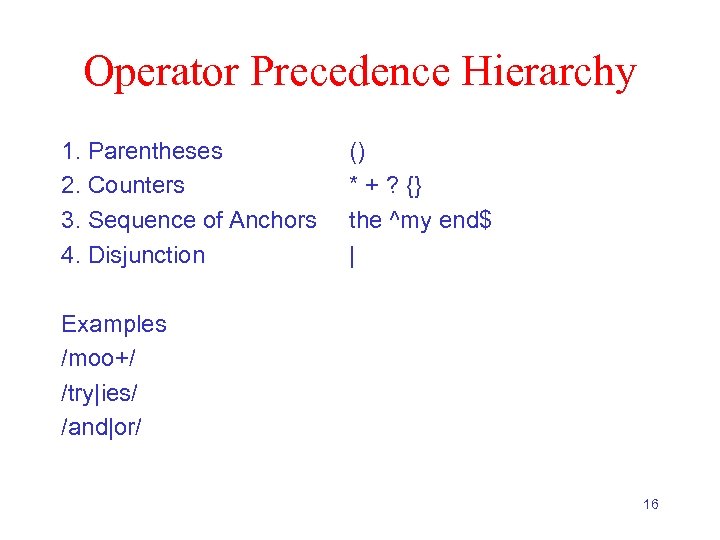
Operator Precedence Hierarchy 1. Parentheses 2. Counters 3. Sequence of Anchors 4. Disjunction () * + ? {} the ^my end$ | Examples /moo+/ /try|ies/ /and|or/ 16
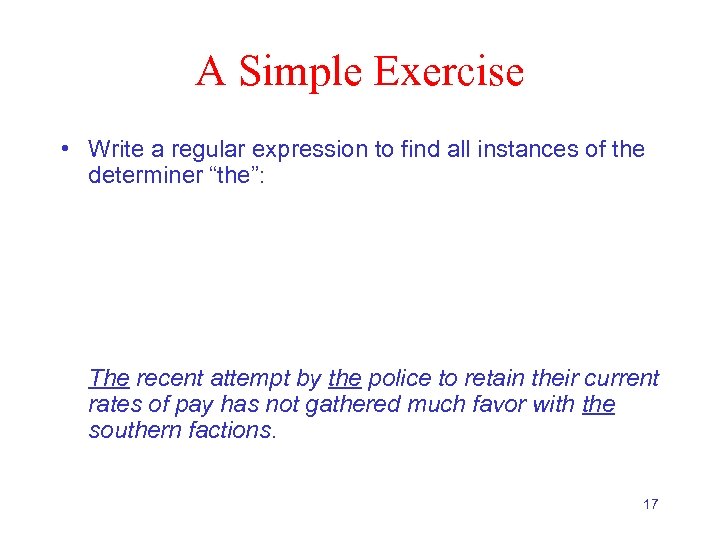
A Simple Exercise • Write a regular expression to find all instances of the determiner “the”: /the/ /[t. T]he/ /b[t. T]heb/ /(^|[^a-z. A-Z][t. T]he[^a-z. A-Z]/ The recent attempt by the police to retain their current rates of pay has not gathered much favor with the southern factions. 17
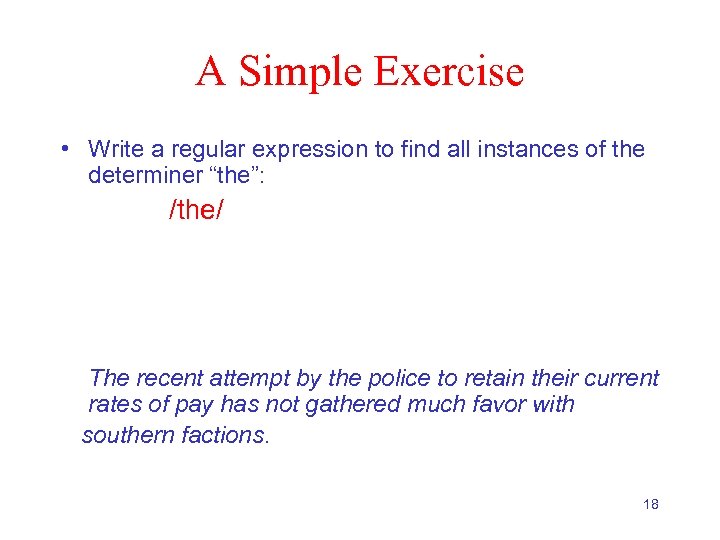
A Simple Exercise • Write a regular expression to find all instances of the determiner “the”: /the/ /[t. T]he/ /b[t. T]heb/ /(^|[^a-z. A-Z][t. T]he[^a-z. A-Z]/ The recent attempt by the police to retain their current rates of pay has not gathered much favor with southern factions. 18
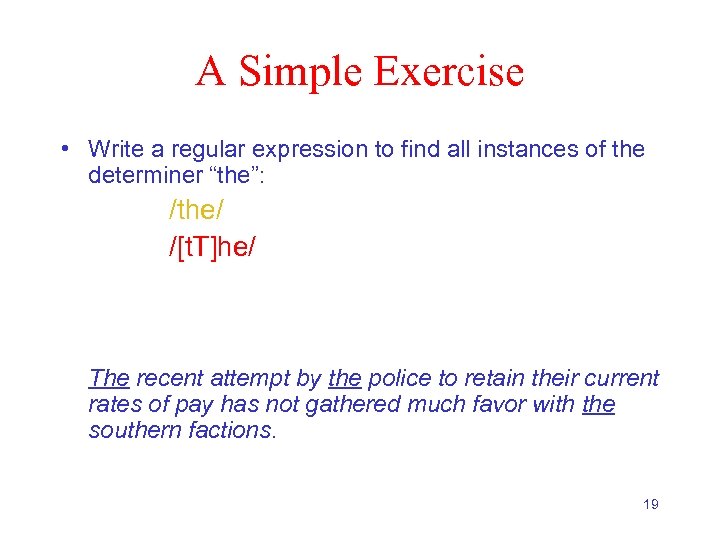
A Simple Exercise • Write a regular expression to find all instances of the determiner “the”: /the/ /[t. T]he/ /b[t. T]heb/ /(^|[^a-z. A-Z][t. T]he[^a-z. A-Z]/ The recent attempt by the police to retain their current rates of pay has not gathered much favor with the southern factions. 19
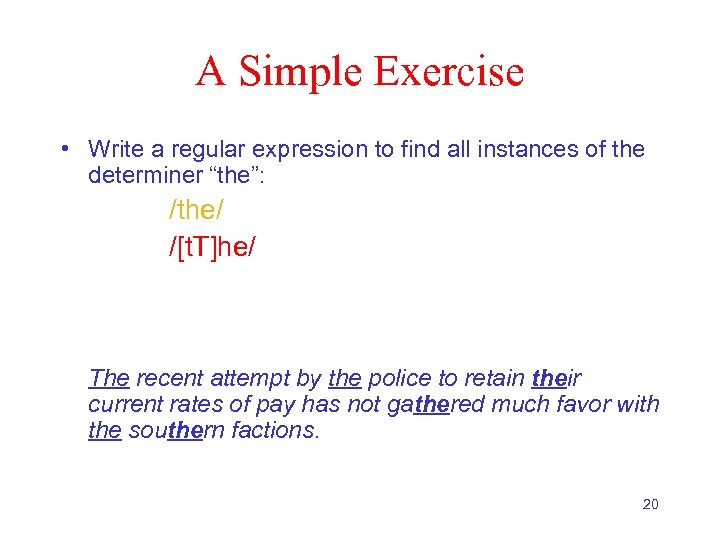
A Simple Exercise • Write a regular expression to find all instances of the determiner “the”: /the/ /[t. T]he/ /b[t. T]heb/ /(^|[^a-z. A-Z][t. T]he[^a-z. A-Z]/ The recent attempt by the police to retain their current rates of pay has not gathered much favor with the southern factions. 20
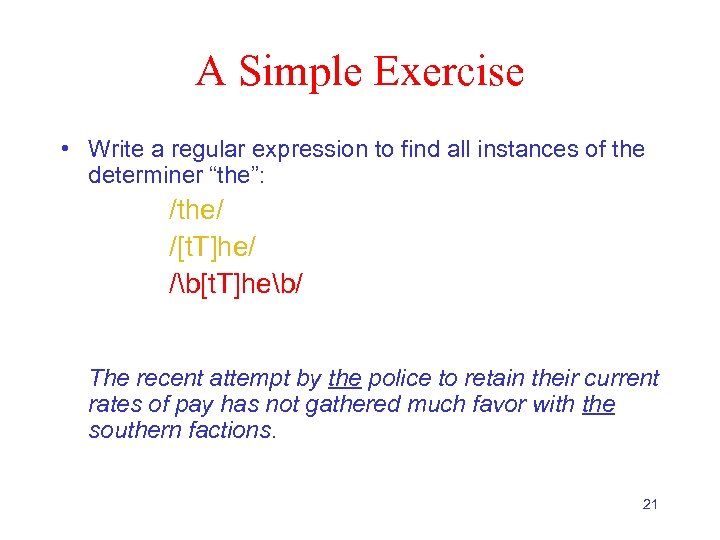
A Simple Exercise • Write a regular expression to find all instances of the determiner “the”: /the/ /[t. T]he/ /b[t. T]heb/ /(^|[^a-z. A-Z][t. T]he[^a-z. A-Z]/ The recent attempt by the police to retain their current rates of pay has not gathered much favor with the southern factions. 21
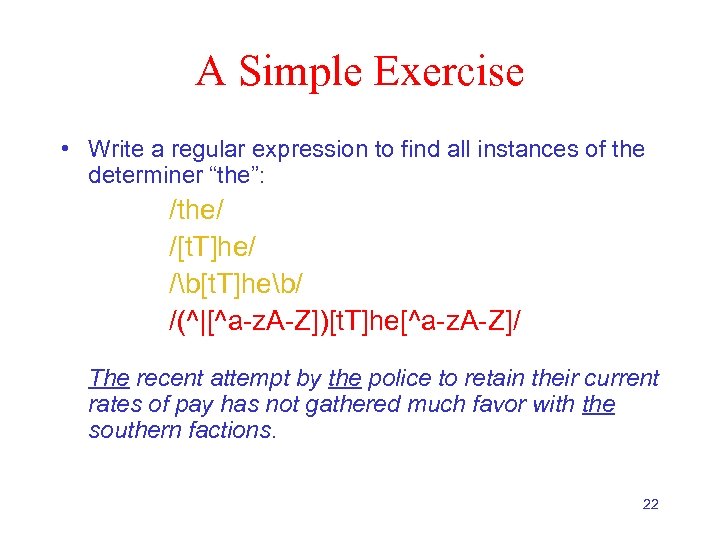
A Simple Exercise • Write a regular expression to find all instances of the determiner “the”: /the/ /[t. T]he/ /b[t. T]heb/ /(^|[^a-z. A-Z])[t. T]he[^a-z. A-Z]/ The recent attempt by the police to retain their current rates of pay has not gathered much favor with the southern factions. 22
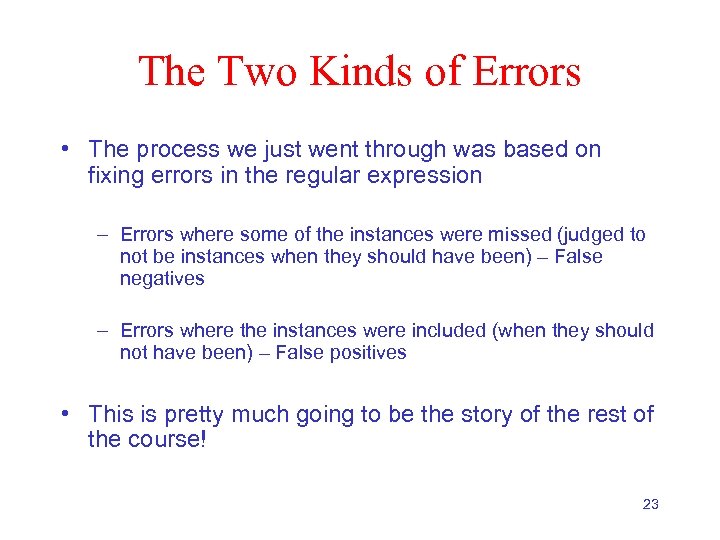
The Two Kinds of Errors • The process we just went through was based on fixing errors in the regular expression – Errors where some of the instances were missed (judged to not be instances when they should have been) – False negatives – Errors where the instances were included (when they should not have been) – False positives • This is pretty much going to be the story of the rest of the course! 23
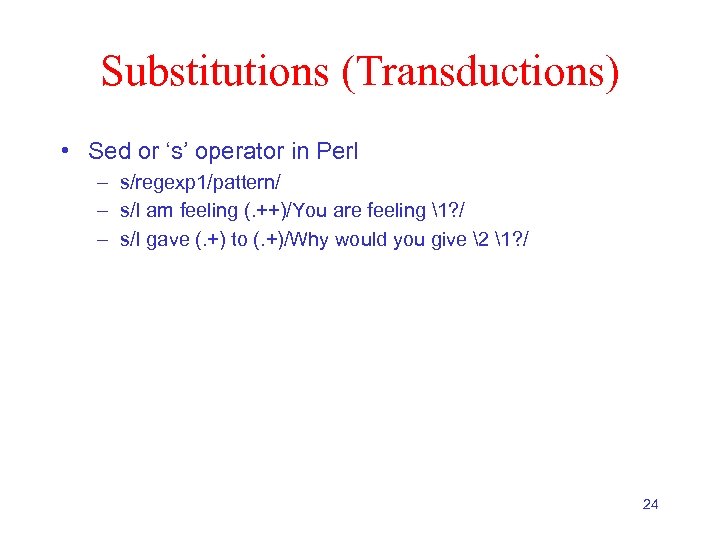
Substitutions (Transductions) • Sed or ‘s’ operator in Perl – s/regexp 1/pattern/ – s/I am feeling (. ++)/You are feeling 1? / – s/I gave (. +) to (. +)/Why would you give 2 1? / 24
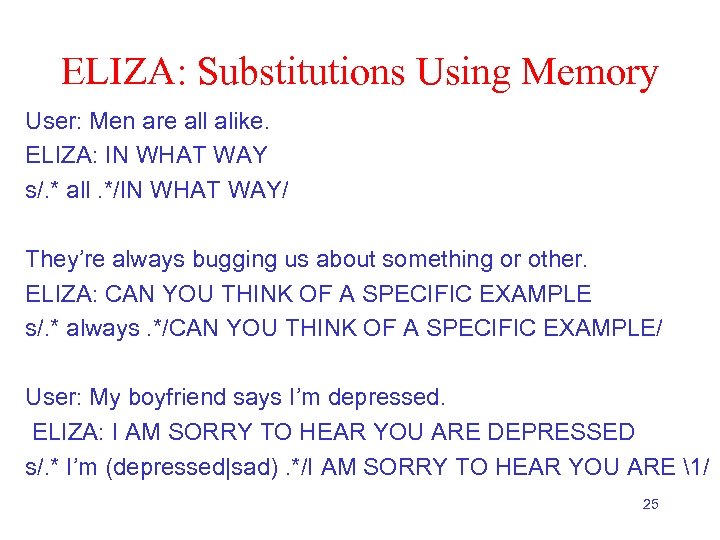
ELIZA: Substitutions Using Memory User: Men are all alike. ELIZA: IN WHAT WAY s/. * all. */IN WHAT WAY/ They’re always bugging us about something or other. ELIZA: CAN YOU THINK OF A SPECIFIC EXAMPLE s/. * always. */CAN YOU THINK OF A SPECIFIC EXAMPLE/ User: My boyfriend says I’m depressed. ELIZA: I AM SORRY TO HEAR YOU ARE DEPRESSED s/. * I’m (depressed|sad). */I AM SORRY TO HEAR YOU ARE 1/ 25
Using RE’s: Examples • Predictions from a news corpus: – Which candidate for Governor of California is mentioned most often in the news? Is going to win? – What stock should you buy? – Which White House advisers have the most power? • Language use: – Which form of comparative is more frequent: ‘oftener’ or ‘more often’? – Which pronouns are conjoined most often? – How often do sentences end with infinitival ‘to’? – What words most often begin and end sentences? – What’s the most common word in your email? Is it different from your neighbor? 26
• Personality profiling: – Are you more or less polite than the people you correspond with? – With labeled data, which words signal friendly messages vs. unfriendly ones? 27
Finite State Automata • Regular Expressions (REs) can be viewed as a way to describe machines called Finite State Automata (FSA, also known as automata, finite automata). • FSAs and their close variants are a theoretical foundation of much of the field of NLP. 28
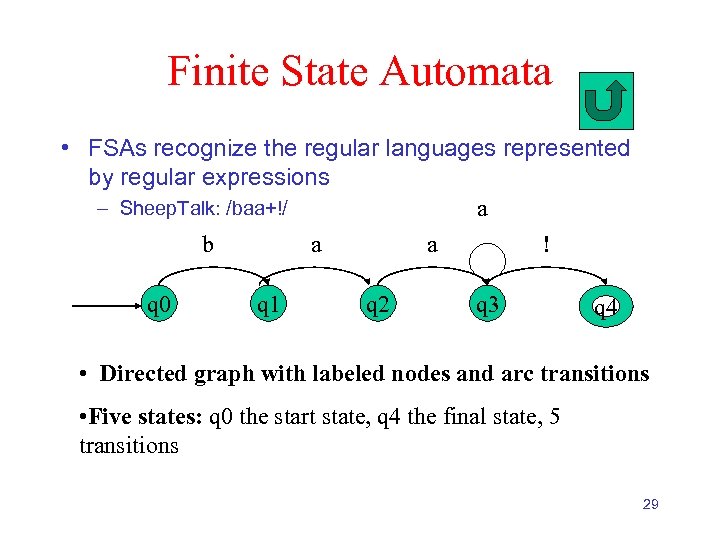
Finite State Automata • FSAs recognize the regular languages represented by regular expressions – Sheep. Talk: /baa+!/ a b a a ! q 0 q 1 q 2 q 3 q 4 • Directed graph with labeled nodes and arc transitions • Five states: q 0 the start state, q 4 the final state, 5 transitions 29
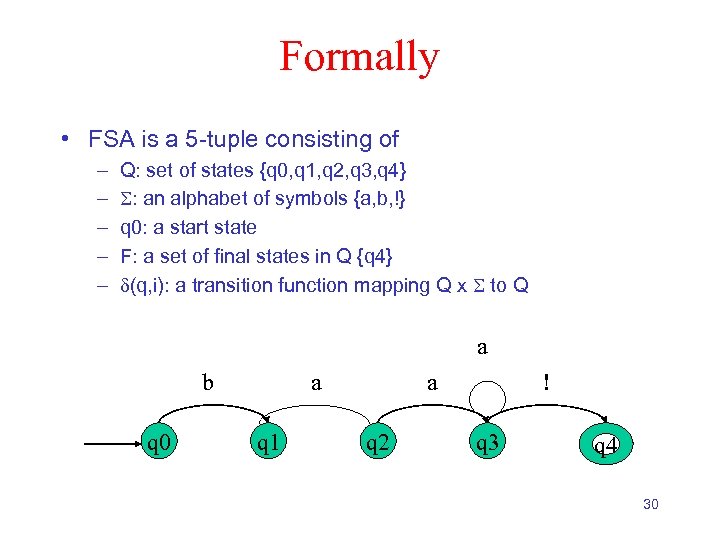
Formally • FSA is a 5 -tuple consisting of – – – Q: set of states {q 0, q 1, q 2, q 3, q 4} : an alphabet of symbols {a, b, !} q 0: a start state F: a set of final states in Q {q 4} (q, i): a transition function mapping Q x to Q a b q 0 a q 1 a q 2 ! q 3 q 4 30
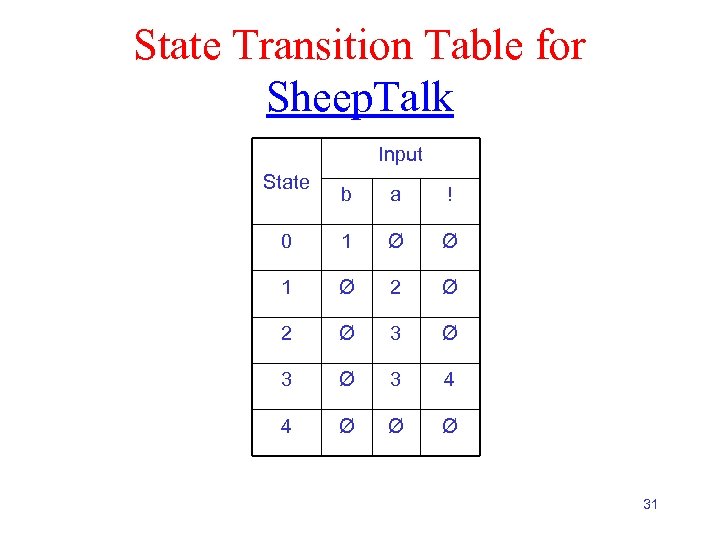
State Transition Table for Sheep. Talk Input State b a ! 0 1 Ø Ø 1 Ø 2 Ø 3 Ø 3 4 4 Ø Ø Ø 31
Recognition • Recognition (or acceptance) is the process of determining whether or not a given input should be accepted by a given machine. • In terms of REs, it’s the process of determining whether or not a given input matches a particular regular expression. • Traditionally, recognition is viewed as processing an input written on a tape consisting of cells containing elements from the alphabet. 32
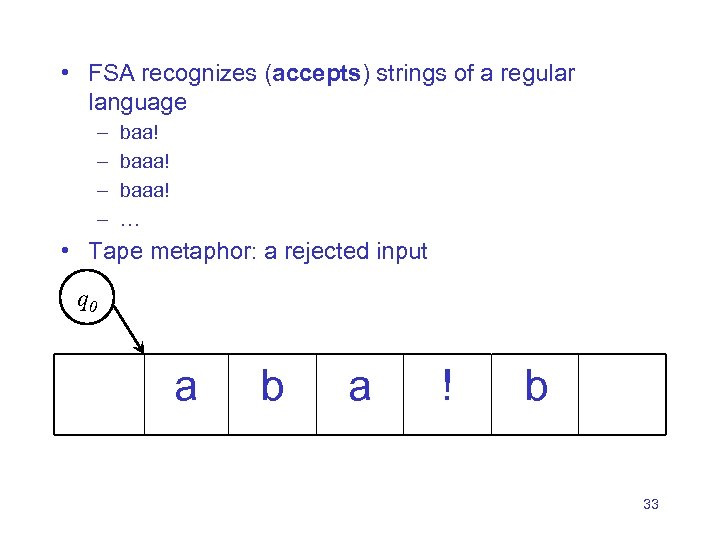
• FSA recognizes (accepts) strings of a regular language – – baa! baaa! … • Tape metaphor: a rejected input q 0 a b a ! b 33
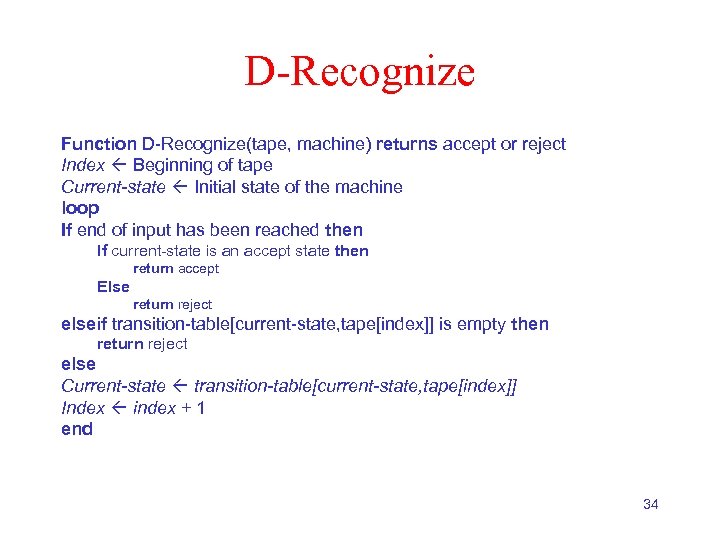
D-Recognize Function D-Recognize(tape, machine) returns accept or reject Index Beginning of tape Current-state Initial state of the machine loop If end of input has been reached then If current-state is an accept state then return accept Else return reject elseif transition-table[current-state, tape[index]] is empty then return reject else Current-state transition-table[current-state, tape[index]] Index index + 1 end 34
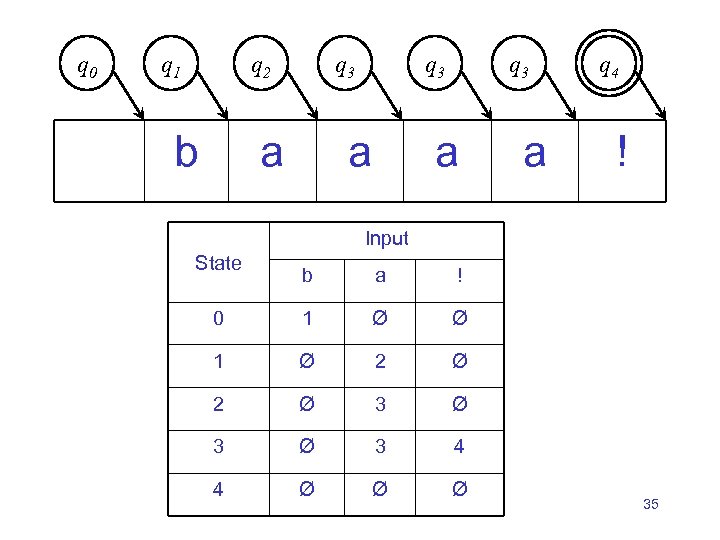
q 0 q 1 q 2 b q 3 a a q 4 ! Input State b a ! 0 1 Ø Ø 1 Ø 2 Ø 3 Ø 3 4 4 Ø Ø Ø 35
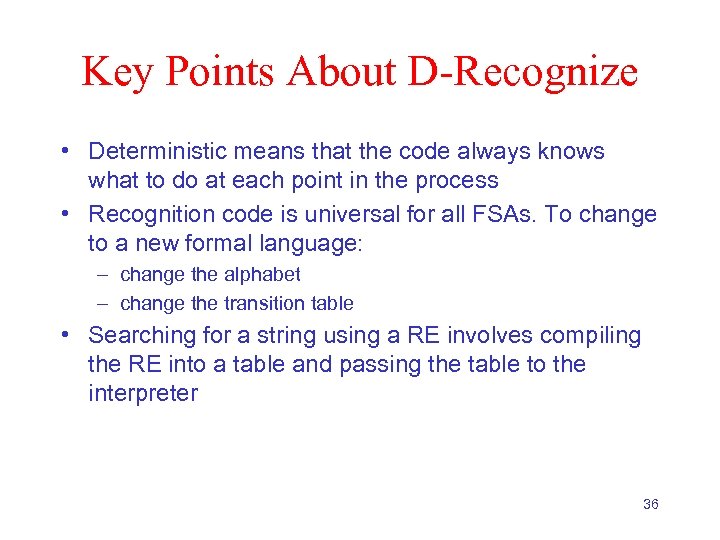
Key Points About D-Recognize • Deterministic means that the code always knows what to do at each point in the process • Recognition code is universal for all FSAs. To change to a new formal language: – change the alphabet – change the transition table • Searching for a string using a RE involves compiling the RE into a table and passing the table to the interpreter 36
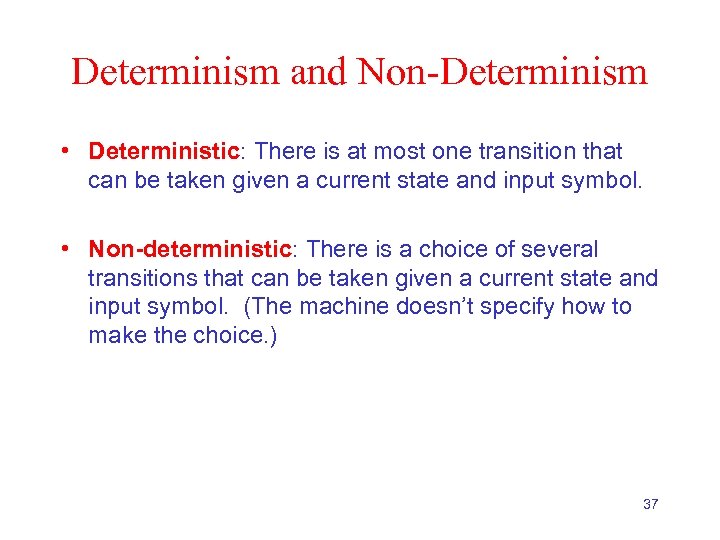
Determinism and Non-Determinism • Deterministic: There is at most one transition that can be taken given a current state and input symbol. • Non-deterministic: There is a choice of several transitions that can be taken given a current state and input symbol. (The machine doesn’t specify how to make the choice. ) 37
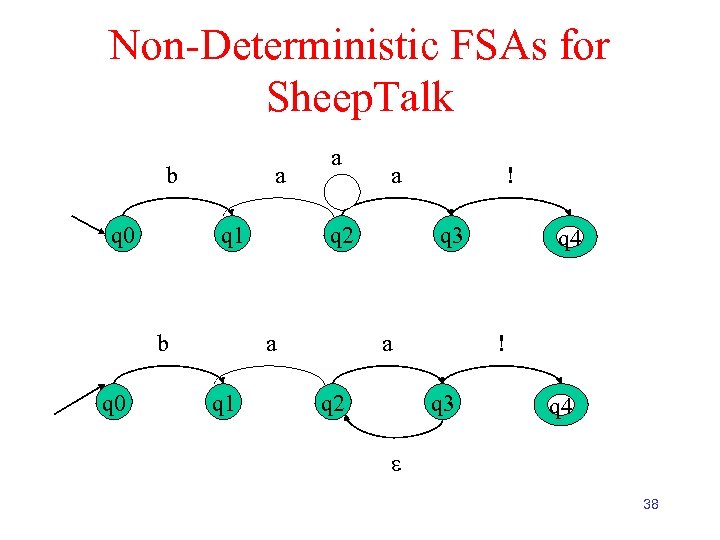
Non-Deterministic FSAs for Sheep. Talk b q 0 a q 1 b q 0 a q 2 a q 1 a ! q 3 a q 2 q 4 ! q 3 q 4 38
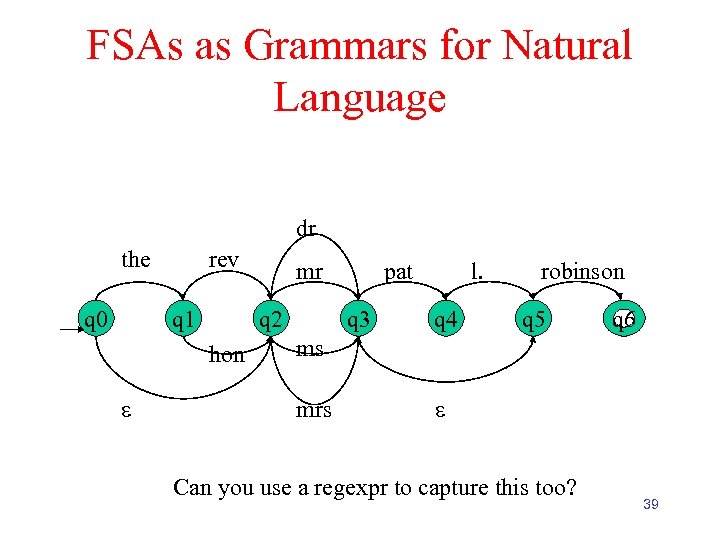
FSAs as Grammars for Natural Language dr the q 0 rev q 1 q 2 hon mr pat q 3 l. q 4 robinson q 5 q 6 ms mrs Can you use a regexpr to capture this too? 39
Problems of Non-Determinism • ‘Natural’…. but at any choice point, we may follow the wrong arc • Potential solutions: – – Save backup states at each choice point Look-ahead in the input before making choice Pursue alternatives in parallel Determinize our NFSAs (and then minimize) • FSAs can be useful tools for recognizing – and generating – subsets of natural language – But they cannot represent all NL phenomena (Center Embedding: The mouse the cat. . . chased died. ) 40
Summing Up • Regular expressions and FSAs can represent subsets of natural language as well as regular languages – Both representations may be impossible for humans to understand for any real subset of a language – But they are very easy to use for smaller subsets • Next time: Read Ch 3 • For fun: – Think of ways you might characterize features of your email using only regular expressions 41
Скачать презентацию Regular Expressions and Automata Lecture 2 September 3
f32473194757c053ce61dfeddd3e9dd9.ppt