 Скачать презентацию Regional Workforce Demands Maximizing Labor Market Responsiveness
256063ae2c868a77e2c59a551de16dce.ppt
- Количество слайдов: 33



Regional Workforce Demands Maximizing Labor Market Responsiveness
Presenters ® Chabot College: Ron Taylor, Vice President, Academic Services ® Tom Clark, Dean of Applied Technology and Business ® Carolyn Arnold, Coordinator, Institutional Research & Grants ® ® Las Positas College: Don Milanese, Vice President, Academic Services ® Birgitte Ryslinge, Dean of Academic Services, Vocational Education & Economic Development ® Amber Machamer, Director of Research and Planning ® 2
Agenda ® Introduction ® Profile of County Employment Demand our Occupational Students ® Community Based Demand on Educational Services and Workforce Training Chabot ® LPC ® ® Apprenticeship ® Challenges and Future Directions ® Discussion and Questions 3
Sources of Data on Employment Demand Projections ® State, Region, and Counties ® LMI: Labor Market Information from CA EDD ® ABAG: Association of Bay Area Governments ® Alameda County ® CC Benefits Strategic Planner Tool (in District) ® Region and Local Service Area Cities ® ABAG ® Community Advisory Groups ® Special Community Surveys/focus groups 4
Local Job Growth & Demand Projected Total Jobs 2005 to 2015 Source: Association of Bay Area Governments (ABAG) Projections 2005 5
Alameda County: Selected Occupational Groups with Highest Projected Growth: 2005 - 2015 Source: CC Benefits Strategic Planner Tool 6
Alameda County: Selected Detailed Occupations requiring AA/AS degree or occupational training with Fastest Projected Growth: 2001 -2008 Source: State of California EDD Employment Projections 7
Occupational Students at Chabot and Las Positas How many? Source: State Chancellor’s Office MIS/VTEA Allocation Report: AY 2003 -04 8
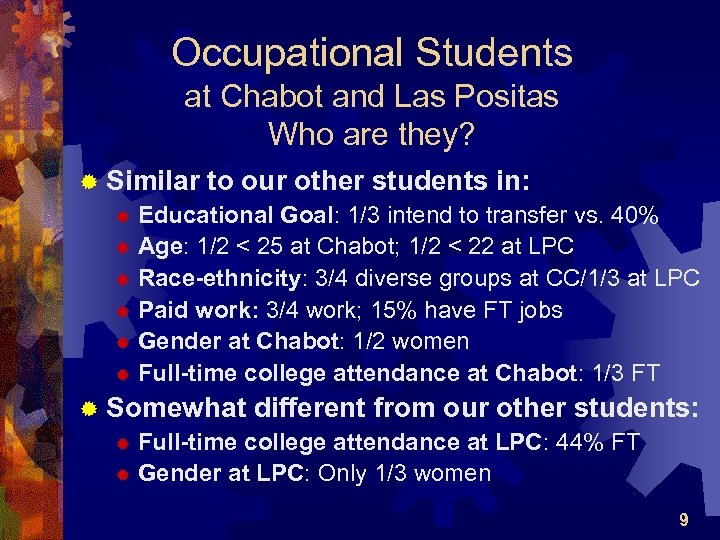
Occupational Students at Chabot and Las Positas Who are they? ® Similar to our other students in: ® Educational Goal: 1/3 intend to transfer vs. 40% ® Age: 1/2 < 25 at Chabot; 1/2 < 22 at LPC ® Race-ethnicity: 3/4 diverse groups at CC/1/3 at LPC ® Paid work: 3/4 work; 15% have FT jobs ® Gender at Chabot: 1/2 women ® Full-time college attendance at Chabot: 1/3 FT ® Somewhat different from our other students: ® Full-time college attendance at LPC: 44% FT ® Gender at LPC: Only 1/3 women 9
Occupational Programs at Chabot Community Input ® October ® 2004 Focus Groups 26 key community advisors ® Selected Top Strategic Objectives Strengthen existing relations … with local businesses and employers…. ® Initiate…industry-educational partnerships in response to … economic development needs. ® Develop and enhance occupational training to meet our student’s needs. ® 10
Occupational Programs at Chabot Community Input ® October 2004 Surveys ® Local Rotary, Business Groups, Advisory Committees, Community Advisors ® General praise for our occupational programs “Prepares students in our area for the workforce” ® “Provides courses geared to the job market area” ® ® Praise for specific programs ® “Great welding department” ® “I am able to hire well-trained teachers” ® “Chabot’s Nursing Program is essential to our operations” 11
Chabot College Current Range of Programs ® Applied Technologies Automotive, Drafting/Design, Electronics and Computer, Interior Design, Machine Tool, Manufacturing and Industrial, Welding. ® Business Studies Accounting, Business and Commerce, Business Management, Computer Applications, International Business and Trade, Marketing, Real Estate, Retailing and Sales Accounting 12
Chabot College Current Range of Programs (cont. ) ® Information Technologies, Media, Communications Journalism, Mass Communication, Applied Photography, Graphic Art and Design, Speech. Language Pathology ® Health and Public Services Administration of Justice, Emergency Medical Services, Fire Technology, Health Information Technologies, Dental, Nursing, Medical Assisting, Fitness, Early Childhood Development 13
Chabot College New and Developing Programs ® NATEF/GM ASEP Automotive Expansion ® Online Business Management Certificate ® Digital Media, Graphics, Photo, Music ® ESL and Technology Students ® Human Services ® Hybrid Electronics/CISCO, Online/LPC ® Nursing Partnerships, VHC, LPC 14
Trends in Employer Needs ® Interpersonal skills, job specific skills, problem solving skills, knowledge of business/industry and basic computer skills ® Global competition is 2 -way (goods & labor) ® Contracted skills (multi-company or part time) ® Bay Area (more recent immigrants, more retirees, limited high tech training needs) ® Upgrades, workers need life-long learning 15
Las Positas College Range of Workforce Programs ® Applied Technology ® Design Technology, Electronics, Laser Tech, Vacuum Tech, Industrial Tech, Welding ® Automotive Technology ® Automotive Electronics, Automotive Service Technician, Smog Certification, General Motors and Isuzu Regional Training Center ® Business Studies ® Accounting, Entrepreneurship, Management/Supervision, Marketing, exploring Micro-Business 16
Las Positas Programs (cont. ) ® Computing Studies ® Information Systems, Networking/Cisco, Computer Science, Application Programming, Web Programming ® Early Childhood Development ® Public Health and Safety ® Administration of Justice, Fire Science, Occupational Safety and Health ® Visual and Performing Arts ® Interior Design, Photography, Visual Communications, Theater, Music ® Viticulture, Enology and Horticulture 17
Challenges in Responding to Workforce Needs ® Understanding and projecting employer trends: local, regional and global perspective ® Adapting internal response systems ® Balancing multiple missions ® California Workforce Development System: complex and inter-related ® High cost of some vocational programs 18
Challenges in Responding to Workforce Needs (cont. ) ® Funding ® Unique and staffing complexities challenges in administration ® Integration with K-12 and 4+ institutions ® Consistent and rapid response to market changes requires a “nimble” organization 19
Responsive Delivery Mechanisms ® Moving beyond programs to services ® Employer services examples ® Interns ® Faculty as subject matter experts ® Recruitment and hiring: One-Stop Career Center ® Advisory boards, curricular input ® Flexibility in delivery mechanisms: content, time, space, place 20
Responsive Delivery Mechanisms (cont. ) ® Examples of Model Customized Workforce Services: ® Retail Management Certificate Program (Safeway & Albertsons) ® Smog Certification ® Nursing partnership: CC, LPC, Valley Care Health System ® Apprenticeship 21
Apprenticeship Programs ® To provide apprenticeship training for their employees, many employers partner with a Local Education Agency (LEA): ® Community College or School District (ROP’s or Adult Education) ® Credit (CC only) or non-credit ® Oversight: CA Department of Apprenticeship Standards l State Chancellor’s Office or California Department of Education l 22
Apprenticeship Programs ® Employees receive on-the-job training from their employer, and employer selected “related and supplemental instruction” from the educational partner (LEA) ® Apprentices can earn certificates or degrees ® California: 66 trades/crafts delivered by 38 CCC campuses 23
Apprenticeship Programs ® Employer Sponsor types ® Single employer ® Employer associations ® Labor/management associations ® Funding: ® $12, 729, 000 State Budget 04 -05 24
Apprenticeship Programs Typical Models ® College delivers instruction, or ® College or district administers and provides oversight, sponsor delivers instruction ® Delivery of instruction funded via “RSI funding” ® Funding split negotiated, 15% -20% for administration/oversight is typical ® Potential FTES cooperative work experience curriculum for on-the-job training component. 25
Apprenticeship Programs Challenges ® State funding stream limits ® No augmentation since 2000 ® 05 -06 projects 10% shortfall for current approved apprenticeship programs ® Timelines: ® New program approvals 18 to 24 months ® Program transfers (CDE to State Chancellor) can take less 26
College Apprenticeship Programs ® Chabot: Automotive, Electrical, Roofers, and Sound & Communication ® 300 apprentices per year, 41, 800 hours of instruction ® These hours down by 35% from three years ago ® Engaged in early plans for assisting with new “Certification” for electricians ® Las Positas ® Automotive, “Isolated Apprentices” ® Under discussion: credit program with Carpenter’s Training Committee of Northern California ® ® Currently non-credit, PUSD, funded via CDE Short term, possible Credit by Examination: l ® future LPC as LEA? 1, 500 apprentices per year, 144 hours of instruction 27
Workforce Preparation Future Directions ® Both colleges must continue to be major contributors to workforce development for our communities ® We must coordinate, partner, and leverage relationships among all segments of the workforce delivery system ® Delivery of workforce education must be timely, market responsive, and flexible in delivery mechanisms 28
Workforce Preparation Future Directions (cont. ) ® Programs and services must be aligned with the state’s current and projected labor force needs: a skilled, educated workforce with relevant technical and soft skills ® Commitment of leadership to workforce development mission, and an erasing of hard lines between “academic” and “vocational” ® We must become ever more proactive, anticipatory and “nimble” to be leaders in workforce preparation 29
Community-Based Demand on Education: A Living Example ® 2005 Study: “The Changing Economic Role and Responsibilities of the Tri-Valley Region” ® 18, 000 companies created in the Tri-Valley since 1990 ® 80% have 5 or fewer employees ® Firms with 100 or more employees have lost jobs 30
Community-Based Demand on Education: A Living Example Small firm-entrepreneurship and innovation has transformed Tri-Valley region’s economic base: ® Four specialization areas a Innovation Services: largest ® Scientific/Biomedical Products & Services: fastest growing ® Business Operations: large and growing ® Information Technology Products & Services: large but contracting ® ® One general support area ® Quality of Life: Hospitality, Tourism, Viticulture 31
Implications for Colleges ® Integrate findings in planning processes ® Understand unique workforce education needs of 18, 000 small businesses ® Specialized curriculum, short term courses, variety of delivery mechanisms ® Non-industry groupings: skill sets, firm size, etc ® Exploration of partnering for Entrepreneurship/Business Development Center ® Continue as research partner in on-going studies ® Use new information to pursue external funding for development 32

Discussion and Questions? 33
Скачать презентацию Regional Workforce Demands Maximizing Labor Market Responsiveness
256063ae2c868a77e2c59a551de16dce.ppt