


 Скачать презентацию Regional Technical Assistance RETA 6306 Mainstreaming Mf DR
91a24cfc8e89198a27c656c8c221e15b.ppt
- Количество слайдов: 94
 Regional Technical Assistance (RETA) 6306 Mainstreaming Mf. DR for Poverty Reduction in South Asia
 Agenda 15: 00 – 15: 30 Registration Chief Guest: Hon’ble Dr. Jagadish C. Pokharel, Vice Chairman, National Planning Commission Chair: Mr. Vidyadhar Mallik, Secretary, Ministry of Finance 15: 30 – 15: 35 – 15: 50 – 15: 55 Welcome address by Subarna L. Shrestha, Officiating Secretary, NPCS Remarks by Ziba Farhadian-Lorie, Principal Economist, SARD, ADB Remarks by Paolo Spantigati, OIC, NRM
 Agenda (continued) 15: 55 – 16: 15 – 16: 45 – 17: 30 – 17: 40 – 17: 50 – 18: 00 Mf. DR change process and role of leaders, Liam Mc. Millan/Bernard Woods Presentations of Readiness Assessment and broad areas of intervention, Dr. Champak Pokharel/ Arun Rana, Consultants, ADB Facilitated discussion and agreements on broad areas of intervention, Facilitated by Liam Mc. Millan/ Bernard Woods Operationalization of Mf. DR, Dr. David Husband, Consultant, ADB Key note address by, NPC Dr. Jagadish C. Pokhrel, Closing Remarks by Vidyadhar Mallik, Chairperson
 Regional Technical Assistance (RETA) 6306 Mainstreaming Mf. DR for Poverty Reduction in South Asia
 RETA 6306: Organization-Level Results Management
 Results as an Organization Change Process More than a new system of measurement A long term change process involving n n n reorientation of thinking and planning change at the institutional level change at the management level
 Drivers of Change External force Leadership and vision n n Positive Negative
 Implementing a Results Focus Two key stages: n Stage 1: Introduction of a results-focus into country planning w creation of logframes and indicators at the sectoral level w sectoral and project accountability w public disclosure of evaluation and results to encourage demand for information n Stage 2: Cascading the philosophy and practices down to the organizations of Government responsible for delivering the planned sectoral results.
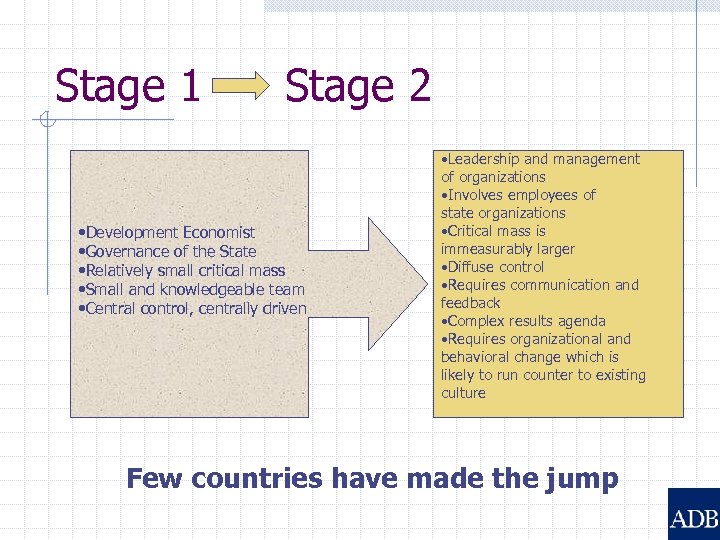 Stage 1 Stage 2 • Development Economist • Governance of the State • Relatively small critical mass • Small and knowledgeable team • Central control, centrally driven • Leadership and management of organizations • Involves employees of state organizations • Critical mass is immeasurably larger • Diffuse control • Requires communication and feedback • Complex results agenda • Requires organizational and behavioral change which is likely to run counter to existing culture Few countries have made the jump
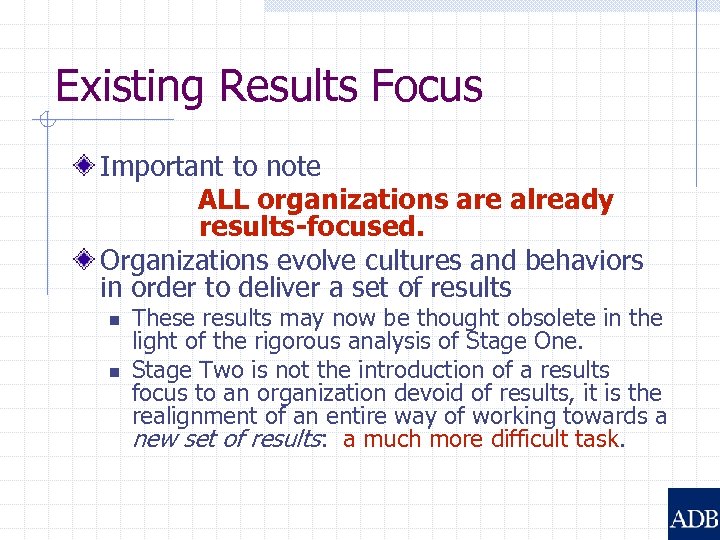 Existing Results Focus Important to note ALL organizations are already results-focused. Organizations evolve cultures and behaviors in order to deliver a set of results n n These results may now be thought obsolete in the light of the rigorous analysis of Stage One. Stage Two is not the introduction of a results focus to an organization devoid of results, it is the realignment of an entire way of working towards a new set of results: a much more difficult task.
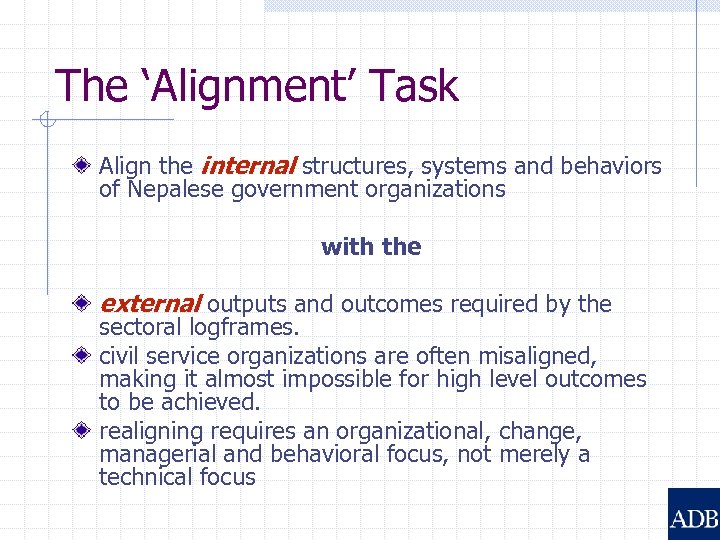 The ‘Alignment’ Task Align the internal structures, systems and behaviors of Nepalese government organizations with the external outputs and outcomes required by the sectoral logframes. civil service organizations are often misaligned, making it almost impossible for high level outcomes to be achieved. realigning requires an organizational, change, managerial and behavioral focus, not merely a technical focus
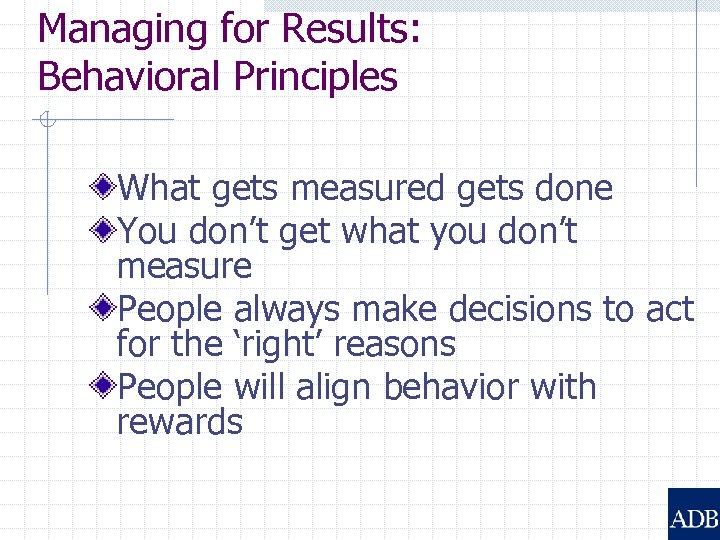 Managing for Results: Behavioral Principles What gets measured gets done You don’t get what you don’t measure People always make decisions to act for the ‘right’ reasons People will align behavior with rewards
 International Lessons Learned
 International Experience With the implementation of Mf. DR now a growing body of evidence on success factors Philippines, Nepal, Malaysia, Canada, China, Australia, Viet Nam etc The international experience is broadly supportive of the steps Nepal has taken and the future direction
 Nepali & International Convergence Leadership at central level is critical Well formulated, results based strategic plan is required Frameworks with results and indicators Consistent budget allocation in line with the priorities of the plan is necessary Plan must be moved beyond just being on paper
 Convergence Continued Mf. DR adapted to the country context Country level coalitions of government and donors to support Mf. DR Requirements for reporting and accountability
 Issues for Consideration at Organization Level An effective M&E system is required with decisionmaking processes that extensively use information from the system (demand not supply driven) User led Involvement of elected representatives in results accountability processes Universal incentives supporting Mf. DR behavior at the agency/department level Statutory requirements for reporting and accountability
 Other Considerations “Mf. DR implementation is a marathon, not a 100 yard dash” Ultimately Mf. DR success is not based on the technical aspects Challenges for Mf. DR leaders occur where the system does not deliver or if main elements of Mf. DR are missing
 RETA 6306 Planning and Process
 RETA 6306 Readiness Assessment Planning and pilot development Implementation Donor coordination
 RA Objectives To provide a descriptive and analytical assessment of the level of readiness of a particular organization to improve it results management orientation To provide the information necessary to develop a capacity building plan to strengthen its results management approach
 Technical Assessment: n What elements of results management are in place, what needs to be strengthened? Change Management Assessment: n How ready is the organisation to make the changes required? Discussion of Assessment Report with partner organisation At each stage of the process the ‘readiness’ of the particular aspect of the organization is evaluated and capacity gaps are identified.
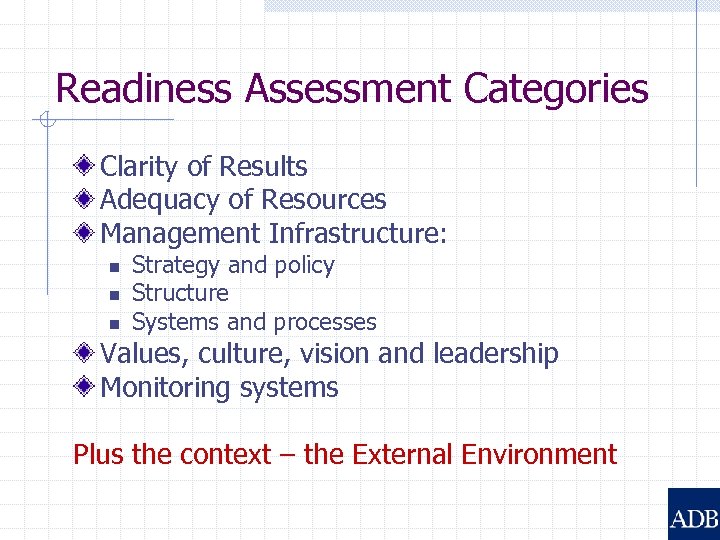 Readiness Assessment Categories Clarity of Results Adequacy of Resources Management Infrastructure: n n n Strategy and policy Structure Systems and processes Values, culture, vision and leadership Monitoring systems Plus the context – the External Environment
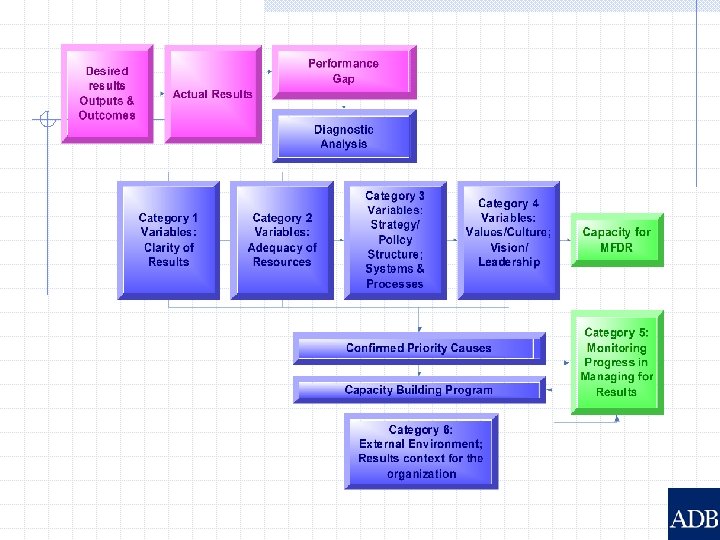
 RA Analysis The RA enables the ‘mapping’ of readiness against the six categories of the readiness tool This enables identification and comparison of key areas of capacity weakness RA details provide information required to develop interventions to strengthen capacity in the six categories
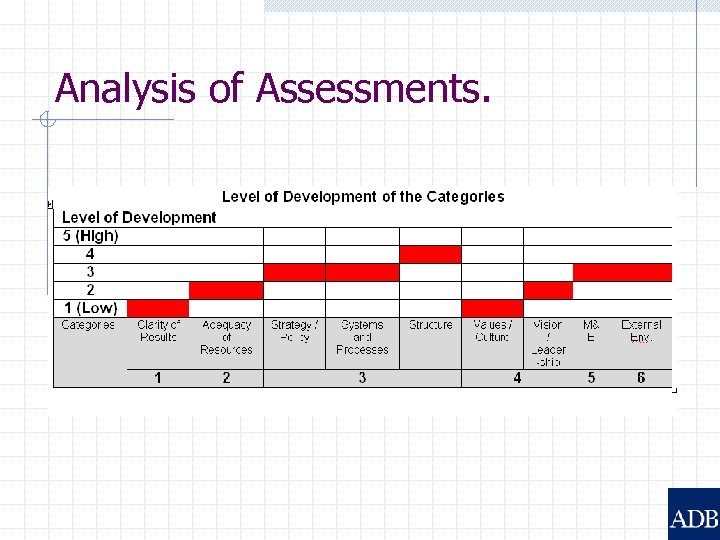 Analysis of Assessments.
 RA Findings and Implementation Plans
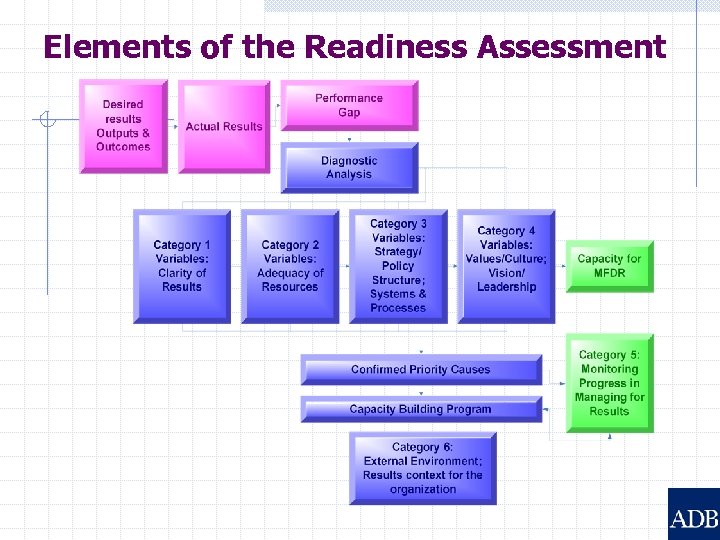 Elements of the Readiness Assessment
 Four Readiness Reports Ministry of Education and Sports (Ministry Level) Ministry of Physical Planning and Works (Ministry Level) Department of Water Supply and Sewerage (Department Level) District Development Committee Dhanusha
 Major Findings and Issues: External Environment to the Organizations Good at National Level. System driven from nineties and intensified in PRSP n M&E system establishment; APP; LSGA in 1990 s
 Ø 2000 onwards: Ø Ø Ø PRSP with log-frame by all sectors; indicators for monitoring; project prioritization framework, MTEF and project prioritization in all budget; business plan, Sector-wide approach for donor harmonization, Continued drive to M&E, DPMAS Devolution; PIF policy approved; also in LSGA More donor support in RB the areas at central and district level etc from 2001 New political environment for big change and 3 yr. Interim Plan Nepal receives prizes in Mf. DR!
 External Environment Key Issues Ø Ø Ø Significant influence of traditional culture in bureaucracy Political instability and slow devolution National planning and implementation framework under new political change not yet clear Low salary and morale of civil service System initiated at the national level but weak transfer to organizational level (with some exceptions) Effort is resource intensive and a long term process
 Major Issues- Diagnostic Variable 1: Clarity of Results Broad organizational Mandate of Ministries n Government of Nepal (Work Division) Regulation 2006 Sectoral results framework of PRSP has multiple contributors but lacks clear linkages No organizational results chain n n lack of clarity in addressing the outcomes of the organization itself Lack of clarity in the approach to influencing the outcomes to be delivered through others. Overlapping mandates even within government
 Issue- Diagnostic 2 Variable : Adequacy of Resources Insufficient budget to achieve national targets Need for focused human resource development plan Human resource capacity building in organizational management generally overlooked Modern IT systems and equipment weak at MOPPW, DDC n no official internet connection - personally arranged)
 Issue- Diagnostic 3 Variable: Management Infrastructure Two levels of policy mismatch n n LSGA and Organizations between organizations Parallel systems being developed in water supply and sanitation Weak monitoring structure and lack of resources at ministry level n lack resources blocks demand driven system Resources at department level are higher
 Management Infrastructure continued Donor harmonization generally weak (better in education due to SWAp) Less understanding of working regulatory management frame work at medium and lower level n n PWD; decentralization; Autonomous Institution Act etc leading to pileup of files, undue intervention or slow decisions at higher level
 Management Infrastructure continued Divisions, sections structures require updating n Not aligned to new requirements No performance standards in job descriptions n MOES has initiated in region and district level High Level monitoring meetings: NDAC, MDAC not occurring or irregular n Erosion of demand for monitoring at lower levels
 Issue- Diagnostic 4 Variable : Values/Culture and Vision/ Leadership Low morale of the civil service and low understanding of Mf. DR Traditional working patterns like Tippani remain n some change has started within organizations
 Issue- Diagnostic 5 : Monitoring and Evaluation No M&E Policy for ministry and Lower Levels Weak M&E structure at ministry level leading to low demand for results from lower levels No MIS at MOPPW and DDC No formal periodic publication showing performance gap based on M&E information at most levels Information on NGO and private sectors weak despite their increasing presence.
 Major Suggestions and RETA Intervention Encourage planning which incorporates a organization management and leadership perspective strengthen search committee systems to improve leadership in organizations Rectify policy mismatches Extend performance based evaluation system with incentives/punishment Encourage participation in international professional forums in Mf. DR develop organizational results chains (RETA potential support area) Strengthen ministry level and DDC M&E structures (RETA potential support area)
 Enhance Mf. DR Understanding through n National level training on Mf. DR and international exposure (RETA potential support area) Support periodic succinct publications in Performance Gap and Assessment n e. g. Quarterly 10 page document with tables and bullet issues (RETA potential support area) Develop training manual on MFDR
 initiate regular professional managerial dialogue system in organizations (RETA potential support area) Develop Mf. DR DVD (RETA potential support area) Assist establish/strengthen change management unit at ministry level (RETA potential support area) Further work to assist institutional reorganization at ministry and DDC level
 Discussion of the Key Issues
 Presentation: TA 4765
 Keynote Address Dr. Jagadish C. Pokhrel, Vice Chair Planning Commission
 Closing Remarks Vidyadhar Mallik, Secretary, Ministry of Finance
 Mf. DR Infrastructure
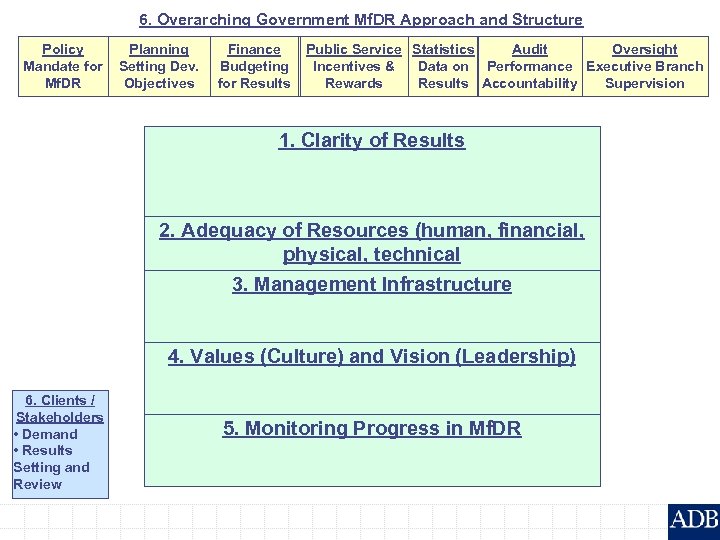 6. Overarching Government Mf. DR Approach and Structure Policy Mandate for Mf. DR Planning Setting Dev. Objectives Finance Budgeting for Results Public Service Statistics Audit Oversight Incentives & Data on Performance Executive Branch Rewards Results Accountability Supervision 1. Clarity of Results 2. Adequacy of Resources (human, financial, physical, technical 3. Management Infrastructure 4. Values (Culture) and Vision (Leadership) 6. Clients / Stakeholders • Demand • Results Setting and Review 5. Monitoring Progress in Mf. DR
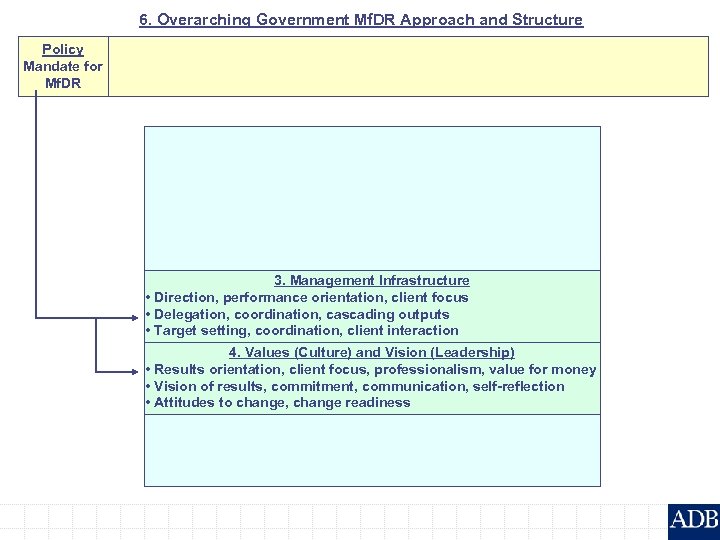 6. Overarching Government Mf. DR Approach and Structure Policy Mandate for Mf. DR 3. Management Infrastructure • Direction, performance orientation, client focus • Delegation, coordination, cascading outputs • Target setting, coordination, client interaction 4. Values (Culture) and Vision (Leadership) • Results orientation, client focus, professionalism, value for money • Vision of results, commitment, communication, self-reflection • Attitudes to change, change readiness
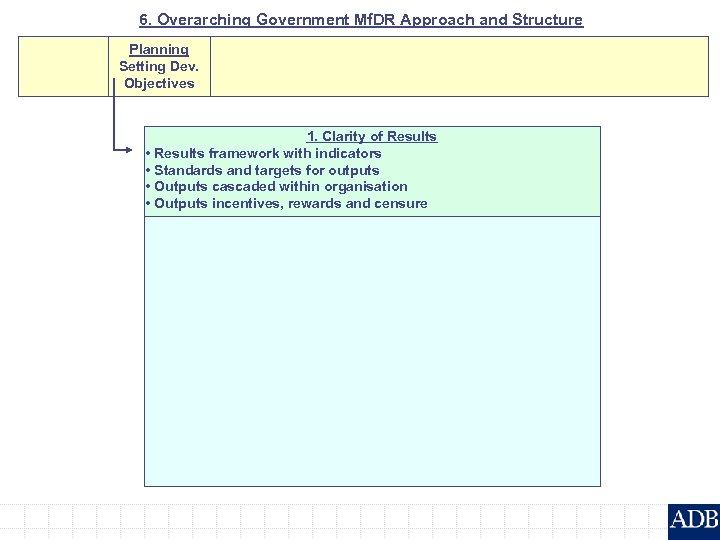 6. Overarching Government Mf. DR Approach and Structure Planning Setting Dev. Objectives 1. Clarity of Results • Results framework with indicators • Standards and targets for outputs • Outputs cascaded within organisation • Outputs incentives, rewards and censure
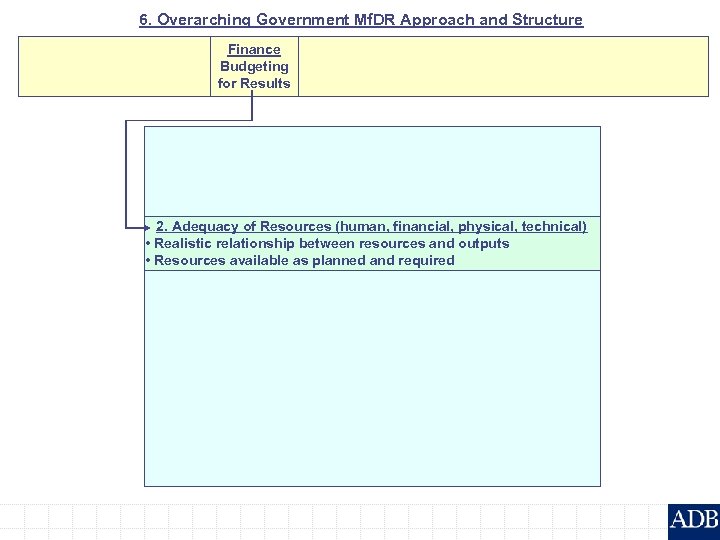 6. Overarching Government Mf. DR Approach and Structure Finance Budgeting for Results 2. Adequacy of Resources (human, financial, physical, technical) • Realistic relationship between resources and outputs • Resources available as planned and required
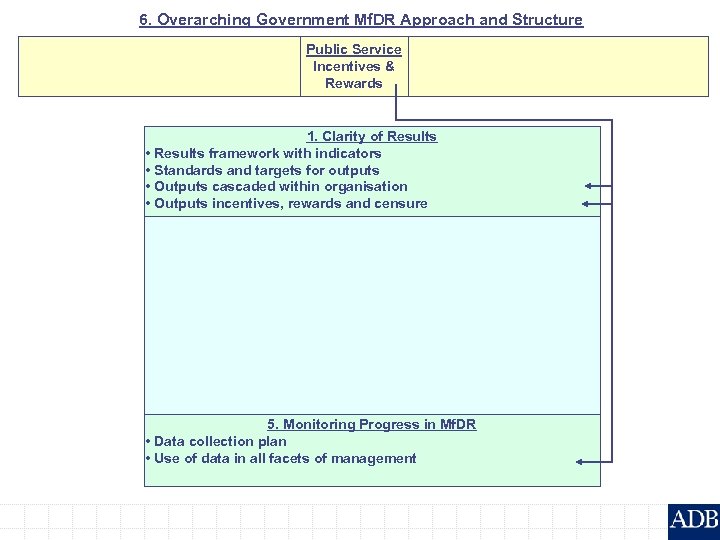 6. Overarching Government Mf. DR Approach and Structure Public Service Incentives & Rewards 1. Clarity of Results • Results framework with indicators • Standards and targets for outputs • Outputs cascaded within organisation • Outputs incentives, rewards and censure 5. Monitoring Progress in Mf. DR • Data collection plan • Use of data in all facets of management
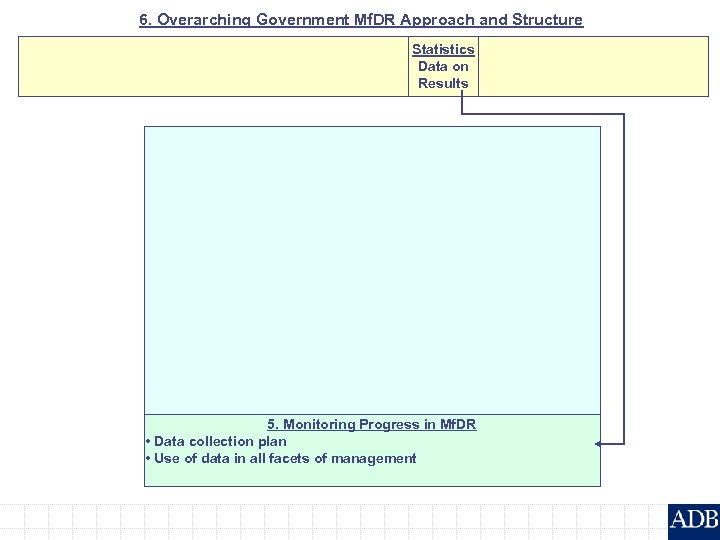 6. Overarching Government Mf. DR Approach and Structure Statistics Data on Results 5. Monitoring Progress in Mf. DR • Data collection plan • Use of data in all facets of management
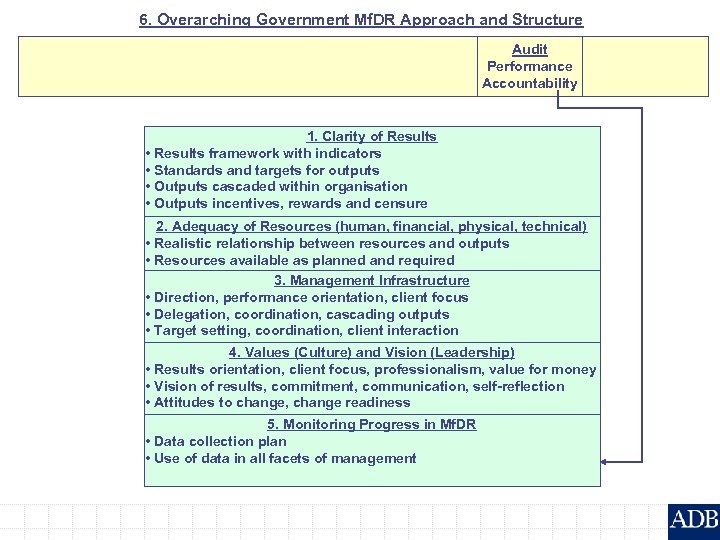 6. Overarching Government Mf. DR Approach and Structure Audit Performance Accountability 1. Clarity of Results • Results framework with indicators • Standards and targets for outputs • Outputs cascaded within organisation • Outputs incentives, rewards and censure 2. Adequacy of Resources (human, financial, physical, technical) • Realistic relationship between resources and outputs • Resources available as planned and required 3. Management Infrastructure • Direction, performance orientation, client focus • Delegation, coordination, cascading outputs • Target setting, coordination, client interaction 4. Values (Culture) and Vision (Leadership) • Results orientation, client focus, professionalism, value for money • Vision of results, commitment, communication, self-reflection • Attitudes to change, change readiness 5. Monitoring Progress in Mf. DR • Data collection plan • Use of data in all facets of management
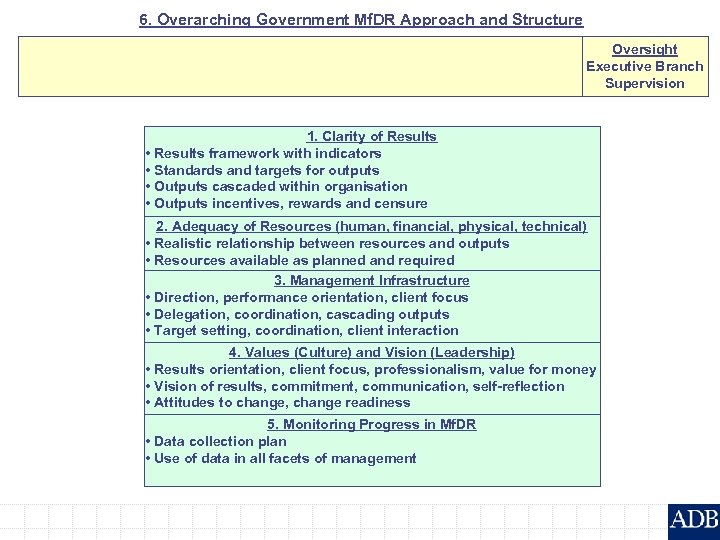 6. Overarching Government Mf. DR Approach and Structure Oversight Executive Branch Supervision 1. Clarity of Results • Results framework with indicators • Standards and targets for outputs • Outputs cascaded within organisation • Outputs incentives, rewards and censure 2. Adequacy of Resources (human, financial, physical, technical) • Realistic relationship between resources and outputs • Resources available as planned and required 3. Management Infrastructure • Direction, performance orientation, client focus • Delegation, coordination, cascading outputs • Target setting, coordination, client interaction 4. Values (Culture) and Vision (Leadership) • Results orientation, client focus, professionalism, value for money • Vision of results, commitment, communication, self-reflection • Attitudes to change, change readiness 5. Monitoring Progress in Mf. DR • Data collection plan • Use of data in all facets of management
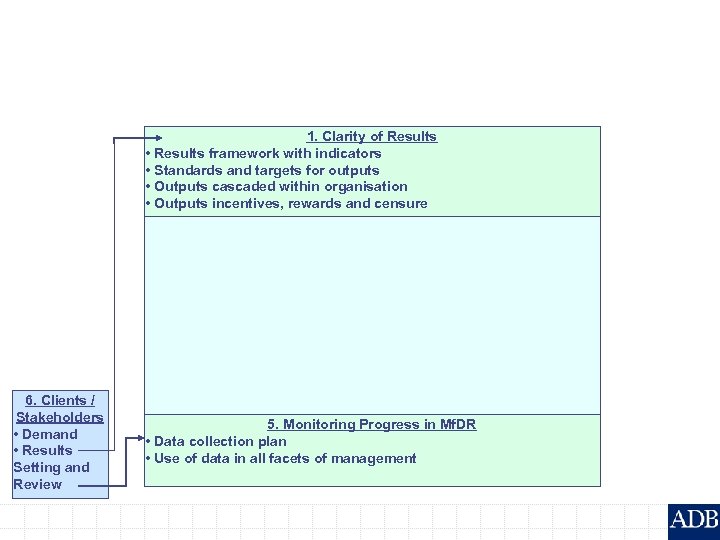 1. Clarity of Results • Results framework with indicators • Standards and targets for outputs • Outputs cascaded within organisation • Outputs incentives, rewards and censure 6. Clients / Stakeholders • Demand • Results Setting and Review 5. Monitoring Progress in Mf. DR • Data collection plan • Use of data in all facets of management
 Clarity of Purpose
 Stage 1 The basis for real advances in strategic clarity is client need, not history or mandate: n n identify one typical user group of the services of the organization. A real user, not an imaginary one! user need / perceived value to identify the group. w having gone through the process for one user group, you can repeat it for other groups
 Stage 2 Identify the Dimensions of Service Quality for the group you have chosen. n identify not the features of the products/services offered by your organization, but the benefits and services sought by the user group. w what total needs are they trying to satisfy? not what services are they currently using, nor the delivery role you have traditionally played in delivering those services.
 Stage 3 Rate the Dimensions of Perceived Service Quality n n n you may have developed a long list of benefits during Stage 2 not all will be equally important in delivering perceived quality identify the most important of the services required and arrange them according to rank w allocate 100 points across the top five or six dimensions of perceived quality that you identify.
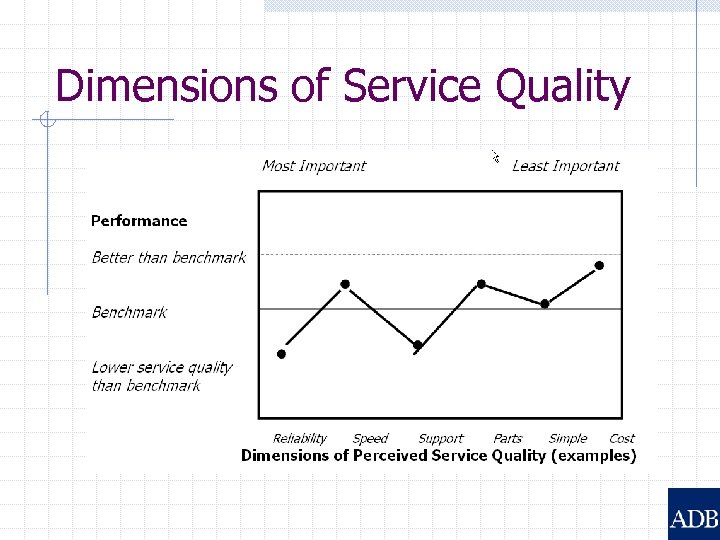 Dimensions of Service Quality
 Stage 4 Assess the relative performance of your organization on the Critical Dimensions of Perceived Service Quality Ideally this should be an external task. n n internally you have to guard against being too optimistic or pessimistic. a good way of checking is to compare the ratings with recent successes or failures in the services you offer to the public. w Good ratings on the critical dimensions should be reflected in success. w If successes do not reflect the ratings either the dimensions or the ratings are wrong. Or there may be a time lag in operation. You can map your performance against other organizations within the Government, or against the equivalent organizations in other countries.
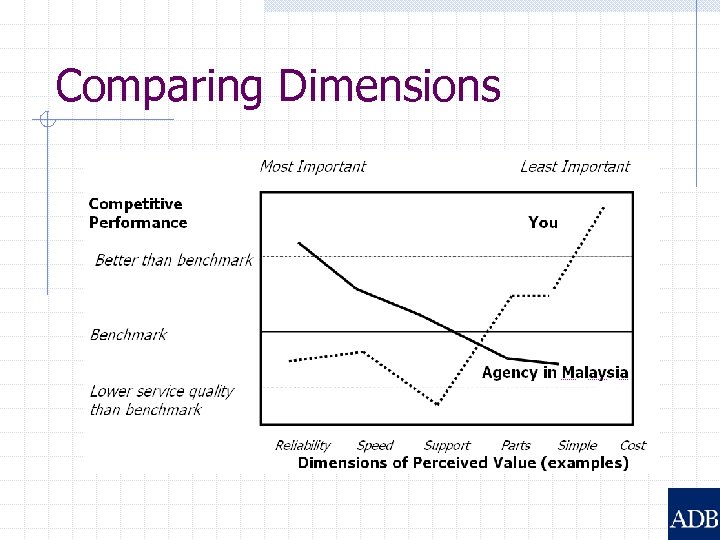 Comparing Dimensions
 Stage 5 Having completed the analysis for one user group, the analysis can be extended across all user groups – looking for common features. Key questions. Which dimensions of service quality: n n do you need to be as good as the benchmark? do you need to be better than the benchmark? can you cut costs by delivering value at a lessor rate than the benchmark? are becoming irrelevant to the users and can be cut out?
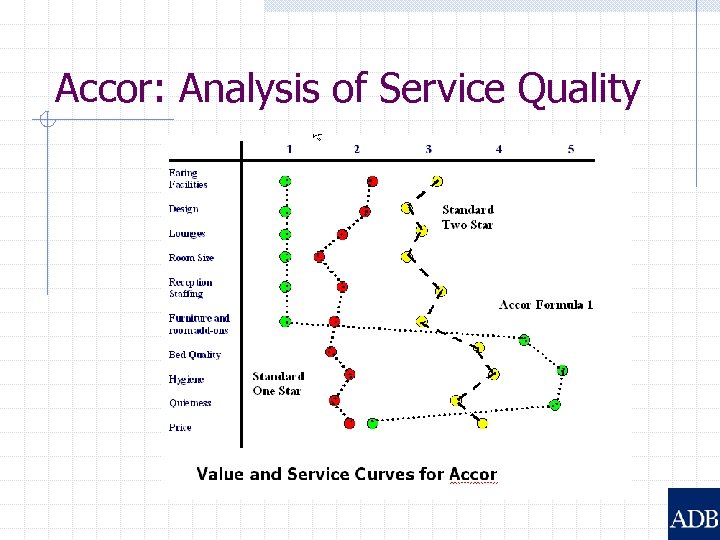 Accor: Analysis of Service Quality
 n Are they ‘innovators’? w new shapes of service quality curves w parts of an organization that are pioneers contribute to overall reform in the organization n n Are they, at a less innovative level, “migrators”, offering better service quality without changing the shape of the curve? Are they “settlers”, focusing upon just performing to the minimum government standards, conforming, at best, to benchmark curve shapes and levels. w Service quality curves that conform in shape to the standard w parts of the organization that are settlers don’t contribute to real reform Real improvements in results requires all three in the right areas and right proportions.
 Summary: Creating Service Quality identify and discuss the prevailing thinking then challenge it n n n investigate assumptions the strategic focus the approaches to customers, people and assets ask the key questions: n n what can we eliminate? what should be reduced below the current standard? what should be raised? what new factors are needed?
 Management Meeting Define the internal clarity Define the inputs and activities to the delivery of the internal quality Assess your performance on the inputs and activities Assess the level of delivery required in each of the inputs and activities Discuss the shape of the service value curve
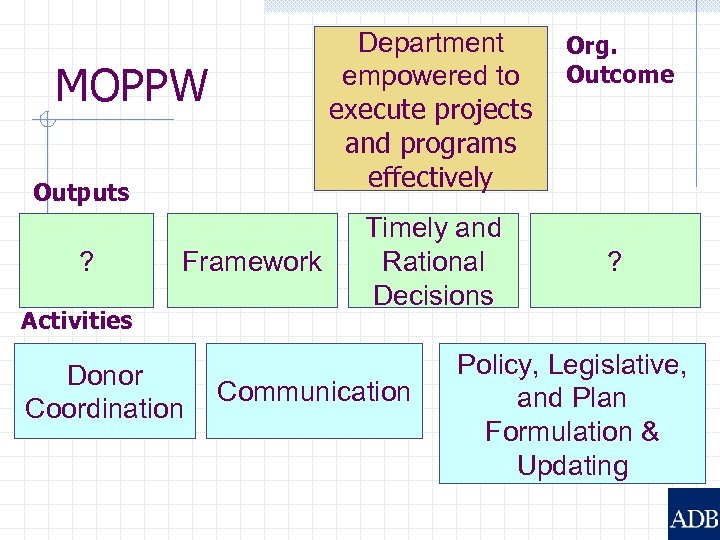 Department empowered to execute projects and programs effectively MOPPW Outputs ? Framework Activities Donor Coordination Timely and Rational Decisions Communication Org. Outcome ? Policy, Legislative, and Plan Formulation & Updating
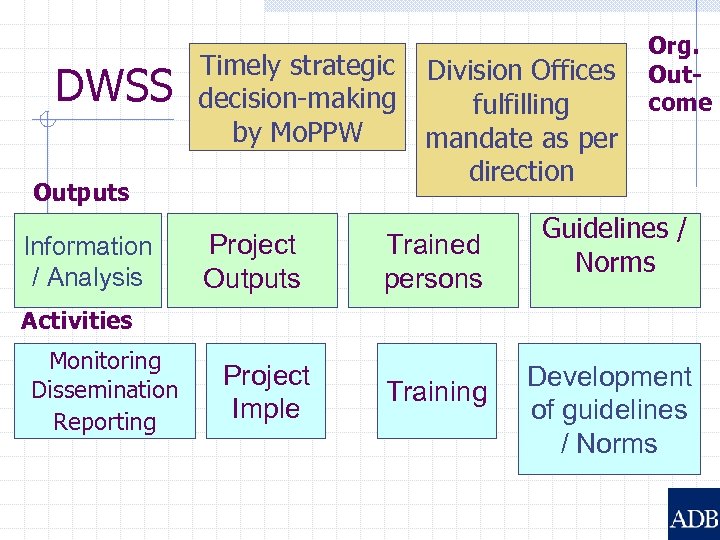 DWSS Timely strategic decision-making by Mo. PPW Outputs Information / Analysis Project Outputs Division Offices fulfilling mandate as per direction Trained persons Org. Outcome Guidelines / Norms Activities Monitoring Dissemination Reporting Project Imple Training Development of guidelines / Norms
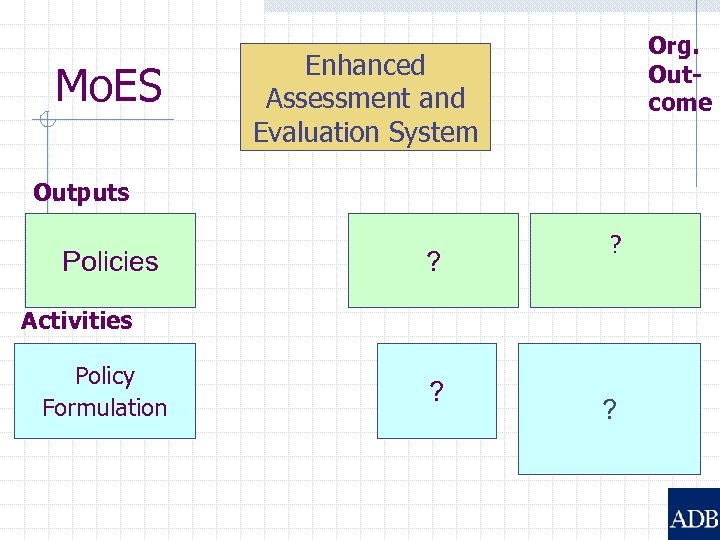 Mo. ES Org. Outcome Enhanced Assessment and Evaluation System Outputs Policies ? ? Activities Policy Formulation ? ?
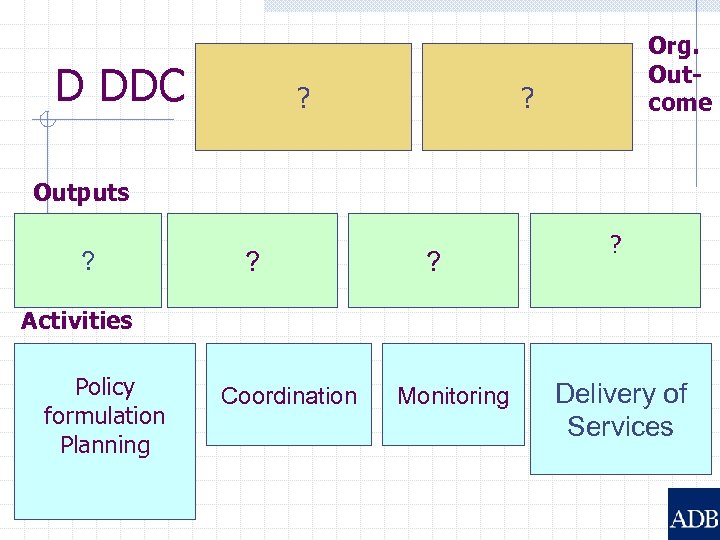 D DDC ? Org. Outcome ? Outputs ? ? Activities Policy formulation Planning Coordination Monitoring Delivery of Services
 Defining Your Results
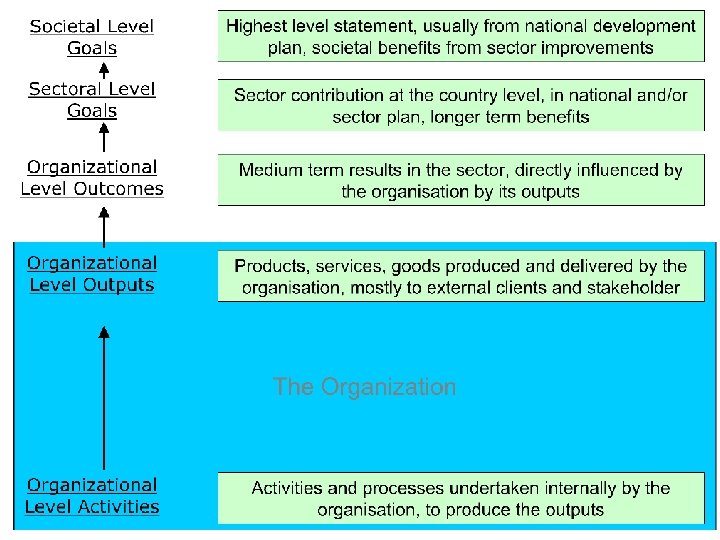
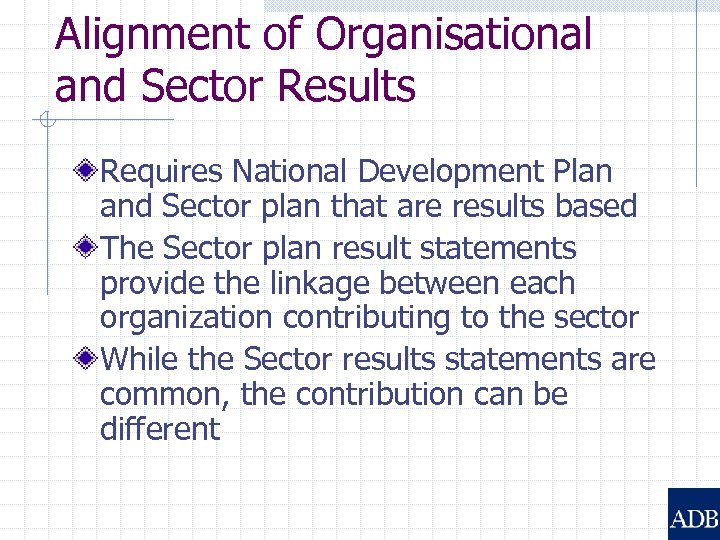 Alignment of Organisational and Sector Results Requires National Development Plan and Sector plan that are results based The Sector plan result statements provide the linkage between each organization contributing to the sector While the Sector results statements are common, the contribution can be different
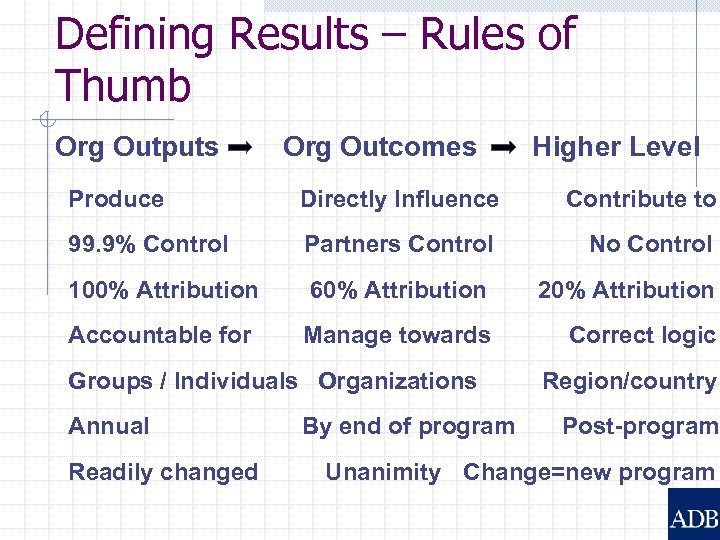 Defining Results – Rules of Thumb Org Outputs Org Outcomes Higher Level Produce Directly Influence Contribute to 99. 9% Control Partners Control No Control 100% Attribution 60% Attribution 20% Attribution Accountable for Manage towards Correct logic Groups / Individuals Organizations Annual Readily changed By end of program Region/country Post-program Unanimity Change=new program
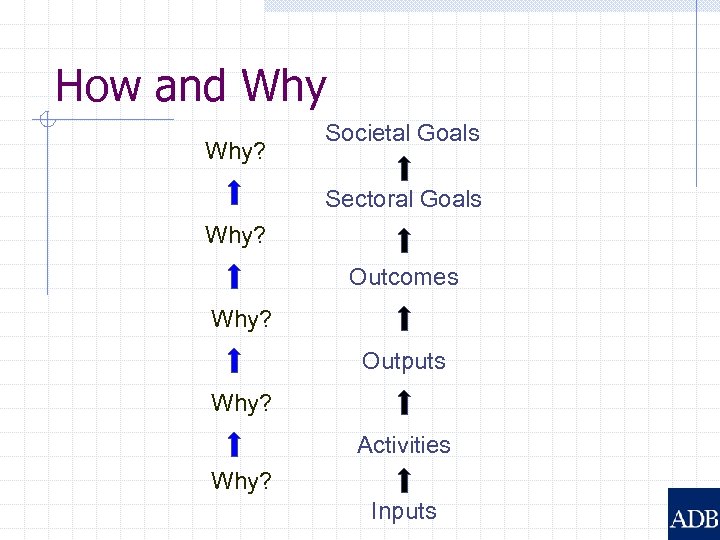 How and Why? Societal Goals Sectoral Goals Why? Outcomes Why? Outputs Why? Activities Why? Inputs
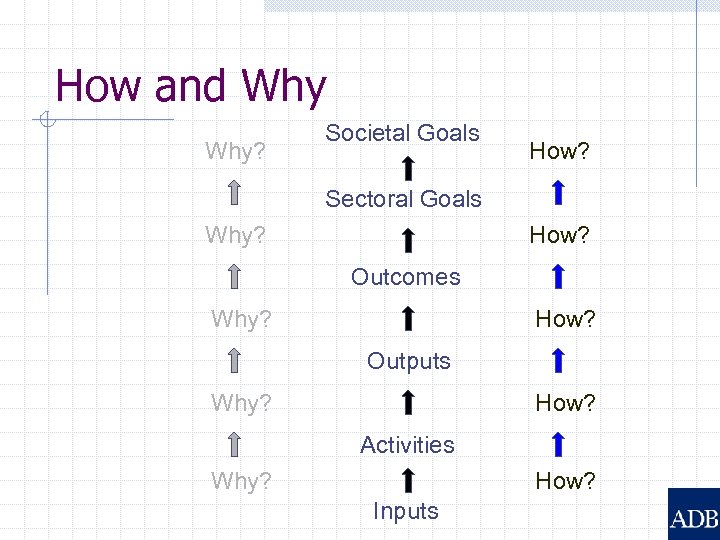 How and Why? Societal Goals How? Sectoral Goals Why? How? Outcomes Why? How? Outputs Why? How? Activities Why? How? Inputs
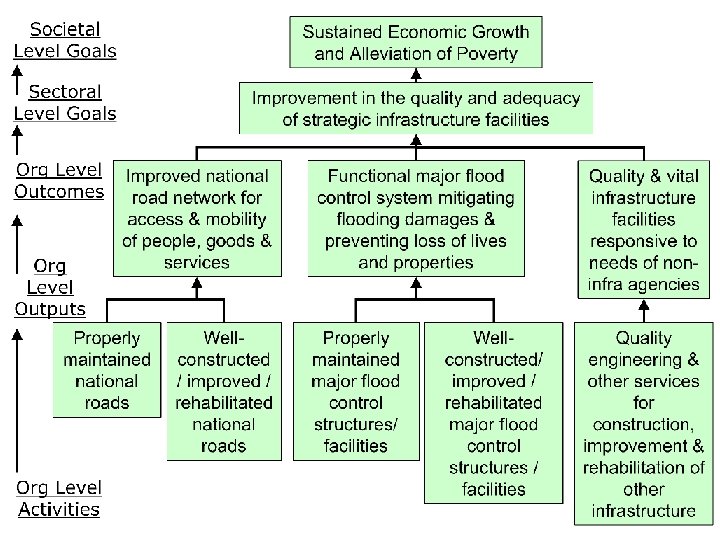
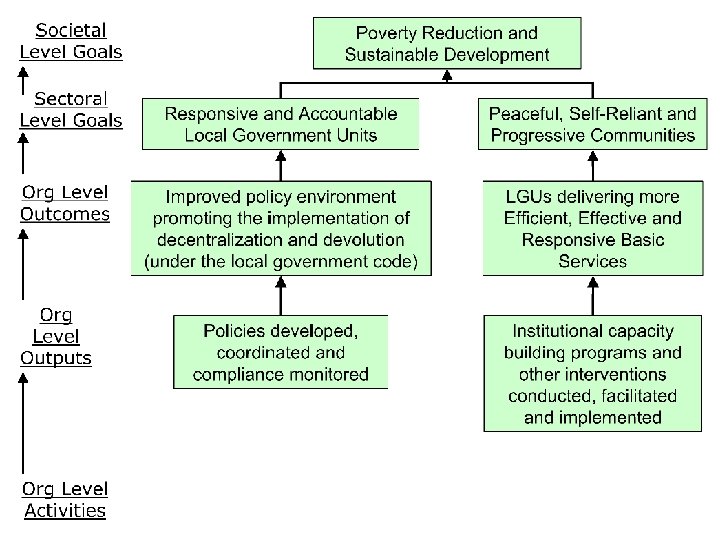
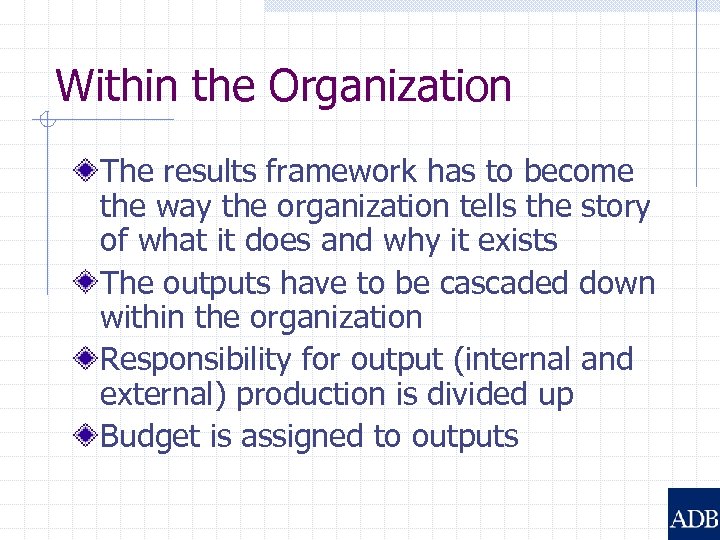 Within the Organization The results framework has to become the way the organization tells the story of what it does and why it exists The outputs have to be cascaded down within the organization Responsibility for output (internal and external) production is divided up Budget is assigned to outputs
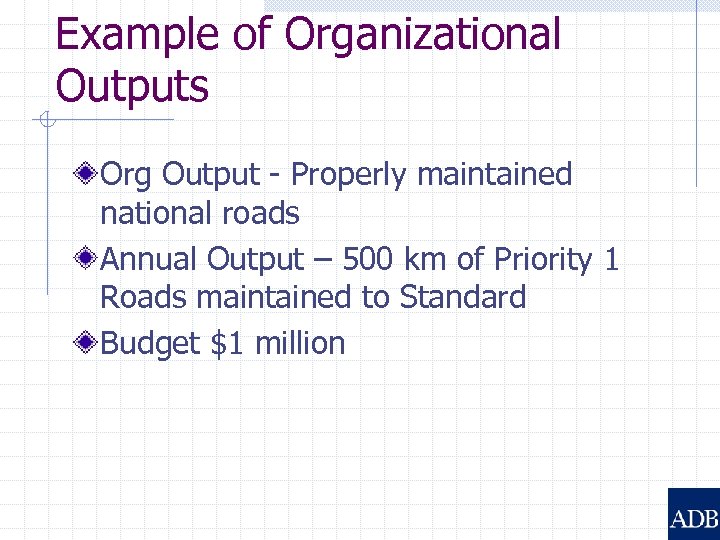 Example of Organizational Outputs Org Output - Properly maintained national roads Annual Output – 500 km of Priority 1 Roads maintained to Standard Budget $1 million
 Cascading Sub-Outputs and indicators to measure them are assigned to units within the organization Unit heads are responsible and accountable for sub-output production and unit performance Externalities / risks are identified and documented
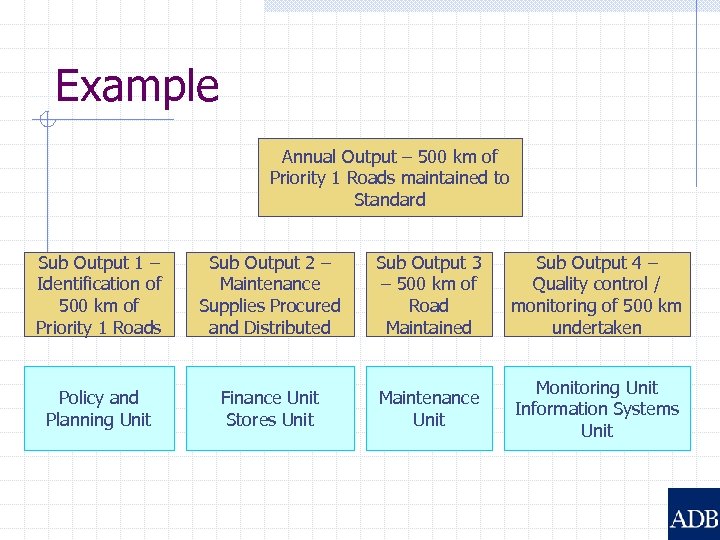 Example Annual Output – 500 km of Priority 1 Roads maintained to Standard Sub Output 1 – Identification of 500 km of Priority 1 Roads Sub Output 2 – Maintenance Supplies Procured and Distributed Sub Output 3 – 500 km of Road Maintained Sub Output 4 – Quality control / monitoring of 500 km undertaken Policy and Planning Unit Finance Unit Stores Unit Maintenance Unit Monitoring Unit Information Systems Unit
 Link to Performance Management at each level demands information on output and sub-output achievement to measure progress M&E systems capture and package the performance information for management Performance is assessed and rewarded at the individual, unit, and organizational level Externalities are taken into account in assessment
 Role of Senior Management Promote a culture of results and performance Manage with performance information Demand information on performance while facilitating its collection and analysis Use whatever incentives / sanction that are available, to manage behavior
 RETA 6306 Action Planning
 Discussion of Issues
 Discussion of RETA Priorities
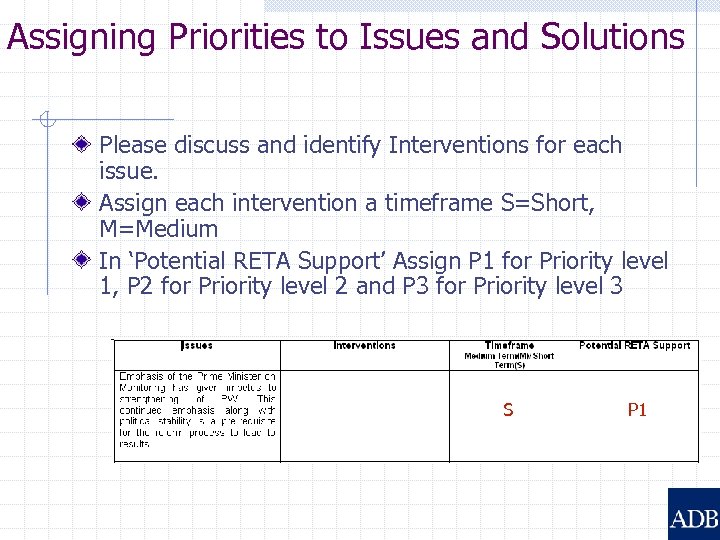 Assigning Priorities to Issues and Solutions Please discuss and identify Interventions for each issue. Assign each intervention a timeframe S=Short, M=Medium In ‘Potential RETA Support’ Assign P 1 for Priority level 1, P 2 for Priority level 2 and P 3 for Priority level 3 S P 1
 Post Seminar Discussions
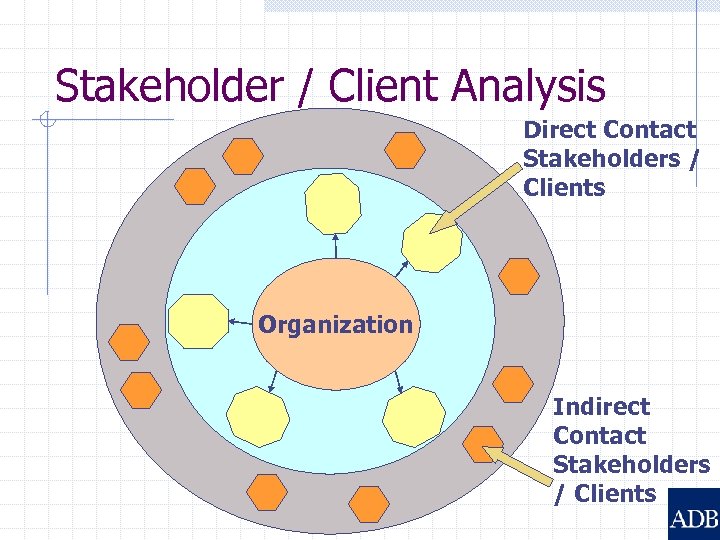 Stakeholder / Client Analysis Direct Contact Stakeholders / Clients Organization Indirect Contact Stakeholders / Clients
 Stakeholder / Client Analysis Exercise Brainstorm a list of all the external stakeholders, clients, customers, beneficiaries that you have Separate them into two lists: n n Ones you have direct contact with Ones you are indirectly linked to For Direct ones, list what behavioural changes you would like to / should influence with them This will help to develop your "clarity of purpose"
 Next Steps from Retreats