 Скачать презентацию Regional security in Kazakhstan Developed by Smagzamova
Моля проект.pptx
- Количество слайдов: 20



Regional security in Kazakhstan Developed by : Smagzamova Moldir, 403 group Scientific consultant: Kisaeva. G
Plan Introduction Kazakhstan and SCO Kazakhstan and CICA Conclusion List of literature
Central Asian foreign policy vector, alongside questions of regional security maintenance, are one of the major items on the agenda in Kazakhstan's strategy. Kazakhstan actively support regional integration, which is determined by the group of different factors. Among this factors the important place is occupied with questions protecting national interests by means of interstate security system
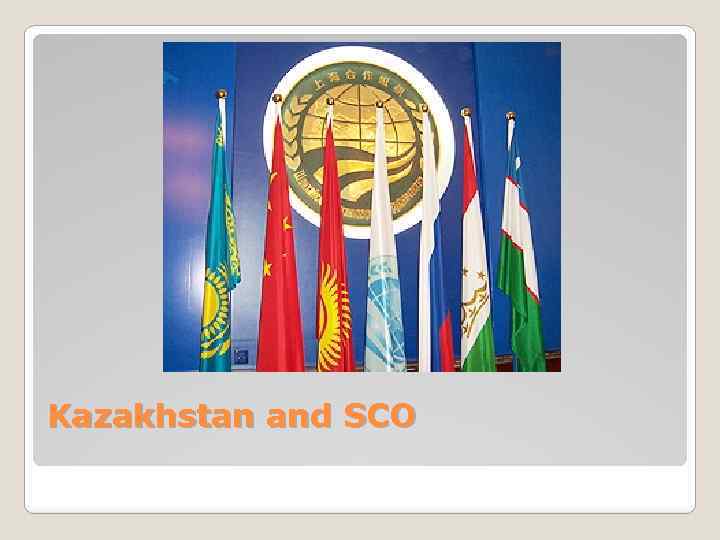
Kazakhstan and SCO
The Shanghai Cooperation Organization (SCO) is a permanent intergovernmental international organization creation of which was proclaimed on 15 June 2001 in Shanghai (China) by the Republic of Kazakhstan, the People’s Republic of China, the Kyrgyz Republic, the Russian Federation, the Republic of Tajikistan and the Republic of Uzbekistan. Its prototype is the Shanghai Five mechanism.
The main goals of the SCO are strengthening mutual confidence relations among the member countries; promoting effective cooperation in politics, trade and economy, science and technology, culture as well as education, energy, transportation, tourism, environmental protection and other fields; making joint efforts to maintain and ensure peace, security and stability in the region, moving towards the establishment of a new, democratic, just and rational political and economic international order.
The SCO member states occupy a territory of around 30 million 189 thousand square kilometers, which makes up three fifths of the Eurasian continent, and have a population of 1. 5 billion, which makes up a quarter of the planet’s population.
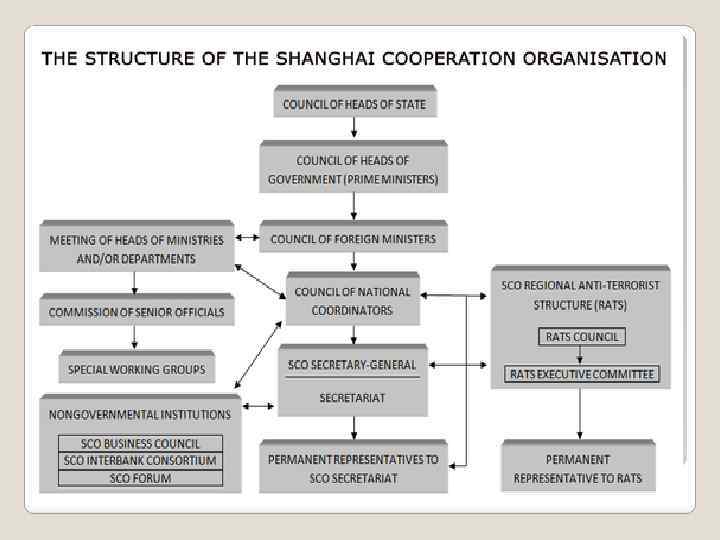
The Executive Committee of the Regional Counter-Terrorism Structure (RCTS) of the Shanghai Cooperation Organization (SCO) is the permanent body of the SCO RCTS based in Tashkent, the capital of Uzbekistan. Its main tasks and duties are as follows: 1. Maintaining working relations with competent institutions of the member states and international organizations tackling issues of fighting terrorism, separatism and extremism; 2. Assistance in interaction among the member states in preparation and staging of counterterrorism exercises at the request of concerned member states, preparation and conduct of search operations and other activities in the field of fighting terrorism, separatism and extremism; 3. Joint drafting of international legal documents concerning the fight against terrorism, separatism and extremism; 4. Gathering and analysis of information coming to the RCTS from the member states, formation and filling of RCTS data bank; 5. Joint formation of a system of effective response to global challenges and threats; 6. Preparation and holding of scientific conferences and workshops, assistance in sharing experience in the field of fighting terrorism, separatism and extremism.
According to the Charter of the SCO, summits of the Council of Heads of State shall be held annually at alternating venues. The locations of these summits follow the alphabetical order of the member state's name in Russian. The charter also dictates that the Council of Heads of Government (that is, the Prime Ministers) shall meet annually in a place decided upon by the council members. The Council of Foreign Ministers is supposed to hold a summit one month before the annual summit of Heads of State. Extraordinary meetings of the Council of Foreign Ministers can be called by any two member states.
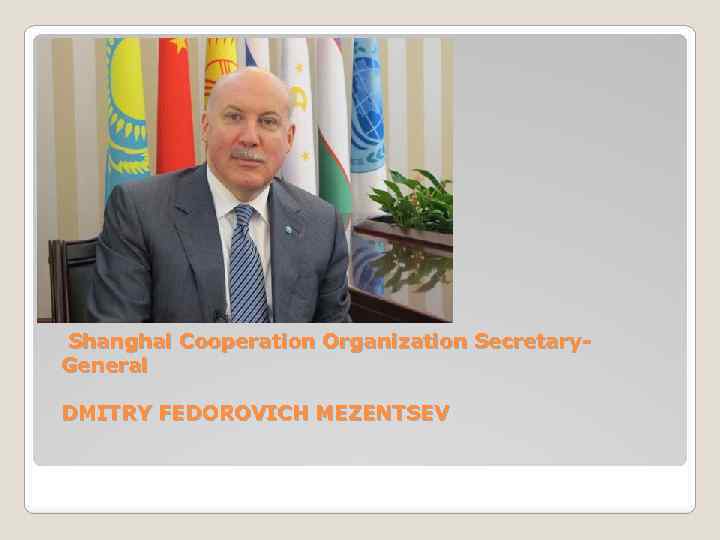
Shanghai Cooperation Organization Secretary. General DMITRY FEDOROVICH MEZENTSEV
Kazakhstan and CICA
Conference on Interaction and Confidence-Building Measures in Asia (CICA) is an international forum to strengthen cooperation to ensure peace, security and stability in Asia. CICA-Forum, based on the understanding of the existence of a direct link between peace, security and stability in Asia and throughout the world. States-members, reaffirming its commitment to the UN Charter, believe that peace and security in Asia can be achieved through dialogue and cooperation leading to a common indivisible security in Asia, where they will coexist peacefully States and their peoples - to live in peace, freedom and prosperity.
The Declaration of Principles Guiding Relations among the CICA Member States adopted at the First Meeting of Ministers on 14 September 1999 in Almaty and the Almaty Act, CICA charter, adopted during the first summit June 4, 2002, are the main documents of the CICA. These two documents were the key to the future evolution of the CICA process.
Objectives: The fight against illicit drug production and trafficking; Expansion of trade and economic cooperation for the prosperity and stability in Asia; The fight against terrorism in all its forms and manifestations; Cooperation on all issues related to environmental protection; Preventing the spread and consistent elimination of weapons of mass destruction; The development of confidence-building measures in the humanitarian dimension; Strengthening of mutual respect, understanding and tolerance between civilizations; Implementation of confidence-building measures between the Member States.
Basic principles: Sovereign equality and respect for sovereign rights; Use of force or threat of force; Territorial integrity of states; Peaceful resolution of conflicts; Non-interference in the internal affairs of States; Disarmament and arms control; Economic, social and cultural cooperation; Respect for human rights and fundamental freedoms.
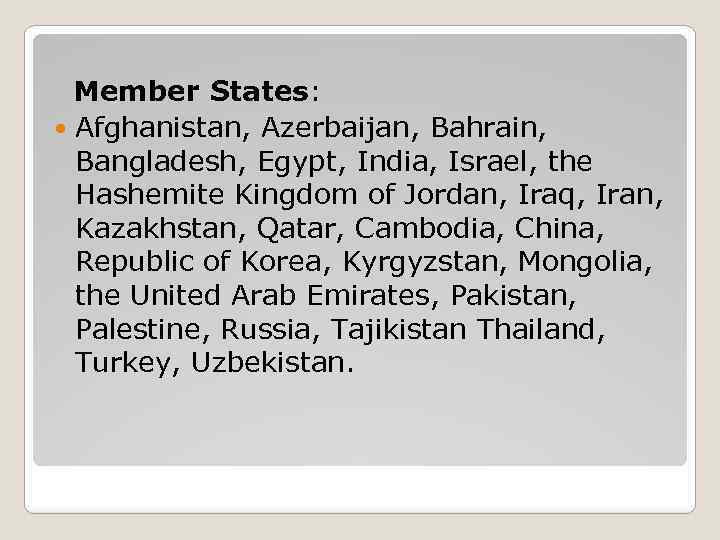
Member States: Afghanistan, Azerbaijan, Bahrain, Bangladesh, Egypt, India, Israel, the Hashemite Kingdom of Jordan, Iraq, Iran, Kazakhstan, Qatar, Cambodia, China, Republic of Korea, Kyrgyzstan, Mongolia, the United Arab Emirates, Pakistan, Palestine, Russia, Tajikistan Thailand, Turkey, Uzbekistan.
Conclusion In maintenance of social and political stability, economic growth in the Central Asia as a basis of regional security preservation the most essential are the following directions of Kazakhstan's foreign policy activity: 1) Formation of effective system of regional and national security. Assistance to settlement of situations in zones adjacent to the CA countries, especially in Afghanistan. 2) Preservation of political and macroeconomic stability in the region, stability of national political systems on the basis of strengthening of a democratic institutes role.
List of literature: 1. William J. Baumol, Sue Anne Batey Blackman, and Edward N. Wolff. Productivity and American Leadership: The Long View. Cambridge, Mass. : MIT Press, 1989. 2. Annetine C. Gelijns and Ethan A. Halm, Eds. The Changing Economics of Medical Technology. Washington, D. C. : National Academy Press, 1991. 3. Carnegie Commission on Science, Technology, and Government, Task Force on National Security. New. Thinking and American Defense Technology. New York: Carnegie Commission on Science, Technology, and Government, 1990. 4. George Heaton, Robert Repetto, and Rodney Sobin. Transforming. Technology: An Agenda for Environmentally Sustainable Growth in the 21 st Century. Washington, D. C. : World Resources Institute, 1991. 5. “Papers from the NAS Colloquium on Industrial Ecology, ” Proceedings of the National Academy of Sciences, Vol. 89, No. 3 ( February 1, 1992), pp. 793– 1148
Скачать презентацию Regional security in Kazakhstan Developed by Smagzamova
Моля проект.pptx