


 Скачать презентацию Regional Report 2008 on ASEAN University-Level e Learning
ba496d8952a90c662268d14acf99b9a2.ppt
- Количество слайдов: 171
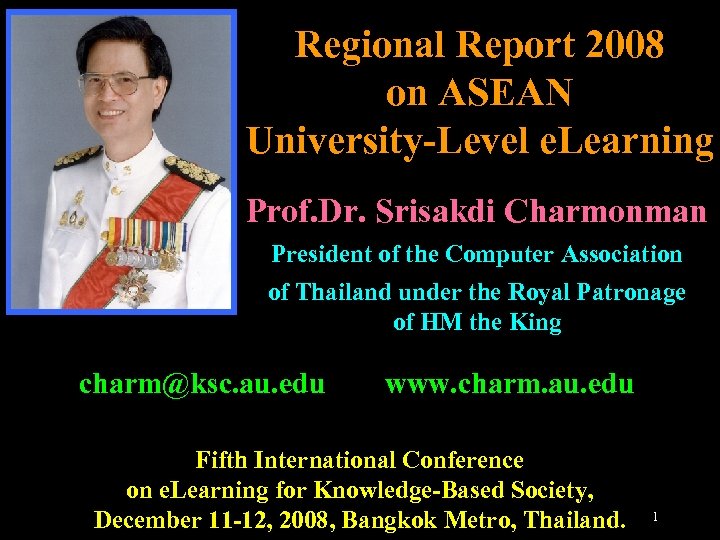 Regional Report 2008 on ASEAN University-Level e. Learning Prof. Dr. Srisakdi Charmonman President of the Computer Association of Thailand under the Royal Patronage of HM the King charm@ksc. au. edu www. charm. au. edu Fifth International Conference on e. Learning for Knowledge-Based Society, December 11 -12, 2008, Bangkok Metro, Thailand. 1
 Regional Report 2008 on ASEAN University-Level e. Learning 1. Introduction. 2. Hi-Ed e. Learning in Brunei Darussalam. 3. Hi-Ed e. Learning in Cambodia. 4. Hi-Ed e. Learning in Indonesia. 5. Hi-Ed e. Learning in Laos. 6. Hi-Ed e. Learning in Malaysia. 2 2
 Regional Report 2008 on ASEAN University-Level e. Learning 7. Hi-Ed e. Learning in Myanmar. 8. Hi-Ed e. Learning in Philippines. 9. Hi-Ed e. Learning in Singapore. 10. Hi-Ed e. Learning in Thailand. 11. Hi-Ed e. Learning in Vietnam. 12. Concluding Remarks. 3 3
 1. Introduction. v There are many definitions of the term “e. Learning” and a very popular one is that from the Sloan Consortium which states that “Online or e. Learning” is learning in which 80 -100% is done thru the Internet, and that the term “Blended or Hybrid learning” is when 30 -79% of learning is done thru the Internet. 4 4
 Introduction (Cont. ) v For the university-level e. Learning, it may be said that the US is the most advanced with - Jones International University as the first accredited virtual university. - University of Phoenix offering e. Learning degree programs to the largest number of students. 5 5
 Introduction (Cont. ) - Capella University as the first virtual university to enter NASDAQ stock market (raising US$ 70 million in pre-IPO funding and US$ 86 million in IPO) 6 6
 Introduction (Cont. ) v Other countries are also committed to university-level e. Learning. v For example, Canada has established the Canadian Virtual University. 7 7
 Introduction (Cont. ) v The United Kingdom government originally allocated Pound Stering 62 million for the UK e-University (UKe. U) but the project faced serious difficulty and has to be disbanded. v However, the universities such as Middlesex continue e. Learning development on their own. 8 8
 Introduction (Cont. ) v In ASEAN, the Universiti Tun Abdul Razak (UNITAR) became the first virtual university in the region, and Assumption University of Thailand established the first and only Ph. D. in e. Learning Methodology program. 9 9
 Introduction (Cont. ) v The Free Trade Agreement (FTA) and the General Agreement on Trades in Services (GATS) include “Education”. v Peter Drucker predicted that the commercial value of e. Learning will be greater than that of e. Commerce. v Therefore, all countries including those in ASEAN must promote e. Learning. 10 10
 Introduction (Cont. ) v This paper presents the regional report for the year 2008 on e. Learning in Higher Education which may be referred to as “Hi-Ed e. Learning” in each and all of the ten countries in ASEAN. 11 11
 2. Hi-Ed e. Learning in Brunei Darussalam. v From “www. mct. gov. jm” , the Ministry of Education of Brunei established the “e-Education Flagship” project which was signed on January 26, 2008. 12 12
 Hi-Ed e. Learning in Brunei (Cont. ) v From “www. asknlearn. com/pdf/Brunei. MOE 08. pdf” on August 13, 2008, University Brunei Darussalam (UBD) hosted the e-Learning Information Day to report that the e. Learning project has progressed successfully with almost 50 members of the Brunei academic community actively involved. 13 13
 Hi-Ed e. Learning in Brunei (Cont. ) v There were three key milestones achieved - Delivery of strategic study report - Completion of requirements study for the Learning Management System (LMS) - Delivery of the authoring tool 14 14
 Hi-Ed e. Learning in Brunei (Cont. ) v In the strategic study report, over 1, 000 educators and administrators in the Brunei higher education institutes were interviewed resulting in recommendations - to adopt ICT Common Standards and Tools - to expand connectivity and optimize existing infrastructure 15 15
 Hi-Ed e. Learning in Brunei (Cont. ) - to build awareness of ICT in education - to implement best practices for ICT in education - to provide incentives 16 16
 Hi-Ed e. Learning in Brunei (Cont. ) v From the LMS requirements study, Wiz. Learn 8. 0 LMS was customized for Brunei. v Over 200 specific requests and recommendations for the LMS were made by key representatives of the Brunei Higher Education System. 17 17
 Hi-Ed e. Learning in Brunei (Cont. ) v Of the 200 requested, - 60% already existed - 20% are being incorporated in the Brunei version - 20% will be considered later 18 18
 Hi-Ed e. Learning in Brunei (Cont. ) v In delivery of the authoring tool, Ultranote 2. 0 authoring tool has been released for acceptance test. The tool can be installed on a PC without an Internet connection. 19 19
 Hi-Ed e. Learning in Brunei (Cont. ) v The Ministry of Education hopes that all students and teachers will make good use of the system, and that the project will be completed by March 2009 with a four-year maintenance period. 20 20
 Hi-Ed e. Learning in Brunei (Cont. ) v Although the project started with school level rather than university level, the experience will definitely be beneficial for the establishment of hi-ed degree programs in the e. Learning mode in Brunei. 21 21
 3. Hi-Ed e. Learning in Cambodia. v On 25 – 26 February, 2003, a national seminar was held by the Ministry of Education Youth and Sport (Mo. EYS) with the support of UNESCO Office in Cambodia. 22 22
 Hi-Ed e. Learning in Cambodia (Cont. ) v The purpose of the seminar was to develop a national plan of action to achieve “Education For All (EFA)” by 2015. In order to achieve the policy, the Cambodian government would have to use Information and Communications Technology (ICT) as the major means of education delivery system. 23 23
 Hi-Ed e. Learning in Cambodia (Cont. ) v Resulted from the seminar are four specific policies. v The first policy is to use ICT for all teachers and students to reduce the digital divide between Cambodian schools and other schools in the world. 24 24
 Hi-Ed e. Learning in Cambodia (Cont. ) v The second policy is to use ICT as a teaching and learning tool. v The third policy is to use ICT to increase productivity, efficiency, and effectiveness of the management system. v The fourth policy is to promote education for all Cambodian students thru distance education and self-learning. 25 25
 Hi-Ed e. Learning in Cambodia (Cont. ) v Cambodia started university-level e. Learning in 2004. The National Institute of Business with the web (www. nib. edu. kh) was supported by Japan Overseas Development Corporation (JODC) to provide e. Learning Bachelor’s and Master’s degrees in many fields such as Accounting and Finance, Sales and Marketing and Business Management. 26 26
 Hi-Ed e. Learning in Cambodia (Cont. ) v The Ministry of Education, Youth and Sports promotes education for all through distance education and self-learning. v University of Cambodia (www. uc. edu. kh) offers e. Learning and provides free email accounts with wireless Internet access. 27 27
 Hi-Ed e. Learning in Cambodia (Cont. ) v From “www. dot-comalliance. org/newsletter/article. php? article_id= 141” , a Provincial Business e-Learning Project was proposed by The Asia Foundation (TAF). 28 28
 Hi-Ed e. Learning in Cambodia (Cont. ) v The project would be using access point for virtual learning in five Community Information Centers (CICs) with funding from USAID/ANE to start online learning or e. Learning in rural areas. 29 29
 Hi-Ed e. Learning in Cambodia (Cont. ) v There were 250 Cambodian students who got scholarships to study business courses in their towns without having to relocate. v The International Institute of Cambodia (IIC) was selected as the educational institution in the project. 30 30
 Hi-Ed e. Learning in Cambodia (Cont. ) v SDLearn was selected as the NGO to provide online and face to face “Train-the-Trainer” courses which may be said to be “Blended Learning”. 31 31
 Hi-Ed e. Learning in Cambodia (Cont. ) v Another NGO by the name of “Khmer OS” was assigned to train the IIC instructors, CIC staffs and students to use the Khmer Unicode keyboard. v Finally, the CICs would create an enabling learning venue for students to learn the Khmer e. Learning platform. 32 32
 Hi-Ed e. Learning in Cambodia (Cont. ) v A private university in Phnom Penh also cooperated with CICs in the provinces. TAF improved the Internet connections and related installation at the participating CICs, and SDLearn provided technical assistance to CICs and IIC. 33 33
 Hi-Ed e. Learning in Cambodia (Cont. ) v Moreover, CICs also provided - Online library of reference materials in Khmer language - Online environment for study group, interactive tools, and guidance with IT trainers to introduce e. Learning 34 34
 Hi-Ed e. Learning in Cambodia (Cont. ) v From an evaluation between first and second semester of the project, it was found that - about 80% of the originally enrolled students completed the courses - at least 50% of students were women. 35 35
 Hi-Ed e. Learning in Cambodia (Cont. ) v From the mid-term evaluation, it was found that - 90% of the students were interested in taking e. Learning course in the future - more than 85% of the students’ employment probability had been increased 36 36
 Hi-Ed e. Learning in Cambodia (Cont. ) v From the first semester, it was found that - 16% of the students got a new job after completion - about 40% of the students had been promoted in their organizations 37 37
 4. Hi-Ed e. Learning in Indonesia. v The Presidential decree number 50, 2000 established a team of “Telematika” to utilize ICT in various aspects including education, especially, to facilitate the use of the Internet for more efficient teaching-learning process. 38 38
 Hi-Ed e. Learning in Indonesia (Cont. ) v The implementation of e. Learning in Indonesian education may be said to have stared in the year 2002 when the Center for Information and Communication Technology for Education cooperated with the Directorate of Secondary Education and the Directorate of Vocational Education to develop e. Learning under e-education program. 39 39
 Hi-Ed e. Learning in Indonesia (Cont. ) v The learning materials developed were in - Mathematics - Physics - Chemistry - Biology - Electronics - Information technology for senior secondary schools and vocational schools 40 40
 Hi-Ed e. Learning in Indonesia (Cont. ) v There were five examples of e. Learning-related developments in Indonesia by the year 2004. v The first example was online courses by Petra Christian University in Surabaya. v The second example was online tutorial by Open University. 41 41
 Hi-Ed e. Learning in Indonesia (Cont. ) v The third example was a joint research program thru ICT by - Bandung Institute of Technology - Bogor Institute of Agriculture - Gadjah Mada University - University of Diponegoro 42 42
 Hi-Ed e. Learning in Indonesia (Cont. ) v The fourth example was digital library network supported by - Canadian International Development Agency (CIDA) - Mc. Gill University of Canada - Indonesia Institute of Science 43 43
 Hi-Ed e. Learning in Indonesia (Cont. ) v The fifth example was Computer Assisted Instruction (CAI) learning material developed by the Center for Information and Communication Technologies for Education. 44 44
 Hi-Ed e. Learning in Indonesia (Cont. ) v Sulistyo-Basuki stated in his report in the year 2007 that beginning in the year 2000, e. Learning was started in Indonesia. Based on his study of about 60 e. Learning sites, he found four constraints. 45 45
 Hi-Ed e. Learning in Indonesia (Cont. ) v The fist constraint was the lack of infrastructure in the sense that out of the population of 223 million people, only about 20 million own fixed telephone line which is required for connection to the Internet and mobile phone connection to the Internet would be too expensive. 46 46
 Hi-Ed e. Learning in Indonesia (Cont. ) v The second constraint was that the standards on content management did not reach the academic intellectual level. 47 47
 Hi-Ed e. Learning in Indonesia (Cont. ) v The third constraint was that there was no coordination in conducting e. Learning. In some universities, each department established its own e. Learning facilities without coordination with other departments. 48 48
 Hi-Ed e. Learning in Indonesia (Cont. ) v The fourth constraint was the cultural factor in the sense that Indonesian prefer talking over writing and listening to lecture over self study thru the Internet. 49 49
 Hi-Ed e. Learning in Indonesia (Cont. ) v There are many Indonesian universities engaging in e. Learning and a few examples will be given here. 50 50
 Hi-Ed e. Learning in Indonesia (Cont. ) v The fist example of hi-ed e. Learning in Indonesia is at Universitas Terbuka (UT) which had 400, 392 students in the year 2007. UT offers over 58 subjects online such as “STAT 4432 Computer 1”. 51 51
 Hi-Ed e. Learning in Indonesia (Cont. ) v The second example is Universitas Indonesia (UI) which started e. Learning in three different departments - Internal Medicine - International Relation - Computer Science 52 52
 Hi-Ed e. Learning in Indonesia (Cont. ) v By early 2004. the Faculty of Computer Science launched the “Student-Centered E-Learning Environment (SCELE)” supported by printed textbook and face-to-face teaching. 53 53
 Hi-Ed e. Learning in Indonesia (Cont. ) v The third example is the Institute Teknologi Bandung (ITB) established the School In the Internet in Asia (SOI Asia) focusing on course exchange via the Internet and teleconferencing. 54 54
 Hi-Ed e. Learning in Indonesia (Cont. ) v The fourth example is Universitas Gadjah Mada (UGM) started small scale development of e. Learning in the Faculty of Engineering to use the problem-based learning virtually. Contents for engineering courses were developed with theories, concepts, exercises, practices, and linkages to external sources. 55 55
 Hi-Ed e. Learning in Indonesia (Cont. ) v The fifth example is Universitas Islam Sultan Agung (UNISSULA) which developed “Sinau Online” as its Learning Management System. The purpose of Sinau Online was for learning thru multiple channels and medias to exchange classroom-based learning. v There are over 40 courses available online at Sinau Online. 56 56
 Hi-Ed e. Learning in Indonesia (Cont. ) v The sixth example is Universitas Padjadjaram (UNPAD) started blended learning using web-based technology. v The seventh and eighth examples are Universitas Bina Nusantara and Universitas Pelita Harapan which offer web-based e. Learning programs. 57 57
 Hi-Ed e. Learning in Indonesia (Cont. ) v The ninth example is Trisakti University (www. trisakti. ac. id) which has already offered Master of Management in e. Learning mode and in the process of preparation of other e. Learning degree programs such as - Bachelor of Management - Bachelor of IT - Master of Accountancy - Master of Industry Technology - Ph. D. in Economics 58 58
 Hi-Ed e. Learning in Indonesia (Cont. ) v Examples of other Indonesian universities offering e. Learning are - Universitas Cenderwasih - Gorontalo Teacher College - Universitas Hasanudin - Universitas Udayana - Etc 59 59
 Hi-Ed e. Learning in Indonesia (Cont. ) v Southeast Asian Ministers of Education Organization Regional Open Learning Centre (SEAMOLEC) had conducted many e. Learning-related workshops in Indonesia such as - Universitas Lampung - Universitas Warmadewa - Institut Pertanian Bogor 60 60
 5. Hi-Ed e. Learning in Laos. v In the year 1995, ten higher-learning institutions in Laos were integrated into the National University of Laos (www. nuol. edu. la). 61 61
 Hi-Ed e. Learning in Laos (Cont. ) v In August 2004, with the support of Kobe University in Japan and Japan International Corporation Agency (JICA), it organized lectures on the topic of “International Economics” which were given in Kobe and attended in interactive mode by 120 students in Vientiane. 62 62
 Hi-Ed e. Learning in Laos (Cont. ) v From Lao County Report to Asia e-Learning Network in the year 2002, an institution active in e. Learning was Science Technology and Environment Agency which is under the Prime Minister Office. It has 150 staff members. 63 63
 Hi-Ed e. Learning in Laos (Cont. ) v Its responsibilities include - Information Technology research and development - Knowledge-based capacity building - Information Technology monitoring and management for the government 64 64
 Hi-Ed e. Learning in Laos (Cont. ) - Creation and maintenance of Information Technology standards - Intellectual Property and Copyright of Information Technology products 65 65
 Hi-Ed e. Learning in Laos (Cont. ) v Another country report mentioned “National ICT Policy Vision 2020” which includes bringing the country into the information age, and developing necessary human resources and institutional capacities. 66 66
 Hi-Ed e. Learning in Laos (Cont. ) v There is also “Lao National Internet Committee (LANIC)” responsible for national Internet policy and regulation. 67 67
 Hi-Ed e. Learning in Laos (Cont. ) v It was mentioned that in the year 2003, there was an e-Learning implementation which failed but it familiarized Lao learners with e-Learning. 68 68
 Hi-Ed e. Learning in Laos (Cont. ) v Laos has one e. Learning Center located at the Faculty of Engineering of the National University and it is supported by the Japanese Government. 69 69
 6. Hi-Ed e. Learning in Malaysia. v In the paper on “Higher Education in Malaysia: Quality e-Learning on High”, November 2008, there was a study carried out in six higher education institutions (HEI) by visiting and discussing with the individuals responsible for e. Learning, analysis of documents, websites, and learning management systems. 70 70
 Hi-Ed e. Learning in Malaysia (Cont. ) v It was found out that most of the HEI started by acquisition of adequate infrastructure to offer good e. Learning platform to students. Massive investment were made from 2003 -2007 for the infrastructure and Learning Management Systems. 71 71
 Hi-Ed e. Learning in Malaysia (Cont. ) v The second phase of e. Learning development in Malaysia was the integration of ICT with the teaching and learning processes which include strategic plans for using ICT in - teaching and learning - the translation of the plans into reality - the coordination of the strategies for the success of e. Learning - the right combination of human resources 72 72
 Hi-Ed e. Learning in Malaysia (Cont. ) v The study revealed that most institutions have not drawn strategic plans for using ICT in teaching and learning according to the plans led out in the year 2000 calling for institutional support, course development, teaching/learning, course structure, student support, faculty support, evaluation and assessment. 73 73
 Hi-Ed e. Learning in Malaysia (Cont. ) v The institutions interviewed gave impressions that the decision on the use of e. Learning was made by the management because everyone else was doing it. It was believed that every institution has to offer e. Learning to compete with other institutions. 74 74
 Hi-Ed e. Learning in Malaysia (Cont. ) v Malaysia has the first e. Learning or virtual university in ASEAN and that is the Universiti Tun Abdul Razak (UNITAR) with the web (www. unitar. edu. my). v UNITAR was established in 1997 as the first virtual or e. Learning university in ASEAN. 75 75
 Hi-Ed e. Learning in Malaysia (Cont. ) v Among the accredited degree programs are - Bachelor of Business Administration - Bachelor of Information System - Bachelor of Management - Master of Business Administration - Master of Information and Multimedia Tech - Master of Information Technology and Management 76 76
 Hi-Ed e. Learning in Malaysia (Cont. ) v The second virtual university in Malaysia is the Multimedia University (www. mmu. edu. my) which was established in 1999. 77 77
 Hi-Ed e. Learning in Malaysia (Cont. ) v It offers two accredited e. Learning degrees programs - Bachelor of Management - Bachelor of Business Administration in Human Resource Management. 78 78
 Hi-Ed e. Learning in Malaysia (Cont. ) v MMU is planning to offer three more degree programs which are - Bachelor of e-Business - Bachelor of Information Technology - Master of Business Administration 79 79
 Hi-Ed e. Learning in Malaysia (Cont. ) v The third example of Malaysian universities offering e. Learning is the University Technology MARA (www. uitm. edu. my) which was established in 1956. 80 80
 Hi-Ed e. Learning in Malaysia (Cont. ) v In the year 2008, it provides 3 satellite campuses, 15 branch campuses, 9 city campuses and 25 franchise colleges which included e. Learning students in the faculty of Business Management and faculty of Information Studies. 81 81
 Hi-Ed e. Learning in Malaysia (Cont. ) v The forth example in Malaysia is the Universiti Putra Malaysia (www. upm. edu. my) which was established in 1931. It provides e. Learning with support of Mahirnet (www. mahirnet. com) with online tutorial. 82 82
 Hi-Ed e. Learning in Malaysia (Cont. ) v The fifth example in Malaysia is the Open University Malaysia, (www. unitem. edu. my) which was established in the year 2000. It provides degree programs delivered by using Learning Management System (LMS). 83 83
 Hi-Ed e. Learning in Malaysia (Cont. ) v The sixth example is Asia e University (Ae. U) which is a dual-mode multinational university in Malaysia. It was established as the Asia Cooperation Dialogue Countries (ACD) with the support of 30 ACD member countries. 84 84
 Hi-Ed e. Learning in Malaysia (Cont. ) v There are seven major schools offering various programs - The schools are School of Management - School of Information and Communications Technology - School of Education and Cognitive Sciences - School of Arts and Social Sciences 85 85
 Hi-Ed e. Learning in Malaysia (Cont. ) - School of Science, Health and Environmental Studies - School of Foundation, Vocational and Technical Studies - School for Lifelong Learning 86 86
 Hi-Ed e. Learning in Malaysia (Cont. ) v The schools are supported by service centers such as - Centre for Graduate Studies - Centre of Instructional and Learning Technologies (CILT) - Centre for Research, Innovation and Commercialization (CRIC) - Centre for Languages (CL) 87 87
 7. Hi-Ed e. Learning in Myanmar. v Japan’s Minitry of Economy, Trade and Industry supported the e. Learning Center (www. yangon. com. mm. ) It offers preparatory materials on WBT (e. Learning system from WBT System Ltd. in Ireland) for IT engineer examination. 88 88
 Hi-Ed e. Learning in Myanmar (Cont. ) v There is an “MBA Program” and 180 students have graduated and may later be expanded in e. Learning mode. 89 89
 Hi-Ed e. Learning in Myanmar (Cont. ) v In the report “E-Learning Status in Myanmar”, it was stated that the Myanmar ICT Development Council was established in the year 2000 and the e-learning initiatives include - establishing multimedia classroom in high schools and middle schools all over the country 90 90
 Hi-Ed e. Learning in Myanmar (Cont. ) - starting ICT education by opening Computer Universities in Yangon and Mandalay and Computer Colleges in big cities 91 91
 Hi-Ed e. Learning in Myanmar (Cont. ) - starting e-education program by Electronic Data Broadcasting System for University for Distance Learning by opening over 200 e-Learning centers all over the country 92 92
 Hi-Ed e. Learning in Myanmar (Cont. ) - opening 24 government computers colleges in addition to Universities of Computer Studies - offering from Diploma to Doctoral courses on ICT 93 93
 Hi-Ed e. Learning in Myanmar (Cont. ) v The number of e-learning centers opened was 619. Yangon University of Distance Education and Mandalay University of Distance Education have been providing parts of their instruction in e-learning mode to the 619 centers. The Ministry of Education has been using e-Learning in teacher upgrading program. 94 94
 Hi-Ed e. Learning in Myanmar (Cont. ) v Yangon Institute of Economic has been offering Diploma in Education Management in e. Learning mode. v The English Department of Yangon University has launched e. Learning in the “Young Faculty Development Program”. 95 95
 Hi-Ed e. Learning in Myanmar (Cont. ) v The University of Computer Studies in Yangon offers MSC in Computer Science in the blended learning mode. v Myanmar Computer Federation e-Learning Centre has been conducting e-learning training courses. 96 96
 Hi-Ed e. Learning in Myanmar (Cont. ) v The e-learning centers throughout Myanmar have been providing - Training courses to 1. 25 million students - 10, 000 teachers - About 700, 000 students in universities and colleges 97 97
 8. Hi-Ed e. Learning in Philippines. v In the year 2000, Philippine passed the E-Commerce Act and then established the Information Technology and E-Commerce Council (ITECC) which came up with the vision of an e. Philippines. 98 98
 Hi-Ed e. Learning in Philippines (Cont. ) v The ITECC Human Resource Committee announced the plan to - Promote e. Learning at all level of education - Organize a national e. Learning conference - Enable more schools to teach ICT - Promote the collaboration in development of e. Learning programs and instructional materials 99 99
 Hi-Ed e. Learning in Philippines (Cont. ) v Several universities in the Philippines have started e. Learning degree programs. v The first example is the University of The Philippines Open University (UPOU). It was established in 1995. 100
 Hi-Ed e. Learning in Philippines (Cont. ) v It has 30 learning centers. Contact can be made by telephone and email. Online short courses are available via the website. It adopted the Integrated Virtual Learning Environment (IVLE) from the National University of Singapore. 101
 Hi-Ed e. Learning in Philippines (Cont. ) v The second example is De La Salle University (www. dlsu. edu. ph) which is a Catholic university founded in 1911. The Graduate School of Business offers two modes of online courses. 102
 Hi-Ed e. Learning in Philippines (Cont. ) v The first mode is mixed-mode with face-to-face 8 times and web-based 6 times. v The second mode is full online where there is face-to-face for orientation only. v The university implemented the “Internet-Enhanced Master of Arts in Teaching Literature Program”. 103
 Hi-Ed e. Learning in Philippines (Cont. ) v The third example is Ateneo de Manila University (ADMU) which implemented “International e. Learning for Professional Journalists”. 104
 Hi-Ed e. Learning in Philippines (Cont. ) v The fourth example is Polytechnic University of the Philippines (PUP) which promotes e. Learning. 105
 Hi-Ed e. Learning in Philippines (Cont. ) v The fifth example is the collaboration project between Simon Fraser University in Canada and UPOU in 1996 to 2001 to support expansion of human resource and development opportunities. 106
 Hi-Ed e. Learning in Philippines (Cont. ) v The sixth example is the project to develop course materials for small business training and certification program sponsored by the Canadian International Development Agency (CIDA) in 1999 -2000. 107
 Hi-Ed e. Learning in Philippines (Cont. ) v The seventh example is the project to design and develop training program for marine deck officers funded by the Norwegian Maritime Directorate in 2002 to 2004. 108
 Hi-Ed e. Learning in Philippines (Cont. ) v On July 17, 2008, Intel and the Department of Education launched e. Learning Site for public schools after Intel trained more than 80, 000 teachers on basic computer skills. 109
 9. Hi-Ed e. Learning in Singapore. v From the 2004 report on e-learning in Singapore, Singapore aimed to be the e-Learning Hub in Asia and Pacific. 110
 Hi-Ed e. Learning in Singapore (Cont. ) v From the 2007 report on e-learning in Singapore, the Singaporean Information Technology Standard Committee (ITSC) conducted an e. Learning survey in 2005 and found that over 80% of e. Learning courses were available to staff and students in schools, and 75% of schools were using Learning Management Systems (LMS). 111
 Hi-Ed e. Learning in Singapore (Cont. ) v Singapore Government has been spending a lot of resources in universities, especially the two full-fledged public universities - National University of Singapore (NUS) - Nanyang Technological University (NTU) - Singapore Management University (SMU) (a private university) 112
 Hi-Ed e. Learning in Singapore (Cont. ) v In the year 2001, U 21 Global which is a consortium of leading universities has chosen Singapore as the global headquarter to develop and deliver e. Learning. 113
 Hi-Ed e. Learning in Singapore (Cont. ) v The first example is the National University of Singapore (www. nus. edu. sg). It is the oldest university in Singapore. Since 1997, NUS offers Integrated Virtual Environment (IVLE) as a web-based tool for e. Learning. IVLE has hosted more than 2, 500 discussion forums and 3, 000 assignment repositories. 114
 Hi-Ed e. Learning in Singapore (Cont. ) v The second example is Nanyang Technological University. In the year 2000, NTU launched S$ 6 million e. Learning program named “edve. NTUre” to facilitate 23, 000 students and 1, 300 academic staff. Within three years of implementation, 90% of the NTU courses have started using e. Learning tools. 115
 Hi-Ed e. Learning in Singapore (Cont. ) v The third example is Singapore Management University (www. smu. edu. sg). SMU provides “SMUConnect” portal for access to - Class lists - Lecture plans - Discussion forums - Notifications - Examination records - Etc. 116
 Hi-Ed e. Learning in Singapore (Cont. ) v The fourth example is U 21 Global which hopes to offer e. Learning to a good portion of the 32 million students around the world. It claims to feature innovative interface design, thoughtful integration of web-based resource, productive use interpersonal interaction, and support services. 117
 Hi-Ed e. Learning in Singapore (Cont. ) v On July 16, 2007, PRlog issued a press release that Sky. Quest. Com has been recognized as the largest self-development portal in Singapore, featuring library of 200 online video seminars and 4, 000 e. Books of the world’s best speakers. 118
 10. Hi-Ed e. Learning in Thailand. v In the year 1995, Thailand started e. Learning by establishing the project “Distance Learning Foundation’s e. Learning to Honour HM the King”. 119
 Hi-Ed e. Learning in Thailand (Cont. ) v As of the year 2008, the project offers e. Learning for - over 3, 000 secondary schools - 15, 000 primary schools - 5 universities in Yunnan, China - 3 schools in Laos 120
 Hi-Ed e. Learning in Thailand (Cont. ) - one university and one junior college in Vietnam - University of Distance Education in Yanson, Myanmar - 15 Thai temples in Malaysia - Etc 121
 Hi-Ed e. Learning in Thailand (Cont. ) v University-level e. Learning in Thailand started in the year 2002 when Prof. Dr. Srisakdi Charmonman proposed to the Prime Minister that Thailand established a decree that allowed Thai universities to offer e. Learning degree programs. 122
 Hi-Ed e. Learning in Thailand (Cont. ) v He authored the first draft of the e. Learning law and submitted it to the Ministry of University Affairs. 123
 Hi-Ed e. Learning in Thailand (Cont. ) v After several meetings, the Ministry organized an open hearing on the e. Learning law. v In his capacity as the President of the Computer Association of Thailand under the Royal Patronage of HM the King, he presented the draft law and chaired the open hearing. 124
 Hi-Ed e. Learning in Thailand (Cont. ) v The results from the hearing were used to modify the law. In August 2004, Prof. Charmonman was elected Chairman of e. ASEAN Business Council and Thailand had not approved the e. Learning law. 125
 Hi-Ed e. Learning in Thailand (Cont. ) v So, he mounted another push by proposing to the ASEAN Ministers that e. Learning be promoted by all ASEAN member countries and the Ministers agreed. 126
 Hi-Ed e. Learning in Thailand (Cont. ) v He also sent letters to the Prime Minister such as that Thailand was behind Campuchia in e. Learning, similar to the case of the US being behind Russian Sputnik and the US urgently rectified the situation. 127
 Hi-Ed e. Learning in Thailand (Cont. ) v He requested the Prime Minister to rectify the situation by speeding up the approval of the e. Learning decree. The Prime Ministered took action and the e. Learning decree was published in the Royal Gazette on October 26, 2005. From the year 2002 to 2005, Prof. Charmonman lobbied five Ministers and was finally successful. 128
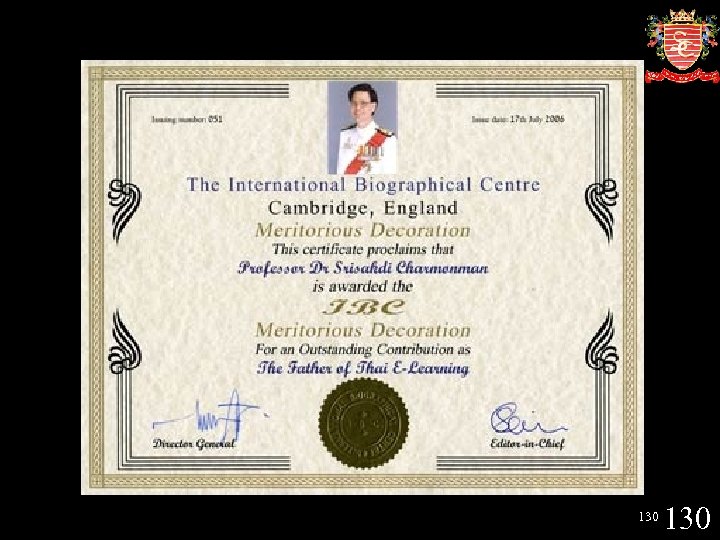
 Hi-Ed e. Learning in Thailand (Cont. ) v On July 17, 2006, he was also named “The Father of Thai E-Learning” by the International Biographical Centre, Cambridge, England, 129
 130
130
 Hi-Ed e. Learning in Thailand (Cont. ) v In January 2006, the first e. Learning degree program was offered in Thailand that was at the College of Internet Distance Education of Assumption University with Prof. Charmonman as the CEO of the College and Program Director of the M. Sc. in Management program. 131
 Hi-Ed e. Learning in Thailand (Cont. ) v As of the year 2008, universities in Thailand offers all levels of complete e. Learning programs from - Ph. D. - Master’s - Bachelor’s - Certificates - Short courses 132
 Hi-Ed e. Learning in Thailand (Cont. ) v At the Ph. D. level, Thailand offers the first, and as of the year 2008, the only Ph. D. program in e. Learning Methodology, in the e. Learning mode. 133
 Hi-Ed e. Learning in Thailand (Cont. ) v Searching for “Ph. D. e. Learning Methodology” from Google, the first five entries are about the Ph. D. degree at Assumption University. 134
 Hi-Ed e. Learning in Thailand (Cont. ) v The Ph. D. students are from 12 countries such as - US - Canada - England - Australia - New Zealand - Romania - Iran - Etc 135
 Hi-Ed e. Learning in Thailand (Cont. ) v In additional to students from the twelve countries, there applications from - German - Japan - China - Philippines - Kenya - Sri Lanka - Pakistan - Etc 136
 Hi-Ed e. Learning in Thailand (Cont. ) v For complete e. Learning degree programs at the Master’s level, Thailand offers - Assumption University * Master of Science in Management * Master of Science in ICT * Master of Science in e. Learning Methodology 137
 Hi-Ed e. Learning in Thailand (Cont. ) - Chulalongkorn University * Master of Nursing Science * Master of Public Health * Master of Arts in Cultural Management * Master of Science in Social and Administrative Pharmacy - Mahidol University * Master of Science in Public Health 138
 Hi-Ed e. Learning in Thailand (Cont. ) - Rangsit University * Mater of Arts in Leadership * Master of Science in IT Management - University of Thai Chamber of Commerce * Master of Business Administration 139
 Hi-Ed e. Learning in Thailand (Cont. ) - Chiangmai University * Master of Education - Silpakorn University * Master of Arts in Knowledge Management 140
 Hi-Ed e. Learning in Thailand (Cont. ) v For complete e. Learning degree programs at the Bachelor’s level, Thailand offers - Chulalongkorn University * Bachelor of Science in Software Development - Naresuan University * Bachelor of Business Administration in Tourism 141
 Hi-Ed e. Learning in Thailand (Cont. ) - Rangsit University * Bachelor of Law - University of Thai Chamber of Commerce * Bachelor of Accountancy - Kasetsart University * Bachelor of Science in Automotive Industry 142
 Hi-Ed e. Learning in Thailand (Cont. ) v For certificate programs in e. Learning mode, Thailand offers several such as - Assumption University * Certificate in SME Management - Thai Cyber University * Certificate for e. Learning Professional * Certificate in Car’s Structure and Systems * Certificate in Computer Skills 143
 Hi-Ed e. Learning in Thailand (Cont. ) v The Certificate in SME Management is a joint program between the College of Internet Distance Education of Assumption University and the Office of Small and Medium Enterprise Promotion. It is called “e. SME University”. 144
 Hi-Ed e. Learning in Thailand (Cont. ) v e. SME University includes 18 courses which may be taken free of charge. There have already been over 20, 000 students from 9 million potential students working in SME in Thailand. 145
 Hi-Ed e. Learning in Thailand (Cont. ) v For individual courses not in complete e. Learning degree programs, Thailand offers numerous courses. For example, Mae Fah Luang University offers 30 courses, and Chiang Mia Rajabhat University offers 110 courses. 146
 Hi-Ed e. Learning in Thailand (Cont. ) v Another interesting e. Learning program from Thailand is “e. Learning for Bedside Chorus” in which the College of Internet Distance Education of Assumption University cooperated with the Hospice Foundation of Thailand to produce “e. Learning for Bedside Chorus for Palliative Care”. 147
 Hi-Ed e. Learning in Thailand (Cont. ) v The e. Learning courses offered free of charge are “How to Sing” and 20 singing lessons for patients who have been diagnosed to die in about 6 months and their relatives to entertain the patients by singing at their bedside. 148
 Hi-Ed e. Learning in Thailand (Cont. ) v Another noted development was that Thai Cyber University (TCU) was established on January 12, 2005. As of the year 2008, there about 34 universities in the TCU consortium and offers 480 courses with over 50, 000 students but does not offer e. Learning degree program. 149
 11. Hi-Ed e. Learning in Vietnam. v In the year 2008, e. Learning in Vietnam is still in the early phase of development with about 10 e. Learning websites 150
 Hi-Ed e. Learning in Vietnam (Cont. ) v The Ministry of Education and Training takes responsibility for the content of the e. Learning websites, and the Ministry of Planning and Investment is in charge of granting licenses to set up e. Learning websites for business purposes. 151
 Hi-Ed e. Learning in Vietnam (Cont. ) v From “english. vietnamnet. vn”, the Head of the Information Technology under the Ministry of Education and Training (Mo. ET), Quach Tuan Ngoc, stated that e. Learning is the model of training of the future, and there are many e. Learning programs promoted in Vietnam. 152
 Hi-Ed e. Learning in Vietnam (Cont. ) v Moreover, there are three channels for e. Learning - Websites provided by companies - e. Training provided by universities - Training programs imported from other countries 153
 Hi-Ed e. Learning in Vietnam (Cont. ) v From “www. seekingmedia. com. au” on 26 February 2008, the Vietnamese government has given final approval to a joint venture between the Coffs Harbour-based Janison which is Australia’s large provider of online-learning services and Gensoft which is a Vietnamese software development company to complete the largest e. Learning project in Vietnam. 154
 Hi-Ed e. Learning in Vietnam (Cont. ) v The project started 2 years ago. After an eight- month trial period from April to December 2007, the project was given final approval by the Ministry of Labour and Social Affairs in February in 2008. The trail includes 600 days of training to school staff at 9 different locations with 428 online modules created. 155
 Hi-Ed e. Learning in Vietnam (Cont. ) v An example of e. Learning degree in Vietnam is at Can Tho University (www. ctu. edu. vn) which is more of Blended Learning rather than e. Learning. 156
 Hi-Ed e. Learning in Vietnam (Cont. ) v The Blended Learning includes delivery of lessons in the form of DVD, VCD, CDROMS, and Video Cassettes. Communication between instructors and students are via e. Mail and Videoconferencing. 157
 Hi-Ed e. Learning in Vietnam (Cont. ) v From “English. vietnamnet. vn” on 25 September 2008, the Ministry of Education and Training and Viettel organized a launching ceremony for the education network which allow 39, 000 students access to the Internet free of charge. 158
 Hi-Ed e. Learning in Vietnam (Cont. ) v For 600 universities, colleges, and vocational training schools, Viettel will charge monthly payment for usage of the Internet. 159
 Hi-Ed e. Learning in Vietnam (Cont. ) v The Ministry of Education and Training has declared the 2008 -2009 academic years as the year of IT application by providing teachers IT skills, and preparing software for e. Learning. 160
 Hi-Ed e. Learning in Vietnam (Cont. ) v From “www. owli. org” on 13 December 2007, Vietnam Open. Course. Ware (OCW) makes e. Learning available to students. OCW consortium was established by Massachusetts Institute of Technology. Its membership includes 150 universities worldwide to provide a free and open digital publication of high quality education material, organized as courses. 161
 Hi-Ed e. Learning in Vietnam (Cont. ) v For Vietnam, it may be said that OCW is a channel for Vietnamese. The Vietnamese OCW project started in June 2005, after the Vietnamese Prime Minister visited MIT. 162
 Hi-Ed e. Learning in Vietnam (Cont. ) v However, the MIT curriculum and teaching methods are different from the Vietnamese. v Therefore, the MIT’s OCW was replaced by the Rice University’s OCW program called “Rice Connecxions” with the cooperation agreement signed in May 2006. v Finally, the Vietnamese designed its own Vietnam’s OCW. 163
 Hi-Ed e. Learning in Vietnam (Cont. ) v June 3 – 8, 2007, seven managers of Hanoi Open University took “e. Learning Methodology: Process and Management Training” at the College of Internet Distance Education of Assumption University. 164
 Hi-Ed e. Learning in Vietnam (Cont. ) v The topics include - overview of e. Learning - e. Learning Methodology - Quality Assurance - e. Learning Finance 165
 Hi-Ed e. Learning in Vietnam (Cont. ) - Operation and Marketing Management - Online Courseware Development * Design * System * Implementation * Assessment 166
 12. Concluding Remarks. v As of the year 2008, all countries in ASEAN are promoting e. Learning. According to Slaon Consortium, the term “e. Learning” should be applied only when the Internet is used in 80 -100% of teaching/learning. 167
 Concluding Remarks (Cont. ) v Less than 80%, the term applied should be “Blended Learning”. v Not many universities in ASEAN offer university-level degree programs in the e. Learning mode according to Sloan Consortium. 168
 Concluding Remarks (Cont. ) v Example of e. Learning degree programs are at the College of Internet Distance Education of Assumption University of Thailand De La Salle University of Philippines. 169
 Concluding Remarks (Cont. ) v The other universities are offering blended learning or web-based learning. However, it does not really mater whether e. Learning or blended learning is used as long as the goals of education is achieved for the benefits of all concerned. 170
 171
171